

Widespread theta synchrony and high-frequency desynchronization underlies enhanced cognition
Open accessThe DOI matches its Crossref record; 59 of the 59 references it cites were found in a registry or an index.
Abstract
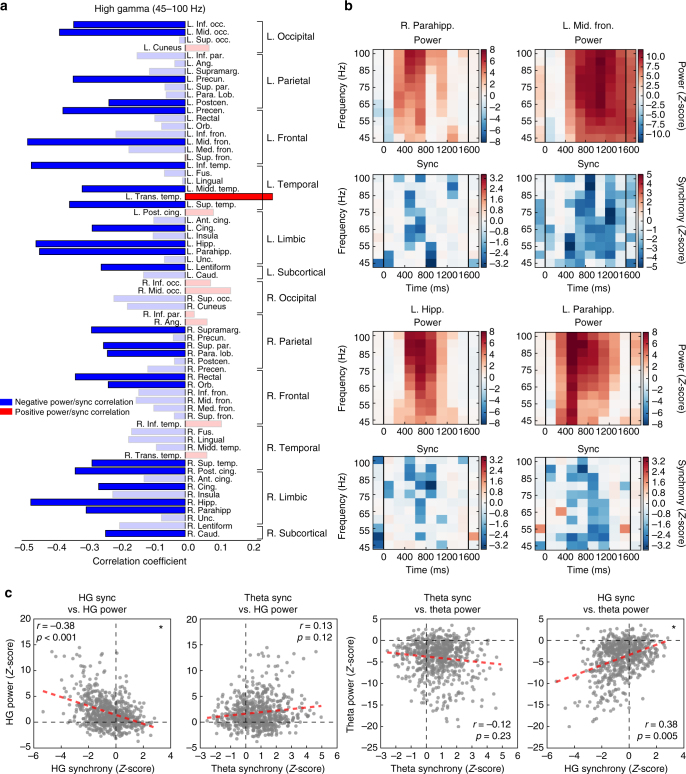
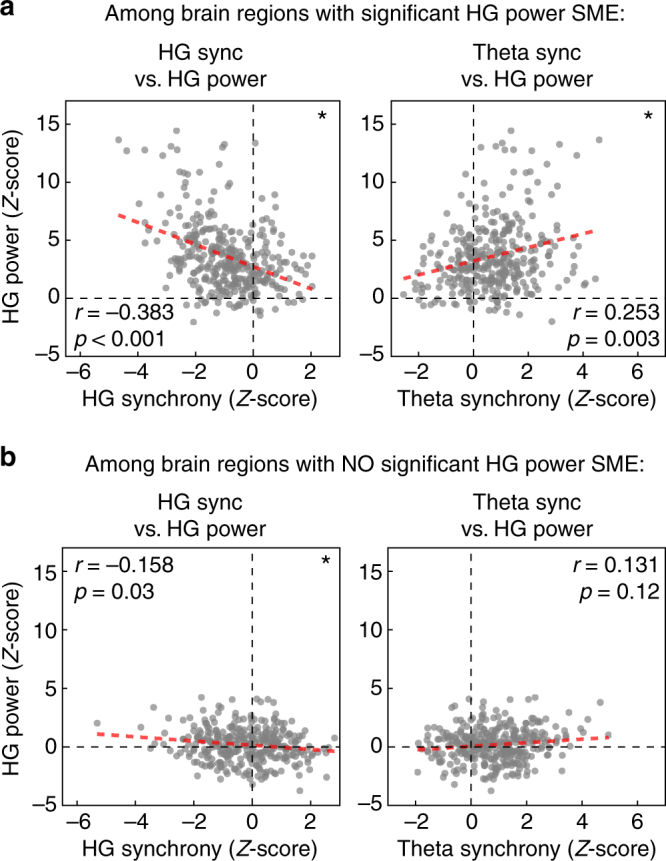
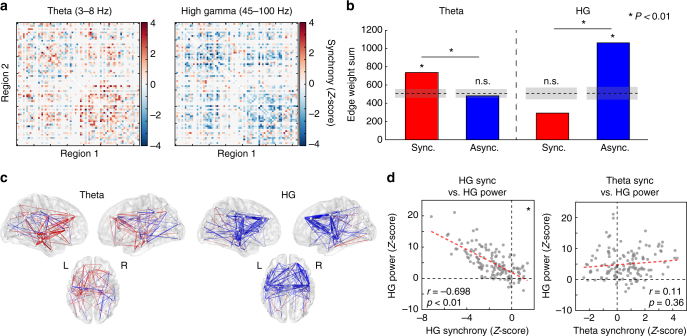
The idea that synchronous neural activity underlies cognition has driven an extensive body of research in human and animal neuroscience. Yet, insufficient data on intracranial electrical connectivity has precluded a direct test of this hypothesis in a whole-brain setting. Through the lens of memory encoding and retrieval processes, we construct whole-brain connectivity maps of fast gamma (30-100 Hz) and slow theta (3-8 Hz) spectral neural activity, based on data from 294 neurosurgical patients fitted with indwelling electrodes. Here we report that gamma networks desynchronize and theta networks synchronize during encoding and retrieval. Furthermore, for nearly all brain regions we studied, gamma power rises as that region desynchronizes with gamma activity elsewhere in the brain, establishing gamma as a largely asynchronous phenomenon. The abundant phenomenon of theta synchrony is positively correlated with a brain region's gamma power, suggesting a predominant low-frequency mechanism for inter-regional communication.
Overview
The claims and statistics of this paper haven’t been checked yet.
Free: it reads the open-access text and checks the first 5 claims that cite a source we can check. Create a free account to check every claim.
Integrity signals
Registry
Cites
Statistics
Figures
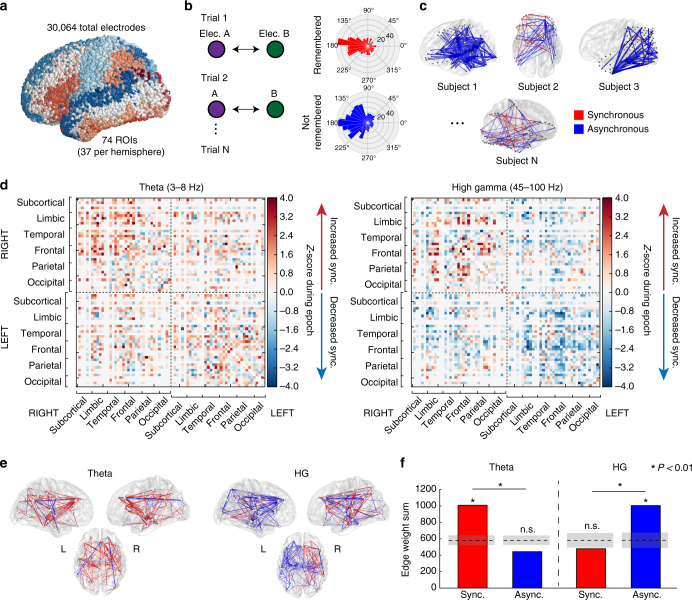
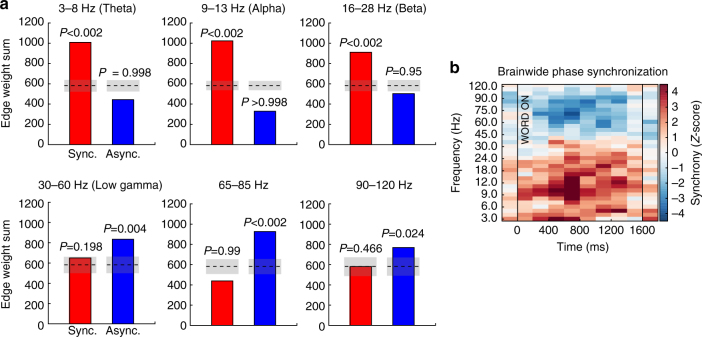
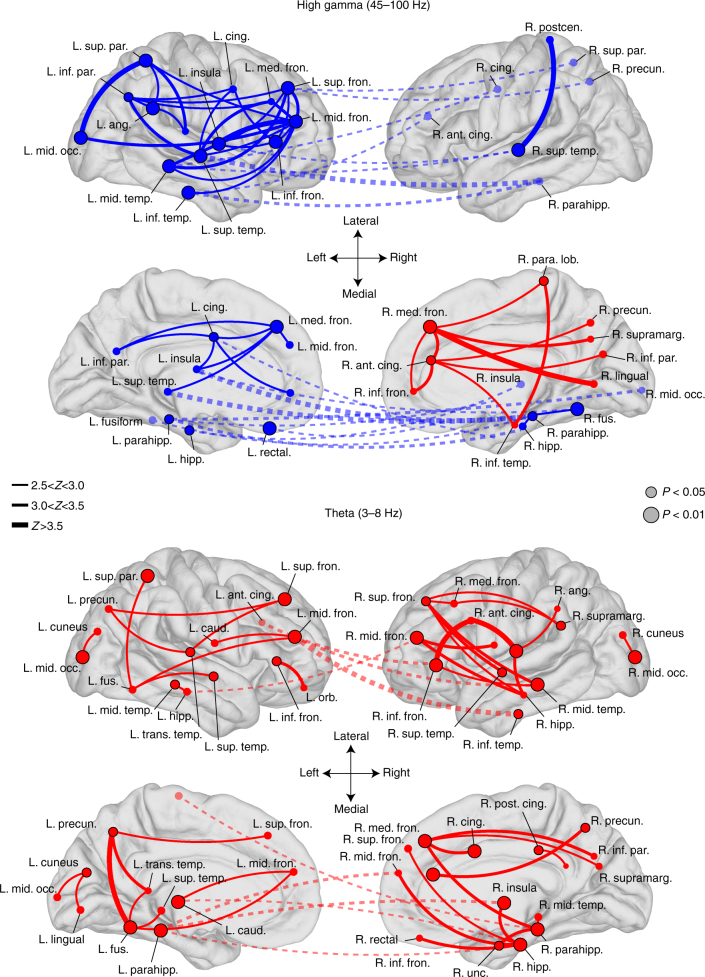
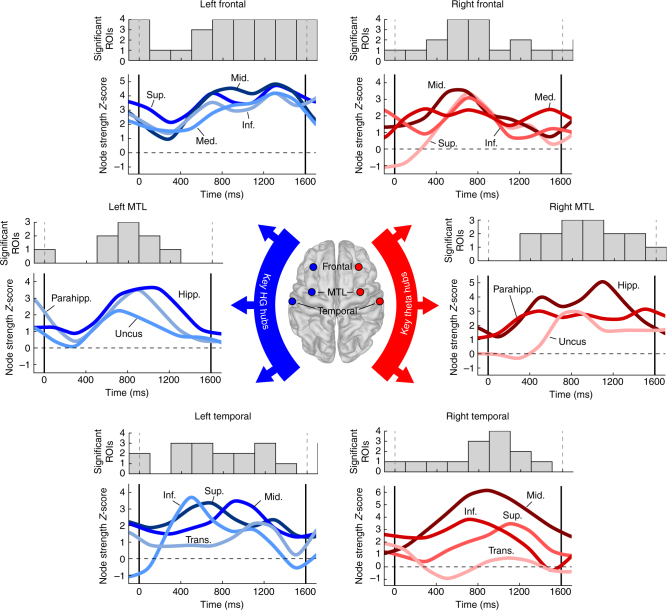
Verification
Claims the paper makes
The claims and statistics of this paper haven’t been checked yet.
Free: it reads the open-access text and checks the first 5 claims that cite a source we can check. Create a free account to check every claim.
Claims other papers make about this one
Each is checked against this paper’s own text: does it say what the citing paper says it does?
The source backs part of the claim, not all of it — or backs it for a different population, condition or comparison.
In the citing paper
“Present findings of theta synchrony for handwriting suggest that low-frequency connections support the integration of information during memory formation, and follow from earlier studies that have reported low-frequency entrainment to be essential to cognition (Solomon et al., 2017).”
From Handwriting but not typewriting leads to widespread brain connectivity: a high-density EEG study with implications for the classroom (2024) · cites this paper as Solomon et al., 2017
Experimental — accuracy not yet measuredThe source backs part of the claim, not all of it — or backs it for a different population, condition or comparison.
In the citing paper
“Present findings of theta synchrony for handwriting suggest that low-frequency connections support the integration of information during memory formation, and follow from earlier studies that have reported low-frequency entrainment to be essential to cognition (Solomon et al., 2017).”
From Handwriting but not typewriting leads to widespread brain connectivity: a high-density EEG study with implications for the classroom (2024) · cites this paper as Solomon et al., 2017
Experimental — accuracy not yet measuredThe cited source says what the claim attributes to it.
In the citing paper
“Others have suggested that theta connectivity activity (see Figure 3) is positively correlated with a brain region’s gamma power, suggesting a potent low-frequency mechanism for communication between brain regions (Solomon et al., 2017).”
From Handwriting but not typewriting leads to widespread brain connectivity: a high-density EEG study with implications for the classroom (2024) · cites this paper as Solomon et al., 2017
Self-check
Percentages, sums and reported differences re-computed from the paper’s own numbers.
The self-check needs the paper’s full text.
Citations
Cites
Complex brain networks: graph theoretical analysis of structural and functional systems
Bullmore, E., & Sporns, O. (2009) · Nature Reviews Neuroscience · doi:10.1038/nrn2575 · Cited by 11,820
Complex network measures of brain connectivity: Uses and interpretations
Rubinov, M., & Sporns, O. (2010) · NeuroImage · doi:10.1016/j.neuroimage.2009.10.003 · Cited by 11,522
Neuronal Oscillations in Cortical Networks
Buzsáki, G., & Draguhn, A. (2004) · Science · doi:10.1126/science.1099745 · Cited by 6,576
AVANTS, B., EPSTEIN, C., GROSSMAN, M., & GEE, J. (2008) · Medical Image Analysis · doi:10.1016/j.media.2007.06.004 · Cited by 5,669
The brainweb: phase synchronization and large-scale integration
Varela, F., Lachaux, J.-P., Rodriguez, E., & Martinerie, J. (2001) · Nature Reviews Neuroscience · doi:10.1038/35067550 · Cited by 4,761
Automatically Parcellating the Human Cerebral Cortex
Fischl, B. (2004) · Cerebral Cortex · doi:10.1093/cercor/bhg087 · Cited by 4,253
Measuring phase synchrony in brain signals
Lachaux, J.-P., Rodriguez, E., Martinerie, J., & Varela, F. J. (1999) · Human Brain Mapping · doi:10.1002/(sici)1097-0193(1999)8:4<194::aid-hbm4>3.0.co;2-c · Cited by 3,798
Automated Talairach Atlas labels for functional brain mapping
Lancaster, J. L., Woldorff, M. G., Parsons, L. M., Liotti, M., Freitas, C. S., Rainey, L., Kochunov, P. V., Nickerson, D., Mikiten, S. A., & Fox, P. T. (2000) · Human Brain Mapping · doi:10.1002/1097-0193(200007)10:3<120::aid-hbm30>3.0.co;2-8 · Cited by 3,387
CircStat : A MATLAB Toolbox for Circular Statistics
Berens, P. (2009) · Journal of Statistical Software · doi:10.18637/jss.v031.i10 · Cited by 3,099
Buckner, R. L., Sepulcre, J., Talukdar, T., Krienen, F. M., Liu, H., Hedden, T., Andrews-Hanna, J. R., Sperling, R. A., & Johnson, K. A. (2009) · The Journal of Neuroscience · doi:10.1523/jneurosci.5062-08.2009 · Cited by 2,862
Cited by
Theta Oscillations in Human Memory
Herweg, N. A., Solomon, E. A., & Kahana, M. J. (2020) · Trends in Cognitive Sciences · doi:10.1016/j.tics.2019.12.006 · Cited by 550
Self-citationClosed-loop stimulation of temporal cortex rescues functional networks and improves memory
Ezzyat, Y., Wanda, P. A., Levy, D. F., Kadel, A., Aka, A., Pedisich, I., Sperling, M. R., Sharan, A. D., Lega, B. C., Burks, A., et al. (2018) · Nature Communications · doi:10.1038/s41467-017-02753-0 · Cited by 347
Self-citationA Neural Chronometry of Memory Recall
Staresina, B. P., & Wimber, M. (2019) · Trends in Cognitive Sciences · doi:10.1016/j.tics.2019.09.011 · Cited by 171
“21 limited to the hippocampus [75], but rather synchronizes larger neocortical networks during both encoding and recall [85, 92], presumably facilitating inter-regional communication.”
Creativity comes in waves: an EEG-focused exploration of the creative brain
Stevens, C. E., & Zabelina, D. L. (2019) · Current Opinion in Behavioral Sciences · doi:10.1016/j.cobeha.2019.02.003 · Cited by 163
Hippocampal theta codes for distances in semantic and temporal spaces
Solomon, E. A., Lega, B. C., Sperling, M. R., & Kahana, M. J. (2019) · Proceedings of the National Academy of Sciences · doi:10.1073/pnas.1906729116 · Cited by 154
Self-citationLarge-Scale Communication in the Human Brain Is Rhythmically Modulated through Alpha Coherence
Chapeton, J. I., Haque, R. U., Wittig, J. H., Inati, S. K., & Zaghloul, K. A. (2019) · Current Biology · doi:10.1016/j.cub.2019.07.014 · Cited by 145
“In a single participant (participant 9), we found that the average SFC across all units exhibits a sharp peak in the high theta/low alpha range (Figure 1B), and that around 40% of the units are preferentially locked to this small range of frequencies (f = [7,8]Hz) (Figure 1C); in a second participant, we found peaks i…”
BackgroundSelf-citationBetzel, R. F., Medaglia, J. D., Kahn, A. E., Soffer, J., Schonhaut, D. R., & Bassett, D. S. (2019) · Nature Biomedical Engineering · doi:10.1038/s41551-019-0404-5 · Cited by 138
Dynamic Theta Networks in the Human Medial Temporal Lobe Support Episodic Memory
Solomon, E. A., Stein, J. M., Das, S. R., Gorniak, R., Sperling, M. R., Worrell, G. A., Inman, C. S., Tan, R. J., Jobst, B. C., Rizzuto, D. S., et al. (2018) · Current Biology · doi:10.1016/j.cub.2019.02.020 · Cited by 131
“The general trend of decreased theta power and increased HFA aligns with a robust literature demonstrating this same effect across a diverse array of cortical regions and the MTL [3, 27, 28, 50].”
Self-citationMohan, U. R., Watrous, A. J., Miller, J. F., Lega, B. C., Sperling, M. R., Worrell, G. A., Gross, R. E., Zaghloul, K. A., Jobst, B. C., Davis, K. A., et al. (2020) · Brain Stimulation · doi:10.1016/j.brs.2020.05.009 · Cited by 120
Self-citationBoran, E., Fedele, T., Klaver, P., Hilfiker, P., Stieglitz, L. H., Grünwald, T., & Sarnthein, J. (2019) · Science Advances · doi:10.1126/sciadv.aav3687 · Cited by 117
Frontoparietal theta-gamma interactions track working memory enhancement with training and tDCS
Jones, K. T., Johnson, E. L., & Berryhill, M. E. (2020) · NeuroImage · doi:10.1016/j.neuroimage.2020.116615 · Cited by 116
“Indeed, our initial report is one of many linking cognitive performance to coordinated theta activity across spatial scales (Alekseichuk et al., 2017; Hsu et al., 2017; Polania et al., 2012; Reinhart et al., 2017; Anguera et al., 2013; Solomon et al., 2017; Johnson et al., 2017).”
Rajan, A., Siegel, S., Liu, Y., Bengson, J. J., Mangun, G. R., & Ding, M. (2018) · Cerebral Cortex · doi:10.1093/cercor/bhy149 · Cited by 100
“Moreover, low frequency oscillations such as theta are thought to be more suited for long-range communications (von Stein and Sarnthein 2000; Wang et al. 2012; Solomon et al. 2017), because slow oscillations have long time windows which allows distant neuronal assemblies to phase synchronize with each other (Fries 200…”
BackgroundNeural Oscillations: Understanding a Neural Code of Pain
Kim, J. A., & Davis, K. D. (2020) · The Neuroscientist · doi:10.1177/1073858420958629 · Cited by 97
Self-citationGamma oscillations and episodic memory
Griffiths, B., & Jensen, O. B. (2023) · Trends in Neurosciences · doi:10.1016/j.tins.2023.07.003 · Cited by 95
Ose Askvik, E., van der Weel, F. R. (., & van der Meer, A. L. H. (2020) · Frontiers in Psychology · doi:10.3389/fpsyg.2020.01810 · Cited by 86
Van der Weel, F. R. (., & Van der Meer, A. L. H. (2024) · Frontiers in Psychology · doi:10.3389/fpsyg.2023.1219945 · Cited by 85
Causal Evidence for the Role of Neuronal Oscillations in Top–Down and Bottom–Up Attention
Riddle, J., Hwang, K., Cellier, D., Dhanani, S., & D’Esposito, M. (2019) · Journal of Cognitive Neuroscience · doi:10.1162/jocn_a_01376 · Cited by 85
“A uthor M anuscript A uthor M anuscript A uthor M anuscript A uthor M anuscript Ezzyat, & Davachi, 2016; Klimesch, Doppelmayr, Russegger, & Pachinger, 1996) or acts as a carrier frequency for long-distance coordination of bottom-up information processing (Solomon et al., 2017).”
Johnson, E. L., Kam, J. W. Y., Tzovara, A., & Knight, R. T. (2020) · Journal of Neural Engineering · doi:10.1088/1741-2552/abb7a5 · Cited by 84
“Successful word encoding was further linked to global connectivity in the theta band concomitant with decreased connectivity in the gamma band [88] (figure 4(c)).”
BackgroundMedial temporal lobe functional connectivity predicts stimulation-induced theta power
Solomon, E. A., Kragel, J. E., Gross, R. E., Lega, B. C., Sperling, M. R., Worrell, G. A., Sheth, S. A., Zaghloul, K. A., Jobst, B. C., Stein, J. M., et al. (2018) · Nature Communications · doi:10.1038/s41467-018-06876-w · Cited by 82
Self-citationSpatial Representations in the Human Brain
Herweg, N. A., & Kahana, M. J. (2018) · Frontiers in Human Neuroscience · doi:10.3389/fnhum.2018.00297 · Cited by 81
Self-citationDas, A., Angeles, C. D. L., & Menon, V. (2022) · NeuroImage · doi:10.1016/j.neuroimage.2022.118927 · Cited by 78
Fellner, M.-C., Gollwitzer, S., Rampp, S., Kreiselmeyr, G., Bush, D., Diehl, B., Axmacher, N., Hamer, H. M., & Hanslmayr, S. (2019) · PLoS Biology · doi:10.1371/journal.pbio.3000403 · Cited by 76
Khambhati, A. N., Kahn, A. E., Costantini, J. G., Ezzyat, Y., Solomon, E. A., Gross, R. E., Jobst, B. C., Sheth, S. A., Zaghloul, K. A., Worrell, G. A., et al. (2019) · Network Neuroscience · doi:10.1162/netn_a_00089 · Cited by 68
“The neurophysiologic interpretation of these states can depend on the measured frequency range of the functional network (Bassett, Meyer-Lindenberg, Achard, Duke, & Bullmore, 2006; Solomon et al., 2017), which in turn implicates certain types of cells interacting over specific spatial scales (Kopell, Ermentrout, Whitt…”
BackgroundSelf-citationHippocampal CA1 gamma power predicts the precision of spatial memory judgments
Stevenson, R. F., Zheng, J., Mnatsakanyan, L., Vadera, S., Knight, R. T., Lin, J. J., & Yassa, M. A. (2018) · Proceedings of the National Academy of Sciences · doi:10.1073/pnas.1805724115 · Cited by 68
“These distributions of permuted difference values were then averaged first over electrode pairs and then across sessions, as described above (38).”
MethodNeural activity reveals interactions between episodic and semantic memory systems during retrieval.
Weidemann, C. T., Kragel, J. E., Lega, B. C., Worrell, G. A., Sperling, M. R., Sharan, A. D., Jobst, B. C., Khadjevand, F., Davis, K. A., Wanda, P. A., et al. (2019) · Journal of Experimental Psychology General · doi:10.1037/xge0000480 · Cited by 66
“Some of the analyzed data have been used in other studies (Ezzyat et al., 2017; Kragel et al., 2017; Long et al., 2017; Solomon et al., 2017), but the analyses reported here are novel.”
ResultSelf-citationTheta-burst stimulation entrains frequency-specific oscillatory responses
Solomon, E. A., Sperling, M. R., Sharan, A. D., Wanda, P. A., Levy, D. F., Lyalenko, A., Pedisich, I., Rizzuto, D. S., & Kahana, M. J. (2021) · Brain stimulation · doi:10.1016/j.brs.2021.08.014 · Cited by 63
“As part of that function, theta oscillations serve as an inter-regional phase reference [52] which organizes the spiking activity of neuronal assemblies [53e55].”
BackgroundSelf-citationAcetylcholine modulates the temporal dynamics of human theta oscillations during memory
Gedankien, T., Tan, R. J., Qasim, S. E., Moore, H. C., McDonagh, D. L., Jacobs, J., & Lega, B. C. (2023) · Nature Communications · doi:10.1038/s41467-023-41025-y · Cited by 62
“…band predicts successful memory (Rizzuto et al., 2006; Fell et al., 2008; Kleen et al., 2016; Lin et al., 2017; Kota et al., 2020; Cruzat et al., 2021), and that theta networks synchronize during memory processing (Eichenbaum, 2000; Solomon et al., 2017; Gruber et al., 2018; Choi et al., 2020).”
BackgroundSelf-citationFusco, G., Scandola, M., Feurra, M., Pavone, E. F., Rossi, S., & Aglioti, S. M. (2018) · European Journal of Neuroscience · doi:10.1111/ejn.14174 · Cited by 57
“Theta- band (θ, 4–7 Hz) is a rhythmic endogenous oscillation recorded across several areas of the brain and associated with high- order cognitive functions (Cavanagh & Frank, 2014; Nigbur, Ivanova, & Stürmer, 2011; Raghavachari et al., 2006; Solomon et al., 2017).”
BackgroundInformation flows from hippocampus to auditory cortex during replay of verbal working memory items
Dimakopoulos, V. S., Mégevand, P., Stieglitz, L. H., Imbach, L., & Sarnthein, J. (2022) · eLife · doi:10.7554/elife.78677 · Cited by 60
Keerativittayayut, R., Aoki, R., Sarabi, M. T., Jimura, K., & Nakahara, K. (2018) · eLife · doi:10.7554/elife.32696 · Cited by 58
Deep Predictive Learning in Neocortex and Pulvinar
O’Reilly, R. C., Russin, J., Zolfaghar, M., & Rohrlich, J. (2021) · Journal of Cognitive Neuroscience · doi:10.1162/jocn_a_01708 · Cited by 57
Reactivated Spatial Context Guides Episodic Recall
Herweg, N. A., Sharan, A. D., Sperling, M. R., Brandt, A., Schulze‐Bonhage, A., & Kahana, M. J. (2020) · Journal of Neuroscience · doi:10.1523/jneurosci.1640-19.2019 · Cited by 55
Self-citationThe anterior and centromedian thalamus: Anatomy, function, and dysfunction in epilepsy
Warsi, N. M., Yan, H., Suresh, H., Wong, S. M., Arski, O. N., Gorodetsky, C., Zhang, K., Gouveia, F. V., & Ibrahim, G. M. (2022) · Epilepsy Research · doi:10.1016/j.eplepsyres.2022.106913 · Cited by 54
Klink, K., Peter, J., Wyss, P., & Klöppel, S. (2020) · Frontiers in Aging Neuroscience · doi:10.3389/fnagi.2020.00066 · Cited by 54
Category Selectivity for Face and Scene Recognition in Human Medial Parietal Cortex
Woolnough, O., Rollo, P. S., Forseth, K. J., Kadipasaoglu, C. M., Ekstrom, A. D., & Tandon, N. (2020) · Current Biology · doi:10.1016/j.cub.2020.05.018 · Cited by 49
Resting-state brain oscillations predict trait-like cognitive styles
Erickson, B. A., Truelove‐Hill, M., Oh, Y., Anderson, J., Zhang, F., & Kounios, J. (2018) · Neuropsychologia · doi:10.1016/j.neuropsychologia.2018.09.014 · Cited by 48
Lam, J., Lee, J., Williams, M., Cohn, M., Wilson, M. L., Mark, C., Esnaashari, N., Petkus, A. J., Hui, J. S., Feigenbaum, D., et al. (2021) · Brain stimulation · doi:10.1016/j.brs.2020.12.014 · Cited by 40
Fleck, J. I., Arnold, M. S., Dykstra, B., Casario, K., Douglas, E. A., & Morris, O. (2019) · Frontiers in Aging Neuroscience · doi:10.3389/fnagi.2019.00310 · Cited by 39
Lee, D. J., Drummond, N. M., Saha, U., Vloo, P. D., Dallapiazza, R. F., Gramer, R., Al‐Ozzi, T. M., Lam, J., Loh, A., Elias, G. J. B., et al. (2021) · Brain stimulation · doi:10.1016/j.brs.2021.04.016 · Cited by 38
Testing Models of Human Declarative Memory at the Single-Neuron Level
Rutishauser, U. (2019) · Trends in Cognitive Sciences · doi:10.1016/j.tics.2019.03.006 · Cited by 78
Characterizing Inscapes and resting-state in MEG: Effects in typical and atypical development
Vandewouw, M. M., Dunkley, B. T., Lerch, J. P., Anagnostou, E. A., & Taylor, M. J. (2020) · NeuroImage · doi:10.1016/j.neuroimage.2020.117524 · Cited by 36
“, 1998), and activity in the theta band has been shown to be indicative of synchronization between task-relevant brain regions (Mizuhara and Yamaguchi, 2007; Molinaro et al., 2013; Solomon et al., 2017).”
Biomarker-guided neuromodulation aids memory in traumatic brain injury
Kahana, M. J., Ezzyat, Y., Wanda, P. A., Solomon, E. A., Adamovich‐Zeitlin, R., Lega, B. C., Jobst, B. C., Gross, R. E., Ding, K., & Diaz-Arrastia, R. R. (2023) · Brain stimulation · doi:10.1016/j.brs.2023.07.002 · Cited by 36
Self-citationDas, A., & Menon, V. (2021) · Journal of Neuroscience · doi:10.1523/jneurosci.0802-21.2021 · Cited by 35
“Details of the task are described elsewhere (Solomon et al., 2017, 2019).”
MethodDistinct cortical systems reinstate the content and context of episodic memories
Kragel, J. E., Ezzyat, Y., Lega, B. C., Sperling, M. R., Worrell, G. A., Gross, R. E., Jobst, B. C., Sheth, S. A., Zaghloul, K. A., Stein, J. M., et al. (2021) · Nature Communications · doi:10.1038/s41467-021-24393-1 · Cited by 34
Self-citationDas, A., & Menon, V. (2024) · eLife · doi:10.1101/2024.02.28.582593 · Cited by 33
Neural evidence for attentional capture by salient distractors
Lin, R., Meng, X., Chen, F., Li, X., Jensen, O. B., Theeuwes, J., & Wang, B. (2024) · Nature Human Behaviour · doi:10.1038/s41562-024-01852-5 · Cited by 35
“Moreover, HF activity has previously been shown to be correlated with a wide range of cognitive functions, such as memory 30,31 , attention 32 , learning 33 and language comprehension 34,35 , underscoring its importance.”
Saboo, K., Varatharajah, Y., Berry, B. M., Křemen, V., Sperling, M. R., Davis, K. A., Jobst, B. C., Gross, R. E., Lega, B. C., Sheth, S. A., et al. (2019) · Scientific Reports · doi:10.1038/s41598-019-53925-5 · Cited by 33
Self-citationFoME: A foundation model for EEG using adaptive temporal-lateral attention scaling
Shi, E., Zhao, K., Yuan, Q., Hu, H., Wang, J., Yu, S., Chen, G., Zhang, D., Yuan, Y., Zhang, Y., et al. (2026) · Computerized Medical Imaging and Graphics · doi:10.1016/j.compmedimag.2026.102817 · Cited by 32
Dini, H., Ghassemi, F., & Sendi, M. S. E. (2020) · Brain Topography · doi:10.1007/s10548-020-00794-1 · Cited by 32
Dissociable oscillatory theta signatures of memory formation in the developing brain
Johnson, E. L., Yin, Q., O'Hara, N. B., Tang, L., Jeong, J., Asano, E., & Ofen, N. (2022) · Current Biology · doi:10.1016/j.cub.2022.01.053 · Cited by 32
Memory-related processing is the primary driver of human hippocampal theta oscillations
Seger, S. E., Kriegel, J., Lega, B. C., & Ekstrom, A. D. (2023) · Neuron · doi:10.1016/j.neuron.2023.06.015 · Cited by 33
Self-citationChen, Z., Yang, R., Huang, M., Wang, Z., & Liu, X. (2024) · IEEE Transactions on Emerging Topics in Computational Intelligence · doi:10.1109/tetci.2024.3359097 · Cited by 33
“2) Brain nonlinear dynamics factor: Coordinated activity and information transfer across various brain regions are responsible for generating behaviors and thoughts in the brain [51], [69].”
BackgroundA rapid theta network mechanism for flexible information encoding
Johnson, E. L., Lin, J. J., King‐Stephens, D., Weber, P. B., Laxer, K. D., Sáez, I., Girgis, F., D’Esposito, M., Knight, R. T., & Badre, D. (2023) · Nature Communications · doi:10.1038/s41467-023-38574-7 · Cited by 31
Excitatory TMS modulates memory representations
Wang, W., Wing, E. A., Murphy, D. L. K., Luber, B. M., Lisanby, S. H., Cabeza, R. E. L., & Davis, S. W. (2018) · Cognitive Neuroscience · doi:10.1080/17588928.2018.1512482 · Cited by 30
“…to validate this observation, which suggest that widespread synchronization of theta networks predict successful encoding (Ezzyat et al., 2017; Solomon et al., 2017), and that selective modulations of theta- and high-gamma-band activity in the temporal lobes can be used to decode successful…”
BackgroundAtypical resting state neuromagnetic connectivity and spectral power in very preterm children
Kozhemiako, N., Nunes, A. S., Vakorin, V. A., Chau, C. M. Y., Moiseev, A., Ribary, U., GRUNAU, R. E., & Doesburg, S. M. (2019) · Journal of Child Psychology and Psychiatry · doi:10.1111/jcpp.13026 · Cited by 30
EEG decoders track memory dynamics
Li, Y., Pazdera, J. K., & Kahana, M. J. (2024) · Nature Communications · doi:10.1038/s41467-024-46926-0 · Cited by 29
Self-citationClosed-loop control of theta oscillations enhances human hippocampal network connectivity
Kragel, J. E., Lurie, S. M., Issa, N. P., Haider, H. A., Wu, S., Tao, J. X., Warnke, P. C., Schuele, S., Rosenow, J. M., Zelano, C., et al. (2025) · Nature Communications · doi:10.1038/s41467-025-59417-7 · Cited by 28
“Our fi ndings have two primary advantages that overcome the limitations of previous work that examined synchrony in hippocampal networks 6,54 .”
InfluentialSelf-citationTan, R. J., Rugg, M. D., & Lega, B. C. (2020) · Neuropsychologia · doi:10.1016/j.neuropsychologia.2020.107595 · Cited by 28
Self-citationCole, E. R., Grogan, D. P., Laxpati, N. G., Fernandez, A. M., Skelton, H. M., Isbaine, F., Gutekunst, C., & Gross, R. E. (2022) · Epilepsia · doi:10.1111/epi.17326 · Cited by 28
Frontal Midline Theta as a Model Specimen of Cortical Theta
Cavanagh, J. F., & Cohen, M. X. (2022) · Oxford University Press eBooks · doi:10.1093/oxfordhb/9780192898340.013.9 · Cited by 27
Das, A., & Menon, V. (2024) · Cerebral Cortex · doi:10.1093/cercor/bhae287 · Cited by 27
Rajakumar, K. D., & Jagannath, M. (2024) · Results in Engineering · doi:10.1016/j.rineng.2024.102224 · Cited by 27
Does data cleaning improve brain state classification?
Meisler, S. L., Kahana, M. J., & Ezzyat, Y. (2019) · Journal of Neuroscience Methods · doi:10.1016/j.jneumeth.2019.108421 · Cited by 27
Self-citationAlpha connectivity and inhibitory control in adults with autism spectrum disorder
Yuk, V., Dunkley, B. T., Anagnostou, E. A., & Taylor, M. J. (2020) · Molecular Autism · doi:10.1186/s13229-020-00400-y · Cited by 28
Mujib, M. D., Hasan, M. A., Qazi, S. A., & Vučković, A. (2021) · Experimental Brain Research · doi:10.1007/s00221-021-06132-6 · Cited by 26
“(2013) and it represents synchronous multi-unit neural gamma activity (Solomon et al. 2017).”
BackgroundGuo, Y., Dang, G., Hordacre, B. G., Su, X., Yan, N., Chen, S., Ren, H., Shi, X., Cai, M., Zhang, S., et al. (2021) · Frontiers in Aging Neuroscience · doi:10.3389/fnagi.2021.679585 · Cited by 26
“Beta activity has traditionally been associated with sensorimotor processing, and recent research has suggested its role in various cognitive functions (Spitzer and Haegens, 2017).”
BackgroundYeh, W.-H., Ju, Y.-J., Liu, Y.-T., & Wang, T. (2022) · International Journal of Environmental Research and Public Health · doi:10.3390/ijerph191711037 · Cited by 27
“Moreover, event-related synchronization in theta activity reflects the cognitive process [1,7].”
BackgroundThe preterm social brain: altered functional networks for Theory of Mind in very preterm children
Mossad, S. I., Vandewouw, M. M., Smith, M. L., & Taylor, M. J. (2021) · Brain Communications · doi:10.1093/braincomms/fcaa237 · Cited by 25
“…processing, whereas theta reflects long-range communication in the brain (Von Stein and Sarnthein, 2000; Engel and Fries, 2010; Palva et al., 2010; Klimesch, 2012; Mellem et al., 2013; Sherman et al., 2016; Solomon et al., 2017; Betti et al., 2018; Richter et al., 2018; SotoIcaza et al., 2019).”
BackgroundDas, A., & Menon, V. (2021) · Cortex · doi:10.1016/j.cortex.2021.11.012 · Cited by 24
Cannabinoid disruption of learning mechanisms involved in reward processing
Lupica, C. R., & Hoffman, A. F. (2018) · Learning & Memory · doi:10.1101/lm.046748.117 · Cited by 25
Marks, V. S., Saboo, K., Topçu, Ç., Lech, M., Thayib, T. P., Nejedlý, P., Křemen, V., Worrell, G. A., & Kucewicz, M. T. (2021) · NeuroImage · doi:10.1016/j.neuroimage.2021.118637 · Cited by 23
Self-citationThe Spatial Reach of Neuronal Coherence and Spike-Field Coupling across the Human Neocortex
Myers, J. C., Smith, E. H., Leszczynski, M., O'Sullivan, J., Yates, M. J., McKhann, G., Mesgarani, N., Schroeder, C., Schevon, C., & Sheth, S. A. (2022) · The Journal of Neuroscience · doi:10.1523/jneurosci.0050-22.2022 · Cited by 20
Self-citationKaterman, B. S., Li, Y., Pazdera, J. K., Keane, C., & Kahana, M. J. (2021) · NeuroImage · doi:10.1016/j.neuroimage.2021.118748 · Cited by 22
Self-citationMTL neurons phase-lock to human hippocampal theta
Schonhaut, D. R., Rao, A. M., Ramayya, A. G., Solomon, E. A., Herweg, N. A., Fried, I., & Kahana, M. J. (2024) · eLife · doi:10.7554/elife.85753 · Cited by 20
“Macroscale theta phase-synchronization within the MTL and PFC has consistently correlated with better memory performance ( Babiloni et al., 2009 ; Watrous et al., 2013b ; Solomon et al., 2017 ; Zheng et al., 2019 ; Kunz et al., 2019 ).”
MethodSelf-citationIntracranial EEG evidence of functional specialization for taxonomic and thematic relations
Thye, M. D., Geller, J., Szaflarski, J. P., & Mirman, D. (2021) · Cortex · doi:10.1016/j.cortex.2021.03.018 · Cited by 20
Widespread theta coherence during spatial cognitive control
Myers, J. C., Chinn, L. K., Sur, S., & Golob, E. J. (2021) · Neuropsychologia · doi:10.1016/j.neuropsychologia.2021.107979 · Cited by 20
“Widespread theta coherence during accurate task performance has also been observed in a recent ECoG study (Solomon et al., 2017).”
BackgroundSyrjälä, J., Basti, A., Guidotti, R., Marzetti, L., & Pizzella, V. (2021) · Journal of Neural Engineering · doi:10.1088/1741-2552/abcefe · Cited by 19
“These res-ults accumulate evidence for the crucial role of low-frequency oscillatory networks in inter-regional communication, especially in tasks involving top-down processes [6, 91–93].”
BackgroundTheta-phase locking of single neurons during human spatial memory
Guth, T. A., Brandt, A., Reinacher, P. C., Schulze‐Bonhage, A., Jacobs, J., & Kunz, L. (2025) · Nature Communications · doi:10.1038/s41467-025-62553-9 · Cited by 18
Das, A., & Menon, V. (2023) · Journal of Neuroscience · doi:10.1523/jneurosci.1728-22.2023 · Cited by 18
“1 c ) (Solomon et al., 2017, 2019).”
Frolov, N. S., Николаевна, П. Е., Grubov, V., Badarin, A., Александрович, М. В., Zakharov, A. V., Kurkin, S., & Hramov, A. E. (2023) · Sensors · doi:10.3390/s23146420 · Cited by 18
“Event-related synchronization in theta activity is known to reflect the cognitive processes [43], and occipital theta power can even be used as a diagnostic test for the prediction of neurodegeneration with a sensitivity of 79% and specificity of 77% [44].”
BackgroundTheta band network supporting human episodic memory is not activated in the seizure onset zone
Young, J., Rudebeck, P. H., Marcuse, L. V., Fields, M. C., Yoo, J. Y., Panov, F. E., Ghatan, S., Fazl, A., Mandelbaum, S., & Baxter, M. G. (2018) · NeuroImage · doi:10.1016/j.neuroimage.2018.08.052 · Cited by 17
Collomb‐Clerc, A., Gueguen, M. C. M., Minotti, L., Kahane, P., Navarro, V., Bartoloméi, F., Carron, R., Régis, J. M., Chabardès, S., Palminteri, S., et al. (2023) · Nature Communications · doi:10.1038/s41467-023-42380-6 · Cited by 16
Kraft, J. D., & Hampstead, B. M. (2023) · Neuropsychology Review · doi:10.1007/s11065-023-09621-3 · Cited by 16
“Local and distant theta frequency synchronization in frontal and temporal/medial temporal cortices are thought to underlie memory encoding and associative memory binding (Clouter et al., 2017; Klimesch, 1999; Solomon et al., 2017).”
Reduced Theta Power During Memory Retrieval in Depressed Adults
Kane, J., Cavanagh, J. F., & Dillon, D. G. (2019) · Biological Psychiatry Cognitive Neuroscience and Neuroimaging · doi:10.1016/j.bpsc.2019.03.004 · Cited by 16
“Second, there is cross-species evidence that communication between the hippocampus and cortex, and between different cortical sectors, involves theta synchrony (17; 18).”
BackgroundImmediate neural impact and incomplete compensation after semantic hub disconnection
Kocsis, Z., Jenison, R. L., Taylor, P. N., Calmus, R., McMurray, B., Rhone, A. E., Sarrett, M. E., Streese, C. D., Kikuchi, Y., Gander, P. E., et al. (2023) · Nature Communications · doi:10.1038/s41467-023-42088-7 · Cited by 15
“Moreover, inter-regional theta-based synchronization is often associated with effective encoding and retrieval in memory tasks 32 .”
InfluentialFunctional and anatomical connectivity predict brain stimulation’s mnemonic effects
Ezzyat, Y., Kragel, J. E., Solomon, E. A., Lega, B. C., Aronson, J. P., Jobst, B. C., Gross, R. E., Sperling, M. R., Worrell, G. A., Sheth, S. A., et al. (2023) · Cerebral Cortex · doi:10.1093/cercor/bhad427 · Cited by 16
“Prior studies have shown that brain networks become coherent at low-frequencies during successful memory encoding and retrieval (Solomon et al. 2017; Kragel, Ezzyat, et al. 2021), so we used low-frequency coherence to measure the network node strength of each stimulation target.”
BackgroundSelf-citationLongitudinal Differences in Human Hippocampal Connectivity During Episodic Memory Processing
Choi, K., Bagen, L., Robinson, L., Umbach, G. S., Rugg, M. D., & Lega, B. C. (2020) · Cerebral Cortex Communications · doi:10.1093/texcom/tgaa010 · Cited by 15
“Bipolar signals were notch filtered at 60 Hz with a fourth order 2 Hz stopband butterworth notch filter in order to remove the effects of line noise on the iEEG signals (Solomon et al. 2017).”
BackgroundMethodResultSelf-citationDirect brain stimulation during episodic memory
Ezzyat, Y., & Rizzuto, D. S. (2018) · Current Opinion in Biomedical Engineering · doi:10.1016/j.cobme.2018.11.004 · Cited by 15
Self-citationMultivariate Stochastic Volatility Modeling of Neural Data
Phan, T., Wachter, J. A., Solomon, E. A., & Kahana, M. J. (2019) · eLife · doi:10.2139/ssrn.3429132 · Cited by 15
Self-citationMesoscopic physiological interactions in the human brain reveal small-world properties
Wang, J., Tao, A., Anderson, W. S., Madsen, J. R., & Kreiman, G. (2021) · Cell Reports · doi:10.1016/j.celrep.2021.109585 · Cited by 15
“…examined resting state interactions over short periods spanning several seconds to minutes (Betzel et al., 2019; Fox et al., 2020; Keller et al., 2014; Solomon et al., 2017; Trebaul et al., 2018), except for one study that followed six subjects for almost a whole day each (Kramer et al., 2011).”
Cimbálník, J., Doležal, J., Topçu, Ç., Lech, M., Marks, V. S., Joseph, B., Dobias, M., Gompel, J. J. V., Worrell, G. A., & Kucewicz, M. T. (2022) · Scientific Data · doi:10.1038/s41597-021-01099-z · Cited by 15
Self-citationCharacterising the spatial and oscillatory unfolding of Theory of Mind in adults using fMRI and MEG
Mossad, S. I., Vandewouw, M. M., de Villa, K., Pang, E. W., & Taylor, M. J. (2022) · Frontiers in Human Neuroscience · doi:10.3389/fnhum.2022.921347 · Cited by 13
“Previous MEG connectivity studies have shown that cognitive processes are modulated by specific frequency oscillations including theta (implicated in long-range communication in the brain), alpha (implicated in several cognitive processes including attention and memory), beta (implicated in top down processing) and ga…”
BackgroundLim, P. C., Ward, E. J., Vickery, T. J., & Johnson, M. R. (2019) · Journal of Cognitive Neuroscience · doi:10.1162/jocn_a_01427 · Cited by 13
Linde, L. D., Ortiz, O., Choles, C. M., & Kramer, J. L. K. (2022) · Journal of Neurophysiology · doi:10.1152/jn.00357.2022 · Cited by 12
Wang, D. X., Ng, N., Seger, S. E., Ekstrom, A. D., Kriegel, J., & Lega, B. C. (2023) · Cerebral Cortex · doi:10.1093/cercor/bhad105 · Cited by 12
Self-citationYin, Q., Johnson, E. L., & Ofen, N. (2023) · Developmental Cognitive Neuroscience · doi:10.1016/j.dcn.2023.101312 · Cited by 12
“For example, Solomon et al. (2017) examined phase synchrony between widespread cortical regions in a verbal free recall task.”
BackgroundHippocampal activity predicts contextual misattribution of false memories
Herz, N., Bukala, B. R., Kragel, J. E., & Kahana, M. J. (2023) · Proceedings of the National Academy of Sciences · doi:10.1073/pnas.2305292120 · Cited by 13
Self-citationFang, W., Jiang, X., Chen, J., Zhang, C., & Wang, L. (2025) · Current Biology · doi:10.1016/j.cub.2025.02.031 · Cited by 11
Kanno, A., Kochi, R., Sakakura, K., Kitazawa, Y., Uda, H., Ueda, R., Sonoda, M., Lee, M.-H., Jeong, J., Rothermel, R., et al. (2025) · NeuroImage · doi:10.1016/j.neuroimage.2025.121319 · Cited by 11
Davila, C. E., Wang, D. X., Ritzer, M., Moran, R., & Lega, B. C. (2022) · IEEE Transactions on Neural Systems and Rehabilitation Engineering · doi:10.1109/tnsre.2022.3192170 · Cited by 11
“Both animal and human studies have established that changes in gamma oscillatory power predict memory success, along with participating in local and regional coupling via phase synchrony and cross frequency coupling [19], [20].”
BackgroundSelf-citation
Metadata
- Authors
- Solomon, E. A., Kragel, J. E., Sperling, M. R., Sharan, A., Worrell, G., Kucewicz, M., Inman, C. S., Lega, B., Davis, K. A., Stein, J. M., Jobst, B. C., Zaghloul, K. A., Sheth, S. A., Rizzuto, D. S., & Kahana, M. J.
- Affiliations
- University of Pennsylvania (US)
- Thomas Jefferson University Hospital (US)
- Mayo Clinic (US)
- Emory University (US)
- The University of Texas Southwestern Medical Center (US)
- Hospital of the University of Pennsylvania (US)
- Dartmouth–Hitchcock Medical Center (US)
- National Institutes of Health (US)
- Columbia University Irving Medical Center (US)
- Corresponding author
- Solomon, E. A.
- Kahana, M. J.
- ORCID
- Venue
- Nature Communications
- Published
- 2017-11-22
- Volume
- 8
- Issue
- 1
- Pages
- 1704-1704
- ISSN
- 2041-1723 (ISSN-L)
- PMC
- PMC5700170
- OpenAlex
- W2770613913
- Cited by
- 221
- References
- 59
- Citations by year
- 2026: 15 · 2025: 31 · 2024: 36 · 2023: 30 · 2022: 21 · 2021: 21 · 2020: 26 · 2019: 23 · 2018: 18
- FWCI
- 10.52
- Type
- journal article
- Language
- en
- Open access
- gold
- doi.org
- Licence
- cc-by
- creativecommons.org/licenses/by/4.0 (tdm)
- creativecommons.org/licenses/by/4.0 (vor)
- Locations
- Nature Communications (publishedVersion, cc-by)
- Europe PMC (PubMed Central) (publishedVersion, cc-by)
- PubMed Central (publishedVersion, cc-by)
- PubMed (publishedVersion)
- The Medicine Forum (submittedVersion, cc-by)
- RePEc: Research Papers in Economics (submittedVersion)
- DOAJ (DOAJ: Directory of Open Access Journals) (submittedVersion, cc-by-sa)
- Funders
- U.S. Department of Defense (N660011424032, T32NS091006)
- National Institutes of Health (5r01ns099348-04, MH55687)
- Defense Advanced Research Projects Agency (N66001, Cooperative Agreement N66001-14-2-4032, N66001-14-2-4032)
- National Institute of Mental Health (R01MH055687)
- National Institute of Neurological Disorders and Stroke (T32NS091006, (R01 NS099348)
- Topics
- Life Sciences › Neuroscience › Cognitive Neuroscience › Neural dynamics and brain function
- Life Sciences › Neuroscience › Cognitive Neuroscience › Memory and Neural Mechanisms
- Life Sciences › Neuroscience › Cognitive Neuroscience › Functional Brain Connectivity Studies
- Keywords
- whole-brain connectivity, memory encoding, memory retrieval, interregional communication, neurosurgical patients, cognitive enhancement
- MeSH terms
- Animals, Brain, Cognition, Humans, Memory, Mental Recall, Theta Rhythm, Electroencephalography Phase Synchronization, Connectome, Gamma Rhythm
About these checks
Registry, retraction, Cites and statistics results are computed, not judged, with one exception: a printed reference that no index lists is read once by a model before it counts as a citation error. Claims are extracted by a model and kept only when their quote appears verbatim in the text; each cited source is then checked, with a model’s help, for whether it says what the claim relies on. Those verdicts can be wrong — read the claim’s quote and the cited source before relying on one.
Statistics and arithmetic are recomputed, not judged.
Confidence bands are shown only for fields calibrated on our annotated test set. None is calibrated yet, so no band is shown.
What counts as a claim ›How we measure confidence ›How we check this ›
Are you an author, or do you see a problem with this page? Request a review
Data sources
Bibliographic data: Semantic Scholar, OpenAlex, Crossref.
Contains information from the Semantic Scholar Academic Graph Datasets, made available under the ODC Attribution License (ODC-BY 1.0).
Semantic Scholar’s data is described in: Kinney, R., et al. (2023). The Semantic Scholar Open Data Platform. arXiv:2301.10140.
