

Widespread theta synchrony and high-frequency desynchronization underlies enhanced cognition
Open accessThe DOI matches its Crossref record; 59 of the 59 references it cites were found in a registry or an index.
Abstract
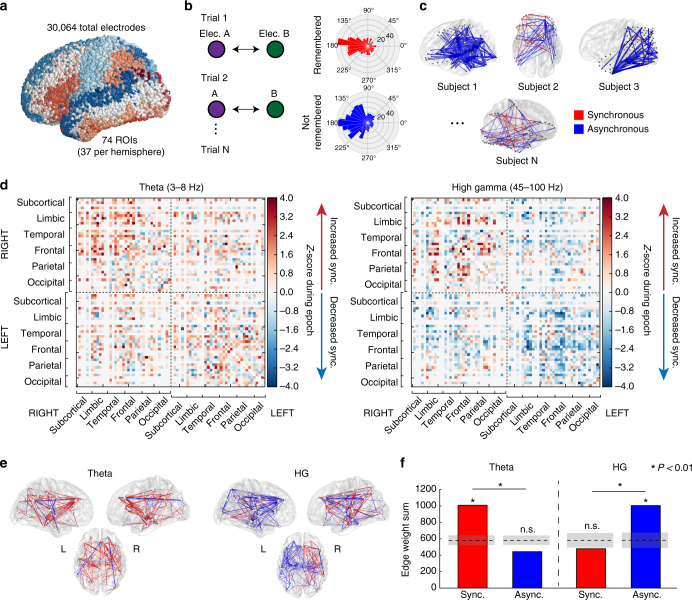
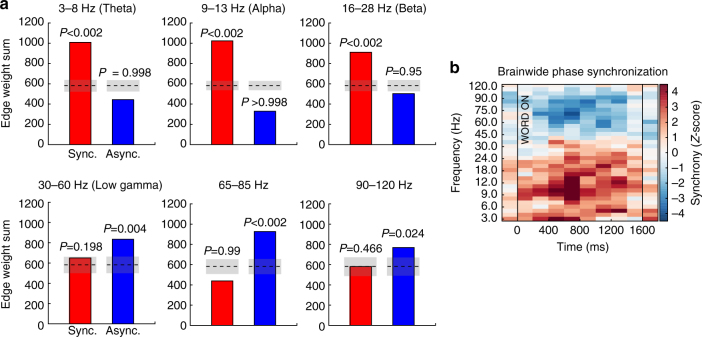
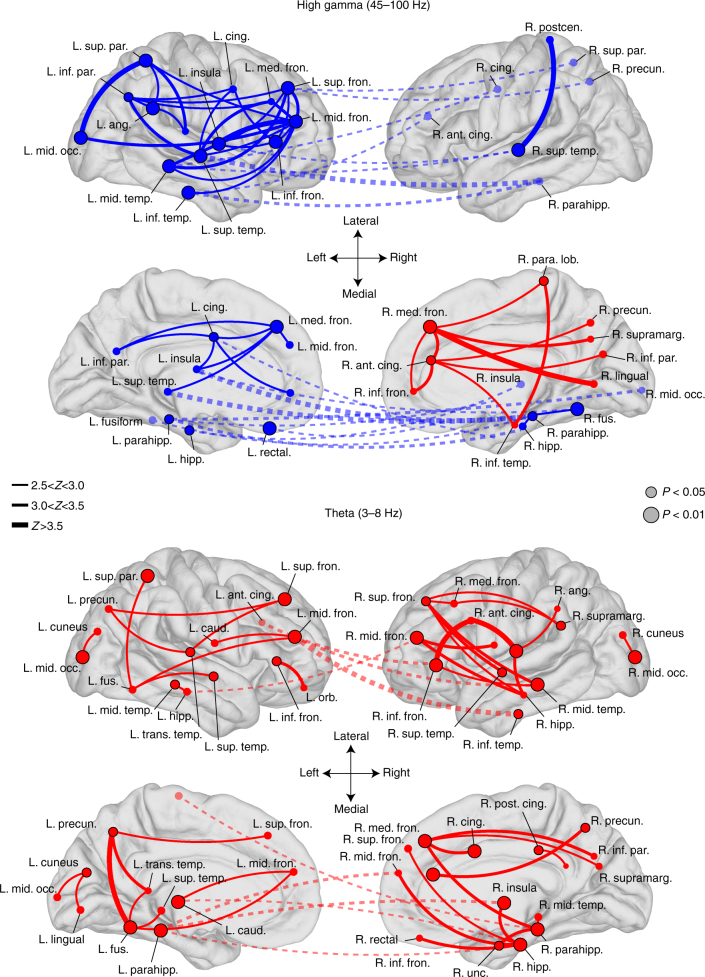
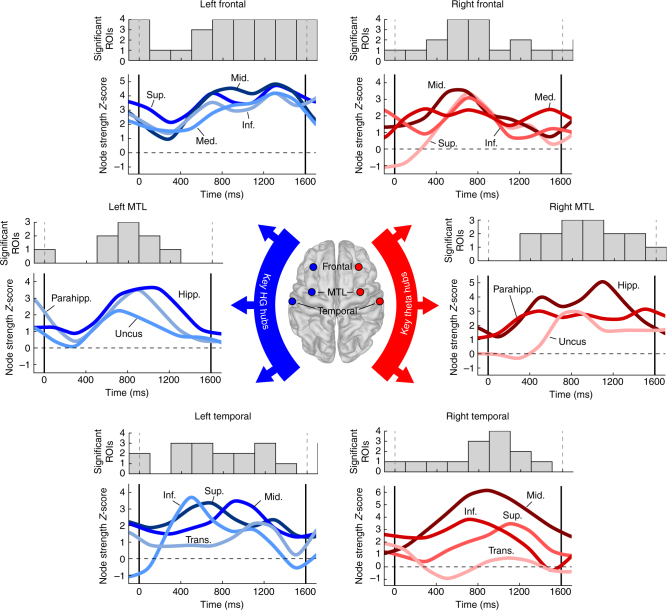
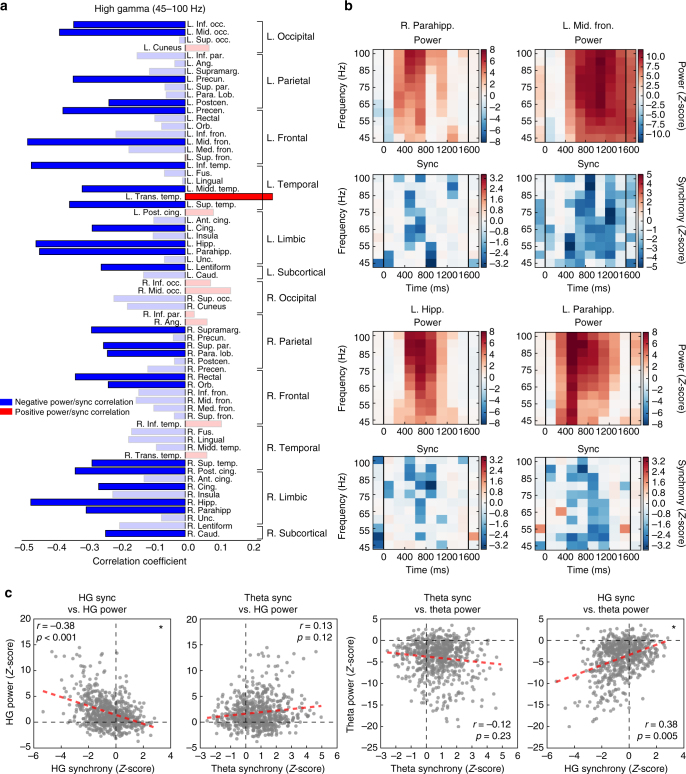
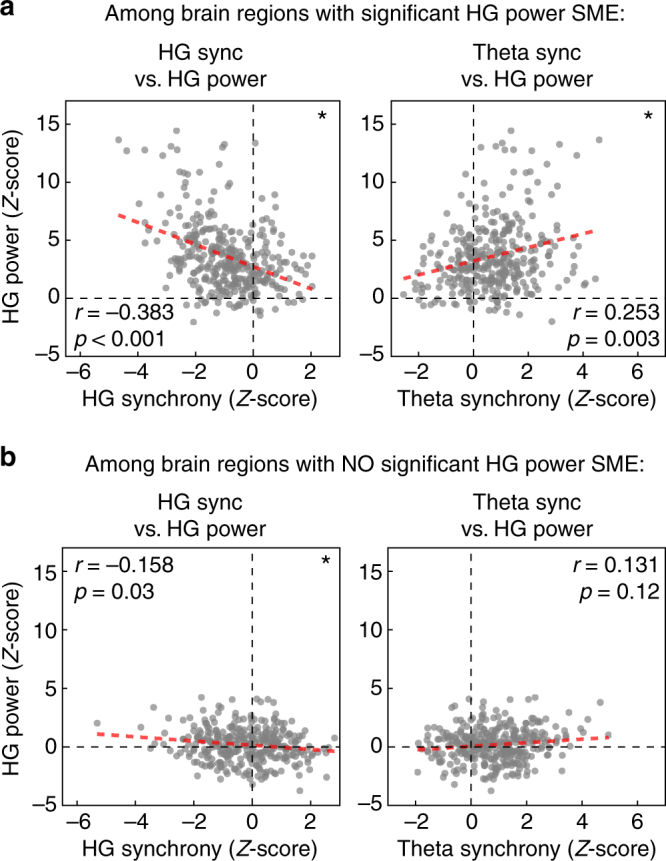
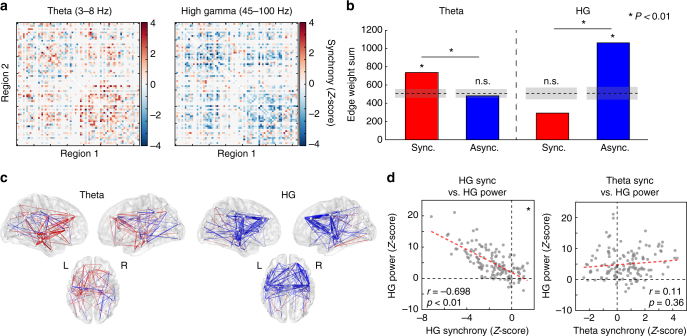
The idea that synchronous neural activity underlies cognition has driven an extensive body of research in human and animal neuroscience. Yet, insufficient data on intracranial electrical connectivity has precluded a direct test of this hypothesis in a whole-brain setting. Through the lens of memory encoding and retrieval processes, we construct whole-brain connectivity maps of fast gamma (30-100 Hz) and slow theta (3-8 Hz) spectral neural activity, based on data from 294 neurosurgical patients fitted with indwelling electrodes. Here we report that gamma networks desynchronize and theta networks synchronize during encoding and retrieval. Furthermore, for nearly all brain regions we studied, gamma power rises as that region desynchronizes with gamma activity elsewhere in the brain, establishing gamma as a largely asynchronous phenomenon. The abundant phenomenon of theta synchrony is positively correlated with a brain region's gamma power, suggesting a predominant low-frequency mechanism for inter-regional communication.
Overview
The claims and statistics of this paper haven’t been checked yet.
Free: it reads the open-access text and checks the first 5 claims that cite a source we can check. Create a free account to check every claim.
Integrity signals
Registry
Cites
Statistics
Figures
Verification
Claims the paper makes
The claims and statistics of this paper haven’t been checked yet.
Free: it reads the open-access text and checks the first 5 claims that cite a source we can check. Create a free account to check every claim.
Claims other papers make about this one
Each is checked against this paper’s own text: does it say what the citing paper says it does?
The source backs part of the claim, not all of it — or backs it for a different population, condition or comparison.
In the citing paper
“Present findings of theta synchrony for handwriting suggest that low-frequency connections support the integration of information during memory formation, and follow from earlier studies that have reported low-frequency entrainment to be essential to cognition (Solomon et al., 2017).”
From Handwriting but not typewriting leads to widespread brain connectivity: a high-density EEG study with implications for the classroom (2024) · cites this paper as Solomon et al., 2017
Experimental — accuracy not yet measuredThe source backs part of the claim, not all of it — or backs it for a different population, condition or comparison.
In the citing paper
“Present findings of theta synchrony for handwriting suggest that low-frequency connections support the integration of information during memory formation, and follow from earlier studies that have reported low-frequency entrainment to be essential to cognition (Solomon et al., 2017).”
From Handwriting but not typewriting leads to widespread brain connectivity: a high-density EEG study with implications for the classroom (2024) · cites this paper as Solomon et al., 2017
Experimental — accuracy not yet measuredThe cited source says what the claim attributes to it.
In the citing paper
“Others have suggested that theta connectivity activity (see Figure 3) is positively correlated with a brain region’s gamma power, suggesting a potent low-frequency mechanism for communication between brain regions (Solomon et al., 2017).”
From Handwriting but not typewriting leads to widespread brain connectivity: a high-density EEG study with implications for the classroom (2024) · cites this paper as Solomon et al., 2017
Self-check
Percentages, sums and reported differences re-computed from the paper’s own numbers.
The self-check needs the paper’s full text.
Citations
Cites
Complex brain networks: graph theoretical analysis of structural and functional systems
Bullmore, E., & Sporns, O. (2009) · Nature Reviews Neuroscience · doi:10.1038/nrn2575 · Cited by 11,820
Complex network measures of brain connectivity: Uses and interpretations
Rubinov, M., & Sporns, O. (2010) · NeuroImage · doi:10.1016/j.neuroimage.2009.10.003 · Cited by 11,522
Neuronal Oscillations in Cortical Networks
Buzsáki, G., & Draguhn, A. (2004) · Science · doi:10.1126/science.1099745 · Cited by 6,576
AVANTS, B., EPSTEIN, C., GROSSMAN, M., & GEE, J. (2008) · Medical Image Analysis · doi:10.1016/j.media.2007.06.004 · Cited by 5,669
The brainweb: phase synchronization and large-scale integration
Varela, F., Lachaux, J.-P., Rodriguez, E., & Martinerie, J. (2001) · Nature Reviews Neuroscience · doi:10.1038/35067550 · Cited by 4,761
Automatically Parcellating the Human Cerebral Cortex
Fischl, B. (2004) · Cerebral Cortex · doi:10.1093/cercor/bhg087 · Cited by 4,253
Measuring phase synchrony in brain signals
Lachaux, J.-P., Rodriguez, E., Martinerie, J., & Varela, F. J. (1999) · Human Brain Mapping · doi:10.1002/(sici)1097-0193(1999)8:4<194::aid-hbm4>3.0.co;2-c · Cited by 3,798
Automated Talairach Atlas labels for functional brain mapping
Lancaster, J. L., Woldorff, M. G., Parsons, L. M., Liotti, M., Freitas, C. S., Rainey, L., Kochunov, P. V., Nickerson, D., Mikiten, S. A., & Fox, P. T. (2000) · Human Brain Mapping · doi:10.1002/1097-0193(200007)10:3<120::aid-hbm30>3.0.co;2-8 · Cited by 3,387
CircStat : A MATLAB Toolbox for Circular Statistics
Berens, P. (2009) · Journal of Statistical Software · doi:10.18637/jss.v031.i10 · Cited by 3,099
Buckner, R. L., Sepulcre, J., Talukdar, T., Krienen, F. M., Liu, H., Hedden, T., Andrews-Hanna, J. R., Sperling, R. A., & Johnson, K. A. (2009) · The Journal of Neuroscience · doi:10.1523/jneurosci.5062-08.2009 · Cited by 2,862
Cited by
Items 201–244 of 244
Helfrich, R. F., Knight, R. T., & D’Esposito, M. (2024) · Oxford University Press eBooks · doi:10.1093/oxfordhb/9780190917982.013.5
Das, A., & Menon, V. (2024) · eLife · doi:10.7554/elife.99018.2
Adam, C. D., Mirzakhalili, E., Gagnon, K. G., Cottone, C., Arena, J. D., Ulyanova, A. V., Johnson, V. E., & Wolf, J. A. (2024) · eLife · doi:10.7554/elife.100642.1.sa0
Zhige, C., & Chengxuan, Q. (2024) · arXiv (Cornell University) · doi:10.48550/arxiv.2411.05862
“As determined by the interaction mechanism of the human brain [33], the function and cognition of the whole brain can be described as a global combination of local brain regions with different topological connections and duration [3], [11], [31].”
BackgroundSeger, S. E., Kriegel, J., Lega, B. C., & Ekstrom, A. D. (2024) · bioRxiv (Cold Spring Harbor Laboratory) · doi:10.1101/2024.12.04.626897
“Memory encoding and retrieval has no overt demands on movement, sensorimotor integration, or spatial component (Sederberg et al., 2003; Lega et al., 2012; Solomon et al., 2017).”
Self-citationDunkley, B. T., Solar, K. G., Zamyadi, R., Reichelt, A. C., Morrison, E., Scratch, S. E., & Hamilton, J. K. (2025) · medRxiv · doi:10.1101/2025.02.25.25322869
WITHDRAWNPreprint
(2025) · PsyArXiv (OSF Preprints) · doi:10.31234/osf.io/uhj97_v2
Bairachnaya, M., Shnyder, A., Pinhasov, A., & Michaelevski, I. (2025) · European Journal of Neuroscience · doi:10.1111/ejn.70184
“This synchronization has been shown to support information retention during working memory and to enhance cognitive performance (Li et al. 2017; Solomon et al. 2017; Weiss et al. 2000).”
Conscious Quantum Field Hypothesis (CQFH) v2.4Preprint
Koski, A. G. (2025) · OSF Preprints (OSF Preprints) · doi:10.31219/osf.io/x97ds_v2
Frontal Theta Modulation in Sequential Working Memory: the Impact of Spatial Regularity and Scenario
Huang, Y., Ke, Y., Li, J., Liu, S., & Ming, D. (2025) · Brain Topography · doi:10.1007/s10548-025-01152-9
“Meanwhile, inter-regional theta coupling syn-chronizes distributed representations during encoding and retrieval (Sauseng et al. 2004; Solomon et al. 2017, 2019).”
Takemi, M., Madsen, M. A. J., Kesselheim, J., & Siebner, H. R. (2025) · bioRxiv (Cold Spring Harbor Laboratory) · doi:10.1101/2025.09.29.679395
“Given the role of theta oscillations in large-scale communication (Solomon et al., 2017), theta AM-tACS may influence corticospinal excitability via frontoparietal connectivity rather than local entrainment, consistent with effects of theta–gamma tACS on motor learning and cognitive control (Akkad…”
The Cognitive and Neural Mechanisms of Curiosity Driven by Visual Uncertainty
Chen, X. (2023) · Lancaster EPrints (Lancaster University) · doi:10.17635/lancaster/thesis/1923
Yuk, V., Dunkley, B. T., Anagnostou, E. A., & Taylor, M. J. (2020) · Figshare · doi:10.6084/m9.figshare.13347064
Yuk, V., Dunkley, B. T., Anagnostou, E. A., & Taylor, M. J. (2020) · Figshare · doi:10.6084/m9.figshare.13347058
Yuk, V., Dunkley, B. T., Anagnostou, E. A., & Taylor, M. J. (2020) · Figshare · doi:10.6084/m9.figshare.13347070
Temporal Attention Modulates Episodic Encoding and EEG Subsequent Memory Effects
Broitman, A. W. (2023) · eCommons (Cornell University) · doi:10.7298/j7yv-k934
Duville, M. M., Alonso-Valerdi, L. M., & Ibarra-Zarate, D. I. (2024) · Figshare · doi:10.6084/m9.figshare.26693548
Yuk, V., Dunkley, B. T., Anagnostou, E. A., & Taylor, M. J. (2020) · Figshare · doi:10.6084/m9.figshare.13347061
Yuk, V., Dunkley, B. T., Anagnostou, E. A., & Taylor, M. J. (2020) · Figshare · doi:10.6084/m9.figshare.13347067
Hippocampal theta-gamma phase-amplitude coupling in memory encoding and retrieval
Saint Amour di Chanaz, L. (2024) · Dipòsit Digital de la Universitat de Barcelona (Universitat de Barcelona)
Divergent Electrophysiological Responses in the Human Hippocampus During Verbal Memory ProcessingPreprint
Huang, W., Quabs, J., Lyu, D., van Staalduinen, E. K., Pantis, S., Marais, O., Stieger, J., Liang, E. Y., Deutsch, G. K., He, Z., et al. (2026) · bioRxiv (Cold Spring Harbor Laboratory) · doi:10.64898/2026.01.28.702353
Veezhinathan, M., Balasubramanian, G., & Jagannath, M. (2026) · Engineering Research Express · doi:10.1088/2631-8695/ae4e7d · Cited by 1
Kognitiivisen harjoittelun vaikutukset hermosolujen synkroniaverkostossa – EEG lepomittausanalyysi
Lönnberg, E. (2022) · Aaltodoc (Aalto University)
Multiscale Mechanisms of Human Memory Modulation by Deep Brain StimulationPreprint
Li, Y., Gao, Y., Li, T., Peng, X., Zhang, L., Yang, G., He, L., Axmacher, N., Yu, T., & Xue, G. (2026) · bioRxiv (Cold Spring Harbor Laboratory) · doi:10.64898/2026.04.14.718584
Lateralisation and localisation of spatial and verbal associative recognition memory
Baker, N. A., Bentvelzen, A. C., Francis, H., & Badcock, N. A. (2026) · Neurobiology of Learning and Memory · doi:10.1016/j.nlm.2026.108162
Gander, S., Rouge, C., Peiffer, A., Peigneux, P., Simor, P., Bourguignon, M., Wens, V., Tiège, X. D., Deliens, G., & Urbain, C. M. (2026) · bioRxiv (Cold Spring Harbor Laboratory) · doi:10.64898/2026.04.30.721844
Neural connectivity patterns underlying yes and no responses across sensory modalities
Moghadam, S. S., Vaghef, L., & Hosseini, S. (2026) · Discover Neuroscience · doi:10.1186/s13064-026-00254-9
“…with previous literature, our generally minimal gamma-band coherence across modalities suggests that high-frequency synchrony may play a more limited role in long-range intention-related connectivity, possibly reflecting local processing rather than widespread network coordination [9, 24, 39].”
Processing of different word list lengths during encoding and retrieval in Broca’s area
Veliks, V., Koļesovs, A., Porozovs, J., & Igonins, D. (2026) · Frontiers in Human Neuroscience · doi:10.3389/fnhum.2026.1757160
“…analysis of the effects of synchronization and desynchronization of neurophysiological activity on memory processes (Hanslmayr et al., 2009, 2016; Rao et al., 2025; Solomon et al., 2017) allows us to expect variability in oscillatory power during encoding and during correct and incorrect retrieval.”
Hippocampal theta distinguishes between memory-guided and exploratory saccades in humansPreprint
Castelblanco, C. A., Angeli, P. A., van der Meer, M. A. A., Bujarski, K. A., & Robertson, C. E. (2026) · bioRxiv (Cold Spring Harbor Laboratory) · doi:10.64898/2026.07.20.739696
“In contrast, slow theta typically arises in the anterior hippocampus (Goyal et al., 2020) and is related to successful encoding (Lega et al., 2012) and recall (Kragel et al., 2017; Solomon et al., 2017, 2019).”
Hippocampal Theta Distinguishes between Memory-Guided and Exploratory Saccades in Humans
Castelblanco, C. A., Angeli, P. A., van der Meer, M. A. A., Bujarski, K. A., & Robertson, C. E. (2026) · Journal of Neuroscience · doi:10.1523/jneurosci.0047-26.2026
Hippocampal-cortical coupling dynamics drive system consolidation of remote memory
Sheng, T., Wang, S., Zhang, J., Xing, D., Wu, Y., Wang, Q., & Lu, W. (2026) · Cell Reports · doi:10.1016/j.celrep.2026.117810
Stimulation de l'hémodynamique anticipatoire chez l'homme
Mierzwinski, G. (2020) · Knowledge UdeS (Institutional Deposit of the University of Sherbrooke)
Ma, Y., Sin, W. W. F., Kraemer, K. M., Kwok, J. Y. Y., Yang, E., Kim, K., Randolph, M., Horan, H., Mullington, J. M., Wayne, P. M., et al. (2026) · Global Advances in Integrative Medicine and Health · doi:10.1177/27536130261478126
Hippocampal and cortical oscillations support the encoding of event memories during movie watchingPreprint
Silva, M., Wu, X., Sabio‐Albert, M., Blanco, E. C., Roldán, P., Donaire, A., Carreño, M., Fuentemilla, L., Baldassano, C. A., & Jacobs, J. (2026) · bioRxiv (Cold Spring Harbor Laboratory) · doi:10.64898/2026.09.06.749693
Whole-brain millisecond-scale effective connectivity of auditory and visual naming
Kochi, R., Kanno, A., Uda, H., Hatano, K., Sonoda, M., Endo, H., Cools, M., Rothermel, R., Luat, A. F., & Asano, E. (2026) · NeuroImage · doi:10.1016/j.neuroimage.2026.122236
“We computed group-level mean high-gamma amplitudes for 66 ROIs, each based on data from ≥7 patients (eTable 2) (Solomon et al., 2017).”
Grigoryan, G. A., & Balaban, P. M. (2026) · Biosystems · doi:10.1016/j.biosystems.2026.105967
Imbalzano, G. (n.d.) · Institutional Research Information System University of Turin (University of Turin)
Saboo, K. (2023) · Illinois Digital Environment for Access to Learning and Scholarship (University of Illinois at Urbana-Champaign)
Parvizi, J., Jung, H., Keleş, Ü., Huang, W., Mo, Y., Yih, J., Jain, H., Chen, G., Shi-bei, T., Pushkarev, O., et al. (2026) · Research Square · doi:10.21203/rs.3.rs-11380728/v1
Metadata
- Authors
- Solomon, E. A., Kragel, J. E., Sperling, M. R., Sharan, A., Worrell, G., Kucewicz, M., Inman, C. S., Lega, B., Davis, K. A., Stein, J. M., Jobst, B. C., Zaghloul, K. A., Sheth, S. A., Rizzuto, D. S., & Kahana, M. J.
- Affiliations
- University of Pennsylvania (US)
- Thomas Jefferson University Hospital (US)
- Mayo Clinic (US)
- Emory University (US)
- The University of Texas Southwestern Medical Center (US)
- Hospital of the University of Pennsylvania (US)
- Dartmouth–Hitchcock Medical Center (US)
- National Institutes of Health (US)
- Columbia University Irving Medical Center (US)
- Corresponding author
- Solomon, E. A.
- Kahana, M. J.
- ORCID
- Venue
- Nature Communications
- Published
- 2017-11-22
- Volume
- 8
- Issue
- 1
- Pages
- 1704-1704
- ISSN
- 2041-1723 (ISSN-L)
- PMC
- PMC5700170
- OpenAlex
- W2770613913
- Cited by
- 221
- References
- 59
- Citations by year
- 2026: 15 · 2025: 31 · 2024: 36 · 2023: 30 · 2022: 21 · 2021: 21 · 2020: 26 · 2019: 23 · 2018: 18
- FWCI
- 10.52
- Type
- journal article
- Language
- en
- Open access
- gold
- doi.org
- Licence
- cc-by
- creativecommons.org/licenses/by/4.0 (tdm)
- creativecommons.org/licenses/by/4.0 (vor)
- Locations
- Nature Communications (publishedVersion, cc-by)
- Europe PMC (PubMed Central) (publishedVersion, cc-by)
- PubMed Central (publishedVersion, cc-by)
- PubMed (publishedVersion)
- The Medicine Forum (submittedVersion, cc-by)
- RePEc: Research Papers in Economics (submittedVersion)
- DOAJ (DOAJ: Directory of Open Access Journals) (submittedVersion, cc-by-sa)
- Funders
- U.S. Department of Defense (N660011424032, T32NS091006)
- National Institutes of Health (5r01ns099348-04, MH55687)
- Defense Advanced Research Projects Agency (N66001, Cooperative Agreement N66001-14-2-4032, N66001-14-2-4032)
- National Institute of Mental Health (R01MH055687)
- National Institute of Neurological Disorders and Stroke (T32NS091006, (R01 NS099348)
- Topics
- Life Sciences › Neuroscience › Cognitive Neuroscience › Neural dynamics and brain function
- Life Sciences › Neuroscience › Cognitive Neuroscience › Memory and Neural Mechanisms
- Life Sciences › Neuroscience › Cognitive Neuroscience › Functional Brain Connectivity Studies
- Keywords
- whole-brain connectivity, memory encoding, memory retrieval, interregional communication, neurosurgical patients, cognitive enhancement
- MeSH terms
- Animals, Brain, Cognition, Humans, Memory, Mental Recall, Theta Rhythm, Electroencephalography Phase Synchronization, Connectome, Gamma Rhythm
About these checks
Registry, retraction, Cites and statistics results are computed, not judged, with one exception: a printed reference that no index lists is read once by a model before it counts as a citation error. Claims are extracted by a model and kept only when their quote appears verbatim in the text; each cited source is then checked, with a model’s help, for whether it says what the claim relies on. Those verdicts can be wrong — read the claim’s quote and the cited source before relying on one.
Statistics and arithmetic are recomputed, not judged.
Confidence bands are shown only for fields calibrated on our annotated test set. None is calibrated yet, so no band is shown.
What counts as a claim ›How we measure confidence ›How we check this ›
Are you an author, or do you see a problem with this page? Request a review
Data sources
Bibliographic data: Semantic Scholar, OpenAlex, Crossref.
Contains information from the Semantic Scholar Academic Graph Datasets, made available under the ODC Attribution License (ODC-BY 1.0).
Semantic Scholar’s data is described in: Kinney, R., et al. (2023). The Semantic Scholar Open Data Platform. arXiv:2301.10140.
