

Widespread theta synchrony and high-frequency desynchronization underlies enhanced cognition
Open accessThe DOI matches its Crossref record; 59 of the 59 references it cites were found in a registry or an index.
Abstract
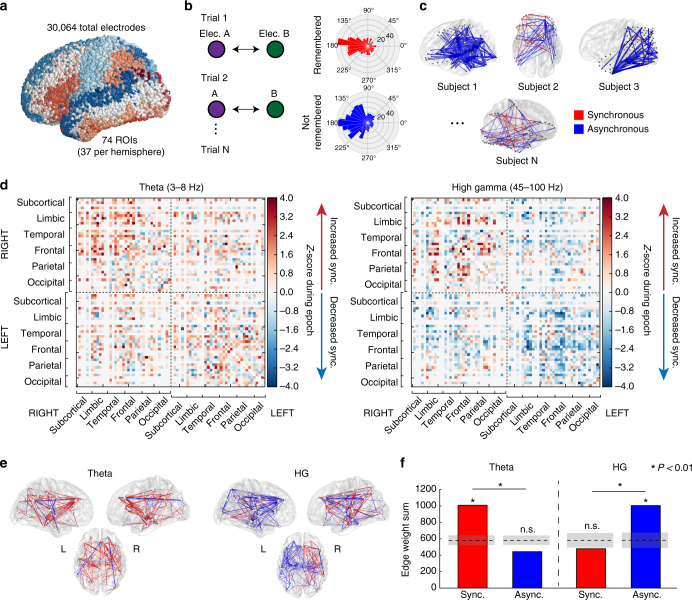
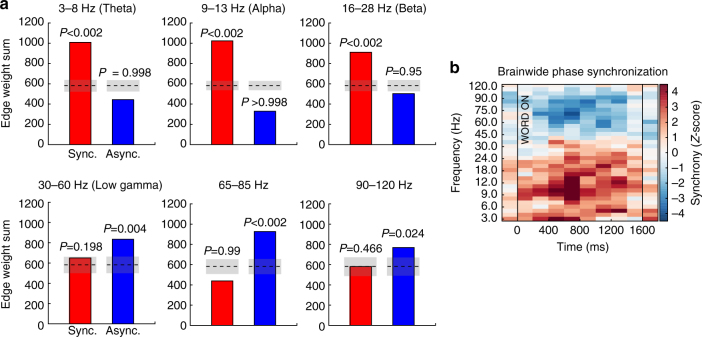
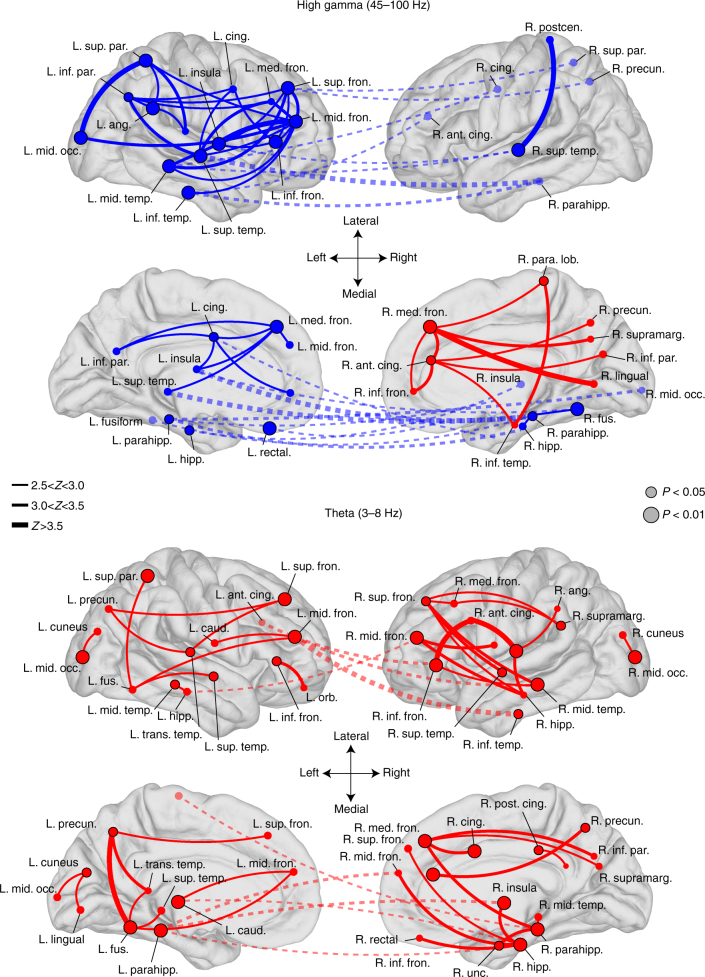
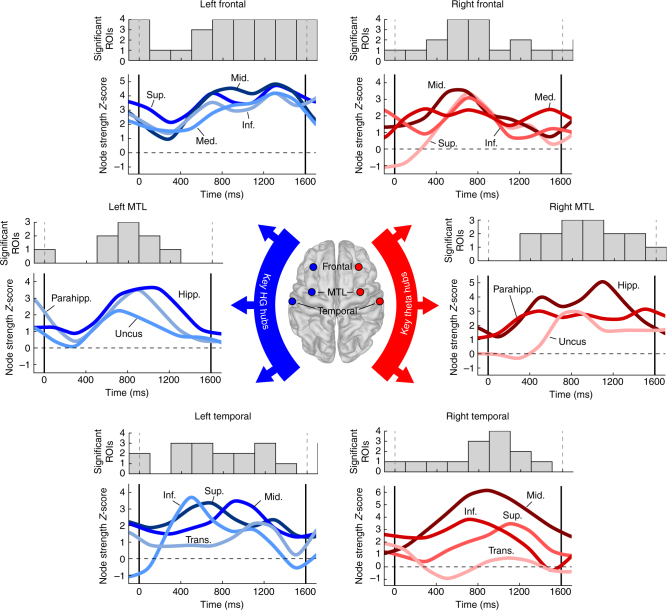
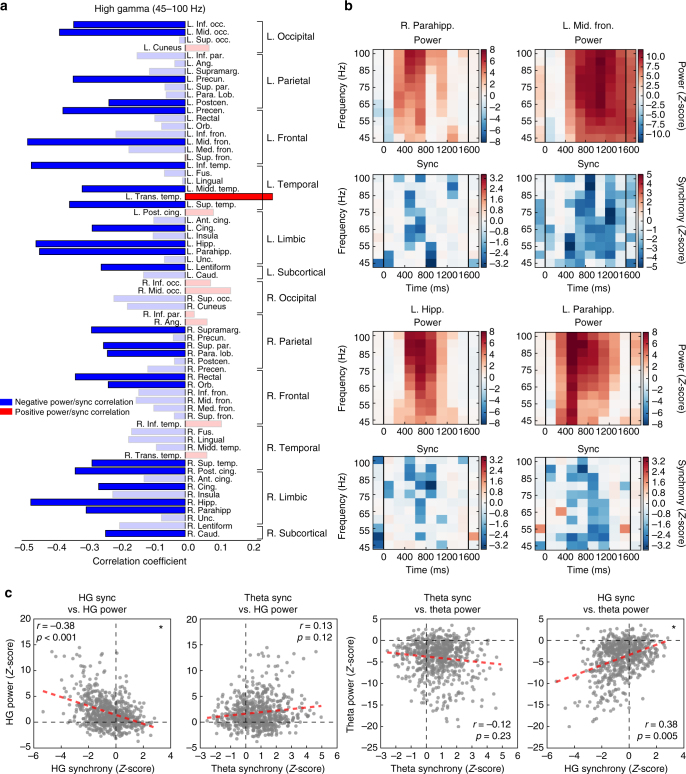
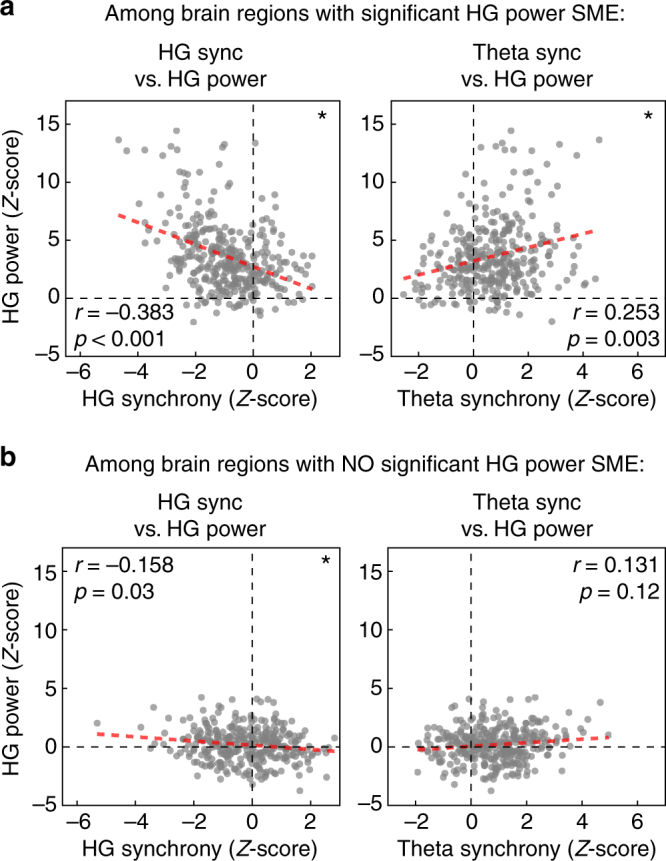
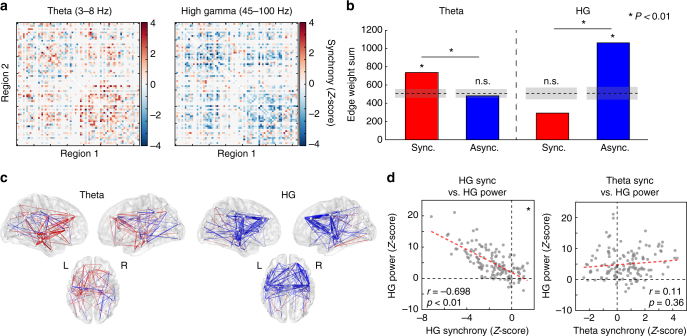
The idea that synchronous neural activity underlies cognition has driven an extensive body of research in human and animal neuroscience. Yet, insufficient data on intracranial electrical connectivity has precluded a direct test of this hypothesis in a whole-brain setting. Through the lens of memory encoding and retrieval processes, we construct whole-brain connectivity maps of fast gamma (30-100 Hz) and slow theta (3-8 Hz) spectral neural activity, based on data from 294 neurosurgical patients fitted with indwelling electrodes. Here we report that gamma networks desynchronize and theta networks synchronize during encoding and retrieval. Furthermore, for nearly all brain regions we studied, gamma power rises as that region desynchronizes with gamma activity elsewhere in the brain, establishing gamma as a largely asynchronous phenomenon. The abundant phenomenon of theta synchrony is positively correlated with a brain region's gamma power, suggesting a predominant low-frequency mechanism for inter-regional communication.
Overview
The claims and statistics of this paper haven’t been checked yet.
Free: it reads the open-access text and checks the first 5 claims that cite a source we can check. Create a free account to check every claim.
Integrity signals
Registry
Cites
Statistics
Figures
Verification
Claims the paper makes
The claims and statistics of this paper haven’t been checked yet.
Free: it reads the open-access text and checks the first 5 claims that cite a source we can check. Create a free account to check every claim.
Claims other papers make about this one
Each is checked against this paper’s own text: does it say what the citing paper says it does?
The source backs part of the claim, not all of it — or backs it for a different population, condition or comparison.
In the citing paper
“Present findings of theta synchrony for handwriting suggest that low-frequency connections support the integration of information during memory formation, and follow from earlier studies that have reported low-frequency entrainment to be essential to cognition (Solomon et al., 2017).”
From Handwriting but not typewriting leads to widespread brain connectivity: a high-density EEG study with implications for the classroom (2024) · cites this paper as Solomon et al., 2017
Experimental — accuracy not yet measuredThe source backs part of the claim, not all of it — or backs it for a different population, condition or comparison.
In the citing paper
“Present findings of theta synchrony for handwriting suggest that low-frequency connections support the integration of information during memory formation, and follow from earlier studies that have reported low-frequency entrainment to be essential to cognition (Solomon et al., 2017).”
From Handwriting but not typewriting leads to widespread brain connectivity: a high-density EEG study with implications for the classroom (2024) · cites this paper as Solomon et al., 2017
Experimental — accuracy not yet measuredThe cited source says what the claim attributes to it.
In the citing paper
“Others have suggested that theta connectivity activity (see Figure 3) is positively correlated with a brain region’s gamma power, suggesting a potent low-frequency mechanism for communication between brain regions (Solomon et al., 2017).”
From Handwriting but not typewriting leads to widespread brain connectivity: a high-density EEG study with implications for the classroom (2024) · cites this paper as Solomon et al., 2017
Self-check
Percentages, sums and reported differences re-computed from the paper’s own numbers.
The self-check needs the paper’s full text.
Citations
Cites
Complex brain networks: graph theoretical analysis of structural and functional systems
Bullmore, E., & Sporns, O. (2009) · Nature Reviews Neuroscience · doi:10.1038/nrn2575 · Cited by 11,820
Complex network measures of brain connectivity: Uses and interpretations
Rubinov, M., & Sporns, O. (2010) · NeuroImage · doi:10.1016/j.neuroimage.2009.10.003 · Cited by 11,522
Neuronal Oscillations in Cortical Networks
Buzsáki, G., & Draguhn, A. (2004) · Science · doi:10.1126/science.1099745 · Cited by 6,576
AVANTS, B., EPSTEIN, C., GROSSMAN, M., & GEE, J. (2008) · Medical Image Analysis · doi:10.1016/j.media.2007.06.004 · Cited by 5,669
The brainweb: phase synchronization and large-scale integration
Varela, F., Lachaux, J.-P., Rodriguez, E., & Martinerie, J. (2001) · Nature Reviews Neuroscience · doi:10.1038/35067550 · Cited by 4,761
Automatically Parcellating the Human Cerebral Cortex
Fischl, B. (2004) · Cerebral Cortex · doi:10.1093/cercor/bhg087 · Cited by 4,253
Measuring phase synchrony in brain signals
Lachaux, J.-P., Rodriguez, E., Martinerie, J., & Varela, F. J. (1999) · Human Brain Mapping · doi:10.1002/(sici)1097-0193(1999)8:4<194::aid-hbm4>3.0.co;2-c · Cited by 3,798
Automated Talairach Atlas labels for functional brain mapping
Lancaster, J. L., Woldorff, M. G., Parsons, L. M., Liotti, M., Freitas, C. S., Rainey, L., Kochunov, P. V., Nickerson, D., Mikiten, S. A., & Fox, P. T. (2000) · Human Brain Mapping · doi:10.1002/1097-0193(200007)10:3<120::aid-hbm30>3.0.co;2-8 · Cited by 3,387
CircStat : A MATLAB Toolbox for Circular Statistics
Berens, P. (2009) · Journal of Statistical Software · doi:10.18637/jss.v031.i10 · Cited by 3,099
Buckner, R. L., Sepulcre, J., Talukdar, T., Krienen, F. M., Liu, H., Hedden, T., Andrews-Hanna, J. R., Sperling, R. A., & Johnson, K. A. (2009) · The Journal of Neuroscience · doi:10.1523/jneurosci.5062-08.2009 · Cited by 2,862
High Gamma Power Is Phase-Locked to Theta Oscillations in Human Neocortex
Canolty, R. T., Edwards, E., Dalal, S. S., Soltani, M., Nagarajan, S. S., Kirsch, H. E., Berger, M. S., Barbaro, N. M., & Knight, R. T. (2006) · Science · doi:10.1126/science.1128115 · Cited by 2,650
Neuronal Synchrony: A Versatile Code for the Definition of Relations?
Singer, W. (1999) · Neuron · doi:10.1016/s0896-6273(00)80821-1 · Cited by 2,581
The Medial Temporal Lobe and Recognition Memory
Eichenbaum, H., Yonelinas, A. P., & Ranganath, C. (2007) · Annual Review of Neuroscience · doi:10.1146/annurev.neuro.30.051606.094328 · Cited by 2,580
Perception's shadow: long-distance synchronization of human brain activity
Rodriguez, E., George, N., Lachaux, J.-P., Martinerie, J., Renault, B., & Varela, F. J. (1999) · Nature · doi:10.1038/17120 · Cited by 1,915
A cortical–hippocampal system for declarative memory
Eichenbaum, H. (2000) · Nature Reviews Neuroscience · doi:10.1038/35036213 · Cited by 1,727
Neuronal gamma-band synchronization as a fundamental process in cortical computation
Fries, P. (2009) · Annual Review of Neuroscience · doi:10.1146/annurev.neuro.051508.135603 · Cited by 1,713
The role of phase synchronization in memory processes
Fell, J., & Axmacher, N. (2011) · Nature Reviews Neuroscience · doi:10.1038/nrn2979 · Cited by 1,620
Lisman, J. E., & Jensen, O. (2013) · Neuron · doi:10.1016/j.neuron.2013.03.007 · Cited by 1,609
High-frequency, long-range coupling between prefrontal and visual cortex during attention
Gregoriou, G. G., Gotts, S. J., Zhou, H., & Desimone, R. (2009) · Science · doi:10.1126/science.1171402 · Cited by 1,194 · cited 1×
“Across all ROIs (74) and timepoints (10) together, the HG power-synchrony Pearson correlation was −0.”
BackgroundManning, J. R., Jacobs, J., Fried, I., & Kahana, M. J. (2009) · The Journal of Neuroscience · doi:10.1523/jneurosci.2041-09.2009 · Cited by 973
Self-citationCoherent spontaneous activity identifies a hippocampal-parietal memory network
Vincent, J. L., Snyder, A. Z., Fox, M. D., Shannon, B. J., Andrews, J. R., Raichle, M. E., & Buckner, R. L. (2006) · Journal of Neurophysiology · doi:10.1152/jn.00048.2006 · Cited by 959
Controllability of structural brain networks
Gu, S., Pasqualetti, F., Cieslak, M., Telesford, Q. K., Yu, A. B., Kahn, A. E., Medaglia, J. D., Vettel, J. M., Miller, M. B., Grafton, S. T., et al. (2015) · Nature Communications · doi:10.1038/ncomms9414 · Cited by 912
Observing the transformation of experience into memory
Paller, K. A., & Wagner, A. D. (2002) · Trends in Cognitive Sciences · doi:10.1016/s1364-6613(00)01845-3 · Cited by 852
Coherence of gamma-band EEG activity as a basis for associative learning
Miltner, W. H. R., Braun, C., Arnold, M., Witte, H., & Taub, E. (1999) · Nature · doi:10.1038/17126 · Cited by 802
Synchronization between prefrontal and posterior association cortex during human working memory
Sarnthein, J., Petsche, H., Rappelsberger, P., Shaw, G. L., & von Stein, A. (1998) · Proceedings of the National Academy of Sciences · doi:10.1073/pnas.95.12.7092 · Cited by 723
Attentional stimulus selection through selective synchronization between monkey visual areas
Bosman, C. A., Schoffelen, J.-M., Brunet, N., Oostenveld, R., Bastos, A. M., Womelsdorf, T., Rubehn, B., Stieglitz, T., De Weerd, P., & Fries, P. (2012) · Neuron · doi:10.1016/j.neuron.2012.06.037 · Cited by 720
Human memory formation is accompanied by rhinal–hippocampal coupling and decoupling
Fell, J., Klaver, P., Lehnertz, K., Grunwald, T., Schaller, C., Elger, C. E., & Fernández, G. (2001) · Nature Neuroscience · doi:10.1038/nn759 · Cited by 691
Shadlen, M. N., & Movshon, J. A. (1999) · Neuron · doi:10.1016/s0896-6273(00)80822-3 · Cited by 606
Yushkevich, P. A., Pluta, J. B., Wang, H., Xie, L., Ding, S.-L., Gertje, E. C., Mancuso, L., Kliot, D., Das, S. R., & Wolk, D. A. (2015) · Human Brain Mapping · doi:10.1002/hbm.22627 · Cited by 599
The Croonian lecture.—La fine structure des centres nerveux
Ramon y Cajal, S. (1894) · Proceedings of the Royal Society of London · doi:10.1098/rspl.1894.0063 · Cited by 502
Memory formation by neuronal synchronization
Axmacher, N., Mormann, F., Fernández, G., Elger, C. E., & Fell, J. (2006) · Brain Research Reviews · doi:10.1016/j.brainresrev.2006.01.007 · Cited by 490
Coordination of entorhinal–hippocampal ensemble activity during associative learning
Igarashi, K. M., Lu, L., Colgin, L. L., Moser, M.-B., & Moser, E. I. (2014) · Nature · doi:10.1038/nature13162 · Cited by 439
Differences in Gamma Frequencies across Visual Cortex Restrict Their Possible Use in Computation
Ray, S., & Maunsell, J. H. R. (2010) · Neuron · doi:10.1016/j.neuron.2010.08.004 · Cited by 437
Hippocampal and Neocortical Gamma Oscillations Predict Memory Formation in Humans
Sederberg, P. B., Schulze-Bonhage, A., Madsen, J. R., Bromfield, E. B., McCarthy, D. C., Brandt, A., Tully, M. S., & Kahana, M. J. (2006) · Cerebral Cortex · doi:10.1093/cercor/bhl030 · Cited by 413
Self-citationSuccessful Execution of Working Memory Linked to Synchronized High-Frequency Gamma Oscillations
Yamamoto, J., Suh, J., Takeuchi, D., & Tonegawa, S. (2014) · Cell · doi:10.1016/j.cell.2014.04.009 · Cited by 352
Frequency-specific network connectivity increases underlie accurate spatiotemporal memory retrieval
Watrous, A. J., Tandon, N., Conner, C. R., Pieters, T., & Ekstrom, A. D. (2013) · Nature Neuroscience · doi:10.1038/nn.3315 · Cited by 296
Ward, A. M., Schultz, A. P., Huijbers, W., Van Dijk, K. R. A., Hedden, T., & Sperling, R. A. (2014) · Human Brain Mapping · doi:10.1002/hbm.22234 · Cited by 274
Miller, K. J., Honey, C. J., Hermes, D., Rao, R. P., denNijs, M., & Ojemann, J. G. (2014) · NeuroImage · doi:10.1016/j.neuroimage.2013.08.070 · Cited by 273
Robust Gamma Coherence between Macaque V1 and V2 by Dynamic Frequency Matching
Roberts, M. J., Lowet, E., Brunet, N. M., Ter Wal, M., Tiesinga, P., Fries, P., & De Weerd, P. (2013) · Neuron · doi:10.1016/j.neuron.2013.03.003 · Cited by 258
Do gamma oscillations play a role in cerebral cortex?
Ray, S., & Maunsell, J. H. R. (2015) · Trends in Cognitive Sciences · doi:10.1016/j.tics.2014.12.002 · Cited by 253
Synchronous and asynchronous theta and gamma activity during episodic memory formation
Burke, J. F., Zaghloul, K. A., Jacobs, J., Williams, R. B., Sperling, M. R., Sharan, A. D., & Kahana, M. J. (2013) · The Journal of Neuroscience · doi:10.1523/jneurosci.2057-12.2013 · Cited by 250
Self-citationDirect Brain Stimulation Modulates Encoding States and Memory Performance in Humans
Ezzyat, Y., Kragel, J. E., Burke, J. F., Levy, D. F., Lyalenko, A., Wanda, P., O’Sullivan, L., Hurley, K. B., Busygin, S., Pedisich, I., et al. (2017) · Current Biology · doi:10.1016/j.cub.2017.03.028 · Cited by 238
Self-citationLega, B., Burke, J., Jacobs, J., & Kahana, M. J. (2016) · Cerebral Cortex · doi:10.1093/cercor/bhu232 · Cited by 219
Self-citationWhitten, T. A., Hughes, A. M., Dickson, C. T., & Caplan, J. B. (2010) · NeuroImage · doi:10.1016/j.neuroimage.2010.08.064 · Cited by 170
Long-Range Neural Synchrony in Behavior
Harris, A. Z., & Gordon, J. A. (2015) · Annual Review of Neuroscience · doi:10.1146/annurev-neuro-071714-034111 · Cited by 166
Comparison of spectral analysis methods for characterizing brain oscillations
van Vugt, M. K., Sederberg, P. B., & Kahana, M. J. (2007) · Journal of Neuroscience Methods · doi:10.1016/j.jneumeth.2006.12.004 · Cited by 165
Self-citationHuman intracranial high-frequency activity maps episodic memory formation in space and time
Burke, J. F., Long, N. M., Zaghloul, K. A., Sharan, A. D., Sperling, M. R., & Kahana, M. J. (2014) · NeuroImage · doi:10.1016/j.neuroimage.2013.06.067 · Cited by 151
Self-citationKing, D. R., de Chastelaine, M., Elward, R. L., Wang, T. H., & Rugg, M. D. (2015) · The Journal of Neuroscience · doi:10.1523/jneurosci.3219-14.2015 · Cited by 147
On High-Frequency Field Oscillations (>100 Hz) and the Spectral Leakage of Spiking Activity
Scheffer-Teixeira, R., Belchior, H., Leão, R. N., Ribeiro, S., & Tort, A. B. L. (2013) · The Journal of Neuroscience · doi:10.1523/jneurosci.4217-12.2013 · Cited by 131
Theta and High-Frequency Activity Mark Spontaneous Recall of Episodic Memories
Burke, J., Sharan, A., Sperling, M., Ramayya, A. G., Evans, J. J., Healey, M. K., Beck, E. N., Davis, K., Lucas, T. H., & Kahana, M. (2014) · Journal of Neuroscience · doi:10.1523/jneurosci.2654-13.2014 · Cited by 129
Self-citationMultiple interacting brain areas underlie successful spatiotemporal memory retrieval in humans
Schedlbauer, A. M., Copara, M. S., Watrous, A. J., & Ekstrom, A. D. (2014) · Scientific Reports · doi:10.1038/srep06431 · Cited by 119
Connectome-wide network analysis of youth with Psychosis-Spectrum symptoms
Satterthwaite, T. D., Vandekar, S., Wolf, D. H., Bassett, D. S., Ruparel, K., Shehzad, Z. E., Craddock, R. C., Shinohara, R. T., Moore, T. M., Gennatas, E. D., et al. (2015) · Molecular Psychiatry · doi:10.1038/mp.2015.66 · Cited by 117
Phase-locking within human mediotemporal lobe predicts memory formation
Fell, J., Ludowig, E., Rosburg, T., Axmacher, N., & Elger, C. E. (2008) · NeuroImage · doi:10.1016/j.neuroimage.2008.07.021 · Cited by 112
Dissecting gamma frequency activity during human memory processing
Kucewicz, M. T., Berry, B. M., Kremen, V., Brinkmann, B. H., Sperling, M. R., Jobst, B. C., Gross, R. E., Lega, B., Sheth, S. A., Stein, J. M., et al. (2017) · Brain · doi:10.1093/brain/awx043 · Cited by 100
Self-citationBurke, J. F., Ramayya, A. G., & Kahana, M. J. (2015) · Current Opinion in Neurobiology · doi:10.1016/j.conb.2014.09.003 · Cited by 95
Self-citationHisted, M. H., & Maunsell, J. H. R. (2014) · Proceedings of the National Academy of Sciences · doi:10.1073/pnas.1318750111 · Cited by 86
Hughes, A. M., Whitten, T. A., Caplan, J. B., & Dickson, C. T. (2012) · Hippocampus · doi:10.1002/hipo.20979 · Cited by 82
Molinaro, N., Barraza, P., & Carreiras, M. (2013) · NeuroImage · doi:10.1016/j.neuroimage.2013.01.031 · Cited by 68
Hirabayashi, T., Tamura, K., Takeuchi, D., Takeda, M., Koyano, K. W., & Miyashita, Y. (2014) · Journal of Neuroscience · doi:10.1523/jneurosci.0600-14.2014 · Cited by 16
Cited by
Theta Oscillations in Human Memory
Herweg, N. A., Solomon, E. A., & Kahana, M. J. (2020) · Trends in Cognitive Sciences · doi:10.1016/j.tics.2019.12.006 · Cited by 550
Self-citationClosed-loop stimulation of temporal cortex rescues functional networks and improves memory
Ezzyat, Y., Wanda, P. A., Levy, D. F., Kadel, A., Aka, A., Pedisich, I., Sperling, M. R., Sharan, A. D., Lega, B. C., Burks, A., et al. (2018) · Nature Communications · doi:10.1038/s41467-017-02753-0 · Cited by 347
Self-citationA Neural Chronometry of Memory Recall
Staresina, B. P., & Wimber, M. (2019) · Trends in Cognitive Sciences · doi:10.1016/j.tics.2019.09.011 · Cited by 171
“21 limited to the hippocampus [75], but rather synchronizes larger neocortical networks during both encoding and recall [85, 92], presumably facilitating inter-regional communication.”
Creativity comes in waves: an EEG-focused exploration of the creative brain
Stevens, C. E., & Zabelina, D. L. (2019) · Current Opinion in Behavioral Sciences · doi:10.1016/j.cobeha.2019.02.003 · Cited by 163
Hippocampal theta codes for distances in semantic and temporal spaces
Solomon, E. A., Lega, B. C., Sperling, M. R., & Kahana, M. J. (2019) · Proceedings of the National Academy of Sciences · doi:10.1073/pnas.1906729116 · Cited by 154
Self-citation
Metadata
- Authors
- Solomon, E. A., Kragel, J. E., Sperling, M. R., Sharan, A., Worrell, G., Kucewicz, M., Inman, C. S., Lega, B., Davis, K. A., Stein, J. M., Jobst, B. C., Zaghloul, K. A., Sheth, S. A., Rizzuto, D. S., & Kahana, M. J.
- Affiliations
- University of Pennsylvania (US)
- Thomas Jefferson University Hospital (US)
- Mayo Clinic (US)
- Emory University (US)
- The University of Texas Southwestern Medical Center (US)
- Hospital of the University of Pennsylvania (US)
- Dartmouth–Hitchcock Medical Center (US)
- National Institutes of Health (US)
- Columbia University Irving Medical Center (US)
- Corresponding author
- Solomon, E. A.
- Kahana, M. J.
- ORCID
- Venue
- Nature Communications
- Published
- 2017-11-22
- Volume
- 8
- Issue
- 1
- Pages
- 1704-1704
- ISSN
- 2041-1723 (ISSN-L)
- PMC
- PMC5700170
- OpenAlex
- W2770613913
- Cited by
- 221
- References
- 59
- Citations by year
- 2026: 15 · 2025: 31 · 2024: 36 · 2023: 30 · 2022: 21 · 2021: 21 · 2020: 26 · 2019: 23 · 2018: 18
- FWCI
- 10.52
- Type
- journal article
- Language
- en
- Open access
- gold
- doi.org
- Licence
- cc-by
- creativecommons.org/licenses/by/4.0 (tdm)
- creativecommons.org/licenses/by/4.0 (vor)
- Locations
- Nature Communications (publishedVersion, cc-by)
- Europe PMC (PubMed Central) (publishedVersion, cc-by)
- PubMed Central (publishedVersion, cc-by)
- PubMed (publishedVersion)
- The Medicine Forum (submittedVersion, cc-by)
- RePEc: Research Papers in Economics (submittedVersion)
- DOAJ (DOAJ: Directory of Open Access Journals) (submittedVersion, cc-by-sa)
- Funders
- U.S. Department of Defense (N660011424032, T32NS091006)
- National Institutes of Health (5r01ns099348-04, MH55687)
- Defense Advanced Research Projects Agency (N66001, Cooperative Agreement N66001-14-2-4032, N66001-14-2-4032)
- National Institute of Mental Health (R01MH055687)
- National Institute of Neurological Disorders and Stroke (T32NS091006, (R01 NS099348)
- Topics
- Life Sciences › Neuroscience › Cognitive Neuroscience › Neural dynamics and brain function
- Life Sciences › Neuroscience › Cognitive Neuroscience › Memory and Neural Mechanisms
- Life Sciences › Neuroscience › Cognitive Neuroscience › Functional Brain Connectivity Studies
- Keywords
- whole-brain connectivity, memory encoding, memory retrieval, interregional communication, neurosurgical patients, cognitive enhancement
- MeSH terms
- Animals, Brain, Cognition, Humans, Memory, Mental Recall, Theta Rhythm, Electroencephalography Phase Synchronization, Connectome, Gamma Rhythm
About these checks
Registry, retraction, Cites and statistics results are computed, not judged, with one exception: a printed reference that no index lists is read once by a model before it counts as a citation error. Claims are extracted by a model and kept only when their quote appears verbatim in the text; each cited source is then checked, with a model’s help, for whether it says what the claim relies on. Those verdicts can be wrong — read the claim’s quote and the cited source before relying on one.
Statistics and arithmetic are recomputed, not judged.
Confidence bands are shown only for fields calibrated on our annotated test set. None is calibrated yet, so no band is shown.
What counts as a claim ›How we measure confidence ›How we check this ›
Are you an author, or do you see a problem with this page? Request a review
Data sources
Bibliographic data: Semantic Scholar, OpenAlex, Crossref.
Contains information from the Semantic Scholar Academic Graph Datasets, made available under the ODC Attribution License (ODC-BY 1.0).
Semantic Scholar’s data is described in: Kinney, R., et al. (2023). The Semantic Scholar Open Data Platform. arXiv:2301.10140.
