

Nanodroplet processing platform for deep and quantitative proteome profiling of 10–100 mammalian cells
Open accessThe DOI matches its Crossref record; 44 of the 44 references it cites were found in a registry or an index.
Abstract
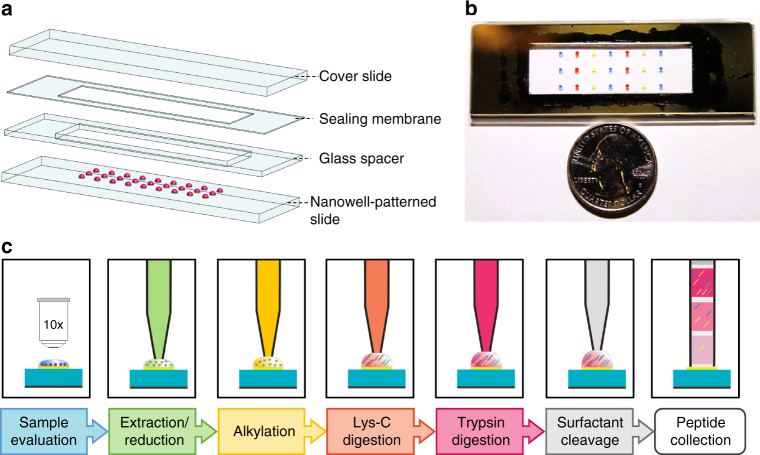
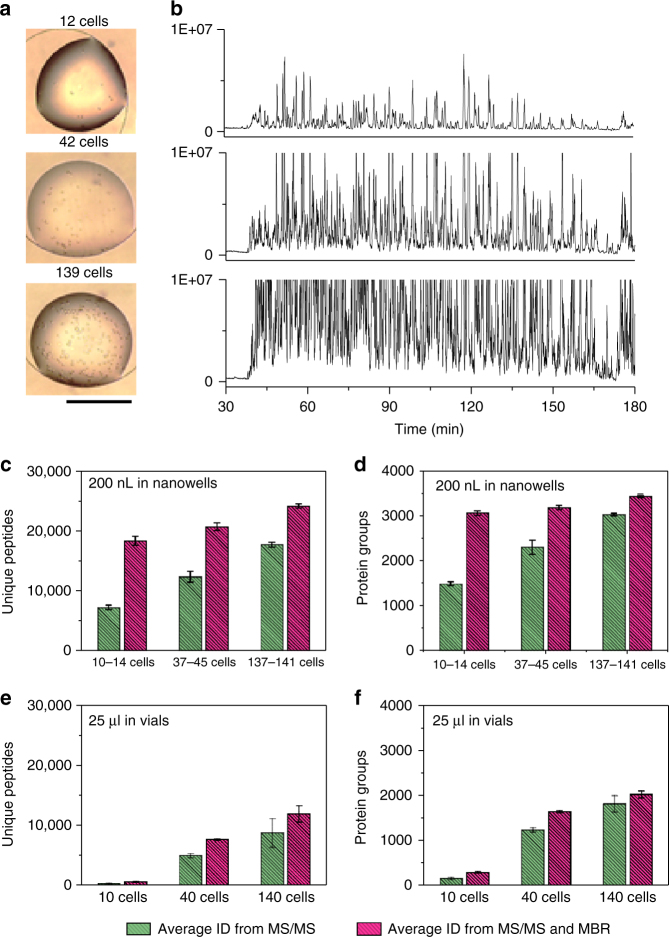
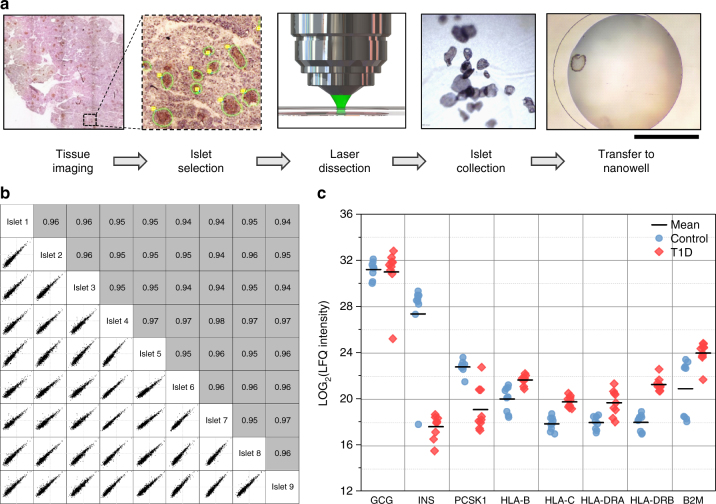
Nanoscale or single-cell technologies are critical for biomedical applications. However, current mass spectrometry (MS)-based proteomic approaches require samples comprising a minimum of thousands of cells to provide in-depth profiling. Here, we report the development of a nanoPOTS (nanodroplet processing in one pot for trace samples) platform for small cell population proteomics analysis. NanoPOTS enhances the efficiency and recovery of sample processing by downscaling processing volumes to <200 nL to minimize surface losses. When combined with ultrasensitive liquid chromatography-MS, nanoPOTS allows identification of ~1500 to ~3000 proteins from ~10 to ~140 cells, respectively. By incorporating the Match Between Runs algorithm of MaxQuant, >3000 proteins are consistently identified from as few as 10 cells. Furthermore, we demonstrate quantification of ~2400 proteins from single human pancreatic islet thin sections from type 1 diabetic and control donors, illustrating the application of nanoPOTS for spatially resolved proteome measurements from clinical tissues.
Overview
The claims and statistics of this paper haven’t been checked yet.
Free: it reads the open-access text and checks the first 5 claims that cite a source we can check. Create a free account to check every claim.
Integrity signals
Registry
Cites
Statistics
Figures
Verification
Claims the paper makes
The claims and statistics of this paper haven’t been checked yet.
Free: it reads the open-access text and checks the first 5 claims that cite a source we can check. Create a free account to check every claim.
Claims other papers make about this one
Each is checked against this paper’s own text: does it say what the citing paper says it does?
In the citing paper
“To improve the sensitivity and automation of top-down sample preparation, Zhu and coworkers have adapted the nanoPOTS (nanodroplet processing in one pot for trace samples) [37] technology for top-down proteomics.”
From Top-down proteomics: challenges, innovations, and applications in basic and clinical research (2020) · cites this paper as [37]
In the citing paper
“The nanoPOTS platform enabled the identification and quantitation of ~3000 proteins from 10 HeLa cells and ~2400 proteins from a single human pancreatic islet thin section.31”
From Sensitive Top-Down Proteomics Analysis of a Low Number of Mammalian Cells Using a Nanodroplet Sample Processing Platform (2020) · cites this paper as [31]
Self-check
Percentages, sums and reported differences re-computed from the paper’s own numbers.
The self-check needs the paper’s full text.
Citations
Cites
NIH Image to ImageJ: 25 years of image analysis
Schneider, C. A., Rasband, W. S., & Eliceiri, K. W. (2012) · Nature Methods · doi:10.1038/nmeth.2089 · Cited by 64,638
The Perseus computational platform for comprehensive analysis of (prote)omics data
Tyanova, S., Temu, T., Sinitcyn, P., Carlson, A., Hein, M. Y., Geiger, T., Mann, M., & Cox, J. (2016) · Nature Methods · doi:10.1038/nmeth.3901 · Cited by 8,803
The MaxQuant computational platform for mass spectrometry-based shotgun proteomics
Tyanova, S., Temu, T., & Cox, J. (2016) · Nature Protocols · doi:10.1038/nprot.2016.136 · Cited by 4,797
2016 update of the PRIDE database and its related tools
Vizcaíno, J. A., Csordas, A., del-Toro, N., Dianes, J. A., Griss, J., Lavidas, I., Mayer, G., Perez-Riverol, Y., Reisinger, F., Ternent, T., et al. (2016) · Nucleic Acids Research · doi:10.1093/nar/gkv1145 · Cited by 3,451
Bendall, S. C., Simonds, E. F., Qiu, P., Amir, E.-A. D., Krutzik, P. O., Finck, R., Bruggner, R. V., Melamed, R., Trejo, A., Ornatsky, O. I., et al. (2011) · Science · doi:10.1126/science.1198704 · Cited by 2,279
Massively parallel single-cell RNA-seq for marker-free decomposition of tissues into cell types
Jaitin, D. A., Kenigsberg, E., Keren-Shaul, H., Elefant, N., Paul, F., Zaretsky, I., Mildner, A., Cohen, N., Jung, S., Tanay, A., et al. (2014) · Science · doi:10.1126/science.1247651 · Cited by 1,795
Single-cell sequencing-based technologies will revolutionize whole-organism science
Shapiro, E., Biezuner, T., & Linnarsson, S. (2013) · Nature Reviews Genetics · doi:10.1038/nrg3542 · Cited by 1,177
BoxPlotR: a web tool for generation of box plots
Spitzer, M., Wildenhain, J., Rappsilber, J., & Tyers, M. (2014) · Nature Methods · doi:10.1038/nmeth.2811 · Cited by 815
A “Proteomic Ruler” for Protein Copy Number and Concentration Estimation without Spike-in Standards
Wiśniewski, J. R., Hein, M. Y., Cox, J., & Mann, M. (2014) · Molecular & Cellular Proteomics · doi:10.1074/mcp.m113.037309 · Cited by 690
High-throughput microfluidic single-cell RT-qPCR
White, A. K., VanInsberghe, M., Petriv, O. I., Hamidi, M., Sikorski, D., Marra, M. A., Piret, J., Aparicio, S., & Hansen, C. L. (2011) · Proceedings of the National Academy of Sciences · doi:10.1073/pnas.1019446108 · Cited by 440
Cited by
Items 401–500 of 600
Chou, T.-F., Chiu, H., Gebreyesus, S. T., Chen, G.-F., Chen, Y., Velasquez, A. R. F., Lin, K., Chen, Y., & Tu, H. (2026) · Analytical Chemistry · doi:10.1021/acs.analchem.5c07275 · Cited by 6
Applications of high performance liquid chromatography-mass spectrometry in proteomics
Wei, L. I. U., Weng, L., Gao, M., & Zhang, X. (2024) · Chinese Journal of Chromatography · doi:10.3724/sp.j.1123.2023.11006 · Cited by 9
Sarkar, S., Zheng, X., Clair, G., Kwon, Y. M., You, Y., Swensen, A., Webb‐Robertson, B., Nakayasu, E. S., Qian, W.-J., & Metz, T. (2024) · Trends in Molecular Medicine · doi:10.1016/j.molmed.2024.07.009 · Cited by 6
Self-citationvan der Pan, K., Kassem, S., Khatri, I., de Ru, A. H., Janssen, G. M. C., Tjokrodirijo, R. T. N., al Makindji, F., Stavrakaki, Ε., de Jager, A. L., Naber, B. A. E., et al. (2022) · Frontiers in Medicine · doi:10.3389/fmed.2022.997305 · Cited by 7
Single Cell Proteomics Using Multiplexed Isobaric Labeling for Mass Spectrometric Analysis
Végvári, Á., Murillo, J. R., & Zubarev, R. A. (2021) · Methods in molecular biology · doi:10.1007/978-1-0716-1771-7_8 · Cited by 6
The Breast Cancer Proteome and Precision Oncology
Lei, J. T., Jaehnig, E. J., Smith, H. L., Holt, M. V., Li, X., Anurag, M., Ellis, M. J., Mills, G. B., Zhang, B., & Labrie, M. (2023) · Cold Spring Harbor Perspectives in Medicine · doi:10.1101/cshperspect.a041323 · Cited by 7
Dutta, S., Pang, M., Coughlin, G. M., Gudavalli, S., Roukes, M. L., Chou, T., & Gradinaru, V. (2025) · bioRxiv (Cold Spring Harbor Laboratory) · doi:10.1101/2025.02.10.637505 · Cited by 6
Fan, Q., Jiang, Y., Chen, J., Chen, Y., Xu, Q., Wu, J., Wang, H., Yang, Y., Pan, J., & Fang, Q. (2025) · Analytical Chemistry · doi:10.1021/acs.analchem.5c00809 · Cited by 6
Self-citationXing, G., Yao, H., Wu, Z., Li, Y., Hou, Y., & Lin, J. (2026) · Chemical Science · doi:10.1039/d5sc05261k · Cited by 7
Yang, Z., Ma, T. P., Choi, M., Yu, F., & Zhu, Y. (2026) · Journal of Proteome Research · doi:10.1021/acs.jproteome.5c01028 · Cited by 7
Self-citationInto the microscale: Low-input sequencing technologies and applications in medicine
Li, Y., Xu, F., Qiao, J., & Yuan, P. (2023) · The Innovation Medicine · doi:10.59717/j.xinn-med.2023.100041 · Cited by 5
Yu, S., Chen, S.-C., Wu, P., Kuo, P.-I., Chen, T.-A., Lee, H., & Lin, M. (2024) · Molecular & Cellular Proteomics · doi:10.1016/j.mcpro.2024.100768 · Cited by 6
Weng, L., Yan, G., Liu, W., Tai, Q., Gao, M., & Zhang, X. (2024) · Journal of Proteome Research · doi:10.1021/acs.jproteome.4c00117 · Cited by 6
Single-cell and spatial omics: exploring hypothalamic heterogeneity
Junaid, M., Lee, E. J., & Lim, S. B. (2024) · Neural Regeneration Research · doi:10.4103/nrr.nrr-d-24-00231 · Cited by 6
“…Matrix-Assisted Laser Desorption Electrospray Ionization and nanodroplet Processing in one pot for Trace Samples-Liquid Chromatography-Tandem Mass Spectrometry to understand the biochemical and morphological aspect of the brain (Zhu et al., 2018b; Pace et al., 2020; Caleb Bagley et al., 2023).”
Maia, T. M., Haver, D. V., Dufour, S., Linden, M. V. D., Dendooven, A., Impens, F., & Devos, S. (2024) · Methods in molecular biology · doi:10.1007/978-1-0716-4298-6_20 · Cited by 6
Zemaitis, K. J., & Paša‐Tolić, L. (2024) · Seminars in Nephrology · doi:10.1016/j.semnephrol.2025.151583 · Cited by 5
The Application of Single-Cell Technologies for Vaccine Development Against Viral Infections
Nguyen, H. N., Vanderzee, I., & Wen, F. (2025) · Vaccines · doi:10.3390/vaccines13070687 · Cited by 8
“Current scMS methods can quantify approximately 1000–3000 proteins per cell [130,131].”
Infrared Laser Ablation Microsampling for Small Volume Proteomics
Dong, C., Donnarumma, F., & Murray, K. K. (2022) · Journal of the American Society for Mass Spectrometry · doi:10.1021/jasms.2c00063 · Cited by 5
Proteomics mining of cancer hallmarks on a single‐cell resolution
Li, M., Zuo, J., Yang, K., Wang, P., & Zhou, S. (2023) · Mass Spectrometry Reviews · doi:10.1002/mas.21842 · Cited by 7
Ding, F., & Liu, Y. (2024) · Journal of Molecular Liquids · doi:10.1016/j.molliq.2024.124694 · Cited by 5
Thermal Denaturation of Fresh Frozen Tissue Enhances Mass Spectrometry Detection of Peptides
Kruse, A. R. S., Judd, A. M., Gutierrez, D. B., Allen, J. L., Dufresne, M., Farrow, M. A., Powers, A. C., Norris, J. L., Caprioli, R. M., & Spraggins, J. M. (2024) · Analytical Chemistry · doi:10.1021/acs.analchem.4c03625 · Cited by 5
Reubsaet, L., Sweredoski, M. J., Moradian, A., Lomenick, B., Eggleston‐Rangel, R., & Garbis, S. D. (2019) · Journal of Chromatography A · doi:10.1016/j.chroma.2019.460507 · Cited by 5
Gong, S., Hu, X., Chen, S., Sun, B., Wu, J., & Li, N. (2022) · Medicinal Research Reviews · doi:10.1002/med.21889 · Cited by 6
Veličković, M., Fillmore, T., Attah, K., Posso, C., Pino, J. C., Zhao, R., Williams, S., Veličković, D., Jacobs, J., Burnum-Johnson, K., et al. (2023) · bioRxiv (Cold Spring Harbor Laboratory) · doi:10.1101/2023.03.13.531822 · Cited by 5
Self-citationOne-STAGE Tip Method for TMT-Based Proteomic Analysis of a Minimal Amount of Cells
Park, N., Lee, H., Kwon, Y. M., Ju, S., Lee, S., Yoo, S., Park, K.-S., & Lee, C. (2023) · ACS Omega · doi:10.1021/acsomega.3c01392 · Cited by 5
Rivandi, M., Franken, A., Yang, L., Abramova, A., Stamm, N., Eberhardt, J., Gierke, B., Beer, M., Fehm, T. N., Niederacher, D., et al. (2024) · Journal of Translational Medicine · doi:10.1186/s12967-024-05616-7 · Cited by 5
“…further enhanced by adjusting the sample lysis volume to 40 nL per single cell and using only 2 nL per spot on the ZeptoChip, which results in lower lysate consumption and improved sensitivity relative to methods like SCoPE-MS [52] and OAD and nanoPOTs [48, 53], which require larger sample volumes.”
MethodSpatial Proteomics towards cellular Resolution
Kwon, Y. M., Fulcher, J. M., Paša‐Tolić, L., & Qian, W. (2024) · Expert Review of Proteomics · doi:10.1080/14789450.2024.2445809 · Cited by 6
“NanoPOTS represents one of the first technologies that enabled label-free proteomics from single cells or near-single-cell samples using a microfluidic sample preparation method [33].”
Self-citationOffset Mass Carrier Proteome Improves Quantification of Multiplexed Single Cell Proteomics
Cheung, T. K., Zhu, Y., & Rose, C. M. (2025) · Molecular & Cellular Proteomics · doi:10.1016/j.mcpro.2025.100959 · Cited by 4
Self-citationAkamatsu, K., Kanao, E., Tomioka, A., & Ishihama, Y. (2025) · Analytical Chemistry · doi:10.1021/acs.analchem.5c00011 · Cited by 4
SPIN: Inkjet-Driven Nanowell Workflow for Scalable and Sensitive Single-Cell Proteomics
Cheng, E., Chi, S., Zhong, H., Coope, R., Foster, L. J., & Cheung, K. C. (2026) · Analytical Chemistry · doi:10.1021/acs.analchem.5c07174 · Cited by 4
From proteomic landscape to single-cell oncoproteomics
Xue, V. W., Wong, S. C. C., & Cho, W. C. S. (2021) · Expert Review of Proteomics · doi:10.1080/14789450.2021.1890036 · Cited by 5
“Compared with SCoPE-MS, nanodroplet processing in one pot for trace samples (nanoPOTS) overcomes the potential effects from carrier proteome and achieves the quantification of over 1,000 proteins in dozens of cells [27].”
MethodQuantitative analysis of bio-molecules in single cells by mass spectrometry
Yin, X., Xue, Z., Feng, L., Tan, S., Li, K., Jiang, Y., Gong, X., Dai, X., & Fang, X. (2023) · TrAC Trends in Analytical Chemistry · doi:10.1016/j.trac.2023.117503 · Cited by 7
Mapping the human brain proteome: opportunities, challenges, and clinical potential
Cartas‐Cejudo, P., Cortés, A., Lachén‐Montes, M., Anaya‐Cubero, E., Peral, E., Ausín, K., Díaz, R., Fernández‐Irigoyen, J., & Santamaría, E. (2024) · Expert Review of Proteomics · doi:10.1080/14789450.2024.2313073 · Cited by 5
“Consequently, new sophisticated techniques are being developed in this context such as the nanoPOTS platform capable to process less than 200nL volume samples [133] or the proteoCHIP, an automated workflow that has identify 2000 protein groups across 158 multiplexed single cells [134].”
Label-Free Sample Preparation for Single-Cell Proteomics
Hartlmayr, D., Ctortecka, C., Mayer, R. L., Mechtler, K., & Seth, A. (2024) · Methods in molecular biology · doi:10.1007/978-1-0716-3934-4_1 · Cited by 4
Maqbool, M. A., Okamoto, S., Shibata, T., Santra, T. S., & Nagai, M. (2024) · Instrumentation Science & Technology · doi:10.1080/10739149.2024.2390907 · Cited by 4
Parallel sample processing for mass spectrometry-based single cell proteomics
Wang, J., Xue, B., Awoyemi, O., yuliantoro, H., Mendis, B. L., DeVor, A., Valentine, S. J., & Li, P. (2024) · Analytica Chimica Acta · doi:10.1016/j.aca.2024.343241 · Cited by 5
Salinity‐Induced Photorespiration in Populus Vascular Tissues Facilitate Nitrogen Reallocation
Wilhelmi, M. D. M. R., Maneejantra, N., Balasubramanian, V. K., Purvine, S. O., Williams, S., DiFazio, S. P., Stewart, C. N., Ahkami, A. H., & Blumwald, E. (2024) · Plant Cell & Environment · doi:10.1111/pce.15180 · Cited by 4
Time‐dependent density functional study for nanodroplet coalescence
Niu, Y., Liu, Y., Liu, H., & Hu, Y. (2019) · AIChE Journal · doi:10.1002/aic.16810 · Cited by 4
Omics and systems view of innate immune pathways
Rathore, D., Marino, M. J., & Nita‐Lazar, A. (2023) · PROTEOMICS · doi:10.1002/pmic.202200407 · Cited by 4
A simple method to quantify protein abundances from one thousand cells
Vitrinel, B., Iannitelli, D. E., Mazzoni, E. O., Christiaen, L., & Vogel, C. (2019) · doi:10.1101/753582 · Cited by 4
Benchmarking PSM identification tools for single cell proteomicsPreprint
Watt, D. V. D., Boekweg, H., Truong, T., Guise, A. J., Plowey, E. D., Kelly, R., & Payne, S. (2021) · bioRxiv (Cold Spring Harbor Laboratory) · doi:10.1101/2021.08.17.456676 · Cited by 4
“However, recent improvements in experimental methods and instrumentation have enabled single cell proteomics 3–5 .”
BackgroundSelf-citationBuur, L. M., Declercq, A., Strobl, M., Bouwmeester, R., Degroeve, S., Martens, L., Dorfer, V., & Gabriels, R. (2023) · ChemRxiv · doi:10.26434/chemrxiv-2023-rvr9n · Cited by 4
The evolution of analytical techniques for multiplex analysis of protein biomarkers
Kim, H., Hall, D. R., Nierves, L. A., Lin, T., Kitata, R. B., Shi, T., & Liu, T. (2025) · Expert Review of Proteomics · doi:10.1080/14789450.2025.2529185 · Cited by 6
“Single-cell proteome analysis technologies such as nanoPOTS (nanodroplet processing in one pot for trace samples) [131,132], SOP-MS (surfactant-assisted one-pot sample preparation coupled with mass spectrometry) [133], and SCoPE-MS (Single Cell ProtEomics by Mass Spectrometry) [90] have made…”
Wang, H., Chen, K., & Wang, Z. (2025) · View · doi:10.1002/viw.20250065 · Cited by 3
Unveiling nanodroplet impact force on material interfaces
Hu, Z., Ran, H., Liu, H., Ji, B., Zhang, J., & Chu, F. (2026) · Droplet · doi:10.1002/dro2.70045 · Cited by 3
Wang, J., Sun, Z., Zhou, Y., Wang, L., & Liu, J. (2026) · Stem Cell Research & Therapy · doi:10.1186/s13287-025-04885-3 · Cited by 3
Shen, B., Pade, L. R., Zhou, F., & Nemes, P. (2026) · Proceedings of the National Academy of Sciences · doi:10.1073/pnas.2518372123 · Cited by 6
Dawar, P., Markillie, L. M., Williams, S. M., Mitchell, H. D., Bagnoli, J., Cantlon-Bruce, J., Seth, A., Bracken, C. C., Pasa-Tolic, L., Zhu, Y., et al. (2026) · Lab on a Chip · doi:10.1039/d5lc01008j · Cited by 5
Self-citationRecent Advances in Top‐Down Proteomics for Single‐Cell Research
Melby, J. A., Su, P., & Gomes, F. P. (2026) · Mass Spectrometry Reviews · doi:10.1002/mas.70031 · Cited by 4
Jassinskaja, M., & Hansson, J. (2022) · Frontiers in Cell and Developmental Biology · doi:10.3389/fcell.2022.824098 · Cited by 3
“Several sample preparation protocols designed specifically for low-input samples have been developed to combat these issues, including nanodroplet processing in one pot for trace samples (nanoPOTS) (Zhu et al., 2018; Liang et al., 2021), single-pot, solid-phase-enhanced sample preparation (SP3) (Hughes et al.”
BackgroundYeo, S., Jang, J., Jung, H. J., Lee, H., Lee, S., & Choe, Y. (2024) · Analytical Chemistry · doi:10.1021/acs.analchem.4c00158 · Cited by 3
Protein biomarkers for subtyping breast cancer and implications for future research: a 2024 update
Mueller, C., Davis, J. B., & Espina, V. A. (2024) · Expert Review of Proteomics · doi:10.1080/14789450.2024.2423625 · Cited by 4
“This nanoPOTS method is able to sequence as few as 10–140 cells, and cells from micro-dissected tissue sections, with adequate peptide coverage [60,61].”
Martin, K., Zhang, T., Zhang, P., Chrisler, W., Thomas, F. L., Liu, F., Liu, T., Qian, W., Smith, R. D., & Shi, T. (2020) · Journal of Visualized Experiments · doi:10.3791/61797 · Cited by 3
Self-citationSanford, J. A., Wang, Y., Hansen, J., Gritsenko, M., Weitz, K., Sagendorf, T. J., Tognon, C. E., Petyuk, V., Qian, W., Liu, T., et al. (2021) · Journal of the American Society for Mass Spectrometry · doi:10.1021/jasms.1c00169 · Cited by 3
Self-citationQin, S., Bai, Y., & Liu, H. (2021) · Chinese Journal of Chromatography · doi:10.3724/sp.j.1123.2020.08030 · Cited by 5
The application of high-throughput proteomics in cytopathology
Nikas, I. P., & Ryu, H. S. (2022) · Journal of Pathology and Translational Medicine · doi:10.4132/jptm.2022.08.30 · Cited by 5
“Furthermore, the enhanced sensitivity and specificity of mass spectrometry, enabling the measurement of minute amount of proteins, has allowed the consideration of proteomics application into future routine clinical practice [22,23].”
BackgroundEmerging insights and challenges for understanding T cell function through the proteome
Solt, L. A. (2022) · Frontiers in Immunology · doi:10.3389/fimmu.2022.1028366 · Cited by 4
“Specifically, they were able to quantify ~2400 proteins from single human pancreatic islet crosssections, isolated by laser microdissection, from a patient with type 1 diabetes vs a healthy control (61).”
BackgroundLi, M., Ma, M., & Li, L. (2023) · Analytical and Bioanalytical Chemistry · doi:10.1007/s00216-023-04877-3 · Cited by 3
“…a microfluidic sample preparation platform using nanodroplet processing in one-pot for trace samples (nanoPOTS) to reduce the sample loss [27]; Mann lab developed a highly sensitive technique using the Bruker timsTOF SCP platform combined with 384-well plastic plates sample preparation…”
MethodExploring the feasibility of a single-protoplast proteomic analysis
Vu, H. M., Lee, J. Y., Kim, Y., Park, S., Izaguirre, F., Lee, J., Lee, J., Jo, M., Woo, H. R., Kim, J. Y., et al. (2024) · Journal of Analytical Science & Technology · doi:10.1186/s40543-024-00457-x · Cited by 3
Rosàs, E., Modzelewski, A. J., He, L., & Herr, A. E. (2018) · bioRxiv (Cold Spring Harbor Laboratory) · doi:10.1101/357731 · Cited by 3
Zhu, Y., Scheibinger, M., Ellwanger, D. C., Krey, J. F., Choi, D., Kelly, R., Heller, S., & Gillespie, P. G. (2019) · bioRxiv (Cold Spring Harbor Laboratory) · doi:10.1101/727412 · Cited by 3
Self-citationEl-Achkar, T. M., Eadon, M., Menon, R., Lake, B., Sigdel, T., Alexandrov, T., Parikh, S., Zhang, G.-S., Dobi, D., Dunn, K., et al. (2019) · bioRxiv · doi:10.1101/828665 · Cited by 9
“The UCSF group is employing recently developed nanoscale proteomics analysis in which a few cells can be processed to generate cell-specific protein profiles (21).”
MethodSwensen, A., Piehowski, P., Chen, J., Chan, X. Y., Kelly, S. S., Petyuk, V., Moore, R. J., Nasif, L. H., Butterworth, E. A., Atkinson, M. A., et al. (2024) · bioRxiv (Cold Spring Harbor Laboratory) · doi:10.1101/2024.09.13.612933 · Cited by 3
Self-citationEnd-to-end high-throughput single-cell proteomics via SPRINT and dual-spray LC-MSPreprint
Liu, Z., Dong, W., Gu, L., Ge, R., Zeng, X., Deng, J., Zhang, H., & Ye, Z. (2025) · bioRxiv (Cold Spring Harbor Laboratory) · doi:10.1101/2025.11.03.686420 · Cited by 6
Golubova, A., & Lanekoff, I. (2025) · Talanta · doi:10.1016/j.talanta.2025.128482 · Cited by 3
“Alternatively to MSI, spatial metabolomics of larger regions on tissue can be performed by physically removing tissue regions for analysis through dissection, including macrodissection, microdissection, or laser micro-dissection [9,10].”
Combinatorial and alternating droplet printing with self-regulating pen-needle-based micronozzle
Maqbool, M. A., Maqbool, M. Z., Okamoto, S., Shibata, T., Santra, T. S., & Nagai, M. (2025) · MRS Advances · doi:10.1557/s43580-025-01338-0 · Cited by 2
Single-cell protein profiling energized by microfluidic technology
Yang, R., Ruan, Q., Guo, W., Shen, H., Lin, X., Chen, Y., Tao, Y., Yang, C. J., & Ren, Y. (2026) · Lab on a Chip · doi:10.1039/d5lc00854a · Cited by 3
The Evolution of Spatial Omics Technologies Introduces A Novel Avenue for Lung Cancer Research
(何越), Y. H., Li, Z., (王文香), W. W., Liu, X., Lu, S., (白晶), J. B., Weng, L., Zhang, Q., Wang, J., & Chen, K. (2026) · Genomics Proteomics & Bioinformatics · doi:10.1093/gpbjnl/qzag010 · Cited by 2
Mass spectrometry-based single-cell proteomics technologies, trends, and biological insights
Hu, R., Montes, C., & Walley, J. W. (2026) · Trends in Biochemical Sciences · doi:10.1016/j.tibs.2026.04.011 · Cited by 6
The clinical promise of mass spectrometry-based single-cell proteomics: from bedside to bench
Prado, H. M. D. A., Miyamoto, J. G., Busso-Lopes, A. F., Tofani, L. B., Coimbra, N. D. R., Patroni, F. M. D. S., de Figueiredo, D., Rocha, G. F., Pauletti, B. A., Carnielli, C. M., et al. (2026) · Expert Review of Proteomics · doi:10.1080/14789450.2026.2701811 · Cited by 3
“Following pre-processing, isolated cells are prepared for proteomic analysis using miniaturized sample preparation platforms designed for low-input workflows [13,15,102,120,121].”
Pandey, S., Tůma, Z., Šmrhová, T., Čedíková, M., Macanova, T., & Dvorakova, M. C. (2021) · Pharmaceutics · doi:10.3390/pharmaceutics13060883 · Cited by 2
“Zhu et al., 2018, demonstrated that the NanoPOTS platform can minimize sample processing volume up to 200 nL and can enhance the recovery rate [12].”
BackgroundMultimodal joint deconvolution and integrative signature selection in proteomics
Pan, Y., Wang, X., Sun, J., Liu, C., Peng, J., & Li, Q. (2024) · Communications Biology · doi:10.1038/s42003-024-06155-z · Cited by 1
“Recent advances in liquid chromatography mass spectrometry (LC–MS)- based proteomics methods have addressed the limitations in the sensitivity and throughput [6, 7], which accelerates the evolvement of single cell mass spectrometry (scMS) proteomics.”
BackgroundKitano, E. S., Nisbet, G. A. A., Demyanenko, Y., Kowalczyk, K. M., Iselin, L., Cross, S., Castelló, A., & Mohammed, S. (2024) · Analytical Chemistry · doi:10.1021/acs.analchem.4c01731 · Cited by 2
Ying, G., He, Y., Yang, M., Lü, G., Li, Y., Cui, W., Hu, Z., & Zhang, Z. (2025) · Analytical Chemistry · doi:10.1021/acs.analchem.4c04857 · Cited by 2
Cell-Lineage Guided Mass Spectrometry Proteomics in the Developing (Frog) Embryo
Baxi, A. B., Pade, L. R., & Nemes, P. (2022) · Journal of Visualized Experiments · doi:10.3791/63586 · Cited by 3
Droplet-based microextraction — when to go with the flow?
You, J. B. (2021) · Korea-Australia Rheology Journal · doi:10.1007/s13367-021-0016-y · Cited by 3
Erber, L. N., & Chen, Y. (2021) · ACS in focus · doi:10.1021/acsinfocus.7e5010 · Cited by 2
Amon, S., Meier-Abt, F., Gillet, L. C. J., Dimitrieva, S., Theocharides, A., Manz, M., & Aebersold, R. (2018) · bioRxiv · doi:10.1101/371161
Kitano, E. S., Nisbet, G. A. A., Demyanenko, Y., Kowalczyk, K. M., Iselin, L., Cross, S., Castelló, A., & Mohammed, S. (2024) · bioRxiv (Cold Spring Harbor Laboratory) · doi:10.1101/2024.04.02.587751 · Cited by 2
Exploration of potential applications of nano-droplets according to their basic properties
Gu, Z. (2022) · International Conference on Materials Chemistry and Environmental Engineering (CONF-MCEE) · doi:10.1117/12.2646184 · Cited by 1
“[27] reported a chip-based nano-droplet processing platform – nanoPOTS (nano-droplet Processing in One pot for Trace Samples).”
BackgroundMethodInfluentialSajid, R. S., van Winden, L. J., & Diamandis, P. (2023) · PROTEOMICS · doi:10.1002/pmic.202200401 · Cited by 1
“[44,45] Another approach, Single Cell ProtEomics by Mass Spectrometry (SCoPE-MS), combines TMT labeling with protein carriers to increase sequencing efficiency and can quantify over 3000 proteins from approximately 1500 single cells.”
MethodProteomics in the Pharmaceutical Industry: Prospects and Challenges
Patel, D., Patel, V., Patel, G., & Patel, J. K. (2024) · Springer eBooks · doi:10.1007/978-3-031-64021-6_14 · Cited by 1
Protocol for generating high-fidelity proteomic profiles using DROPPS
Waas, M., Govindarajan, M., Khoo, A., Zuo, C., Aastha, A., He, J., Woolman, M., Ha, A., Lin, B., & Kislinger, T. (2024) · STAR Protocols · doi:10.1016/j.xpro.2024.103397 · Cited by 1
IS-SCP: enhanced single-cell proteomics using an in situ simplified strategy
Yang, Z., Jiang, Y., Xu, Q., Chen, J., Pan, J., Di, X., & Fang, Q. (2025) · The Analyst · doi:10.1039/d5an00149h · Cited by 1
Self-citationNing, X., Li, J., Huang, Y., Chen, H., Zhang, X., Mei, Z., Fan, L., Chen, L., Gao, L. P., Li, S., et al. (2025) · Analytical Chemistry · doi:10.1021/acs.analchem.5c05757 · Cited by 1
A Single-Cell Omics Technical Guide for Advancing Neuropsychiatric Research
Casmey, K., Zimmermann, M., Xie, Y., Codeluppi-Arrowsmith, S. A., & Turecki, G. (2025) · Genes · doi:10.3390/genes16121394 · Cited by 3
“Improved sample preparation methodology, such as nanoPOTS, reduces protein loss [335].”
Single-Cell Protein Assays in Context: From 2D to 3D and In Situ Analysis
Baker, J. S., Joseph, N. I., Lao, A., & Vlassakis, J. (2025) · Annual Review of Analytical Chemistry · doi:10.1146/annurev-anchem-101724-105925 · Cited by 1
“NanoPOTS, developed in the Kelly lab, is a chip-based platform allowing for scMS preparation in a single-cell nanodroplet (21).”
Mass spectrometry-based single-cell metabolomics and metabolic tracing analysis
Zhu, X., Yi, J., & Qiao, L. (2026) · TrAC Trends in Analytical Chemistry · doi:10.1016/j.trac.2026.118871 · Cited by 2
Kamarulzaman, L., Kim, S., Hidaka, T., Tsuchida, M., & Taniguchi, Y. (2026) · Nature Communications · doi:10.1038/s41467-026-74840-0 · Cited by 4
“Since then, many MS-based single-cell proteomics technologies have been developed to improve the detection sensitivity 16 – 24 .”
Binek, A., & Angel, P. M. (2026) · Circulation Research · doi:10.1161/circresaha.126.327684 · Cited by 2
Single-Cell and Spatial Omics Technologies in Rice Abiotic Stress Biology: A Methodological Review
Chen, J., Chen, Z., Yin, C., Zhou, L., & Da, Z. (2026) · International Journal of Molecular Sciences · doi:10.3390/ijms27167114 · Cited by 1
Self-citationRapid Eco-AI CE–MS Enables Sub-7 Min Low-Input Proteome Profiling with Quantitative Validation
Zhou, F., Shen, B., Luz, I. S., García, L. D., Prior, S. J., Fontes, W., & Nemes, P. (2026) · Analytical Chemistry · doi:10.1021/acs.analchem.6c03046 · Cited by 1
Analytical Technology for Single-Cancer-Cell Analysis
Kuo, C., & Lee, H. (2020) · Springer eBooks · doi:10.1007/978-981-10-4857-9_33-1 · Cited by 1
Biosensors for single-cell proteomic characterization
Zhao, Y., Zhao, S., Li, Y., Yang, Y., & Liu, M. (2021) · Elsevier eBooks · doi:10.1016/b978-0-323-89841-6.00004-9 · Cited by 2
Mass Spectrometry-Based Analytical Strategy for Single-Cell Proteomics
Végvári, Á. (2021) · Methods in molecular biology · doi:10.1007/978-1-0716-1936-0_6 · Cited by 1
Zhao, H.-X., Chen, Y., Li, H., Zhang, Y.-J., Zhang, W.-J., & Qin, W.-J. (2023) · Analytical Methods · doi:10.1039/d2ay01884e · Cited by 1
The potential of proteomics for in-depth molecular investigations of progressive supranuclear palsy
Romero-Murillo, S., Lee, S., Fernández‐Irigoyen, J., Martínez-Valbuena, I., & Santamaría, E. (2025) · Expert Review of Proteomics · doi:10.1080/14789450.2025.2519466 · Cited by 1
“While most studies at the single-cell level have concentrated on nucleic acids, it is important to note that mass spectro-metry has proven to be sufficiently sensitive to detect proteins at the single-cell level [96,97].”
Generating Cell Type-Specific Protein Signatures from Non-symptomatic and Diseased Tissues
Sadick, J. S., Crawford, L. A., Cramer, H. C., Franck, C., Liddelow, S. A., & Darling, E. M. (2020) · Annals of Biomedical Engineering · doi:10.1007/s10439-020-02507-y · Cited by 1
Proteomics in support of immunotherapy: contribution to model-based precision medicine
Nony, E., & Moingeon, P. E. (2021) · Expert Review of Proteomics · doi:10.1080/14789450.2021.2020653 · Cited by 1
“2 ng, which requires performing MS analyses of a few zeptomoles of a protein or peptide [11,12].”
BackgroundSingle-Cell Proteome Profiling of Neuronal Cells
Misal, S. A., & Kelly, R. (2022) · Neuromethods · doi:10.1007/978-1-0716-2525-5_3 · Cited by 1
Self-citation
Metadata
- Authors
- Zhu, Y., Piehowski, P. D., Zhao, R., Chen, J., Shen, Y., Moore, R. J., Shukla, A. K., Petyuk, V. A., Campbell-Thompson, M., Mathews, C. E., Smith, R. D., Qian, W.-J., & Kelly, R. T.
- Affiliations
- Pacific Northwest National Laboratory (US)
- University of Florida (US)
- Corresponding author
- Kelly, Ryan T.
- ORCID
- Venue
- Nature Communications
- Published
- 2018-02-28
- Volume
- 9
- Issue
- 1
- Pages
- 882-882
- ISSN
- 2041-1723 (ISSN-L)
- PMC
- PMC5830451
- OpenAlex
- W2807662170
- Cited by
- 587
- References
- 44
- Citations by year
- 2026: 58 · 2025: 62 · 2024: 99 · 2023: 80 · 2022: 83 · 2021: 80 · 2020: 56 · 2019: 43 · 2018: 26
- FWCI
- 22.11
- Type
- journal article
- Language
- en
- Open access
- gold
- doi.org
- Licence
- cc-by
- creativecommons.org/licenses/by/4.0 (tdm)
- creativecommons.org/licenses/by/4.0 (vor)
- Locations
- Nature Communications (publishedVersion, cc-by)
- Europe PMC (PubMed Central) (publishedVersion, cc-by)
- PubMed Central (publishedVersion, cc-by)
- PubMed (publishedVersion)
- OSTI OAI (U.S. Department of Energy Office of Scientific and Technical Information) (submittedVersion)
- RePEc: Research Papers in Economics (submittedVersion)
- DOAJ (DOAJ: Directory of Open Access Journals) (submittedVersion, cc-by-sa)
- DOAJ (DOAJ: Directory of Open Access Journals) (submittedVersion)
- Funders
- U.S. Department of Energy (GM103493)
- National Institutes of Health (1s10od016350-01, 8p41gm103493-10, P41-GM103493, GM103493)
- National Cancer Institute (R33CA225248)
- National Institute of General Medical Sciences (P41-GM103493)
- National Institute of Diabetes and Digestive and Kidney Diseases (UC4DK104167, DP3DK110844)
- National Institute of Biomedical Imaging and Bioengineering (R21EB020976)
- Biological and Environmental Research
- Pacific Northwest National Laboratory
- Topics
- Physical Sciences › Chemistry › Spectroscopy › Advanced Proteomics Techniques and Applications
- Physical Sciences › Chemistry › Spectroscopy › Mass Spectrometry Techniques and Applications
- Life Sciences › Biochemistry, Genetics and Molecular Biology › Molecular Biology › Metabolomics and Mass Spectrometry Studies
- Keywords
- single-cell proteomics, liquid chromatography-mass spectrometry, protein quantification, pancreatic islets, type 1 diabetes, spatial proteomics, sample volume reduction
- MeSH terms
- Humans, Islets of Langerhans, Proteins, Mass Spectrometry, Proteome, Gene Expression Profiling, Proteomics
About these checks
Registry, retraction, Cites and statistics results are computed, not judged, with one exception: a printed reference that no index lists is read once by a model before it counts as a citation error. Claims are extracted by a model and kept only when their quote appears verbatim in the text; each cited source is then checked, with a model’s help, for whether it says what the claim relies on. Those verdicts can be wrong — read the claim’s quote and the cited source before relying on one.
Statistics and arithmetic are recomputed, not judged.
Confidence bands are shown only for fields calibrated on our annotated test set. None is calibrated yet, so no band is shown.
What counts as a claim ›How we measure confidence ›How we check this ›
Are you an author, or do you see a problem with this page? Request a review
Data sources
Bibliographic data: Semantic Scholar, OpenAlex, Crossref.
Contains information from the Semantic Scholar Academic Graph Datasets, made available under the ODC Attribution License (ODC-BY 1.0).
Semantic Scholar’s data is described in: Kinney, R., et al. (2023). The Semantic Scholar Open Data Platform. arXiv:2301.10140.
