

Nanodroplet processing platform for deep and quantitative proteome profiling of 10–100 mammalian cells
Open accessThe DOI matches its Crossref record; 44 of the 44 references it cites were found in a registry or an index.
Abstract
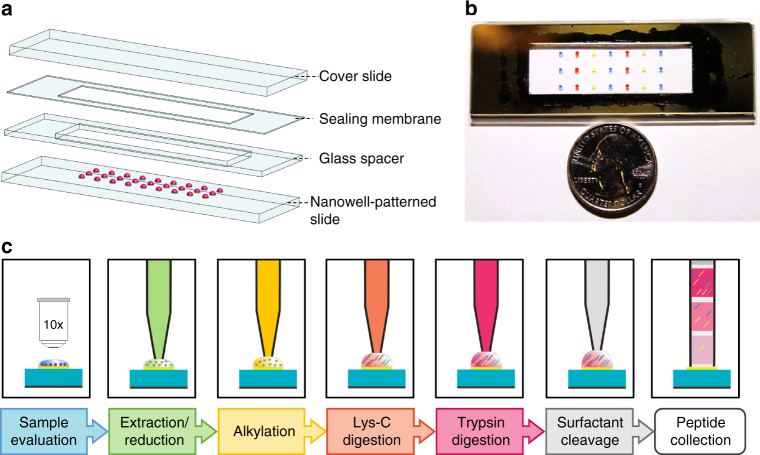
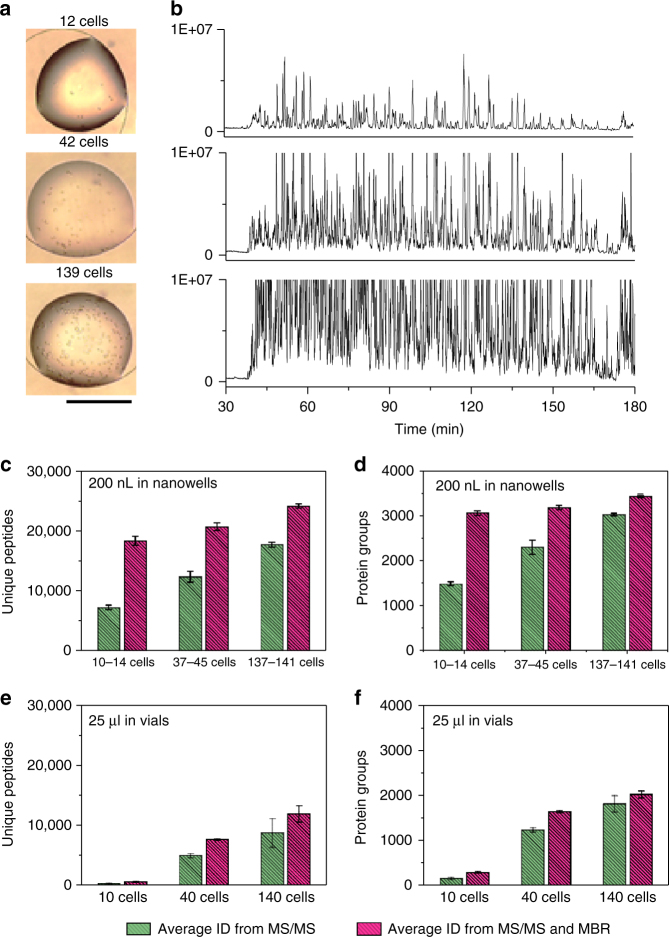
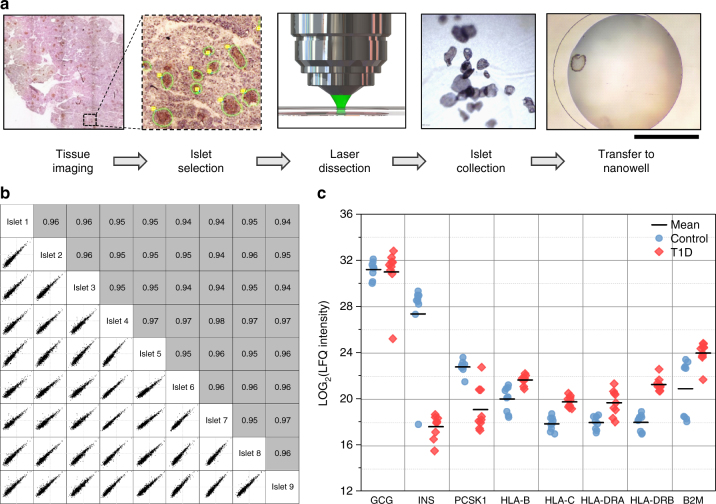
Nanoscale or single-cell technologies are critical for biomedical applications. However, current mass spectrometry (MS)-based proteomic approaches require samples comprising a minimum of thousands of cells to provide in-depth profiling. Here, we report the development of a nanoPOTS (nanodroplet processing in one pot for trace samples) platform for small cell population proteomics analysis. NanoPOTS enhances the efficiency and recovery of sample processing by downscaling processing volumes to <200 nL to minimize surface losses. When combined with ultrasensitive liquid chromatography-MS, nanoPOTS allows identification of ~1500 to ~3000 proteins from ~10 to ~140 cells, respectively. By incorporating the Match Between Runs algorithm of MaxQuant, >3000 proteins are consistently identified from as few as 10 cells. Furthermore, we demonstrate quantification of ~2400 proteins from single human pancreatic islet thin sections from type 1 diabetic and control donors, illustrating the application of nanoPOTS for spatially resolved proteome measurements from clinical tissues.
Overview
The claims and statistics of this paper haven’t been checked yet.
Free: it reads the open-access text and checks the first 5 claims that cite a source we can check. Create a free account to check every claim.
Integrity signals
Registry
Cites
Statistics
Figures
Verification
Claims the paper makes
The claims and statistics of this paper haven’t been checked yet.
Free: it reads the open-access text and checks the first 5 claims that cite a source we can check. Create a free account to check every claim.
Claims other papers make about this one
Each is checked against this paper’s own text: does it say what the citing paper says it does?
In the citing paper
“To improve the sensitivity and automation of top-down sample preparation, Zhu and coworkers have adapted the nanoPOTS (nanodroplet processing in one pot for trace samples) [37] technology for top-down proteomics.”
From Top-down proteomics: challenges, innovations, and applications in basic and clinical research (2020) · cites this paper as [37]
In the citing paper
“The nanoPOTS platform enabled the identification and quantitation of ~3000 proteins from 10 HeLa cells and ~2400 proteins from a single human pancreatic islet thin section.31”
From Sensitive Top-Down Proteomics Analysis of a Low Number of Mammalian Cells Using a Nanodroplet Sample Processing Platform (2020) · cites this paper as [31]
Self-check
Percentages, sums and reported differences re-computed from the paper’s own numbers.
The self-check needs the paper’s full text.
Citations
Cites
NIH Image to ImageJ: 25 years of image analysis
Schneider, C. A., Rasband, W. S., & Eliceiri, K. W. (2012) · Nature Methods · doi:10.1038/nmeth.2089 · Cited by 64,638
The Perseus computational platform for comprehensive analysis of (prote)omics data
Tyanova, S., Temu, T., Sinitcyn, P., Carlson, A., Hein, M. Y., Geiger, T., Mann, M., & Cox, J. (2016) · Nature Methods · doi:10.1038/nmeth.3901 · Cited by 8,803
The MaxQuant computational platform for mass spectrometry-based shotgun proteomics
Tyanova, S., Temu, T., & Cox, J. (2016) · Nature Protocols · doi:10.1038/nprot.2016.136 · Cited by 4,797
2016 update of the PRIDE database and its related tools
Vizcaíno, J. A., Csordas, A., del-Toro, N., Dianes, J. A., Griss, J., Lavidas, I., Mayer, G., Perez-Riverol, Y., Reisinger, F., Ternent, T., et al. (2016) · Nucleic Acids Research · doi:10.1093/nar/gkv1145 · Cited by 3,451
Bendall, S. C., Simonds, E. F., Qiu, P., Amir, E.-A. D., Krutzik, P. O., Finck, R., Bruggner, R. V., Melamed, R., Trejo, A., Ornatsky, O. I., et al. (2011) · Science · doi:10.1126/science.1198704 · Cited by 2,279
Massively parallel single-cell RNA-seq for marker-free decomposition of tissues into cell types
Jaitin, D. A., Kenigsberg, E., Keren-Shaul, H., Elefant, N., Paul, F., Zaretsky, I., Mildner, A., Cohen, N., Jung, S., Tanay, A., et al. (2014) · Science · doi:10.1126/science.1247651 · Cited by 1,795
Single-cell sequencing-based technologies will revolutionize whole-organism science
Shapiro, E., Biezuner, T., & Linnarsson, S. (2013) · Nature Reviews Genetics · doi:10.1038/nrg3542 · Cited by 1,177
BoxPlotR: a web tool for generation of box plots
Spitzer, M., Wildenhain, J., Rappsilber, J., & Tyers, M. (2014) · Nature Methods · doi:10.1038/nmeth.2811 · Cited by 815
A “Proteomic Ruler” for Protein Copy Number and Concentration Estimation without Spike-in Standards
Wiśniewski, J. R., Hein, M. Y., Cox, J., & Mann, M. (2014) · Molecular & Cellular Proteomics · doi:10.1074/mcp.m113.037309 · Cited by 690
High-throughput microfluidic single-cell RT-qPCR
White, A. K., VanInsberghe, M., Petriv, O. I., Hamidi, M., Sikorski, D., Marra, M. A., Piret, J., Aparicio, S., & Hansen, C. L. (2011) · Proceedings of the National Academy of Sciences · doi:10.1073/pnas.1019446108 · Cited by 440
Cited by
Items 501–600 of 600
Proteomic Techniques and Their Applications
Juan, H. (2019) · Wiley eBooks · doi:10.1002/9781119483977.ch5 · Cited by 1
A multiomics focusing towards the molecular networks of lung development
Clair, G. (2019) · American Journal of Physiology-Lung Cellular and Molecular Physiology · doi:10.1152/ajplung.00364.2019 · Cited by 1
Advances in LC-MS/MS Usher in the Era of Single-cell Proteomics
Free, T. (2022) · BioTechniques · doi:10.2144/btn-2022-0053 · Cited by 1
Protein Sequence Determination: Methodology and Evolutionary Implications
Bradshaw, R. A. (2022) · Elsevier eBooks · doi:10.1016/b978-0-12-821618-7.00198-x · Cited by 1
Aptamer-functionalized interface nanopores enable amino acid-specific single-molecule proteomicsPreprint
Schlotter, T., Kloter, T., Hengsteler, J., Ragavan, S., Hu, H., Zhang, X., Duru, J., Vörös, J., Zambelli, T., & Nakatsuka, N. (2023) · Research Square · doi:10.21203/rs.3.rs-3015491/v1 · Cited by 1
Droplet based low input proteomic platform for rare cell populationsPreprint
Waas, M., Khoo, A., Tharmapalan, P., McCloskey, C. W., Govindarajan, M., Zhang, B., Khan, S., Waterhouse, P. D., Khokha, R., & Kislinger, T. (2023) · bioRxiv (Cold Spring Harbor Laboratory) · doi:10.1101/2023.09.11.557098 · Cited by 1
Filter-aided expansion proteomicsPreprint
Dong, Z., Zhu, Y., Zhang, F., Wu, C., Chen, T., Chen, J., Jiang, W., Xiao, Q., Zheng, S. S., Piatkevich, K. D., et al. (2023) · bioRxiv (Cold Spring Harbor Laboratory) · doi:10.1101/2023.11.29.569242 · Cited by 1
Self-citationShen, B., Zhou, F., & Nemes, P. (2025) · bioRxiv (Cold Spring Harbor Laboratory) · doi:10.1101/2025.04.16.649123 · Cited by 1
“Nanoliter-processing systems (e.g., nanoPOTS 11 and nPOP 12 ) down-scaled bottom-up proteomic workflows to sub-microliter volumes.”
Rapid CE–MS with Real-Time Eco–AI Resolves Proteomic Heterogeneity Among Single Human NeutrophilsPreprint
Shen, B., Zhou, F., Luz, I. S., Rodriguez, L. G., Prior, S. J., Fontes, W., & Nemes, P. (2025) · bioRxiv (Cold Spring Harbor Laboratory) · doi:10.1101/2025.08.14.670204 · Cited by 1
“Its performance can be further enhanced through automated nanoliter-scale sample handling (e.g., nanoPOTS 40 , SCopE MS 17, 41 ), advanced microanalytical CE systems (e.g., RoboCap 42 ), and coupling to contemporary mass analyzers (time-of-flight 16, 43 and Orbitrap 44 ) with higher speed and…”
Kelly, S. S., Sarkar, S., Williams, S. M., Fu, A., Butterworth, E. A., Sagendorf, T. J., Nierves, L. A., Kwon, Y. M., Li, X., Petyuk, V., et al. (2025) · bioRxiv (Cold Spring Harbor Laboratory) · doi:10.1101/2025.11.10.687674 · Cited by 2
Self-citationKamarulzaman, L., Kim, S., Hidaka, T., Tsuchida, M., & Taniguchi, Y. (2026) · bioRxiv (Cold Spring Harbor Laboratory) · doi:10.64898/2026.01.14.699423 · Cited by 1
“Since then, many MS-based single-cell proteomics technologies have been developed to improve the detection sensitivity 16,17,18,19,20,21,22,23,24 .”
Single-Cell Proteomics of Human Peripheral Blood Mononuclear Cells Exceeding 600 Cells per DayPreprint
Fulcher, J. M., Kwon, Y., Dawar, P., Kumar, R., Williams, S. M., Miller, P. J., Liyu, A. V., Chen, L., Orton, D., Olson, H. M., et al. (2026) · bioRxiv (Cold Spring Harbor Laboratory) · doi:10.64898/2026.02.01.703169 · Cited by 5
Self-citationNanoflow ion-pairing LC–MS for ultra-low-input polar metabolomics and isotope tracingPreprint
Ellis, A. E., Deshpande, R., Cook, A., Dufresne, C. P., Bailey, M. J., Bird, S. S., & Sheldon, R. D. (2026) · bioRxiv (Cold Spring Harbor Laboratory) · doi:10.64898/2026.06.03.729938 · Cited by 1
A simple approach for accurate peptide quantification in MS-based proteomicsPreprint
Maia, T. M., Staes, A., Plasman, K., Pauwels, J., Boucher, K. L., Argentini, A., Martens, L., Montoye, T., Gevaert, K., & Impens, F. (2019) · bioRxiv (Cold Spring Harbor Laboratory) · doi:10.1101/703397
Ben, F. D., Bulfoni, M., Turetta, M., Brisotto, G., Steffan, A., & Curcio, F. (2019) · La Rivista Italiana della Medicina di Laboratorio - Italian Journal of Laboratory Medicine · doi:10.23736/s1825-859x.19.00004-5
Multiple Testing in Proteomics
Videira, A. J. C. (2020) · Portuguese National Funding Agency for Science, Research and Technology (RCAAP Project by FCT) · doi:10.34626/c3e7-6132
Steyer, D. J. (2019) · Deep Blue (University of Michigan)
Kelly, V., al-Rawi, A., Lewis, D. A., Kustatscher, G., & Ly, T. (2020) · bioRxiv (Cold Spring Harbor Laboratory) · doi:10.1101/2020.07.03.186023
“~3,000 proteins were identified from 10 HeLa cells using 71 ‘nanodroplet processing in one pot for trace samples’ (nanoPOTS) [4].”
BackgroundMethodOptimized Data-Independent Acquisition Approach for Proteomic Analysis at Single-Cell LevelPreprint
Wang, Y., Lih, T. M., Chen, L., Xu, Y., Kuczler, M. D., Cao, L., Pienta, K. J., Amend, S. R., & Zhang, H. (2021) · Research Square · doi:10.21203/rs.3.rs-977693/v1
Functional single cell proteomic profiling of cells with abnormal DNA damage response dynamicsPreprint
Su, P.-R., You, L., Beerens, C. E. M. T., Bezstarosti, K., Demmers, J., Pabst, M., Kanaar, R., Hsu, C., & Chien, M. (2021) · bioRxiv (Cold Spring Harbor Laboratory) · doi:10.1101/2021.10.13.464241
Chemical derivatization of peptides for quantitative proteomics
Leitner, A. (2021) · Elsevier eBooks · doi:10.1016/b978-0-12-821433-6.00002-7
Martin, K., Zhang, T., Chrisler, W., Thomas, F. L., Qian, W., & Shi, T. (2021) · doi:10.17504/protocols.io.bwnbpdan
Self-citationAnalytical Technology for Single-Cancer-Cell Analysis
Kuo, C., & Lee, H. (2021) · Springer eBooks · doi:10.1007/978-981-10-8953-4_33
Trends in Single-Cell Proteomics Technology
Masuda, T. (2022) · Journal of the Mass Spectrometry Society of Japan · doi:10.5702/massspec.s22-13
Huang, J. (2022) · Research Publications (Maastricht University) · doi:10.26481/dis.20221220jh
Huffman, R. G. (2022) · Digital Repository Service (Northeastern University) · doi:10.17760/d20474745
Johnson, K. R. (2022) · Digital Repository Service (Northeastern University) · doi:10.17760/d20467259
Untangling the Complexities of Single Cell Protein Analysis
Cowen, L. (2022) · Inside Precision Medicine · doi:10.1089/ipm.09.06.04
Maqbool, M. A., Okamoto, S., Shibata, T., & Nagai, M. (2022) · International Symposium on Micro-NanoMechatronics and Human Science · doi:10.1109/mhs56725.2022.10138071
“microscale cell assay, and (6) micro-sample analysis with high-resolution analysis [1].”
MethodChen, Y., Du, Z., Zhao, H., Fang, W., Liu, T., Zhang, Y., Zhang, W., & Qin, W. (2023) · Analytica Chimica Acta · doi:10.1016/j.aca.2023.341793
Single-Cell Proteomics Using Mass Spectrometry
Masuda, T. (2023) · Journal of the Mass Spectrometry Society of Japan · doi:10.5702/massspec.s23-43
Rivandi, M., Franken, A., Yang, L., Abramova, A., Stamm, N., Eberhardt, J., Gierke, B., Beer, M., Fehm, T. N., Niederacher, D., et al. (2023) · bioRxiv (Cold Spring Harbor Laboratory) · doi:10.1101/2023.09.16.558042
“approximately 40 nL for every single cell, with only 2 nL print volume applied per replicate spots on the ZeptoChip surface, leading to less single cell sample lysate consumed per array and demonstrating higher sensitivity compared to other methods such as SCoPE-MS(47) and OAD and nanoPOTs(48, 49), which have larger s…”
MethodKrull, K. K., Ali, S. A., & Krijgsveld, J. (2024) · bioRxiv (Cold Spring Harbor Laboratory) · doi:10.1101/2024.01.10.575010
Buur, L. M., Declercq, A., Strobl, M., Bouwmeester, R., Degroeve, S., Martens, L., Dorfer, V., & Gabriels, R. (2024) · ChemRxiv · doi:10.26434/chemrxiv-2023-rvr9n-v2
The 15-min (Sub)Cellular ProteomePreprint
Shen, B., Pade, L. R., & Nemes, P. (2024) · bioRxiv (Cold Spring Harbor Laboratory) · doi:10.1101/2024.02.15.580399
Wang, Y., Lih, T. M., Chen, L., Xu, Y., Kuczler, M. D., Cao, L., Pienta, K. J., Amend, S. R., & Zhang, H. (2022) · Figshare · doi:10.6084/m9.figshare.20282155
Truong, T., Sanchez-Avila, X., Webber, K. G. I., Johnston, S. M., & Kelly, R. (2024) · Methods in molecular biology · doi:10.1007/978-1-0716-3934-4_7
Self-citationXu, Z., Zou, R., Horn, N., Kitata, R. B., & Shi, T. (2024) · Methods in molecular biology · doi:10.1007/978-1-0716-3934-4_8 · Cited by 1
Zhu, L., & Wong, C. C. L. (2024) · Methods in molecular biology · doi:10.1007/978-1-0716-3934-4_5 · Cited by 1
Microfluidic Sample Preparation for Multiplexed Single-Cell Proteomics Using a Nested Nanowell Chip
Park, J., Cheung, T. K., & Zhu, Y. (2024) · Methods in molecular biology · doi:10.1007/978-1-0716-3922-1_10
Self-citationYuan, Y., Hu, M., Zheng, Y., Zhang, Y., Pang, Y., & Xie, X. S. (2024) · bioRxiv (Cold Spring Harbor Laboratory) · doi:10.1101/2024.09.28.614398 · Cited by 1
Proteomics and Its Application to the Human Pathogenic Fungus Aspergillus fumigatus
Krüger, T., & Kniemeyer, O. (2024) · The mycota · doi:10.1007/978-3-031-64853-3_11
Trace sample proteomics pre-treatment technology based on boric acid metal-organic frameworks
Zhang, S., & Ding, X. (2025) · Chinese Science Bulletin (Chinese Version) · doi:10.1360/tb-2024-1132
Fu, X., Lanrui, C., Jiang, Y., Yang, Z., Ren, P., Zhao, P., Zhang, Y., Zhang, S., Fan, H., Wang, Y., et al. (2025) · Research Square · doi:10.21203/rs.3.rs-6309099/v1
Shen, B., Zhou, F., & Nemes, P. (2025) · Angewandte Chemie · doi:10.1002/ange.202510692
spammR: an R package designed for analysis and integration of spatial multi-omic measurements
Mahlich, Y., Sohi, H. K., Veličković, M., Piehowski, P., McDermott, J., & Gosline, S. J. C. (2026) · Bioinformatics Advances · doi:10.1093/bioadv/vbag163
“Mass spectrometry (MS) based technologies to measure proteins (Zhu et al .”
Self-citationChen, H., Guzmán, U. H., & Olsen, J. V. (2025) · bioRxiv (Cold Spring Harbor Laboratory) · doi:10.1101/2025.11.06.686925
Desire, C. T., Dilmetz, B. A., Degenhardt, J., Donnellan, L., Condina, M. R., Young, C., & Hoffmann, P. (2025) · ACS Omega · doi:10.1021/acsomega.5c09856
Jin, K., Ding, F., Liu, X., Zhang, M., Hu, S., & Ma, H. (2025) · Sensors and Actuators B Chemical · doi:10.1016/j.snb.2025.139213
Arif, A., Kumar, R., Kwon, Y. M., Rodriguez, R., Cordts, S. C., Koppaka, S., Zhu, Y., Paša‐Tolić, L., & Tang, S. K. Y. (2025) · bioRxiv (Cold Spring Harbor Laboratory) · doi:10.64898/2025.12.12.694048
Self-citationRefining Liquid Chromatography Conditions across Platforms To Democratize Single-Cell Proteomics
Wang, Y., Zhao, Q., Tang, Y. S., Lai, W., & Yu, H. (2026) · Journal of Proteome Research · doi:10.64898/2025.12.16.694739
“…refold misfolded proteins, and proteasomes to degrade damaged proteins 13 . scProteomics workflows often require several dedicated equipment at different steps, such as dedicated single cell sorter 14 , automated nanoliter pipettor 15 and various microfluidic devices 12,16 for sample preparation.”
Additional file 1 of Exploring the feasibility of a single-protoplast proteomic analysis
Vu, H. M., Lee, J. Y., Kim, Y., Park, S., Izaguirre, F., Lee, J., Lee, J.-H., Jo, M., Woo, H. R., Kim, J. Y., et al. (2024) · Figshare · doi:10.6084/m9.figshare.26420368
Additional file 2 of Exploring functional protein covariation across single cells using nPOP
Leduc, A., Huffman, R. G., Cantlon, J., Khan, S., & Slavov, N. (2024) · Figshare · doi:10.6084/m9.figshare.26555081
Additional file 4 of Exploring functional protein covariation across single cells using nPOP
Leduc, A., Huffman, R. G., Cantlon, J., Khan, S., & Slavov, N. (2024) · Figshare · doi:10.6084/m9.figshare.26555084
Additional file 5 of Exploring the feasibility of a single-protoplast proteomic analysis
Vu, H. M., Lee, J. Y., Kim, Y., Park, S., Izaguirre, F., Lee, J., Lee, J.-H., Jo, M., Woo, H. R., Kim, J. Y., et al. (2024) · Figshare · doi:10.6084/m9.figshare.26756533
Rivandi, M., Franken, A., Yang, L., Abramova, A., Stamm, N., Eberhardt, J., Gierke, B., Beer, M., Fehm, T., Niederacher, D., et al. (2024) · Figshare · doi:10.6084/m9.figshare.27078855
Additional file 1 of Exploring functional protein covariation across single cells using nPOP
Leduc, A., Huffman, R. G., Cantlon, J., Khan, S., & Slavov, N. (2024) · Figshare · doi:10.6084/m9.figshare.26555078
Additional file 3 of Exploring the feasibility of a single-protoplast proteomic analysis
Vu, H. M., Lee, J. Y., Kim, Y., Park, S., Izaguirre, F., Lee, J., Lee, J.-H., Jo, M., Woo, H. R., Kim, J. Y., et al. (2024) · Figshare · doi:10.6084/m9.figshare.26756527
Additional file 2 of Exploring the feasibility of a single-protoplast proteomic analysis
Vu, H. M., Lee, J. Y., Kim, Y., Park, S., Izaguirre, F., Lee, J., Lee, J.-H., Jo, M., Woo, H. R., Kim, J. Y., et al. (2024) · Figshare · doi:10.6084/m9.figshare.26420537
Additional file 4 of Exploring the feasibility of a single-protoplast proteomic analysis
Vu, H. M., Lee, J. Y., Kim, Y., Park, S., Izaguirre, F., Lee, J., Lee, J.-H., Jo, M., Woo, H. R., Kim, J. Y., et al. (2024) · Figshare · doi:10.6084/m9.figshare.26756530
Additional file 6 of Exploring the feasibility of a single-protoplast proteomic analysis
Vu, H. M., Lee, J. Y., Kim, Y., Park, S., Izaguirre, F., Lee, J., Lee, J.-H., Jo, M., Woo, H. R., Kim, J. Y., et al. (2024) · Figshare · doi:10.6084/m9.figshare.26756536
Additional file 5 of Exploring functional protein covariation across single cells using nPOP
Leduc, A., Huffman, R. G., Cantlon, J., Khan, S., & Slavov, N. (2024) · Figshare · doi:10.6084/m9.figshare.26555087
Measuring single-cell expression heterogeneity of cytoskeletal protein complexes
Vlassakis, J. (2020) · Figshare · doi:10.6084/m9.figshare.c.5115779
Spatial omics in pulmonary fibrosis: advancing mechanistic insights and therapeutic strategies
Peng, Y., Yunyun, X. I. E., Yang, F., Xin, Q. I. A. O., & Tian, Y. (2026) · Journal of Zhejiang University (Medical Sciences) · doi:10.3724/zdxbyxb-2025-0785
Nwosu, A. J., Chen, L., Kumar, R., Kwon, Y., Goodyear, S. M., Kardosh, A., Fulcher, J. M., & Pasa-Tolic, L. (2026) · bioRxiv (Cold Spring Harbor Laboratory) · doi:10.64898/2026.02.06.704439
“30,31 For sample preparation conditions, 200 nL of extraction buffer (1 mM DTT, 0.1% DDM, 100 mM ABC buffer, and 10% DMSO) was added to each nanowell, followed by incubation at 90 °C for 90 min to facilitate protein decrosslinking, extraction, and denaturation for standard high temperature…”
InfluentialSingle‐Cell Nanodroplet Processing Proteomics Pipeline for Analysis of Human‐Derived Microglia
Ives, A. N., Fulcher, J. M., Bautista, A. R., Kitata, R. B., Williams, S. M., Bennett, D. A. A., Jager, P. L. D., & Petyuk, V. (2026) · PROTEOMICS · doi:10.1002/pmic.70112 · Cited by 1
“…from freshly refrigerated tissue, cryopreservation, piezoelectric cell sorting (via cellenONE), nanodroplet processing platform (nanoPOTS) [ 34 ], and high-field asymmetric waveform ion mobility spectrometry (FAIMS)- data-independent acquisition (DIA) on the Orbitrap Astral mass analyzer […”
Self-citationSystems analysis of intercellular communication in the tumor microenvironment
Massenet-Regad, L. (2023) · theses.fr (ABES) · doi:10.70675/909b8153z00efz42f7za922z6b476829dbf2
Kuhn, F. R., Klaassen, R. V., Koopmans, F., Koolman, T. S. Z., SMIT, A. B., & Spijker, S. (2026) · Cells · doi:10.3390/cells15080736
“…(extraction, alkylation, digestion and peptide collection) in a semi-automatic manner within a single droplet, making this technique ideal for small biological samples (as low as 10–100 cells) as it reduces sample loss and increases robustness and reproducibility for high-throughput studies [79].”
Exploring drug mechanisms through single‐cell proteomics
Sun, Y., Liu, R., Mu, J., Zhang, L., & Wang, Y. (2026) · British Journal of Pharmacology · doi:10.1111/bph.70487
From Function to Single Cells: Analytical Innovations in Islet Biology and Diabetes Research
Roper, M. G., Edwards, J. L., & Wang, Y. J. (2026) · Annual Review of Analytical Chemistry · doi:10.1146/annurev-anchem-082024-121650
Recovering biological structure in sparse single-cell proteomics with GIRAFIPreprint
Zhong, H., Chi, S., Wong, R., Rogalski, J. C., Wang, Z., Chan, S. Y., Bailey, M. L., Ebrahimi, A., Jayme, G., Yin, J., et al. (2026) · bioRxiv (Cold Spring Harbor Laboratory) · doi:10.64898/2026.05.18.726081
Kim, H. J., Lee, H. J., Hong, J., & Park, D. (2026) · Molecular Oncology · doi:10.1002/1878-0261.70285 · Cited by 3
Korff, K., Henneberg, L. T., Oliinyk, D., Eikmeier, N., Schuele, A. M., Heymann, T., Schebesta, A.-S., Albrecht, V., Roehrl, M., Kaiser, C. J. O., et al. (2026) · Molecular & Cellular Proteomics · doi:10.1016/j.mcpro.2026.101696
Hinrichs, M., Wallner, J., Thiery, J., Kleber, C., Metzger, M., Sieber, S. A., Hutzenlaub, T., Schilling, O., Paust, N., Hahne, H., et al. (2026) · Lab on a Chip · doi:10.1039/d6lc00211k
Brenes, A. J., Mayer, R. L., Makar, A. N., Coelho, P., van Stralen, G., Sadiku, P., Walmsley, S. R., Matzinger, M., Mechtler, K., & von Kriegsheim, A. (2026) · bioRxiv (Cold Spring Harbor Laboratory) · doi:10.64898/2026.06.12.731618 · Cited by 1
Cardiac immunity and heart repair: Mechanism, challenge, and future direction
Liu, Y., Ren, Q., Wang, H. T., Jiang, X., Zhao, M. H., Min, Q., Xie, Y., Cai, D., & Nie, Y. (2026) · Chinese Medical Journal · doi:10.1097/cm9.0000000000004078 · Cited by 1
“[317] To enhance throughput in SCP, Kreimer et al [318] developed a nano-flow Dual-Trap Single-Column (nanoDTSC) strategy, which enabled the quantification of over 1000 proteins from isolated mouse cardiomyocytes and aortic cells.”
Unbiased Spatial Proteomics Uncovers Hepatic in Situ Regulation in Alcohol-Associated Hepatitis
Day, L. Z., Hernández‐Tejero, M., Jalan‐Sakrikar, N., Mokbul, M. I., Williams, S., Veličković, M., Kwon, Y., Call, D. H., Fulcher, J. M., Morgan, T. R. M., et al. (2026) · American Journal Of Pathology · doi:10.1016/j.ajpath.2026.06.001
A guide to laser microdissection‐based proteomics
Shen, C., Schoffer, K., Williams, C., & Tanzer, M. C. (2026) · FEBS Journal · doi:10.1111/febs.70653
Improved Surfactant-Assisted One-Pot Sample Preparation for Robust Convenient Single-Cell Proteomics
Kitata, R. B., Xu, Z., Bayou, N., Zhao, R., Chrisler, W. B., Gaffrey, M. J., Weitz, K., Serafini, M. S., Molteni, E., Petyuk, V., et al. (2026) · Journal of Proteome Research · doi:10.1021/acs.jproteome.6c00063
Self-citationProteomic investigation of signaling dynamics: from static maps to network rewiring
Dionne, U., Vafaee, K., Hesketh, G. G., & Gingras, A. (2026) · Bioscience Reports · doi:10.1042/bsr20250116
Top-Down versus Bottom-Up Proteomics in Highly Sensitive LC-MS-Based Profiling of Limited Samples
Gao, Y., Greguš, M., Kostas, J. C., Marie, A., & Ivanov, A. R. (2026) · Analytical Chemistry · doi:10.1021/acs.analchem.6c01310
Ding, Y., Huang, C., Ning, S., Liu, J., Ge, Y., & Chi, Y. (2026) · Pathogens · doi:10.3390/pathogens15070754
“…nanoPOTS miniaturized sample preparation reduces biomass requirements toward levels compatible with rare subpopulations or clinical specimens [33]; FAIMS-MS improves gas-phase phosphopeptide selectivity [34]; and single-cell proteomics frameworks [35,36] and spatial phosphoproteomics [37]…”
Luo, X., Zhuang, D., & Liu, W. (2026) · Buildings · doi:10.3390/buildings16142914
Ebrahimi, A., Chi, S., Yang, J., Lee, P. Y., Colling, P. K., Mendenhall, H., Wang, Z., Giusti, C., Foster, L. J., Hendrix, D. A., et al. (2026) · ACS Chemical Neuroscience · doi:10.1021/acschemneuro.6c00109
Editorial: Multiomics advances: bridging gaps in understanding intricate biological systems
Singh, V. (2026) · Frontiers in Plant Science · doi:10.3389/fpls.2026.1941133
Zhang, B., Hrdý, I., Tachezy, J., Gao, Y., Williams, S. M., Fulcher, J. M., Munoz, N. M., Burnet, M., Baker, S., & O’Malley, M. (2026) · mBio · doi:10.1128/mbio.01643-26 · Cited by 2
Lei, X., Cui, X., Ni, Y., Ding, Y., Miao, Y., Qian, C., & Shan, J. (2026) · Journal of Advanced Research · doi:10.1016/j.jare.2026.08.054
An Instrumental Optimization of a Label-Free Proteomic Method for Trace Protein Input
Shin, D., Lee, S., Yang, S., Hong, J., Lee, D., Jeon, Y. J., Lee, A. C., Kim, Y., Ryu, H. S., & Park, J. (2026) · Analytical Chemistry · doi:10.1021/acs.analchem.6c02686
Wei, Z., Huang, F., Wang, Y., Sun, Y., Li, W., & Guo, W. (2026) · Protein Expression and Purification · doi:10.1016/j.pep.2026.107002
Lorentzian, A. C., Bartleson, J. M., Ho, T., Xu, H., Bullock, C. B., Yang, Z., Gutierrez, A. G., Choi, M., Cheung, T. K., Rose, C. M., et al. (2026) · Nature Communications · doi:10.1038/s41467-026-77876-4 · Cited by 1
“The sample preparation procedures were performed on the nanoMAPS chip, a selectively patterned glass slide with an array of 2-mm-diameter microwells 24,25 .”
Self-citationBenchmarking Sample Preservation Strategies for Clinical Single-Cell Proteomics
Prado, H. M. D. A., Miyamoto, J. G., de Figueiredo, D., Cardoso, E. C., Patroni, F. M. D. S., Domingues, R. R., Pauletti, B. A., & Leme, A. F. P. (2026) · Molecular & Cellular Proteomics · doi:10.1016/j.mcpro.2026.101676
Making the Impossible Possible: Uniting TMT and DIA for Scalable Low-Input-ProteomicsPreprint
Thierer, T., Birklbauer, M. J., Dorfer, V., Mechtler, K., & Matzinger, M. (2026) · bioRxiv (Cold Spring Harbor Laboratory) · doi:10.64898/2026.10.20.760427
“Since the first introduction of single-cell proteomics (SCP) methods in 2018 1,2 the field made enormous advances, now enabling deep proteome coverage of >5000 proteins from a single cell with high quantitative perfor-37 mance 3,4 .”
Yates, J. R., Csősz, É., Eyers, C. E., Geddes‐McAlister, J., Holmes, E. C., Kelly, R., Kislinger, T., Li, H., Palmblad, M., & Thakur, S. S. (2026) · Journal of Proteome Research · doi:10.1021/acs.jproteome.6c00542
Self-citationFAIRsharing record for: NIH Human BioMolecular Atlas Program Data Portal
FAIRsharing Team, & Anderson, L. (2023) · FAIRsharing.org · doi:10.25504/fairsharing.2fe38c
Developing Single-Cell Proteomics to Open New Perspectives on Biology
Slavov, N. (2026) · Journal of the American Society for Mass Spectrometry · doi:10.1021/jasms.6c00362 · Cited by 1
Mass Spectrometry Imaging–Guided Proteomics, an Emerging Frontier in Spatial Biology
Weke, K., Lum, J. J., Goodlett, D. R., Pětrošová, H., & Đapić, I. (2026) · Mass Spectrometry Reviews · doi:10.1002/mas.70048
Quantitative Top‐Down Proteomics: A Review
Cupp‐Sutton, K. A., Atallah, M. A., Zhao, Z., Anjum, S., Chowdhury, T., Sunny, A. T., Szamweber, P., & Wu, S. (2026) · Mass Spectrometry Reviews · doi:10.1002/mas.70051
Single-cell nanodroplet processing proteomics pipeline for analysis of human-derived microglia
Ives, A. N., Fulcher, J. M., Bautista, A. R., Kitata, R. B., Williams, S. M., Bennett, D. A., De Jager, P. L., & Petyuk, V. A. (2025) · doi:10.1101/2025.10.02.680067
Self-citation
Metadata
- Authors
- Zhu, Y., Piehowski, P. D., Zhao, R., Chen, J., Shen, Y., Moore, R. J., Shukla, A. K., Petyuk, V. A., Campbell-Thompson, M., Mathews, C. E., Smith, R. D., Qian, W.-J., & Kelly, R. T.
- Affiliations
- Pacific Northwest National Laboratory (US)
- University of Florida (US)
- Corresponding author
- Kelly, Ryan T.
- ORCID
- Venue
- Nature Communications
- Published
- 2018-02-28
- Volume
- 9
- Issue
- 1
- Pages
- 882-882
- ISSN
- 2041-1723 (ISSN-L)
- PMC
- PMC5830451
- OpenAlex
- W2807662170
- Cited by
- 587
- References
- 44
- Citations by year
- 2026: 58 · 2025: 62 · 2024: 99 · 2023: 80 · 2022: 83 · 2021: 80 · 2020: 56 · 2019: 43 · 2018: 26
- FWCI
- 22.11
- Type
- journal article
- Language
- en
- Open access
- gold
- doi.org
- Licence
- cc-by
- creativecommons.org/licenses/by/4.0 (tdm)
- creativecommons.org/licenses/by/4.0 (vor)
- Locations
- Nature Communications (publishedVersion, cc-by)
- Europe PMC (PubMed Central) (publishedVersion, cc-by)
- PubMed Central (publishedVersion, cc-by)
- PubMed (publishedVersion)
- OSTI OAI (U.S. Department of Energy Office of Scientific and Technical Information) (submittedVersion)
- RePEc: Research Papers in Economics (submittedVersion)
- DOAJ (DOAJ: Directory of Open Access Journals) (submittedVersion, cc-by-sa)
- DOAJ (DOAJ: Directory of Open Access Journals) (submittedVersion)
- Funders
- U.S. Department of Energy (GM103493)
- National Institutes of Health (1s10od016350-01, 8p41gm103493-10, P41-GM103493, GM103493)
- National Cancer Institute (R33CA225248)
- National Institute of General Medical Sciences (P41-GM103493)
- National Institute of Diabetes and Digestive and Kidney Diseases (UC4DK104167, DP3DK110844)
- National Institute of Biomedical Imaging and Bioengineering (R21EB020976)
- Biological and Environmental Research
- Pacific Northwest National Laboratory
- Topics
- Physical Sciences › Chemistry › Spectroscopy › Advanced Proteomics Techniques and Applications
- Physical Sciences › Chemistry › Spectroscopy › Mass Spectrometry Techniques and Applications
- Life Sciences › Biochemistry, Genetics and Molecular Biology › Molecular Biology › Metabolomics and Mass Spectrometry Studies
- Keywords
- single-cell proteomics, liquid chromatography-mass spectrometry, protein quantification, pancreatic islets, type 1 diabetes, spatial proteomics, sample volume reduction
- MeSH terms
- Humans, Islets of Langerhans, Proteins, Mass Spectrometry, Proteome, Gene Expression Profiling, Proteomics
About these checks
Registry, retraction, Cites and statistics results are computed, not judged, with one exception: a printed reference that no index lists is read once by a model before it counts as a citation error. Claims are extracted by a model and kept only when their quote appears verbatim in the text; each cited source is then checked, with a model’s help, for whether it says what the claim relies on. Those verdicts can be wrong — read the claim’s quote and the cited source before relying on one.
Statistics and arithmetic are recomputed, not judged.
Confidence bands are shown only for fields calibrated on our annotated test set. None is calibrated yet, so no band is shown.
What counts as a claim ›How we measure confidence ›How we check this ›
Are you an author, or do you see a problem with this page? Request a review
Data sources
Bibliographic data: Semantic Scholar, OpenAlex, Crossref.
Contains information from the Semantic Scholar Academic Graph Datasets, made available under the ODC Attribution License (ODC-BY 1.0).
Semantic Scholar’s data is described in: Kinney, R., et al. (2023). The Semantic Scholar Open Data Platform. arXiv:2301.10140.
