

The DOI matches its Crossref record; 69 of the 69 references it cites were found in a registry or an index.
Towards a new approach to reveal dynamical organization of the brain using topological data analysis
Open accessAbstract
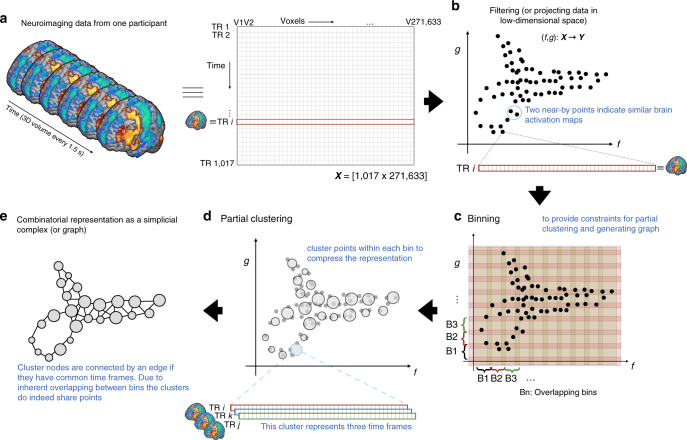
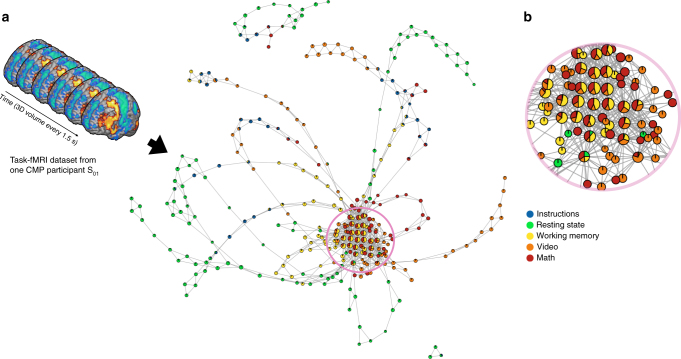
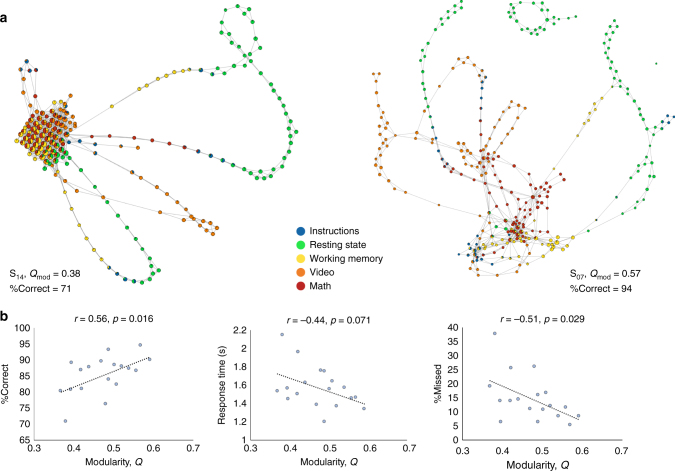
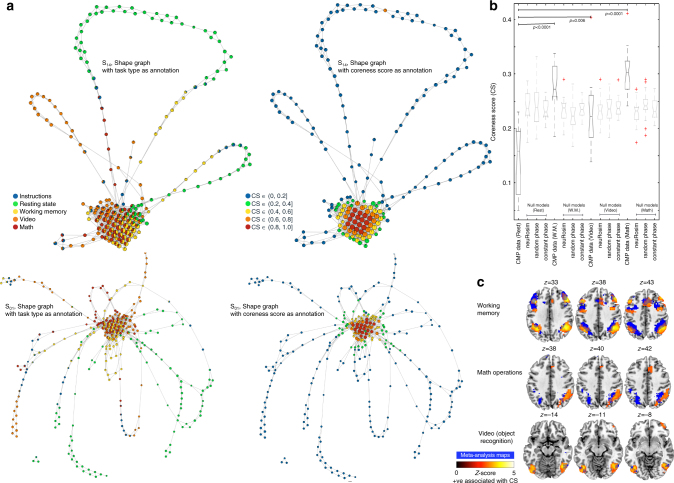
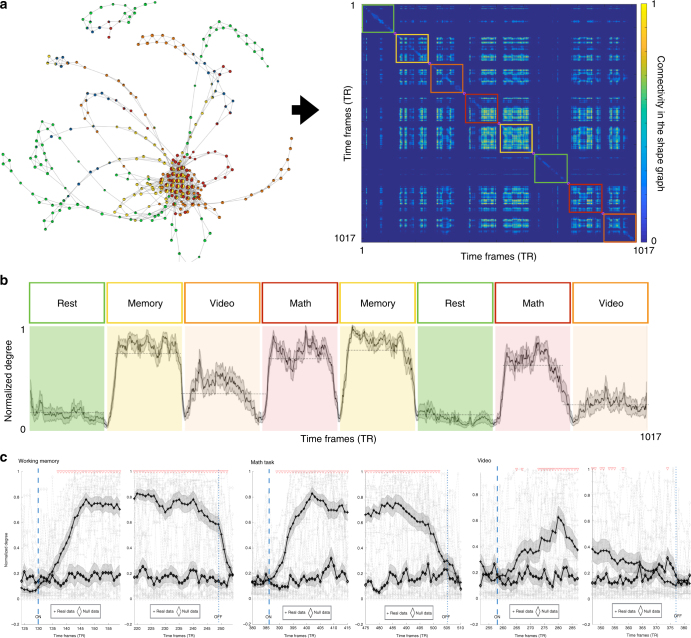
Little is known about how our brains dynamically adapt for efficient functioning. Most previous work has focused on analyzing changes in co-fluctuations between a set of brain regions over several temporal segments of the data. We argue that by collapsing data in space or time, we stand to lose useful information about the brain’s dynamical organization. Here we use Topological Data Analysis to reveal the overall organization of whole-brain activity maps at a single-participant level—as an interactive representation—without arbitrarily collapsing data in space or time. Using existing multitask fMRI datasets, with the known ground truth about the timing of transitions from one task-block to next, our approach tracks both within- and between-task transitions at a much faster time scale (~4–9 s) than before. The individual differences in the revealed dynamical organization predict task performance. In summary, our approach distills complex brain dynamics into interactive and behaviorally relevant representations.
Overview
The claims and statistics of this paper haven’t been checked yet.
Run the check — free, no account needed. It reads the open-access text and checks the sources it cites.
Integrity signals
Registry
Cites
Statistics
Figures
Verification
Claims the paper makes
The claims and statistics of this paper haven’t been checked yet.
Run the check — free, no account needed. It reads the open-access text and checks the sources it cites.
Claims other papers make about this one
Each is checked against this paper’s own text: does it say what the citing paper says it does?
In the citing paper
“Several recent studies have further shown how individual differences in task performance are related to patterns of dynamic brain organization54,55.”
From Cognitive and behavioural flexibility: Neural mechanisms and clinical considerations (2021) · cites this paper as [55]
Self-check
Percentages, sums and reported differences re-computed from the paper’s own numbers.
The self-check needs the paper’s full text.
Citations
Cites
(2008) · Journal of Machine Learning Research · Cited by 33,051
A Global Geometric Framework for Nonlinear Dimensionality Reduction
Tenenbaum, J. B., Silva, V. D., & Langford, J. C. (2000) · Science · doi:10.1126/science.290.5500.2319 · Cited by 13,585
Complex brain networks: graph theoretical analysis of structural and functional systems
Bullmore, E., & Sporns, O. (2009) · Nature Reviews Neuroscience · doi:10.1038/nrn2575 · Cited by 11,820
Self-citationFortunato, S. (2010) · Physics Reports · doi:10.1016/j.physrep.2009.11.002 · Cited by 11,293
Fast algorithm for detecting community structure in networks
Newman, M. E. J. (2004) · Physical Review E · doi:10.1103/physreve.69.066133 · Cited by 5,415
The minimal preprocessing pipelines for the Human Connectome Project
Glasser, M. F., Sotiropoulos, S. N., Wilson, J. A., Coalson, T. S., Fischl, B., Andersson, J. L., Xu, J., Jbabdi, S., Webster, M., Polimeni, J. R., et al. (2013) · NeuroImage · doi:10.1016/j.neuroimage.2013.04.127 · Cited by 5,253
Correspondence of the brain's functional architecture during activation and rest
Smith, S. M., Fox, P. T., Miller, K. L., Glahn, D. C., Fox, P. M., Mackay, C. E., Filippini, N., Watkins, K. E., Toro, R., Laird, A. R., et al. (2009) · Proceedings of the National Academy of Sciences · doi:10.1073/pnas.0905267106 · Cited by 5,150
A component based noise correction method (CompCor) for BOLD and perfusion based fMRI
Behzadi, Y., Restom, K., Liau, J., & Liu, T. T. (2007) · NeuroImage · doi:10.1016/j.neuroimage.2007.04.042 · Cited by 4,502
Consistent resting-state networks across healthy subjects
Damoiseaux, J. S., Rombouts, S. A. R. B., Barkhof, F., Scheltens, P., Stam, C. J., Smith, S. M., & Beckmann, C. F. (2006) · Proceedings of the National Academy of Sciences · doi:10.1073/pnas.0601417103 · Cited by 4,326
Functional Network Organization of the Human Brain
Power, J. D., Cohen, A. L., Nelson, S. M., Wig, G. S., Barnes, K. A., Church, J. A., Vogel, A. C., Laumann, T. O., Miezin, F. M., Schlaggar, B. L., et al. (2011) · Neuron · doi:10.1016/j.neuron.2011.09.006 · Cited by 4,124
Cited by
Sorted by citations
Items 201–251 of 251
Investigating the Nonlinear Dynamics of Human Balance Using Topological Data Analysis
Siegrist, K. W., Kramer, R. M., & Chagdes, J. R. (2020) · Journal of Computational and Nonlinear Dynamics · doi:10.1115/1.4047937
Zhang, Y., Fan, L., Jiang, T., Dagher, A., & Bellec, P. (2022) · bioRxiv (Cold Spring Harbor Laboratory) · doi:10.1101/2022.09.30.510241
Ekstrand, C. (2023) · bioRxiv (Cold Spring Harbor Laboratory) · doi:10.1101/2023.06.15.545143
Olave, A. A., Perea, J. A., & Gómez, F. (2024) · bioRxiv (Cold Spring Harbor Laboratory) · doi:10.1101/2024.01.29.577820
Topology-enhanced machine learning for speech signal processing
Feng, P., Qu, Q., Zhang, H., Yi, S., Yu, Z., Ding, Z., & Zhu, Y. (2026) · Nature Communications · doi:10.21203/rs.3.rs-3978261/v1
Zhang, Y., Fan, L., Hao, Y., Dagher, A., Jiang, T., & Bellec, P. (2024) · 中国科学通报:英文版 · doi:10.1016/j.scib.2024.08.029
Tassi, E., Fisher, H. P., Bolender, A., Lee, J., Ayoub, L. J., Bianchi, A. M., Kuo, B., Napadow, V., Maggioni, E., & Sclocco, R. (2024) · Lecture notes in computer science · doi:10.1007/978-3-031-73967-5_9
The neural correlates of shared and individual experience
Coppola, P., Owen, A. M., Menon, D. K., Naçi, L., & Stamatakis, E. A. (2026) · Communications Biology · doi:10.1038/s42003-025-09355-3 · Cited by 1
Lou, C., & Joanisse, M. F. (2024) · NeuroImage · doi:10.1016/j.neuroimage.2024.120941
Oral microbiome profiles relate periodontal disease and brain health - the PAROMIND StudyPreprint
Petersen, M., Walther, C., Borof, K., Heydecke, G., Beikler, T., Alawi, M., Müller, C., Nägele, F. L., Zyriax, B., Fiehler, J., et al. (2025) · medRxiv · doi:10.1101/2025.02.22.25322702
The Topology of Evasion: Persistent Homology of Gene Repertoires of ImmunityPreprint
Hampton, M. E., & Mamudu, I. (2025) · bioRxiv (Cold Spring Harbor Laboratory) · doi:10.1101/2025.02.27.640626
Brain Signal Analysis of Neurological Disorders Using Topological GraphsPreprint
Chen, Y., & Kuruoğlu, E. E. (2025) · Research Square · doi:10.21203/rs.3.rs-6183264/v1
WITHDRAWNPreprint
(2025) · doi:10.31234/osf.io/vujfn_v3
WITHDRAWNPreprint
Szymańska, A. (2025) · doi:10.31234/osf.io/vujfn_v5
Revealing brain network dynamics during the emotional state of suspense using TDA
Olave, A. A., Perea, J. A., & Gómez, F. (2025) · Network Neuroscience · doi:10.1162/netn.a.34 · Cited by 1
Time Series Analysis of Spiking Neural Systems via Transfer Entropy and Directed Persistent HomologyPreprint
Peek, D., Pritam, S., Skerritt, M. P., & Chalup, S. K. (2025) · SSRN Electronic Journal · doi:10.2139/ssrn.5459120
Topology-Aware Deep Models for Skin Lesion Classification
Chakraborty, S., Koung, P., & Coşkunuzer, B. (2025) · Lecture notes in computer science · doi:10.1007/978-3-032-05825-6_4
Conditional Graph Diffusion with Topological Constraints for Brain Network Generation
Park, J., Lee, D., Guorong Wu, A., & Kim, W. H. (2025) · Lecture notes in computer science · doi:10.1007/978-3-032-05162-2_22
TopoTome: Topology-informed unsupervised segmentation and analysis of 3D imagesPreprint
Bourgeat, S. S., Derveni, F., Gamblin, V., Bilgic, E. N., Arslan, F. N., Oates, A. C., Aztekin, C., Zenk, F. L., Reis, P. M., & Jakšić, A. M. (2025) · bioRxiv (Cold Spring Harbor Laboratory) · doi:10.1101/2025.09.26.678737
Owais, W. B., Jelinek, H. F., & Elfadel, I. M. (2025) · medRxiv · doi:10.1101/2025.11.05.25339645
Topologically Optimized Intrinsic Brain Networks
Lewis, N., Iraji, A., Miller, R. L., Agcaoglu, O., & Calhoun, V. D. (2025) · Human Brain Mapping · doi:10.1002/hbm.70380
Time series analysis of spiking neural systems via transfer entropy and directed persistent homology
Peek, D., Pritam, S., Skerritt, M. P., & Chalup, S. K. (2026) · Neurocomputing · doi:10.1016/j.neucom.2026.133541 · Cited by 1
In search of invariants in electroencephalography signals for brain-computer interfaces
Xu, X. (2023) · theses.fr (ABES) · doi:10.70675/a10e24bbz2b86z4604z87e0zec83c09a8f17
Detecting unique wind field features in hurricane Sandy from topological data maps
Hoffmeier, J. (2026) · Environmental Data Science · doi:10.1017/eds.2026.10035
The evolution and impact of group collaboration in crisis response
Zhang, A., Kong, D., Lai, J., Zhang, G., Li, J., Wang, Y., Li, Y., & González, M. C. (2026) · Communications Physics · doi:10.1038/s42005-026-02588-6
Topological Data Analysis for Neural Time Series: Persistent Homology and Brain Dynamics
Bush, J. (2026) · Springer eBooks · doi:10.1007/978-3-030-93954-0_90-1
Liu, S., Wu, H., Sun, C., Qiu, Y., Wu, H., Wei, Y., Lv, Y., & Yang, Z. (2026) · Sensors · doi:10.3390/s26165221
The individuality of single-frame functional brain connectivity
McIntyre, C. C., Shappell, H. M., Bahrami, M., Lyday, R. G., & Laurienti, P. J. (2026) · Imaging Neuroscience · doi:10.1162/imag.a.1254
Commentary on Ooi et al. 2025: What the BWAS debate reveals about brains, data, and dynamics
McIntosh, A. (2026) · Aperture Neuro · doi:10.52294/001c.157518
Lee, R., O’Boyle, M., & Garrett, A. S. (2026) · NeuroImage · doi:10.1016/j.neuroimage.2026.122008
Higher-order homophily analysis for hypergraphs with time-varying node categories
Kumano, M., Nishimura, K., & Kimura, M. (2026) · Applied Network Science · doi:10.1007/s41109-026-00801-7 · Cited by 1
dos Santos, T. C., Araújo, D. B., Felippe, H., Miranda, J. G. V., Palhano-Fontes, F., do Rosário, R. S., Onias, H., Viol, A., Viswanathan, G. M., & Santos, F. A. N. (2026) · Chaos Solitons & Fractals · doi:10.1016/j.chaos.2026.118554
An application of the topological data analysis approach in Persian poetry classification
Elyasi, N., & Moghadam, M. H. (2025) · Signal and Data Processing · doi:10.66224/jsdp.22.3.77
Ge, Z., & Dou, W. (2026) · bioRxiv (Cold Spring Harbor Laboratory) · doi:10.64898/2026.06.15.732296
Resting fMRI functional connectivity reflects fluctuations in inhibitory interneuron activityPreprint
Zaldivar, D., Ives, L., Koyano, K., Bhik‐Ghanie, R., Russ, B., Ye, F., & Leopold, D. A. (2026) · bioRxiv (Cold Spring Harbor Laboratory) · doi:10.64898/2026.06.25.734567
Zdrazil, J., Kong, L., Flores‐Hernández, E., Rodríguez‐Kessler, M., Klimeš, P., Spíchal, L., Diego, N. D., & Snåšel, V. (2026) · bioRxiv (Cold Spring Harbor Laboratory) · doi:10.64898/2026.06.23.733990
Reiling, J., Padilla-Coreano, N., Patel, D., Frӧhlich, F., & Zhang, M. (2026) · bioRxiv (Cold Spring Harbor Laboratory) · doi:10.64898/2026.07.01.735818
Topological Data Analysis for Neural Time Series: Persistent Homology and Brain Dynamics
Bush, J. (2026) · Springer eBooks · doi:10.1007/978-3-032-16368-4_90
McMahon, E. (2026) · Neuroscience Informatics · doi:10.1016/j.neuri.2026.100288
Bailey, M. M. (2026) · Chaos An Interdisciplinary Journal of Nonlinear Science · doi:10.1063/5.0337419 · Cited by 1
Topological analysis of spatio-temporal rainfall patterns using the Mapper algorithm
Hasan, Z. A., Gobithaasan, R. U., & Hasni, R. (2026) · Modeling Earth Systems and Environment · doi:10.1007/s40808-026-02878-6
Evolutionary Weighted Hodge Laplacian Descriptors for rs-fMRI Brain Networks
Ma, L., Li, F., Zhang, X., Lei, F., Liang, L., & Mao, X. (2026) · Journal of Chemical Information and Modeling · doi:10.1021/acs.jcim.6c02573
Enhancing structural to functional brain network prediction using topological graph learning
Rajakaruna, S. N. K., Dey, A. K., & Chatterje, S. (2026) · Frontiers in Neuroscience · doi:10.3389/fnins.2026.1939985
Zhan, D., Zhou, Z., & Qi, X. (2026) · IEEE Transactions on Neural Systems and Rehabilitation Engineering · doi:10.1109/tnsre.2026.3740584
Fan, L., Li, Y., Duan, S.-Q., An, S., Wu, Y., Yao, N., Zhu, Q., Zhang, M., Huang, Z.-G., & Zhang, S.-P. (2026) · Cognitive Neurodynamics · doi:10.1007/s11571-026-10568-3
Metadata
- Authors
- Saggar, M., Sporns, O., Gonzalez-Castillo, J., Bandettini, P. A., Carlsson, G., Glover, G., & Reiss, A. L.
- Affiliations
- Stanford Medicine (US)
- Indiana University Bloomington (US)
- National Institutes of Health (US)
- Ayasdi (United States) (US)
- Stanford University (US)
- Corresponding author
- Saggar, Manish
- Venue
- Nature Communications
- Published
- 2018-04-11
- Volume
- 9
- Issue
- 1
- Pages
- 1399-1399
- ISSN
- 2041-1723 (ISSN-L)
- PMC
- PMC5895632
- OpenAlex
- W2797507693
- Cited by
- 253
- References
- 69
- Citations by year
- 2026: 29 · 2025: 32 · 2024: 19 · 2023: 40 · 2022: 24 · 2021: 40 · 2020: 27 · 2019: 32 · 2018: 10
- FWCI
- 16.23
- Type
- journal article
- Language
- en
- Open access
- gold
- doi.org
- Locations
- Nature Communications (publishedVersion, cc-by)
- Europe PMC (PubMed Central) (publishedVersion, other-oa)
- PubMed Central (publishedVersion, cc-by)
- PubMed (publishedVersion)
- RePEc: Research Papers in Economics (submittedVersion)
- DOAJ (DOAJ: Directory of Open Access Journals) (submittedVersion)
- DOAJ (DOAJ: Directory of Open Access Journals) (submittedVersion, cc-by-sa)
- IUScholarWorks Open (Indiana University) (submittedVersion)
- Funders
- National Alliance for Research on Schizophrenia and Depression
- National Institutes of Health (93-M-0170, NCT00001360, 5u54mh091657-05, 1U54‐MH‐091657)
- McDonnell Center for Systems Neuroscience (ZIAMH002783, 1U54MH091657)
- National Institute of Mental Health (K99MH104605, 1U54 MH091657, U54-MH091657, 93- M-0170, NCT00001360, R00MH104605, ZIAMH002783)
- Topics
- Life Sciences › Neuroscience › Cognitive Neuroscience › Functional Brain Connectivity Studies
- Physical Sciences › Computer Science › Computational Theory and Mathematics › Topological and Geometric Data Analysis
- Life Sciences › Neuroscience › Cognitive Neuroscience › Neural dynamics and brain function
- Keywords
- brain dynamics, topological data analysis, task transitions, interactive visualization, individual differences, task performance prediction
- MeSH terms
- Adult, Brain, Female, Humans, Magnetic Resonance Imaging, Male, Memory, Short-Term, Nerve Net, Rest, Task Performance and Analysis, Connectome, Datasets as Topic
About these checks
Registry, retraction, Cites and statistics results are computed, not judged, with one exception: a printed reference that no index lists is read once by a model before it counts as a citation error. Claims are extracted by a model and kept only when their quote appears verbatim in the text; each cited source is then checked, with a model’s help, for whether it says what the claim relies on. Those verdicts can be wrong — read the claim’s quote and the cited source before relying on one.
Statistics and arithmetic are recomputed, not judged.
Confidence bands are shown only for fields calibrated on our annotated test set. None is calibrated yet, so no band is shown.
What counts as a claim ›How we measure confidence ›How we check this ›
Are you an author, or do you see a problem with this page? Request a review
