

The DOI matches its Crossref record; 50 of the 50 references it cites were found in a registry or an index.
Incorporation of bridged nucleic acids into CRISPR RNAs improves Cas9 endonuclease specificity
Open accessAbstract
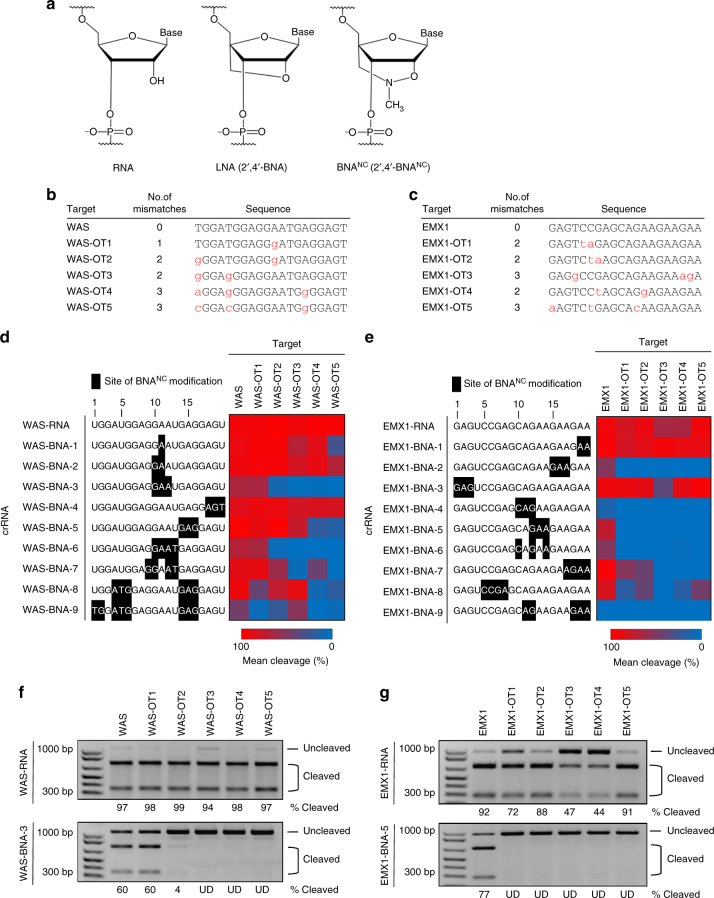
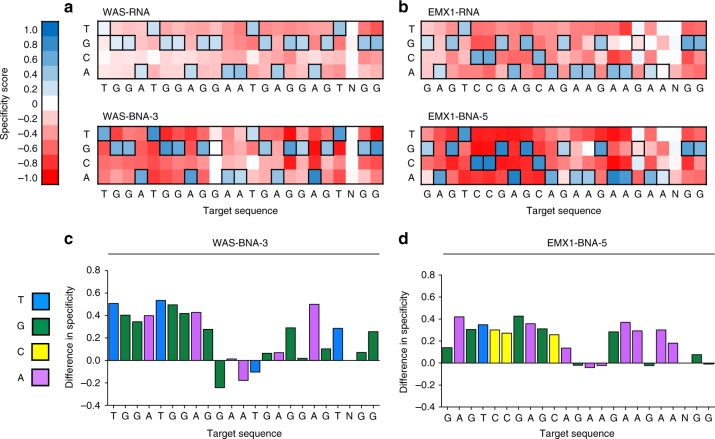
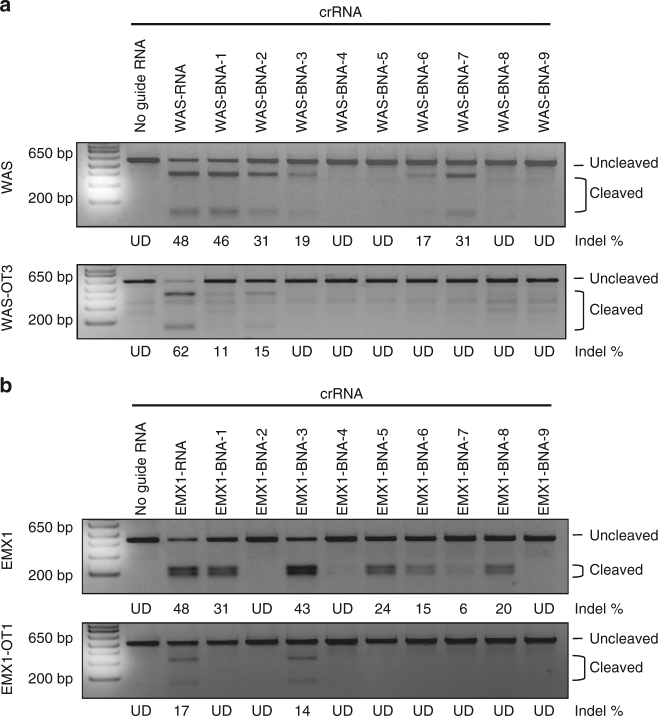
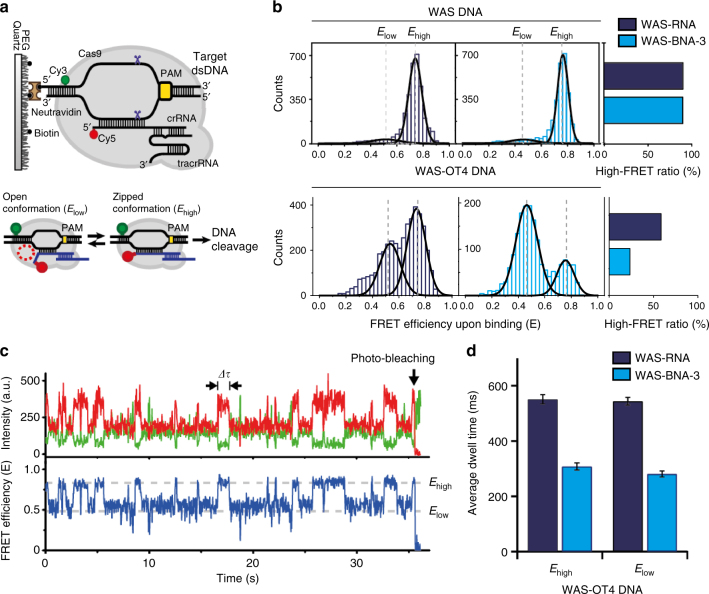
Abstract Off-target DNA cleavage is a paramount concern when applying CRISPR-Cas9 gene-editing technology to functional genetics and human therapeutic applications. Here, we show that incorporation of next-generation bridged nucleic acids (2′,4′-BNA NC [N-Me]) as well as locked nucleic acids (LNA) at specific locations in CRISPR-RNAs (crRNAs) broadly reduces off-target DNA cleavage by Cas9 in vitro and in cells by several orders of magnitude. Using single-molecule FRET experiments we show that BNA NC incorporation slows Cas9 kinetics and improves specificity by inducing a highly dynamic crRNA–DNA duplex for off-target sequences, which shortens dwell time in the cleavage-competent, “zipped” conformation. In addition to describing a robust technique for improving the precision of CRISPR/Cas9-based gene editing, this study illuminates an application of synthetic nucleic acids.
Overview
The claims and statistics of this paper haven’t been checked yet.
Run the check — free, no account needed. It reads the open-access text and checks the sources it cites.
Integrity signals
Registry
Cites
Statistics
Figures
Verification
Claims the paper makes
The claims and statistics of this paper haven’t been checked yet.
Run the check — free, no account needed. It reads the open-access text and checks the sources it cites.
Claims other papers make about this one
Each is checked against this paper’s own text: does it say what the citing paper says it does?
The source backs part of the claim, not all of it — or backs it for a different population, condition or comparison.
In the citing paper
“Incorporation of bridged nucleic acids (2’,4’-BNANC [N-Me]) or locked nucleic acids (LNA) into the sgRNAs also reduces the kinetics of Cas9 nuclease reactivity, thereby improving the specificity of genome editing”
From Off-target effects in CRISPR/Cas9 gene editing (2023) · cites this paper as Cromwell et al., 2018
Experimental — accuracy not yet measuredThe cited source says what the claim attributes to it.
In the citing paper
“Apart from sgRNA length adjustment, chemical modifications on sgRNAs can also influence their off-target effect.”
From Off-target effects in CRISPR/Cas9 gene editing (2023) · cites this paper as Cromwell et al., 2018
Self-check
Percentages, sums and reported differences re-computed from the paper’s own numbers.
The self-check needs the paper’s full text.
Citations
Cites
A Programmable Dual-RNA–Guided DNA Endonuclease in Adaptive Bacterial Immunity
Jinek, M., Chylinski, K., Fonfara, I., Hauer, M., Doudna, J. A., & Charpentier, E. (2012) · Science · doi:10.1126/science.1225829 · Cited by 17,116
Multiplex Genome Engineering Using CRISPR/Cas Systems
Cong, L., Ran, F. A., Cox, D., Lin, S., Barretto, R., Habib, N., Hsu, P. D., Wu, X., Jiang, W., Marraffini, L. A., et al. (2013) · Science · doi:10.1126/science.1231143 · Cited by 15,339
Programmable editing of a target base in genomic DNA without double-stranded DNA cleavage
Komor, A. C., Kim, Y. B., Packer, M. S., Zuris, J. A., & Liu, D. R. (2016) · Nature · doi:10.1038/nature17946 · Cited by 5,437
CRISPR-Cas systems for editing, regulating and targeting genomes
Sander, J. D., & Joung, J. K. (2014) · Nature Biotechnology · doi:10.1038/nbt.2842 · Cited by 3,153
Gasiunas, G., Barrangou, R., Horvath, P., & Siksnys, V. (2012) · Proceedings of the National Academy of Sciences · doi:10.1073/pnas.1208507109 · Cited by 2,769
High-fidelity CRISPR-Cas9 nucleases with no detectable genome-wide off-target effects
Kleinstiver, B. P., Pattanayak, V., Prew, M. S., Tsai, S. Q., Nguyen, N. T., Zheng, Z., & Joung, J. K. (2016) · Nature · doi:10.1038/nature16526 · Cited by 2,673
CRISPR/Cas, the Immune System of Bacteria and Archaea
Horvath, P., & Barrangou, R. (2010) · Science · doi:10.1126/science.1179555 · Cited by 2,471
RNA-guided editing of bacterial genomes using CRISPR-Cas systems
Jiang, W., Bikard, D., Cox, D., Zhang, F., & Marraffini, L. A. (2013) · Nature Biotechnology · doi:10.1038/nbt.2508 · Cited by 2,429
Rationally engineered Cas9 nucleases with improved specificity
Slaymaker, I. M., Gao, L., Zetsche, B., Scott, D. A., Yan, W. X., & Zhang, F. (2016) · Science · doi:10.1126/science.aad5227 · Cited by 2,414
Crystal structure of Cas9 in complex with guide RNA and target DNA
Nishimasu, H., Ran, F. A., Hsu, P. D., Konermann, S., Shehata, S. I., Dohmae, N., Ishitani, R., Zhang, F., & Nureki, O. (2014) · Cell · doi:10.1016/j.cell.2014.02.001 · Cited by 2,306
CRISPR–Cas9 Structures and Mechanisms
Jiang, F., & Doudna, J. A. (2017) · Annual Review of Biophysics · doi:10.1146/annurev-biophys-062215-010822 · Cited by 2,029
Improving CRISPR-Cas nuclease specificity using truncated guide RNAs
Fu, Y., Sander, J. D., Reyon, D., Cascio, V. M., & Joung, J. K. (2014) · Nature Biotechnology · doi:10.1038/nbt.2808 · Cited by 1,993
Pattanayak, V., Lin, S., Guilinger, J. P., Ma, E., Doudna, J. A., & Liu, D. R. (2013) · Nature Biotechnology · doi:10.1038/nbt.2673 · Cited by 1,487
Zuris, J. A., Thompson, D. B., Shu, Y., Guilinger, J. P., Bessen, J. L., Hu, J. H., Maeder, M. L., Joung, J. K., Chen, Z.-Y., & Liu, D. R. (2015) · Nature Biotechnology · doi:10.1038/nbt.3081 · Cited by 1,460
Structural basis of PAM-dependent target DNA recognition by the Cas9 endonuclease
Anders, C., Niewoehner, O., Duerst, A., & Jinek, M. (2014) · Nature · doi:10.1038/nature13579 · Cited by 1,323
Genome-scale CRISPR-Cas9 Knockout and Transcriptional Activation Screening
Joung, J., Konermann, S., Gootenberg, J. S., Abudayyeh, O. O., Platt, R. J., Brigham, M. D., Sanjana, N. E., & Zhang, F. (2017) · Nature Protocols · doi:10.1038/nprot.2017.016 · Cited by 1,243
Enhanced proofreading governs CRISPR-Cas9 targeting accuracy
Chen, J. S., Dagdas, Y. S., Kleinstiver, B. P., Welch, M. M., Sousa, A. A., Harrington, L. B., Sternberg, S. H., Joung, J. K., Yildiz, A., & Doudna, J. A. (2017) · Nature · doi:10.1038/nature24268 · Cited by 1,168
Chemically modified guide RNAs enhance CRISPR-Cas genome editing in human primary cells
Hendel, A., Bak, R. O., Clark, J. T., Kennedy, A. B., Ryan, D. E., Roy, S., Steinfeld, I., Lunstad, B. D., Kaiser, R. J., Wilkens, A. B., et al. (2015) · Nature Biotechnology · doi:10.1038/nbt.3290 · Cited by 1,090
Guilinger, J. P., Thompson, D. B., & Liu, D. R. (2014) · Nature Biotechnology · doi:10.1038/nbt.2909 · Cited by 836
LNA (Locked Nucleic Acid): High-Affinity Targeting of Complementary RNA and DNA
Vester, B., & Wengel, J. (2004) · Biochemistry · doi:10.1021/bi0485732 · Cited by 727
Conformational control of DNA target cleavage by CRISPR–Cas9
Sternberg, S. H., LaFrance, B., Kaplan, M., & Doudna, J. A. (2015) · Nature · doi:10.1038/nature15544 · Cited by 627
Locked nucleic acid (LNA) mediated improvements in siRNA stability and functionality
Elmén, J. (2005) · Nucleic Acids Research · doi:10.1093/nar/gki193 · Cited by 574
A Cas9–guide RNA complex preorganized for target DNA recognition
Jiang, F., Zhou, K., Ma, L., Gressel, S., & Doudna, J. A. (2015) · Science · doi:10.1126/science.aab1452 · Cited by 562
A Rapid and General Assay for Monitoring Endogenous Gene Modification
Guschin, D. Y., Waite, A. J., Katibah, G. E., Miller, J. C., Holmes, M. C., & Rebar, E. J. (2010) · Methods in molecular biology · doi:10.1007/978-1-60761-753-2_15 · Cited by 509
Structure-guided chemical modification of guide RNA enables potent non-viral in vivo genome editing
Yin, H., Song, C.-Q., Suresh, S., Wu, Q., Walsh, S., Rhym, L. H., Mintzer, E., Bolukbasi, M. F., Zhu, L. J., Kauffman, K., et al. (2017) · Nature Biotechnology · doi:10.1038/nbt.4005 · Cited by 499
Swayze, E. E., Siwkowski, A. M., Wancewicz, E. V., Migawa, M. T., Wyrzykiewicz, T. K., Hung, G., Monia, B. P., & Bennett, A. C. F. (2006) · Nucleic Acids Research · doi:10.1093/nar/gkl1071 · Cited by 483
Klann, T. S., Black, J. B., Chellappan, M., Safi, A., Song, L., Hilton, I. B., Crawford, G. E., Reddy, T. E., & Gersbach, C. A. (2017) · Nature Biotechnology · doi:10.1038/nbt.3853 · Cited by 447
Wang, X., Wang, Y., Wu, X., Wang, J., Wang, Y., Qiu, Z., Chang, T., Huang, H., Lin, R.-J., & Yee, J.-K. (2015) · Nature Biotechnology · doi:10.1038/nbt.3127 · Cited by 442
Cas-analyzer: an online tool for assessing genome editing results using NGS data
Park, J., Lim, K., Kim, J., & Bae, S. (2016) · Bioinformatics · doi:10.1093/bioinformatics/btw561 · Cited by 406
Self-citationDesign of LNA probes that improve mismatch discrimination
You, Y. (2006) · Nucleic Acids Research · doi:10.1093/nar/gkl175 · Cited by 338
Methods for Optimizing CRISPR-Cas9 Genome Editing Specificity
Tycko, J., Myer, V. E., & Hsu, P. D. (2016) · Molecular Cell · doi:10.1016/j.molcel.2016.07.004 · Cited by 315
CRISPR/Cas9-Mediated Correction of the Sickle Mutation in Human CD34+ cells
Hoban, M. D., Lumaquin, D., Kuo, C. Y., Romero, Z., Long, J., Ho, M., Young, C. S., Mojadidi, M., Fitz-Gibbon, S., Cooper, A. R., et al. (2016) · Molecular Therapy · doi:10.1038/mt.2016.148 · Cited by 220
Guilinger, J. P., Pattanayak, V., Reyon, D., Tsai, S. Q., Sander, J. D., Joung, J. K., & Liu, D. R. (2014) · Nature Methods · doi:10.1038/nmeth.2845 · Cited by 219
A genome-wide analysis of Cas9 binding specificity using ChIP-seq and targeted sequence capture
O'Geen, H., Henry, I. M., Bhakta, M. S., Meckler, J. F., & Segal, D. J. (2015) · Nucleic Acids Research · doi:10.1093/nar/gkv137 · Cited by 219
Genome-wide target specificities of CRISPR-Cas9 nucleases revealed by multiplex Digenome-seq
Kim, D., Kim, S., Kim, S., Park, J., & Kim, J.-S. (2016) · Genome Research · doi:10.1101/gr.199588.115 · Cited by 208
Self-citationSynthetic CRISPR RNA-Cas9–guided genome editing in human cells
Rahdar, M., McMahon, M. A., Prakash, T. P., Swayze, E. E., Bennett, C. F., & Cleveland, D. W. (2015) · Proceedings of the National Academy of Sciences · doi:10.1073/pnas.1520883112 · Cited by 184
Design, Synthesis, and Properties of 2‘,4‘-BNA NC : A Bridged Nucleic Acid Analogue
Rahman, S. M. A., Seki, S., Obika, S., Yoshikawa, H., Miyashita, K., & Imanishi, T. (2008) · Journal of the American Chemical Society · doi:10.1021/ja710342q · Cited by 164
2′-O,4′-C-methylene bridged nucleic acid (2′,4′-BNA)
Obika, S., Uneda, T., Sugimoto, T., Nanbu, D., Minami, T., Doi, T., & Imanishi, T. (2001) · Bioorganic & Medicinal Chemistry · doi:10.1016/s0968-0896(00)00325-4 · Cited by 152
Continuous directed evolution of DNA-binding proteins to improve TALEN specificity
Hubbard, B. P., Badran, A. H., Zuris, J. A., Guilinger, J. P., Davis, K. M., Chen, L., Tsai, S. Q., Sander, J. D., Joung, J. K., & Liu, D. R. (2015) · Nature Methods · doi:10.1038/nmeth.3515 · Cited by 121
Self-citationStructural roles of guide RNAs in the nuclease activity of Cas9 endonuclease
Lim, Y., Bak, S. Y., Sung, K., Jeong, E., Lee, S. H., Kim, J., Bae, S., & Kim, S. K. (2016) · Nature Communications · doi:10.1038/ncomms13350 · Cited by 113
Self-citationHybridization Kinetics Explains CRISPR-Cas Off-Targeting Rules
Klein, M., Eslami-Mossallam, B., Arroyo, D. G., & Depken, M. (2018) · Cell Reports · doi:10.1016/j.celrep.2018.01.045 · Cited by 113
How specific is CRISPR/Cas9 really?
O’Geen, H., Yu, A. S., & Segal, D. J. (2015) · Current Opinion in Chemical Biology · doi:10.1016/j.cbpa.2015.10.001 · Cited by 108
Towards personalised allele-specific CRISPR gene editing to treat autosomal dominant disorders
Christie, K. A., Courtney, D., DeDionisio, L., Chao-Shern, C., Majumdar, S. D., Mairs, L., Nesbit, M. A., & Moore, T. (2017) · Scientific Reports · doi:10.1038/s41598-017-16279-4 · Cited by 83
Xu, X., Duan, D., & Chen, S. (2017) · Scientific Reports · doi:10.1038/s41598-017-00180-1 · Cited by 79
Editing of mouse and human immunoglobulin genes by CRISPR-Cas9 system
Cheong, T.-C., Compagno, M., & Chiarle, R. (2016) · Nature Communications · doi:10.1038/ncomms10934 · Cited by 73
Mapping the sugar dependency for rational generation of a DNA-RNA hybrid-guided Cas9 endonuclease
Rueda, F. O., Biśta, M., Newton, M. D., Goeppert, A. U., Cuomo, M. E., Gordon, E., Kroener, F., Read, J. A., Wrigley, J. D. J., Rueda, D., et al. (2017) · Nature Communications · doi:10.1038/s41467-017-01732-9 · Cited by 70
Gotfredsen, C. H., Schultze, P., & Feigon, J. F. (1998) · Journal of the American Chemical Society · doi:10.1021/ja973221m · Cited by 46
CRISPR-DAV: CRISPR NGS data analysis and visualization pipeline
Wang, X., Tilford, C. A., Neuhaus, I., Mintier, G. A., Guo, Q. J., Feder, J. N., & Kirov, S. A. (2017) · Bioinformatics · doi:10.1093/bioinformatics/btx518 · Cited by 45
Anders, C., Niewoehner, O., & Jínek, M. (2015) · Methods in enzymology on CD-ROM/Methods in enzymology · doi:10.1016/bs.mie.2015.02.008 · Cited by 30
BNANC Gapmers Revert Splicing and Reduce RNA Foci with Low Toxicity in Myotonic Dystrophy Cells
Manning, K. S., Rao, A. N., Castro, M., & Cooper, T. A. (2017) · ACS Chemical Biology · doi:10.1021/acschembio.7b00416 · Cited by 20
Cited by
Sorted by citations
RNA-based therapeutics: an overview and prospectus
Zhu, Y., Zhu, L., Wang, X., & Jin, H. (2022) · Cell Death and Disease · doi:10.1038/s41419-022-05075-2 · Cited by 683
Off-target effects in CRISPR/Cas9 gene editing
Guo, C., Ma, X., Gao, F., & Guo, Y. (2023) · Frontiers in Bioengineering and Biotechnology · doi:10.3389/fbioe.2023.1143157 · Cited by 704
“[N-Me]) or locked nucleic acids (LNA) into the sgRNAs also reduces the kinetics of Cas9 nuclease reactivity, thereby improving the specificity of genome editing (Cromwell et al., 2018).”
BackgroundCRISPR-Based Therapeutic Genome Editing: Strategies and In Vivo Delivery by AAV Vectors
Wang, D., Zhang, F., & Gao, G. (2020) · Cell · doi:10.1016/j.cell.2020.03.023 · Cited by 539
Latest Developed Strategies to Minimize the Off-Target Effects in CRISPR-Cas-Mediated Genome Editing
Naeem, M., Majeed, S., Hoque, M. Z., & Ahmad, I. (2020) · Cells · doi:10.3390/cells9071608 · Cited by 457
Recent progress in non-native nucleic acid modifications
McKenzie, L. K., El-Khoury, R., Thorpe, J. D., Damha, M. J., & Hollenstein, M. (2021) · Chemical Society Reviews · doi:10.1039/d0cs01430c · Cited by 306
Metadata
- Authors
- Cromwell, C. R., Sung, K., Park, J., Krysler, A. R., Jovel, J., Kim, S. K., & Hubbard, B. P.
- Affiliations
- University of Alberta (CA)
- Seoul National University (KR)
- Corresponding author
- Hubbard, Basil P.
- ORCID
- Venue
- Nature Communications
- Published
- 2018-04-13
- Volume
- 9
- Issue
- 1
- Pages
- 1448-1448
- ISSN
- 2041-1723 (ISSN-L)
- PMC
- PMC5899152
- OpenAlex
- W2796961959
- Cited by
- 190
- References
- 50
- Citations by year
- 2026: 13 · 2025: 15 · 2024: 29 · 2023: 19 · 2022: 30 · 2021: 33 · 2020: 26 · 2019: 17 · 2018: 8
- FWCI
- 7.47
- Type
- journal article
- Language
- en
- Open access
- gold
- doi.org
- Locations
- Nature Communications (publishedVersion, cc-by)
- Europe PMC (PubMed Central) (publishedVersion, other-oa)
- PubMed Central (publishedVersion, cc-by)
- PubMed (publishedVersion)
- RePEc: Research Papers in Economics (submittedVersion)
- DOAJ (DOAJ: Directory of Open Access Journals) (submittedVersion)
- DOAJ (DOAJ: Directory of Open Access Journals) (submittedVersion, cc-by-sa)
- Funders
- Universities Space Research Association
- National Research Foundation
- National Research Foundation of Korea (2018R1A2B2001422)
- Natural Sciences and Engineering Research Council of Canada (rgpin-2016-06381, RGPIN-2016)
- Topics
- Life Sciences › Biochemistry, Genetics and Molecular Biology › Molecular Biology › CRISPR and Genetic Engineering
- Life Sciences › Biochemistry, Genetics and Molecular Biology › Molecular Biology › DNA and Nucleic Acid Chemistry
- Life Sciences › Biochemistry, Genetics and Molecular Biology › Molecular Biology › Advanced biosensing and bioanalysis techniques
- Keywords
- CRISPR/Cas9, bridged nucleic acids, locked nucleic acid, single-molecule FRET, dwell time, synthetic nucleic acids
- MeSH terms
- RNA, Guide, CRISPR-Cas Systems, DNA, Endonucleases, Escherichia coli, HeLa Cells, Humans, RNA, Sensitivity and Specificity, Streptococcus pyogenes, RNA, Guide, Kinetoplastida, Polymorphism, Single Nucleotide, Fluorescence Resonance Energy Transfer, Cell Line, Tumor, DNA Cleavage, Clustered Regularly Interspaced Short Palindromic Repeats, CRISPR-Cas Systems
About these checks
Registry, retraction, Cites and statistics results are computed, not judged, with one exception: a printed reference that no index lists is read once by a model before it counts as a citation error. Claims are extracted by a model and kept only when their quote appears verbatim in the text; each cited source is then checked, with a model’s help, for whether it says what the claim relies on. Those verdicts can be wrong — read the claim’s quote and the cited source before relying on one.
Statistics and arithmetic are recomputed, not judged.
Confidence bands are shown only for fields calibrated on our annotated test set. None is calibrated yet, so no band is shown.
What counts as a claim ›How we measure confidence ›How we check this ›
Are you an author, or do you see a problem with this page? Request a review
