

The DOI matches its Crossref record; 42 of the 42 references it cites were found in a registry or an index.
Implementation of multilayer perceptron network with highly uniform passive memristive crossbar circuits
Open accessAbstract
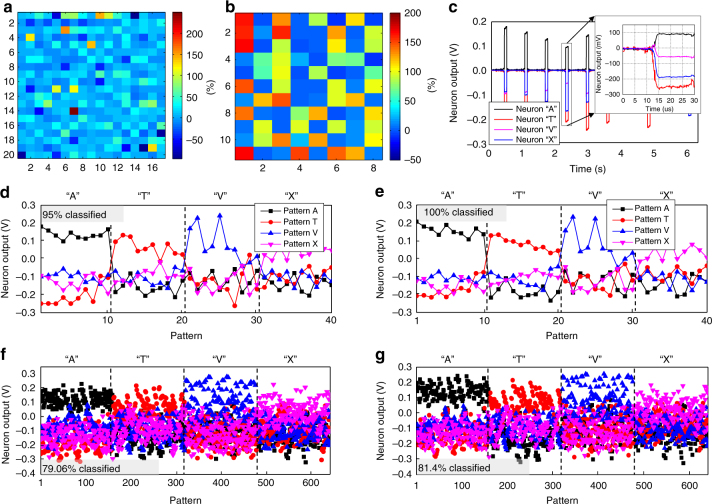
The progress in the field of neural computation hinges on the use of hardware more efficient than the conventional microprocessors. Recent works have shown that mixed-signal integrated memristive circuits, especially their passive (0T1R) variety, may increase the neuromorphic network performance dramatically, leaving far behind their digital counterparts. The major obstacle, however, is immature memristor technology so that only limited functionality has been reported. Here we demonstrate operation of one-hidden layer perceptron classifier entirely in the mixed-signal integrated hardware, comprised of two passive 20 × 20 metal-oxide memristive crossbar arrays, board-integrated with discrete conventional components. The demonstrated network, whose hardware complexity is almost 10× higher as compared to previously reported functional classifier circuits based on passive memristive crossbars, achieves classification fidelity within 3% of that obtained in simulations, when using ex-situ training. The successful demonstration was facilitated by improvements in fabrication technology of memristors, specifically by lowering variations in their I–V characteristics.
Overview
The claims and statistics of this paper haven’t been checked yet.
Free: it reads the open-access text and checks the first 5 claims that cite a source we can check. Create a free account to check every claim.
Integrity signals
Registry
Cites
Statistics
Figures


Verification
Claims the paper makes
The claims and statistics of this paper haven’t been checked yet.
Free: it reads the open-access text and checks the first 5 claims that cite a source we can check. Create a free account to check every claim.
Claims other papers make about this one
Each is checked against this paper’s own text: does it say what the citing paper says it does?
The source backs part of the claim, not all of it — or backs it for a different population, condition or comparison.
In the citing paper
“The progress in the most prospective, passive analog-grade ReRAM circuits13,17,21,22,24, however, has been much slower, mainly because of much stricter requirements for the uniformity of memory cells’ I–V characteristics (Supplementary Fig. 1).”
From 4K-memristor analog-grade passive crossbar circuit (2021) · cites this paper as [24]
Experimental — accuracy not yet measuredThe source backs part of the claim, not all of it — or backs it for a different population, condition or comparison.
In the citing paper
“The developed circuits have ten times more devices and excellent uniformity allowing for significantly better array-scale conductance tuning precision as compared to the previous work24 that reported the largest passive analog-grade memristive crossbar circuits with detailed characterization statistics.”
From 4K-memristor analog-grade passive crossbar circuit (2021) · cites this paper as [24]
Experimental — accuracy not yet measuredThe source backs part of the claim, not all of it — or backs it for a different population, condition or comparison.
In the citing paper
“the former can be achieved by reducing leakages within the device and between neighboring lines, e.g., by patterning the active switching layer and scaling down device feature sizes24, and making higher-aspect ratio electrodes”
From 4K-memristor analog-grade passive crossbar circuit (2021) · cites this paper as [24]
Experimental — accuracy not yet measuredThe cited source says what the claim attributes to it.
In the citing paper
“The developed circuits have ten times more devices and excellent uniformity allowing for significantly better array-scale conductance tuning precision as compared to the previous work24 that reported the largest passive analog-grade memristive crossbar circuits with detailed characterization statistics.”
From 4K-memristor analog-grade passive crossbar circuit (2021) · cites this paper as [24]
Self-check
Percentages, sums and reported differences re-computed from the paper’s own numbers.
The self-check needs the paper’s full text.
Citations
Cites
ImageNet classification with deep convolutional neural networks
Krizhevsky, A., Sutskever, I., & Hinton, G. E. (2017) · Communications of the ACM · doi:10.1145/3065386 · Cited by 112,155
LeCun, Y., Bengio, Y., & Hinton, G. (2015) · Nature · doi:10.1038/nature14539 · Cited by 84,126
Deep learning in neural networks: an overview
Schmidhuber, J. (2015) · Neural Networks · doi:10.1016/j.neunet.2014.09.003 · Cited by 18,570 · cited 3×
“(Similar to our previous work [1, 2], only inference stage was performed in a hardware during such in-situ training, while other operations, such as computing and storing the necessary weight updates, were assisted by an external computer.)”
BackgroundMethodResultA million spiking-neuron integrated circuit with a scalable communication network and interface
Merolla, P. A., Arthur, J. V., Alvarez-Icaza, R., Cassidy, A. S., Sawada, J., Akopyan, F., Jackson, B. L., Imam, N., Guo, C., Nakamura, Y., et al. (2014) · Science · doi:10.1126/science.1254642 · Cited by 4,147
Memristive devices for computing
Yang, J. J., Strukov, D. B., & Stewart, D. R. (2013) · Nature Nanotechnology · doi:10.1038/nnano.2012.240 · Cited by 3,885
Self-citationEyeriss: An Energy-Efficient Reconfigurable Accelerator for Deep Convolutional Neural Networks
Chen, Y.-H., Krishna, T., Emer, J. S., & Sze, V. (2017) · IEEE Journal of Solid-State Circuits · doi:10.1109/jssc.2016.2616357 · Cited by 3,247 · cited 1×
“The breakthrough 3 was enabled not by any significant algorithm advance, but rather by the use of high performance graphics processors 4 , and the further progress is being fueled now by the development of even more powerful graphics processors and custom integrated circuits 5-7 .”
MethodTraining and operation of an integrated neuromorphic network based on metal-oxide memristors
Prezioso, M., Merrikh-Bayat, F., Hoskins, B. D., Adam, G. C., Likharev, K. K., & Strukov, D. B. (2015) · Nature · doi:10.1038/nature14441 · Cited by 3,001 · cited 3×
“26,27 .”
BackgroundInfluentialSelf-citationWong, H.-S. P., Lee, H.-Y., Yu, S., Chen, Y.-S., Wu, Y., Chen, P.-S., Lee, B., Chen, F. T., & Tsai, M.-J. (2012) · Proceedings of the IEEE · doi:10.1109/jproc.2012.2190369 · Cited by 2,757
Memristors with diffusive dynamics as synaptic emulators for neuromorphic computing
Wang, Z., Joshi, S., Savel’ev, S. E., Jiang, H., Midya, R., Lin, P., Hu, M., Ge, N., Strachan, J. P., Li, Z., et al. (2017) · Nature Materials · doi:10.1038/nmat4756 · Cited by 2,358
van de Burgt, Y., Lubberman, E., Fuller, E. J., Keene, S. T., Faria, G. C., Agarwal, S., Marinella, M. J., Alec Talin, A., & Salleo, A. (2017) · Nature Materials · doi:10.1038/nmat4856 · Cited by 1,872
Research works printed but not linked: 10
- Moons, B., Uytterhoeven, R., Dehaene, W. & Verhelst, M. in IEEE International Sold-State Circuits Conference (ISSCC) 246–257 (IEEE, 2017).
- Jouppi, N. P. et al. in Proc. of the 44th Annual International Symposium on Computer Architecture 1–12 (ACM, 2017).
- Mead, C. Analog VLSI and Neural Systems (Addison-Wesley Longman Publishing Co. Inc., Boston, MA, USA, 1989).
- Suri, M. et al. in 2012 International Electron Devices Meeting 235–238 (IEEE, 2012).
- Piccolboni, G. et al. in 2015 International Electron Devices Meeting (IEDM) 447–450 (IEEE, 2015).
- Kim, S. et al. in 2015 International Electron Devices Meeting (IEDM) 443–446 (IEEE, 2015).
- Prezioso, M. et al. in 2015 International Electron Devices Meeting (IEDM) 455–458 (IEEE, 2015).
- Yu, S. et al. in 2016 International Electron Devices Meeting (IEDM) 416–419 (IEEE, 2016).
- Govoreanu, B. et al. in 2011 International Electron Devices Meeting 729–732 (IEEE, 2011).
- Ceze, L. et al. in 2016 74th Annual Device Research Conference (DRC) 1–2 (IEEE, 2016).
Cited by
Memristive crossbar arrays for brain-inspired computing
Xia, Q., & Yang, J. J. (2019) · Nature Materials · doi:10.1038/s41563-019-0291-x · Cited by 1,800
Resistive switching materials for information processing
Wang, Z., Wu, H., Burr, G. W., Hwang, C. S., Wang, K. L., Xia, Q., & Yang, J. J. (2020) · Nature Reviews Materials · doi:10.1038/s41578-019-0159-3 · Cited by 1,214
Physics for neuromorphic computing
Marković, D., Mizrahi, A., Querlioz, D., & Grollier, J. (2020) · Nature Reviews Physics · doi:10.1038/s42254-020-0208-2 · Cited by 1,176
Neuromorphic nanoelectronic materials
Sangwan, V. K., & Hersam, M. C. (2020) · Nature Nanotechnology · doi:10.1038/s41565-020-0647-z · Cited by 890
Tang, J., Yuan, F., Shen, X., Wang, Z., Rao, M., He, Y., Sun, Y., Li, X., Zhang, W., Li, Y., et al. (2019) · Advanced Materials · doi:10.1002/adma.201902761 · Cited by 834
Metadata
- Authors
- Bayat, F. M., Prezioso, M., Chakrabarti, B., Nili, H., Kataeva, I., & Strukov, D.
- Affiliations
- University of California, Santa Barbara (US)
- Corresponding author
- Kataeva, I.
- Strukov, D.
- Venue
- Nature Communications
- Published
- 2018-06-13
- Volume
- 9
- Issue
- 1
- Pages
- 2331-2331
- ISSN
- 2041-1723 (ISSN-L)
- PMC
- PMC5998062
- OpenAlex
- W2964263004
- Cited by
- 377
- References
- 41
- Citations by year
- 2026: 9 · 2025: 24 · 2024: 38 · 2023: 46 · 2022: 53 · 2021: 54 · 2020: 88 · 2019: 50 · 2018: 14
- FWCI
- 19.71
- Type
- journal article
- Language
- en
- Open access
- gold
- doi.org
- Licence
- cc-by
- creativecommons.org/licenses/by/4.0 (tdm)
- creativecommons.org/licenses/by/4.0 (vor)
- Locations
- Nature Communications (publishedVersion, cc-by)
- Europe PMC (PubMed Central) (publishedVersion, cc-by)
- PubMed Central (publishedVersion, cc-by)
- PubMed (publishedVersion)
- arXiv (Cornell University) (submittedVersion)
- RePEc: Research Papers in Economics (submittedVersion)
- DOAJ (DOAJ: Directory of Open Access Journals) (submittedVersion)
- DOAJ (DOAJ: Directory of Open Access Journals) (submittedVersion, cc-by-sa)
- arXiv (Cornell University)
- Funders
- DOD | Defense Advanced Research Projects Agency (HR0011-13-C-0051UPSIDE)
- NSF | Directorate for Computer & Information Science and Engineering | Division of Computing and Communication Foundations (1528205)
- Topics
- Physical Sciences › Engineering › Electrical and Electronic Engineering › Advanced Memory and Neural Computing
- Physical Sciences › Computer Science › Artificial Intelligence › Neural Networks and Applications
- Physical Sciences › Computer Science › Artificial Intelligence › Neural Networks and Reservoir Computing
- Keywords
- memristor crossbar, multilayer perceptron, neuromorphic hardware, mixed-signal circuits, metal-oxide memristors, hardware implementation of neural networks
About these checks
Registry, retraction, Cites and statistics results are computed, not judged, with one exception: a printed reference that no index lists is read once by a model before it counts as a citation error. Claims are extracted by a model and kept only when their quote appears verbatim in the text; each cited source is then checked, with a model’s help, for whether it says what the claim relies on. Those verdicts can be wrong — read the claim’s quote and the cited source before relying on one.
Statistics and arithmetic are recomputed, not judged.
Confidence bands are shown only for fields calibrated on our annotated test set. None is calibrated yet, so no band is shown.
What counts as a claim ›How we measure confidence ›How we check this ›
Are you an author, or do you see a problem with this page? Request a review
How to cite
Cite CoChat for the checks on this page, and the paper for its own findings.
- This page
- CoChat. (2026). Citation check: Implementation of multilayer perceptron network with highly uniform passive memristive crossbar circuits. https://app.cochat.ai/papers/10.1038/s41467-018-04482-4
- The paper
- Bayat, F. M., Prezioso, M., Chakrabarti, B., Nili, H., Kataeva, I., & Strukov, D. (2018). Implementation of multilayer perceptron network with highly uniform passive memristive crossbar circuits. Nature Communications. https://doi.org/10.1038/s41467-018-04482-4
Data sources
Bibliographic data: Semantic Scholar, OpenAlex, Crossref.
Contains information from the Semantic Scholar Academic Graph Datasets, made available under the ODC Attribution License (ODC-BY 1.0).
Semantic Scholar’s data is described in: Kinney, R., et al. (2023). The Semantic Scholar Open Data Platform. arXiv:2301.10140.
