

Implementation of multilayer perceptron network with highly uniform passive memristive crossbar circuits
Open accessThe DOI matches its Crossref record; 42 of the 42 references it cites were found in a registry or an index.
Abstract
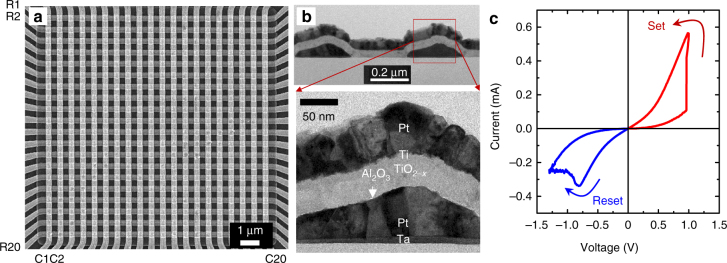
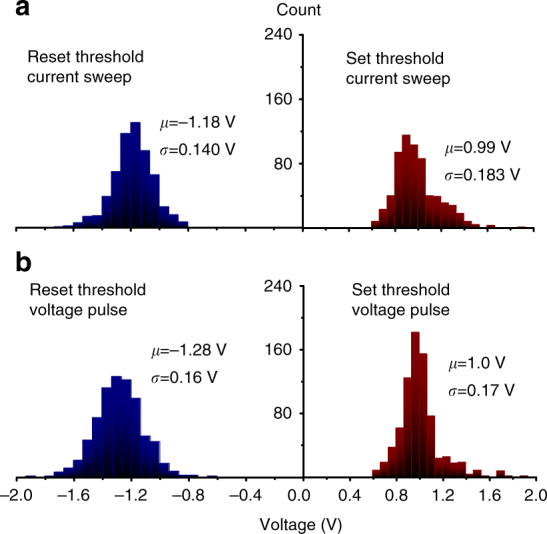
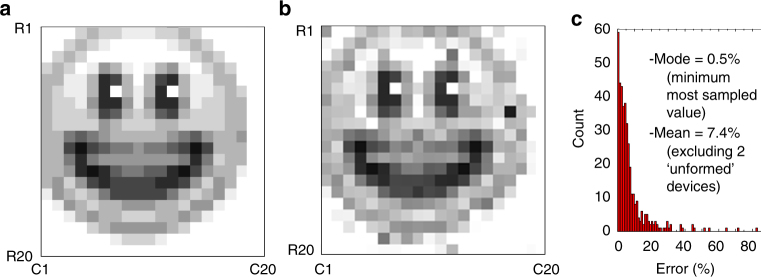
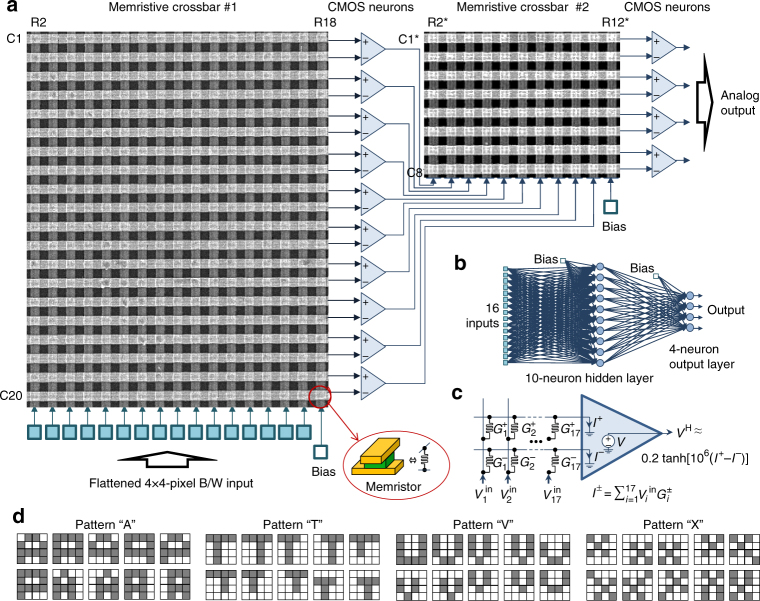
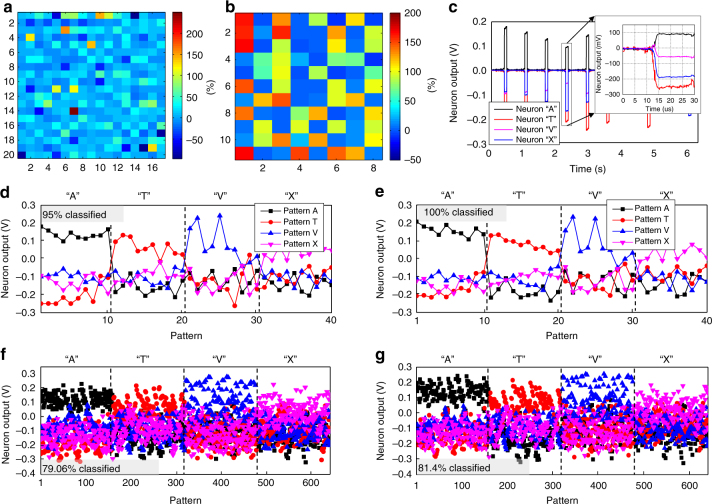
The progress in the field of neural computation hinges on the use of hardware more efficient than the conventional microprocessors. Recent works have shown that mixed-signal integrated memristive circuits, especially their passive (0T1R) variety, may increase the neuromorphic network performance dramatically, leaving far behind their digital counterparts. The major obstacle, however, is immature memristor technology so that only limited functionality has been reported. Here we demonstrate operation of one-hidden layer perceptron classifier entirely in the mixed-signal integrated hardware, comprised of two passive 20 × 20 metal-oxide memristive crossbar arrays, board-integrated with discrete conventional components. The demonstrated network, whose hardware complexity is almost 10× higher as compared to previously reported functional classifier circuits based on passive memristive crossbars, achieves classification fidelity within 3% of that obtained in simulations, when using ex-situ training. The successful demonstration was facilitated by improvements in fabrication technology of memristors, specifically by lowering variations in their I–V characteristics.
Overview
The claims and statistics of this paper haven’t been checked yet.
Free: it reads the open-access text and checks the first 5 claims that cite a source we can check. Create a free account to check every claim.
Integrity signals
Registry
Cites
Statistics
Figures
Verification
Claims the paper makes
The claims and statistics of this paper haven’t been checked yet.
Free: it reads the open-access text and checks the first 5 claims that cite a source we can check. Create a free account to check every claim.
Claims other papers make about this one
Each is checked against this paper’s own text: does it say what the citing paper says it does?
The source backs part of the claim, not all of it — or backs it for a different population, condition or comparison.
In the citing paper
“The progress in the most prospective, passive analog-grade ReRAM circuits13,17,21,22,24, however, has been much slower, mainly because of much stricter requirements for the uniformity of memory cells’ I–V characteristics (Supplementary Fig. 1).”
From 4K-memristor analog-grade passive crossbar circuit (2021) · cites this paper as [24]
Experimental — accuracy not yet measuredThe source backs part of the claim, not all of it — or backs it for a different population, condition or comparison.
In the citing paper
“The developed circuits have ten times more devices and excellent uniformity allowing for significantly better array-scale conductance tuning precision as compared to the previous work24 that reported the largest passive analog-grade memristive crossbar circuits with detailed characterization statistics.”
From 4K-memristor analog-grade passive crossbar circuit (2021) · cites this paper as [24]
Experimental — accuracy not yet measuredThe source backs part of the claim, not all of it — or backs it for a different population, condition or comparison.
In the citing paper
“the former can be achieved by reducing leakages within the device and between neighboring lines, e.g., by patterning the active switching layer and scaling down device feature sizes24, and making higher-aspect ratio electrodes”
From 4K-memristor analog-grade passive crossbar circuit (2021) · cites this paper as [24]
Experimental — accuracy not yet measuredThe cited source says what the claim attributes to it.
In the citing paper
“The developed circuits have ten times more devices and excellent uniformity allowing for significantly better array-scale conductance tuning precision as compared to the previous work24 that reported the largest passive analog-grade memristive crossbar circuits with detailed characterization statistics.”
From 4K-memristor analog-grade passive crossbar circuit (2021) · cites this paper as [24]
Self-check
Percentages, sums and reported differences re-computed from the paper’s own numbers.
The self-check needs the paper’s full text.
Citations
Cites
ImageNet classification with deep convolutional neural networks
Krizhevsky, A., Sutskever, I., & Hinton, G. E. (2017) · Communications of the ACM · doi:10.1145/3065386 · Cited by 112,155
LeCun, Y., Bengio, Y., & Hinton, G. (2015) · Nature · doi:10.1038/nature14539 · Cited by 84,126
Deep learning in neural networks: an overview
Schmidhuber, J. (2015) · Neural Networks · doi:10.1016/j.neunet.2014.09.003 · Cited by 18,570 · cited 3×
“(Similar to our previous work [1, 2], only inference stage was performed in a hardware during such in-situ training, while other operations, such as computing and storing the necessary weight updates, were assisted by an external computer.)”
BackgroundMethodResultA million spiking-neuron integrated circuit with a scalable communication network and interface
Merolla, P. A., Arthur, J. V., Alvarez-Icaza, R., Cassidy, A. S., Sawada, J., Akopyan, F., Jackson, B. L., Imam, N., Guo, C., Nakamura, Y., et al. (2014) · Science · doi:10.1126/science.1254642 · Cited by 4,147
Memristive devices for computing
Yang, J. J., Strukov, D. B., & Stewart, D. R. (2013) · Nature Nanotechnology · doi:10.1038/nnano.2012.240 · Cited by 3,885
Self-citationEyeriss: An Energy-Efficient Reconfigurable Accelerator for Deep Convolutional Neural Networks
Chen, Y.-H., Krishna, T., Emer, J. S., & Sze, V. (2017) · IEEE Journal of Solid-State Circuits · doi:10.1109/jssc.2016.2616357 · Cited by 3,247 · cited 1×
“The breakthrough 3 was enabled not by any significant algorithm advance, but rather by the use of high performance graphics processors 4 , and the further progress is being fueled now by the development of even more powerful graphics processors and custom integrated circuits 5-7 .”
MethodTraining and operation of an integrated neuromorphic network based on metal-oxide memristors
Prezioso, M., Merrikh-Bayat, F., Hoskins, B. D., Adam, G. C., Likharev, K. K., & Strukov, D. B. (2015) · Nature · doi:10.1038/nature14441 · Cited by 3,001 · cited 3×
“26,27 .”
BackgroundInfluentialSelf-citationWong, H.-S. P., Lee, H.-Y., Yu, S., Chen, Y.-S., Wu, Y., Chen, P.-S., Lee, B., Chen, F. T., & Tsai, M.-J. (2012) · Proceedings of the IEEE · doi:10.1109/jproc.2012.2190369 · Cited by 2,757
Memristors with diffusive dynamics as synaptic emulators for neuromorphic computing
Wang, Z., Joshi, S., Savel’ev, S. E., Jiang, H., Midya, R., Lin, P., Hu, M., Ge, N., Strachan, J. P., Li, Z., et al. (2017) · Nature Materials · doi:10.1038/nmat4756 · Cited by 2,358
van de Burgt, Y., Lubberman, E., Fuller, E. J., Keene, S. T., Faria, G. C., Agarwal, S., Marinella, M. J., Alec Talin, A., & Salleo, A. (2017) · Nature Materials · doi:10.1038/nmat4856 · Cited by 1,872
Research works printed but not linked: 10
- Moons, B., Uytterhoeven, R., Dehaene, W. & Verhelst, M. in IEEE International Sold-State Circuits Conference (ISSCC) 246–257 (IEEE, 2017).
- Jouppi, N. P. et al. in Proc. of the 44th Annual International Symposium on Computer Architecture 1–12 (ACM, 2017).
- Mead, C. Analog VLSI and Neural Systems (Addison-Wesley Longman Publishing Co. Inc., Boston, MA, USA, 1989).
- Suri, M. et al. in 2012 International Electron Devices Meeting 235–238 (IEEE, 2012).
- Piccolboni, G. et al. in 2015 International Electron Devices Meeting (IEDM) 447–450 (IEEE, 2015).
- Kim, S. et al. in 2015 International Electron Devices Meeting (IEDM) 443–446 (IEEE, 2015).
- Prezioso, M. et al. in 2015 International Electron Devices Meeting (IEDM) 455–458 (IEEE, 2015).
- Yu, S. et al. in 2016 International Electron Devices Meeting (IEDM) 416–419 (IEEE, 2016).
- Govoreanu, B. et al. in 2011 International Electron Devices Meeting 729–732 (IEEE, 2011).
- Ceze, L. et al. in 2016 74th Annual Device Research Conference (DRC) 1–2 (IEEE, 2016).
Cited by
Memristive crossbar arrays for brain-inspired computing
Xia, Q., & Yang, J. J. (2019) · Nature Materials · doi:10.1038/s41563-019-0291-x · Cited by 1,800
Resistive switching materials for information processing
Wang, Z., Wu, H., Burr, G. W., Hwang, C. S., Wang, K. L., Xia, Q., & Yang, J. J. (2020) · Nature Reviews Materials · doi:10.1038/s41578-019-0159-3 · Cited by 1,214
Physics for neuromorphic computing
Marković, D., Mizrahi, A., Querlioz, D., & Grollier, J. (2020) · Nature Reviews Physics · doi:10.1038/s42254-020-0208-2 · Cited by 1,176
Neuromorphic nanoelectronic materials
Sangwan, V. K., & Hersam, M. C. (2020) · Nature Nanotechnology · doi:10.1038/s41565-020-0647-z · Cited by 890
Tang, J., Yuan, F., Shen, X., Wang, Z., Rao, M., He, Y., Sun, Y., Li, X., Zhang, W., Li, Y., et al. (2019) · Advanced Materials · doi:10.1002/adma.201902761 · Cited by 834
A fully integrated reprogrammable memristor–CMOS system for efficient multiply–accumulate operations
Cai, F., Correll, J. M., Lee, S. H., Lim, Y., Bothra, V., Zhang, Z., Flynn, M. P., & Lu, W. D. (2019) · Nature Electronics · doi:10.1038/s41928-019-0270-x · Cited by 728
Emerging Memristive Artificial Synapses and Neurons for Energy‐Efficient Neuromorphic Computing
Choi, S., Yang, J., & Wang, G. (2020) · Advanced Materials · doi:10.1002/adma.202004659 · Cited by 424
Brain-inspired computing with memristors: Challenges in devices, circuits, and systems
Zhang, Y., Wang, Z., Zhu, J., Yang, Y., Rao, M., Song, W., Zhuo, Y., Zhang, X., Cui, M., Shen, L., et al. (2020) · Applied Physics Reviews · doi:10.1063/1.5124027 · Cited by 384
Reinforcement learning with analogue memristor arrays
Wang, Z., Li, C., Song, W., Rao, M., Belkin, D., Li, Y., Yan, P., Jiang, H., Lin, P., Hu, M., et al. (2019) · Nature Electronics · doi:10.1038/s41928-019-0221-6 · Cited by 370
Intelligent metasurfaces: control, communication and computing
Li, L., Zhao, H., Liu, C., Li, L., & Cui, T. J. (2022) · eLight · doi:10.1186/s43593-022-00013-3 · Cited by 347
Wan, C., Cai, P., Wang, M., Qian, Y., Huang, W., & Chen, X. (2020) · Advanced Materials · doi:10.1002/adma.201902434 · Cited by 343
In situ training of feed-forward and recurrent convolutional memristor networks
Wang, Z., Li, C., Lin, P., Rao, M., Nie, Y., Song, W., Qiu, Q., Li, Y., Yan, P., Strachan, J. P., et al. (2019) · Nature Machine Intelligence · doi:10.1038/s42256-019-0089-1 · Cited by 307
Recent Advances and Future Prospects for Memristive Materials, Devices, and Systems
Song, M.-K., Kang, J.-H., Zhang, X., Ji, W., Ascoli, A., Messaris, I., Demirkol, A. S., Dong, B., Aggarwal, S., Wan, W., et al. (2023) · ACS Nano · doi:10.1021/acsnano.3c03505 · Cited by 300
Self-citationZhu, M., He, T., & Lee, C. (2020) · Applied Physics Reviews · doi:10.1063/5.0016485 · Cited by 287
4K-memristor analog-grade passive crossbar circuit
Kim, H., Mahmoodi, M. R., Nili, H., & Strukov, D. B. (2021) · Nature Communications · doi:10.1038/s41467-021-25455-0 · Cited by 265
“Bottom left and bottom right insets show, correspondingly, material layers at the device cross-section with corresponding thicknesses in nanometers, and the packaged chip. memristors 17,24 .”
BackgroundMethodResultInfluentialSelf-citationResearch progress on solutions to the sneak path issue in memristor crossbar arrays
Shi, L., Zheng, G., Tian, B., Dkhil, B., & Duan, C. (2020) · Nanoscale Advances · doi:10.1039/d0na00100g · Cited by 262
Challenges in materials and devices for resistive-switching-based neuromorphic computing
del Valle, J., Ramírez, J. G., Rozenberg, M. J., & Schuller, I. K. (2018) · Journal of Applied Physics · doi:10.1063/1.5047800 · Cited by 254
Low-power linear computation using nonlinear ferroelectric tunnel junction memristors
Berdan, R., Marukame, T., Ota, K., Yamaguchi, M., Saitoh, M., Fujii, S., Deguchi, J., & Nishi, Y. (2020) · Nature Electronics · doi:10.1038/s41928-020-0405-0 · Cited by 238
Nanoscale resistive switching memory devices: a review
Slesazeck, S., & Mikolajick, T. (2019) · Nanotechnology · doi:10.1088/1361-6528/ab2084 · Cited by 217
“conductance regime that is centred in the dynamic range [160].”
BackgroundHardware Implementation of Neuromorphic Computing Using Large‐Scale Memristor Crossbar Arrays
Li, Y., & Ang, K.-W. (2021) · Advanced Intelligent Systems · doi:10.1002/aisy.202000137 · Cited by 220
Organic Memory and Memristors: From Mechanisms, Materials to Devices
Yuan, L., Liu, S., Chen, W., Fan, F., & Liu, G. (2021) · Advanced Electronic Materials · doi:10.1002/aelm.202100432 · Cited by 212
Amirsoleimani, A., Alibart, F., Yon, V., Xu, J., Pazhouhandeh, M. R., Ecoffey, S., Beilliard, Y., Genov, R., & Drouin, D. (2020) · Advanced Intelligent Systems · doi:10.1002/aisy.202000115 · Cited by 216
Prezioso, M., Mahmoodi, M. R., Bayat, F. M., Nili, H., Kim, H., Vincent, A., & Strukov, D. B. (2018) · Nature Communications · doi:10.1038/s41467-018-07757-y · Cited by 215
Self-citationAnalog architectures for neural network acceleration based on non-volatile memory
Xiao, T. P., Bennett, C. H., Feinberg, B., Agarwal, S., & Marinella, M. J. (2020) · Applied Physics Reviews · doi:10.1063/1.5143815 · Cited by 193
Research Progress on Memristor: From Synapses to Computing Systems
Yang, X., Taylor, B., Wu, A., Chen, Y., & Chua, L. O. (2022) · IEEE Transactions on Circuits and Systems I: Regular Papers · doi:10.1109/tcsi.2022.3159153 · Cited by 200
Energy-efficient memcapacitor devices for neuromorphic computing
Demasius, K.-U., Kirschen, A., & Parkin, S. (2021) · Nature Electronics · doi:10.1038/s41928-021-00649-y · Cited by 207
Memristive Crossbar Arrays for Storage and Computing Applications
Li, H., Wang, S., Zhang, X., Wang, W., Yang, R., Sun, Z., Feng, W., Lin, P., Wang, Z., Sun, L., et al. (2021) · Advanced Intelligent Systems · doi:10.1002/aisy.202100017 · Cited by 205
He, K., Wang, C., He, Y., Su, J., & Chen, X. (2023) · Chemical Reviews · doi:10.1021/acs.chemrev.3c00527 · Cited by 200
Graphene memristive synapses for high precision neuromorphic computing
Schranghamer, T. F., Oberoi, A., & Das, S. (2020) · Nature Communications · doi:10.1038/s41467-020-19203-z · Cited by 190
Neurohybrid Memristive CMOS-Integrated Systems for Biosensors and Neuroprosthetics
Mikhaylov, A., Pimashkin, A., Pigareva, Y., Gerasimova, S., Gryaznov, E., Shchanikov, S., Zuev, A., Talanov, M., Lavrov, I., Demin, V., et al. (2020) · Frontiers in Neuroscience · doi:10.3389/fnins.2020.00358 · Cited by 185
“Although some higher functionalities of board-integrated systems like multilayer perceptron (Bayat et al., 2018; Li et al., 2018a; Mikhaylov et al., 2018) and the first fully memristive neural network with unsupervised learning (Wang et al.”
BackgroundStimuli‐Responsive Memristive Materials for Artificial Synapses and Neuromorphic Computing
Bian, H., Goh, Y. Y., Liu, Y., Ling, H., Xie, L., & Liu, X. (2021) · Advanced Materials · doi:10.1002/adma.202006469 · Cited by 182
Chen, S., Zhang, T., Tappertzhofen, S., Yang, Y., & Valov, I. (2023) · Advanced Materials · doi:10.1002/adma.202301924 · Cited by 177
Analog content-addressable memories with memristors
Li, C., Graves, C. E., Sheng, X., Miller, D., Foltin, M., Pedretti, G., & Strachan, J. P. (2020) · Nature Communications · doi:10.1038/s41467-020-15254-4 · Cited by 171
Recent Progress in Optoelectronic Synapses for Artificial Visual‐Perception System
Han, X., Xu, Z., Wu, W., Liu, X., Yan, P., & Pan, C. (2020) · Small Structures · doi:10.1002/sstr.202000029 · Cited by 176
Memristor-based hardware accelerators for artificial intelligence
Huang, Y., Ando, T., Sebastian, A., Chang, M., Yang, J. J., & Xia, Q. (2024) · Nature Reviews Electrical Engineering · doi:10.1038/s44287-024-00037-6 · Cited by 196
“The analogue VMM implementations on memristive crossbar arrays have been successfully demonstrated across numerous AI applications with off-the-shelf peripherals 20,70,71,78 .”
Roadmap to neuromorphic computing with emerging technologies
Mehonić, A., Ielmini, D., Roy, K., Mutlu, O., Kvatinsky, S., Serrano‐Gotarredona, T., Linares-Barranco, B., Spiga, S., Savel'ev, S. E., Balanov, A. G., et al. (2024) · APL Materials · doi:10.1063/5.0179424 · Cited by 201
Self-citationYin, S., Sun, X., Yu, S., & Seo, J.-S. (2020) · IEEE Transactions on Electron Devices · doi:10.1109/ted.2020.3015178 · Cited by 171
“same technology [17], while peripheral circuits can dominate”
BackgroundLow-Power Memristor for Neuromorphic Computing: From Materials to Applications
Xia, Z., Sun, X., Wang, Z., Meng, J., Jin, B., & Wang, T. (2025) · Nano-Micro Letters · doi:10.1007/s40820-025-01705-4 · Cited by 181
“Copyright (2017) The Authors. g SEM image of a 20 × 20 crossbar array, used for neuromorphic computing with each memristor acting as a synapse [67].”
Danial, L., Pikhay, E., Herbelin, E., Wainstein, N., Gupta, V., Wald, N., Roizin, Y., Daniel, R., & Kvatinsky, S. (2019) · Nature Electronics · doi:10.1038/s41928-019-0331-1 · Cited by 164
Essential Characteristics of Memristors for Neuromorphic Computing
Chen, W., Song, L., Wang, S., Zhang, Z., Wang, G., Hu, G., & Gao, S. (2022) · Advanced Electronic Materials · doi:10.1002/aelm.202200833 · Cited by 165
Nonlinearity in memristors for neuromorphic dynamic systems
Yang, K., Joshua Yang, J., Huang, R., & Yang, Y. (2022) · Small Science · doi:10.1002/smsc.202100049 · Cited by 151
Bengel, C., Siemon, A., Cüppers, F., Hoffmann‐Eifert, S., Hardtdegen, A., von Witzleben, M., Hellmich, L., Waser, R. M., & Menzel, S. (2020) · IEEE Transactions on Circuits and Systems I Regular Papers · doi:10.1109/tcsi.2020.3018502 · Cited by 168
“Those neural networks can either be built up from fully passive arrays [38] or from 1T1R arrays [11], which already today enables more advanced architectures.”
BackgroundEmergent dynamics of neuromorphic nanowire networks
Álvarez, A. D., Higuchi, R., Sanz‐Leon, P., Marcus, I., Shingaya, Y., Stieg, A. Z., Gimzewski, J. K., Kuncic, Z., & Nakayama, T. (2019) · Scientific Reports · doi:10.1038/s41598-019-51330-6 · Cited by 160
Kamaei, S., Liu, X., Saeidi, A., Wei, Y., Gastaldi, C., Brügger, J., & Ionescu, A. M. (2023) · Nature Electronics · doi:10.1038/s41928-023-01018-7 · Cited by 155
“More importantly, the neuromorphic hardware should contain additional CMOS circuits to support processing units, peripheral interfaces, memory, clocking circuits and input/output for a complete application 48,49 .”
Demin, V. A., Nekhaev, D., Surazhevsky, I. A., Nikiruy, K. E., Emelyanov, A. V., Nikolaev, S. N., Rylkov, V. V., & Kovalchuk, M. V. (2020) · Neural Networks · doi:10.1016/j.neunet.2020.11.005 · Cited by 143
Neuromorphic Spiking Neural Networks and Their Memristor-CMOS Hardware Implementations
Camuñas-Mesa, L. A., Linares-Barranco, B., & Serrano‐Gotarredona, T. (2019) · Materials · doi:10.3390/ma12172745 · Cited by 147
“However, so far experimental demonstrations of classification and training of memristive based analogue-memory learning systems have been on reduced systems and without achieving monolithic integration of the CMOS and memristive part [160], and suffered from classification inaccuracies due to device imperfections as c…”
BackgroundParylene Based Memristive Devices with Multilevel Resistive Switching for Neuromorphic Applications
Minnekhanov, A. A., Emelyanov, A. V., Lapkin, D. A., Nikiruy, K. E., Shvetsov, B. S., Несмелов, А. А., Rylkov, V. V., Demin, V. A., & Erokhin, V. V. (2019) · Scientific Reports · doi:10.1038/s41598-019-47263-9 · Cited by 134
Memristor‐Based Intelligent Human‐Like Neural Computing
Wang, S., Song, L., Chen, W., Wang, G., Hao, E., Li, C., Hu, Y., Pan, Y., Nathan, A., Hu, G., et al. (2022) · Advanced Electronic Materials · doi:10.1002/aelm.202200877 · Cited by 133
Organic small molecule-based RRAM for data storage and neuromorphic computing
Mu, B., Hsu, H., Kuo, C., Han, S., & Zhou, Y. (2020) · Journal of Materials Chemistry C · doi:10.1039/d0tc02116d · Cited by 125
Han, J., Oh, J., Yun, G., Yoo, D.-E., Kim, M., Yu, J., Choi, S., & Choi, Y. (2021) · Science Advances · doi:10.1126/sciadv.abg8836 · Cited by 123
“21–23 Therefore, the neuromorphic hardware should contain additional CMOS circuits to support processing units, peripheral interfaces, memory, clocking circuits, and input/output for a complete application.”
BackgroundSokolov, A. S., Ali, M., Riaz, R., Abbas, Y., Ko, M. J., & Choi, C. (2019) · Advanced Functional Materials · doi:10.1002/adfm.201807504 · Cited by 121
Multilayer Metal‐Oxide Memristive Device with Stabilized Resistive Switching
Mikhaylov, A. N., Belov, A. I., Korolev, D. S., Antonov, I. N., Kotomina, V. E., Kotina, A., Gryaznov, E. G., Шарапов, А. Н., Koryazhkina, M. N., Kryukov, R. N., et al. (2019) · Advanced Materials Technologies · doi:10.1002/admt.201900607 · Cited by 121
Dual-Gated MoS 2 Neuristor for Neuromorphic Computing
Bao, L., Zhu, J., Yu, Z., Jia, R., Cai, Q., Wang, Z., Xu, L., Wu, Y., Yang, Y., Cai, Y., et al. (2019) · ACS Applied Materials & Interfaces · doi:10.1021/acsami.9b10072 · Cited by 110
Memristive Synapses for Brain‐Inspired Computing
Wang, J., & Zhuge, F. (2019) · Advanced Materials Technologies · doi:10.1002/admt.201800544 · Cited by 112
Huang, X., Li, Y., Li, H., Xue, K., Wang, X., & Miao, X. (2020) · IEEE Electron Device Letters · doi:10.1109/led.2020.2977397 · Cited by 110
“mance as well as to overcome the reliability issue of TMOs memristors [2], [4], [8], [11], [12].”
BackgroundChaos in the discrete memristor-based system with fractional-order difference
Peng, Y., He, S., & Sun, K. (2021) · Results in Physics · doi:10.1016/j.rinp.2021.104106 · Cited by 107
Applications and Techniques for Fast Machine Learning in Science
Deiana, A. M., Tran, N., Agar, J., Blott, M., Di Guglielmo, G., Duarte, J., Harris, P., Hauck, S., Liu, M., Neubauer, M. S., et al. (2022) · Frontiers in Big Data · doi:10.3389/fdata.2022.787421 · Cited by 63
Self-citationNeuroinspired unsupervised learning and pruning with subquantum CBRAM arrays
Shi, Y., Nguyen, L., Oh, S., Liu, X., Koushan, F., Jameson, J. R., & Kuzum, D. (2018) · Nature Communications · doi:10.1038/s41467-018-07682-0 · Cited by 106
Mahmoodi, M. R., Prezioso, M., & Strukov, D. B. (2019) · Nature Communications · doi:10.1038/s41467-019-13103-7 · Cited by 104
Self-citationMultiply accumulate operations in memristor crossbar arrays for analog computing
Chen, J., Li, J., Li, Y., & Miao, X. (2021) · Journal of Semiconductors · doi:10.1088/1674-4926/42/1/013104 · Cited by 109
K-means Data Clustering with Memristor Networks
Jeong, Y., Lee, J., Moon, J., Shin, J. H., & Lu, W. D. (2018) · Nano Letters · doi:10.1021/acs.nanolett.8b01526 · Cited by 101
Artificial Neuronal Devices Based on Emerging Materials: Neuronal Dynamics and Applications
Liu, H., Qin, Y., Chen, H., Wu, J., Ma, J., Du, Z., Wang, N., Zou, J., Lin, S., Zhang, X., et al. (2023) · Advanced Materials · doi:10.1002/adma.202205047 · Cited by 108
Baek, Y., Bae, B., Shin, H., Sonnadara, C. S. S., Cho, H., Lin, C., Mu, Y., Shen, C., Shah, S. S., Wang, G., et al. (2025) · npj Unconventional Computing · doi:10.1038/s44335-025-00040-6 · Cited by 114
“…including fl oating-gate transistors, resistive random-access memory (ReRAM) crossbars, and FeFET arrays have been explored to further increase computational density by storing multi-bitweightinsitu,while delivering low-currentanalog readout that further reduces energy consumption 136 – 138 .”
A fully hardware-based memristive multilayer neural network
Kiani, F., Yin, J., Wang, Z., Yang, J. J., & Xia, Q. (2021) · Science Advances · doi:10.1126/sciadv.abj4801 · Cited by 97
Artificial Perception Built on Memristive System: Visual, Auditory, and Tactile Sensations
Ji, X., Zhao, X., Tan, M. C., & Zhao, R. J. (2020) · Advanced Intelligent Systems · doi:10.1002/aisy.201900118 · Cited by 101
Memristive Devices and Networks for Brain‐Inspired Computing
Zhang, T., Ke, Y., Xu, X., Cai, Y., Yang, Y., & Huang, R. (2019) · physica status solidi (RRL) - Rapid Research Letters · doi:10.1002/pssr.201900029 · Cited by 95
Hong, Q., Yan, R., Wang, C., & Sun, J. (2020) · IEEE Transactions on Biomedical Circuits and Systems · doi:10.1109/tbcas.2020.3018777 · Cited by 92
Photonic Synapses for Ultrahigh‐Speed Neuromorphic Computing
Zhuge, X., Wang, J., & Zhuge, F. (2019) · physica status solidi (RRL) - Rapid Research Letters · doi:10.1002/pssr.201900082 · Cited by 90
Echo state graph neural networks with analogue random resistive memory arrays
Wang, S., Li, Y., Wang, D., Zhang, W., Chen, X., Dong, D., Wang, S., Zhang, X., Lin, P., Gallicchio, C., et al. (2023) · Nature Machine Intelligence · doi:10.1038/s42256-023-00609-5 · Cited by 84
An associative memory circuit based on physical memristors
Guo, M. L., Zhu, Y., Liu, R., Zhao, K., & Dou, G. (2021) · Neurocomputing · doi:10.1016/j.neucom.2021.11.034 · Cited by 84
Artificial Neural Networks Based on Memristive Devices: From Device to System
Huang, H.-M., Wang, Z., Wang, T., Xiao, Y., & Guo, X. (2020) · Advanced Intelligent Systems · doi:10.1002/aisy.202000149 · Cited by 82
Memristor-based neural networks with weight simultaneous perturbation training
Wang, C., Xiong, L., Sun, J., & Yao, W. (2018) · Nonlinear Dynamics · doi:10.1007/s11071-018-4730-z · Cited by 82
On the resistive switching mechanism of parylene-based memristive devices
Minnekhanov, A. A., Shvetsov, B. S., Николаевич, М. М., Nikiruy, K. E., Kukueva, E. V., Presnyakov, M. Y., Форш, П. А., Rylkov, V. V., Erokhin, V. V., Demin, V. A., et al. (2019) · Organic Electronics · doi:10.1016/j.orgel.2019.06.052 · Cited by 85
Integrated neuromorphic computing networks by artificial spin synapses and spin neurons
Yang, S., Shin, J., Kim, T.-Y., Moon, K., Kim, J., Jang, G., Hyeon, D. S., Yang, J., Hwang, C., Jeong, Y., et al. (2021) · NPG Asia Materials · doi:10.1038/s41427-021-00282-3 · Cited by 79
Kim, K., Song, M. S., Hwang, H., Hwang, S., & Kim, H. (2024) · Frontiers in Neuroscience · doi:10.3389/fnins.2024.1279708 · Cited by 81
Shchanikov, S., Zuev, A. D., Bordanov, I., Danilin, S. N., Lukoyanov, V., Korolev, D. S., Belov, A. I., Pigareva, Y., Gladkov, A., Pimashkin, A. S., et al. (2020) · Chaos Solitons & Fractals · doi:10.1016/j.chaos.2020.110504 · Cited by 75
“…significant progress has been made in fabricating large RRAM crossbar arrays integrated with mixed signal peripheral circuits for hardware implementation of basic vector-matrix multiplication (VMM) operations [12], as well as more complex artificial neural network (ANN) circuits [21][22][23].”
BackgroundMethodInfluentialNanoscale memristor devices: materials, fabrication, and artificial intelligence
Yu, Y., Xiao, M., Fieser, D., Zhou, W., & Hu, A. (2024) · Journal of Materials Chemistry C · doi:10.1039/d3tc04510b · Cited by 79
Quantitative, Dynamic TaO x Memristor/Resistive Random Access Memory Model
Lee, S. H., Moon, J., Jeong, Y., Lee, J., Li, X., Wu, H., & Lu, W. D. (2020) · ACS Applied Electronic Materials · doi:10.1021/acsaelm.9b00792 · Cited by 79
Memristors for Neuromorphic Circuits and Artificial Intelligence Applications
Miranda, E. A., & Suñé, J. (2020) · Materials · doi:10.3390/ma13040938 · Cited by 72
“Recently, the same research group presented another demonstrator of a perceptron classifier with one hidden layer implemented with two purely passive 20 × 20 crossbar arrays board-integrated with discrete conventional components [12].”
BackgroundToward memristive in-memory computing: principles and applications
Bao, H., Zhou, H., Li, J., Pei, H.-Z., Tian, J., Yang, L., Ren, S., Tong, S.-Q., Li, Y., He, Y., et al. (2022) · Frontiers of Optoelectronics · doi:10.1007/s12200-022-00025-4 · Cited by 80
“The simple structure makes MLP the most popular model for memristive neural network prototype demonstrations in their early stage [22, 55], and two representative studies are reviewed in detail.”
BackgroundFull-Circuit Implementation of Transformer Network Based on Memristor
Yang, C., Wang, X., & Zeng, Z. (2022) · IEEE Transactions on Circuits and Systems I Regular Papers · doi:10.1109/tcsi.2021.3136355 · Cited by 76
Jang, J., Gi, S., Yeo, I., Choi, S., Jang, S., Ham, S., Lee, B., & Wang, G. (2022) · Advanced Science · doi:10.1002/advs.202201117 · Cited by 68
IAPSO-AIRS: A novel improved machine learning-based system for wart disease treatment
Abdar, M., Wijayaningrum, V. N., Hussain, S., Alizadehsani, R., Pławiak, P., Acharya, U. R., & Makarenkov, V. (2019) · Journal of Medical Systems · doi:10.1007/s10916-019-1343-0 · Cited by 69
Byun, K., Choi, I., Kwon, S., Kim, Y., Kang, D., Cho, Y. W., Yoon, S. K., & Kim, S. (2022) · Advanced Materials Technologies · doi:10.1002/admt.202200884 · Cited by 68
Emerging higher-order memristors for bio-realistic neuromorphic computing: A review
Chaurasiya, R., Shih, L., Chen, K., & Chen, J. (2023) · Materials Today · doi:10.1016/j.mattod.2023.08.002 · Cited by 71
Resistance switching characteristics and mechanisms of MXene/SiO2 structure-based memristor
Lian, X., Shen, X., Zhang, M., Xu, J., Gao, F., Wan, X., Hu, E., Guo, Y., Zhao, J. H., & Tong, Y. (2019) · Applied Physics Letters · doi:10.1063/1.5087423 · Cited by 66
Research progress in architecture and application of RRAM with computing-in-memory
Wang, C., Shi, G., Qiao, F., Lin, R., Wu, S., & Hu, Z. (2023) · Nanoscale Advances · doi:10.1039/d3na00025g · Cited by 70
Ziegler, M., Wenger, C., Chicca, E., & Kohlstedt, H. (2018) · Journal of Applied Physics · doi:10.1063/1.5042040 · Cited by 66
Qin, F. H., Zhang, Y., Song, H. W., & Lee, S. (2023) · Materials Advances · doi:10.1039/d3ma00069a · Cited by 69
Peng, H., Gan, L., & Guo, X. (2024) · Chip · doi:10.1016/j.chip.2024.100093 · Cited by 69
Recent Progress in Neuromorphic Computing from Memristive Devices to Neuromorphic Chips
Xiao, Y., Gao, C., Jin, J., Sun, W., Wang, B., Bao, Y., Liu, C., Huang, W., Zeng, H., & Yu, Y. (2024) · Advanced Devices & Instrumentation · doi:10.34133/adi.0044 · Cited by 69
Resistive Switching Crossbar Arrays Based on Layered Materials
Lanza, M., Hui, F., Wen, C., & Ferrari, A. C. (2023) · Advanced Materials · doi:10.1002/adma.202205402 · Cited by 63
Dopamine-like STDP modulation in nanocomposite memristors
Nikiruy, K. E., Emelyanov, A. V., Demin, V. A., Ситников, А. В., Minnekhanov, A. A., Rylkov, V. V., Kashkarov, P. K., & Kovalchuk, M. V. (2019) · AIP Advances · doi:10.1063/1.5111083 · Cited by 59
Machine Learning in Nano-Scale Biomedical Engineering
Boulogeorgos, A. A., Trevlakis, S. E., Tegos, S. A., Papanikolaou, V. K., & Karagiannidis, G. K. (2020) · IEEE Transactions on Molecular Biological and Multi-Scale Communications · doi:10.1109/tmbmc.2020.3035383 · Cited by 59
“In nano-scale biomedical engineering, MLPs have been applied for nano-structure properties discovery [178], [179] and data analysis [84].”
MethodPark, J., Kim, S., Song, M. S., Youn, S., Kim, K., Kim, T.-H., & Kim, H. (2024) · ACS Applied Materials & Interfaces · doi:10.1021/acsami.3c13775 · Cited by 56
Generalized Bell-Shaped Membership Function Generation Circuit for Memristive Neural Networks
Dorzhigulov, A., & James, A. P. (2019) · IEEE International Symposium on Circuits and Systems proceedings · doi:10.1109/iscas.2019.8702214 · Cited by 55
“Firstly, such networks are very structurally similar to the basic Multi-Layered Perceptron (MLP) networks and MLPs are already implemented with memristive crossbars [10], [11], so MLP circuit structure could be partially used with proposed circuit to implement RBF neural network as analog circuit.”
Multi-level resistive switching in hafnium-oxide-based devices for neuromorphic computing
Hellenbrand, M., & MacManus‐Driscoll, J. L. (2023) · Nano Convergence · doi:10.1186/s40580-023-00392-4 · Cited by 57
Dynamic Electrical Pathway Tuning in Neuromorphic Nanowire Networks
Li, Q., Álvarez, A. D., Iguchi, R., Hochstetter, J., Loeffler, A., Zhu, R., Shingaya, Y., Kuncic, Z., Uchida, K., & Nakayama, T. (2020) · Advanced Functional Materials · doi:10.1002/adfm.202003679 · Cited by 57
Highly Reliable Textile‐Type Memristor by Designing Aligned Nanochannels
Liu, Y., Zhou, X., Yan, H., Shi, X., Chen, K., Zhou, J., Meng, J., Wang, T., Ai, Y., Wu, J., et al. (2023) · Advanced Materials · doi:10.1002/adma.202301321 · Cited by 54
Integrated Memristor Network for Physiological Signal Processing
Cai, L., Yu, L., Yue, W., Zhu, Y., Yang, Z., Li, Y., Tao, Y., & Yang, Y. (2023) · Advanced Electronic Materials · doi:10.1002/aelm.202300021 · Cited by 50
Metadata
- Authors
- Bayat, F. M., Prezioso, M., Chakrabarti, B., Nili, H., Kataeva, I., & Strukov, D.
- Affiliations
- University of California, Santa Barbara (US)
- Corresponding author
- Kataeva, I.
- Strukov, D.
- Venue
- Nature Communications
- Published
- 2018-06-13
- Volume
- 9
- Issue
- 1
- Pages
- 2331-2331
- ISSN
- 2041-1723 (ISSN-L)
- PMC
- PMC5998062
- OpenAlex
- W2964263004
- Cited by
- 377
- References
- 41
- Citations by year
- 2026: 9 · 2025: 24 · 2024: 38 · 2023: 46 · 2022: 53 · 2021: 54 · 2020: 88 · 2019: 50 · 2018: 14
- FWCI
- 19.71
- Type
- journal article
- Language
- en
- Open access
- gold
- doi.org
- Licence
- cc-by
- creativecommons.org/licenses/by/4.0 (tdm)
- creativecommons.org/licenses/by/4.0 (vor)
- Locations
- Nature Communications (publishedVersion, cc-by)
- Europe PMC (PubMed Central) (publishedVersion, cc-by)
- PubMed Central (publishedVersion, cc-by)
- PubMed (publishedVersion)
- arXiv (Cornell University) (submittedVersion)
- RePEc: Research Papers in Economics (submittedVersion)
- DOAJ (DOAJ: Directory of Open Access Journals) (submittedVersion)
- DOAJ (DOAJ: Directory of Open Access Journals) (submittedVersion, cc-by-sa)
- arXiv (Cornell University)
- Funders
- DOD | Defense Advanced Research Projects Agency (HR0011-13-C-0051UPSIDE)
- NSF | Directorate for Computer & Information Science and Engineering | Division of Computing and Communication Foundations (1528205)
- Topics
- Physical Sciences › Engineering › Electrical and Electronic Engineering › Advanced Memory and Neural Computing
- Physical Sciences › Computer Science › Artificial Intelligence › Neural Networks and Applications
- Physical Sciences › Computer Science › Artificial Intelligence › Neural Networks and Reservoir Computing
- Keywords
- memristor crossbar, multilayer perceptron, neuromorphic hardware, mixed-signal circuits, metal-oxide memristors, hardware implementation of neural networks
About these checks
Registry, retraction, Cites and statistics results are computed, not judged, with one exception: a printed reference that no index lists is read once by a model before it counts as a citation error. Claims are extracted by a model and kept only when their quote appears verbatim in the text; each cited source is then checked, with a model’s help, for whether it says what the claim relies on. Those verdicts can be wrong — read the claim’s quote and the cited source before relying on one.
Statistics and arithmetic are recomputed, not judged.
Confidence bands are shown only for fields calibrated on our annotated test set. None is calibrated yet, so no band is shown.
What counts as a claim ›How we measure confidence ›How we check this ›
Are you an author, or do you see a problem with this page? Request a review
Data sources
Bibliographic data: Semantic Scholar, OpenAlex, Crossref.
Contains information from the Semantic Scholar Academic Graph Datasets, made available under the ODC Attribution License (ODC-BY 1.0).
Semantic Scholar’s data is described in: Kinney, R., et al. (2023). The Semantic Scholar Open Data Platform. arXiv:2301.10140.
