

Implementation of multilayer perceptron network with highly uniform passive memristive crossbar circuits
Open accessThe DOI matches its Crossref record; 42 of the 42 references it cites were found in a registry or an index.
Abstract
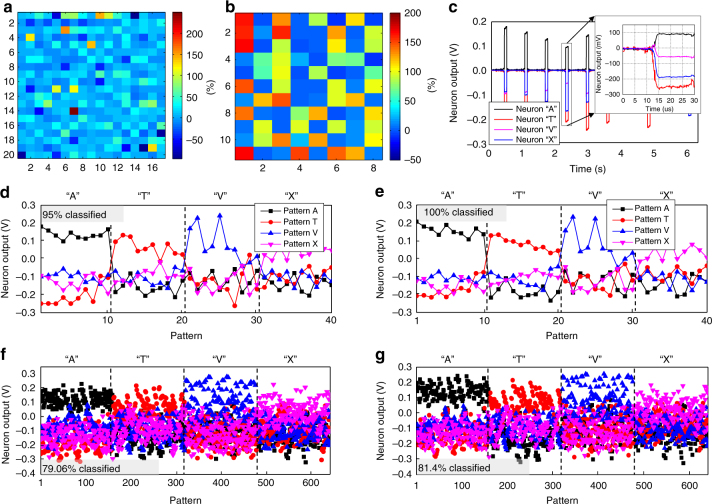
The progress in the field of neural computation hinges on the use of hardware more efficient than the conventional microprocessors. Recent works have shown that mixed-signal integrated memristive circuits, especially their passive (0T1R) variety, may increase the neuromorphic network performance dramatically, leaving far behind their digital counterparts. The major obstacle, however, is immature memristor technology so that only limited functionality has been reported. Here we demonstrate operation of one-hidden layer perceptron classifier entirely in the mixed-signal integrated hardware, comprised of two passive 20 × 20 metal-oxide memristive crossbar arrays, board-integrated with discrete conventional components. The demonstrated network, whose hardware complexity is almost 10× higher as compared to previously reported functional classifier circuits based on passive memristive crossbars, achieves classification fidelity within 3% of that obtained in simulations, when using ex-situ training. The successful demonstration was facilitated by improvements in fabrication technology of memristors, specifically by lowering variations in their I–V characteristics.
Overview
The claims and statistics of this paper haven’t been checked yet.
Free: it reads the open-access text and checks the first 5 claims that cite a source we can check. Create a free account to check every claim.
Integrity signals
Registry
Cites
Statistics
Figures
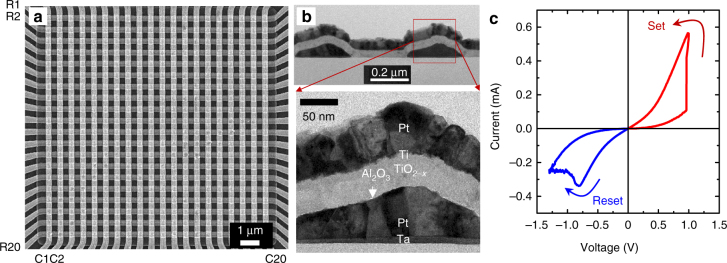
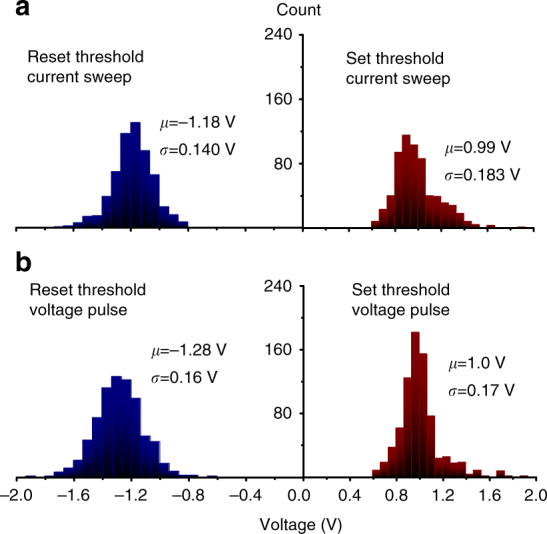
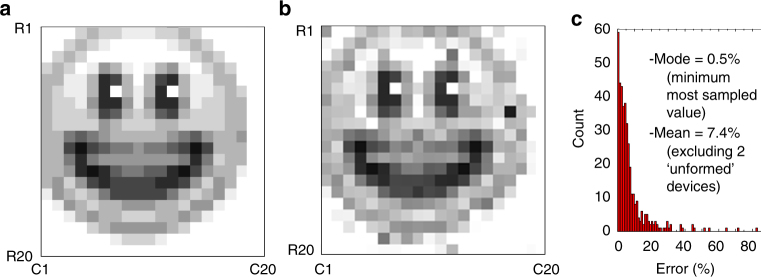
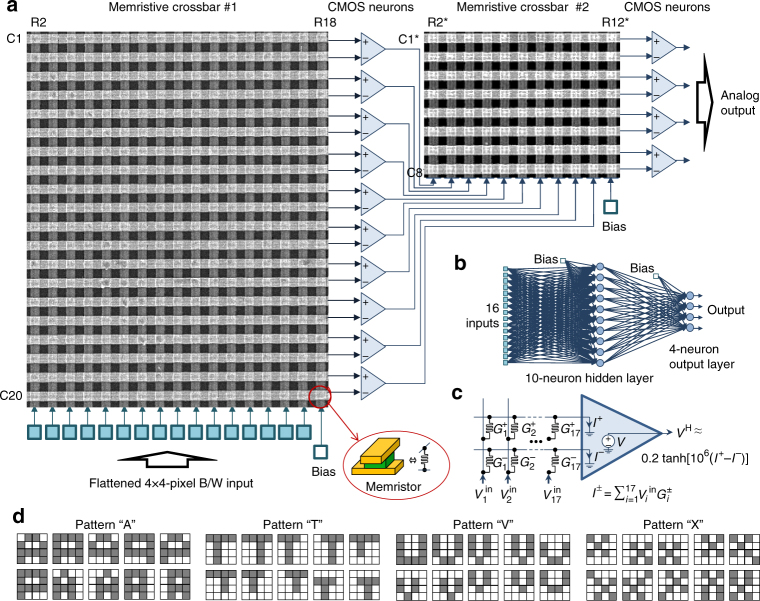
Verification
Claims the paper makes
The claims and statistics of this paper haven’t been checked yet.
Free: it reads the open-access text and checks the first 5 claims that cite a source we can check. Create a free account to check every claim.
Claims other papers make about this one
Each is checked against this paper’s own text: does it say what the citing paper says it does?
The source backs part of the claim, not all of it — or backs it for a different population, condition or comparison.
In the citing paper
“The progress in the most prospective, passive analog-grade ReRAM circuits13,17,21,22,24, however, has been much slower, mainly because of much stricter requirements for the uniformity of memory cells’ I–V characteristics (Supplementary Fig. 1).”
From 4K-memristor analog-grade passive crossbar circuit (2021) · cites this paper as [24]
Experimental — accuracy not yet measuredThe source backs part of the claim, not all of it — or backs it for a different population, condition or comparison.
In the citing paper
“The developed circuits have ten times more devices and excellent uniformity allowing for significantly better array-scale conductance tuning precision as compared to the previous work24 that reported the largest passive analog-grade memristive crossbar circuits with detailed characterization statistics.”
From 4K-memristor analog-grade passive crossbar circuit (2021) · cites this paper as [24]
Experimental — accuracy not yet measuredThe source backs part of the claim, not all of it — or backs it for a different population, condition or comparison.
In the citing paper
“the former can be achieved by reducing leakages within the device and between neighboring lines, e.g., by patterning the active switching layer and scaling down device feature sizes24, and making higher-aspect ratio electrodes”
From 4K-memristor analog-grade passive crossbar circuit (2021) · cites this paper as [24]
Experimental — accuracy not yet measuredThe cited source says what the claim attributes to it.
In the citing paper
“The developed circuits have ten times more devices and excellent uniformity allowing for significantly better array-scale conductance tuning precision as compared to the previous work24 that reported the largest passive analog-grade memristive crossbar circuits with detailed characterization statistics.”
From 4K-memristor analog-grade passive crossbar circuit (2021) · cites this paper as [24]
Self-check
Percentages, sums and reported differences re-computed from the paper’s own numbers.
The self-check needs the paper’s full text.
Citations
Cites
ImageNet classification with deep convolutional neural networks
Krizhevsky, A., Sutskever, I., & Hinton, G. E. (2017) · Communications of the ACM · doi:10.1145/3065386 · Cited by 112,155
LeCun, Y., Bengio, Y., & Hinton, G. (2015) · Nature · doi:10.1038/nature14539 · Cited by 84,126
Deep learning in neural networks: an overview
Schmidhuber, J. (2015) · Neural Networks · doi:10.1016/j.neunet.2014.09.003 · Cited by 18,570 · cited 3×
“(Similar to our previous work [1, 2], only inference stage was performed in a hardware during such in-situ training, while other operations, such as computing and storing the necessary weight updates, were assisted by an external computer.)”
BackgroundMethodResultA million spiking-neuron integrated circuit with a scalable communication network and interface
Merolla, P. A., Arthur, J. V., Alvarez-Icaza, R., Cassidy, A. S., Sawada, J., Akopyan, F., Jackson, B. L., Imam, N., Guo, C., Nakamura, Y., et al. (2014) · Science · doi:10.1126/science.1254642 · Cited by 4,147
Memristive devices for computing
Yang, J. J., Strukov, D. B., & Stewart, D. R. (2013) · Nature Nanotechnology · doi:10.1038/nnano.2012.240 · Cited by 3,885
Self-citationEyeriss: An Energy-Efficient Reconfigurable Accelerator for Deep Convolutional Neural Networks
Chen, Y.-H., Krishna, T., Emer, J. S., & Sze, V. (2017) · IEEE Journal of Solid-State Circuits · doi:10.1109/jssc.2016.2616357 · Cited by 3,247 · cited 1×
“The breakthrough 3 was enabled not by any significant algorithm advance, but rather by the use of high performance graphics processors 4 , and the further progress is being fueled now by the development of even more powerful graphics processors and custom integrated circuits 5-7 .”
MethodTraining and operation of an integrated neuromorphic network based on metal-oxide memristors
Prezioso, M., Merrikh-Bayat, F., Hoskins, B. D., Adam, G. C., Likharev, K. K., & Strukov, D. B. (2015) · Nature · doi:10.1038/nature14441 · Cited by 3,001 · cited 3×
“26,27 .”
BackgroundInfluentialSelf-citationWong, H.-S. P., Lee, H.-Y., Yu, S., Chen, Y.-S., Wu, Y., Chen, P.-S., Lee, B., Chen, F. T., & Tsai, M.-J. (2012) · Proceedings of the IEEE · doi:10.1109/jproc.2012.2190369 · Cited by 2,757
Memristors with diffusive dynamics as synaptic emulators for neuromorphic computing
Wang, Z., Joshi, S., Savel’ev, S. E., Jiang, H., Midya, R., Lin, P., Hu, M., Ge, N., Strachan, J. P., Li, Z., et al. (2017) · Nature Materials · doi:10.1038/nmat4756 · Cited by 2,358
van de Burgt, Y., Lubberman, E., Fuller, E. J., Keene, S. T., Faria, G. C., Agarwal, S., Marinella, M. J., Alec Talin, A., & Salleo, A. (2017) · Nature Materials · doi:10.1038/nmat4856 · Cited by 1,872
Neuromorphic Silicon Neuron Circuits
Indiveri, G., Linares-Barranco, B., Hamilton, T. J., Schaik, A. V., Etienne-Cummings, R., Delbruck, T., Liu, S.-C., Dudek, P., Häfliger, P., Renaud, S., et al. (2011) · Frontiers in Neuroscience · doi:10.3389/fnins.2011.00073 · Cited by 1,821 · cited 2×
“On the other hand, recent works have shown 11-16 that analog and mixed-signal integrated circuits, especially using nanoscale devices, may increase the neuromorphic network performance dramatically, leaving far behind both their digital counterparts and biological prototypes and approaching the…”
BackgroundFurber, S. B., Galluppi, F., Temple, S., & Plana, L. A. (2014) · Proceedings of the IEEE · doi:10.1109/jproc.2014.2304638 · Cited by 1,350
Analogue signal and image processing with large memristor crossbars
Li, C., Hu, M., Li, Y., Jiang, H., Ge, N., Montgomery, E., Zhang, J., Song, W., Dávila, N., Graves, C. E., et al. (2017) · Nature Electronics · doi:10.1038/s41928-017-0002-z · Cited by 1,292
Neurogrid: A Mixed-Analog-Digital Multichip System for Large-Scale Neural Simulations
Benjamin, B. V., Gao, P., McQuinn, E., Choudhary, S., Chandrasekaran, A. R., Bussat, J.-M., Alvarez-Icaza, R., Arthur, J. V., Merolla, P. A., & Boahen, K. (2014) · Proceedings of the IEEE · doi:10.1109/jproc.2014.2313565 · Cited by 1,266
Burr, G. W., Shelby, R. M., Sidler, S., di Nolfo, C., Jang, J., Boybat, I., Shenoy, R. S., Narayanan, P., Virwani, K., Giacometti, E. U., et al. (2015) · IEEE Transactions on Electron Devices · doi:10.1109/ted.2015.2439635 · Cited by 936
Kim, K.-H., Gaba, S., Wheeler, D., Cruz-Albrecht, J. M., Hussain, T., Srinivasa, N., & Lu, W. (2012) · Nano Letters · doi:10.1021/nl203687n · Cited by 924 · cited 3×
“For example, an analog tuning was essential for other demonstrations based on passive memristive circuits, though was performed with much cruder precision 19,39 .”
BackgroundFace classification using electronic synapses
Yao, P., Wu, H., Gao, B., Eryilmaz, S. B., Huang, X., Zhang, W., Zhang, Q., Deng, N., Shi, L., Wong, H.-S. P., et al. (2017) · Nature Communications · doi:10.1038/ncomms15199 · Cited by 909
Pattern classification by memristive crossbar circuits using ex situ and in situ training
Alibart, F., Zamanidoost, E., & Strukov, D. B. (2013) · Nature Communications · doi:10.1038/ncomms3072 · Cited by 642
Self-citationSparse coding with memristor networks
Sheridan, P. M., Cai, F., Du, C., Ma, W., Zhang, Z., & Lu, W. D. (2017) · Nature Nanotechnology · doi:10.1038/nnano.2017.83 · Cited by 619 · cited 1×
“For example, an analog tuning was essential for other demonstrations based on passive memristive circuits, though was performed with much cruder precision 19,39 .”
Learning through ferroelectric domain dynamics in solid-state synapses
Boyn, S., Grollier, J., Lecerf, G., Xu, B., Locatelli, N., Fusil, S., Girod, S., Carrétéro, C., Garcia, K., Xavier, S., et al. (2017) · Nature Communications · doi:10.1038/ncomms14736 · Cited by 600 · cited 1×
“Various types of emerging nonvolatile memories are now being actively investigated for their use in fast and energy-efficient neuromorphic networks 19-41 19-41 .”
BackgroundHigh precision tuning of state for memristive devices by adaptable variation-tolerant algorithm
Alibart, F., Gao, L., Hoskins, B. D., & Strukov, D. B. (2012) · Nanotechnology · doi:10.1088/0957-4484/23/7/075201 · Cited by 557 · cited 1×
“G(1)± and G(2)± are the device conductances in the first and second crossbar circuits, with ± superscripts denoting a specific device of a differential pair, while I± are the currents flowing into the corresponding neurons.”
BackgroundSelf-citationAnalog Versus Digital: Extrapolating from Electronics to Neurobiology
Sarpeshkar, R. (1998) · Neural Computation · doi:10.1162/089976698300017052 · Cited by 496 · cited 1×
“Though potential advantages of specialized hardware for neuromorphic computing had been recognized several decades ago 17,18 , up until recently, adjustable conductance devices were mostly implemented using the standard CMOS technology 13 .”
MethodFinding a roadmap to achieve large neuromorphic hardware systems
Hasler, J., & Marr, B. (2013) · Frontiers in Neuroscience · doi:10.3389/fnins.2013.00118 · Cited by 392 · cited 2×
“Nevertheless, the energy efficiency of these implementations of convolutional networks (and other neuromorphic systems 8-11 ) remains well below that of their biological prototypes 12,13 , even when the most advanced CMOS technology is used.”
BackgroundMethodSerb, A., Bill, J., Khiat, A., Berdan, R., Legenstein, R., & Prodromakis, T. (2016) · Nature Communications · doi:10.1038/ncomms12611 · Cited by 339
Neuromorphic Hardware System for Visual Pattern Recognition With Memristor Array and CMOS Neuron
Chu, M., Kim, B., Park, S., Hwang, H., Jeon, M., Lee, B. H., & Lee, B.-G. (2015) · IEEE Transactions on Industrial Electronics · doi:10.1109/tie.2014.2356439 · Cited by 296
Associative memory realized by a reconfigurable memristive Hopfield neural network
Hu, S. G., Liu, Y., Liu, Z., Chen, T. P., Wang, J. J., Yu, Q., Deng, L. J., Yin, Y., & Hosaka, S. (2015) · Nature Communications · doi:10.1038/ncomms8522 · Cited by 258
Ambrogio, S., Balatti, S., Milo, V., Carboni, R., Wang, Z.-Q., Calderoni, A., Ramaswamy, N., & Ielmini, D. (2016) · IEEE Transactions on Electron Devices · doi:10.1109/ted.2016.2526647 · Cited by 256
3-D Memristor Crossbars for Analog and Neuromorphic Computing Applications
Adam, G. C., Hoskins, B. D., Prezioso, M., Merrikh-Bayat, F., Chakrabarti, B., & Strukov, D. B. (2017) · IEEE Transactions on Electron Devices · doi:10.1109/ted.2016.2630925 · Cited by 234 · cited 1×
“We envision that the most promising implementations will be based on passive memristor technology, i.e. similar to the one demonstrated in this paper, because it is suitable for monolithical back-end-of-line integration of multiple crossbar layers 46 .”
MethodSelf-citationBinary neural network with 16 Mb RRAM macro chip for classification and online training
Yu, S., Li, Z., Chen, P.-Y., Wu, H., Gao, B., Wang, D., Wu, W., & Qian, H. (2016) · 2016 IEEE International Electron Devices Meeting (IEDM) · doi:10.1109/iedm.2016.7838429 · Cited by 219 · cited 1×
“Such work has already been started by several groups 19,30 , including ours 47 .”
BackgroundBrain-like associative learning using a nanoscale non-volatile phase change synaptic device array
Eryilmaz, S. B., Kuzum, D., Jeyasingh, R., Kim, S., BrightSky, M., Lam, C., & Wong, H.-S. P. (2014) · Frontiers in Neuroscience · doi:10.3389/fnins.2014.00205 · Cited by 205
Choi, S., Shin, J. H., Lee, J., Sheridan, P., & Lu, W. D. (2017) · Nano Letters · doi:10.1021/acs.nanolett.7b00552 · Cited by 189
Gao, B., Bi, Y., Chen, H.-Y., Liu, R., Huang, P., Chen, B., Liu, L., Liu, X., Yu, S., Wong, H.-S. P., et al. (2014) · ACS Nano · doi:10.1021/nn501824r · Cited by 188 · cited 1×
“Our particular focus is on passive (“0T1R”) memristive crossbar circuits, which are naturally suitable for three-dimensional integration 45-47 .”
BackgroundHigh-Performance Mixed-Signal Neurocomputing With Nanoscale Floating-Gate Memory Cell Arrays
Merrikh-Bayat, F., Guo, X., Klachko, M., Prezioso, M., Likharev, K. K., & Strukov, D. B. (2018) · IEEE Transactions on Neural Networks and Learning Systems · doi:10.1109/tnnls.2017.2778940 · Cited by 167
Self-citationA Programmable and Configurable Mixed-Mode FPAA SoC
George, S., Kim, S., Shah, S., Hasler, J., Collins, M., Adil, F., Wunderlich, R., Nease, S., & Ramakrishnan, S. (2016) · IEEE Transactions on Very Large Scale Integration (VLSI) Systems · doi:10.1109/tvlsi.2015.2504119 · Cited by 159 · cited 1×
“[14, 15].”
Four-dimensional address topology for circuits with stacked multilayer crossbar arrays
Strukov, D. B., & Williams, R. S. (2009) · Proceedings of the National Academy of Sciences · doi:10.1073/pnas.0906949106 · Cited by 153 · cited 1×
“The three dimensional nature of such circuits 49 will enable neuromorphic networks with extremely high synaptic density, e.g. potentially reaching 10 13 synapses in one square centimeter for 100-layer 10-nm memristive crossbar circuits, which is only hundred times less compared to the total number…”
BackgroundSelf-citationFerroelectric Artificial Synapses for Recognition of a Multishaded Image
Kaneko, Y., Nishitani, Y., & Ueda, M. (2014) · IEEE Transactions on Electron Devices · doi:10.1109/ted.2014.2331707 · Cited by 149
Sub-Microwatt Analog VLSI Trainable Pattern Classifier
Chakrabartty, S., & Cauwenberghs, G. (2007) · IEEE Journal of Solid-State Circuits · doi:10.1109/jssc.2007.894803 · Cited by 122 · cited 1×
“[14, 15].”
CrossNets: Neuromorphic Hybrid CMOS/Nanoelectronic Networks
Likharev, K. K. (2011) · Science of Advanced Materials · doi:10.1166/sam.2011.1177 · Cited by 115 · cited 1×
“Nevertheless, the energy efficiency of these implementations of convolutional networks (and other neuromorphic systems 8-11 ) remains well below that of their biological prototypes 12,13 , even when the most advanced CMOS technology is used.”
BackgroundEfficient training algorithms for neural networks based on memristive crossbar circuits
Kataeva, I., Merrikh-Bayat, F., Zamanidoost, E., & Strukov, D. (2015) · 2015 International Joint Conference on Neural Networks (IJCNN) · doi:10.1109/ijcnn.2015.7280785 · Cited by 103
Self-citationFirst steps towards the realization of a double layer perceptron based on organic memristive devices
Emelyanov, A. V., Lapkin, D. A., Demin, V. A., Erokhin, V. V., Battistoni, S., Baldi, G., Dimonte, A., Коровин, А. Н., Iannotta, S., Kashkarov, P. K., et al. (2016) · AIP Advances · doi:10.1063/1.4966257 · Cited by 103
A multiply-add engine with monolithically integrated 3D memristor crossbar/CMOS hybrid circuit
Chakrabarti, B., Lastras-Montaño, M. A., Adam, G., Prezioso, M., Hoskins, B., Payvand, M., Madhavan, A., Ghofrani, A., Theogarajan, L., Cheng, K.-T., et al. (2017) · Scientific Reports · doi:10.1038/srep42429 · Cited by 101 · cited 2×
“Our particular focus is on passive (“0T1R”) memristive crossbar circuits, which are naturally suitable for three-dimensional integration 45-47 .”
BackgroundSelf-citationDot-product engine as computing memory to accelerate machine learning algorithms
Hu, M., Strachan, J. P., Li, Z., Stanley, R., & Williams (2016) · 2016 17th International Symposium on Quality Electronic Design (ISQED) · doi:10.1109/isqed.2016.7479230 · Cited by 50
Research works printed but not linked: 10
- Moons, B., Uytterhoeven, R., Dehaene, W. & Verhelst, M. in IEEE International Sold-State Circuits Conference (ISSCC) 246–257 (IEEE, 2017).
- Jouppi, N. P. et al. in Proc. of the 44th Annual International Symposium on Computer Architecture 1–12 (ACM, 2017).
- Mead, C. Analog VLSI and Neural Systems (Addison-Wesley Longman Publishing Co. Inc., Boston, MA, USA, 1989).
- Suri, M. et al. in 2012 International Electron Devices Meeting 235–238 (IEEE, 2012).
- Piccolboni, G. et al. in 2015 International Electron Devices Meeting (IEDM) 447–450 (IEEE, 2015).
- Kim, S. et al. in 2015 International Electron Devices Meeting (IEDM) 443–446 (IEEE, 2015).
- Prezioso, M. et al. in 2015 International Electron Devices Meeting (IEDM) 455–458 (IEEE, 2015).
- Yu, S. et al. in 2016 International Electron Devices Meeting (IEDM) 416–419 (IEEE, 2016).
- Govoreanu, B. et al. in 2011 International Electron Devices Meeting 729–732 (IEEE, 2011).
- Ceze, L. et al. in 2016 74th Annual Device Research Conference (DRC) 1–2 (IEEE, 2016).
Cited by
Memristive crossbar arrays for brain-inspired computing
Xia, Q., & Yang, J. J. (2019) · Nature Materials · doi:10.1038/s41563-019-0291-x · Cited by 1,800
Resistive switching materials for information processing
Wang, Z., Wu, H., Burr, G. W., Hwang, C. S., Wang, K. L., Xia, Q., & Yang, J. J. (2020) · Nature Reviews Materials · doi:10.1038/s41578-019-0159-3 · Cited by 1,214
Physics for neuromorphic computing
Marković, D., Mizrahi, A., Querlioz, D., & Grollier, J. (2020) · Nature Reviews Physics · doi:10.1038/s42254-020-0208-2 · Cited by 1,176
Neuromorphic nanoelectronic materials
Sangwan, V. K., & Hersam, M. C. (2020) · Nature Nanotechnology · doi:10.1038/s41565-020-0647-z · Cited by 890
Tang, J., Yuan, F., Shen, X., Wang, Z., Rao, M., He, Y., Sun, Y., Li, X., Zhang, W., Li, Y., et al. (2019) · Advanced Materials · doi:10.1002/adma.201902761 · Cited by 834
Metadata
- Authors
- Bayat, F. M., Prezioso, M., Chakrabarti, B., Nili, H., Kataeva, I., & Strukov, D.
- Affiliations
- University of California, Santa Barbara (US)
- Corresponding author
- Kataeva, I.
- Strukov, D.
- Venue
- Nature Communications
- Published
- 2018-06-13
- Volume
- 9
- Issue
- 1
- Pages
- 2331-2331
- ISSN
- 2041-1723 (ISSN-L)
- PMC
- PMC5998062
- OpenAlex
- W2964263004
- Cited by
- 377
- References
- 41
- Citations by year
- 2026: 9 · 2025: 24 · 2024: 38 · 2023: 46 · 2022: 53 · 2021: 54 · 2020: 88 · 2019: 50 · 2018: 14
- FWCI
- 19.71
- Type
- journal article
- Language
- en
- Open access
- gold
- doi.org
- Licence
- cc-by
- creativecommons.org/licenses/by/4.0 (tdm)
- creativecommons.org/licenses/by/4.0 (vor)
- Locations
- Nature Communications (publishedVersion, cc-by)
- Europe PMC (PubMed Central) (publishedVersion, cc-by)
- PubMed Central (publishedVersion, cc-by)
- PubMed (publishedVersion)
- arXiv (Cornell University) (submittedVersion)
- RePEc: Research Papers in Economics (submittedVersion)
- DOAJ (DOAJ: Directory of Open Access Journals) (submittedVersion)
- DOAJ (DOAJ: Directory of Open Access Journals) (submittedVersion, cc-by-sa)
- arXiv (Cornell University)
- Funders
- DOD | Defense Advanced Research Projects Agency (HR0011-13-C-0051UPSIDE)
- NSF | Directorate for Computer & Information Science and Engineering | Division of Computing and Communication Foundations (1528205)
- Topics
- Physical Sciences › Engineering › Electrical and Electronic Engineering › Advanced Memory and Neural Computing
- Physical Sciences › Computer Science › Artificial Intelligence › Neural Networks and Applications
- Physical Sciences › Computer Science › Artificial Intelligence › Neural Networks and Reservoir Computing
- Keywords
- memristor crossbar, multilayer perceptron, neuromorphic hardware, mixed-signal circuits, metal-oxide memristors, hardware implementation of neural networks
About these checks
Registry, retraction, Cites and statistics results are computed, not judged, with one exception: a printed reference that no index lists is read once by a model before it counts as a citation error. Claims are extracted by a model and kept only when their quote appears verbatim in the text; each cited source is then checked, with a model’s help, for whether it says what the claim relies on. Those verdicts can be wrong — read the claim’s quote and the cited source before relying on one.
Statistics and arithmetic are recomputed, not judged.
Confidence bands are shown only for fields calibrated on our annotated test set. None is calibrated yet, so no band is shown.
What counts as a claim ›How we measure confidence ›How we check this ›
Are you an author, or do you see a problem with this page? Request a review
Data sources
Bibliographic data: Semantic Scholar, OpenAlex, Crossref.
Contains information from the Semantic Scholar Academic Graph Datasets, made available under the ODC Attribution License (ODC-BY 1.0).
Semantic Scholar’s data is described in: Kinney, R., et al. (2023). The Semantic Scholar Open Data Platform. arXiv:2301.10140.
