

The DOI matches its Crossref record; 38 of the 38 references it cites were found in a registry or an index.
Brain-controlled modulation of spinal circuits improves recovery from spinal cord injury
Open accessAbstract
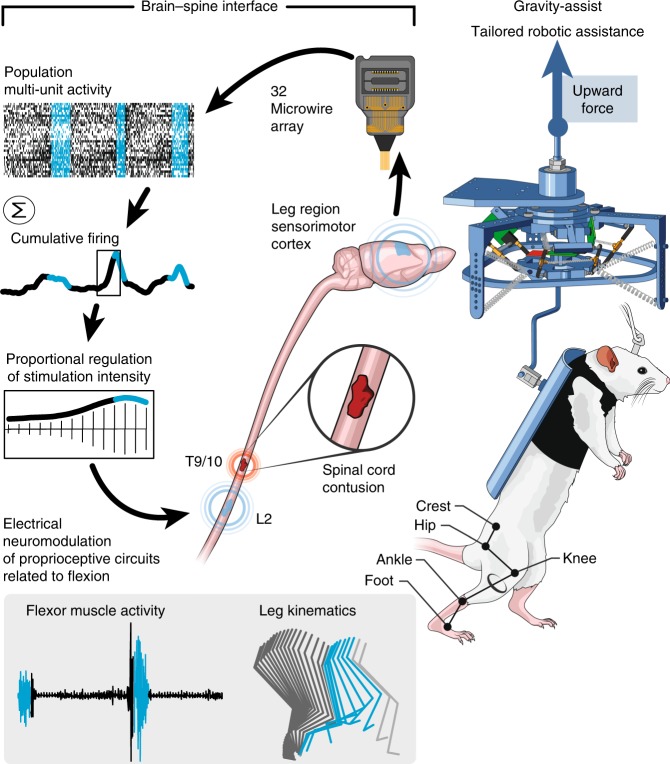
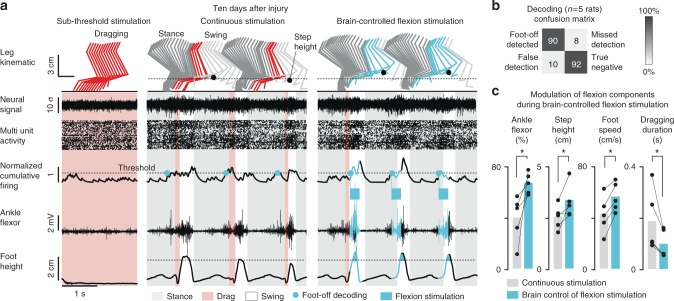
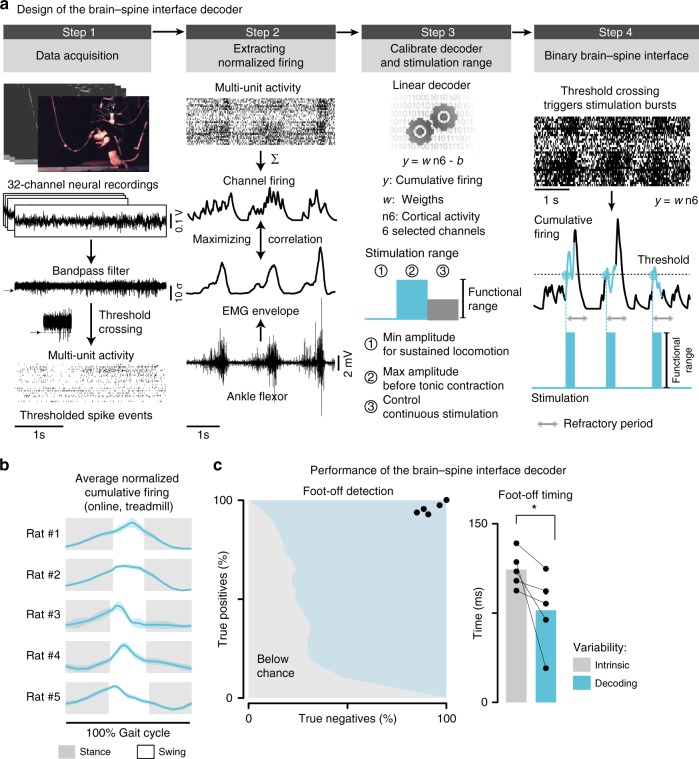
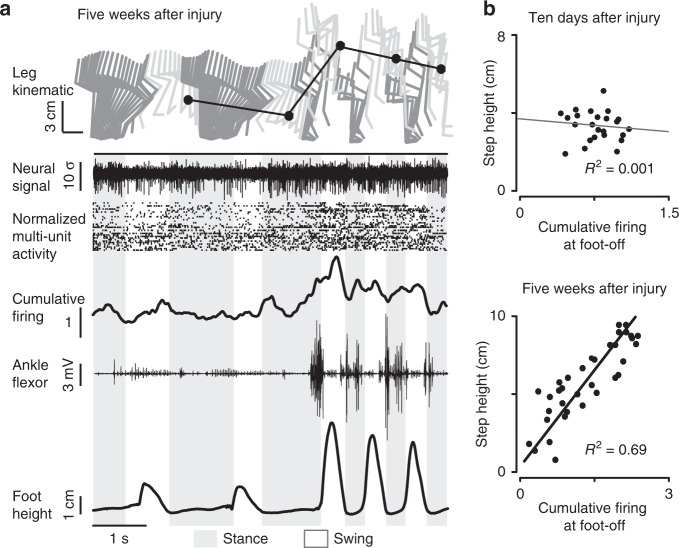
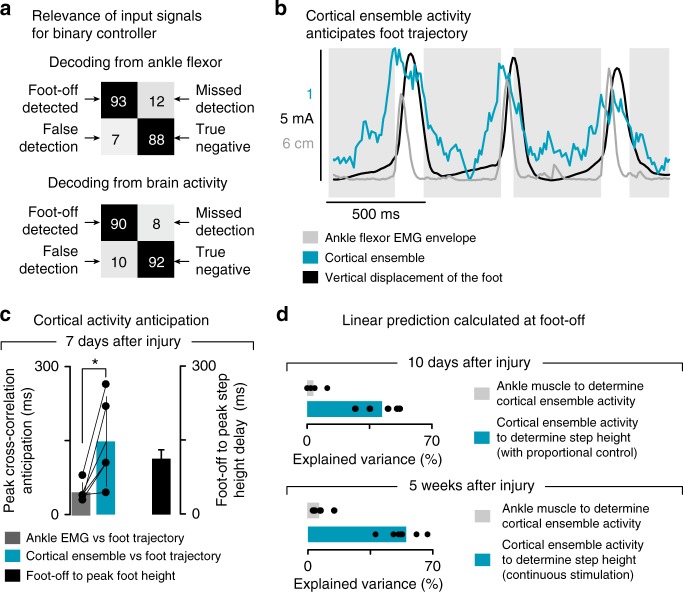
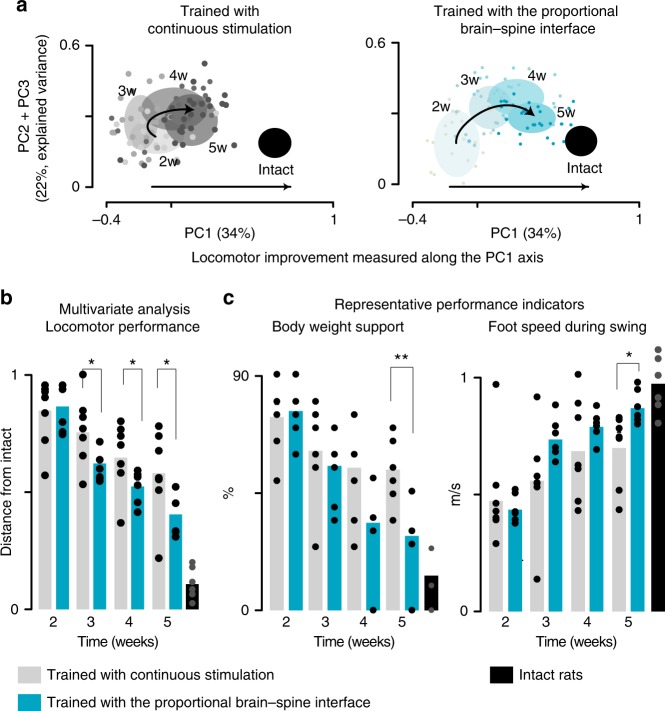
The delivery of brain-controlled neuromodulation therapies during motor rehabilitation may augment recovery from neurological disorders. To test this hypothesis, we conceived a brain-controlled neuromodulation therapy that combines the technical and practical features necessary to be deployed daily during gait rehabilitation. Rats received a severe spinal cord contusion that led to leg paralysis. We engineered a proportional brain–spine interface whereby cortical ensemble activity constantly determines the amplitude of spinal cord stimulation protocols promoting leg flexion during swing. After minimal calibration time and without prior training, this neural bypass enables paralyzed rats to walk overground and adjust foot clearance in order to climb a staircase. Compared to continuous spinal cord stimulation, brain-controlled stimulation accelerates and enhances the long-term recovery of locomotion. These results demonstrate the relevance of brain-controlled neuromodulation therapies to augment recovery from motor disorders, establishing important proofs-of-concept that warrant clinical studies.
Overview
The claims and statistics of this paper haven’t been checked yet.
Run the check — free, no account needed. It reads the open-access text and checks the sources it cites.
Integrity signals
Registry
Cites
Statistics
Figures
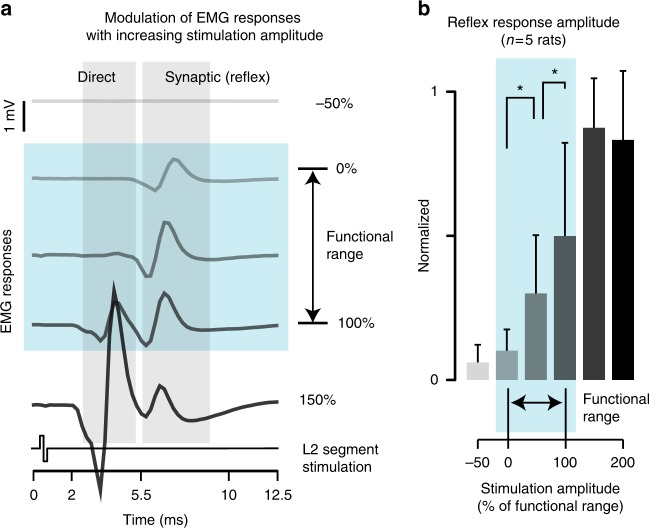
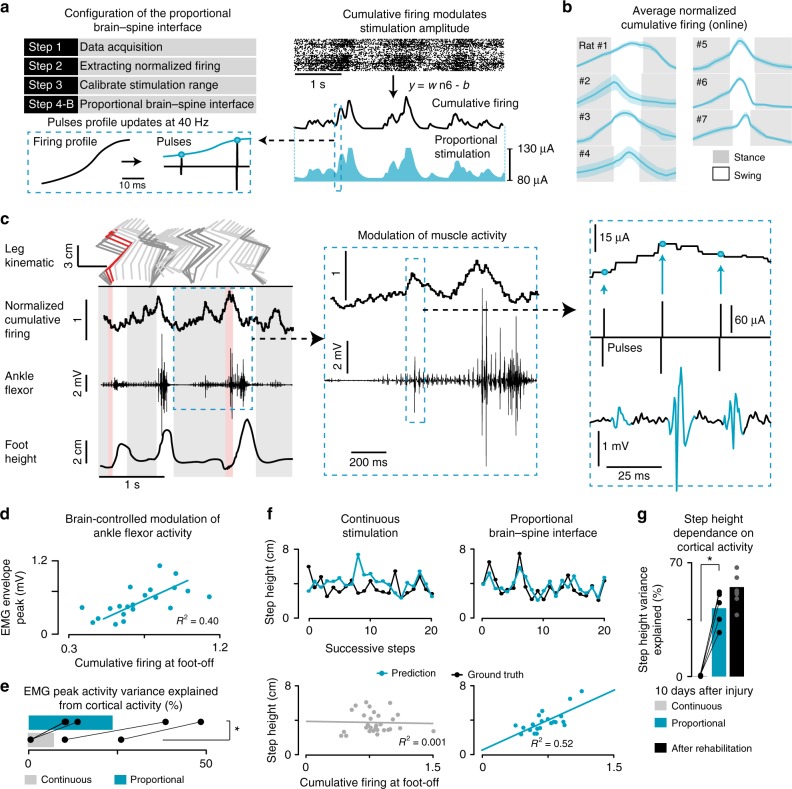
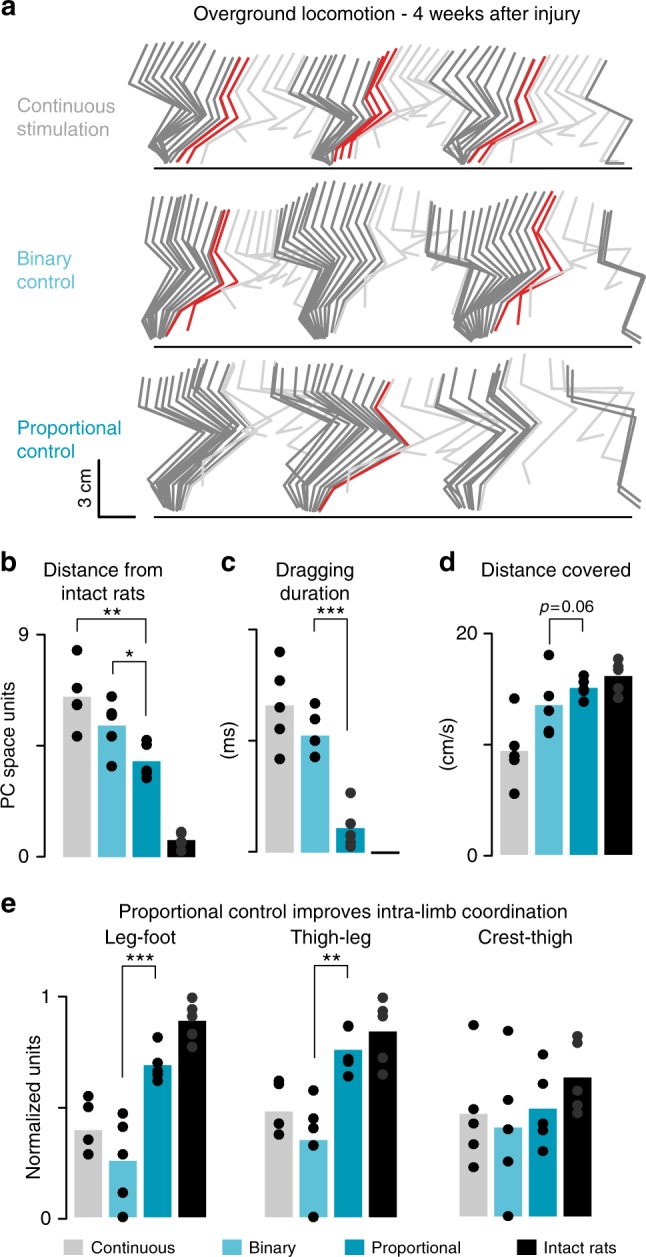
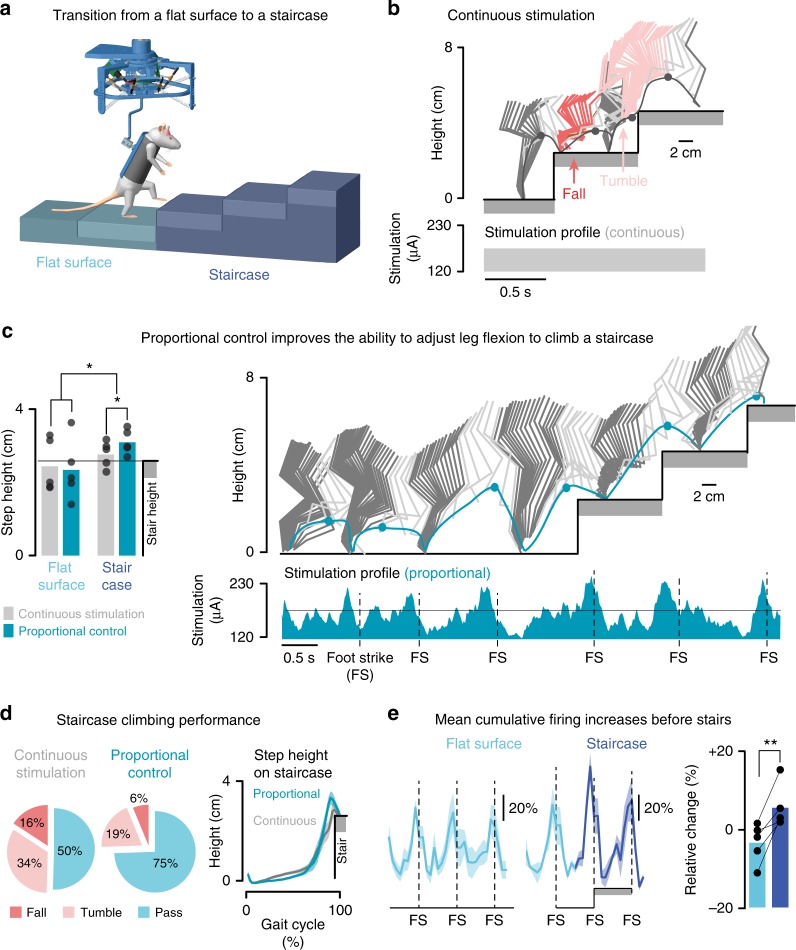
Verification
Claims the paper makes
The claims and statistics of this paper haven’t been checked yet.
Run the check — free, no account needed. It reads the open-access text and checks the sources it cites.
Claims other papers make about this one
Each is checked against this paper’s own text: does it say what the citing paper says it does?
The cited source says what the claim attributes to it.
In the citing paper
“In preclinical models, neurorehabilitation supported by a digital bridge triggered superior recovery compared to epidural electrical stimulation alone15.”
From Walking naturally after spinal cord injury using a brain–spine interface (2023) · cites this paper as [15]
Self-check
Percentages, sums and reported differences re-computed from the paper’s own numbers.
The self-check needs the paper’s full text.
Citations
Cites
Reach and grasp by people with tetraplegia using a neurally controlled robotic arm
Hochberg, L. R., Bacher, D., Jarosiewicz, B., Masse, N. Y., Simeral, J. D., Vogel, J., Haddadin, S., Liu, J., Cash, S. S., van der Smagt, P., et al. (2012) · Nature · doi:10.1038/nature11076 · Cited by 2,719
van den Berg, R. A., Hoefsloot, H. C., Westerhuis, J. A., Smilde, A. K., & van der Werf, M. J. (2006) · BMC Genomics · doi:10.1186/1471-2164-7-142 · Cited by 2,450
Experience-dependent structural synaptic plasticity in the mammalian brain
Holtmaat, A., & Svoboda, K. (2009) · Nature Reviews Neuroscience · doi:10.1038/nrn2699 · Cited by 1,934
High-performance neuroprosthetic control by an individual with tetraplegia
Collinger, J. L., Wodlinger, B., Downey, J. E., Wang, W., Tyler-Kabara, E. C., Weber, D. J., McMorland, A. J., Velliste, M., Boninger, M. L., & Schwartz, A. B. (2013) · The Lancet · doi:10.1016/s0140-6736(12)61816-9 · Cited by 1,848
Restoring cortical control of functional movement in a human with quadriplegia
Bouton, C. E., Shaikhouni, A., Annetta, N. V., Bockbrader, M. A., Friedenberg, D. A., Nielson, D. M., Sharma, G., Sederberg, P. B., Glenn, B. C., Mysiw, W. J., et al. (2016) · Nature · doi:10.1038/nature17435 · Cited by 924
Ajiboye, A. B., Willett, F. R., Young, D. R., Memberg, W. D., Murphy, B. A., Miller, J. P., Walter, B. L., Sweet, J. A., Hoyen, H. A., Keith, M. W., et al. (2017) · The Lancet · doi:10.1016/s0140-6736(17)30601-3 · Cited by 862
Restoring Voluntary Control of Locomotion after Paralyzing Spinal Cord Injury
van den Brand, R., Heutschi, J., Barraud, Q., DiGiovanna, J., Bartholdi, K., Huerlimann, M., Friedli, L., Vollenweider, I., Moraud, E. M., Duis, S., et al. (2012) · Science · doi:10.1126/science.1217416 · Cited by 767
Self-citationA brain–spine interface alleviating gait deficits after spinal cord injury in primates
Capogrosso, M., Milekovic, T., Borton, D., Wagner, F., Moraud, E. M., Mignardot, J.-B., Buse, N., Gandar, J., Barraud, Q., Xing, D., et al. (2016) · Nature · doi:10.1038/nature20118 · Cited by 635
Self-citationMotor Cortex Is Required for Learning but Not for Executing a Motor Skill
Kawai, R., Markman, T. M., Poddar, R., Ko, R., Fantana, A. L., Dhawale, A. K., Kampff, A. R., & Ölveczky, B. P. (2015) · Neuron · doi:10.1016/j.neuron.2015.03.024 · Cited by 583
Restoration of grasp following paralysis through brain-controlled stimulation of muscles
Ethier, C., Oby, E. R., Bauman, M. J., & Miller, L. E. (2012) · Nature · doi:10.1038/nature10987 · Cited by 485
Donati, A. R. C., Shokur, S., Morya, E., Campos, D. S. F., Moioli, R. C., Gitti, C. M., Augusto, P. B., Tripodi, S., Pires, C. G., Pereira, G. A., et al. (2016) · Scientific Reports · doi:10.1038/srep30383 · Cited by 428
Wenger, N., Moraud, E. M., Gandar, J., Musienko, P., Capogrosso, M., Baud, L., Le Goff, C. G., Barraud, Q., Pavlova, N., Dominici, N., et al. (2016) · Nature Medicine · doi:10.1038/nm.4025 · Cited by 369
Self-citationAsboth, L., Friedli, L., Beauparlant, J., Martinez-Gonzalez, C., Anil, S., Rey, E., Baud, L., Pidpruzhnykova, G., Anderson, M. A., Shkorbatova, P., et al. (2018) · Nature Neuroscience · doi:10.1038/s41593-018-0093-5 · Cited by 324
Self-citationTakeoka, A., Vollenweider, I., Courtine, G., & Arber, S. (2014) · Cell · doi:10.1016/j.cell.2014.11.019 · Cited by 318
Self-citationCortex commands the performance of skilled movement
Guo, J., Graves, A. R., Guo, W. W., Zheng, J., Lee, A., Rodríguez-González, J., Li, N., Macklin, J. J., Phillips, J. W., Mensh, B. D., et al. (2015) · eLife · doi:10.7554/elife.10774 · Cited by 256
Moraud, E. M., Capogrosso, M., Formento, E., Wenger, N., DiGiovanna, J., Courtine, G., & Micera, S. (2016) · Neuron · doi:10.1016/j.neuron.2016.01.009 · Cited by 220
Self-citationWenger, N., Moraud, E. M., Raspopovic, S., Bonizzato, M., DiGiovanna, J., Musienko, P., Morari, M., Micera, S., & Courtine, G. (2014) · Science Translational Medicine · doi:10.1126/scitranslmed.3008325 · Cited by 209
Self-citationKrucoff, M. O., Rahimpour, S., Slutzky, M. W., Edgerton, V. R., & Turner, D. A. (2016) · Frontiers in Neuroscience · doi:10.3389/fnins.2016.00584 · Cited by 196
Wireless Neurosensor for Full-Spectrum Electrophysiology Recordings during Free Behavior
Yin, M., Borton, D. A., Komar, J., Agha, N. S., Lu, Y., Li, H., Laurens, J., Lang, Y., Li, Q., Bull, C. W., et al. (2014) · Neuron · doi:10.1016/j.neuron.2014.11.010 · Cited by 185
Self-citationMcPherson, J. G., Miller, R. R., & Perlmutter, S. I. (2015) · Proceedings of the National Academy of Sciences · doi:10.1073/pnas.1505383112 · Cited by 152
Spike-Timing-Dependent Plasticity in Primate Corticospinal Connections Induced during Free Behavior
Nishimura, Y., Perlmutter, S. I., Eaton, R. W., & Fetz, E. E. (2013) · Neuron · doi:10.1016/j.neuron.2013.08.028 · Cited by 145
Moritz, C. T., Lucas, T. H., Perlmutter, S. I., & Fetz, E. E. (2006) · Journal of Neurophysiology · doi:10.1152/jn.00414.2006 · Cited by 103
Motor-cortical activity in tetraplegics
Shoham, S., Halgren, E., Maynard, E. M., & Normann, R. A. (2001) · Nature · doi:10.1038/35101651 · Cited by 99
Flint, R. D., Scheid, M. R., Wright, Z. A., Solla, S. A., & Slutzky, M. W. (2016) · Journal of Neuroscience · doi:10.1523/jneurosci.2339-15.2016 · Cited by 93
Ryk controls remapping of motor cortex during functional recovery after spinal cord injury
Hollis, E. R., II, Ishiko, N., Yu, T., Lu, C.-C., Haimovich, A., Tolentino, K. E., Richman, A., Tury, A., Wang, S. J., Pessian, M., et al. (2016) · Nature Neuroscience · doi:10.1038/nn.4282 · Cited by 92
Hilton, B. J., Anenberg, E., Harrison, T. C., Boyd, J. D., Murphy, T. H., & Tetzlaff, W. (2016) · Journal of Neuroscience · doi:10.1523/jneurosci.3386-15.2016 · Cited by 92
Engagement of the Rat Hindlimb Motor Cortex across Natural Locomotor Behaviors
DiGiovanna, J., Dominici, N., Friedli, L., Rigosa, J., Duis, S., Kreider, J., Beauparlant, J., van den Brand, R., Schieppati, M., Micera, S., et al. (2016) · Journal of Neuroscience · doi:10.1523/jneurosci.4343-15.2016 · Cited by 89
Self-citationBrain-controlled neuromuscular stimulation to drive neural plasticity and functional recovery
Éthier, C., Gallego, J. Á., & Miller, L. E. (2015) · Current Opinion in Neurobiology · doi:10.1016/j.conb.2015.03.007 · Cited by 84
Mignardot, J.-B., Goff, C. G. L., van den Brand, R., Capogrosso, M., Fumeaux, N., Vallery, H., Anil, S., Lanini, J., Fodor, I., Eberle, G., et al. (2017) · Science Translational Medicine · doi:10.1126/scitranslmed.aah3621 · Cited by 58
Self-citationDecoding bipedal locomotion from the rat sensorimotor cortex
Rigosa, J., Panarese, A., Dominici, N., Friedli, L., van den Brand, R., Carpaneto, J., DiGiovanna, J., Courtine, G., & Micera, S. (2015) · Journal of Neural Engineering · doi:10.1088/1741-2560/12/5/056014 · Cited by 44
Self-citationAdaptation to a Cortex-Controlled Robot Attached at the Pelvis and Engaged during Locomotion in Rats
Song, W., & Giszter, S. F. (2011) · Journal of Neuroscience · doi:10.1523/jneurosci.2335-10.2011 · Cited by 43
Song, W., Ramakrishnan, A., Udoekwere, U. I., & Giszter, S. F. (2009) · IEEE Transactions on Biomedical Engineering · doi:10.1109/tbme.2009.2026284 · Cited by 42
Feed-Forwardness of Spinal Networks in Posture and Locomotion
Gerasimenko, Y., Sayenko, D. G., Gad, P. N., Liu, C.-T., Tillakaratne, N. J. K., Roy, R. R., Kozlovskaya, I. B., & Edgerton, V. R. (2016) · The Neuroscientist · doi:10.1177/1073858416683681 · Cited by 42
Manohar, A., Foffani, G., Ganzer, P. D., Bethea, J. R., & Moxon, K. A. (2017) · eLife · doi:10.7554/elife.23532 · Cited by 38
Decoding Hindlimb Movement for a Brain Machine Interface after a Complete Spinal Transection
Manohar, A., Flint, R. D., Knudsen, E. B., & Moxon, K. A. (2012) · PLoS ONE · doi:10.1371/journal.pone.0052173 · Cited by 34
Defining Ecological Strategies in Neuroprosthetics
Courtine, G., & Bloch, J. (2015) · Neuron · doi:10.1016/j.neuron.2015.02.039 · Cited by 31
Self-citationQi, H., Reed, J. L., Gharbawie, O. A., Burish, M. J., & Kaas, J. H. (2014) · Journal of Neuroscience · doi:10.1523/jneurosci.4954-13.2014 · Cited by 23
Alam, M., Chen, X., Zhang, Z., Li, Y., & He, J. (2014) · PLoS ONE · doi:10.1371/journal.pone.0103764 · Cited by 15
Cited by
Sorted by citations
Walking naturally after spinal cord injury using a brain–spine interface
Lorach, H., Galvez, A., Spagnolo, V., Martel, F., Karakas, S., Intering, N., Vat, M., Faivre, O., Harte, C., Komi, S., et al. (2023) · Nature · doi:10.1038/s41586-023-06094-5 · Cited by 631
“In preclinical models, neurorehabilitation supported by a digital bridge triggered superior recovery compared to epidural electrical stimulation alone 15 .”
BackgroundSelf-citationSpinal cord repair: advances in biology and technology
Courtine, G., & Sofroniew, M. V. (2019) · Nature Medicine · doi:10.1038/s41591-019-0475-6 · Cited by 508
Self-citationRowald, A., Komi, S., Demesmaeker, R., Baaklini, E., Hernandez-Charpak, S. D., Paoles, E., Montanaro, H., Cassara, A., Becce, F., Lloyd, B., et al. (2022) · Nature Medicine · doi:10.1038/s41591-021-01663-5 · Cited by 455
Self-citationThe translational landscape in spinal cord injury: focus on neuroplasticity and regeneration
Hutson, T. H., & Giovanni, S. D. (2019) · Nature Reviews Neurology · doi:10.1038/s41582-019-0280-3 · Cited by 311
Recent progress and challenges in the treatment of spinal cord injury
Tian, T., Zhang, S., & Yang, M. (2023) · Protein & Cell · doi:10.1093/procel/pwad003 · Cited by 203
Metadata
- Authors
- Bonizzato, M., Pidpruzhnykova, G., DiGiovanna, J., Shkorbatova, P., Pavlova, N., Micera, S., & Courtine, G.
- Affiliations
- École Polytechnique Fédérale de Lausanne (CH)
- Pavlov Institute of Physiology of the Russian Academy of Sciences (RU)
- Scuola Superiore Sant'Anna (IT)
- Board of the Swiss Federal Institutes of Technology (CH)
- Corresponding author
- Courtine, Grégoire
- ORCID
- Venue
- Nature Communications
- Published
- 2018-08-01
- Volume
- 9
- Issue
- 1
- Pages
- 3015-3015
- ISSN
- 2041-1723 (ISSN-L)
- PMC
- PMC6070513
- OpenAlex
- W2882976771
- Cited by
- 149
- References
- 38
- Citations by year
- 2026: 17 · 2025: 11 · 2024: 13 · 2023: 27 · 2022: 24 · 2021: 28 · 2020: 12 · 2019: 13 · 2018: 4
- FWCI
- 10.84
- Type
- journal article
- Language
- en
- Open access
- gold
- doi.org
- Locations
- Nature Communications (publishedVersion, cc-by)
- Europe PMC (PubMed Central) (publishedVersion, cc-by)
- PubMed Central (publishedVersion, cc-by)
- PubMed (publishedVersion)
- SERVAL (Université de Lausanne) (publishedVersion, cc-by)
- IRIS (submittedVersion, cc-by)
- RePEc: Research Papers in Economics (submittedVersion)
- DOAJ (DOAJ: Directory of Open Access Journals) (submittedVersion, cc-by-sa)
- DOAJ (DOAJ: Directory of Open Access Journals) (submittedVersion)
- Infoscience (Ecole Polytechnique Fédérale de Lausanne) (submittedVersion, cc-by-nc-nd)
- PolyPublie (École Polytechnique de Montréal) (submittedVersion)
- CINECA IRIS Institutional Research Information System (Sant'Anna School of Advanced Studies) (submittedVersion)
- Funders
- National Science Foundation
- Wyss Center for Bio and Neuroengineering
- Schweizerischer Nationalfonds zur Förderung der Wissenschaftlichen Forschung (160696)
- H2020 European Research Council (682999)
- Topics
- Health Sciences › Medicine › Clinical Neurology › Spinal Cord Injury Research
- Health Sciences › Medicine › Rehabilitation › Stroke Rehabilitation and Recovery
- Life Sciences › Neuroscience › Cellular and Molecular Neuroscience › Neuroscience and Neural Engineering
- Keywords
- spinal cord injury, spinal cord stimulation, locomotor recovery, gait rehabilitation, leg paralysis, overground walking, foot clearance, stair climbing
- MeSH terms
- Animals, Brain, Electromyography, Electric Stimulation Therapy, Extremities, Female, Gait, Locomotion, Muscles, Nerve Net, Rats, Inbred Lew, Spinal Cord, Spinal Cord Injuries, Reproducibility of Results, Walking, Recovery of Function
About these checks
Registry, retraction, Cites and statistics results are computed, not judged, with one exception: a printed reference that no index lists is read once by a model before it counts as a citation error. Claims are extracted by a model and kept only when their quote appears verbatim in the text; each cited source is then checked, with a model’s help, for whether it says what the claim relies on. Those verdicts can be wrong — read the claim’s quote and the cited source before relying on one.
Statistics and arithmetic are recomputed, not judged.
Confidence bands are shown only for fields calibrated on our annotated test set. None is calibrated yet, so no band is shown.
What counts as a claim ›How we measure confidence ›How we check this ›
Are you an author, or do you see a problem with this page? Request a review
