

Speed dependent descending control of freezing behavior in Drosophila melanogaster
Open accessPublished version of a preprint
The DOI matches its Crossref record; 60 of the 61 references it cites were found in a registry or an index.
Abstract
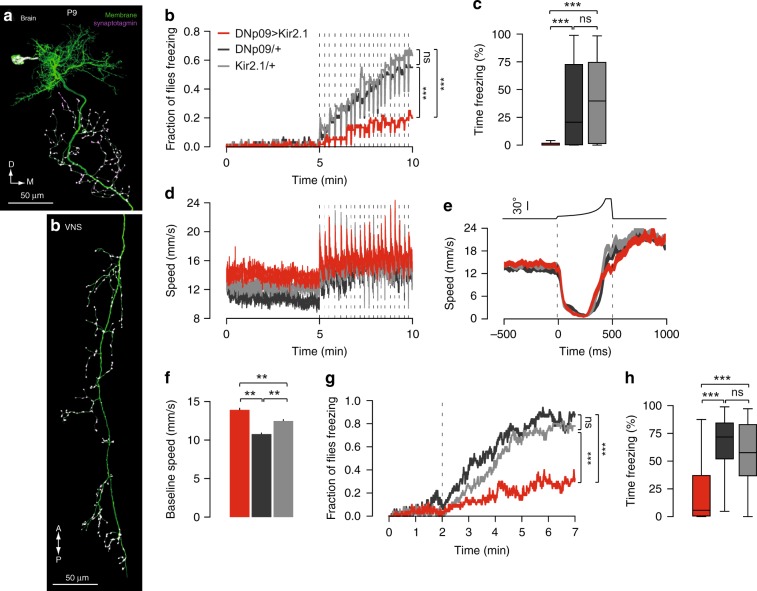
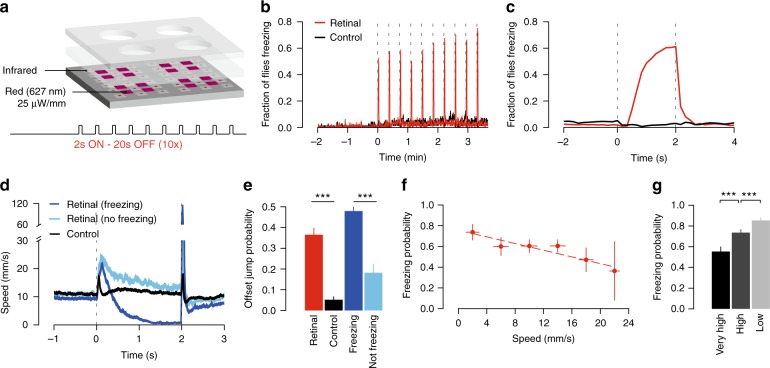
The most fundamental choice an animal has to make when it detects a threat is whether to freeze, reducing its chances of being noticed, or to flee to safety. Here we show that Drosophila melanogaster exposed to looming stimuli in a confined arena either freeze or flee. The probability of freezing versus fleeing is modulated by the fly's walking speed at the time of threat, demonstrating that freeze/flee decisions depend on behavioral state. We describe a pair of descending neurons crucially implicated in freezing. Genetic silencing of DNp09 descending neurons disrupts freezing yet does not prevent fleeing. Optogenetic activation of both DNp09 neurons induces running and freezing in a state-dependent manner. Our findings establish walking speed as a key factor in defensive response choices and reveal a pair of descending neurons as a critical component in the circuitry mediating selection and execution of freezing or fleeing behaviors.
Overview
The claims and statistics of this paper haven’t been checked yet.
Free: it reads the open-access text and checks the first 5 claims that cite a source we can check. Create a free account to check every claim.
Integrity signals
Registry
Cites
Statistics
Figures
Verification
Claims the paper makes
The claims and statistics of this paper haven’t been checked yet.
Free: it reads the open-access text and checks the first 5 claims that cite a source we can check. Create a free account to check every claim.
Claims other papers make about this one
Each is checked against this paper’s own text: does it say what the citing paper says it does?
The source backs part of the claim, not all of it — or backs it for a different population, condition or comparison.
In the citing paper
“many Drosophila descending neurons (DNs) involved in walking control are uniquely identifiable as individual right-left cell pairs28–34.”
From Fine-grained descending control of steering in walking Drosophila (2023) · cites this paper as [33]
Experimental — accuracy not yet measuredIn the citing paper
“This is another example where a DN (DNp09) represents a bridge between sensory integration and motor execution, and its activation instantiates the decision to run or halt [62].”
From Descending control of motor sequences in Drosophila (2024) · cites this paper as [62]
Self-check
Percentages, sums and reported differences re-computed from the paper’s own numbers.
The self-check needs the paper’s full text.
Citations
Cites
PsychoPy—Psychophysics software in Python
Peirce, J. W. (2007) · Journal of Neuroscience Methods · doi:10.1016/j.jneumeth.2006.11.017 · Cited by 4,603
Independent optical excitation of distinct neural populations
Klapoetke, N. C., Murata, Y., Kim, S. S., Pulver, S. R., Birdsey-Benson, A., Cho, Y. K., Morimoto, T. K., Chuong, A. S., Carpenter, E. J., Tian, Z., et al. (2014) · Nature Methods · doi:10.1038/nmeth.2836 · Cited by 2,344
Ventromedial hypothalamic neurons control a defensive emotion state
Kunwar, P. S., Zelikowsky, M., Remedios, R., Cai, H., Yilmaz, M., Meister, M., & Anderson, D. J. (2015) · eLife · doi:10.7554/elife.06633 · Cited by 1,101
Crouching as an index of fear.
Blanchard, R. J., & Blanchard, D. C. (1969) · Journal of Comparative and Physiological Psychology · doi:10.1037/h0026779 · Cited by 1,077
Neural organization of the defensive behavior system responsible for fear
Fanselow, M. S. (1994) · Psychonomic Bulletin & Review · doi:10.3758/bf03210947 · Cited by 1,000
Arousal and Locomotion Make Distinct Contributions to Cortical Activity Patterns and Visual Encoding
Vinck, M., Batista-Brito, R., Knoblich, U., & Cardin, J. A. (2015) · Neuron · doi:10.1016/j.neuron.2015.03.028 · Cited by 819
Risks and Rewards of Nest Defence by Parent Birds
Montgomerie, R. D., & Weatherhead, P. J. (1988) · The Quarterly Review of Biology · doi:10.1086/415838 · Cited by 816
Midbrain circuits for defensive behaviour
Tovote, P., Esposito, M. S., Botta, P., Chaudun, F., Fadok, J. P., Markovic, M., Wolff, S. B. E., Ramakrishnan, C., Fenno, L., Deisseroth, K., et al. (2016) · Nature · doi:10.1038/nature17996 · Cited by 732
Altered Electrical Properties in Drosophila Neurons Developing without Synaptic Transmission
Baines, R. A., Uhler, J. P., Thompson, A., Sweeney, S. T., & Bate, M. (2001) · The Journal of Neuroscience · doi:10.1523/jneurosci.21-05-01523.2001 · Cited by 634
Kim, J. J., Rison, R. A., & Fanselow, M. S. (1993) · Behavioral Neuroscience · doi:10.1037/0735-7044.107.6.1093 · Cited by 615
Gross, C. T., & Canteras, N. S. (2012) · Nature Reviews Neuroscience · doi:10.1038/nrn3301 · Cited by 596
Bonsai: an event-based framework for processing and controlling data streams
Lopes, G., Bonacchi, N., Frazão, J., Neto, J. P., Atallah, B. V., Soares, S., Moreira, L., Matias, S., Itskov, P. M., Correia, P. A., et al. (2015) · Frontiers in Neuroinformatics · doi:10.3389/fninf.2015.00007 · Cited by 593
Alarm substance induced behavioral responses in zebrafish (Danio rerio)
Speedie, N., & Gerlai, R. (2008) · Behavioural Brain Research · doi:10.1016/j.bbr.2007.10.031 · Cited by 480
A competitive inhibitory circuit for selection of active and passive fear responses
Fadok, J. P., Krabbe, S., Markovic, M., Courtin, J., Xu, C., Massi, L., Botta, P., Bylund, K., Müller, C., Kovacevic, A., et al. (2017) · Nature · doi:10.1038/nature21047 · Cited by 473
The Mauthner Cell Half a Century Later: A Neurobiological Model for Decision-Making?
Korn, H., & Faber, D. S. (2005) · Neuron · doi:10.1016/j.neuron.2005.05.019 · Cited by 469
Active flight increases the gain of visual motion processing in Drosophila
Maimon, G., Straw, A. D., & Dickinson, M. H. (2010) · Nature Neuroscience · doi:10.1038/nn.2492 · Cited by 420
Defensive behaviors of laboratory and wild Rattus norvegicus..
Blanchard, R. J., Flannelly, K. J., & Blanchard, D. C. (1986) · Journal of comparative psychology · doi:10.1037/0735-7036.100.2.101 · Cited by 405
The habenula is crucial for experience-dependent modification of fear responses in zebrafish
Agetsuma, M., Aizawa, H., Aoki, T., Nakayama, R., Takahoko, M., Goto, M., Sassa, T., Amo, R., Shiraki, T., Kawakami, K., et al. (2010) · Nature Neuroscience · doi:10.1038/nn.2654 · Cited by 390
Amorapanth, P., LeDoux, J. E., & Nader, K. (2000) · Nature Neuroscience · doi:10.1038/71145 · Cited by 374
The functional organization of descending sensory-motor pathways in Drosophila
Namiki, S., Dickinson, M. H., Wong, A. M., Korff, W., & Card, G. M. (2018) · eLife · doi:10.7554/elife.34272 · Cited by 337
Self-citationVisually mediated motor planning in the escape response of Drosophila
Card, G., & Dickinson, M. H. (2008) · Current Biology · doi:10.1016/j.cub.2008.07.094 · Cited by 309
Self-citationSubthreshold mechanisms underlying state-dependent modulation of visual responses
Bennett, C., Arroyo, S., & Hestrin, S. (2013) · Neuron · doi:10.1016/j.neuron.2013.08.007 · Cited by 292
Eilam, D. (2005) · Neuroscience & Biobehavioral Reviews · doi:10.1016/j.neubiorev.2005.03.027 · Cited by 292
Walking Modulates Speed Sensitivity in Drosophila Motion Vision
Chiappe, M. E., Seelig, J. D., Reiser, M. B., & Jayaraman, V. (2010) · Current Biology · doi:10.1016/j.cub.2010.06.072 · Cited by 273
Lebestky, T., Chang, J.-S. C., Dankert, H., Zelnik, L., Kim, Y.-C., Han, K.-A., Wolf, F. W., Perona, P., & Anderson, D. J. (2009) · Neuron · doi:10.1016/j.neuron.2009.09.031 · Cited by 261
Independent hypothalamic circuits for social and predator fear
Silva, B. A., Mattucci, C., Krzywkowski, P., Murana, E., Illarionova, A., Grinevich, V., Canteras, N. S., Ragozzino, D., & Gross, C. T. (2013) · Nature Neuroscience · doi:10.1038/nn.3573 · Cited by 260
Descending command neurons in the brainstem that halt locomotion
Bouvier, J., Caggiano, V., Leiras, R., Caldeira, V., Bellardita, C., Balueva, K., Fuchs, A., & Kiehn, O. (2015) · Cell · doi:10.1016/j.cell.2015.10.074 · Cited by 259
A spike-timing mechanism for action selection
von Reyn, C. R., Breads, P., Peek, M. Y., Zheng, G. Z., Williamson, W. R., Yee, A. L., Leonardo, A., & Card, G. M. (2014) · Nature Neuroscience · doi:10.1038/nn.3741 · Cited by 254
Self-citationA neural switch for active and passive fear
Gozzi, A., Jain, A., Giovanelli, A., Bertollini, C., Crestan, V., Schwarz, A. J., Tsetsenis, T., Ragozzino, D., Gross, C. T., & Bifone, A. (2010) · Neuron · doi:10.1016/j.neuron.2010.07.008 · Cited by 209
Bass, S. L. S., & Gerlai, R. (2008) · Behavioural Brain Research · doi:10.1016/j.bbr.2007.07.037 · Cited by 196
Dorsal periaqueductal gray-amygdala pathway conveys both innate and learned fear responses in rats
Kim, E. J., Horovitz, O., Pellman, B. A., Tan, L. M., Li, Q., Richter-Levin, G., & Kim, J. J. (2013) · Proceedings of the National Academy of Sciences · doi:10.1073/pnas.1310845110 · Cited by 191
Performance trade-offs in the flight initiation of Drosophila
Card, G., & Dickinson, M. (2008) · Journal of Experimental Biology · doi:10.1242/jeb.012682 · Cited by 166
Self-citationNatural Selection in the Wild.
Schultz, D. L., & Endler, J. A. (1987) · Systematic Zoology · doi:10.2307/2413313 · Cited by 166
Card, G. M. (2012) · Current Opinion in Neurobiology · doi:10.1016/j.conb.2011.12.009 · Cited by 163
Self-citationOptogenetic dissection of descending behavioral control in Drosophila
Cande, J., Namiki, S., Qiu, J., Korff, W., Card, G. M., Shaevitz, J. W., Stern, D. L., & Berman, G. J. (2018) · eLife · doi:10.7554/elife.34275 · Cited by 163
Self-citationI'll take the low road: the evolutionary underpinnings of visually triggered fear
Carr, J. A. (2015) · Frontiers in Neuroscience · doi:10.3389/fnins.2015.00414 · Cited by 161
The locust jump. II. Neural circuits of the motor programme
Heitler, W. J., & Burrows, M. (1977) · Journal of Experimental Biology · doi:10.1242/jeb.66.1.221 · Cited by 157
Loom-Sensitive Neurons Link Computation to Action in the Drosophila Visual System
de Vries, S. E. J., & Clandinin, T. R. (2012) · Current Biology · doi:10.1016/j.cub.2012.01.007 · Cited by 142
Gibson, W. T., Gonzalez, C. R., Fernandez, C., Ramasamy, L., Tabachnik, T., Du, R. R., Felsen, P. D., Maire, M. R., Perona, P., & Anderson, D. J. (2015) · Current Biology · doi:10.1016/j.cub.2015.03.058 · Cited by 141
Two types of social buffering differentially mitigate conditioned fear responses
Kiyokawa, Y., Takeuchi, Y., & Mori, Y. (2007) · European Journal of Neuroscience · doi:10.1111/j.1460-9568.2007.05969.x · Cited by 136
Rapid Spatial Learning Controls Instinctive Defensive Behavior in Mice
Vale, R., Evans, D. A., & Branco, T. (2017) · Current Biology · doi:10.1016/j.cub.2017.03.031 · Cited by 126
Organization of descending neurons in Drosophila melanogaster
Hsu, C. T., & Bhandawat, V. (2016) · Scientific Reports · doi:10.1038/srep20259 · Cited by 117
Neural substrates underlying fear‐evoked freezing: the periaqueductal grey–cerebellar link
Koutsikou, S., Crook, J. J., Earl, E. V., Leith, J. L., Watson, T. C., Lumb, B. M., & Apps, R. (2014) · The Journal of Physiology · doi:10.1113/jphysiol.2013.268714 · Cited by 111
Neural Correlates of Fear in the Periaqueductal Gray
Watson, T. C., Cerminara, N. L., Lumb, B. M., & Apps, R. (2016) · Journal of Neuroscience · doi:10.1523/jneurosci.1100-16.2016 · Cited by 107
Main olfactory system mediates social buffering of conditioned fear responses in male rats
Kiyokawa, Y., Takeuchi, Y., Nishihara, M., & Mori, Y. (2009) · European Journal of Neuroscience · doi:10.1111/j.1460-9568.2009.06618.x · Cited by 102
A Novel Neuronal Pathway for Visually Guided Escape in Drosophila melanogaster
Fotowat, H., Fayyazuddin, A., Bellen, H. J., & Gabbiani, F. (2009) · Journal of Neurophysiology · doi:10.1152/jn.00073.2009 · Cited by 102
Tauber, E., & Camhi, J. M. (1995) · Journal of Experimental Biology · doi:10.1242/jeb.198.9.1895 · Cited by 97
Visual Threat Assessment and Reticulospinal Encoding of Calibrated Responses in Larval Zebrafish
Bhattacharyya, K., McLean, D. L., & MacIver, M. A. (2017) · Current Biology · doi:10.1016/j.cub.2017.08.012 · Cited by 97
McKenna, M., Monte, P., Helfand, S. L., Woodard, C., & Carlson, J. (1989) · Proceedings of the National Academy of Sciences · doi:10.1073/pnas.86.20.8118 · Cited by 94
Rickenbacher, E., Perry, R. E., Sullivan, R. M., & Moita, M. A. (2017) · eLife · doi:10.7554/elife.24080 · Cited by 81
Self-citationLlaneza, D. C., & Frye, C. A. (2009) · Pharmacology Biochemistry and Behavior · doi:10.1016/j.pbb.2009.05.003 · Cited by 75
Hunger promotes fear extinction by activation of an amygdala microcircuit
Verma, D., Wood, J., Lach, G., Herzog, H., Sperk, G., & Tasan, R. (2016) · Neuropsychopharmacology · doi:10.1038/npp.2015.163 · Cited by 69
Is there anybody out there? Neural circuits of threat detection in vertebrates
Pereira, A. G., & Moita, M. A. (2016) · Current Opinion in Neurobiology · doi:10.1016/j.conb.2016.09.011 · Cited by 69
Self-citationMedical data transformation using rewriting
Ashish, N., & Toga, A. W. (2015) · Frontiers in Neuroinformatics · doi:10.3389/fninf.2015.00001 · Cited by 64
Escape flight initiation in the fly
Hammond, S., & O’Shea, M. (2007) · Journal of Comparative Physiology A · doi:10.1007/s00359-006-0203-9 · Cited by 62
Giaquinto, P. C., & Volpato, G. L. (2001) · Behaviour · doi:10.1163/15685390152822175 · Cited by 60
Initiation of flight in the unrestrained fly, Drosophila melanogaster
Trimarchi, J. R., & Schneiderman, A. M. (1995) · Journal of Zoology · doi:10.1111/j.1469-7998.1995.tb05138.x · Cited by 54
Zabala, F., Polidoro, P., Robie, A., Branson, K., Perona, P., & Dickinson, M. H. (2012) · Current Biology · doi:10.1016/j.cub.2012.05.024 · Cited by 51
Modeling novelty habituation during exploratory activity in Drosophila
Soibam, B., Shah, S. K., Gunaratne, G. H., & Roman, G. (2013) · Behavioural Processes · doi:10.1016/j.beproc.2013.04.005 · Cited by 25
Brief Flight to a Familiar Enclosure in Response to a Conditional Stimulus in Rats
De, B. M., Minor, T. R., & Fanselow, M. S. (2007) · The Journal of General Psychology · doi:10.3200/genp.134.2.153-172 · Cited by 22
Cited by
Cognitive Control of Escape Behaviour
Evans, D. A., Stempel, A. V., Vale, R., & Branco, T. (2019) · Trends in Cognitive Sciences · doi:10.1016/j.tics.2019.01.012 · Cited by 241
“In flies, a recent study has shown that walking speed controls the selection between freezing and fleeing, suggesting that the ongoing behavioural state of the animal can bias the choice of defensive behaviour [91].”
BackgroundOptogenetic dissection of descending behavioral control in Drosophila
Cande, J., Namiki, S., Qiu, J., Korff, W., Card, G. M., Shaevitz, J. W., Stern, D. L., & Berman, G. J. (2018) · eLife · doi:10.7554/elife.34275 · Cited by 163
Self-citationEscape responses of fish: a review of the diversity in motor control, kinematics and behaviour
Domenici, P., & Hale, M. E. (2019) · Journal of Experimental Biology · doi:10.1242/jeb.166009 · Cited by 155
Two brain pathways initiate distinct forward walking programs in Drosophila
Bidaye, S. S., Laturney, M., Chang, A. K., Liu, Y., Bockemühl, T., Büschges, A., & Scott, K. (2020) · Neuron · doi:10.1016/j.neuron.2020.07.032 · Cited by 109
Expressions of emotions across species
Zych, A. D., & Gogolla, N. (2021) · Current Opinion in Neurobiology · doi:10.1016/j.conb.2021.01.003 · Cited by 108
Metadata
- Authors
- Zacarias, R., Namiki, S., Card, G. M., Vasconcelos, M. L., & Moita, M. A.
- Affiliations
- Centro Champalimaud (PT)
- Howard Hughes Medical Institute (US)
- Corresponding author
- Moita, Marta A.
- Venue
- Nature Communications
- Published
- 2018-09-12
- Volume
- 9
- Issue
- 1
- Pages
- 3697-3697
- ISSN
- 2041-1723 (ISSN-L)
- PMC
- PMC6135764
- OpenAlex
- W2951044964
- Cited by
- 106
- References
- 61
- Citations by year
- 2026: 11 · 2025: 17 · 2024: 19 · 2023: 14 · 2022: 16 · 2021: 11 · 2020: 9 · 2019: 7 · 2018: 2
- FWCI
- 3.27
- Type
- journal article
- Language
- en
- Open access
- gold
- doi.org
- Licence
- cc-by
- creativecommons.org/licenses/by/4.0 (tdm)
- creativecommons.org/licenses/by/4.0 (vor)
- Locations
- Nature Communications (publishedVersion, cc-by)
- Europe PMC (PubMed Central) (publishedVersion, other-oa)
- PubMed Central (publishedVersion, cc-by)
- PubMed (publishedVersion)
- RePEc: Research Papers in Economics (submittedVersion)
- DOAJ (DOAJ: Directory of Open Access Journals) (submittedVersion, cc-by-sa)
- DOAJ (DOAJ: Directory of Open Access Journals) (submittedVersion)
- Funders
- Ministry of Education and Science | Fundação para a Ciência e a Tecnologia (SFRH/BD/51897/2012)
- EC | European Research Council (StG CoCO337747)
- Topics
- Life Sciences › Neuroscience › Cellular and Molecular Neuroscience › Neurobiology and Insect Physiology Research
- Life Sciences › Neuroscience › Cellular and Molecular Neuroscience › Neuroscience and Neuropharmacology Research
- Life Sciences › Neuroscience › Cognitive Neuroscience › Memory and Neural Mechanisms
- Keywords
- freezing behavior, Drosophila melanogaster, descending neurons, walking speed, behavioral state, threat response, looming stimuli, defensive behavior, optogenetic stimulation
- MeSH terms
- Animals, Behavior, Animal, Drosophila melanogaster, Escape Reaction, Neurons, Optogenetics
About these checks
Registry, retraction, Cites and statistics results are computed, not judged, with one exception: a printed reference that no index lists is read once by a model before it counts as a citation error. Claims are extracted by a model and kept only when their quote appears verbatim in the text; each cited source is then checked, with a model’s help, for whether it says what the claim relies on. Those verdicts can be wrong — read the claim’s quote and the cited source before relying on one.
Statistics and arithmetic are recomputed, not judged.
Confidence bands are shown only for fields calibrated on our annotated test set. None is calibrated yet, so no band is shown.
What counts as a claim ›How we measure confidence ›How we check this ›
Are you an author, or do you see a problem with this page? Request a review
Data sources
Bibliographic data: Semantic Scholar, OpenAlex, Crossref.
Contains information from the Semantic Scholar Academic Graph Datasets, made available under the ODC Attribution License (ODC-BY 1.0).
Semantic Scholar’s data is described in: Kinney, R., et al. (2023). The Semantic Scholar Open Data Platform. arXiv:2301.10140.
