

Speed dependent descending control of freezing behavior in Drosophila melanogaster
Open accessPublished version of a preprint
The DOI matches its Crossref record; 60 of the 61 references it cites were found in a registry or an index.
Abstract
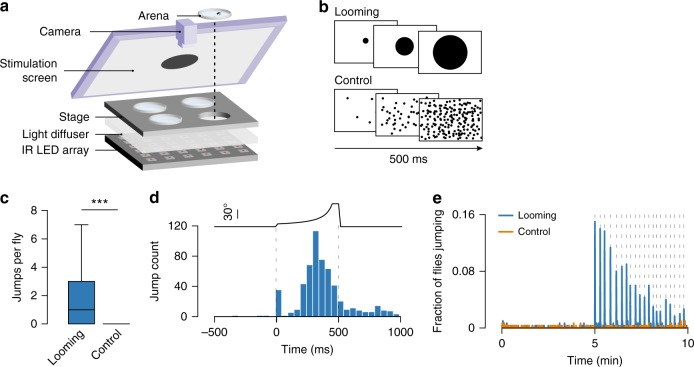
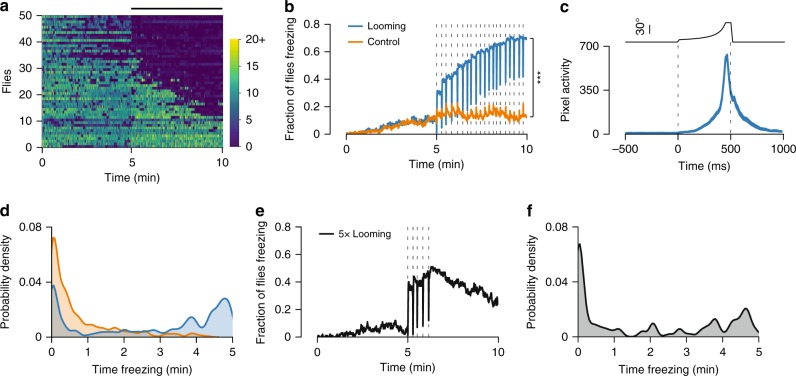
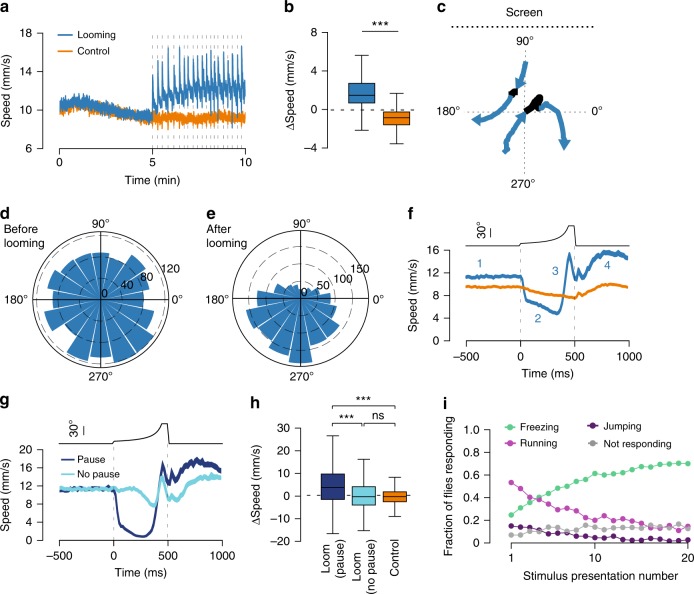
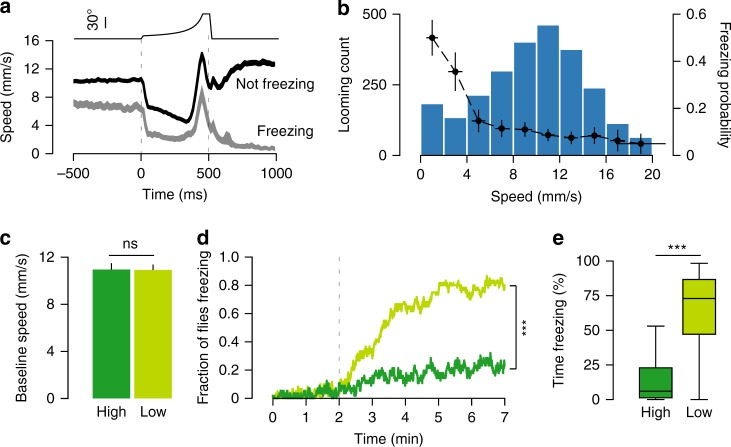
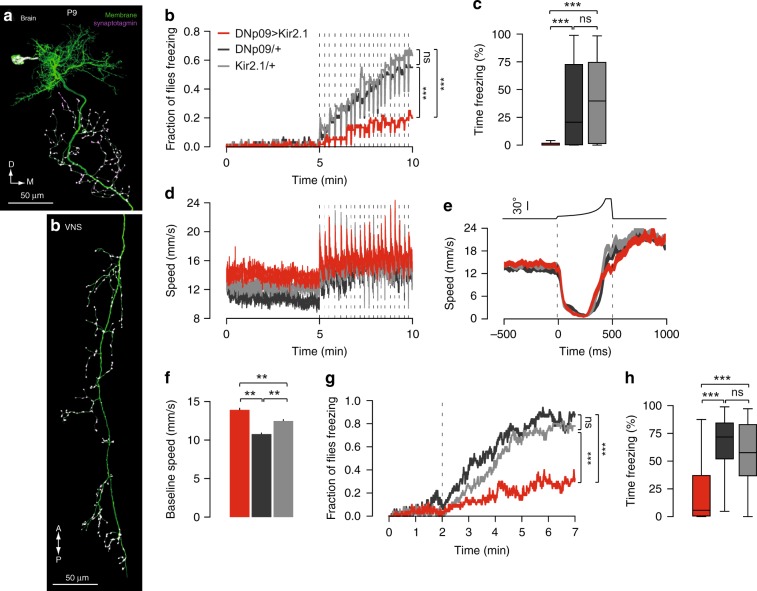
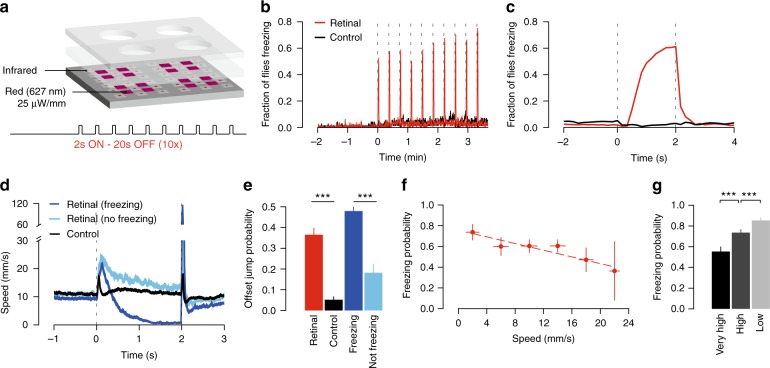
The most fundamental choice an animal has to make when it detects a threat is whether to freeze, reducing its chances of being noticed, or to flee to safety. Here we show that Drosophila melanogaster exposed to looming stimuli in a confined arena either freeze or flee. The probability of freezing versus fleeing is modulated by the fly's walking speed at the time of threat, demonstrating that freeze/flee decisions depend on behavioral state. We describe a pair of descending neurons crucially implicated in freezing. Genetic silencing of DNp09 descending neurons disrupts freezing yet does not prevent fleeing. Optogenetic activation of both DNp09 neurons induces running and freezing in a state-dependent manner. Our findings establish walking speed as a key factor in defensive response choices and reveal a pair of descending neurons as a critical component in the circuitry mediating selection and execution of freezing or fleeing behaviors.
Overview
The claims and statistics of this paper haven’t been checked yet.
Free: it reads the open-access text and checks the first 5 claims that cite a source we can check. Create a free account to check every claim.
Integrity signals
Registry
Cites
Statistics
Figures
Verification
Claims the paper makes
The claims and statistics of this paper haven’t been checked yet.
Free: it reads the open-access text and checks the first 5 claims that cite a source we can check. Create a free account to check every claim.
Claims other papers make about this one
Each is checked against this paper’s own text: does it say what the citing paper says it does?
The source backs part of the claim, not all of it — or backs it for a different population, condition or comparison.
In the citing paper
“many Drosophila descending neurons (DNs) involved in walking control are uniquely identifiable as individual right-left cell pairs28–34.”
From Fine-grained descending control of steering in walking Drosophila (2023) · cites this paper as [33]
Experimental — accuracy not yet measuredIn the citing paper
“This is another example where a DN (DNp09) represents a bridge between sensory integration and motor execution, and its activation instantiates the decision to run or halt [62].”
From Descending control of motor sequences in Drosophila (2024) · cites this paper as [62]
Self-check
Percentages, sums and reported differences re-computed from the paper’s own numbers.
The self-check needs the paper’s full text.
Citations
Cites
PsychoPy—Psychophysics software in Python
Peirce, J. W. (2007) · Journal of Neuroscience Methods · doi:10.1016/j.jneumeth.2006.11.017 · Cited by 4,603
Independent optical excitation of distinct neural populations
Klapoetke, N. C., Murata, Y., Kim, S. S., Pulver, S. R., Birdsey-Benson, A., Cho, Y. K., Morimoto, T. K., Chuong, A. S., Carpenter, E. J., Tian, Z., et al. (2014) · Nature Methods · doi:10.1038/nmeth.2836 · Cited by 2,344
Ventromedial hypothalamic neurons control a defensive emotion state
Kunwar, P. S., Zelikowsky, M., Remedios, R., Cai, H., Yilmaz, M., Meister, M., & Anderson, D. J. (2015) · eLife · doi:10.7554/elife.06633 · Cited by 1,101
Crouching as an index of fear.
Blanchard, R. J., & Blanchard, D. C. (1969) · Journal of Comparative and Physiological Psychology · doi:10.1037/h0026779 · Cited by 1,077
Neural organization of the defensive behavior system responsible for fear
Fanselow, M. S. (1994) · Psychonomic Bulletin & Review · doi:10.3758/bf03210947 · Cited by 1,000
Arousal and Locomotion Make Distinct Contributions to Cortical Activity Patterns and Visual Encoding
Vinck, M., Batista-Brito, R., Knoblich, U., & Cardin, J. A. (2015) · Neuron · doi:10.1016/j.neuron.2015.03.028 · Cited by 819
Risks and Rewards of Nest Defence by Parent Birds
Montgomerie, R. D., & Weatherhead, P. J. (1988) · The Quarterly Review of Biology · doi:10.1086/415838 · Cited by 816
Midbrain circuits for defensive behaviour
Tovote, P., Esposito, M. S., Botta, P., Chaudun, F., Fadok, J. P., Markovic, M., Wolff, S. B. E., Ramakrishnan, C., Fenno, L., Deisseroth, K., et al. (2016) · Nature · doi:10.1038/nature17996 · Cited by 732
Altered Electrical Properties in Drosophila Neurons Developing without Synaptic Transmission
Baines, R. A., Uhler, J. P., Thompson, A., Sweeney, S. T., & Bate, M. (2001) · The Journal of Neuroscience · doi:10.1523/jneurosci.21-05-01523.2001 · Cited by 634
Kim, J. J., Rison, R. A., & Fanselow, M. S. (1993) · Behavioral Neuroscience · doi:10.1037/0735-7044.107.6.1093 · Cited by 615
Cited by
Cognitive Control of Escape Behaviour
Evans, D. A., Stempel, A. V., Vale, R., & Branco, T. (2019) · Trends in Cognitive Sciences · doi:10.1016/j.tics.2019.01.012 · Cited by 241
Optogenetic dissection of descending behavioral control in Drosophila
Cande, J., Namiki, S., Qiu, J., Korff, W., Card, G. M., Shaevitz, J. W., Stern, D. L., & Berman, G. J. (2018) · eLife · doi:10.7554/elife.34275 · Cited by 163
Self-citationEscape responses of fish: a review of the diversity in motor control, kinematics and behaviour
Domenici, P., & Hale, M. E. (2019) · Journal of Experimental Biology · doi:10.1242/jeb.166009 · Cited by 155
Two brain pathways initiate distinct forward walking programs in Drosophila
Bidaye, S. S., Laturney, M., Chang, A. K., Liu, Y., Bockemühl, T., Büschges, A., & Scott, K. (2020) · Neuron · doi:10.1016/j.neuron.2020.07.032 · Cited by 109
Expressions of emotions across species
Zych, A. D., & Gogolla, N. (2021) · Current Opinion in Neurobiology · doi:10.1016/j.conb.2021.01.003 · Cited by 108
Distributed control circuits across a brain-and-cord connectome
Bates, A. S., Phelps, J. S., Kim, M., Yang, H. H., Matsliah, A., Ajabi, Z., Perlman, E., Delgado, K. M., Osman, M. A. M., Salmon, C. K., et al. (2026) · Nature · doi:10.1038/s41586-026-10735-w · Cited by 100
A functionally ordered visual feature map in the Drosophila brain
Klapoetke, N. C., Nern, A., Rogers, E. M., Rubin, G. M., Reiser, M. B., & Card, G. M. (2022) · Neuron · doi:10.1016/j.neuron.2022.02.013 · Cited by 98
“, 2016), freezing (Zacarias et al., 2018), or escape takeoff (Cheong et al.”
Self-citationEarly Life Experience Shapes Male Behavior and Social Networks in Drosophila
Bentzur, A., Ben-Shaanan, S., Benichou, J. I. C., Costi, E., Levi, M., Ilany, A., & Shohat-Ophir, G. (2020) · Current Biology · doi:10.1016/j.cub.2020.10.060 · Cited by 88
Leconstant, C., & Spitz, É. (2022) · Frontiers in Veterinary Science · doi:10.3389/fvets.2022.656833 · Cited by 76
Neural Circuits Underlying Behavioral Flexibility: Insights From Drosophila
Devineni, A. V., & Scaplen, K. M. (2022) · Frontiers in Behavioral Neuroscience · doi:10.3389/fnbeh.2021.821680 · Cited by 74
Behavioral and neuronal underpinnings of safety in numbers in fruit flies
Ferreira, C. H., & Moita, M. A. P. (2020) · Nature Communications · doi:10.1038/s41467-020-17856-4 · Cited by 70
Self-citationSalay, L. D., & Huberman, A. D. (2021) · Cell Reports · doi:10.1016/j.celrep.2021.109792 · Cited by 68
Synaptic gradients transform object location to action
Dombrovski, M., Peek, M. Y., Park, J.-Y., Vaccari, A., Sumathipala, M., Morrow, C., Breads, P., Zhao, A., Kurmangaliyev, Y. Z., Sanfilippo, P., et al. (2023) · Nature · doi:10.1038/s41586-022-05562-8 · Cited by 67
Self-citationNeural circuit mechanisms for steering control in walking Drosophila
Rayshubskiy, A., Holtz, S. L., Bates, A. S., Vanderbeck, Q. X., Capdevila, L. S., Rockwell, V., & Wilson, R. I. (2020) · doi:10.1101/2020.04.04.024703 · Cited by 64
Visual processing in the fly, from photoreceptors to behavior
Currier, T. A., Pang, M. M., & Clandinin, T. R. (2023) · GENETICS · doi:10.1093/genetics/iyad064 · Cited by 63
Creating and controlling visual environments using BonVision
Lopes, G., Farrell, K., Horrocks, E. A. B., Lee, C.-Y., Morimoto, M. M., Muzzu, T., Papanikolaou, A., Rodrigues, F. R., Wheatcroft, T., Zucca, S., et al. (2021) · eLife · doi:10.7554/elife.65541 · Cited by 61
Serotonergic modulation of walking in Drosophila
Howard, C. E., Chen, C.-L., Tabachnik, T., Hormigo, R., Ramdya, P., & Mann, R. S. (2019) · Current Biology · doi:10.1016/j.cub.2019.10.042 · Cited by 59
Ascending neurons convey behavioral state to integrative sensory and action selection brain regions
Chen, C.-L., Aymanns, F., Minegishi, R., Matsuda, V. D. V., Talabot, N., Günel, S., Dickson, B. J., & Ramdya, P. (2023) · Nature Neuroscience · doi:10.1038/s41593-023-01281-z · Cited by 58
“…roles for behavioral state signals in sensory contextualization (for example, flight 6 and walking 7 modulate neurons in the visual system 8,10 ) and action selection (for example, an animal’s walking speed regulates its decision to run or freeze in response to a fear-inducing stimulus 11 ).”
BackgroundMotor control on the move: from insights in insects to general mechanisms
Büschges, A., & Ache, J. M. (2024) · Physiological Reviews · doi:10.1152/physrev.00009.2024 · Cited by 58
Fine-grained descending control of steering in walking Drosophila
Yang, H. H., Brezovec, B. E., Serratosa Capdevila, L., Vanderbeck, Q. X., Adachi, A., Mann, R. S., & Wilson, R. I. (2024) · Cell · doi:10.1016/j.cell.2024.08.033 · Cited by 55
Fine-grained descending control of steering in walking Drosophila
Yang, H. H., Brezovec, L. E., Serratosa Capdevila, L., Vanderbeck, Q. X., Adachi, A., Mann, R. S., & Wilson, R. I. (2023) · doi:10.1101/2023.10.15.562426 · Cited by 55
Descending networks transform command signals into population motor control
Braun, J., Hurtak, F., Wang-Chen, S., & Ramdya, P. (2024) · Nature · doi:10.1038/s41586-024-07523-9 · Cited by 51
“Different studies have reported variable behavioural phenotypes for stimulating the DNp09-spGAL4 driver line: some saw forwards walking 3 , whereas others observed stopping or freezing 18,67 .”
Mating proximity blinds threat perception
Cazalé-Debat, L., Scheunemann, L., Day, M., Alquicira, T. F.-D. V., Dimtsi, A., Zhang, Y., Blackburn, L. A., Ballardini, C. H. M., Greenin‐Whitehead, K., Reynolds, E., et al. (2024) · Nature · doi:10.1038/s41586-024-07890-3 · Cited by 49
Aimon, S., Cheng, K. Y., Gjorgjieva, J., & Grunwald Kadow, I. C. (2023) · eLife · doi:10.7554/elife.85202 · Cited by 48
Object-Displacement-Sensitive Visual Neurons Drive Freezing in Drosophila
Tanaka, R., & Clark, D. A. (2020) · Current Biology · doi:10.1016/j.cub.2020.04.068 · Cited by 44
“We also saw no effect of silencing DNp09, a descending neuron that is implicated in loom induced freezing [69] and forward walking [29] and that is functionally connected to LC11 [29] (Figure S2K).”
BackgroundContext-dependent control of behavior in Drosophila
Oram, T. B., & Card, G. M. (2022) · Current Opinion in Neurobiology · doi:10.1016/j.conb.2022.02.003 · Cited by 44
Self-citationDescending neuron population dynamics during odor-evoked and spontaneous limb-dependent behaviors
Aymanns, F., Chen, C.-L., & Ramdya, P. (2022) · eLife · doi:10.7554/elife.81527 · Cited by 43
Campbell, N. G., Shekar, A., Aguilar, J. I., Peng, D., Navratna, V., Yang, D., Morley, A. N., Duran, A. M., Galli, G., O’Grady, B. J., et al. (2019) · Proceedings of the National Academy of Sciences · doi:10.1073/pnas.1816247116 · Cited by 43
Descending control of motor sequences in Drosophila
Simpson, J. H. (2024) · Current Opinion in Neurobiology · doi:10.1016/j.conb.2023.102822 · Cited by 33
“This is another example where a DN (DNp09) represents a bridge between sensory integration and motor execution, and its activation instantiates the decision to run or halt [62].”
Temporal vision: measures, mechanisms and meaning
Donner, K. (2021) · Journal of Experimental Biology · doi:10.1242/jeb.222679 · Cited by 33
Multi-regional circuits underlying visually guided decision-making in Drosophila
Cheong, H. S., Siwanowicz, I., & Card, G. M. (2020) · Current Opinion in Neurobiology · doi:10.1016/j.conb.2020.10.010 · Cited by 33
Self-citationOn the role of the head ganglia in posture and walking in insects
Emanuel, S., Kaiser, M., Pflueger, H.-J., & Libersat, F. (2020) · Frontiers in Physiology · doi:10.3389/fphys.2020.00135 · Cited by 31
“Activation of different DINs in Drosophila induces running or freezing in a state-dependent manner (Zacarias et al., 2018).”
BackgroundThreat Induces Changes in Cardiac Activity and Metabolism Negatively Impacting Survival in Flies
Barrios, N., Farias, M., & Moita, M. A. P. (2020) · Current Biology · doi:10.1016/j.cub.2021.10.013 · Cited by 31
Self-citationThe development and assembly of the Drosophila adult ventral nerve cord
Venkatasubramanian, L., & Mann, R. S. (2019) · Current Opinion in Neurobiology · doi:10.1016/j.conb.2019.01.013 · Cited by 28
Chen, J., Mandel, H. B., Fitzgerald, J. E., & Clark, D. A. (2019) · eLife · doi:10.7554/elife.47579 · Cited by 28
Neural Circuit Mechanisms Involved in Animals’ Detection of and Response to Visual Threats
Wu, Q., & Zhang, Y. (2023) · Neuroscience Bulletin · doi:10.1007/s12264-023-01021-0 · Cited by 26
Visual motion sensitivity in descending neurons in the hoverfly
Nicholas, S. J., Leibbrandt, R. E., & Nordström, K. (2020) · Journal of Comparative Physiology A · doi:10.1007/s00359-020-01402-0 · Cited by 25
Parallel locomotor control strategies in mice and flies
Gonçalves, A. I., Zavatone-Veth, J. A., Carey, M. R., & Clark, D. A. (2022) · Current Opinion in Neurobiology · doi:10.1016/j.conb.2022.01.001 · Cited by 23
Azimuthal invariance to looming stimuli in the Drosophila giant fiber escape circuit
Jang, H., Goodman, D. P., Ausborn, J., & von Reyn, C. R. (2023) · Journal of Experimental Biology · doi:10.1242/jeb.244790 · Cited by 23
Does Cognition Have a Role in Plasticity of “Innate Behavior”? A Perspective From Drosophila
Gorostiza, E. A. (2018) · Frontiers in Psychology · doi:10.3389/fpsyg.2018.01502 · Cited by 23
Jin, L., Wang, S., Chen, C., Qiu, X., & Wang, C. (2023) · Antioxidants · doi:10.3390/antiox12071345 · Cited by 23
Play-like behavior exhibited by the vinegar fly Drosophila melanogaster
Triphan, T., Ferreira, C. H., & Huetteroth, W. (2025) · Current Biology · doi:10.1016/j.cub.2025.01.025 · Cited by 22
Early Life Experience Shapes Male Behavior and Social Networks in Drosophila
Bentzur, A., Ben-Shaanan, S., Benichou, J. I. C., Costi, E., Levi, M., Ilany, A., & Shohat-Ophir, G. (2021) · Current Biology · doi:10.1016/j.cub.2020.11.036 · Cited by 18
A cerebellar-prepontine circuit for tonic immobility triggered by an inescapable threat
Bhandiwad, A. A., Chu, N., Semenova, S. A., Holmes, G., & Burgess, H. A. (2022) · Science Advances · doi:10.1126/sciadv.abo0549 · Cited by 17
Mechanisms of vision in the fruit fly
de Andres-Bragado, L., & Sprecher, S. G. (2019) · Current Opinion in Insect Science · doi:10.1016/j.cois.2019.06.005 · Cited by 17
Serotonin distinctly controls behavioral states in restrained and freely moving Drosophila
Gowda, S. B. M., Banu, A., Salim, S., Claridge‐Chang, A., Peker, K. A., & Mohammad, F. (2022) · iScience · doi:10.1016/j.isci.2022.105886 · Cited by 16
Recent advances in insect vision in a 3D world: looming stimuli and escape behaviour
Rind, F. C. (2024) · Current Opinion in Insect Science · doi:10.1016/j.cois.2024.101180 · Cited by 15
Heinemans, M., & Moita, M. A. P. (2024) · Scientific Reports · doi:10.1038/s41598-024-70256-2 · Cited by 13
Self-citationSato, D. X., & Takahashi, Y. (2025) · Nature Communications · doi:10.1038/s41467-025-61313-z · Cited by 13
Social Cues of Safety Can Override Differences in Threat Level
Ferreira, C. H., Heinemans, M., Farias, M., Gonçalves, R., & Moita, M. A. P. (2022) · Frontiers in Ecology and Evolution · doi:10.3389/fevo.2022.885795 · Cited by 11
Self-citationThe visuomotor transformations underlying target-directed behavior
Zhao, P., Tong, Y., Lazarte, I. P., Khan, B., Tian, G., Chen, K. K. Y., Lam, T. K. C., Hu, Y., & Semmelhack, J. L. (2025) · Proceedings of the National Academy of Sciences · doi:10.1073/pnas.2416215122 · Cited by 11
Neural Control of Naturalistic Behavior Choices
Asinof, S. K., & Card, G. M. (2024) · Annual Review of Neuroscience · doi:10.1146/annurev-neuro-111020-094019 · Cited by 10
Self-citationNeuronal mechanisms regulating locomotion in adult Drosophila
Gowda, S. B. M., Banu, A., Hussain, S., & Mohammad, F. (2024) · Journal of Neuroscience Research · doi:10.1002/jnr.25332 · Cited by 9
Threatening stimuli elicit a sequential cardiac pattern in arthropods
Pérez-Schuster, V., Salomon, L., Bengochea, M., Basnak, M. A., Duarte, F. V., Hermitte, G., & de Astrada, M. B. (2023) · iScience · doi:10.1016/j.isci.2023.108672 · Cited by 9
Oliva, D., Gültig, M., Cámera, A., & Tomsic, D. (2024) · Journal of Experimental Biology · doi:10.1242/jeb.248124 · Cited by 8
Foot placement control underlies stable locomotion across species
Comite, A. D., & Seethapathi, N. (2025) · Proceedings of the National Academy of Sciences · doi:10.1073/pnas.2413958122 · Cited by 8
Motor state changes escape behavior of crickets
Kiuchi, K., Shidara, H., Iwatani, Y., & Ogawa, H. (2023) · iScience · doi:10.1016/j.isci.2023.107345 · Cited by 6
Neurons with names: Descending control and sensorimotor processing in insect motor control
Büschges, A., & Gorostiza, E. A. (2023) · Current Opinion in Neurobiology · doi:10.1016/j.conb.2023.102766 · Cited by 6
Moulin, T. C., Dey, S., Dashi, G., Li, L., Sridhar, V., Safa, T., Berkins, S., Williams, M. J., & Schiöth, H. B. (2022) · BMC Biology · doi:10.1186/s12915-022-01476-z · Cited by 6
Mice employ a bait-and-switch escape mechanism to de-escalate social conflict
Clein, R. S., Warren, M. R., & Neunuebel, J. P. (2024) · PLoS Biology · doi:10.1371/journal.pbio.3002496 · Cited by 6
Fear Conditioning in Laboratory Rodents
Müller, I., & Fendt, M. (2022) · Neuromethods · doi:10.1007/978-1-0716-2748-8_8 · Cited by 5
Rapid threat assessment in the Drosophila thermosensory system
Jouandet, G. C., Alpert, M. H., Simões, J. M., Suhendra, R., Frank, D. D., Levy, J. I., Para, A., Kath, W. L., & Gallio, M. (2023) · Nature Communications · doi:10.1038/s41467-023-42864-5 · Cited by 5
Bottlenecks, Modularity, and the Neural Control of Behavior
Nande, A., Dubinkina, V. B., Ravasio, R., Zhang, G. H., & Berman, G. J. (2022) · Frontiers in Behavioral Neuroscience · doi:10.3389/fnbeh.2022.835753 · Cited by 5
An updated catalogue of split-GAL4 driver lines for descending neurons in Drosophila melanogaster
Zung, J. L., Namiki, S., Meissner, G. W., Cheong, H. S. J., Costa, M., Eichler, K., Stürner, T., Jefferis, G. S. X. E., Managan, C., FlyLight Project Team, et al. (2025) · doi:10.1101/2025.02.22.639679 · Cited by 4
“This covered roughly half of the ~700 total DNs we estimated at the time based on counting DN cell bodies using a pan-neuronally expressed photoactivatable GFP.”
Self-citationMou, Y., Zhang, Y., Zheng, Y., He, G., Xu, Z., Xiao, X., & Ping, Y. (2024) · Advanced Science · doi:10.1002/advs.202411768 · Cited by 4
Flexible self-protection as evidence of pain-like states in house crickets
Manzi, O., Lynch, K. E., Allman, D. M., Latty, T. M., & White, T. E. (2026) · Proceedings of the Royal Society B Biological Sciences · doi:10.1098/rspb.2026.0609 · Cited by 4
Visually-guided defensive behaviors in triatomines (Heteroptera: Reduviidae)
Chialina, T. M., Vidal, B. L., Minoli, S. A., & de Astrada, M. B. (2025) · Journal of Insect Physiology · doi:10.1016/j.jinsphys.2025.104862 · Cited by 4
Genetic heterogeneity induces non-additive behavioural changes in Drosophila
Okuyama, T., Sato, D. X., & Takahashi, Y. (2025) · Journal of Experimental Biology · doi:10.1242/jeb.249449 · Cited by 4
Nishino, H., & Sakai, M. (2021) · Entomology monographs · doi:10.1007/978-981-33-6598-8_7 · Cited by 4
Covert muscle activity reveals dynamic freezing states and prepares the animal for actionPreprint
Hobbiss, A. F., Franco, M. C., Medeiros, A. M., Rosher, C., Mendes, C. S., & Moita, M. A. (2024) · bioRxiv (Cold Spring Harbor Laboratory) · doi:10.1101/2024.11.26.622641 · Cited by 3
Self-citationTonic Immobility in a Cricket: Neuronal Underpinnings of Global Motor Inhibition
Nishino, H. (2021) · Entomology monographs · doi:10.1007/978-981-33-6598-8_8 · Cited by 3
Luo, L., Hina, B. W., McFarland, B. W., Saunders, J. C., Smolin, N., & von Reyn, C. R. (2022) · PLoS ONE · doi:10.1371/journal.pone.0267834 · Cited by 3
Bak, C., Boutin, A., Gauzin, S., Lejards, C., Rampon, C., & Florian, C. (2024) · Scientific Reports · doi:10.1038/s41598-024-76884-y · Cited by 3
Multifaceted and extensive behavioral trajectories of genomically diverse Drosophila lines
Sato, D. X., Okuyama, T., & Takahashi, Y. (2025) · Scientific Data · doi:10.1038/s41597-025-04724-3 · Cited by 3
Drosophila DNp03 descending neurons serve as a hub within a flight saccade network
Croke, H., Jang, H., Ludlow, B. K., Leung, A., Eichler, K., Stürner, T., Costa, M., Cohen, I., Ausborn, J., & von Reyn, C. R. (2025) · Current Biology · doi:10.1016/j.cub.2025.11.035 · Cited by 2
Male courtship song drives escape responses that are suppressed for successful mating
Arez, E., Mezzera, C., Neto-Silva, R. M., Aranha, M. M., Dias, S., Moita, M. A. P., & Vasconcelos, M. L. (2021) · Scientific Reports · doi:10.1038/s41598-021-88691-w · Cited by 2
Self-citationAn updated catalogue of split-GAL4 driver lines for descending neurons in Drosophila melanogasterPreprint
Zung, J. L., Namiki, S., Meissner, G. W., Cheong, H. S., Costa, M., Eichler, K., Stürner, T., Jefferis, G. S. X. E., Managan, C., FlyLight Project Team, et al. (2025) · eLife · doi:10.7554/elife.107450.1 · Cited by 2
Self-citationHoverfly responses to looming stimuli depend on elevation and speed
Young, A. H., Mitchell, J., Klinge, K. S., Barron, A. B., Ogawa, Y., & Nordström, K. (2026) · Journal of Experimental Biology · doi:10.1242/jeb.252884 · Cited by 2
Descending Neuron for Freezing Behavior in Drosophila melanogaster
Namiki, S. (2021) · Entomology monographs · doi:10.1007/978-981-33-6598-8_10 · Cited by 2
Self-citationHawke, A. (2022) · Otago University Research Archive (University of Otago) · Cited by 2
Okuyama, T., Sato, D. X., & Takahashi, Y. (2026) · iScience · doi:10.1016/j.isci.2026.116171 · Cited by 1
Lueningschroer-Wang, Y., Derksen, E., Wilde, H., Steigmeier, M., & Wegener, C. (2026) · eLife · doi:10.1101/2025.02.28.640745 · Cited by 1
Lueningschroer-Wang, Y., Derksen, E., Wilde, H., Steigmeier, M., & Wegener, C. (2025) · eLife · doi:10.7554/elife.107110.1 · Cited by 1
Kajtor, M., Billes, V., Király, B., Karkusova, P., Kovács, T., Stabb, H., Sviatkó, K., Vizi, A., Ujvári, E., Balázsfi, D., et al. (2025) · eLife · doi:10.7554/elife.90905 · Cited by 1
Kajtor, M., Billes, V., Király, B., Karkusova, P., Kovács, T., Stabb, H., Sviatkó, K., Vizi, A., Ujvári, E., Balázsfi, D., et al. (2025) · eLife · doi:10.1101/2023.08.29.555311 · Cited by 1
Feature encoding: How back-to-front motion guides the polite fly
von Reyn, C. R. (2022) · Current Biology · doi:10.1016/j.cub.2022.04.078 · Cited by 1
An updated catalogue of split-GAL4 driver lines for descending neurons in Drosophila melanogasterPreprint
Zung, J. L., Namiki, S., Meissner, G. W., Cheong, H. S., Costa, M., Eichler, K., Stürner, T., Jefferis, G. S. X. E., Managan, C., FlyLight Project Team, et al. (2025) · eLife · doi:10.7554/elife.107450 · Cited by 1
Self-citationNash equilibrium of attack and defense behaviors between predators and prey
Ichijo, H., Kawamura, Y., & Nakamura, T. (2025) · PLoS Computational Biology · doi:10.1371/journal.pcbi.1013730 · Cited by 1
Sensorimotor behavior from an untrained brain-and-nerve-cord connectomePreprint
Minnick, J., Gonzalez-Ferrer, J., Geng, J., Eshraghian, J. K., Mostajo-Radji, M. A., Haussler, D., & Teodorescu, M. (2026) · arXiv (Cornell University) · doi:10.48550/arxiv.2610.33881 · Cited by 1
Contactless Acoustic Trapping of Hoverflies for Behavioral Studies
Gaillard, T., Contreras, V., Martinez, D., & Viollet, S. (2026) · Annals of the New York Academy of Sciences · doi:10.1111/nyas.70281 · Cited by 1
Lueningschroer-Wang, Y., Derksen, E., Wilde, H., Steigmeier, M., & Wegener, C. (2026) · eLife · doi:10.7554/elife.107110
Kajtor, M., Billes, V., Király, B., Karkusova, P., Kovács, T., Stabb, H., Sviatkó, K., Vizi, A., Ujvári, E., Balázsfi, D., et al. (2025) · eLife · doi:10.7554/elife.90905.2
Fast adaptation in invertebrate looming-sensitive descending neuronsPreprint
Klinge, K. S., & Nordström, K. (2025) · bioRxiv (Cold Spring Harbor Laboratory) · doi:10.1101/2025.02.10.637552
Kajtor, M., Billes, V., Király, B., Stabb, H., Sviatkó, K., Ujvári, E., Balázsfi, D., Seidenbecher, S. E., Kvitsiani, D., Vellai, T., et al. (2024) · eLife · doi:10.7554/elife.90905.1
Sensory biology: Olfactory crosstalk reshapes odor coding
Devineni, A. V. (2022) · Current Biology · doi:10.1016/j.cub.2022.08.077
Oxytocinergic modulation of social information use in threat perception
Akinrinade, I. D. (2020) · Portuguese National Funding Agency for Science, Research and Technology (RCAAP Project by FCT)
A genetic model for neurorehabilitation
Custódio, R. D. (2019) · Portuguese National Funding Agency for Science, Research and Technology (RCAAP Project by FCT)
Serotonin Signaling Modulates Health and Lifespan in Drosophila melanogaster
Munneke, A. S. (2022) · Deep Blue (University of Michigan) · doi:10.7302/6799
Metadata
- Authors
- Zacarias, R., Namiki, S., Card, G. M., Vasconcelos, M. L., & Moita, M. A.
- Affiliations
- Centro Champalimaud (PT)
- Howard Hughes Medical Institute (US)
- Corresponding author
- Moita, Marta A.
- Venue
- Nature Communications
- Published
- 2018-09-12
- Volume
- 9
- Issue
- 1
- Pages
- 3697-3697
- ISSN
- 2041-1723 (ISSN-L)
- PMC
- PMC6135764
- OpenAlex
- W2951044964
- Cited by
- 106
- References
- 61
- Citations by year
- 2026: 11 · 2025: 17 · 2024: 19 · 2023: 14 · 2022: 16 · 2021: 11 · 2020: 9 · 2019: 7 · 2018: 2
- FWCI
- 3.27
- Type
- journal article
- Language
- en
- Open access
- gold
- doi.org
- Licence
- cc-by
- creativecommons.org/licenses/by/4.0 (tdm)
- creativecommons.org/licenses/by/4.0 (vor)
- Locations
- Nature Communications (publishedVersion, cc-by)
- Europe PMC (PubMed Central) (publishedVersion, other-oa)
- PubMed Central (publishedVersion, cc-by)
- PubMed (publishedVersion)
- RePEc: Research Papers in Economics (submittedVersion)
- DOAJ (DOAJ: Directory of Open Access Journals) (submittedVersion, cc-by-sa)
- DOAJ (DOAJ: Directory of Open Access Journals) (submittedVersion)
- Funders
- Ministry of Education and Science | Fundação para a Ciência e a Tecnologia (SFRH/BD/51897/2012)
- EC | European Research Council (StG CoCO337747)
- Topics
- Life Sciences › Neuroscience › Cellular and Molecular Neuroscience › Neurobiology and Insect Physiology Research
- Life Sciences › Neuroscience › Cellular and Molecular Neuroscience › Neuroscience and Neuropharmacology Research
- Life Sciences › Neuroscience › Cognitive Neuroscience › Memory and Neural Mechanisms
- Keywords
- freezing behavior, Drosophila melanogaster, descending neurons, walking speed, behavioral state, threat response, looming stimuli, defensive behavior, optogenetic stimulation
- MeSH terms
- Animals, Behavior, Animal, Drosophila melanogaster, Escape Reaction, Neurons, Optogenetics
About these checks
Registry, retraction, Cites and statistics results are computed, not judged, with one exception: a printed reference that no index lists is read once by a model before it counts as a citation error. Claims are extracted by a model and kept only when their quote appears verbatim in the text; each cited source is then checked, with a model’s help, for whether it says what the claim relies on. Those verdicts can be wrong — read the claim’s quote and the cited source before relying on one.
Statistics and arithmetic are recomputed, not judged.
Confidence bands are shown only for fields calibrated on our annotated test set. None is calibrated yet, so no band is shown.
What counts as a claim ›How we measure confidence ›How we check this ›
Are you an author, or do you see a problem with this page? Request a review
Data sources
Bibliographic data: Semantic Scholar, OpenAlex, Crossref.
Contains information from the Semantic Scholar Academic Graph Datasets, made available under the ODC Attribution License (ODC-BY 1.0).
Semantic Scholar’s data is described in: Kinney, R., et al. (2023). The Semantic Scholar Open Data Platform. arXiv:2301.10140.
