

The DOI matches its Crossref record; 48 of the 48 references it cites were found in a registry or an index.
Copper-on-nitride enhances the stable electrosynthesis of multi-carbon products from CO2
Open accessAbstract
Copper-based materials are promising electrocatalysts for CO 2 reduction. Prior studies show that the mixture of copper (I) and copper (0) at the catalyst surface enhances multi-carbon products from CO 2 reduction; however, the stable presence of copper (I) remains the subject of debate. Here we report a copper on copper (I) composite that stabilizes copper (I) during CO 2 reduction through the use of copper nitride as an underlying copper (I) species. We synthesize a copper-on-nitride catalyst that exhibits a Faradaic efficiency of 64 ± 2% for C 2+ products. We achieve a 40-fold enhancement in the ratio of C 2+ to the competing CH 4 compared to the case of pure copper. We further show that the copper-on-nitride catalyst performs stable CO 2 reduction over 30 h. Mechanistic studies suggest that the use of copper nitride contributes to reducing the CO dimerization energy barrier—a rate-limiting step in CO 2 reduction to multi-carbon products.
Overview
The claims and statistics of this paper haven’t been checked yet.
Run the check — free, no account needed. It reads the open-access text and checks the sources it cites.
Integrity signals
Registry
Cites
Statistics
Figures
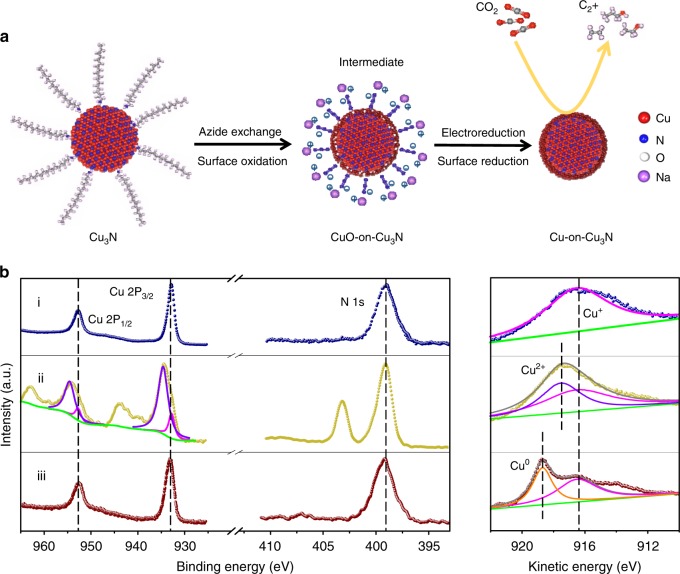
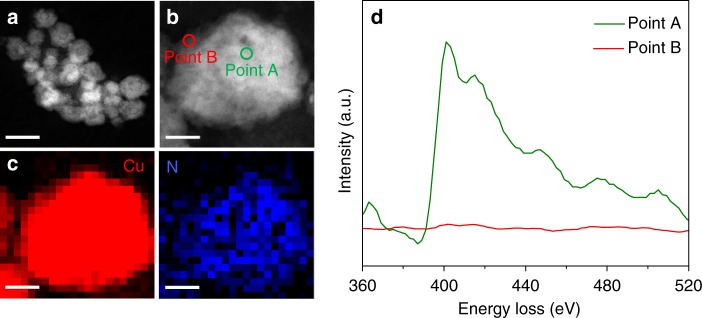
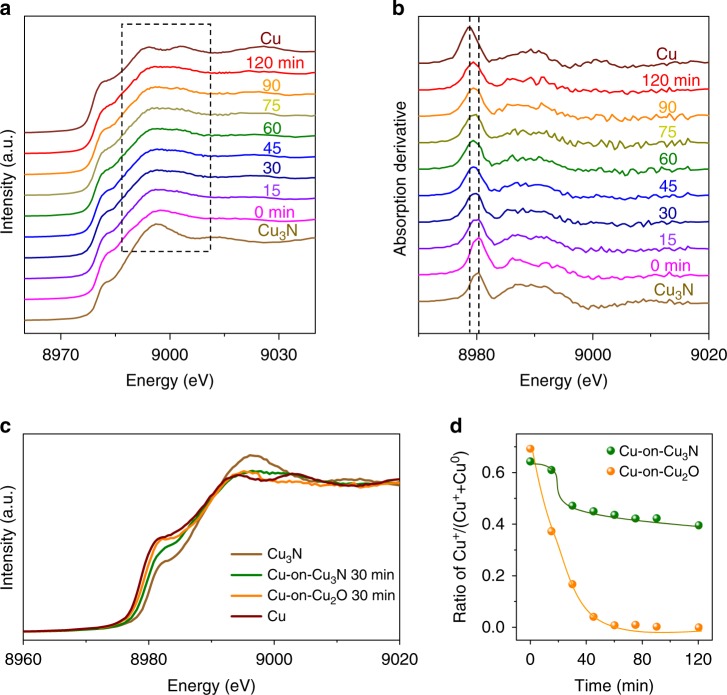
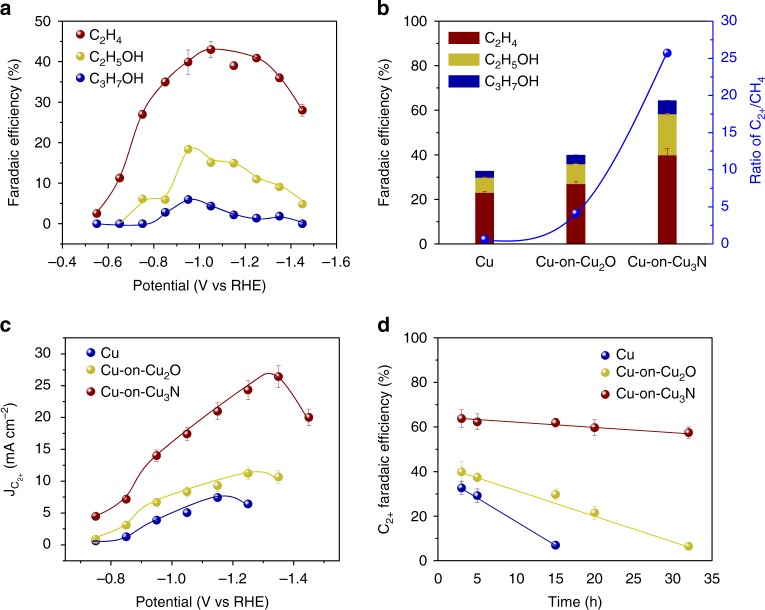
Verification
Claims the paper makes
The claims and statistics of this paper haven’t been checked yet.
Run the check — free, no account needed. It reads the open-access text and checks the sources it cites.
Claims other papers make about this one
Each is checked against this paper’s own text: does it say what the citing paper says it does?
In the citing paper
“Thus, by altering the reaction environment through increased electric fields (e.g.larger cations in the electrolyte), increased CO coverage (e.g. higher CO2 pressure), and/or increased catalyst strain (e.g.engineering a core-shell structure [63] ) it is possible to improve the catalytic activity towards multi-carbon products.”
From Electrochemical CO 2 Reduction into Chemical Feedstocks: From Mechanistic Electrocatalysis Models to System Design (2019) · cites this paper as [63]
Self-check
Percentages, sums and reported differences re-computed from the paper’s own numbers.
The self-check needs the paper’s full text.
Citations
Cites
Modern Aspects of Electrochemistry
Bockris, J. O., White, R. E., & Conway, B. E. (2002) · Kluwer Academic Publishers eBooks · doi:10.1007/b114168 · Cited by 5,954
How copper catalyzes the electroreduction of carbon dioxide into hydrocarbon fuels
Peterson, A. A., Abild-Pedersen, F., Studt, F., Rossmeisl, J., & Nørskov, J. K. (2010) · Energy & Environmental Science · doi:10.1039/c0ee00071j · Cited by 3,784
New insights into the electrochemical reduction of carbon dioxide on metallic copper surfaces
Kuhl, K. P., Cave, E. R., Abram, D. N., & Jaramillo, T. F. (2012) · Energy & Environmental Science · doi:10.1039/c2ee21234j · Cited by 3,160
A review of catalysts for the electroreduction of carbon dioxide to produce low-carbon fuels
Qiao, J., Liu, Y., Hong, F., & Zhang, J. (2014) · Chem. Soc. Rev. · doi:10.1039/c3cs60323g · Cited by 2,990
Lattice-strain control of the activity in dealloyed core–shell fuel cell catalysts
Strasser, P., Koh, S., Anniyev, T., Greeley, J., More, K., Yu, C., Liu, Z., Kaya, S., Nordlund, D., Ogasawara, H., et al. (2010) · Nature Chemistry · doi:10.1038/nchem.623 · Cited by 2,984
Wang, D., Xin, H. L., Hovden, R., Wang, H., Yu, Y., Muller, D. A., DiSalvo, F. J., & Abruña, H. D. (2013) · Nature Materials · doi:10.1038/nmat3458 · Cited by 2,082
Li, C. W., & Kanan, M. W. (2012) · Journal of the American Chemical Society · doi:10.1021/ja3010978 · Cited by 2,000
Non-fermentative pathways for synthesis of branched-chain higher alcohols as biofuels
Atsumi, S., Hanai, T., & Liao, J. C. (2008) · Nature · doi:10.1038/nature06450 · Cited by 1,945
Electroreduction of carbon monoxide to liquid fuel on oxide-derived nanocrystalline copper
Li, C. W., Ciston, J., & Kanan, M. W. (2014) · Nature · doi:10.1038/nature13249 · Cited by 1,728
Highly selective plasma-activated copper catalysts for carbon dioxide reduction to ethylene
Mistry, H., Varela, A. S., Bonifacio, C. S., Zegkinoglou, I., Sinev, I., Choi, Y.-W., Kisslinger, K., Stach, E. A., Yang, J. C., Strasser, P., et al. (2016) · Nature Communications · doi:10.1038/ncomms12123 · Cited by 1,214
Research works printed but not linked: 1
- Papa, A. J. in Ullmann’s Encyclopedia of Industrial Chemistry (Wiley-VCH Verlag GmbH & Co. KGaA, South Charleston, 2000).
Cited by
Sorted by citations
Items 301–393 of 393
Dong, Z., He, Y.-Q., Ou-Yang, H., Zhang, J.-D., Zhang, G., & Han, S. (2024) · Nano Letters · doi:10.1021/acs.nanolett.4c01624 · Cited by 9
Cai, P., Weng, W., Han, Y., Li, X., Lu, Z., & Wen, Z. (2024) · Journal of Colloid and Interface Science · doi:10.1016/j.jcis.2024.11.027 · Cited by 9
Chen, S., Wang, Z., Zhang, Q., Qiu, S., Liu, Y., Hu, G., Luo, J. S., & Liu, X. (2024) · Chemistry - A European Journal · doi:10.1002/chem.202404129 · Cited by 8
Synthetic tuning produces multi-junctions of copper for efficient electroreduction of carbon dioxide
Tabassum, H., Chen, W., Ma, B., Feng, L., Yang, X., Li, Y., Lucero, M., Lyons, M. P., Feng, Z., Hwang, S., et al. (2024) · Applied Catalysis B: Environmental · doi:10.1016/j.apcatb.2024.124922 · Cited by 8
Self-citationStrategies for Enhancing Stability in Electrochemical CO2 Reduction
Zhong, K., Xue, J., Ji, Y., Jiang, Q. M., Zheng, T., & Xia, C. (2025) · Chemistry - An Asian Journal · doi:10.1002/asia.202500174 · Cited by 8
Zhao, R., Li, D., Qu, S., Han, X., Utomo, W. P., Halappa, N. M., Ng, Y. H., & Wu, H. (2026) · Separation and Purification Technology · doi:10.1016/j.seppur.2026.136911 · Cited by 8
Stabilizing Cu Catalysts for Electrochemical CO2 Reduction Using a Carbon Overlayer
Li, M., Kuang, S., Liu, H., Fan, Q., Zhang, S., & Ma, X. (2023) · The Journal of Physical Chemistry C · doi:10.1021/acs.jpcc.2c08305 · Cited by 8
Dopant‐Induced Electronic States Regulation Boosting Electroreduction of Dilute Nitrate to Ammonium
Zhang, L., Jia, Y., Zhan, J., Liu, G., Liu, G., Li, F., & Yu, F. (2023) · Angewandte Chemie · doi:10.1002/ange.202303483 · Cited by 8
Self-citationSurface nitrided CuBi2O4 electrocatalysts with excellent selectivity for CO2 reduction to methanol
Ma, L., Liu, H., Song, Y., Yang, C., Yu, H.-J., Zhou, Y., & Zhang, Y. (2024) · Applications of Surface Science · doi:10.1016/j.apsusc.2024.160215 · Cited by 6
Self-citationCombining experimental and theoretical insights for reduction of CO2 to multi-carbon compounds
Brewis, I., Shahzad, R. F., Field, R. W., Jedidi, A., & Rasul, S. (2022) · Discover Chemical Engineering · doi:10.1007/s43938-022-00009-y · Cited by 8
Carbonized Yolk-shell Metal-Organic Frameworks for Electrochemical Conversion of CO2 into Ethylene
Wang, R., Li, T., Gao, R., Qin, J., Li, M., Guo, Y., & Song, Y. (2022) · Chemical Research in Chinese Universities · doi:10.1007/s40242-022-2149-z · Cited by 8
Wang, X., Lv, X., Zheng, G., & Fu, Y. (2022) · EnergyChem · doi:10.1016/j.enchem.2022.100086 · Cited by 8
Engineering regulated catalysts for electrocatalytically driven CO2 preparation of ethanol
Yang, G., Liang, J., & Wang, F. (2024) · Applied Catalysis A General · doi:10.1016/j.apcata.2024.119828 · Cited by 7
Lattice Strain Engineering Boosts CO2 Electroreduction to C2+ Products
Jiao, J., Kang, X., Yang, J., Jia, S., Chen, X. D., Peng, Y., Chen, C., Xing, X., Chen, Z., He, M., et al. (2024) · Angewandte Chemie · doi:10.1002/ange.202409563 · Cited by 7
Yang, S., Shen, Y., Mao, X., Li, C., Liu, Z., Wang, B., Zhu, D., Li, H., & Li, C. (2025) · AIChE Journal · doi:10.1002/aic.18829 · Cited by 8
Liu, L., Li, Y., Chiaw, K. A., Xi, S., Cheng, S., Dighe, S. U., Chang, H., Tay, B. Y., Tan, M., Huang, K., et al. (2025) · Angewandte Chemie International Edition · doi:10.1002/anie.202506184 · Cited by 7
Self-citationQiao, T., Cui, L., Peng, L., Zeng, Y., Kuang, J., Qiu, R., Hao, W., Guo, Y., Xue, T., Shao, Z., et al. (2025) · Carbon and Hydrogen · doi:10.1002/cbh2.70025 · Cited by 7
Self-citationLiu, Y., Wang, Z., Liao, P., & Chen, X. (2022) · Chemistry - An Asian Journal · doi:10.1002/asia.202200764 · Cited by 7
Du, H., Li, H., Wu, D., Nie, N., Yang, Y. L., Yang, B., Lai, J., & Wang, L. (2024) · Journal of Catalysis · doi:10.1016/j.jcat.2024.115304 · Cited by 7
Feng, C., Duan, R., Chi, H., Liu, F., Song, R., Li, M., Yu, W., Ding, C., & Li, C. (2024) · Chemical Communications · doi:10.1039/d4cc01254b · Cited by 7
Ligand Isomerization Driven Electrocatalytic Switching
Kottaichamy, A. R., Nazrulla, M. A., Parmar, M., Thimmappa, R., Devendrachari, M. C., Vinod, C. P., Volokh, M., Kotresh, H. M. N., Shalom, M., & Thotiyl, M. O. (2024) · Angewandte Chemie · doi:10.1002/ange.202405664 · Cited by 7
Moon, H. S., Yang, Y.-J., Zewdie, G. M., Youn, G., Chen, Y.-A., Chang, Y., Hsiao, K., Lin, T., Lin, Y., Park, J. K., et al. (2025) · Chemical Engineering Journal · doi:10.1016/j.cej.2025.163915 · Cited by 7
Sahoo, G. (2021) · Physica B Condensed Matter · doi:10.1016/j.physb.2021.413238 · Cited by 7
The effect of Cu oxidation states on C2H4 production from electrochemical CO2 conversion
Park, G., Kim, H., Han, G. H., Ha, J., Seo, J. Y., Kang, M., Seo, M., Choi, Y., Kim, S. Y., & Ahn, . H. (2023) · Journal of CO2 Utilization · doi:10.1016/j.jcou.2023.102569 · Cited by 6
Gao, G., Zhang, Y., Chen, F., Xu, M., Sun, C. L., Song, Y., Wang, W., Lu, F., Dong, H. Y., Liu, H., et al. (2025) · Journal of Alloys and Compounds · doi:10.1016/j.jallcom.2025.182065 · Cited by 6
Tomc, B., Kostelec, M., Plut, M., Šket, P., Finšgar, M., Šala, M., Nuhanović, M., Ruiz‐Zepeda, F., Strmcnik, D. S., Bele, M., et al. (2026) · Journal of CO2 Utilization · doi:10.1016/j.jcou.2026.103358 · Cited by 6
Yan, Y., Lei, B., Wang, X., Yao, T., Xu, P., & Song, B. (2024) · ACS Applied Materials & Interfaces · doi:10.1021/acsami.3c18238 · Cited by 6
Real‐Time Carbon Monoxide Detection using a Rotating Gold Ring Electrode: A Feasibility Study
Wu, K., Zhang, Q., Lin, Y., Ali, M. A., Zhao, S., Heumann, S., & Centi, G. (2020) · ChemElectroChem · doi:10.1002/celc.202001263 · Cited by 6
Self-citationWang, S., Zhang, J., Zhao, Y., Zhong, J., Chen, Z., Yang, Y., Han, B., Cheng, Y., Li, M., & Li, Q. (2025) · Green Chemistry · doi:10.1039/d4gc06563h · Cited by 5
Tomc, B., Hotko, M., Marsel, A., Maselj, N., Svete, M., Suhadolnik, L., Bele, M., Martins, P. F. B. D., Strmcnik, D. S., Gaberšček, M., et al. (2025) · ACS electrochemistry. · doi:10.1021/acselectrochem.5c00368 · Cited by 5
Engineering Long-Lasting Electron Buffer of Nanoalloys toward Overall Water Splitting of Nitrides
Zuo, P., Li, N., Lu, J., Wen, Z., Lin, H., Duan, X., & Wang, R. (2025) · ACS Sustainable Chemistry & Engineering · doi:10.1021/acssuschemeng.5c06945 · Cited by 5
Chen, Q., Zhu, H., Guo, Z., Yan, Z., Yang, G., Zheng, Y., Xing, Y., Yin, H., & Wu, T. (2024) · Journal of Alloys and Compounds · doi:10.1016/j.jallcom.2024.174475 · Cited by 5
Choe, S., Kim, J., Kim, S. Y., & Ahn, . H. (2024) · Journal of Alloys and Compounds · doi:10.1016/j.jallcom.2024.176194 · Cited by 5
Xie, S., Deng, C., Huang, Q., Zhang, C., Chen, C., Zhao, J., & Sheng, H. (2023) · Angewandte Chemie · doi:10.1002/ange.202216717 · Cited by 5
Positive Valent Metal Sites in Electrochemical CO2 Reduction Reaction
Li, W. J., Lou, Z. X., Zhao, J. Y., Liu, P. F., Yuan, H., & Yang, H. G. (2023) · ChemPhysChem · doi:10.1002/cphc.202200657 · Cited by 5
Mechanistic insights into the support effects of Cu catalysts in hydrogen combustion
Zhang, X., Fei, N., Sang, K., Chen, W., Qian, G., Zhang, J., Chen, D., Zhou, X., Duan, X., & Yuan, W. (2024) · Cell Reports Physical Science · doi:10.1016/j.xcrp.2024.102014 · Cited by 5
Song, Y., Junqueira, J. R. C., Sikdar, N., Öhl, D., Dieckhöfer, S., Quast, T., Seisel, S., Masa, J., Andronescu, C., & Schuhmann, W. W. (2021) · Angewandte Chemie · doi:10.1002/ange.202016898 · Cited by 5
Szczęsny, R., Hoang, T. K. A., Liliana Dobrzańska, B., & Gregory, D. H. (2021) · Molecules · doi:10.3390/molecules26164926 · Cited by 5
Li, G., Zhao, Y., Li, J. P. H., Chen, W., Li, S., Dong, X., Song, Y., Yang, Y., Wei, W., & Sun, Y. (2021) · Catalysts · doi:10.3390/catal11121502 · Cited by 5
Self-citationZheng, L., & Yang, J. (2025) · Journal of Alloys and Compounds · doi:10.1016/j.jallcom.2025.184746 · Cited by 4
Are plasma discharges really “catalyst-free”?
Le, T. V., Mullins, C. B., & Underwood, T. C. (2026) · EES Catalysis · doi:10.1039/d5ey00305a · Cited by 4
Low-cost preparation and characterization of new CuO/ZnO and Cu3N/ZnO nanocomposites
Szczęsny, R., Sędzicki, P., Trzciński, M., Wiśniewski, M., Ścigała, A., Derkowska-Zielinska, B. J., & Gregory, D. H. (2024) · Journal of Crystal Growth · doi:10.1016/j.jcrysgro.2024.128004 · Cited by 4
Early monitoring of food spoilage using UV-enhanced Cu3N-Ag nanostructured electrodes
Dasgupta, U., Ghosh, M., Gangopadhyay, R., Klyamer, D., Venkatesan, P., Basova, T. V., Doong, R., & Chowdhury, A. D. (2025) · Chemical Engineering Journal · doi:10.1016/j.cej.2025.166394 · Cited by 4
Zhang, S., Zhang, R., Yao, Y., Zong, X., Zhang, J., Xiong, Y., Yang, P., & An, M. (2022) · Ionics · doi:10.1007/s11581-022-04723-z · Cited by 4
Gu, L., & Chowdhury, A. D. (2024) · Journal of Catalysis · doi:10.1016/j.jcat.2024.115768 · Cited by 4
Sun, Z., & Wang, R. (2025) · Fuel · doi:10.1016/j.fuel.2025.135896 · Cited by 4
CO2 Reduction Using Chalcogen-Modified Copper Materials and Nanoclusters: Progress and Challenges
Trenerry, M. J., Kallumkal, M., Eryck Garcia, L., & Bailey, G. A. (2025) · Inorganic Chemistry · doi:10.1021/acs.inorgchem.5c02321 · Cited by 3
Selective C 2 Electroproduction via Back Bonding in Asymmetric Copper‐Copper Motifs
Fang, C., Dai, L., Zhang, X., Li, Z., Wang, Y., Xu, X., San, S., Liu, K., Fu, Y., Cui, J., et al. (2025) · Angewandte Chemie · doi:10.1002/ange.202501254 · Cited by 3
Self-citationModulating Electrochemical CO 2 Reduction Pathways via Interfacial Electric Field
Salehi, M., Gao, Z., Vangala, S. P. K., Farzi, A., Heidarpour, H., McKee, M., Kornienko, N., & Seifitokaldani, A. (2025) · Advanced Functional Materials · doi:10.1002/adfm.202510144 · Cited by 3
Self-citationPang, X., Wang, M., Bai, P., Wang, H., Zhou, M., Liu, Y., Zhou, R., Wang, J., Chen, X., Liu, S., et al. (2026) · Journal of Colloid and Interface Science · doi:10.1016/j.jcis.2026.140549 · Cited by 3
Xu, C., Pang, P., Li, R., Gao, N., Du, X.-L., Li, T., Wang, J.-Q., & Xiao, G. (2025) · Materials Science and Engineering B · doi:10.1016/j.mseb.2025.118263 · Cited by 3
Sahoo, G., & Jena, A. K. (2022) · Materials Today Communications · doi:10.1016/j.mtcomm.2022.104194 · Cited by 3
Löffelholz, M., Weidner, J., Hartmann, J., Ostovari, H., Osiewacz, J., Engbers, S., Ellendorff, B., Junqueira, J. R. C., Weichert, K., von der Assen, N. V., et al. (2023) · Sustainable Chemistry for Climate Action · doi:10.1016/j.scca.2023.100035 · Cited by 3
Pan, J., Kong, Y., Li, Y., Zhang, Y., & Lin, W. (2024) · Journal of CO2 Utilization · doi:10.1016/j.jcou.2024.102849 · Cited by 3
Self-citationXie, R.-R., Liu, Y., Ding, M., Ji, W.-X., Wang, P., Li, F., & Li, S.-S. (2022) · Physical Chemistry Chemical Physics · doi:10.1039/d2cp03766a · Cited by 2
Self-citationElectrocatalytic materials engineering: Towards the renaissance of electrochemical organic synthesis
Liu, G., Zhang, H., Kang, J., & Guo, L. (2025) · Materials Today · doi:10.1016/j.mattod.2025.05.012 · Cited by 2
Li, C., Guo, Z., Cui, J., Zhang, T., Liu, Z., Mao, X., Shen, Y., Yang, S., Jiang, Y., Tang, P., et al. (2025) · AIChE Journal · doi:10.1002/aic.18934 · Cited by 2
Shi, L., Li, D., Guo, S., Zhang, L., Bai, J., Li, M., Peng, S., He, M., Li, Y., & Liu, Y. (2025) · Journal of environmental chemical engineering · doi:10.1016/j.jece.2025.118699 · Cited by 2
Self-citationChen, J., Chowdhury, M. H., Ghosh, S., Thapa, R., Bertino, M. F., Tibbetts, K. M., & Wang, W. (2025) · Chemical Engineering Journal · doi:10.1016/j.cej.2025.168044 · Cited by 4
Nonmetallic Heteroatom Engineering in Copper-Based Electrocatalysts: Advances in CO2 Reduction
Li, N., Peng, H., Liu, X., Li, J., Chen, J., & Wang, L. (2026) · Catalysts · doi:10.3390/catal16010061 · Cited by 2
Self-citationHan, T., Su, Q., Jin, Z., Ding, S., Dong, Y., Qi, K., Liu, L., Fan, J., Huo, T., Hou, K., et al. (2026) · Journal of Colloid and Interface Science · doi:10.1016/j.jcis.2026.140355 · Cited by 2
Wang, L., Wang, P., Liu, Y., Wang, D., Han, F., Chen, X., Meng, X., Zheng, X., Luo, Q., Tang, H., et al. (2026) · ACS Nano · doi:10.1021/acsnano.6c03888 · Cited by 2
Guo, C., Yang, R., Meng, N., Shao, J., Guo, M., Li, H., Cao, A., Zhang, B., & Yu, Y. (2026) · Angewandte Chemie International Edition · doi:10.1002/anie.5526884 · Cited by 2
Wang, S., Wang, L., Zhu, X., Zhuang, Y., Niu, X., & Zhao, Q. (2023) · Nanoscale · doi:10.1039/d3nr04288j · Cited by 2
Tressel, J. T., Liu, Q., DuBois, D. B., Yu, B., Warshana, A., Bridges, F. G., Saltikov, C. W., & Chen, S. W. (2025) · The Journal of Physical Chemistry C · doi:10.1021/acs.jpcc.4c08268 · Cited by 2
Functionalized Nanomaterials for Catalytic Application: Trends and Developments
Kumari, M., Parshad, B., Yadav, J. S., & Kumar, S. (2021) · Wiley eBooks · doi:10.1002/9781119809036.ch13 · Cited by 2
Electrocatalytic Reduction of CO 2to Value‐Added Chemicals and Fuels
Sun, Q., Dastafkan, K., & Zhao, C. (2024) · Wiley eBooks · doi:10.1002/9781119600862.ch9 · Cited by 2
Sahoo, G., Jena, A. K., Patro, L. N., & Behera, G. (2025) · Journal of Physics D Applied Physics · doi:10.1088/1361-6463/ada6c6 · Cited by 1
Interfacial polarization enables dual pathways for electrosynthesis of propyl acetate
Liu, X., Jiang, Y., Chen, W., Wu, J., He, Y., Huang, Y., Lu, Y., Zhou, Y., & Wang, S. (2025) · Chemical Science · doi:10.1039/d5sc08178e · Cited by 1
Self-citationAdhesion-layer-free Cu integration on glass and TaN via nitrogen-mediated interfacial engineering
Yun, J., Bae, J., Lee, S., Yu, S. M., Han, S. Z., & Lee, G. H. (2026) · Applied Surface Science · doi:10.1016/j.apsusc.2026.167311 · Cited by 1
Nikitin, D., Červenková, V., Katuta, R., Wahid, I., Hanuš, J., Ali‐Ogly, S., Škorvánková, K., Biederman, H., van der Veer, M., Daems, N., et al. (2026) · Applied Surface Science Advances · doi:10.1016/j.apsadv.2026.101022 · Cited by 1
Redução Eletroquímica de CO2: Refazendo Nossas Pegadas de Carbono
Ishiki, N. A., Lima, F. H. B., & Ticianelli, E. A. (2023) · Química Nova na Escola · doi:10.21577/0104-8899.20160323 · Cited by 1
Yang, L., Lu, J., Wang, C., Zhang, L., Zhang, C., Li, X., Li, H., & Zhao, X. (2025) · Molecular Catalysis · doi:10.1016/j.mcat.2025.115162 · Cited by 1
Djire, A., Ngozichukwu, B., Lee, C. H., Johnson, D., Kasten, J., & Kwon, J. S. (2024) · Research Square · doi:10.21203/rs.3.rs-3631725/v1 · Cited by 1
Subsurface‐Carbon‐Induced Local Charge of Copper for an On‐Surface Displacement Reaction
Wang, S., Ding, P. C., Li, Z., Mattioli, C., Wenlong, E., Sun, Y., Gourdon, A., Kantorovich, L. N., Besenbacher, F., Yang, X., et al. (2021) · Angewandte Chemie · doi:10.1002/ange.202108712
Electrocatalytic Reduction of Carbon Dioxide
Chen, K., Li, H., Fu, J., Wang, X., & Liu, M. (2024) · Wiley eBooks · doi:10.1002/9783527831005.ch6
Cu‐Based Compounds for Electrocatalytic CO 2 Reduction Reaction
Wang, T., & Yang, Y. (2024) · Wiley eBooks · doi:10.1002/9783527846368.ch18
Wang, L., Tan, Z., & Wu, Y. A. (2025) · Synthesis lectures on green energy and technology · doi:10.1007/978-3-031-98056-5_5
Wang, L., Tan, Z., & Wu, Y. A. (2025) · Synthesis lectures on green energy and technology · doi:10.1007/978-3-031-98056-5_2
Selective electrocatalytic CO2 to methane and acetate on Cu3N-NaN3-EDA nanoparticles
Duong, T. M., Hoang, T. P., Han, H., Tran, P. D., & Le, T. L. (2025) · Advances in Natural Sciences Nanoscience and Nanotechnology · doi:10.1088/2043-6262/adef1c
Liu, L., Li, Y., Chiaw, K. A., Xi, S., Cheng, S., Dighe, S. U., Chang, H., Tay, B. Y., Tan, M., Huang, K., et al. (2025) · Angewandte Chemie · doi:10.1002/ange.202506184
Self-citationKong, Y., Yu, B., Zhang, K., Li, B., Jin, B., Yang, B., & Yao, Y. (2026) · Chemical Engineering Journal · doi:10.1016/j.cej.2026.175979
Highly selective electrocatalysts for carbon monoxide conversion to multi-carbon products
Duong, H. P. (2023) · theses.fr (ABES) · doi:10.70675/73dce0a7z7c99z43b9zb755zcc97a47aa200
Janisch, D. (2023) · theses.fr (ABES) · doi:10.70675/38a1fd42zbca2z4efbzbed7z15cf000c1fe5
Guo, C., Yang, R., Meng, N., Shao, J., Guo, M., Li, H., Cao, A., Zhang, B., & Yu, Y. (2026) · Angewandte Chemie · doi:10.1002/ange.5526884
Li, K., Ding, W., Dong, H., Zhao, C., Lu, Y., He, H., & Zhang, S. (2026) · Interdisciplinary materials · doi:10.1002/idm2.70057
Hong, W. T., Cho, S. C., Kim, J. Y., Yuk, G., Han, H., Song, Y. I., Kim, T., Lee, D. K., Koh, J. H., Chung, C., et al. (2026) · Applied Catalysis B: Environmental · doi:10.1016/j.apcatb.2026.127256
Laser-induced abundant Cu0-Cu+ interfaces for pulsed CO2 electro-reduction to produce ethylene
Wang, P., Gao, Y., Dong, B., Pei, Y., Lan, M., Guo, C., Huang, K., Zhang, J., & Han, X. (2026) · Nano Energy · doi:10.1016/j.nanoen.2026.112250
Katuta, R., Červenková, V., Nikitin, D., Hanuš, J., Wahid, I., Ali‐Ogly, S., Škorvánková, K., Mareš, P., Vyskocil, J., Cieslar, M., et al. (2026) · ACS Applied Nano Materials · doi:10.1021/acsanm.6c02089
Enhanced CO2 Electroreduction Selectivity to n -Propanol over CdS-Modified Cu2O
Manna, R., Bhattacharya, G., Sardar, P., Rahut, S., Jana, A. K., & Samanta, A. N. (2026) · ACS Applied Engineering Materials · doi:10.1021/acsaenm.6c00919
Recent advances in copper nitride for the electrochemical reduction of carbon dioxide
Pang, X., Xue, W., Wang, H., Wen, C., Zhang, X., Ma, X., Lv, Y., Liang, S., Ning, H., & Wu, M. R. (2026) · Green Synthesis and Catalysis · doi:10.1016/j.gresc.2026.08.001
Ha, J., Kim, H., Jang, S., Haryanto, A., Yoo, J., Yun, Y., Ahn, S., Han, G. H., Oh, M. H., Kim, S. Y., et al. (2026) · Nano Convergence · doi:10.1186/s40580-026-00581-x
Enhancing Propanol Production from CO2 Reduction with a Terbium-Doped Copper Nitride Electrocatalyst
Duong, H. P., de la Cruz, J. G. R., Menguy, N., Arnoux, Q., Perou, C., Walls, M. G., Grammatico, D., Tran, N., & Fontecave, M. (2026) · Journal of the American Chemical Society · doi:10.1021/jacs.6c14338
Metadata
- Authors
- Liang, Z.-Q., Zhuang, T.-T., Seifitokaldani, A., Li, J., Huang, C.-W., Tan, C.-S., Li, Y., De Luna, P., Dinh, C. T., Hu, Y., Xiao, Q., Hsieh, P.-L., Wang, Y., Li, F., Quintero-Bermudez, R., Zhou, Y., Chen, P., Pang, Y., Lo, S.-C., Chen, L.-J., Tan, H., Xu, Z., Zhao, S., Sinton, D., & Sargent, E. H.
- Affiliations
- University of Toronto (CA)
- Industrial Technology Research Institute (TW)
- University of Science and Technology of China (CN)
- Canadian Light Source (Canada) (CA)
- National Tsing Hua University (TW)
- Beijing Jiaotong University (CN)
- Corresponding author
- Sargent, Edward H.
- ORCID
- Venue
- Nature Communications
- Published
- 2018-09-20
- Volume
- 9
- Issue
- 1
- Pages
- 3828-3828
- ISSN
- 2041-1723 (ISSN-L)
- PMC
- PMC6148248
- OpenAlex
- W2889577864
- Cited by
- 393
- References
- 48
- Citations by year
- 2026: 22 · 2025: 48 · 2024: 62 · 2023: 64 · 2022: 58 · 2021: 59 · 2020: 54 · 2019: 25 · 2018: 1
- FWCI
- 8.03
- Type
- journal article
- Language
- en
- Open access
- gold
- doi.org
- Locations
- Nature Communications (publishedVersion, cc-by)
- Europe PMC (PubMed Central) (publishedVersion, cc-by)
- PubMed Central (publishedVersion, cc-by)
- PubMed (publishedVersion)
- RePEc: Research Papers in Economics (submittedVersion)
- DOAJ (DOAJ: Directory of Open Access Journals) (submittedVersion)
- DOAJ (DOAJ: Directory of Open Access Journals) (submittedVersion, cc-by-sa)
- Funders
- Canadian Institute for Advanced Research
- Canadian Light Source
- University of Saskatchewan
- Ontario Centres of Excellence
- Nederlandse Organisatie voor Wetenschappelijk Onderzoek (680-50-1511, 680-50-151)
- University of Toronto
- Mitacs
- China Scholarship Council
- Beijing Jiaotong University
- Canadian Institutes of Health Research
- Natural Sciences and Engineering Research Council of Canada
- Western Economic Diversification Canada
- National Research Council Canada
- Fonds de recherche du Québec – Nature et technologies
- Topics
- Physical Sciences › Energy › Renewable Energy, Sustainability and the Environment › CO2 Reduction Techniques and Catalysts
- Physical Sciences › Chemical Engineering › Catalysis › Catalysts for Methane Reforming
- Physical Sciences › Energy › Renewable Energy, Sustainability and the Environment › Advanced Photocatalysis Techniques
- Keywords
- CO2 reduction, copper electrocatalysts, copper nitride, multi-carbon products, Faradaic efficiency, CO dimerization, reaction mechanism, catalyst stability, methane selectivity
About these checks
Registry, retraction, Cites and statistics results are computed, not judged, with one exception: a printed reference that no index lists is read once by a model before it counts as a citation error. Claims are extracted by a model and kept only when their quote appears verbatim in the text; each cited source is then checked, with a model’s help, for whether it says what the claim relies on. Those verdicts can be wrong — read the claim’s quote and the cited source before relying on one.
Statistics and arithmetic are recomputed, not judged.
Confidence bands are shown only for fields calibrated on our annotated test set. None is calibrated yet, so no band is shown.
What counts as a claim ›How we measure confidence ›How we check this ›
Are you an author, or do you see a problem with this page? Request a review
