

Imaging neural activity in the ventral nerve cord of behaving adult Drosophila
Open accessPublished version of a preprint
The DOI matches its Crossref record; 54 of the 54 references it cites were found in a registry or an index.
Abstract
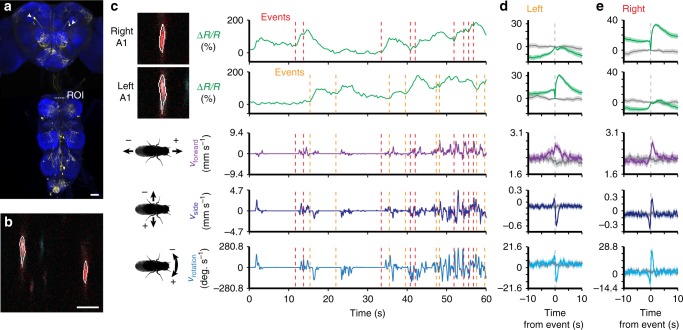
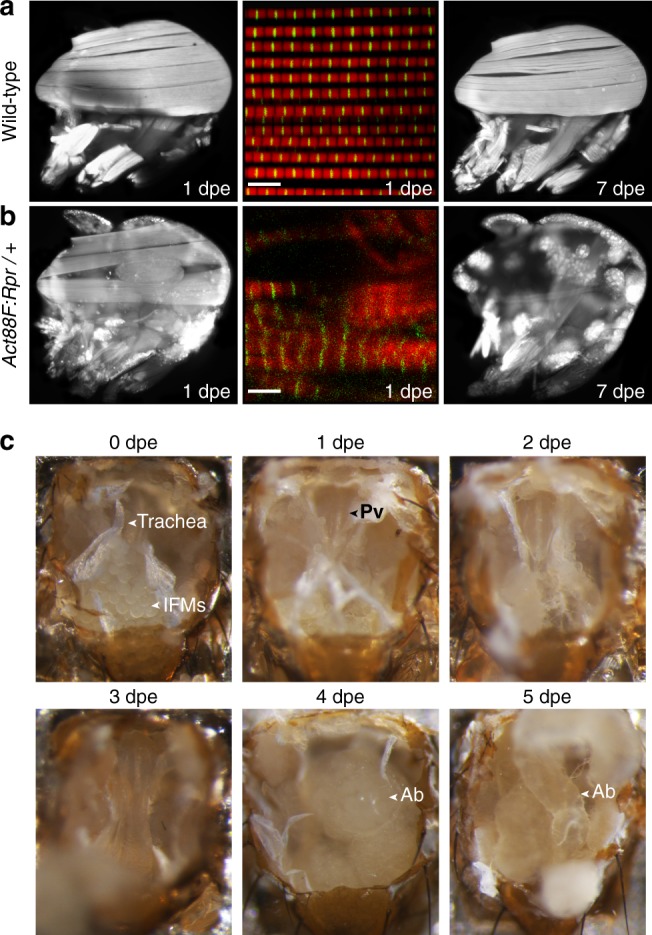
To understand neural circuits that control limbs, one must measure their activity during behavior. Until now this goal has been challenging, because limb premotor and motor circuits have been largely inaccessible for large-scale recordings in intact, moving animals-a constraint that is true for both vertebrate and invertebrate models. Here, we introduce a method for 2-photon functional imaging from the ventral nerve cord (VNC) of behaving adult Drosophila melanogaster. We use this method to reveal patterns of activity across nerve cord populations during grooming and walking and to uncover the functional encoding of moonwalker ascending neurons (MANs), moonwalker descending neurons (MDNs), and a previously uncharacterized class of locomotion-associated A1 descending neurons. Finally, we develop a genetic reagent to destroy the indirect flight muscles and to facilitate experimental access to the VNC. Taken together, these approaches enable the direct investigation of circuits associated with complex limb movements.
Overview
The claims and statistics of this paper haven’t been checked yet.
Free: it reads the open-access text and checks the first 5 claims that cite a source we can check. Create a free account to check every claim.
Integrity signals
Registry
Cites
Statistics
Figures
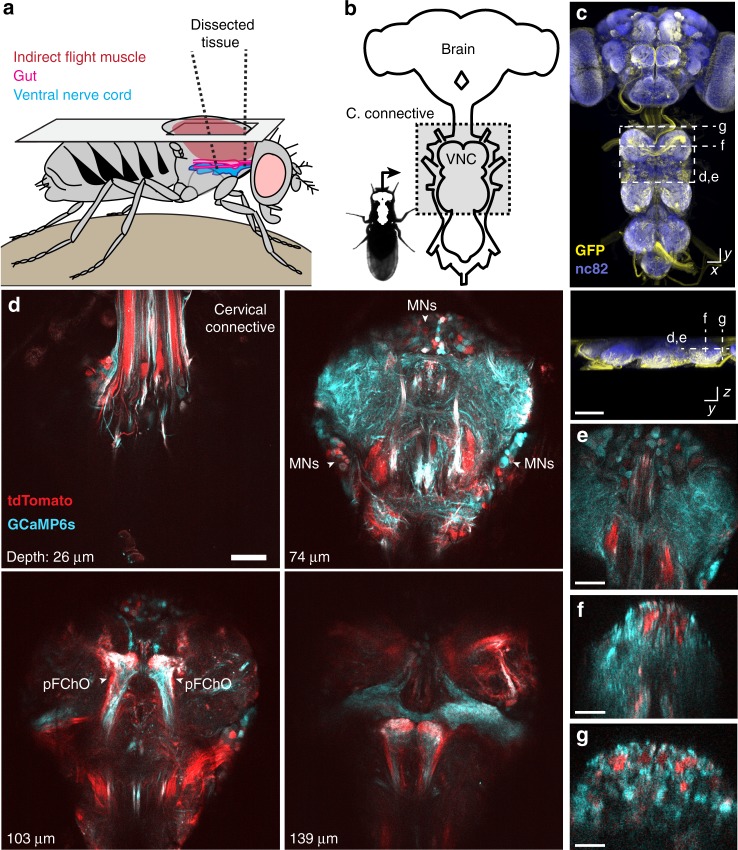
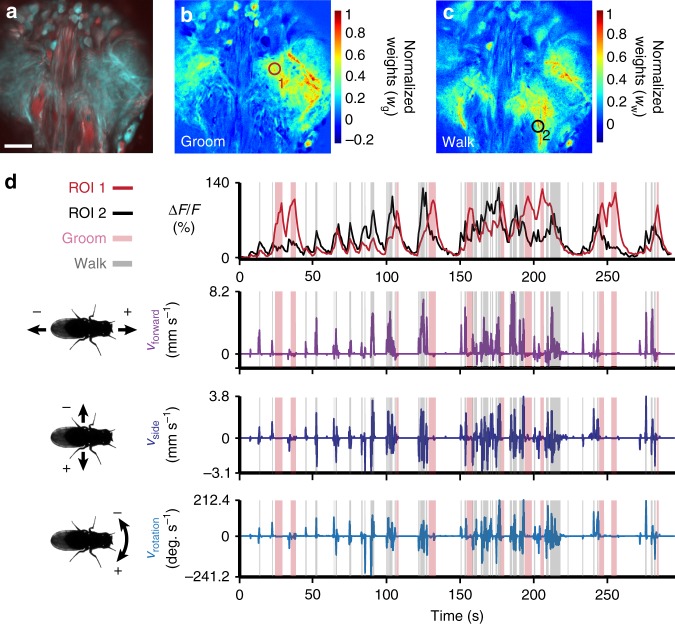
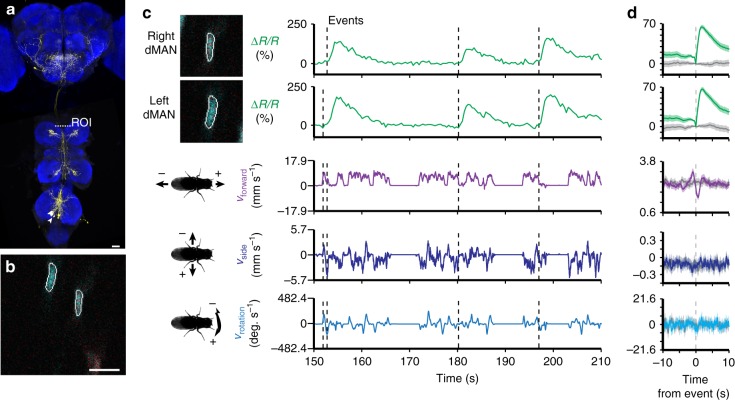
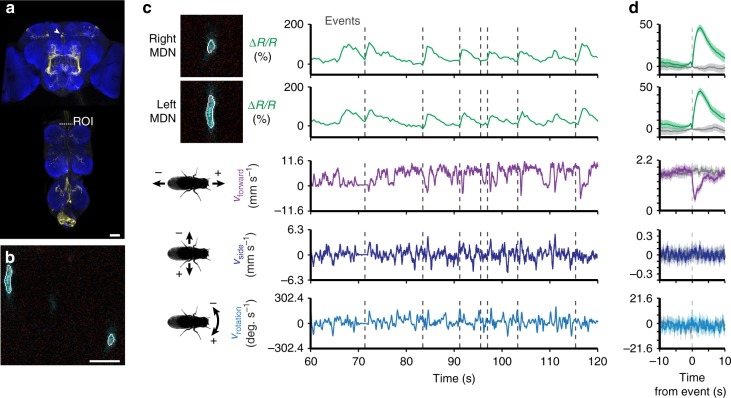
Verification
Claims the paper makes
The claims and statistics of this paper haven’t been checked yet.
Free: it reads the open-access text and checks the first 5 claims that cite a source we can check. Create a free account to check every claim.
Claims other papers make about this one
Each is checked against this paper’s own text: does it say what the citing paper says it does?
The source backs part of the claim, not all of it — or backs it for a different population, condition or comparison.
In the citing paper
“while DNa01 triggers forward walking with a steering component (Cande et al., 2018; Chen et al., 2018; Rayshubskiy et al., 2020).”
From Organization of circuits linking descending input to motor output in the Drosophila Male Adult Nerve Cord connectome (2026) · cites this paper as Chen et al., 2018
Experimental — accuracy not yet measuredThe source backs part of the claim, not all of it — or backs it for a different population, condition or comparison.
In the citing paper
“in reality, there is a graded spectrum of steering maneuvers during walking57 which could arise from graded variations in the recruitment of DNg13 and DNa02 and likely other steering DNs as well30,31,34,56.”
From Fine-grained descending control of steering in walking Drosophila (2023) · cites this paper as [30]
Experimental — accuracy not yet measuredThe source backs part of the claim, not all of it — or backs it for a different population, condition or comparison.
In the citing paper
“Our results support a model where the speed and direction of locomotion are each influenced by the activity of multiple DNs, with some DNs contributing to both29–32,34,48,56.”
From Fine-grained descending control of steering in walking Drosophila (2023) · cites this paper as [30]
Experimental — accuracy not yet measuredThe source backs part of the claim, not all of it — or backs it for a different population, condition or comparison.
In the citing paper
“many Drosophila descending neurons (DNs) involved in walking control are uniquely identifiable as individual right-left cell pairs28–34.”
From Fine-grained descending control of steering in walking Drosophila (2023) · cites this paper as [30]
Experimental — accuracy not yet measuredThe cited source says what the claim attributes to it.
In the citing paper
“DNa01 has been described in steering (Chen et al., 2018; Rayshubskiy et al., 2020) and is similar to DNa02 in its front leg targets, which inhibit the posterior rotator muscles in the thorax.”
From Organization of circuits linking descending input to motor output in the Drosophila Male Adult Nerve Cord connectome (2026) · cites this paper as Chen et al., 2018
12 more claims about this paper
Create a free account to see every claim other papers make about this one.
Self-check
Percentages, sums and reported differences re-computed from the paper’s own numbers.
The self-check needs the paper’s full text.
Citations
Cites
Fiji: an open-source platform for biological-image analysis
Schindelin, J., Arganda-Carreras, I., Frise, E., Kaynig, V., Longair, M., Pietzsch, T., Preibisch, S., Rueden, C., Saalfeld, S., Schmid, B., et al. (2012) · Nature Methods · doi:10.1038/nmeth.2019 · Cited by 66,890
Boyd, S., Parikh, N., Chu, E., Peleato, B., & Eckstein, J. (2011) · Foundations and Trends® in Machine Learning · doi:10.1561/2200000016 · Cited by 17,075
Boyd, S. (2010) · now publishers, Inc. eBooks · doi:10.1561/9781601984616 · Cited by 12,677
Horn, B. K. P., & Schunck, B. G. (1981) · Artificial Intelligence · doi:10.1016/0004-3702(81)90024-2 · Cited by 10,312
Horn, B. K., & Schunck, B. G. (1981) · SPIE Proceedings · doi:10.1117/12.965761 · Cited by 7,394
Ultrasensitive fluorescent proteins for imaging neuronal activity
Chen, T.-W., Wardill, T. J., Sun, Y., Pulver, S. R., Renninger, S. L., Baohan, A., Schreiter, E. R., Kerr, R. A., Orger, M. B., Jayaraman, V., et al. (2013) · Nature · doi:10.1038/nature12354 · Cited by 6,474 · cited 11×
“To address this question, we applied our approach of imaging coronal sections of the thoracic cervical connective using MDN driver line flies expressing GCaMP6s and tdTomato ( MDN-1>GCaMP6s; tdTomato )( Fig.”
MethodInfluentialShaner, N. C., Campbell, R. E., Steinbach, P. A., Giepmans, B. N. G., Palmer, A. E., & Tsien, R. Y. (2004) · Nature Biotechnology · doi:10.1038/nbt1037 · Cited by 4,619
High Accuracy Optical Flow Estimation Based on a Theory for Warping
Brox, T., Bruhn, A., Papenberg, N., & Weickert, J. (2004) · Lecture Notes in Computer Science · doi:10.1007/978-3-540-24673-2_3 · Cited by 2,570
Efficient subpixel image registration algorithms
Guizar-Sicairos, M., Thurman, S. T., & Fienup, J. R. (2008) · Optics Letters · doi:10.1364/ol.33.000156 · Cited by 1,905
A GAL4-Driver Line Resource for Drosophila Neurobiology
Jenett, A., Rubin, G. M., Ngo, T.-T. B., Shepherd, D., Murphy, C., Dionne, H., Pfeiffer, B. D., Cavallaro, A., Hall, D., Jeter, J., et al. (2012) · Cell Reports · doi:10.1016/j.celrep.2012.09.011 · Cited by 1,449 · cited 1×
“To illustrate the extent of VNC access, we drove expression of the genetically encoded calcium indicator, GCaMP6s 15 , together with a fiduciary fluorophore, tdTomato 16 , throughout the entire nervous system ( GMR57C10>GCaMP6s; tdTomato ) 17 , ( Fig.”
Method
Cited by
Phelps, J. S., Hildebrand, D. G. C., Graham, B. J., Kuan, A. T., Thomas, L. A., Nguyen, T. M., Buhmann, J., Azevedo, A. W., Sustar, A., Agrawal, S., et al. (2021) · Cell · doi:10.1016/j.cell.2020.12.013 · Cited by 265
A single-cell transcriptomic atlas of the adult Drosophila ventral nerve cord
Allen, A. M., Neville, M. C., Birtles, S., Croset, V., Treiber, C. D., Waddell, S., & Goodwin, S. F. (2020) · eLife · doi:10.7554/elife.54074 · Cited by 177
“It coordinates muscles in the legs to walk, jump, groom, reach, touch, and taste (Bidaye et al., 2014; Card and Dickinson, 2008; Chen et al., 2018; Gowda et al., 2018; Harris et al., 2015; Howard et al., 2019; Kim et al., 2017; Mamiya et al., 2018; Mendes et al., 2013; Mendes et al., 2014; Seeds et…”
BackgroundGünel, S., Rhodin, H., Morales, D., Campagnolo, J., Ramdya, P., & Fua, P. (2019) · eLife · doi:10.7554/elife.48571 · Cited by 167
Self-citationFast near-whole–brain imaging in adult Drosophila during responses to stimuli and behavior
Aimon, S., Katsuki, T., Jia, T., Grosenick, L., Broxton, M., Deisseroth, K., Sejnowski, T. J., & Greenspan, R. J. (2019) · PLOS Biology · doi:10.1371/journal.pbio.2006732 · Cited by 160
“Imaging the ventral nerve cord in addition to the brain might be feasible with an objective with a larger field of view and the appropriate dissection preparation [38].”
Two brain pathways initiate distinct forward walking programs in Drosophila
Bidaye, S. S., Laturney, M., Chang, A. K., Liu, Y., Bockemühl, T., Büschges, A., & Scott, K. (2020) · Neuron · doi:10.1016/j.neuron.2020.07.032 · Cited by 109
The manifold structure of limb coordination in walking Drosophila
DeAngelis, B. D., Zavatone-Veth, J. A., & Clark, D. A. (2019) · eLife · doi:10.7554/elife.46409 · Cited by 104
Gosztolai, A., Günel, S., Ríos, V. L., Abrate, M. P., Morales, D., Rhodin, H., Fua, P., & Ramdya, P. P. (2021) · Nature Methods · doi:10.1038/s41592-021-01226-z · Cited by 114
Self-citationThe neuromechanics of animal locomotion: From biology to robotics and back
Ramdya, P., & Ijspeert, A. J. (2023) · Science Robotics · doi:10.1126/scirobotics.adg0279 · Cited by 92
Self-citationNeuroMechFly, a neuromechanical model of adult Drosophila melanogaster
Lobato-Rios, V., Ramalingasetty, S. T., Özdil, P. G., Arreguit, J., Ijspeert, A. J., & Ramdya, P. (2022) · Nature Methods · doi:10.1038/s41592-022-01466-7 · Cited by 88
Self-citationA size principle for recruitment of Drosophila leg motor neurons
Azevedo, A. W., Dickinson, E. S., Gurung, P., Venkatasubramanian, L., Mann, R. S., & Tuthill, J. C. (2020) · eLife · doi:10.7554/elife.56754 · Cited by 87
“, 2020) and the ability to image from VNC neurons in walking flies (Chen et al., 2018).”
BackgroundTransforming a head direction signal into a goal-oriented steering command
Westeinde, E. A., Kellogg, E., Dawson, P. M., Lu, J., Hamburg, L., Midler, B., Druckmann, S., & Wilson, R. I. (2024) · Nature · doi:10.1038/s41586-024-07039-2 · Cited by 85
“…these neurons have been shown to predict and influence steering 4 : where θ is head direction and ε is a random term that accounts for neural noise and the influence of unmodeled circuits (that is, the influence of other brain regions that affect steering and other descending pathways 4,55,41 ).”
Transforming a head direction signal into a goal-oriented steering command
Westeinde, E. A., Kellogg, E., Dawson, P. M., Lu, J., Hamburg, L., Midler, B., Druckmann, S., & Wilson, R. I. (2022) · doi:10.1101/2022.11.10.516039 · Cited by 85
Distributed control circuits across a brain-and-cord connectome
Bates, A. S., Phelps, J. S., Kim, M., Yang, H. H., Matsliah, A., Ajabi, Z., Perlman, E., Delgado, K. M., Osman, M. A. M., Salmon, C. K., et al. (2026) · Nature · doi:10.1038/s41586-026-10735-w · Cited by 100
Serotonergic neurons translate taste detection into internal nutrient regulation
Yao, Z., & Scott, K. (2022) · Neuron · doi:10.1016/j.neuron.2021.12.028 · Cited by 80
Distributed control of motor circuits for backward walking in Drosophila
Feng, K., Sen, R., Minegishi, R., Dübbert, M., Bockemühl, T., Büschges, A., & Dickson, B. J. (2020) · Nature Communications · doi:10.1038/s41467-020-19936-x · Cited by 69
Neural circuit mechanisms for steering control in walking Drosophila
Rayshubskiy, A., Holtz, S. L., Bates, A. S., Vanderbeck, Q. X., Capdevila, L. S., Rockwell, V., & Wilson, R. I. (2020) · doi:10.1101/2020.04.04.024703 · Cited by 64
“…similar to cricket neurons that are active during turning (Brodfuehrer and Hoy, 1990; Staudacher and Schildberger, 1998; Zorović and Hedwig, 2011), and a calcium imaging study reported that DNa01 is asymmetrically active in the ventral nerve cord when flies are turning (Chen et al., 2018).”
He, X., Xie, Q., Fan, J., Xu, C., Xu, W., Li, Y., Ding, F., Deng, H., Chen, H., & Shen, J. (2020) · Dyes and Pigments · doi:10.1016/j.dyepig.2020.108255 · Cited by 68
Serotonergic modulation of walking in Drosophila
Howard, C. E., Chen, C.-L., Tabachnik, T., Hormigo, R., Ramdya, P., & Mann, R. S. (2019) · Current Biology · doi:10.1016/j.cub.2019.10.042 · Cited by 59
Self-citationAscending neurons convey behavioral state to integrative sensory and action selection brain regions
Chen, C.-L., Aymanns, F., Minegishi, R., Matsuda, V. D. V., Talabot, N., Günel, S., Dickson, B. J., & Ramdya, P. (2023) · Nature Neuroscience · doi:10.1038/s41593-023-01281-z · Cited by 58
“For example, turn ANs may excite DNa01 and DNa02, which control turning 28,41,52 , and foreleg ANs may excite aDN1 and aDN2, which control grooming 53 .”
BackgroundMethodInfluentialSelf-citationMotor control on the move: from insights in insects to general mechanisms
Büschges, A., & Ache, J. M. (2024) · Physiological Reviews · doi:10.1152/physrev.00009.2024 · Cited by 58
Fine-grained descending control of steering in walking Drosophila
Yang, H. H., Brezovec, B. E., Serratosa Capdevila, L., Vanderbeck, Q. X., Adachi, A., Mann, R. S., & Wilson, R. I. (2024) · Cell · doi:10.1016/j.cell.2024.08.033 · Cited by 55
Fine-grained descending control of steering in walking Drosophila
Yang, H. H., Brezovec, L. E., Serratosa Capdevila, L., Vanderbeck, Q. X., Adachi, A., Mann, R. S., & Wilson, R. I. (2023) · doi:10.1101/2023.10.15.562426 · Cited by 55
“Currently, we know relatively little about the descending control of steering in any species, aside from the fact that descending signals are asymmetric during a turning bout 20,30,31,48–55 .”
InfluentialCheong, H. S., Eichler, K., Stürner, T., Asinof, S. K., Champion, A. S., Marin, E. C., Oram, T. B., Sumathipala, M., Venkatasubramanian, L., Namiki, S., et al. (2026) · eLife · doi:10.7554/elife.96084 · Cited by 54
Neural circuit mechanisms underlying context-specific halting in Drosophila
Sapkal, N., Mancini, N., Kumar, D. S., Spiller, N., Murakami, K., Vitelli, G., Bargeron, B., Maier, K., Eichler, K., Jefferis, G. S. X. E., et al. (2023) · doi:10.1101/2023.09.25.559438 · Cited by 54
Neural circuit mechanisms underlying context-specific halting in Drosophila
Sapkal, N., Mancini, N., Kumar, D. S., Spiller, N., Murakami, K., Vitelli, G., Bargeron, B., Maier, K., Eichler, K., Jefferis, G. S. X. E., et al. (2024) · Nature · doi:10.1038/s41586-024-07854-7 · Cited by 54
“Indeed, some P9 downstream DNs (DNa02 and DNb02) were previously implicated in turning 15,33,34 .”
Aimon, S., Cheng, K. Y., Gjorgjieva, J., & Grunwald Kadow, I. C. (2023) · eLife · doi:10.7554/elife.85202 · Cited by 48
Connecting brain to behaviour: a role for general purpose steering circuits in insect orientation?
Steinbeck, F., Adden, A., & Graham, P. (2020) · Journal of Experimental Biology · doi:10.1242/jeb.212332 · Cited by 52
Descending networks transform command signals into population motor control
Braun, J., Hurtak, F., Wang-Chen, S., & Ramdya, P. (2024) · Nature · doi:10.1038/s41586-024-07523-9 · Cited by 51
“70.”
Self-citationCheong, H. S., Eichler, K., Stürner, T., Asinof, S. K., Champion, A. S., Marin, E. C., Oram, T. B., Sumathipala, M., Venkatasubramanian, L., Namiki, S., et al. (2024) · doi:10.7554/elife.96084.1 · Cited by 51
Spatial Comparisons of Mechanosensory Information Govern the Grooming Sequence in Drosophila
Zhang, N., Guo, L., & Simpson, J. H. (2020) · Current Biology · doi:10.1016/j.cub.2020.01.045 · Cited by 50
A rise-to-threshold process for a relative-value decision
Vijayan, V., Wang, F., Wang, K., Chakravorty, A., Adachi, A., Akhlaghpour, H., Dickson, B. J., & Maimon, G. (2023) · Nature · doi:10.1038/s41586-023-06271-6 · Cited by 49
Olfactory navigation in arthropods
Steele, T., Lanz, A. J., & Nagel, K. I. (2023) · Journal of Comparative Physiology A · doi:10.1007/s00359-022-01611-9 · Cited by 50
Descending neuron population dynamics during odor-evoked and spontaneous limb-dependent behaviors
Aymanns, F., Chen, C.-L., & Ramdya, P. (2022) · eLife · doi:10.7554/elife.81527 · Cited by 43
Self-citationFlexible neural control of transition points within the egg-laying behavioral sequence in Drosophila
Cury, K. M., & Axel, R. (2023) · Nature Neuroscience · doi:10.1038/s41593-023-01332-5 · Cited by 40
Scheffer, L. K., & Meinertzhagen, I. A. (2019) · Annual Review of Cell and Developmental Biology · doi:10.1146/annurev-cellbio-100818-125444 · Cited by 37
Selective presynaptic inhibition of leg proprioception in behaving Drosophila
Dallmann, C. J., Luo, Y., Agrawal, S., Mamiya, A., Chou, G. M., Cook, A., Sustar, A., Brunton, B. W., & Tuthill, J. C. (2025) · Nature · doi:10.1038/s41586-025-09554-2 · Cited by 35
Descending control of motor sequences in Drosophila
Simpson, J. H. (2024) · Current Opinion in Neurobiology · doi:10.1016/j.conb.2023.102822 · Cited by 33
“…tour-de-force, the Ramdya lab developed a dissection and imaging preparation to perform two-photon-based imaging of changes in GCaMP fluorescence, indicating calcium levels commonly thought to correlate with neural activity, in the neck connective and ventral nerve cord of a behaving fly [90].”
Multi-regional circuits underlying visually guided decision-making in Drosophila
Cheong, H. S., Siwanowicz, I., & Card, G. M. (2020) · Current Opinion in Neurobiology · doi:10.1016/j.conb.2020.10.010 · Cited by 33
“New imaging techniques also allow experimenters to monitor neuronal activity in nearly the whole brain [39 ], nerve cord [40], or in multiple specific populations simultaneously [41].”
BackgroundBui, M., Shyong, J., Lutz, E. K., Yang, T., Li, M., Truong, K., Arvidson, R. S., Buchman, A. B., Riffell, J. A., & Akbari, O. S. (2019) · BMC Neuroscience · doi:10.1186/s12868-019-0511-y · Cited by 34
Ehrhardt, E., Whitehead, S. C., Namiki, S., Minegishi, R., Siwanowicz, I., Feng, K., Otsuna, H., FlyLight Project Team, Meissner, G. W., Stern, D., et al. (2023) · bioRxiv (Cold Spring Harbor Laboratory) · doi:10.1101/2023.05.31.542897 · Cited by 29
Self-citationThe development and assembly of the Drosophila adult ventral nerve cord
Venkatasubramanian, L., & Mann, R. S. (2019) · Current Opinion in Neurobiology · doi:10.1016/j.conb.2019.01.013 · Cited by 28
“The ability to merge functional studies with neuronal activity measurements, which have recently become possible in the Drosophila VNC, will be essential to further test these hypotheses (61).”
BackgroundNeural circuit mechanisms for steering control in walking Drosophila
Rayshubskiy, A., Holtz, S. L., Bates, A. S., Vanderbeck, Q. X., Serratosa Capdevila, L., Rockwell, V., & Wilson, R. (2025) · eLife · doi:10.7554/elife.102230 · Cited by 27
“…similar to cricket neurons that are active during turning ( Brodfuehrer and Hoy, 1990 ; Staudacher and Schildberger, 1998 ; Zorovi ć and Hedwig, 2011 ), and a calcium imaging study reported that DNa01 is asymmetrically active in the ventral nerve cord when flies are turning ( Chen et al., 2018 ).”
Issa, A.-R., Picão-Osório, J., Rito, N., Chiappe, M. E., & Alonso, C. R. (2019) · Current Biology · doi:10.1016/j.cub.2019.06.082 · Cited by 30
Extensive and diverse patterns of cell death sculpt neural networks in insects
Pop, S., Chen, C.-L., Sproston, C. J., Kondo, S., Ramdya, P., & Williams, D. W. (2020) · eLife · doi:10.7554/elife.59566 · Cited by 28
Self-citationOlfactory stimuli and moonwalker SEZ neurons can drive backward locomotion in Drosophila
Israel, S., Rozenfeld, E., Weber, D., Huetteroth, W., & Parnas, M. (2022) · Current Biology · doi:10.1016/j.cub.2022.01.035 · Cited by 26
“In support of MDNs role in driving backward locomotion, it was demonstrated thatMDN activity correlateswith episodes of backwardwalking.(19) In addition, it was shown that a population of neurons in the fly’s visual system induce backward walking via MDNs through indirect synaptic connections(20) and that ascending me…”
Behavioral evidence for nested central pattern generator control of Drosophila grooming
Ravbar, P., Zhang, N., & Simpson, J. H. (2021) · eLife · doi:10.7554/elife.71508 · Cited by 27
Visual motion sensitivity in descending neurons in the hoverfly
Nicholas, S. J., Leibbrandt, R. E., & Nordström, K. (2020) · Journal of Comparative Physiology A · doi:10.1007/s00359-020-01402-0 · Cited by 25
Multilevel visuomotor control of locomotion in Drosophila
Cruz, T. L., & Chiappe, M. E. (2023) · Current Opinion in Neurobiology · doi:10.1016/j.conb.2023.102774 · Cited by 21
de Mena, L., & Rincón-Limas, D. E. (2020) · iScience · doi:10.1016/j.isci.2020.101308 · Cited by 17
Facilitation of neural responses to targets moving against optic flow
Nicholas, S. J., & Nordström, K. (2021) · Proceedings of the National Academy of Sciences · doi:10.1073/pnas.2024966118 · Cited by 17
Hermans, L., Kaynak, M., Braun, J., Ríos, V. L., Chen, C.-L., Friedberg, A., Günel, S., Aymanns, F., Sakar, M. S., & Ramdya, P. (2022) · Nature Communications · doi:10.1038/s41467-022-32571-y · Cited by 14
Self-citationNeural circuit mechanisms for steering control in walking Drosophila
Rayshubskiy, A., Holtz, S. L., Bates, A. S., Vanderbeck, Q. X., Capdevila, L. S., Rockwell, V., & Wilson, R. I. (2025) · eLife · doi:10.7554/elife.102230.3 · Cited by 14
Centralized brain networks controlling antennal grooming coordination
Özdil, P. G., Arreguit, J., Scherrer, C., Hurtak, F., Ijspeert, A. J., & Ramdya, P. P. (2026) · Nature Communications · doi:10.1038/s41467-026-72152-x · Cited by 15
Self-citationCircuits for self-motion estimation and walking control in Drosophila
Chiappe, M. E. (2023) · Current Opinion in Neurobiology · doi:10.1016/j.conb.2023.102748 · Cited by 11
Haustein, M., Blanke, A., Bockemühl, T., & Büschges, A. (2024) · Frontiers in Bioengineering and Biotechnology · doi:10.3389/fbioe.2024.1357598 · Cited by 12
“…Ni, 2021) for tracking individual neurons and recording or manipulating their activity in restrained preparations as well as in behaving fl ies (e.g., Chen et al., 2018; Mamiya et al., 2018; Azevedo et al., 2020; Bidaye et al., 2020; Feng et al., 2020; Chockley et al., 2022; Hermans et al., 2022).”
BackgroundPang, Y., Zhang, X., Yuan, J., Zhang, X., Su, M., & Li, F. (2021) · Frontiers in Marine Science · doi:10.3389/fmars.2021.681966 · Cited by 12
“Because there is a close connection between the ventral nerve and the muscle, detection of GSK3 expression in the ventral nerve could more fully reflect the effect of GSK3 on the muscle (Bidaye et al., 2014; Chen et al., 2018; Mamiya et al., 2018).”
BackgroundSpatial Comparisons of Mechanosensory Information Govern the Grooming Sequence in Drosophila
Zhang, N., Guo, L., & Simpson, J. H. (2020) · Current Biology · doi:10.1016/j.cub.2020.08.070 · Cited by 11
Pandit, C., Pandit, S., Pant, M., Ghosh, D., Agarwal, D., Lahiri, D., Nag, M., & Ray, R. R. (2022) · Chemistry Africa · doi:10.1007/s42250-022-00512-3 · Cited by 12
Walkowicz, L., Krzeptowski, W., Krzeptowska, E., Warzecha, K. W., Sałek, J., Górska‐Andrzejak, J., & Pyza, E. (2021) · European Journal of Neuroscience · doi:10.1111/ejn.15171 · Cited by 11
The impulse response of optic flow-sensitive descending neurons to roll m-sequences
Leibbrandt, R. E., Nicholas, S. J., & Nordström, K. (2021) · Journal of Experimental Biology · doi:10.1242/jeb.242833 · Cited by 8
Connecting the dots in ethology: applying network theory to understand neural and animal collectives
Gosztolai, A., & Ramdya, P. P. (2022) · Current Opinion in Neurobiology · doi:10.1016/j.conb.2022.102532 · Cited by 9
“elegans [37, 38], larval [39] and adult Drosophila [40, 41, 42, 43, 44], larval zebrafish [45], and rodents [46, 47, 48].”
BackgroundInfluentialSelf-citationDescending neurons of the hoverfly respond to pursuits of artificial targets
Ogawa, Y., Nicholas, S. J., Thyselius, M., Leibbrandt, R. E., Nowotny, T., Knight, J. C., & Nordström, K. (2023) · Current Biology · doi:10.1016/j.cub.2023.08.091 · Cited by 8
Central versus peripheral neural control of a coordinated walking pattern in DrosophilaPreprint
Sapkal, N., Kumar, D. S., Sunke, S., Mancini, N., Pitchford, J., Murakami, K., & Bidaye, S. S. (2026) · bioRxiv (Cold Spring Harbor Laboratory) · doi:10.64898/2026.04.29.721658 · Cited by 9
Specialized parallel pathways for adaptive control of visual object pursuit
Collie, M. F., Jin, C., Rockwell, V., Kellogg, E. J., Vanderbeck, Q. X., Hartman, A. K., Holtz, S. L., & Wilson, R. I. (2026) · Neuron · doi:10.1016/j.neuron.2026.01.001 · Cited by 7
Pun, P., Brown, J., Cobb, T., Wessells, R. J., & Kim, D. H. (2021) · Sensors · doi:10.3390/s21051651 · Cited by 6
“The optical brain imaging with the tethered fly which walks on a ball allows observing behavior and brain activity simultaneously [20,21].”
BackgroundOrganization of descending neurons in the brain of the desert locust
Staudacher, E. M., Cigan, M., Wenz, F., Pollun, A., Beck, S., Beck, M., Reh, F., Haas, J., & Homberg, U. (2023) · The Journal of Comparative Neurology · doi:10.1002/cne.25513 · Cited by 6
Neural circuit mechanisms for steering control in walking Drosophila
Rayshubskiy, A., Holtz, S. L., Bates, A., Vanderbeck, Q. X., Capdevila, L. S., & Wilson, R. I. (2024) · doi:10.7554/elife.102230.1 · Cited by 5
Control of walking direction by descending and dopaminergic neurons in Drosophila
Liessem, S., Dahlhoff, S., Iqbal, F. M., Palacios-Muñoz, A., Cascino-Milani, F., Volk, H., Erginkaya, M., Diniz, A. M., Gorostiza, E. A., Büschges, A., et al. (2026) · Current Biology · doi:10.1016/j.cub.2026.06.045 · Cited by 5
Li, H., Wang, L., & Wen, J. (2023) · Journal of Experimental Biology · doi:10.1242/jeb.245864 · Cited by 6
Studying complex brain dynamics using Drosophila
Aimon, S., & Kadow, I. C. G. (2019) · Journal of Neurogenetics · doi:10.1080/01677063.2019.1706092 · Cited by 5
“…successful approach has been to use the ‘fly on the ball set-up’, that can be coupled to a closed-loop system that records ball movements and feeds them into a virtual reality (C.-L. Chen et al., 2018; Green et al., 2017; Kohatsu & Yamamoto, 2015; Seelig et al., 2010; Seelig & Jayaraman, 2015).”
BackgroundAn updated catalogue of split-GAL4 driver lines for descending neurons in Drosophila melanogaster
Zung, J. L., Namiki, S., Meissner, G. W., Cheong, H. S. J., Costa, M., Eichler, K., Stürner, T., Jefferis, G. S. X. E., Managan, C., FlyLight Project Team, et al. (2025) · doi:10.1101/2025.02.22.639679 · Cited by 4
“Imaging using genetically encoded calcium indicators has revealed important insights into DN activity (Chen et al. 2018; Namiki et al. 2022; Aymanns et al. 2022).”
Cheong, H. S., Eichler, K., Stürner, T., Asinof, S. K., Champion, A. S., Marin, E. C., Oram, T. B., Sumathipala, M. G., Venkatasubramanian, L., Namiki, S., et al. (2025) · eLife · doi:10.7554/elife.96084.2 · Cited by 10
Catudio-Garrett, E. L., Bielawski, A. M., Ruchti, E., Sherer, L. M., Waghmare, I., Hess-Homeier, D. L., McCabe, B. D., Stowers, R. S., & Certel, S. J. (2023) · Genetics · doi:10.1093/genetics/iyac190 · Cited by 4
Overcoming the Domain Gap in Neural Action Representations
Günel, S., Aymanns, F., Honari, S., Ramdya, P. P., & Fua, P. (2022) · International Journal of Computer Vision · doi:10.1007/s11263-022-01713-6 · Cited by 4
“Recent technological advances have enabled simultaneous recordings of neural activity and behavioral data in experimental animals and humans [11,14,15,51,63,70,71].”
BackgroundSelf-citationConspecific sociability is regulated by associative learning circuitsPreprint
Ríos, V. L., Lam, T. K. C., & Ramdya, P. P. (2024) · bioRxiv (Cold Spring Harbor Laboratory) · doi:10.1101/2024.11.25.624845 · Cited by 2
Self-citationNeural circuit mechanisms for steering control in walking DrosophilaPreprint
Rayshubskiy, A., Holtz, S. L., Bates, A. S., Vanderbeck, Q. X., Capdevila, L. S., Rockwell, V., & Wilson, R. I. (2025) · eLife · doi:10.7554/elife.102230.2 · Cited by 2
Ehrhardt, E., Whitehead, S. C., Namiki, S., Minegishi, R., Siwanowicz, I., Feng, K., Otsuna, H., FlyLight Project Team, Meissner, G. W., Stern, D. L., et al. (2025) · eLife · doi:10.7554/elife.106548.1 · Cited by 4
Self-citationEhrhardt, E., Whitehead, S. C., Namiki, S., Minegishi, R., Siwanowicz, I., Feng, K., Otsuna, H., FlyLight Project Team, Meissner, G. W., Stern, D. L., et al. (2025) · eLife · doi:10.7554/elife.106548 · Cited by 3
Self-citationAn updated catalogue of split-GAL4 driver lines for descending neurons in Drosophila melanogasterPreprint
Zung, J. L., Namiki, S., Meissner, G. W., Cheong, H. S., Costa, M., Eichler, K., Stürner, T., Jefferis, G. S. X. E., Managan, C., FlyLight Project Team, et al. (2025) · eLife · doi:10.7554/elife.107450.1 · Cited by 2
NeuroMechFly: an integrative simulation testbed for studying Drosophila behavioral control
Rios, V. L., Ramdya, P. P., & de Bivort, B. (2022) · Nature Methods · doi:10.1038/s41592-022-01411-8 · Cited by 1
Self-citationBehavioral Electrophysiology in Manduca sexta : The Explore/Exploit Framework
Sharma, V. P., & Ghosh, D. (2026) · Integrative and Comparative Biology · doi:10.1093/icb/icag148 · Cited by 1
An updated catalogue of split-GAL4 driver lines for descending neurons in Drosophila melanogasterPreprint
Zung, J. L., Namiki, S., Meissner, G. W., Cheong, H. S., Costa, M., Eichler, K., Stürner, T., Jefferis, G. S. X. E., Managan, C., FlyLight Project Team, et al. (2025) · eLife · doi:10.7554/elife.107450 · Cited by 1
Issa, A., Picão-Osório, J., Rito, N., Chiappe, M. E., & Alonso, C. R. (2019) · bioRxiv (Cold Spring Harbor Laboratory) · doi:10.1101/511881
Büschges, A. (2020) · Faculty Opinions – Post-Publication Peer Review of the Biomedical Literature · doi:10.3410/f.736073835.793571657
Berigan, B. R. (2022) · MOspace Institutional Repository (University of Missouri) · doi:10.32469/10355/91654
Zhang, H., Deitcher, D. L., & Lau, C. G. (2025) · bioRxiv (Cold Spring Harbor Laboratory) · doi:10.1101/2025.05.13.653908 · Cited by 1
“While modern imaging tools allow us to monitor specific neuronal populations in the brain 34 or the ventral nerve cord 35,36 with impressive precision, the fly's small size makes simultaneous behavior-neural recording notoriously difficult.”
Advancing Genetic-based Tools in Insect Vectors of Disease
Bui, M. (2023) · eScholarship (California Digital Library)
Metadata
- Authors
- Chen, C.-L., Hermans, L., Viswanathan, M. C., Fortun, D., Aymanns, F., Unser, M., Cammarato, A., Dickinson, M. H., & Ramdya, P.
- Affiliations
- École Polytechnique Fédérale de Lausanne (CH)
- Johns Hopkins University (US)
- Centre National de la Recherche Scientifique (FR)
- California Institute of Technology (US)
- Corresponding author
- Ramdya, Pavan
- ORCID
- Venue
- Nature Communications
- Published
- 2018-10-22
- Volume
- 9
- Issue
- 1
- Pages
- 4390-4390
- ISSN
- 2041-1723 (ISSN-L)
- PMC
- PMC6197219
- OpenAlex
- W2785502402
- Cited by
- 84
- References
- 53
- Citations by year
- 2026: 4 · 2025: 11 · 2024: 11 · 2023: 14 · 2022: 10 · 2021: 9 · 2020: 14 · 2019: 11
- FWCI
- 3.87
- Type
- journal article
- Language
- en
- Open access
- gold
- doi.org
- Licence
- cc-by
- creativecommons.org/licenses/by/4.0 (tdm)
- creativecommons.org/licenses/by/4.0 (vor)
- Locations
- Nature Communications (publishedVersion, cc-by)
- bioRxiv (Cold Spring Harbor Laboratory) (acceptedVersion, cc-by-nc-nd)
- Europe PMC (PubMed Central) (publishedVersion, other-oa)
- PubMed Central (publishedVersion, cc-by)
- PubMed (publishedVersion)
- CaltechAUTHORS (California Institute of Technology) (submittedVersion, cc-by)
- HAL (submittedVersion)
- HAL (submittedVersion, cc-by)
- RePEc: Research Papers in Economics (submittedVersion)
- DOAJ (DOAJ: Directory of Open Access Journals) (submittedVersion)
- DOAJ (DOAJ: Directory of Open Access Journals) (submittedVersion, cc-by-sa)
- Infoscience (Ecole Polytechnique Fédérale de Lausanne) (submittedVersion, cc-by-nc-nd)
- Funders
- Foundation for the National Institutes of Health (R01HL124091, U01NS090514)
- Schweizerischer Nationalfonds zur Förderung der Wissenschaftlichen Forschung (31003A_175667)
- Topics
- Life Sciences › Neuroscience › Cellular and Molecular Neuroscience › Neurobiology and Insect Physiology Research
- Life Sciences › Neuroscience › Cellular and Molecular Neuroscience › Neuroscience and Neuropharmacology Research
- Social Sciences › Education › Undergraduate Neuroscience Education and Research
- Keywords
- ventral nerve cord, Drosophila melanogaster, neuronal activity imaging, locomotion, grooming, indirect flight muscle, neural circuits
- MeSH terms
- Animals, Diagnostic Imaging, Drosophila, Locomotion, Motor Neurons, Spinal Nerve Roots, Drosophila Proteins
About these checks
Registry, retraction, Cites and statistics results are computed, not judged, with one exception: a printed reference that no index lists is read once by a model before it counts as a citation error. Claims are extracted by a model and kept only when their quote appears verbatim in the text; each cited source is then checked, with a model’s help, for whether it says what the claim relies on. Those verdicts can be wrong — read the claim’s quote and the cited source before relying on one.
Statistics and arithmetic are recomputed, not judged.
Confidence bands are shown only for fields calibrated on our annotated test set. None is calibrated yet, so no band is shown.
What counts as a claim ›How we measure confidence ›How we check this ›
Are you an author, or do you see a problem with this page? Request a review
Data sources
Bibliographic data: Semantic Scholar, OpenAlex, Crossref.
Contains information from the Semantic Scholar Academic Graph Datasets, made available under the ODC Attribution License (ODC-BY 1.0).
Semantic Scholar’s data is described in: Kinney, R., et al. (2023). The Semantic Scholar Open Data Platform. arXiv:2301.10140.
