

The DOI matches its Crossref record; 37 of the 40 references it cites were found in a registry or an index.
Artificial optic-neural synapse for colored and color-mixed pattern recognition
Open accessAbstract
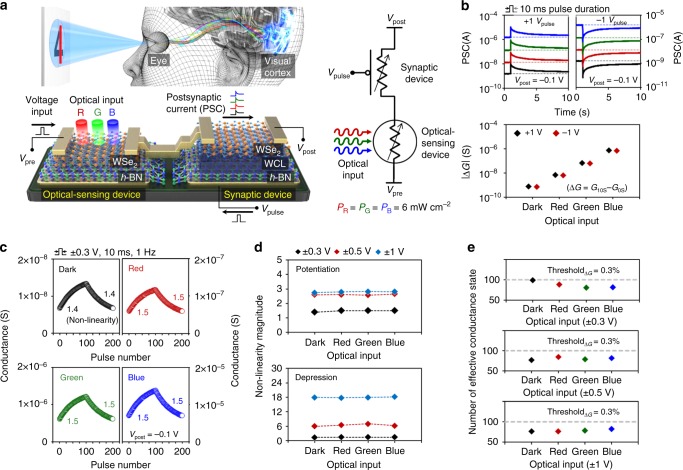
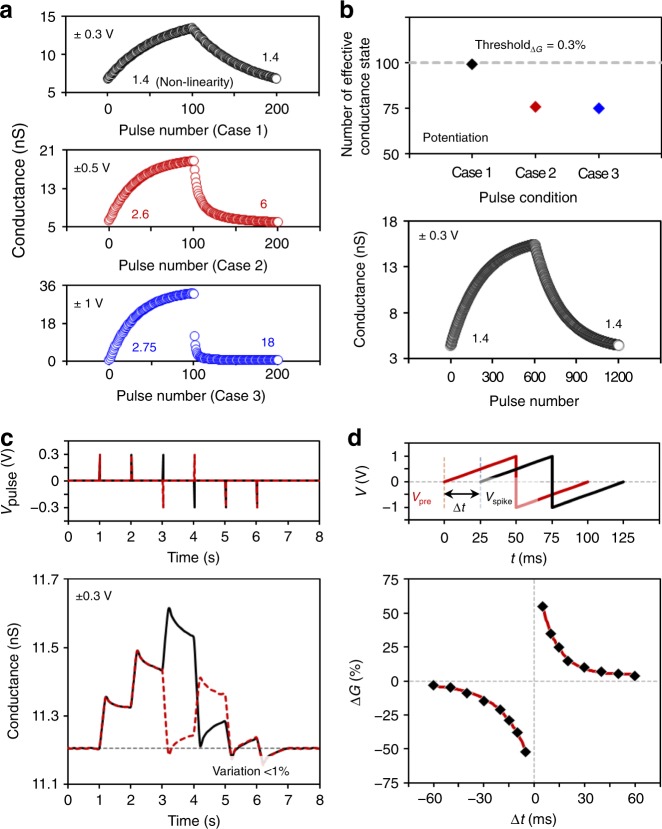
The priority of synaptic device researches has been given to prove the device potential for the emulation of synaptic dynamics and not to functionalize further synaptic devices for more complex learning. Here, we demonstrate an optic-neural synaptic device by implementing synaptic and optical-sensing functions together on h-BN/WSe 2 heterostructure. This device mimics the colored and color-mixed pattern recognition capabilities of the human vision system when arranged in an optic-neural network. Our synaptic device demonstrates a close to linear weight update trajectory while providing a large number of stable conduction states with less than 1% variation per state. The device operates with low voltage spikes of 0.3 V and consumes only 66 fJ per spike. This consequently facilitates the demonstration of accurate and energy efficient colored and color-mixed pattern recognition. The work will be an important step toward neural networks that comprise neural sensing and training functions for more complex pattern recognition.
Overview
The claims and statistics of this paper haven’t been checked yet.
Free: it reads the open-access text and checks the first 5 claims that cite a source we can check. Create a free account to check every claim.
Integrity signals
Registry
Cites
Statistics
Figures


Verification
Claims the paper makes
The claims and statistics of this paper haven’t been checked yet.
Free: it reads the open-access text and checks the first 5 claims that cite a source we can check. Create a free account to check every claim.
Claims other papers make about this one
Each is checked against this paper’s own text: does it say what the citing paper says it does?
The source backs part of the claim, not all of it — or backs it for a different population, condition or comparison.
In the citing paper
“some articles focused on the fabrication and device-level characterization of one/few memristors62–70,186,187, also present some of the figures-of-merit generated by a software-based training ANN process (similar to the ones in Fig. 14) in order to claim that their devices exhibit potential for neuromorphic applications.”
From Hardware implementation of memristor-based artificial neural networks (2024) · cites this paper as [67]
Experimental — accuracy not yet measuredThe cited source says what the claim attributes to it.
In the citing paper
“However, most of those studies in fact only measured the figures-of-merit of one/few devices and simulated the accuracy of an ANN via software62–67 in such type of studies the connection between the memristors fabricated and the ANN is relatively weak.”
From Hardware implementation of memristor-based artificial neural networks (2024) · cites this paper as [67]
Self-check
Percentages, sums and reported differences re-computed from the paper’s own numbers.
The self-check needs the paper’s full text.
Citations
Cites
Gradient-based learning applied to document recognition
Lecun, Y., Bottou, L., Bengio, Y., & Haffner, P. (1998) · Proceedings of the IEEE · doi:10.1109/5.726791 · Cited by 58,805
Parallel Distributed Processing: Explorations in the Microstructure of Cognition: Foundations
Rumelhart, D. E., McClelland, J. L., & AU (1986) · doi:10.7551/mitpress/5236.001.0001 · Cited by 15,686
Mastering the game of Go with deep neural networks and tree search
Silver, D., Huang, A., Maddison, C. J., Guez, A., Sifre, L., van den Driessche, G., Schrittwieser, J., Antonoglou, I., Panneershelvam, V., Lanctot, M., et al. (2016) · Nature · doi:10.1038/nature16961 · Cited by 15,612
Van der Waals heterostructures
Geim, A. K., & Grigorieva, I. V. (2013) · Nature · doi:10.1038/nature12385 · Cited by 10,875
Introduction to the theory of neural computation
(1994) · Neural Networks · doi:10.1016/0893-6080(94)90014-0 · Cited by 6,401
International Conference on Learning Representations (ICLR 2013)
松尾, 豊. (2013) · 人工知能学会誌 = Journal of Japanese Society for Artificial Intelligence · Cited by 6,286
Bi, G.-Q., & Poo, M.-M. (1998) · The Journal of Neuroscience · doi:10.1523/jneurosci.18-24-10464.1998 · Cited by 4,744
Memristive devices for computing
Yang, J. J., Strukov, D. B., & Stewart, D. R. (2013) · Nature Nanotechnology · doi:10.1038/nnano.2012.240 · Cited by 3,885
Training and operation of an integrated neuromorphic network based on metal-oxide memristors
Prezioso, M., Merrikh-Bayat, F., Hoskins, B. D., Adam, G. C., Likharev, K. K., & Strukov, D. B. (2015) · Nature · doi:10.1038/nature14441 · Cited by 3,001
Neuromorphic electronic systems
Mead, C. (1990) · Proceedings of the IEEE · doi:10.1109/5.58356 · Cited by 2,368
Research works printed but not linked: 1
- Anold, A. J. et al. Mimicking neurotransmitter release in chemical synapses via hysteresis engineering in MoS2 transistors. ACS Nano 11, 3310–3118 (2017).
Cited by
Near-sensor and in-sensor computing
Zhou, F., & Chai, Y. (2020) · Nature Electronics · doi:10.1038/s41928-020-00501-9 · Cited by 1,090
Two-dimensional materials for next-generation computing technologies
Liu, C., Chen, H., Wang, S., Liu, Q., Jiang, Y.-G., Zhang, D. W., Liu, M., & Zhou, P. (2020) · Nature Nanotechnology · doi:10.1038/s41565-020-0724-3 · Cited by 1,045
A comprehensive review on emerging artificial neuromorphic devices
Zhu, J., Zhang, T., Yang, Y., & Huang, R. (2020) · Applied Physics Reviews · doi:10.1063/1.5118217 · Cited by 758
Pham, P. V., Bodepudi, S. C., Shehzad, K., Liu, Y., Xu, Y., Yu, B., & Duan, X. (2022) · Chemical Reviews · doi:10.1021/acs.chemrev.1c00735 · Cited by 708
Hardware implementation of memristor-based artificial neural networks
Aguirre, F., Sebastian, A., Le Gallo, M., Song, W., Wang, T., Yang, J. J., Lu, W., Chang, M.-F., Ielmini, D., Yang, Y., et al. (2024) · Nature Communications · doi:10.1038/s41467-024-45670-9 · Cited by 564
“However, most of those studies in fact only measured the fi gures-of-merit of one/few devices and simulated the accuracy of an ANN via software 62 – 67 in such type of studies the connection between the memristors fabricated and the ANN is relatively weak.”
Metadata
- Authors
- Seo, S., Jo, S.-H., Kim, S., Shim, J., Oh, S., Kim, J.-H., Heo, K., Choi, J.-W., Choi, C., Oh, S., Kuzum, D., Wong, H.-S. P., & Park, J.-H.
- Affiliations
- Sungkyunkwan University (KR)
- Hanyang University (KR)
- University of California San Diego (US)
- Stanford University (US)
- Corresponding author
- Park, Jin-Hong
- ORCID
- Venue
- Nature Communications
- Published
- 2018-11-30
- Volume
- 9
- Issue
- 1
- Pages
- 5106-5106
- ISSN
- 2041-1723 (ISSN-L)
- PMC
- PMC6269540
- OpenAlex
- W2902437043
- Cited by
- 731
- References
- 40
- Citations by year
- 2026: 56 · 2025: 115 · 2024: 127 · 2023: 121 · 2022: 132 · 2021: 83 · 2020: 70 · 2019: 26
- FWCI
- 17.12
- Type
- journal article
- Language
- en
- Open access
- gold
- doi.org
- Licence
- cc-by
- creativecommons.org/licenses/by/4.0 (tdm)
- creativecommons.org/licenses/by/4.0 (vor)
- Locations
- Nature Communications (publishedVersion, cc-by)
- Europe PMC (PubMed Central) (publishedVersion, other-oa)
- PubMed Central (publishedVersion, cc-by)
- PubMed (publishedVersion)
- RePEc: Research Papers in Economics (submittedVersion)
- DOAJ (DOAJ: Directory of Open Access Journals) (submittedVersion)
- DOAJ (DOAJ: Directory of Open Access Journals) (submittedVersion, cc-by-sa)
- Funders
- National Research Foundation (2017R1A4A1015400, 2016M3A7B4910426)
- National Research Foundation of Korea (2017R1A4A1015400, 2016M3A7B4910426, 2018R1A2A2A05020475)
- Topics
- Physical Sciences › Engineering › Electrical and Electronic Engineering › Advanced Memory and Neural Computing
- Physical Sciences › Materials Science › Materials Chemistry › 2D Materials and Applications
- Physical Sciences › Computer Science › Artificial Intelligence › Neural Networks and Reservoir Computing
- Keywords
- artificial synapses, color pattern recognition, neuromorphic computing, synaptic weight update, optical sensing, energy-efficient neural networks, low-voltage operation
- MeSH terms
- Algorithms, Humans, Models, Neurological, Neurons, Pattern Recognition, Automated, Synapses
About these checks
Registry, retraction, Cites and statistics results are computed, not judged, with one exception: a printed reference that no index lists is read once by a model before it counts as a citation error. Claims are extracted by a model and kept only when their quote appears verbatim in the text; each cited source is then checked, with a model’s help, for whether it says what the claim relies on. Those verdicts can be wrong — read the claim’s quote and the cited source before relying on one.
Statistics and arithmetic are recomputed, not judged.
Confidence bands are shown only for fields calibrated on our annotated test set. None is calibrated yet, so no band is shown.
What counts as a claim ›How we measure confidence ›How we check this ›
Are you an author, or do you see a problem with this page? Request a review
How to cite
Cite CoChat for the checks on this page, and the paper for its own findings.
- This page
- CoChat. (2026). Citation check: Artificial optic-neural synapse for colored and color-mixed pattern recognition. https://app.cochat.ai/papers/10.1038/s41467-018-07572-5
- The paper
- Seo, S., Jo, S.-H., Kim, S., Shim, J., Oh, S., Kim, J.-H., Heo, K., Choi, J.-W., Choi, C., Oh, S., Kuzum, D., Wong, H.-S. P., & Park, J.-H. (2018). Artificial optic-neural synapse for colored and color-mixed pattern recognition. Nature Communications. https://doi.org/10.1038/s41467-018-07572-5
Data sources
Bibliographic data: Semantic Scholar, OpenAlex, Crossref.
Contains information from the Semantic Scholar Academic Graph Datasets, made available under the ODC Attribution License (ODC-BY 1.0).
Semantic Scholar’s data is described in: Kinney, R., et al. (2023). The Semantic Scholar Open Data Platform. arXiv:2301.10140.
