

Artificial optic-neural synapse for colored and color-mixed pattern recognition
Open accessThe DOI matches its Crossref record; 38 of the 40 references it cites were found in a registry or an index.
Abstract
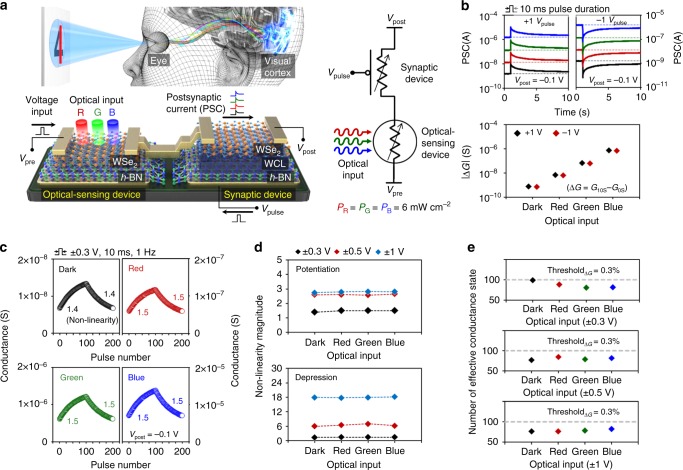
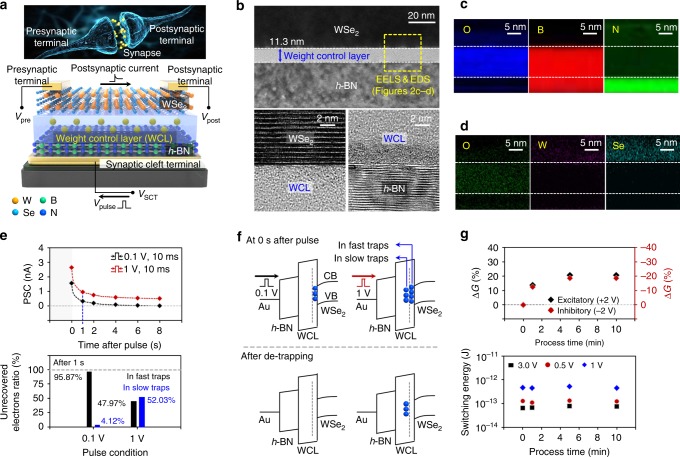
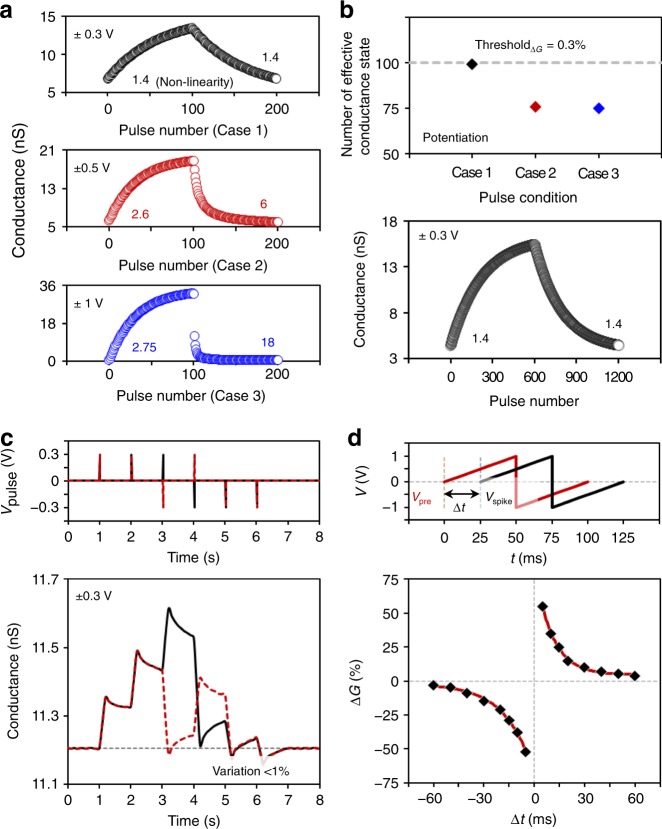
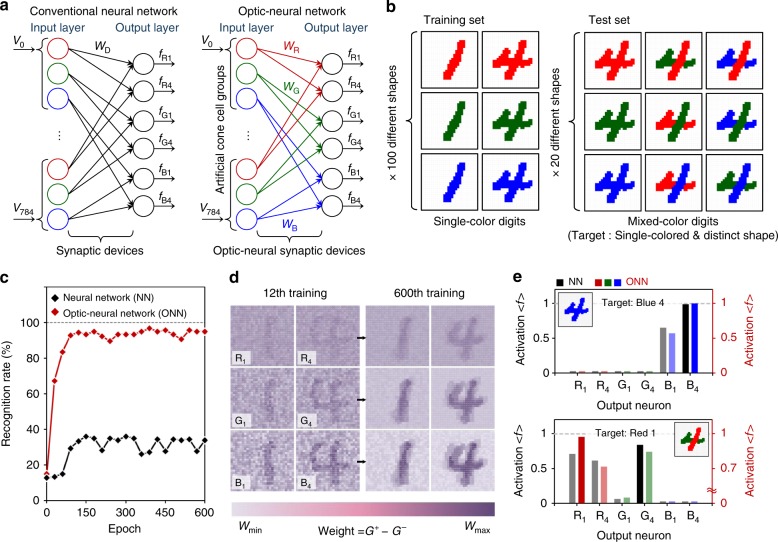
The priority of synaptic device researches has been given to prove the device potential for the emulation of synaptic dynamics and not to functionalize further synaptic devices for more complex learning. Here, we demonstrate an optic-neural synaptic device by implementing synaptic and optical-sensing functions together on h-BN/WSe 2 heterostructure. This device mimics the colored and color-mixed pattern recognition capabilities of the human vision system when arranged in an optic-neural network. Our synaptic device demonstrates a close to linear weight update trajectory while providing a large number of stable conduction states with less than 1% variation per state. The device operates with low voltage spikes of 0.3 V and consumes only 66 fJ per spike. This consequently facilitates the demonstration of accurate and energy efficient colored and color-mixed pattern recognition. The work will be an important step toward neural networks that comprise neural sensing and training functions for more complex pattern recognition.
Overview
The claims and statistics of this paper haven’t been checked yet.
Free: it reads the open-access text and checks the first 5 claims that cite a source we can check. Create a free account to check every claim.
Integrity signals
Registry
Cites
Statistics
Figures
Verification
Claims the paper makes
The claims and statistics of this paper haven’t been checked yet.
Free: it reads the open-access text and checks the first 5 claims that cite a source we can check. Create a free account to check every claim.
Claims other papers make about this one
Each is checked against this paper’s own text: does it say what the citing paper says it does?
The source backs part of the claim, not all of it — or backs it for a different population, condition or comparison.
In the citing paper
“some articles focused on the fabrication and device-level characterization of one/few memristors62–70,186,187, also present some of the figures-of-merit generated by a software-based training ANN process (similar to the ones in Fig. 14) in order to claim that their devices exhibit potential for neuromorphic applications.”
From Hardware implementation of memristor-based artificial neural networks (2024) · cites this paper as [67]
Experimental — accuracy not yet measuredThe cited source says what the claim attributes to it.
In the citing paper
“However, most of those studies in fact only measured the figures-of-merit of one/few devices and simulated the accuracy of an ANN via software62–67 in such type of studies the connection between the memristors fabricated and the ANN is relatively weak.”
From Hardware implementation of memristor-based artificial neural networks (2024) · cites this paper as [67]
Self-check
Percentages, sums and reported differences re-computed from the paper’s own numbers.
The self-check needs the paper’s full text.
Citations
Cites
Gradient-based learning applied to document recognition
Lecun, Y., Bottou, L., Bengio, Y., & Haffner, P. (1998) · Proceedings of the IEEE · doi:10.1109/5.726791 · Cited by 58,805
Parallel Distributed Processing: Explorations in the Microstructure of Cognition: Foundations
Rumelhart, D. E., McClelland, J. L., & AU (1986) · doi:10.7551/mitpress/5236.001.0001 · Cited by 15,686
Mastering the game of Go with deep neural networks and tree search
Silver, D., Huang, A., Maddison, C. J., Guez, A., Sifre, L., van den Driessche, G., Schrittwieser, J., Antonoglou, I., Panneershelvam, V., Lanctot, M., et al. (2016) · Nature · doi:10.1038/nature16961 · Cited by 15,612
Van der Waals heterostructures
Geim, A. K., & Grigorieva, I. V. (2013) · Nature · doi:10.1038/nature12385 · Cited by 10,875
Introduction to the theory of neural computation
(1994) · Neural Networks · doi:10.1016/0893-6080(94)90014-0 · Cited by 6,401
International Conference on Learning Representations (ICLR 2013)
松尾, 豊. (2013) · 人工知能学会誌 = Journal of Japanese Society for Artificial Intelligence · Cited by 6,286
Bi, G.-Q., & Poo, M.-M. (1998) · The Journal of Neuroscience · doi:10.1523/jneurosci.18-24-10464.1998 · Cited by 4,744
Han, S., Mao, H., & Dally, W. J. (2015) · arXiv · doi:10.48550/arxiv.1510.00149 · Cited by 4,662 · cited 1×
“Additionally, to con fi rm if this synaptic device can achieve the number of conductance states that were typically demanded for inference of DNNs (6 − 8 bits = 64 − 256 states) 32,33 , we applied excitatory and inhibitory pulses 600 times each (see Fig.”
MethodMemristive devices for computing
Yang, J. J., Strukov, D. B., & Stewart, D. R. (2013) · Nature Nanotechnology · doi:10.1038/nnano.2012.240 · Cited by 3,885
Training and operation of an integrated neuromorphic network based on metal-oxide memristors
Prezioso, M., Merrikh-Bayat, F., Hoskins, B. D., Adam, G. C., Likharev, K. K., & Strukov, D. B. (2015) · Nature · doi:10.1038/nature14441 · Cited by 3,001
Cited by
Near-sensor and in-sensor computing
Zhou, F., & Chai, Y. (2020) · Nature Electronics · doi:10.1038/s41928-020-00501-9 · Cited by 1,090
“The optical synapses with a wavelength-dependent response also showed colour-filtering behaviours 30 , which has potential for colour segmentation applications of low-level image processing.”
BackgroundMethodTwo-dimensional materials for next-generation computing technologies
Liu, C., Chen, H., Wang, S., Liu, Q., Jiang, Y.-G., Zhang, D. W., Liu, M., & Zhou, P. (2020) · Nature Nanotechnology · doi:10.1038/s41565-020-0724-3 · Cited by 1,045
A comprehensive review on emerging artificial neuromorphic devices
Zhu, J., Zhang, T., Yang, Y., & Huang, R. (2020) · Applied Physics Reviews · doi:10.1063/1.5118217 · Cited by 758
Pham, P. V., Bodepudi, S. C., Shehzad, K., Liu, Y., Xu, Y., Yu, B., & Duan, X. (2022) · Chemical Reviews · doi:10.1021/acs.chemrev.1c00735 · Cited by 708
Hardware implementation of memristor-based artificial neural networks
Aguirre, F., Sebastian, A., Le Gallo, M., Song, W., Wang, T., Yang, J. J., Lu, W., Chang, M.-F., Ielmini, D., Yang, Y., et al. (2024) · Nature Communications · doi:10.1038/s41467-024-45670-9 · Cited by 564
“However, most of those studies in fact only measured the fi gures-of-merit of one/few devices and simulated the accuracy of an ANN via software 62 – 67 in such type of studies the connection between the memristors fabricated and the ANN is relatively weak.”
Flexible Neuromorphic Electronics for Computing, Soft Robotics, and Neuroprosthetics
Park, H., Lee, Y., Kim, N., Seo, D., Go, G., & Lee, T. (2020) · Advanced Materials · doi:10.1002/adma.201903558 · Cited by 533
All‐Optically Controlled Memristor for Optoelectronic Neuromorphic Computing
Hu, L., Yang, J., Wang, J., Cheng, P., Chua, L. O., & Zhuge, F. (2021) · Advanced Functional Materials · doi:10.1002/adfm.202005582 · Cited by 457
Gate-tunable van der Waals heterostructure for reconfigurable neural network vision sensor
Wang, C.-Y., Liang, S.-J., Wang, S., Wang, P., Li, Z., Wang, Z., Gao, A., Pan, C., Liu, C., Liu, J., et al. (2020) · Science Advances · doi:10.1126/sciadv.aba6173 · Cited by 452
“The vdW vertical heterostructures formed by stacking different 2D materials accommodate an abundance of electronic and optoelectronic properties (21-32), which may be exploited to mimic hierarchical architecture and functions of retinal neurons (33-43) in a natural manner to implement a neural network vision sensor.”
Hou, Y.-X., Li, Y., Zhang, Z.-C., Li, J.-Q., Qi, D.-H., Chen, X.-D., Wang, J.-J., Yao, B.-W., Yu, M.-X., Lu, T.-B., et al. (2021) · ACS Nano · doi:10.1021/acsnano.0c08921 · Cited by 438
Retina‐Inspired Carbon Nitride‐Based Photonic Synapses for Selective Detection of UV Light
Park, H., Kim, H., Lim, D., Zhou, H., Kim, Y., Lee, Y., Park, S., & Lee, T. (2020) · Advanced Materials · doi:10.1002/adma.201906899 · Cited by 399
Bioinspired mechano-photonic artificial synapse based on graphene/MoS 2 heterostructure
Yu, J., Yang, X., Gao, G., Xiong, Y., Wang, Y., Han, J., Chen, Y., Zhang, H., Sun, Q., & Wang, Z. L. (2021) · Science Advances · doi:10.1126/sciadv.abd9117 · Cited by 389
2D Material Based Synaptic Devices for Neuromorphic Computing
Cao, G., Meng, P., Chen, J., Liu, H., Bian, R., Zhu, C., Liu, F., & Liu, Z. (2021) · Advanced Functional Materials · doi:10.1002/adfm.202005443 · Cited by 382
Sun, T., Feng, B., Huo, J., Xiao, Y., Wang, W., Peng, J., Li, Z., Du, C., Wang, W., Zou, G., et al. (2024) · Nano-Micro Letters · doi:10.1007/s40820-023-01235-x · Cited by 384
“…for artificial visual sensory systems [194] [182] Copyright (2018) The Authors. b An artificial optic-neural synapse system for pattern recognition [193] Copyright (2018) The Authors. c An artificial optoelectronic neuromorphic circuit array for mimicking environment-adaptable artificial visual…”
BackgroundMetasurface Micro/Nano-Optical Sensors: Principles and Applications
Qin, J., Jiang, S., Wang, Z., Cheng, X., Li, B., Shi, Y., Tsai, D. P., Liu, A. Q., Huang, W., & Zhu, W. (2022) · ACS Nano · doi:10.1021/acsnano.2c03310 · Cited by 359
Photo-induced non-volatile VO2 phase transition for neuromorphic ultraviolet sensors
Li, G., Xie, D., Zhong, H., Zhang, Z., Fu, X., Zhou, Q., Li, Q., Ni, H., Wang, J., Guo, E.-J., et al. (2022) · Nature Communications · doi:10.1038/s41467-022-29456-5 · Cited by 327
Choi, C., Leem, J., Kim, M., Taqieddin, A., Cho, C., Cho, K. W., Lee, G. J., Seung, H., Bae, H. J., Song, Y. M., et al. (2020) · Nature Communications · doi:10.1038/s41467-020-19806-6 · Cited by 338
Self-citationRecent Progress in Three‐Terminal Artificial Synapses: From Device to System
Han, H., Yu, H., Wei, H., Gong, J., & Xu, W. (2019) · Small · doi:10.1002/smll.201900695 · Cited by 348
Kwon, S. M., Cho, S. W., Kim, M., Heo, J. S., Kim, Y., & Park, S. K. (2019) · Advanced Materials · doi:10.1002/adma.201906433 · Cited by 344
Ferroelectric-defined reconfigurable homojunctions for in-memory sensing and computing
Wu, G., Zhang, X., Feng, G., Wang, J., Zhou, K., Zeng, J., Dong, D., Zhu, F., Yang, C., Zhao, X., et al. (2023) · Nature Materials · doi:10.1038/s41563-023-01676-0 · Cited by 294
“16).”
Wan, C., Cai, P., Wang, M., Qian, Y., Huang, W., & Chen, X. (2020) · Advanced Materials · doi:10.1002/adma.201902434 · Cited by 343
Luo, Z.-D., Xia, X., Yang, M.-M., Wilson, N. R., Gruverman, A., & Alexe, M. (2020) · ACS Nano · doi:10.1021/acsnano.9b07687 · Cited by 332
Fully Light‐Controlled Memory and Neuromorphic Computation in Layered Black Phosphorus
Ahmed, T., Tahir, M., Low, M. X., Ren, Y., Tawfik, S. A., Mayes, E. L. H., Kuriakose, S., Nawaz, S., Spencer, M. J. S., Chen, H., et al. (2021) · Advanced Materials · doi:10.1002/adma.202004207 · Cited by 317
A review of memristor: material and structure design, device performance, applications and prospects
Xiao, Y., Jiang, B., Zhang, Z., Ke, S., Jin, Y., Wen, X., & Ye, C. (2023) · Science and Technology of Advanced Materials · doi:10.1080/14686996.2022.2162323 · Cited by 295
“Right: Recognition rate as a function of number of training epochs for ONN and conventional NN. Reproduced with permission from [192], copyright 2018, copyright 2021, Springer Nature. function (PUF) is a promising security primitive that uses the random variations inherent in electronic hardware to…”
BackgroundMethodInfluentialAn artificial sensory neuron with visual-haptic fusion
Wan, C., Cai, P., Guo, X., Wang, M., Matsuhisa, N., Yang, L., Lv, Z., Luo, Y., Loh, X. J., & Chen, X. (2020) · Nature Communications · doi:10.1038/s41467-020-18375-y · Cited by 311
Memristive Artificial Synapses for Neuromorphic Computing
Huang, W., Xia, X., Zhu, C., Steichen, P., Quan, W., Mao, W., Yang, J., Chu, L., & Li, X. (2021) · Nano-Micro Letters · doi:10.1007/s40820-021-00618-2 · Cited by 288
Printable Smart Materials and Devices: Strategies and Applications
Su, M., & Song, Y. (2022) · Chemical Reviews · doi:10.1021/acs.chemrev.1c00303 · Cited by 312
Interface chemistry of two-dimensional heterostructures – fundamentals to applications
Gbadamasi, S., Mohiuddin, M., Krishnamurthi, V., Verma, R., Khan, M. W., Pathak, S., Kalantar-Zadeh, K., & Mahmood, N. (2021) · Chemical Society Reviews · doi:10.1039/d0cs01070g · Cited by 304
Ling, H., Koutsouras, D. A., Kazemzadeh, S., van de Burgt, Y., Yan, F., & Gkoupidenis, P. (2020) · Applied Physics Reviews · doi:10.1063/1.5122249 · Cited by 294
The Roadmap of 2D Materials and Devices Toward Chips
Liu, A., Zhang, X., Liu, Z., Li, Y., Peng, X., Li, X., Qin, Y., Hu, C., Qiu, Y., Jiang, H., et al. (2024) · Nano-Micro Letters · doi:10.1007/s40820-023-01273-5 · Cited by 255
Flexible Artificial Sensory Systems Based on Neuromorphic Devices
Sun, F., Lu, Q., Feng, S., & Zhang, T. (2021) · ACS Nano · doi:10.1021/acsnano.0c10049 · Cited by 286
The Road for 2D Semiconductors in the Silicon Age
Wang, S., Liu, X., & Zhou, P. (2022) · Advanced Materials · doi:10.1002/adma.202106886 · Cited by 277
Synaptic devices based neuromorphic computing applications in artificial intelligence
Sun, B., Guo, T., Zhou, G., Ranjan, S., Jiao, Y., Wei, L., Zhou, Y. N., & Wu, Y. A. (2021) · Materials Today Physics · doi:10.1016/j.mtphys.2021.100393 · Cited by 275
Vertical organic synapse expandable to 3D crossbar array
Choi, Y., Oh, S., Qian, C., Park, J.-H., & Cho, J. H. (2020) · Nature Communications · doi:10.1038/s41467-020-17850-w · Cited by 248
Self-citationYuan, R., Duan, Q., Tiw, P. J., Li, G., Xiao, Z., Jing, Z., Yang, K., Liu, C., Ge, C., Huang, R., et al. (2022) · Nature Communications · doi:10.1038/s41467-022-31747-w · Cited by 242
Tactile sensory coding and learning with bio-inspired optoelectronic spiking afferent nerves
Tan, H., Tao, Q., Pande, I., Majumdar, S., Liu, F., Zhou, Y., Persson, P. O. Å., Rosen, J., & van Dijken, S. (2020) · Nature Communications · doi:10.1038/s41467-020-15105-2 · Cited by 257
Shan, X., Zhao, C., Wang, X., Wang, Z., Fu, S., Lin, Y., Zeng, T., Zhao, X., Xu, H., Zhang, X., et al. (2022) · Advanced Science · doi:10.1002/advs.202104632 · Cited by 254
Artificial van der Waals hybrid synapse and its application to acoustic pattern recognition
Seo, S., Kang, B.-S., Lee, J.-J., Ryu, H.-J., Kim, S., Kim, H., Oh, S., Shim, J., Heo, K., Oh, S., et al. (2020) · Nature Communications · doi:10.1038/s41467-020-17849-3 · Cited by 238
“Such dissipated energy per event were determined by P = I × V × t duration 12,16,18 , and relevant details are provided in Supplementary Fig.”
BackgroundMethodInfluentialSelf-citationFully integrated multi-mode optoelectronic memristor array for diversified in-sensor computing
Huang, H., Liang, X., Wang, Y., Tang, J., Li, Y., Du, Y., Sun, W., Zhang, J., Yao, P., Mou, X., et al. (2025) · Nature Nanotechnology · doi:10.1038/s41565-024-01794-z · Cited by 196
“Image pre-processing plays a crucial role in visual information processing, which can suppress noise, enhance features and facilitate the subsequent processing tasks 6,38 .”
Perovskite/Organic Semiconductor-Based Photonic Synaptic Transistor for Artificial Visual System
Hao, D., Zhang, J., Dai, S., Zhang, J., & Huang, J. (2020) · ACS Applied Materials & Interfaces · doi:10.1021/acsami.0c10851 · Cited by 245
Quantum dots: an overview of synthesis, properties, and applications
Agarwal, K., Rai, H., & Mondal, S. (2023) · Materials Research Express · doi:10.1088/2053-1591/acda17 · Cited by 246
Reconfigurable, non-volatile neuromorphic photovoltaics
Li, T., Miao, J., Fu, X., Song, B., Cai, B., Ge, X., Zhou, X., Zhou, P., Wang, X., Jariwala, D., et al. (2023) · Nature Nanotechnology · doi:10.1038/s41565-023-01446-8 · Cited by 213
“20).”
Ferroelectric photosensor network: an advanced hardware solution to real-time machine vision
Cui, B., Fan, Z., Li, W., Chen, Y., Dong, S., Tan, Z., Cheng, S., Tian, B., Tao, R., Tian, G., et al. (2022) · Nature Communications · doi:10.1038/s41467-022-29364-8 · Cited by 210
Active pixel sensor matrix based on monolayer MoS2 phototransistor array
Dodda, A., Jayachandran, D., Pannone, A., Trainor, N., Stepanoff, S. P., Steves, M. A., Radhakrishnan, S. S., Bachu, S., Ordonez, C. W., Shallenberger, J. R., et al. (2022) · Nature Materials · doi:10.1038/s41563-022-01398-9 · Cited by 213
Recent Progress in Photonic Synapses for Neuromorphic Systems
Zhang, J., Dai, S., Zhao, Y., Zhang, J., & Huang, J. (2020) · Advanced Intelligent Systems · doi:10.1002/aisy.201900136 · Cited by 233
Bioinspired Multifunctional Organic Transistors Based on Natural Chlorophyll/Organic Semiconductors
Yang, B., Lu, Y., Jiang, D., Li, Z., Zeng, Y., Zhang, S., Ye, Y., Liu, Z., Ou, Q., Wang, Y., et al. (2020) · Advanced Materials · doi:10.1002/adma.202001227 · Cited by 231
Kim, M., & Lee, J. (2020) · Advanced Materials · doi:10.1002/adma.201907826 · Cited by 223
Yin, L., Huang, W., Xiao, R., Peng, W., Zhu, Y., Zhang, Y., Pi, X., & Yang, D. (2020) · Nano Letters · doi:10.1021/acs.nanolett.0c00298 · Cited by 220
Cho, S. W., Kwon, S. M., Kim, Y.-H., & Park, S. K. (2021) · Advanced Intelligent Systems · doi:10.1002/aisy.202000162 · Cited by 217
Shi, J., Jie, J., Deng, W., Luo, G., Fang, X., Xiao, Y., Zhang, Y., Zhang, X., & Zhang, X. (2022) · Advanced Materials · doi:10.1002/adma.202200380 · Cited by 203
Emerging 2D Memory Devices for In‐Memory Computing
Yin, L., Cheng, R., Wen, Y., Liu, C., & He, J. (2021) · Advanced Materials · doi:10.1002/adma.202007081 · Cited by 200
Memristive Crossbar Arrays for Storage and Computing Applications
Li, H., Wang, S., Zhang, X., Wang, W., Yang, R., Sun, Z., Feng, W., Lin, P., Wang, Z., Sun, L., et al. (2021) · Advanced Intelligent Systems · doi:10.1002/aisy.202100017 · Cited by 205
Kwon, K. C., Baek, J. H., Hong, K., Kim, S. Y., & Jang, H. W. (2022) · Nano-Micro Letters · doi:10.1007/s40820-021-00784-3 · Cited by 187
Self-citationHe, K., Wang, C., He, Y., Su, J., & Chen, X. (2023) · Chemical Reviews · doi:10.1021/acs.chemrev.3c00527 · Cited by 200
Organic electronic synapses with low energy consumption
Lee, Y., Park, H.-L., Kim, Y., & Lee, T.-W. (2021) · Joule · doi:10.1016/j.joule.2021.01.005 · Cited by 196
“Functional artificial synapses that combine sensing capabilities in a single device have been pursued because compactness without the requirement for additional sensing elements enables low E and high-density integration (Figure 4C).(119) These artificial sensory synapses have P in the microwatt range, which is compar…”
BackgroundLiang, K., Wang, R., Huo, B., Ren, H., Li, D., Wang, Y., Tang, Y., Chen, Y., Song, C., Li, F., et al. (2022) · ACS Nano · doi:10.1021/acsnano.2c00439 · Cited by 196
Wei, H., Shi, R., Sun, L., Yu, H., Gong, J., Liu, C., Xu, Z., Ni, Y., Xu, J., & Xu, W. (2021) · Nature Communications · doi:10.1038/s41467-021-21319-9 · Cited by 192
Multidimensional vision sensors for information processing
Wang, Z., Wan, T., Ma, S., & Chai, Y. (2024) · Nature Nanotechnology · doi:10.1038/s41565-024-01665-7 · Cited by 204
Huang, P., Jiang, B., Chen, H., Xu, J., Wang, K., Zhu, C.-Y., Hu, X.-Y., Li, D., Zhen, L., Zhou, F., et al. (2023) · Nature Communications · doi:10.1038/s41467-023-42488-9 · Cited by 199
“The intriguing chrominance-dependent synaptic dynamics enabled the design of arti fi cial vision systems for colored-mixed pattern recognition 44 .”
Yang, F.-S., Li, M., Lee, M.-P., Ho, I.-Y., Chen, J.-Y., Ling, H., Li, Y., Chang, J.-K., Yang, S.-H., Chang, Y.-M., et al. (2020) · Nature Communications · doi:10.1038/s41467-020-16766-9 · Cited by 169
Stimuli‐Responsive Memristive Materials for Artificial Synapses and Neuromorphic Computing
Bian, H., Goh, Y. Y., Liu, Y., Ling, H., Xie, L., & Liu, X. (2021) · Advanced Materials · doi:10.1002/adma.202006469 · Cited by 182
Chen, S., Zhang, T., Tappertzhofen, S., Yang, Y., & Valov, I. (2023) · Advanced Materials · doi:10.1002/adma.202301924 · Cited by 177
Zhou, H., Li, S., Ang, K., & Zhang, Y. (2024) · Nano-Micro Letters · doi:10.1007/s40820-024-01335-2 · Cited by 209
Li, Y., Wang, J., Yang, Q., & Shen, G. (2022) · Advanced Science · doi:10.1002/advs.202202123 · Cited by 182
Bioinspired interactive neuromorphic devices
Yu, J., Wang, Y., Qin, S., Gao, G., Xu, C., Lin Wang, Z., & Sun, Q. (2022) · Materials Today · doi:10.1016/j.mattod.2022.09.012 · Cited by 176
Recent Progress in Optoelectronic Synapses for Artificial Visual‐Perception System
Han, X., Xu, Z., Wu, W., Liu, X., Yan, P., & Pan, C. (2020) · Small Structures · doi:10.1002/sstr.202000029 · Cited by 176
A skin-like two-dimensionally pixelized full-color quantum dot photodetector
Kim, J., Kwon, S.-M., Kang, Y. K., Kim, Y.-H., Lee, M.-J., Han, K., Facchetti, A., Kim, M.-G., & Park, S. K. (2019) · Science Advances · doi:10.1126/sciadv.aax8801 · Cited by 172
Self-citationNanostructured Materials and Architectures for Advanced Optoelectronic Synaptic Devices
Ilyas, N., Wang, J., Li, C., Li, D., Fu, H., Gu, D., Jiang, X., Liu, F., Jiang, Y., & Li, W. (2022) · Advanced Functional Materials · doi:10.1002/adfm.202110976 · Cited by 168
Synthesis, Modulation, and Application of Two-Dimensional TMD Heterostructures
Wu, R., Zhang, H., Ma, H., Zhao, B., Li, W., Chen, Y., Liu, J., Liang, J., Qin, Q., Qi, W., et al. (2024) · Chemical Reviews · doi:10.1021/acs.chemrev.4c00174 · Cited by 164
Self-Selective Multi-Terminal Memtransistor Crossbar Array for In-Memory Computing
Feng, X., Li, S., Wong, S. L., Tong, S., Chen, L., Zhang, P., Wang, L., Fong, X., Chi, D., & Ang, K.-W. (2021) · ACS Nano · doi:10.1021/acsnano.0c09441 · Cited by 170
Wu, X., Wang, S., Huang, W., Dong, Y., Wang, Z., & Huang, W. (2023) · Nature Communications · doi:10.1038/s41467-023-36205-9 · Cited by 180
Seo, S., Lee, J., Lee, R., Kim, T. H., Park, S., Jung, S., Lee, H., Andreev, M., Lee, K., Jung, K., et al. (2021) · Advanced Materials · doi:10.1002/adma.202102980 · Cited by 167
Self-citationNanowires for UV–vis–IR Optoelectronic Synaptic Devices
Chen, X., Chen, B., Jiang, B., Gao, T., Shang, G., Han, S., Kuo, C., Roy, V. A. L., & Zhou, Y. (2023) · Advanced Functional Materials · doi:10.1002/adfm.202208807 · Cited by 165
Yang, J.-M., Choi, E.-S., Kim, S.-Y., Kim, J.-H., Park, J.-H., & Park, N.-G. (2019) · Nanoscale · doi:10.1039/c8nr09918a · Cited by 163
Self-citationZhang, F., Li, C., Li, Z., Dong, L., & Zhao, J. (2023) · Microsystems & Nanoengineering · doi:10.1038/s41378-023-00487-2 · Cited by 170
A robust neuromorphic vision sensor with optical control of ferroelectric switching
Du, J., Xie, D., Zhang, Q., Zhong, H., Meng, F., Fu, X., Sun, Q., Ni, H., Li, T., Guo, E.-J., et al. (2021) · Nano Energy · doi:10.1016/j.nanoen.2021.106439 · Cited by 158
Seo, S., Lee, J.-J., Lee, H.-J., Lee, H. W., Oh, S., Lee, J. J., Heo, K., & Park, J.-H. (2020) · ACS Applied Electronic Materials · doi:10.1021/acsaelm.9b00694 · Cited by 161
Self-citationHong, S., Choi, S. H., Park, J., Yoo, H., Oh, J. Y., Hwang, E. H., Yoon, D. H., & Kim, S. (2020) · ACS Nano · doi:10.1021/acsnano.0c01689 · Cited by 163
Self-citationEmerging Opportunities for 2D Semiconductor/Ferroelectric Transistor‐Structure Devices
Luo, Z., Yang, M., Liu, Y., & Alexe, M. (2021) · Advanced Materials · doi:10.1002/adma.202005620 · Cited by 162
Technology and Integration Roadmap for Optoelectronic Memristor
Wang, J., Ilyas, N., Ren, Y., Ji, Y., Li, S., Li, C., Liu, F., Gu, D., & Ang, K. (2023) · Advanced Materials · doi:10.1002/adma.202307393 · Cited by 175
Networking retinomorphic sensor with memristive crossbar for brain-inspired visual perception
Wang, S., Wang, C., Wang, P., Wang, C., Li, Z.-A., Pan, C., Dai, Y., Gao, A., Liu, C., Liu, J., et al. (2020) · National Science Review · doi:10.1093/nsr/nwaa172 · Cited by 163
“…potential of two-dimensional (2D) materials in neuromorphic computing [22–33] and in-sensor processing [17,18,27–29, Stackingofdistinct2Dmaterialswouldformadiver-sityofvanderWaals(vdW)heterostructureswith richeroptoelectronicproperties[35–39]forvarious applicationssuchasretinomorphicsensors[40].”
BackgroundMultiwavelength Optoelectronic Synapse with 2D Materials for Mixed-Color Pattern Recognition
Islam, M. M., Krishnaprasad, A., Dev, D., Martinez-Martinez, R., Okonkwo, V., Wu, B., Han, S. S., Bae, T.-S., Chung, H., Touma, J. E., et al. (2022) · ACS Nano · doi:10.1021/acsnano.2c01035 · Cited by 159
Progress of Materials and Devices for Neuromorphic Vision Sensors
Cho, S. W., Jo, C., Kim, Y., & Park, S. K. (2022) · Nano-Micro Letters · doi:10.1007/s40820-022-00945-y · Cited by 166
Qian, C., Oh, S., Choi, Y., Kim, J. H., Sun, J., Huang, H., Yang, J., Gao, Y., Park, J., & Cho, J. H. (2019) · Nano Energy · doi:10.1016/j.nanoen.2019.104095 · Cited by 155
Self-citationJo, C., Kim, J., Kwak, J. Y., Kwon, S. M., Park, J. B., Kim, J., Park, G., Kim, M., Kim, Y., & Park, S. K. (2022) · Advanced Materials · doi:10.1002/adma.202108979 · Cited by 155
Self-citationSeok, H., Lee, D., Son, S., Choi, H., Kim, G., & Kim, T. (2024) · Advanced Electronic Materials · doi:10.1002/aelm.202300839 · Cited by 168
Cheng, Y., Li, H., Liu, B., Jiang, L., Liu, M., Huang, H., Yang, J., He, J., & Jiang, J. (2020) · Small · doi:10.1002/smll.202005217 · Cited by 166
Kamaei, S., Liu, X., Saeidi, A., Wei, Y., Gastaldi, C., Brügger, J., & Ionescu, A. M. (2023) · Nature Electronics · doi:10.1038/s41928-023-01018-7 · Cited by 152
Advancements in 2D layered material memristors: unleashing their potential beyond memory
Nirmal, K. A., Kumbhar, D. D., Kesavan, A. V., Dongale, T. D., & Kim, T. G. (2024) · npj 2D Materials and Applications · doi:10.1038/s41699-024-00522-4 · Cited by 156
“Seo et al. 93 developed optical-neural synapticdevicesbyintegratingsynapticandopticalsensingfunctionswithin an h-BN/WSe 2 heterostructure.”
A Habituation Sensory Nervous System with Memristors
Wu, Z., Lu, J., Shi, T., Zhao, X., Zhang, X., Yang, Y., Wu, F., Li, Y., Liu, Q., & Liu, M. (2020) · Advanced Materials · doi:10.1002/adma.202004398 · Cited by 148
A Bioinspired Stretchable Sensory‐Neuromorphic System
Kim, S. H., Baek, G. W., Yoon, J., Seo, S., Park, J., Hahm, D., Chang, J. H., Seong, D., Seo, H., Oh, S., et al. (2021) · Advanced Materials · doi:10.1002/adma.202104690 · Cited by 142
Self-citationAmorphous InGaZnO (a-IGZO) Synaptic Transistor for Neuromorphic Computing
Jang, Y., Park, J., Kang, J., & Lee, S. (2022) · ACS Applied Electronic Materials · doi:10.1021/acsaelm.1c01088 · Cited by 144
Self-citationYu, R., He, L., Gao, C., Zhang, X., Li, E., Guo, T., Li, W., & Chen, H. (2022) · Nature Communications · doi:10.1038/s41467-022-34565-2 · Cited by 141
Optically driven intelligent computing with ZnO memristor
Yang, J., Hu, L., Shen, L., Wang, J., Cheng, P., Lu, H., Zhuge, F., & Ye, Z. (2022) · Fundamental Research · doi:10.1016/j.fmre.2022.06.019 · Cited by 140
Neuromorphic computing based on halide perovskites
Vasilopoulou, M., Yusoff, A. R. B. M., Chai, Y., Kourtis, M., Matsushima, T., Gasparini, N., Du, R., Gao, F., Nazeeruddin, M. K., Anthopoulos, T. D., et al. (2023) · Nature Electronics · doi:10.1038/s41928-023-01082-z · Cited by 140
“Two-dimensional (2D) van der Waals materials — such as transition metal dichalcogenides (TMD) 21-24 , hexagonal boron nitride (h-BN) 25 and graphene 26,27 — and phase change materials (PCM) like Ge 2 Sb 2 Te 5 (GST) 28 , are also promising for neuromorphic device applications because their structural and electronic pr…”
Liu, L., Xu, W., Ni, Y., Xu, Z., Cui, B., Liu, J., Wei, H., & Xu, W. (2022) · ACS Nano · doi:10.1021/acsnano.1c08482 · Cited by 138
Zhu, X., Gao, C., Ren, Y., Zhang, X., Li, E., Wang, C., Yang, F., Wu, J., Hu, W., & Chen, H. (2023) · Advanced Materials · doi:10.1002/adma.202301468 · Cited by 137
Artificial Neural Pathway Based on a Memristor Synapse for Optically Mediated Motion Learning
He, K., Liu, Y., Yu, J., Guo, X., Wang, M., Zhang, L., Wan, C., Wang, T., Zhou, C., & Chen, X. (2022) · ACS Nano · doi:10.1021/acsnano.2c03100 · Cited by 137
Ferroelectric Field‐Effect‐Transistor Integrated with Ferroelectrics Heterostructure
Baek, S., Yoo, H. H., Ju, J. H., Sriboriboon, P., Singh, P. K., Niu, J., Park, J., Shin, C., Kim, Y., & Lee, S. (2022) · Advanced Science · doi:10.1002/advs.202200566 · Cited by 136
Self-citationYang, R., Wang, Y., Li, S., Hu, D., Chen, Q., Zhuge, F., Ye, Z., Pi, X., & Lü, J. (2023) · Advanced Functional Materials · doi:10.1002/adfm.202312444 · Cited by 136
Huang, X., Li, Q., Shi, W., Liu, K., Zhang, Y., Liu, Y., Wei, X., Zhao, Z., Guo, Y., & Liu, Y. (2021) · Small · doi:10.1002/smll.202102820 · Cited by 135
Metadata
- Authors
- Seo, S., Jo, S.-H., Kim, S., Shim, J., Oh, S., Kim, J.-H., Heo, K., Choi, J.-W., Choi, C., Oh, S., Kuzum, D., Wong, H.-S. P., & Park, J.-H.
- Affiliations
- Sungkyunkwan University (KR)
- Hanyang University (KR)
- University of California San Diego (US)
- Stanford University (US)
- Corresponding author
- Park, Jin-Hong
- ORCID
- Venue
- Nature Communications
- Published
- 2018-11-30
- Volume
- 9
- Issue
- 1
- Pages
- 5106-5106
- ISSN
- 2041-1723 (ISSN-L)
- PMC
- PMC6269540
- OpenAlex
- W2902437043
- Cited by
- 731
- References
- 40
- Citations by year
- 2026: 56 · 2025: 115 · 2024: 127 · 2023: 121 · 2022: 132 · 2021: 83 · 2020: 70 · 2019: 26
- FWCI
- 17.12
- Type
- journal article
- Language
- en
- Open access
- gold
- doi.org
- Licence
- cc-by
- creativecommons.org/licenses/by/4.0 (tdm)
- creativecommons.org/licenses/by/4.0 (vor)
- Locations
- Nature Communications (publishedVersion, cc-by)
- Europe PMC (PubMed Central) (publishedVersion, other-oa)
- PubMed Central (publishedVersion, cc-by)
- PubMed (publishedVersion)
- RePEc: Research Papers in Economics (submittedVersion)
- DOAJ (DOAJ: Directory of Open Access Journals) (submittedVersion)
- DOAJ (DOAJ: Directory of Open Access Journals) (submittedVersion, cc-by-sa)
- Funders
- National Research Foundation (2017R1A4A1015400, 2016M3A7B4910426)
- National Research Foundation of Korea (2017R1A4A1015400, 2016M3A7B4910426, 2018R1A2A2A05020475)
- Topics
- Physical Sciences › Engineering › Electrical and Electronic Engineering › Advanced Memory and Neural Computing
- Physical Sciences › Materials Science › Materials Chemistry › 2D Materials and Applications
- Physical Sciences › Computer Science › Artificial Intelligence › Neural Networks and Reservoir Computing
- Keywords
- artificial synapses, color pattern recognition, neuromorphic computing, synaptic weight update, optical sensing, energy-efficient neural networks, low-voltage operation
- MeSH terms
- Algorithms, Humans, Models, Neurological, Neurons, Pattern Recognition, Automated, Synapses
About these checks
Registry, retraction, Cites and statistics results are computed, not judged, with one exception: a printed reference that no index lists is read once by a model before it counts as a citation error. Claims are extracted by a model and kept only when their quote appears verbatim in the text; each cited source is then checked, with a model’s help, for whether it says what the claim relies on. Those verdicts can be wrong — read the claim’s quote and the cited source before relying on one.
Statistics and arithmetic are recomputed, not judged.
Confidence bands are shown only for fields calibrated on our annotated test set. None is calibrated yet, so no band is shown.
What counts as a claim ›How we measure confidence ›How we check this ›
Are you an author, or do you see a problem with this page? Request a review
Data sources
Bibliographic data: Semantic Scholar, OpenAlex, Crossref.
Contains information from the Semantic Scholar Academic Graph Datasets, made available under the ODC Attribution License (ODC-BY 1.0).
Semantic Scholar’s data is described in: Kinney, R., et al. (2023). The Semantic Scholar Open Data Platform. arXiv:2301.10140.
