

GWAS identifies 14 loci for device-measured physical activity and sleep duration
Open accessPublished version of a preprint
The DOI matches its Crossref record; 92 of the 92 references it cites were found in a registry or an index; 26 of the 45 sources its claims cite were checked for support.
Abstract
Physical activity and sleep duration are established risk factors for many diseases, but their aetiology is poorly understood, partly due to relying on self-reported evidence. Here we report a genome-wide association study (GWAS) of device-measured physical activity and sleep duration in 91,105 UK Biobank participants, finding 14 significant loci (7 novel). These loci account for 0.06% of activity and 0.39% of sleep duration variation. Genome-wide estimates of ~ 15% phenotypic variation indicate high polygenicity. Heritability is higher in women than men for overall activity (23 vs. 20%, p = 1.5 × 10 −4 ) and sedentary behaviours (18 vs. 15%, p = 9.7 × 10 −4 ). Heritability partitioning, enrichment and pathway analyses indicate the central nervous system plays a role in activity behaviours. Two-sample Mendelian randomisation suggests that increased activity might causally lower diastolic blood pressure (beta mmHg/SD: −0.91, SE = 0.18, p = 8.2 × 10 −7 ), and odds of hypertension (Odds ratio/SD: 0.84, SE = 0.03, p = 4.9 × 10 −8 ). Our results advocate the value of physical activity for reducing blood pressure.
Overview
CoChat Summary
TL;DR
This GWAS of device-measured physical activity and sleep duration in 91,105 UK Biobank participants identified 14 genome-wide significant loci (7 novel) and found high polygenicity plus central nervous system enrichment. Mendelian randomisation suggested higher overall activity may causally lower diastolic blood pressure and hypertension odds.
Key findings
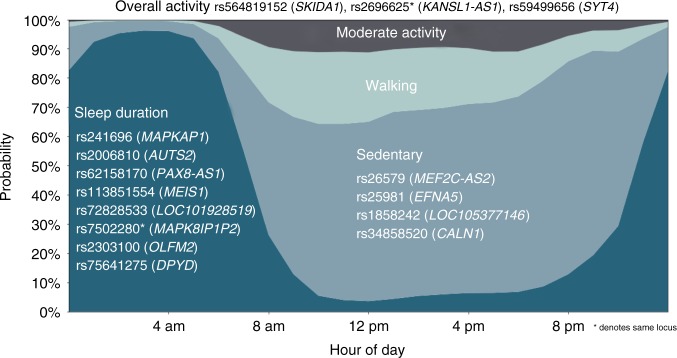
- The study identified 14 significant loci (p < 5 × 10⁻⁹, separated by ≥400 kb), 7 of them novel: one for overall activity (rs564819152 near SKIDA1), two for sleep duration (rs2416963 near MAPKAP1; rs2006810 near AUTS2), and four for sedentary time (near MEF2C-AS2, EFNA5, LOC105377146, CALN1); no loci were identified for walking or moderate intensity activity. These loci account for 0.06% of activity and 0.39% of sleep duration variation.
- Heritability was modest, ranging from 10% for moderate intensity activity to 21% for overall activity; genome-wide estimates of ~15% phenotypic variation indicated high polygenicity. Heritability was higher in women than men for overall activity (23% vs. 20%, p = 1.5 × 10⁻⁴) and sedentary behaviours (18% vs. 15%, p = 9.7 × 10⁻⁴).
- Mendelian randomisation suggested increased overall activity might causally lower diastolic blood pressure (beta mmHg/SD: −0.91, SE = 0.18, p = 8.2 × 10⁻⁷), odds of hypertension (OR/SD: 0.84, SE = 0.03, p = 4.9 × 10⁻⁸), and BMI (beta SD of BMI per SD higher activity: −0.14, SE = 0.015, p = 8.7 × 10⁻²⁰); evidence also indicated a bi-directional relationship between adiposity and overall activity.
- Heritability partitioning, enrichment, and pathway analyses indicated a role for the central nervous system in activity behaviours, with significant tissue enrichments for all traits apart from moderate activity and brain tissue enrichment (p < 1.8 × 10⁻⁴) at cerebellum, frontal cortex, brain cortex, and anterior cingulate cortex.
Methods
- Design and sample: GWAS in 91,105 UK Biobank participants of European descent with 9,926,106 SNPs after QC; participants wore an Axivity AX3 wrist-worn triaxial accelerometer for 7 days. Machine-learning models (balanced random forests with hidden Markov model smoothing) classified 30-s epochs into sleep, sedentary, walking, or moderate intensity, achieving kappa = 0.68 in 153 free-living validation participants.
- Main genetic analysis: BOLT-LMM linear mixed models with covariates including assessment centre, genotyping array, age, age squared, and season; genome-wide significance was set at p < 5 × 10⁻⁹. Downstream analyses included LD score regression, partitioned heritability, GCTA conditional analysis, FUMA/MAGMA gene-based and tissue/pathway analyses, FINEMAP, and PRSice.
- Mendelian randomisation: two-sample MR used 278,374 UK Biobank participants not included in the discovery analysis plus publicly available GWAS summary data from MR-Base; instruments were selected at p < 5 × 10⁻⁶, pruned for LD (r2 < 0.001), and >10,000 kb apart, with sensitivity analyses including weighted median, weighted mode, MR-Egger, leave-one-out, Steiger, and bi-directional tests.
Limitations
- Stated: the cohort age range was 45–80 years and included only European ancestry individuals, so results cannot necessarily be generalised to other age groups or ancestral populations; replication in non-European populations with genetic and accelerometer measures is needed.
- Stated: machine-learned sleep duration relied on self-reported sleep diaries rather than polysomnography, which can be prone to measurement error; the free-living training dataset was not a random subsample of UK Biobank. Sleep MR assumed a linear relationship, whereas future work is needed for the likely U-shape relationship between sleep and disease outcomes.
- Evident from the text: variance explained by genome-wide significant loci was calculated in the discovery dataset, and the high polygenicity of these traits makes precise replication sample-size estimation difficult; the paper states both points.
Model-written summary. Check it against the paper before relying on it.
Integrity signals
Registry
Cites
Statistics
Figures
Verification
Claims the paper makes
17 Valid · 1 Not valid · 13 Not checked · 52 Own results and interpretations
At least one cited source doesn’t support this claim or points to a different paper, and none confirmed it — see the verdicts below.
In the paper
“This allowed us to train a model using all free-living ground truth data, achieving 79% accuracy (kappa = 0.68) across classes of interest14 (Supplementary Table 1).”
§ GWAS identifies 14 loci for device-measured physical activity and sleep duration > Methods > Development and validation of machine-learned phenotypes
What the sources say
- Disputedcites [14] Willetts M Hollowell S Aslett L Holmes C Doherty A Statistical machine learning of sleep and physical activity phenotypes from sensor data in 96,220 UK Biobank participants Sci. Rep. 2018 8 7961 10.1038/s41598-018-26174-1 29784928 PMC5962537 sourceExperimental — accuracy not yet measured
Our copy of Willetts et al. (2018) reports different performance figures for the same model: the Results section states that in leave-one-subject-out cross validation over 132 participants 'our model obtained a mean accuracy of 87% with a kappa inter-rater agreement score of 0.81 over all the behaviour types in 30-second windows', and the Discussion repeats 'overall classification score of kappa = 0.81' and 'overall crude accuracy of 87%'. The only figure near those quoted is the base random-forest kappa of 0.69, which HMM time smoothing raised to 0.81 (Table S1) — no 79% accuracy or kappa = 0.68 appears anywhere in our copy (searched: 'accuracy 79% kappa 0.68', 'mean accuracy 87% kappa 0.81'). The citing sentence therefore attributes to this source accuracy and kappa values contrary to those the source itself reports. (LLM, conf=0.80)
Checked by a reasoning model — may be wrong.
plain- Asserted: passes — The authors put it forward as true.
- Checkable: passes — It can be checked against evidence.
- Load-bearing: passes — The paper’s conclusions depend on it.
- Based: passes — The paper gives a reason why it holds.
- Disputed
The cited sources support only part of this claim — read each source’s verdict below.
In the paper
“the machine-learned phenotypes demonstrated face validity14 with clear and expected differences in sleep duration by self-reported chronotype status (Supplementary Fig. 1).”
§ GWAS identifies 14 loci for device-measured physical activity and sleep duration > Results > Statistical machine learning of behaviours from sensor data
What the sources say
- Partly supportedcites [14] Willetts M Hollowell S Aslett L Holmes C Doherty A Statistical machine learning of sleep and physical activity phenotypes from sensor data in 96,220 UK Biobank participants Sci. Rep. 2018 8 7961 10.1038/s41598-018-26174-1 29784928 PMC5962537 sourceExperimental — accuracy not yet measured
Our copy supports the face-validity framing and a chronotype-related sleep difference: the Results state 'To assess the face validity of our activity recognition method in a large prospective dataset, we applied our model to 103,712 UK Biobank participants... Figure 1a shows self-reported "evening" people were more likely to be classified as sleeping at 8am on weekends vs. "morning" people (55% vs. 22%, p < 10^-100)', and the Discussion concludes the method 'shows face validity in a large health dataset'. However, the source reports this as a time-of-day probability of being asleep (sleeping at 8am on weekends), not a difference in total sleep duration; its sleep-duration/total-time comparisons (Table 2) are stratified by age, sex, self-rated health, weekday/weekend and season, with no chronotype breakdown. The unsupported part of the claim attributed to this source is therefore the specific 'sleep duration' metric by chronotype. (LLM, conf=0.72)
boostedstates an association- Asserted: passes — The authors put it forward as true.
- Checkable: passes — It can be checked against evidence.
- Load-bearing: unclear — It is unclear whether the paper’s conclusions depend on it.
- Based: passes — The paper gives a reason why it holds.
- Partly supported
The cited sources support only part of this claim — read each source’s verdict below.
In the paper
“We found concordance for loci previously reported using UK Biobank data for overall (near PML) and moderate intensity activity8 (near LINC02210-CRHR1, and SYT4), sleep duration12,19,23,24 (near PUM1, CHCHD5, SAMMSON, BTBD9-AS1, LRP12, EBLN3P, BSX, KCNH5, PRKCB, and RPGRIP1L), and sedentary time (near LINC01930 and LY6H) (Supplementary Data 3).”
§ GWAS identifies 14 loci for device-measured physical activity and sleep duration > Results > Loci associated with physical activity and sleep duration
What the sources say
- Partly supportedcites [8] Klimentidis YC Genome-wide association study of habitual physical activity in over 377,000 UK Biobank participants identifies multiple variants including CADM2 and APOE Int. J. Obes. 2018 42 1161 1176 10.1038/s41366-018-0120-3 PMC6195860 29899525 sourceExperimental — accuracy not yet measured
Our copy confirms this is a UK Biobank physical-activity GWAS reporting these loci: CRHR1 is a hit for MVPA (moderate-to-vigorous) and average acceleration and remained genome-wide significant in the fully adjusted Model 3 (Results > Consistent loci across self-report and accelerometry; Results > Accelerometer-based PA in UK Biobank). However, SYT4 is reported only as the 'RIT2/SYT4' locus associated with average acceleration in Model 1 alone — i.e. an overall intensity measure, not moderate-intensity activity — and the PML locus the citing sentence files under 'overall' was significant for fraction of accelerations >425 mg (a vigorous-intensity proxy, 6 METs cutoff) in Models 1 and 2. So the loci are this paper's UK Biobank hits, but the trait labels attached to SYT4 (and PML) overstate/mis-specify what the source reports. (LLM, conf=0.78)
- Not checked yetcites [12] Jansen, P. R. et al. Genome-wide analysis of insomnia (N=1,331,010) identifies novel loci and functional pathways. bioRxiv 214973, 10.1101/214973 (2018). source
- Partly supportedcites [19] Jones SE Genome-wide association analyses in 128,266 individuals identifies new morningness and sleep duration loci PLoS Genet. 2016 12 e1006125 10.1371/journal.pgen.1006125 27494321 PMC4975467 sourceExperimental — accuracy not yet measured
Jones et al. (2016) is indeed a UK Biobank GWAS that reports previously-identified and novel sleep-duration loci, so the broad point — that sleep duration loci were previously reported using UK Biobank data — is in our copy (Results, 'Three loci associated with sleep duration', and Table 2; Abstract). However, the loci this paper reports for sleep duration are only PAX8 (rs62158211) and two conditionally independent VRK2 signals (rs17190618, rs1380703); none of the genes the citing sentence lists for sleep duration (PUM1, CHCHD5, SAMMSON, BTBD9-AS1, LRP12, EBLN3P, BSX, KCNH5, PRKCB, RPGRIP1L) appear anywhere in our copy, and the paper's other UK Biobank loci (Table 1: RGS16, PER2, HCRTR2, INADL, etc.) are chronotype/morningness, not sleep duration. The paper also reports nothing on physical activity or sedentary time, so only the sleep-duration part of the attribution is covered, and even there the specific loci credited are not this paper's. (LLM, conf=0.75)
- Supportedcites [23] Jones, S. E. et al. Genetic studies of accelerometer-based sleep measures in 85,670 individuals yield new insights into human sleep behaviour. bioRxiv 303925, 10.1101/303925 (2018). PMC6451011 30952852 source
The citation is offered for the part of the sentence asserting previously reported UK Biobank sleep-duration loci. Our copy is exactly such a report: the INTRODUCTION and Results ('Ten novel sleep duration loci identified from accelerometer-derived sleep duration GWAS') state a GWAS of accelerometer-derived sleep duration in 85,670 UK Biobank participants yielding 11 loci, and Table 2 lists those sleep-duration loci, including LRP12/ZFPM2 (rs2880370) and KCNH5 (rs10138240), two of the gene regions named in the citing sentence. The remaining loci in the shared list are covered by the co-cited references (12,19,23,24), not by this source alone, and the 'concordance' finding itself is the citing authors' own result rather than an attribution. (LLM, conf=0.85)
- Supportedcites [24] Dashti, H. et al. GWAS in 446,118 European adults identifies 78 genetic loci for self-reported habitual sleep duration supported by accelerometer-derived estimates. bioRxiv 274977, 10.1101/274977 (2018). PMC6405943 30846698 source
Our copy of Dashti et al. (2018) is exactly the UK Biobank sleep-duration GWAS the citing sentence identifies: the Abstract (p. 1) states that in UK Biobank participants of European ancestry (n=446,118) a GWAS 'identified 78 loci for self-reported habitual sleep duration (P<5x10^-8)', and the Population and study design / Genotyping sections confirm the UK Biobank European-ancestry sample. The gene neighbourhoods listed in the citing sentence (PUM1, CHCHD5, SAMMSON, BTBD9-AS1, LRP12, EBLN3P, BSX, KCNH5, PRKCB, RPGRIP1L) are credited jointly to four references and are tabulated in this paper's Supplementary Table 2, which our copy references but does not reproduce, so individual locus names could not be checked here; nothing in our copy contradicts the attribution. (LLM, conf=0.82)
plainstates an association- Asserted: passes — The authors put it forward as true.
- Checkable: passes — It can be checked against evidence.
- Load-bearing: passes — The paper’s conclusions depend on it.
- Based: passes — The paper gives a reason why it holds.
- Partly supported
Every source the paper cites for this claim was checked and supports it.
In the paper
“Estimation of the LD Score intercepts, using LD score regression26, revealed intercepts near 1.00 (range: 0.98–1.02), indicating that the genomic inflation was due to a polygenic architecture rather than inflation due to uncorrected population structure.”
§ GWAS identifies 14 loci for device-measured physical activity and sleep duration > Results > Loci associated with physical activity and sleep duration
What the sources say
- Supportedcites [26] Bulik-Sullivan BK LD Score regression distinguishes confounding from polygenicity in genome-wide association studies Nat. Genet. 2015 47 291 295 10.1038/ng.3211 25642630 PMC4495769 source
The citation is attached to the method identification ('using LD score regression'), and our copy is that method: the Abstract states LD Score regression 'quantifies the contribution of each' of polygenicity and confounding biases 'such as cryptic relatedness and population stratification', and the Results (Simulations with Confounding) show the intercept is 'approximately equal to λGC in simulations with population stratification ... and near 1 in simulations with polygenicity', with Real Data and the Discussion treating a low intercept as evidence that inflation is mostly polygenic. The specific intercept range 0.98–1.02 is the citing authors' own analysis and is not attributed to this source, so nothing here overreaches. (LLM, conf=0.90)
hedgedstates a cause- Asserted: passes — The authors put it forward as true.
- Checkable: passes — It can be checked against evidence.
- Load-bearing: passes — The paper’s conclusions depend on it.
- Based: passes — The paper gives a reason why it holds.
- Supported
Every source the paper cites for this claim was checked and supports it.
In the paper
“Genetic correlations32 of trait architectures as measured using LD score regression26 showed strong correlation between men and women; correlations ranged from 0.92 for overall activity to 0.97 for sleep duration (Supplementary Fig. 6).”
§ GWAS identifies 14 loci for device-measured physical activity and sleep duration > Results > Sexual dimorphism in physical activity and sleep duration
What the sources say
- Supportedcites [32] Bulik-Sullivan B An atlas of genetic correlations across human diseases and traits Nat. Genet. 2015 47 1236 1241 10.1038/ng.3406 26414676 PMC4797329 source
The citation is attached to “genetic correlations,” not to the male–female estimates. The source’s Results > Overview of Methods defines genetic correlation and explains its estimation using LD Score regression. The 0.92–0.97 range is presented as a result in the citing paper’s Supplementary Fig. 6, not as a finding attributed to this source. (LLM, conf=0.88)
- Supportedcites [26] Bulik-Sullivan BK LD Score regression distinguishes confounding from polygenicity in genome-wide association studies Nat. Genet. 2015 47 291 295 10.1038/ng.3211 25642630 PMC4495769 source
Citation 26 is attached to “LD score regression,” identifying the method used, not to the reported men–women correlations. The Introduction describes regressing GWAS statistics against LD Score and calls this LD Score regression. The correlation values are not attributed to this source. (LLM, conf=0.93)
boostedstates an association- Asserted: passes — The authors put it forward as true.
- Checkable: passes — It can be checked against evidence.
- Load-bearing: passes — The paper’s conclusions depend on it.
- Based: passes — The paper gives a reason why it holds.
- Supported
50 more claims · 9 with their cited sources checked
Create a free account to see all 83 claims and to verify the 19 references still open.
- Probably not a substantial claim. 10
- It may state two separate claims as one. 21
Claims other papers make about this one
Each is checked against this paper’s own text: does it say what the citing paper says it does?
In the citing paper
“existing actigraphy-based sleep studies on large health datasets have only focused on the differentiation between sleep and wakefulness4,9–11 without evaluating variations in the stages of sleep.”
From Self-supervised learning of accelerometer data provides new insights for sleep and its association with mortality (2024) · cites this paper as [9]
Self-check
Percentages, sums and reported differences re-computed from the paper’s own numbers.
Each contradiction between two passages listed here was confirmed by an independent check.
Rated major: it would touch a result — a value a result rests on, reported and recomputed p-values on opposite sides of the significance level, two passages that conflict with no sign which is right, or a cited work retracted before this paper was published.
In the paper
§ GWAS identifies 14 loci for device-measured physical activity and sleep duration > Results > Loci associated with physical activity and sleep duration
“rs564819152 near SKIDA1, p = 1.9 × 10⁻⁹”
§ GWAS identifies 14 loci for device-measured physical activity and sleep duration > Results > Loci associated with physical activity and sleep duration
“| Novel | Overall activity | 1 | 10 | rs564819152 | 21,820,650 | SKIDA1 | A/G | 0.679 | 0.028 | 0.005 | 4.20E-09 |”
Rated major: it would touch a result — a value a result rests on, reported and recomputed p-values on opposite sides of the significance level, two passages that conflict with no sign which is right, or a cited work retracted before this paper was published.
In the paper
§ GWAS identifies 14 loci for device-measured physical activity and sleep duration > Abstract
“These loci account for 0.06% of activity and 0.39% of sleep duration variation.”
§ GWAS identifies 14 loci for device-measured physical activity and sleep duration > Results > Genetic architecture of physical activity and sleep duration
“Genome-wide significant loci account for 0.06% (overall activity) to 0.33% (sleep duration) of phenotypic variance across the traits”
Rated minor: it would not touch a result — a value no result rests on, a p-value that stays on the same side of the significance level, or a conflict that is clerical, resolved elsewhere in the paper, or outside its own findings.
In the paper
§ GWAS identifies 14 loci for device-measured physical activity and sleep duration > Results > Genetic architecture of physical activity and sleep duration
“p < 4.7 × 10⁻⁴, accounting for 21 functional categories and five traits”
§ GWAS identifies 14 loci for device-measured physical activity and sleep duration > Methods > Genetic architecture of physical activity and sleep duration
“p < 3.57 × 10⁻⁴ for functional categories (i.e., p < 0.05/28 categories/5 traits)”
Rated minor: it would not touch a result — a value no result rests on, a p-value that stays on the same side of the significance level, or a conflict that is clerical, resolved elsewhere in the paper, or outside its own findings.
In the paper
§ GWAS identifies 14 loci for device-measured physical activity and sleep duration > Results > Loci associated with physical activity and sleep duration
“After quality control, 91,105 participants of European descent and 9,926,106 single-nucleotide polymorphisms (SNPs) remained for subsequent genetic association analysis (Methods).”
§ GWAS identifies 14 loci for device-measured physical activity and sleep duration > Methods > Association of physical activity and sleep with other traits
“We removed participants from the accelerometer discovery sample (n = 91,112)”
Citations
Cites
Breiman, L. (2001) · Machine Learning · doi:10.1023/a:1010933404324 · Cited by 133,538
Sudlow, C., Gallacher, J., Allen, N., Beral, V., Burton, P., Danesh, J., Downey, P., Elliott, P., Green, J., Landray, M., et al. (2015) · PLOS Medicine · doi:10.1371/journal.pmed.1001779 · Cited by 12,728
Second-generation PLINK: rising to the challenge of larger and richer datasets
Chang, C. C., Chow, C. C., Tellier, L. C., Vattikuti, S., Purcell, S. M., & Lee, J. J. (2015) · Gigascience · doi:10.1186/s13742-015-0047-8 · Cited by 12,709
Bowden, J., Davey Smith, G., & Burgess, S. (2015) · International Journal of Epidemiology · doi:10.1093/ije/dyv080 · Cited by 9,816
Bowden, J., Davey Smith, G., Haycock, P. C., & Burgess, S. (2016) · Genetic Epidemiology · doi:10.1002/gepi.21965 · Cited by 8,922
The UK Biobank resource with deep phenotyping and genomic data
Bycroft, C., Freeman, C., Petkova, D., Band, G., Elliott, L. T., Sharp, K., Motyer, A., Vukcevic, D., Delaneau, O., O’Connell, J., et al. (2018) · Nature · doi:10.1038/s41586-018-0579-z · Cited by 8,876
Lee, I.-M., Shiroma, E. J., Lobelo, F., Puska, P., Blair, S. N., & Katzmarzyk, P. T. (2012) · The Lancet · doi:10.1016/s0140-6736(12)61031-9 · Cited by 8,215
The MR-Base platform supports systematic causal inference across the human phenome
Hemani, G., Zheng, J., Elsworth, B., Wade, K. H., Haberland, V., Baird, D., Laurin, C., Burgess, S., Bowden, J., Langdon, R., et al. (2018) · eLife · doi:10.7554/elife.34408 · Cited by 7,959
Mendelian Randomization Analysis With Multiple Genetic Variants Using Summarized Data
Burgess, S., Butterworth, A., & Thompson, S. G. (2013) · Genetic Epidemiology · doi:10.1002/gepi.21758 · Cited by 6,050
LD Score regression distinguishes confounding from polygenicity in genome-wide association studies
Schizophrenia Working Group of the Psychiatric Genomics Consortium, Bulik-Sullivan, B. K., Loh, P.-R., Finucane, H. K., Ripke, S., Yang, J., Patterson, N., Daly, M. J., Price, A. L., & Neale, B. M. (2015) · Nature Genetics · doi:10.1038/ng.3211 · Cited by 5,559
Research works printed but not linked: 3
- Lane JM Genome-wide association analysis identifies novel loci for chronotype in 100,420 individuals from the UK Biobank Nat. Commun. 2016 7 10889 10.1038/ncomms10889 26955885 PMC4786869 · DOI · Paper page
- Topouzi, M., Grunewald, P., Gershuny, J. & Harms, T. Everyday household practices and electricity use: early findings from a mixed-method approach to assign demand flexibility. in 4th European Conference on Behaviour and Energy Efficiency (Springer Verlag, Berlin, 2016).
- Fernández-Delgado M Cernadas E Barro S Amorim D Do we need hundreds of classifiers to solve real world classification problems? J. Mach. Learn. Res. 2014 15 3133 3181
Cited by
Items 101–200 of 412
Genomic perspectives on the circadian clock hypothesis of psychiatric disorders
von Schantz, M., Leocádio-Miguel, M. A., McCarthy, M. J., Papiol, S., & Landgraf, D. (2020) · Advances in genetics · doi:10.1016/bs.adgen.2020.11.005 · Cited by 30
Genome-wide association analysis of insomnia using data from Partners Biobank
Song, W., Torous, J. B., Kossowsky, J., Chen, C., Huang, H., & Wright, A. T. (2020) · Scientific Reports · doi:10.1038/s41598-020-63792-0 · Cited by 26
Polygenic Score for Physical Activity Is Associated with Multiple Common Diseases
Sillanpää, E., Palviainen, T., Ripatti, S., Kujala, U. M., & Kaprio, J. A. (2021) · Medicine & Science in Sports & Exercise · doi:10.1249/mss.0000000000002788 · Cited by 26
“(11) using comprehensiveMendelian randomization design andUK biobank data.”
MethodResultInfluentialLi, X., & Zhao, H. (2020) · PLoS Genetics · doi:10.1371/journal.pgen.1009089 · Cited by 27
Davies, A. J., Allman-Farinelli, M. A., Owen, K., Signal, L. N., Hosking, C., Wang, L., & Bauman, A. E. (2020) · International Journal of Environmental Research and Public Health · doi:10.3390/ijerph17249323 · Cited by 27
“Finally, wearable camera annotation from a previous study suggested different activity intensity categories for certain Compendium codes [42].”
MethodPhysical activity and risk of multiple sclerosis: A Mendelian randomization study
Li, C., Lin, J., Yang, T., Xiao, Y., Jiang, Q., & Shang, H. (2022) · Frontiers in Immunology · doi:10.3389/fimmu.2022.872126 · Cited by 29
“As a replication, we further analyzed summary data from another GWAS on overall physical activity measured using wrist worn accelerometers (N=91,105) (13) (Supplementary Table 1).”
MethodSchnurr, T. M., Stallknecht, B. M., Sørensen, T. I. A., Kilpeläinen, T. O., & Hansen, T. F. (2020) · Obesity Reviews · doi:10.1111/obr.13182 · Cited by 29
“Similar to physical activity, the studies that measured sedentary behaviour objectively found the highest genetic correlations.(20,49) 3.”
BackgroundMethodResultInfluentialUnderstanding How Much TV is Too Much
Foster, H. M. E., Ho, F. K. W., Sattar, N. A., Welsh, P. I., Pell, J. P., Gill, J. M. R., Gray, S. R., & Celis-Morales, C. A. (2020) · Mayo Clinic Proceedings · doi:10.1016/j.mayocp.2020.04.035 · Cited by 26
“Results of a genome-wide association study (GWAS) of objectively measured physical activity suggest that higher ‘overall activity’ might causally lower blood pressure.(30) More recently, a combined GWAS and mendelian randomisation analysis found that TV”
BackgroundGenomic predictors of physical activity and athletic performance
Ahmetov, I. I., John, G., Semenova, E. A., & Hall, E. C. R. (2024) · Advances in genetics · doi:10.1016/bs.adgen.2024.01.001 · Cited by 27
Big data and real-world data-based medicine in the management of hypertension
Okada, M. (2020) · Hypertension Research · doi:10.1038/s41440-020-00580-3 · Cited by 26
Grant, A. J., Gill, D., Kirk, P., & Burgess, S. (2022) · PLoS Genetics · doi:10.1371/journal.pgen.1009975 · Cited by 23
Cohort profile: Genetic data in the German Socio-Economic Panel Innovation Sample (SOEP-G)
Koellinger, P., Okbay, A., Kweon, H., Schweinert, A., Linnér, R. K., Goebel, J., Richter, D., Reiber, L., Zweck, B. M., Belsky, D. W., et al. (2023) · PLoS ONE · doi:10.1371/journal.pone.0294896 · Cited by 25
Exome sequencing identifies genes associated with sleep-related traits
Fei, C.-J., Li, Z.-Y., Ning, J., Yang, L., Wu, B., Kang, J., Liu, W., He, X., You, J., Chen, S.-D., et al. (2024) · Nature Human Behaviour · doi:10.1038/s41562-023-01785-5 · Cited by 27
“In addition, the pleiotropy of sleep-related signals is shown in Supplementary Tables 9 and 10, and shared genetic determinants were found for chronotype and ease of getting up in the morning.”
Hamer, M., Bauman, A. E., Bell, J. A., & Stamatakis, E. (2018) · International Journal of Epidemiology · doi:10.1093/ije/dyy272 · Cited by 20
Education Attainment, Intelligence and COVID-19: A Mendelian Randomization Study
Li, G. H., Lam, S. K. K., Wong, I. C. K., Chu, J. K.-P., & Cheung, C. (2021) · Journal of Clinical Medicine · doi:10.3390/jcm10214870 · Cited by 25
“8 Overall activity time (measurement based on wrist-worn accelerometer) [25] Potential mediator A GWAS of overall activity time (a continuous phenotype) conducted in the U.”
MethodDegenfellner, J., & Schernhammer, E. S. (2021) · Occupational Medicine · doi:10.1093/occmed/kqab138 · Cited by 23
Selection of genetic instruments in Mendelian randomisation studies of sleep traits
Paz, V., Dashti, H. S., Burgess, S., & Garfield, V. (2023) · Sleep Medicine · doi:10.1016/j.sleep.2023.10.036 · Cited by 26
“Many of the GWAS of sleep traits available are based on self-report questions, but some used and/or have been replicated with accelerometer-derived data, polysomnography or electronic medical records [69,90,91].”
MethodPapiol, S., Schmitt, A., Maurus, I., Rossner, M. J., Schulze, T. G., & Falkai, P. (2020) · JAMA Psychiatry · doi:10.1001/jamapsychiatry.2020.3946 · Cited by 24
Si, S., Li, J., Tewara, M. A., Li, H., Liu, X., Li, Y., Chen, X., Liu, C., Yuan, T., Li, W., et al. (2021) · British Journal of Cancer · doi:10.1038/s41416-021-01576-7 · Cited by 22
Huang, Z.-D., Peng, S., Cen, T., Wang, X., Ma, L., & Cao, Z. (2024) · Journal Of Clinical Periodontology · doi:10.1111/jcpe.14040 · Cited by 23
Khankari, N. K., Keaton, J. M., Walker, V. M., Lee, K. M., Shuey, M. M., Clarke, S. L., Heberer, K. R., Miller, D. R., Reaven, P. D., Lynch, J. A., et al. (2022) · EBioMedicine · doi:10.1016/j.ebiom.2022.104038 · Cited by 20
Li, C., Chen, K., Fang, Q., Shi, S., Nan, J., He, J., Yin, Y., Li, X., Li, J., Hou, L., et al. (2024) · Cell Genomics · doi:10.1016/j.xgen.2024.100605 · Cited by 23
“78 As an example, we show that the SNP rs2271397 associated with bipolar disorder is the lead variant mediating the crosstalk between H3K27ac and a m 6 A modification within the LINGO1 gene (Figure 4B), which plays an essential role in the central nervous system and is relevant to neurodegeneration.”
Recent advances in sleep genetics
Webb, J. M., & Fu, Y. (2020) · Current Opinion in Neurobiology · doi:10.1016/j.conb.2020.11.012 · Cited by 20
Tängdén, T., Gustafsson, S., Rao, A. S., & Ingelsson, E. (2022) · Scientific Reports · doi:10.1038/s41598-022-05838-z · Cited by 20
The genetic basis of exercise and cardiorespiratory fitness – relation to cardiovascular disease
Klevjer, M., Nordeidet, A. N., & Bye, A. (2023) · Current Opinion in Physiology · doi:10.1016/j.cophys.2023.100649 · Cited by 20
Winiger, E. A., Ellingson, J. M., Morrison, C. L., Corley, R. P., Pasman, J. A., Wall, T. L., Hopfer, C. J., & Hewitt, J. K. (2020) · SLEEP · doi:10.1093/sleep/zsaa188 · Cited by 20
Exercise and cardiovascular health: new routes to reap more rewards
Channon, K. M. (2019) · Cardiovascular Research · doi:10.1093/cvr/cvz264 · Cited by 25
“Nevertheless, systematic use of activity monitoring devices in middle-aged people is feasible in large populations and is being implemented as part of the UK Biobank study.(2)”
BackgroundJia, Y., Wang, R., Guo, D., Sun, L., Shi, M., Zhang, K., Yang, P., Zang, Y., Wang, Y., Liu, F., et al. (2022) · Nutrition Metabolism and Cardiovascular Diseases · doi:10.1016/j.numecd.2022.04.019 · Cited by 20
Using Chronobiological Phenotypes to Address Heterogeneity in Bipolar Disorder
Gonzalez, R., Gonzalez, S. D., & McCarthy, M. J. (2019) · Complex Psychiatry · doi:10.1159/000506636 · Cited by 17
Physical Activity Does Not Lower the Risk of Lung Cancer
Baumeister, S., Leitzmann, M. F., Bahls, M., Meisinger, C., Amos, C. I., Hung, R. J., Teumer, A., & Baurecht, H. (2020) · Cancer Research · doi:10.1158/0008-5472.can-20-1127 · Cited by 21
“edu/content/data (access date: 01/27/2020) and the summary data for the GWAS by Doherty and colleagues (12) are available at https://doi.”
BackgroundMethodInfluentialGenetic influences on the intrinsic and extrinsic functional organizations of the cerebral cortexPreprint
Zhao, B., Li, T., Smith, S. M., Fan, Z., Yang, X., Yang, Y., Shu, J., Xiong, D., Wang, X., Yang, Y., et al. (2021) · medRxiv · doi:10.1101/2021.07.27.21261187 · Cited by 15
Divergent biological pathways linking short and long sleep durations to mental and physical health
Li, Y., Gong, W., Sahakian, B. J., Huang, S., Zhang, W., Zhao, Y., Ma, L., Naismith, S. L., Yu, J., Jia, T., et al. (2025) · Nature Mental Health · doi:10.1038/s44220-025-00395-6 · Cited by 25
“Sleep duration has been identified as a polygenic and heritable characteristic 14,15 .”
Hamer, M., Ding, D., Chau, J. Y., Duncan, M. J., & Stamatakis, E. (2020) · Journal of Epidemiology & Community Health · doi:10.1136/jech-2019-212739 · Cited by 17
Peterson, R. E., Bigdeli, T. B., Ripke, S., Bacanu, S., Gejman, P. V., Levinson, D. F., Li, Q. S., Rujescu, D., Rietschel, M., Weinberger, D. R., et al. (2021) · Journal of Psychiatric Research · doi:10.1016/j.jpsychires.2021.02.027 · Cited by 18
Physical activity and academic performance: Genetic and environmental associations
AALTONEN, S., LATVALA, A., JELENKOVIC, A., ROSE, R. J., KUJALA, U. M., KAPRIO, J., & SILVENTOINEN, K. (2020) · Medicine & Science in Sports & Exercise · doi:10.1249/mss.0000000000002124 · Cited by 15
Modifiable pathways for longevity: A Mendelian randomization analysis
Ni, X., Su, H., Lv, Y., Li, R., Liu, L., Zhu, Y. P., Yang, Z., & Hu, C. (2023) · Clinical Nutrition · doi:10.1016/j.clnu.2023.04.026 · Cited by 18
Hu, J., Wang, X., Cheng, L., Dang, K., Zhu, M., Tao, X., Xu, X., Sarker, S. K., & Li, Y. (2024) · Diabetology & Metabolic Syndrome · doi:10.1186/s13098-024-01261-8 · Cited by 15
“In the current study, we selected 348 SNPs related to chronotype [39], 112 SNPs related to sleep duration [40], 248 SNPs related to insomnia [41], 41 SNPs linked to snoring [42], and 124 SNPs associated with daytime sleepiness [43] (see Additional file 2 for detailed information).”
MethodPhysical Activity, Sedentary Behavior, and Pancreatic Cancer Risk: A Mendelian Randomization Study
Gentiluomo, M., Dixon‐Suen, S. C., Farinella, R., Peduzzi, G., Canzian, F., Milne, R. L., Lynch, B. M., & Campa, D. (2024) · Journal of the Endocrine Society · doi:10.1210/jendso/bvae017 · Cited by 18
“Overall activity was assessed with an accelerometer as the average vector magnitude (milligravities per 30-second period), with 1 SD corresponding to ∼ 50 minutes of moderate activity (eg, brisk walking) per week [36, 38].”
BackgroundMethodOnset of regular cannabis use and young adult insomnia: an analysis of shared genetic liability
Winiger, E. A., Huggett, S. B., Hatoum, A. S., Friedman, N. P., Drake, C. L., Wright, K. P., & Hewitt, J. K. (2019) · SLEEP · doi:10.1093/sleep/zsz293 · Cited by 19
Wang, J., Battioui, C., McCarthy, A. P., Dang, X., Zhang, H., Man, A., Zou, J. F., Kyle, J. A., Munsie, L. M., Pugh, M., et al. (2022) · Journal of Parkinson s Disease · doi:10.3233/jpd-213126 · Cited by 15
“Although the actigraphy-measured sleep appeared to be more sensitive than clinical measurements, it is important to note that sleep was measured using an actigraphybased algorithm [22, 32, 33]; in future studies, the use of devices that measure other physiological measures related to sleep, such as heart rate variabil…”
MethodShared brain and genetic architectures between mental health and physical activity
Zhang, W., Paul, S. E., Winkler, A. M., Bogdan, R., & Bijsterbosch, J. D. (2022) · Translational Psychiatry · doi:10.1038/s41398-022-02172-w · Cited by 18
“The UK Biobank (UKB) is an openly accessible population dataset with neuroimaging data collection, in addition to extensive demographic, behavioral, lifestyle, and cognitive measures [8, 46].”
BackgroundMethodInfluentialApproaches to Improve Causal Inference in Physical Activity Epidemiology
Lynch, B. M., Dixon‐Suen, S. C., Varela, A. R., Yang, Y., English, D. R., Ding, D., Gardiner, P. A., & Boyle, T. (2019) · Journal of Physical Activity and Health · doi:10.1123/jpah.2019-0515 · Cited by 16
Accelerometer-measured physical activity and functional behaviours among people on dialysis
Nawab, K., Storey, B. C., Staplin, N., Walmsley, R., Haynes, R., Sutherland, S., Crosbie, S., Pugh, C. W., Harper, C., Landray, M., et al. (2020) · Clinical Kidney Journal · doi:10.1093/ckj/sfaa045 · Cited by 16
“The recent application of machinelearning methods to accelerometer data has enabled the measurement of functional behaviours, including time spent walking, in sedentary activity and asleep [5].”
InfluentialSelf-citationFoo, H., Thalamuthu, A., Jiang, J., Koch, F. C., Mather, K. A., Wen, W. X., & Sachdev, P. S. (2021) · Scientific Reports · doi:10.1038/s41598-021-94182-9 · Cited by 19
Larsen, M., He, F., Kawasawa, Y. I., Berg, A. S., Vgontzas, A. N., Liao, D., Bixler, E. O., & Fernández‐Mendoza, J. (2023) · Clinical Epigenetics · doi:10.1186/s13148-023-01553-2 · Cited by 16
“Second, we analyzed specific genes based on previous sleep-related GWAS investigations (i.e., GWAS-informed DNAm) [12–16].”
BackgroundMethodA fast non-parametric test of association for multiple traits
Garrido-Martín, D., Calvo, M., Reverter, F., & Guigó, R. (2023) · Genome biology · doi:10.1186/s13059-023-03076-8 · Cited by 21
“Consider also the measurements obtained from wearable devices [70] or the information that can be automatically extracted using deep learning techniques, such as features obtained from histological images via convolutional autoencoder networks [71].”
BackgroundKjaergaard, A. D., Ellervik, C., Jessen, N., & Lessard, S. J. (2024) · The Journal of Clinical Endocrinology & Metabolism · doi:10.1210/clinem/dgae393 · Cited by 16
Narcolepsy type 1: what have we learned from genetics?
Ollila, H. M. (2020) · SLEEP · doi:10.1093/sleep/zsaa099 · Cited by 16
Causal Relations between Exposome and Stroke: A Mendelian Randomization Study
Li, H., Feng, Y., Yang, Y., Leng, X., Zhang, C., Chen, S.-D., Kuo, K., Huang, S., Zhang, X., Dong, Y., et al. (2022) · Journal of Stroke · doi:10.5853/jos.2021.01340 · Cited by 14
Smoking and coronary artery disease risk in patients with diabetes: A Mendelian randomization study
Chen, S., Yang, F., Xu, T., Wang, Y., Zhang, K., Fu, G., & Zhang, W. (2023) · Frontiers in Immunology · doi:10.3389/fimmu.2023.891947 · Cited by 21
“Activity NA 91,105 European UK biobank (19)”
Bragantini, D., Sivertsen, B., Gehrman, P., Lydersen, S., & Güzey, I. C. (2019) · BMC Medical Genetics · doi:10.1186/s12881-019-0916-6 · Cited by 14
The promise and reality of therapeutic discovery from large cohorts
Melamud, E., Taylor, D. L., Sethi, A., Cule, M., Baryshnikova, A., Saleheen, D., van Bruggen, N., & FitzGerald, G. A. (2020) · Journal of Clinical Investigation · doi:10.1172/jci129196 · Cited by 14
“In addition, passive data collection from wearable devices allows for physiological monitoring at high temporal resolution (40). lication cannot address biases present in that cohort (e.g., access to health care, prevalence of smoking), as every random subset of the cohort used in cross-validations…”
Backgroundde Geus, E. J. C. (2020) · Mental health and physical activity · doi:10.1016/j.mhpa.2020.100378 · Cited by 19
Ba, H., Zhang, L., Peng, H., He, X., & Wang, Y. (2024) · Annals of General Psychiatry · doi:10.1186/s12991-024-00495-0 · Cited by 18
“Comprehensive details of these physical activity measures can be found in the original study [16].”
BackgroundMethodBeyer, K. B., Weber, K. S., Cornish, B. F., Vert, A., Thai, V., Godkin, F. E., McIlroy, W. E., & Ooteghem, K. V. (2024) · BMC Digital Health · doi:10.1186/s44247-024-00062-3 · Cited by 17
Validation of Candidate Sleep Disorder Risk Genes Using Zebrafish
Tran, S., & Prober, D. A. (2022) · Frontiers in Molecular Neuroscience · doi:10.3389/fnmol.2022.873520 · Cited by 15
Sonti, S., & Grant, S. F. A. (2022) · SLEEP · doi:10.1093/sleep/zsac180 · Cited by 14
Walmsley, R., Chan, S., Smith-Byrne, K., Ramakrishnan, R., Woodward, M., Rahimi, K., Dwyer, T., Bennett, D., & Doherty, A. (2020) · doi:10.1101/2020.11.10.20227769 · Cited by 12
“11 While we are not aware of previous applications of a Compositional Data Analysis approach in the context of incident cardiovascular disease, McGregor et al investigated the association between movement behaviours and risk of death among 1,468 US adults (135 deaths) and found associations similar…”
BackgroundMethodInfluentialSelf-citationCavallo, F. R., & Toumazou, C. (2023) · PLOS Digital Health · doi:10.1371/journal.pdig.0000333 · Cited by 16
“[58] that quantify the association between selected Single Nucleotide Polymorphisms (SNP) and PA or SB.”
BackgroundBehren, L. E., König, S., & May, K. (2023) · Genes · doi:10.3390/genes14101933 · Cited by 12
“For example, a GWAS in humans identified several genes involved in physical activity and sleep duration, where genomic heritabilities for both traits were moderate [160].”
BackgroundThe dihydropyrimidine dehydrogenase gene contributes to heritable differences in sleep in mice
Keenan, B. T., Galante, R. J., Lian, J., Zhang, L., Guo, X., Veatch, O. J., Chesler, E. J., O’Brien, W. T., Svenson, K. L., Churchill, G. A., et al. (2021) · Current Biology · doi:10.1016/j.cub.2021.09.049 · Cited by 16
Zhou, J., Lin, J., & Zheng, Y. (2022) · Frontiers in Genetics · doi:10.3389/fgene.2022.925874 · Cited by 14
“The remaining 11 risk factors for aortic aneurysms used the same GWASs mentioned above (Onengut-Gumuscu et al., 2015; Doherty et al., 2018; Klimentidis et al., 2018; Xue et al., 2018; Yengo et al., 2018; Elsworth et al., 2019; Liu et al., 2019; Pulit et al., 2019; Wootton et al., 2020).”
BackgroundMethodGoallec, A. L., Collin, S., Jabri, M., Diai, S., Vincent, T., & Patel, C. J. (2023) · PLOS Digital Health · doi:10.1371/journal.pdig.0000176 · Cited by 15
“The first software [28] generated 813 features from which we filtered out 66 (S21 Table) non-biological features (e.”
MethodZhao, J., Ke, Z., Huang, R., Wen, X., Liu, W., Wang, S., Zhang, X. D., Zhuang, X., Pan, L., & Liao, L. (2024) · European Review of Aging and Physical Activity · doi:10.1186/s11556-024-00359-2 · Cited by 15
“More-over, Doherty et al [41]. recently performed a one-sample MR analysis, and no associations were observed between physical activity or walking status and the risk of developing coronary heart disease.”
Lee, S., Bijsterbosch, J. D., Alfaro‐Almagro, F., Elliott, L. T., McCarthy, P., Taschler, B., Sala‐Llonch, R., Beckmann, C. F., Duff, E. P., Smith, S. M., et al. (2022) · NeuroImage · doi:10.1016/j.neuroimage.2022.119779 · Cited by 17
“, rs7556815 and rs62158206), also eQTLs of CBWD2 and FOXD4L1 in the thyroid, were found to be associated with sleep duration in UKB GWAS studies (Dashti et al., 2019; Doherty et al., 2018; Jansen et al., 2019) and the Cohorts for Heart and Aging Research in Genomic Epidemiology (CHARGE) Consortium GWAS study (Gottlieb…”
BackgroundPhysical activity and risk of gallstone disease: A Mendelian randomization study
Qian, Q., Jiang, H., Cai, B., Chen, D., & Jiang, M. (2022) · Frontiers in Genetics · doi:10.3389/fgene.2022.943353 · Cited by 16
“Initially, the PLINK clumping method (r2 = 0.001 and clumping distance = 10,000 kb) was applied to select a total of 19 single-nucleotide polymorphisms (SNPs) associated with selfreported moderate-to-vigorous PA and eight SNPs associated with accelerometer-measured “average acceleration” PA at the genome-wide signific…”
MethodInfluentialOccupational factors and low back pain: a Mendelian randomization study
Wang, Z., Feng, W., & Jin, Q. (2023) · Frontiers in Public Health · doi:10.3389/fpubh.2023.1236331 · Cited by 17
“The phenotypes of sleep time, sedentary habits and total physical activity in daily life were objectively measured using a wearable accelerometer (23).”
MethodInvestigating sedentariness and health status of primary school teachers in Ghana
Ansah, E. W., Adabla, M., Norgbedzie, J., Aloko, E. A., & Hagan, J. E. (2023) · BMC Health Services Research · doi:10.1186/s12913-023-09925-3 · Cited by 17
“These routines may involve sitting and standing with an energy expenditure of less than 1.5 METs per day leading to high level of sedentary behavior [34], even though studies have suggested that men are generally active than women [35].”
BackgroundInfluentialDistilling causality between physical activity traits and obesity via Mendelian randomization
Wang, Z., Smith, G. D., Loos, R. J. F., & den Hoed, M. (2023) · Communications Medicine · doi:10.1038/s43856-023-00407-5 · Cited by 15
“In line with previous studies 25 – 27 , we found that MV physical activity and screen time are strongly genetically correlated with years of schooling (r 0.62 and − 0.58, respectively), as well as with multiple obesity-related traits (r up to − 0.33 and 0.41, respectively), suggesting a shared…”
InfluentialSun, Y., Zhao, G., Zhang, Y., Lu, Z., Kang, Z., Sun, J., Feng, X., Guo, J., Liao, Y., Guo, L., et al. (2025) · Cell Reports Medicine · doi:10.1016/j.xcrm.2025.102119 · Cited by 13
Behavioral and neuronal interactions between exercise and alcohol: Sex and genetic differences
Booher, W. C., Martínez, G. J. R., & Ehringer, M. A. (2020) · Genes Brain & Behavior · doi:10.1111/gbb.12632 · Cited by 15
“highly expressed in the mesolimbic system of the brain, including DRD2, SLC9A9 and GABRG3.(99,100) DRD2 codes for the dopamine D2 receptor and was identified as significant in genome-wide association”
BackgroundInfluentialPhysical activity in relation to circulating hormone concentrations in 117,100 men in UK Biobank
Watts, E. L., Perez‐Cornago, A., Doherty, A., Allen, N. E., Fensom, G. K., Tin, S. T., Key, T. J., & Travis, R. C. (2021) · Cancer Causes & Control · doi:10.1007/s10552-021-01466-6 · Cited by 11
Self-citationJia, Y., Guo, D., Sun, L., Shi, M., Zhang, K., Yang, P., Zang, Y., Wang, Y., Liu, F., Chen, G.-C., et al. (2022) · Canadian Journal of Diabetes · doi:10.1016/j.jcjd.2022.06.001 · Cited by 17
Dietary factors in relation to hypertension: a mendelian randomization study
Cai, J., Sun, X., Li, M., Luo, R., Wang, W., Wang, Z., Akkaif, M. A., & Liu, H. (2024) · Journal of Health Population and Nutrition · doi:10.1186/s41043-024-00575-7 · Cited by 11
“…proliferation of comprehensive genome-wide association studies (GWAS), MR techniques have gained prominence in probing connections between diverse CVD risk elements—such as smoking, body mass index, alcohol intake, physical activity, and lipid profiles—and the susceptibility to hypertension [8–12].”
BackgroundHeritability of objectively assessed and self‐reported sedentary behavior
Schutte, N. M., Huppertz, C., Doornweerd, S., Bartels, M., de Geus, E. J. C., & van der Ploeg, H. P. (2020) · Scandinavian Journal of Medicine and Science in Sports · doi:10.1111/sms.13658 · Cited by 12
Genetically predicted physical activity is associated with lower serum urate concentrations
Guan, Y., Wei, J., Meng, L., Li, Y., Wang, T., Chen, D., & Qian, Q. (2022) · Genes & Genomics · doi:10.1007/s13258-022-01239-8 · Cited by 11
“Summary-level data for three PA phenotypes were obtained from two published genome-wide association studies (GWASs) implemented in the UK Biobank (Klimentidis et al. 2018) (Doherty et al. 2018).”
MethodYang, F., Huangfu, N., Chen, S., Hu, T., Qu, Z., Wang, K., Cui, H., & Xie, X. (2022) · Nutrition Metabolism and Cardiovascular Diseases · doi:10.1016/j.numecd.2022.07.005 · Cited by 10
Sirignano, L., Streit, F., Frank, J., Zillich, L., Witt, S. H., Rietschel, M., & Foo, J. C. (2022) · Scientific Reports · doi:10.1038/s41598-022-19720-5 · Cited by 13
Genetically Determined Physical Activity and Its Association with Circulating Blood Cells
Prins, F. M., Said, M. A., van de Vegte, Y. J., Verweij, N., Groot, H. E., & van der Harst, P. (2019) · Genes · doi:10.3390/genes10110908 · Cited by 11
“from wrist-worn accelerometers of PA in a large sub-cohort of the UK Biobank identified newly associated single nucleotide polymorphisms (SNPs) and studied whether activity might contribute causally to disease outcomes [12].”
BackgroundInfluence of Regular Physical Activity on Sleep
McGranahan, M. J., & O’Connor, P. J. (2024) · Current topics in behavioral neurosciences · doi:10.1007/7854_2024_503 · Cited by 12
Mendelian randomization on the association of obesity with vitamin D: Guangzhou Biobank Cohort Study
Huang, Y. Y., Zhang, W. S., Jiang, C. Q., Zhu, F., Jin, Y. L., Cheng, K. K., Lam, T., & Xu, L. (2022) · European Journal of Clinical Nutrition · doi:10.1038/s41430-022-01234-y · Cited by 9
“, sex [24, 25], age [26, 27], education [28, 29], smoking status [30, 31], alcohol use [32, 33] and physical activity [34, 35]] might affect both BMI and vitamin D, and are unlikely to be mediators of the BMI-vitamin D pathway, we adjusted for these factors in the analysis.”
BackgroundCircadian rhythms and mental health: wearable sensing at scale
Doherty, A. (2018) · The Lancet Psychiatry · doi:10.1016/s2215-0366(18)30172-x · Cited by 9
Self-citationNatural selection on sleep duration in Drosophila melanogaster
Souto-Maior, C., Negron, Y. L. S., & Harbison, S. T. (2020) · Scientific Reports · doi:10.1038/s41598-020-77680-0 · Cited by 9
Watts, E. L., Gonzales, T. I., Strain, T., Saint‐Maurice, P. F., Bishop, D. T., Chanock, S. J., Johansson, M., Keku, T. O., Marchand, L. L., Moreno, V. R., et al. (2023) · British Journal of Cancer · doi:10.1038/s41416-023-02489-3 · Cited by 8
Self-citationGenetics of Circadian and Sleep Measures in Adults: Implications for Sleep Medicine
Yamazaki, E. M., & Goel, N. (2020) · Current Sleep Medicine Reports · doi:10.1007/s40675-020-00165-z · Cited by 11
Health risks and genetic architecture of objectively measured multidimensional sleep health
Zhang, S., Zhang, M., Yuan, Y., Li, Z., Li, X., & Li, X. (2025) · Nature Communications · doi:10.1038/s41467-025-62338-0 · Cited by 17
“These two variants are previously reported to be associated with sleep health traits, such as, sleep duration 29 and insomnia complaints 30 .”
Quantified Canine: Inferring Dog Personality From Wearables
Meegahapola, L., Constantinides, M., Radivojević, Z., Li, H., Quercia, D., & Eggleston, M. S. (2023) · CHI Conference on Human Factors in Computing Systems · doi:10.1145/3544548.3581088 · Cited by 13
“Next, using non-overlapping time windows of 60 seconds, 126 time and frequency domain features such as mean, standard deviation, median, minimum, maximum, 25th and 75th percentiles of vector magnitude, kurtosis, and skewness were generated [23, 90, 101].”
Methodde Lange, M. A., Richmond, R. C., Birnie, K., Shapland, C. Y., Tilling, K. M., & Davies, N. M. (2024) · Journal of Sleep Research · doi:10.1111/jsr.14335 · Cited by 8
“…time-use information and sleep diaries, the machine learning model used to create the sleep data in this study correctly identified sleep with a very high level of accuracy: 91% of sleep was correctly identified (overall Kappa agreement score for all activity states: 0.69) (Doherty et al., 2018).”
InfluentialGWAS Identifies LINC01184/SLC12A2 as a Risk Locus for Skin and Soft Tissue Infections
Rogne, T., Liyanarachi, K. V., Rasheed, H., Thomas, L. F., Flatby, H. M., Stenvik, J., Løset, M., Gill, D., Burgess, S., Willer, C. J., et al. (2021) · Journal of Investigative Dermatology · doi:10.1016/j.jid.2021.01.020 · Cited by 8
The Associations Between Leisure-Time Physical Activity and Academic Performance: A Twin Study
Aaltonen, S., Palviainen, T., Rose, R. J., Kujala, U. M., Kaprio, J. A., & Silventoinen, K. (2021) · Journal of Physical Activity and Health · doi:10.1123/jpah.2020-0746 · Cited by 12
Nishida, Y., Hara, M., Ohmomo, H., Ono, K., Shimizu, A., Horita, M., Shimanoe, C., Taguchi, N., Higaki, Y., & Tanaka, K. (2022) · Medicine & Science in Sports & Exercise · doi:10.1249/mss.0000000000002970 · Cited by 8
Lei, W., Yang, M., Yuan, Z., Feng, R., Kuang, X., Liu, Z., Deng, Z., Hu, X., & Tai, W. (2023) · Respiratory Research · doi:10.1186/s12931-023-02610-3 · Cited by 8
“Additionally, sedentary time data were extracted from the UK Biobank accelerometer data, defined as activity levels equal to or below 1.5 METs (metabolic equivalent of task score) [20].”
MethodInfluentialGalimberti, M., Levey, D. F., Deak, J. D., Adhikari, K., Overstreet, C. M., Gupta, P. D., Nitin, R., Zhou, H., Lake, N. J., Harrington, K. M., et al. (2025) · Nature Genetics · doi:10.1038/s41588-025-02260-9 · Cited by 9
“Two previous studies of PA used UK Biobank (UKB) data 13,14 .”
Yang, F., Hu, T., Chen, S., Wang, K., Qu, Z., & Cui, H. (2022) · Frontiers in Genetics · doi:10.3389/fgene.2022.756901 · Cited by 8
“, 2019), physical activity (Doherty et al., 2018), sleep duration (Dashti et al.”
BackgroundRamadan, F. A., Bea, J. W., Garcia, D. O., Ellingson, K., Canales, R. A., Raichlen, D. A., & Klimentidis, Y. C. (2022) · BMJ Open Sport & Exercise Medicine · doi:10.1136/bmjsem-2021-001291 · Cited by 8
“Acceleration data in the UKB were captured for over 90 000 participants over a one-week duration with the Axivity AX3 wrist-worn triaxial accelerometer.(23) Data were calibrated, resampled, and summarized using previously outlined procedures.”
BackgroundMethodInfluentialWearable device-measured physical activity and incident cardiovascular disease in cancer survivors
Jiang, C., Li, Z., Guo, B., Chen, L., Zhu, L., Liang, Y., Shen, Y., Long, T., Zhai, M., Shi, J., et al. (2025) · British Journal of Sports Medicine · doi:10.1136/bjsports-2024-108734 · Cited by 8
Physical activity and amyotrophic lateral sclerosis: a Mendelian randomization study
Zhang, G., Zhang, L., Tang, L., Xia, K., Huang, T., & Fan, D. (2021) · Neurobiology of Aging · doi:10.1016/j.neurobiolaging.2021.04.010 · Cited by 8
CLOCK Genetic Variations Are Associated With Age-Related Changes in Sleep Duration and Brain Volume
Kim, S. E., Kim, S., Kim, H. J., Kim, R. E. Y., Kim, S.-A., Shin, C., & Lee, H. W. (2021) · The Journals of Gerontology Series A · doi:10.1093/gerona/glab365 · Cited by 8
What have we learned about sleep from selective breeding strategies?
Harbison, S. T. (2022) · SLEEP · doi:10.1093/sleep/zsac147 · Cited by 7
Wang, J., Zhao, H., Zhu, J., & Jiang, M. (2023) · Digital Health · doi:10.1177/20552076231162988 · Cited by 8
“The summary statistics from two recently published genome-wide association studies (GWAS) on self-reported moderate-to-vigorous PA (MVPA) and accelerometry PA from the UK Biobank were leveraged.(16,17) In short, the UK Biobank is a large prospective cohort study of about a half-million participants with a wide range o…”
Method
Metadata
- Authors
- Doherty, A., Smith-Byrne, K., Ferreira, T., Holmes, M. V., Holmes, C., Pulit, S. L., & Lindgren, C. M.
- Affiliations
- John Radcliffe Hospital (GB)
- University of Oxford (GB)
- Centre for Human Genetics (GB)
- Broad Institute (US)
- Corresponding author
- Doherty, Aiden
- ORCID
- Venue
- Nature Communications
- Published
- 2018-12-10
- Volume
- 9
- Issue
- 1
- Pages
- 5257-5257
- ISSN
- 2041-1723 (ISSN-L)
- PMC
- PMC6288145
- OpenAlex
- W2903445830
- Semantic Scholar
- a670c44b7f7794dd2eb1fb67583dc37c7e54a5b7
- Cited by
- 408
- References
- 88
- Citations by year
- 2026: 28 · 2025: 45 · 2024: 66 · 2023: 50 · 2022: 68 · 2021: 76 · 2020: 48 · 2019: 21 · 2018: 5
- FWCI
- 23.00
- Type
- journal article
- Language
- en
- Open access
- gold
- doi.org
- Licence
- cc-by
- creativecommons.org/licenses/by/4.0 (tdm)
- creativecommons.org/licenses/by/4.0 (vor)
- Locations
- Nature Communications (publishedVersion, cc-by)
- bioRxiv (Cold Spring Harbor Laboratory) (acceptedVersion, other-oa)
- Europe PMC (PubMed Central) (publishedVersion, other-oa)
- PubMed Central (publishedVersion, cc-by)
- PubMed (publishedVersion)
- RePEc: Research Papers in Economics (submittedVersion)
- DOAJ (DOAJ: Directory of Open Access Journals) (submittedVersion)
- DOAJ (DOAJ: Directory of Open Access Journals) (submittedVersion, cc-by-sa)
- Funders
- Li Ka Shing Foundation
- Wellcome Trust (RE/13/1/30181)
- Broad Institute
- National Institute for Health and Care Research
- British Heart Foundation (18/23/33512, RE/13/1/30181, FS/18/23/33512)
- University of Oxford (RE/13/1/30181)
- European Commission (HORIZON2020)
- National Institutes of Health (FS/18/23/33512, CR00.01, CRR00070 CR00.01, CRR00070)
- Medical Research Council (13/1/30181, RE/13/1/30181, MC_PC_17228)
- Economic and Social Research Council (ES/L011662/1)
- National Center for Research Resources (M01RR000070)
- Topics
- Life Sciences › Biochemistry, Genetics and Molecular Biology › Genetics › Genetic Associations and Epidemiology
- Life Sciences › Biochemistry, Genetics and Molecular Biology › Genetics › Genetics and Physical Performance
- Health Sciences › Medicine › Public Health, Environmental and Occupational Health › Physical Activity and Health
- Keywords
- physical activity, sleep duration, device-measured activity, heritability, sedentary behavior, central nervous system, diastolic blood pressure, hypertension, Mendelian randomization, genetic architecture
- MeSH terms
- Adolescent, Adult, Aged, Aged, 80 and over, Female, Humans, Male, Middle Aged, Sex Factors, Sleep, Exercise, Polymorphism, Single Nucleotide, Genome-Wide Association Study, Young Adult, Genetic Loci, Accelerometry
About these checks
Registry, retraction, Cites and statistics results are computed, not judged, with one exception: a printed reference that no index lists is read once by a model before it counts as a citation error. Claims are extracted by a model and kept only when their quote appears verbatim in the text; each cited source is then checked, with a model’s help, for whether it says what the claim relies on. Those verdicts can be wrong — read the claim’s quote and the cited source before relying on one.
The claim verdicts this report counts are experimental: their accuracy is not yet measured.
A language model drew the claims from the paper on 2026-10-05, under version 3 of the claim definition (model deepseek-v4.1-flash, prompt extract-v3).
A second model labelled each claim on 2026-10-05 (model jev-1.13-20260917, definition revision gold-guideline-v0.2).
Cited sources are checked with a language model’s help (qwen3.8-omni-flash and gpt-6-sol).
Statistics and arithmetic are recomputed, not judged.
Confidence bands are shown only for fields calibrated on our annotated test set. None is calibrated yet, so no band is shown.
What counts as a claim ›How we measure confidence ›How we check this ›
Are you an author, or do you see a problem with this page? Request a review
Data sources
Bibliographic data: Semantic Scholar, OpenAlex, Crossref.
Contains information from the Semantic Scholar Academic Graph Datasets, made available under the ODC Attribution License (ODC-BY 1.0).
Semantic Scholar’s data is described in: Kinney, R., et al. (2023). The Semantic Scholar Open Data Platform. arXiv:2301.10140.
