

GWAS identifies 14 loci for device-measured physical activity and sleep duration
Open accessPublished version of a preprint
The DOI matches its Crossref record; 92 of the 92 references it cites were found in a registry or an index; 26 of the 45 sources its claims cite were checked for support.
Abstract
Physical activity and sleep duration are established risk factors for many diseases, but their aetiology is poorly understood, partly due to relying on self-reported evidence. Here we report a genome-wide association study (GWAS) of device-measured physical activity and sleep duration in 91,105 UK Biobank participants, finding 14 significant loci (7 novel). These loci account for 0.06% of activity and 0.39% of sleep duration variation. Genome-wide estimates of ~ 15% phenotypic variation indicate high polygenicity. Heritability is higher in women than men for overall activity (23 vs. 20%, p = 1.5 × 10 −4 ) and sedentary behaviours (18 vs. 15%, p = 9.7 × 10 −4 ). Heritability partitioning, enrichment and pathway analyses indicate the central nervous system plays a role in activity behaviours. Two-sample Mendelian randomisation suggests that increased activity might causally lower diastolic blood pressure (beta mmHg/SD: −0.91, SE = 0.18, p = 8.2 × 10 −7 ), and odds of hypertension (Odds ratio/SD: 0.84, SE = 0.03, p = 4.9 × 10 −8 ). Our results advocate the value of physical activity for reducing blood pressure.
Overview
CoChat Summary
TL;DR
This GWAS of device-measured physical activity and sleep duration in 91,105 UK Biobank participants identified 14 genome-wide significant loci (7 novel) and found high polygenicity plus central nervous system enrichment. Mendelian randomisation suggested higher overall activity may causally lower diastolic blood pressure and hypertension odds.
Key findings
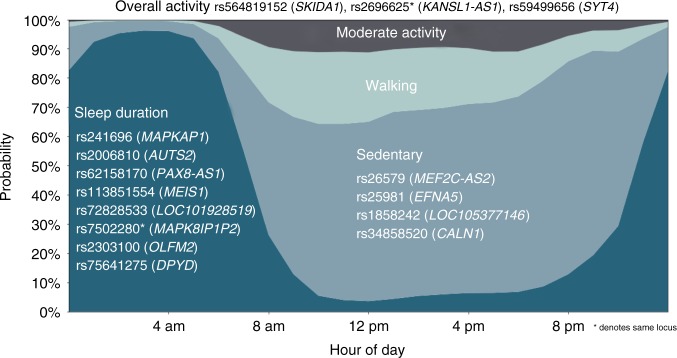
- The study identified 14 significant loci (p < 5 × 10⁻⁹, separated by ≥400 kb), 7 of them novel: one for overall activity (rs564819152 near SKIDA1), two for sleep duration (rs2416963 near MAPKAP1; rs2006810 near AUTS2), and four for sedentary time (near MEF2C-AS2, EFNA5, LOC105377146, CALN1); no loci were identified for walking or moderate intensity activity. These loci account for 0.06% of activity and 0.39% of sleep duration variation.
- Heritability was modest, ranging from 10% for moderate intensity activity to 21% for overall activity; genome-wide estimates of ~15% phenotypic variation indicated high polygenicity. Heritability was higher in women than men for overall activity (23% vs. 20%, p = 1.5 × 10⁻⁴) and sedentary behaviours (18% vs. 15%, p = 9.7 × 10⁻⁴).
- Mendelian randomisation suggested increased overall activity might causally lower diastolic blood pressure (beta mmHg/SD: −0.91, SE = 0.18, p = 8.2 × 10⁻⁷), odds of hypertension (OR/SD: 0.84, SE = 0.03, p = 4.9 × 10⁻⁸), and BMI (beta SD of BMI per SD higher activity: −0.14, SE = 0.015, p = 8.7 × 10⁻²⁰); evidence also indicated a bi-directional relationship between adiposity and overall activity.
- Heritability partitioning, enrichment, and pathway analyses indicated a role for the central nervous system in activity behaviours, with significant tissue enrichments for all traits apart from moderate activity and brain tissue enrichment (p < 1.8 × 10⁻⁴) at cerebellum, frontal cortex, brain cortex, and anterior cingulate cortex.
Methods
- Design and sample: GWAS in 91,105 UK Biobank participants of European descent with 9,926,106 SNPs after QC; participants wore an Axivity AX3 wrist-worn triaxial accelerometer for 7 days. Machine-learning models (balanced random forests with hidden Markov model smoothing) classified 30-s epochs into sleep, sedentary, walking, or moderate intensity, achieving kappa = 0.68 in 153 free-living validation participants.
- Main genetic analysis: BOLT-LMM linear mixed models with covariates including assessment centre, genotyping array, age, age squared, and season; genome-wide significance was set at p < 5 × 10⁻⁹. Downstream analyses included LD score regression, partitioned heritability, GCTA conditional analysis, FUMA/MAGMA gene-based and tissue/pathway analyses, FINEMAP, and PRSice.
- Mendelian randomisation: two-sample MR used 278,374 UK Biobank participants not included in the discovery analysis plus publicly available GWAS summary data from MR-Base; instruments were selected at p < 5 × 10⁻⁶, pruned for LD (r2 < 0.001), and >10,000 kb apart, with sensitivity analyses including weighted median, weighted mode, MR-Egger, leave-one-out, Steiger, and bi-directional tests.
Limitations
- Stated: the cohort age range was 45–80 years and included only European ancestry individuals, so results cannot necessarily be generalised to other age groups or ancestral populations; replication in non-European populations with genetic and accelerometer measures is needed.
- Stated: machine-learned sleep duration relied on self-reported sleep diaries rather than polysomnography, which can be prone to measurement error; the free-living training dataset was not a random subsample of UK Biobank. Sleep MR assumed a linear relationship, whereas future work is needed for the likely U-shape relationship between sleep and disease outcomes.
- Evident from the text: variance explained by genome-wide significant loci was calculated in the discovery dataset, and the high polygenicity of these traits makes precise replication sample-size estimation difficult; the paper states both points.
Model-written summary. Check it against the paper before relying on it.
Integrity signals
Registry
Cites
Statistics
Figures
Verification
Claims the paper makes
17 Valid · 1 Not valid · 13 Not checked · 52 Own results and interpretations
At least one cited source doesn’t support this claim or points to a different paper, and none confirmed it — see the verdicts below.
In the paper
“This allowed us to train a model using all free-living ground truth data, achieving 79% accuracy (kappa = 0.68) across classes of interest14 (Supplementary Table 1).”
§ GWAS identifies 14 loci for device-measured physical activity and sleep duration > Methods > Development and validation of machine-learned phenotypes
What the sources say
- Disputedcites [14] Willetts M Hollowell S Aslett L Holmes C Doherty A Statistical machine learning of sleep and physical activity phenotypes from sensor data in 96,220 UK Biobank participants Sci. Rep. 2018 8 7961 10.1038/s41598-018-26174-1 29784928 PMC5962537 sourceExperimental — accuracy not yet measured
Our copy of Willetts et al. (2018) reports different performance figures for the same model: the Results section states that in leave-one-subject-out cross validation over 132 participants 'our model obtained a mean accuracy of 87% with a kappa inter-rater agreement score of 0.81 over all the behaviour types in 30-second windows', and the Discussion repeats 'overall classification score of kappa = 0.81' and 'overall crude accuracy of 87%'. The only figure near those quoted is the base random-forest kappa of 0.69, which HMM time smoothing raised to 0.81 (Table S1) — no 79% accuracy or kappa = 0.68 appears anywhere in our copy (searched: 'accuracy 79% kappa 0.68', 'mean accuracy 87% kappa 0.81'). The citing sentence therefore attributes to this source accuracy and kappa values contrary to those the source itself reports. (LLM, conf=0.80)
Checked by a reasoning model — may be wrong.
plain- Asserted: passes — The authors put it forward as true.
- Checkable: passes — It can be checked against evidence.
- Load-bearing: passes — The paper’s conclusions depend on it.
- Based: passes — The paper gives a reason why it holds.
- Disputed
The cited sources support only part of this claim — read each source’s verdict below.
In the paper
“the machine-learned phenotypes demonstrated face validity14 with clear and expected differences in sleep duration by self-reported chronotype status (Supplementary Fig. 1).”
§ GWAS identifies 14 loci for device-measured physical activity and sleep duration > Results > Statistical machine learning of behaviours from sensor data
What the sources say
- Partly supportedcites [14] Willetts M Hollowell S Aslett L Holmes C Doherty A Statistical machine learning of sleep and physical activity phenotypes from sensor data in 96,220 UK Biobank participants Sci. Rep. 2018 8 7961 10.1038/s41598-018-26174-1 29784928 PMC5962537 sourceExperimental — accuracy not yet measured
Our copy supports the face-validity framing and a chronotype-related sleep difference: the Results state 'To assess the face validity of our activity recognition method in a large prospective dataset, we applied our model to 103,712 UK Biobank participants... Figure 1a shows self-reported "evening" people were more likely to be classified as sleeping at 8am on weekends vs. "morning" people (55% vs. 22%, p < 10^-100)', and the Discussion concludes the method 'shows face validity in a large health dataset'. However, the source reports this as a time-of-day probability of being asleep (sleeping at 8am on weekends), not a difference in total sleep duration; its sleep-duration/total-time comparisons (Table 2) are stratified by age, sex, self-rated health, weekday/weekend and season, with no chronotype breakdown. The unsupported part of the claim attributed to this source is therefore the specific 'sleep duration' metric by chronotype. (LLM, conf=0.72)
boostedstates an association- Asserted: passes — The authors put it forward as true.
- Checkable: passes — It can be checked against evidence.
- Load-bearing: unclear — It is unclear whether the paper’s conclusions depend on it.
- Based: passes — The paper gives a reason why it holds.
- Partly supported
The cited sources support only part of this claim — read each source’s verdict below.
In the paper
“We found concordance for loci previously reported using UK Biobank data for overall (near PML) and moderate intensity activity8 (near LINC02210-CRHR1, and SYT4), sleep duration12,19,23,24 (near PUM1, CHCHD5, SAMMSON, BTBD9-AS1, LRP12, EBLN3P, BSX, KCNH5, PRKCB, and RPGRIP1L), and sedentary time (near LINC01930 and LY6H) (Supplementary Data 3).”
§ GWAS identifies 14 loci for device-measured physical activity and sleep duration > Results > Loci associated with physical activity and sleep duration
What the sources say
- Partly supportedcites [8] Klimentidis YC Genome-wide association study of habitual physical activity in over 377,000 UK Biobank participants identifies multiple variants including CADM2 and APOE Int. J. Obes. 2018 42 1161 1176 10.1038/s41366-018-0120-3 PMC6195860 29899525 sourceExperimental — accuracy not yet measured
Our copy confirms this is a UK Biobank physical-activity GWAS reporting these loci: CRHR1 is a hit for MVPA (moderate-to-vigorous) and average acceleration and remained genome-wide significant in the fully adjusted Model 3 (Results > Consistent loci across self-report and accelerometry; Results > Accelerometer-based PA in UK Biobank). However, SYT4 is reported only as the 'RIT2/SYT4' locus associated with average acceleration in Model 1 alone — i.e. an overall intensity measure, not moderate-intensity activity — and the PML locus the citing sentence files under 'overall' was significant for fraction of accelerations >425 mg (a vigorous-intensity proxy, 6 METs cutoff) in Models 1 and 2. So the loci are this paper's UK Biobank hits, but the trait labels attached to SYT4 (and PML) overstate/mis-specify what the source reports. (LLM, conf=0.78)
- Not checked yetcites [12] Jansen, P. R. et al. Genome-wide analysis of insomnia (N=1,331,010) identifies novel loci and functional pathways. bioRxiv 214973, 10.1101/214973 (2018). source
- Partly supportedcites [19] Jones SE Genome-wide association analyses in 128,266 individuals identifies new morningness and sleep duration loci PLoS Genet. 2016 12 e1006125 10.1371/journal.pgen.1006125 27494321 PMC4975467 sourceExperimental — accuracy not yet measured
Jones et al. (2016) is indeed a UK Biobank GWAS that reports previously-identified and novel sleep-duration loci, so the broad point — that sleep duration loci were previously reported using UK Biobank data — is in our copy (Results, 'Three loci associated with sleep duration', and Table 2; Abstract). However, the loci this paper reports for sleep duration are only PAX8 (rs62158211) and two conditionally independent VRK2 signals (rs17190618, rs1380703); none of the genes the citing sentence lists for sleep duration (PUM1, CHCHD5, SAMMSON, BTBD9-AS1, LRP12, EBLN3P, BSX, KCNH5, PRKCB, RPGRIP1L) appear anywhere in our copy, and the paper's other UK Biobank loci (Table 1: RGS16, PER2, HCRTR2, INADL, etc.) are chronotype/morningness, not sleep duration. The paper also reports nothing on physical activity or sedentary time, so only the sleep-duration part of the attribution is covered, and even there the specific loci credited are not this paper's. (LLM, conf=0.75)
- Supportedcites [23] Jones, S. E. et al. Genetic studies of accelerometer-based sleep measures in 85,670 individuals yield new insights into human sleep behaviour. bioRxiv 303925, 10.1101/303925 (2018). PMC6451011 30952852 source
The citation is offered for the part of the sentence asserting previously reported UK Biobank sleep-duration loci. Our copy is exactly such a report: the INTRODUCTION and Results ('Ten novel sleep duration loci identified from accelerometer-derived sleep duration GWAS') state a GWAS of accelerometer-derived sleep duration in 85,670 UK Biobank participants yielding 11 loci, and Table 2 lists those sleep-duration loci, including LRP12/ZFPM2 (rs2880370) and KCNH5 (rs10138240), two of the gene regions named in the citing sentence. The remaining loci in the shared list are covered by the co-cited references (12,19,23,24), not by this source alone, and the 'concordance' finding itself is the citing authors' own result rather than an attribution. (LLM, conf=0.85)
- Supportedcites [24] Dashti, H. et al. GWAS in 446,118 European adults identifies 78 genetic loci for self-reported habitual sleep duration supported by accelerometer-derived estimates. bioRxiv 274977, 10.1101/274977 (2018). PMC6405943 30846698 source
Our copy of Dashti et al. (2018) is exactly the UK Biobank sleep-duration GWAS the citing sentence identifies: the Abstract (p. 1) states that in UK Biobank participants of European ancestry (n=446,118) a GWAS 'identified 78 loci for self-reported habitual sleep duration (P<5x10^-8)', and the Population and study design / Genotyping sections confirm the UK Biobank European-ancestry sample. The gene neighbourhoods listed in the citing sentence (PUM1, CHCHD5, SAMMSON, BTBD9-AS1, LRP12, EBLN3P, BSX, KCNH5, PRKCB, RPGRIP1L) are credited jointly to four references and are tabulated in this paper's Supplementary Table 2, which our copy references but does not reproduce, so individual locus names could not be checked here; nothing in our copy contradicts the attribution. (LLM, conf=0.82)
plainstates an association- Asserted: passes — The authors put it forward as true.
- Checkable: passes — It can be checked against evidence.
- Load-bearing: passes — The paper’s conclusions depend on it.
- Based: passes — The paper gives a reason why it holds.
- Partly supported
Every source the paper cites for this claim was checked and supports it.
In the paper
“Estimation of the LD Score intercepts, using LD score regression26, revealed intercepts near 1.00 (range: 0.98–1.02), indicating that the genomic inflation was due to a polygenic architecture rather than inflation due to uncorrected population structure.”
§ GWAS identifies 14 loci for device-measured physical activity and sleep duration > Results > Loci associated with physical activity and sleep duration
What the sources say
- Supportedcites [26] Bulik-Sullivan BK LD Score regression distinguishes confounding from polygenicity in genome-wide association studies Nat. Genet. 2015 47 291 295 10.1038/ng.3211 25642630 PMC4495769 source
The citation is attached to the method identification ('using LD score regression'), and our copy is that method: the Abstract states LD Score regression 'quantifies the contribution of each' of polygenicity and confounding biases 'such as cryptic relatedness and population stratification', and the Results (Simulations with Confounding) show the intercept is 'approximately equal to λGC in simulations with population stratification ... and near 1 in simulations with polygenicity', with Real Data and the Discussion treating a low intercept as evidence that inflation is mostly polygenic. The specific intercept range 0.98–1.02 is the citing authors' own analysis and is not attributed to this source, so nothing here overreaches. (LLM, conf=0.90)
hedgedstates a cause- Asserted: passes — The authors put it forward as true.
- Checkable: passes — It can be checked against evidence.
- Load-bearing: passes — The paper’s conclusions depend on it.
- Based: passes — The paper gives a reason why it holds.
- Supported
Every source the paper cites for this claim was checked and supports it.
In the paper
“Genetic correlations32 of trait architectures as measured using LD score regression26 showed strong correlation between men and women; correlations ranged from 0.92 for overall activity to 0.97 for sleep duration (Supplementary Fig. 6).”
§ GWAS identifies 14 loci for device-measured physical activity and sleep duration > Results > Sexual dimorphism in physical activity and sleep duration
What the sources say
- Supportedcites [32] Bulik-Sullivan B An atlas of genetic correlations across human diseases and traits Nat. Genet. 2015 47 1236 1241 10.1038/ng.3406 26414676 PMC4797329 source
The citation is attached to “genetic correlations,” not to the male–female estimates. The source’s Results > Overview of Methods defines genetic correlation and explains its estimation using LD Score regression. The 0.92–0.97 range is presented as a result in the citing paper’s Supplementary Fig. 6, not as a finding attributed to this source. (LLM, conf=0.88)
- Supportedcites [26] Bulik-Sullivan BK LD Score regression distinguishes confounding from polygenicity in genome-wide association studies Nat. Genet. 2015 47 291 295 10.1038/ng.3211 25642630 PMC4495769 source
Citation 26 is attached to “LD score regression,” identifying the method used, not to the reported men–women correlations. The Introduction describes regressing GWAS statistics against LD Score and calls this LD Score regression. The correlation values are not attributed to this source. (LLM, conf=0.93)
boostedstates an association- Asserted: passes — The authors put it forward as true.
- Checkable: passes — It can be checked against evidence.
- Load-bearing: passes — The paper’s conclusions depend on it.
- Based: passes — The paper gives a reason why it holds.
- Supported
50 more claims · 9 with their cited sources checked
Create a free account to see all 83 claims and to verify the 19 references still open.
- Probably not a substantial claim. 10
- It may state two separate claims as one. 21
Claims other papers make about this one
Each is checked against this paper’s own text: does it say what the citing paper says it does?
In the citing paper
“existing actigraphy-based sleep studies on large health datasets have only focused on the differentiation between sleep and wakefulness4,9–11 without evaluating variations in the stages of sleep.”
From Self-supervised learning of accelerometer data provides new insights for sleep and its association with mortality (2024) · cites this paper as [9]
Self-check
Percentages, sums and reported differences re-computed from the paper’s own numbers.
Each contradiction between two passages listed here was confirmed by an independent check.
Rated major: it would touch a result — a value a result rests on, reported and recomputed p-values on opposite sides of the significance level, two passages that conflict with no sign which is right, or a cited work retracted before this paper was published.
In the paper
§ GWAS identifies 14 loci for device-measured physical activity and sleep duration > Results > Loci associated with physical activity and sleep duration
“rs564819152 near SKIDA1, p = 1.9 × 10⁻⁹”
§ GWAS identifies 14 loci for device-measured physical activity and sleep duration > Results > Loci associated with physical activity and sleep duration
“| Novel | Overall activity | 1 | 10 | rs564819152 | 21,820,650 | SKIDA1 | A/G | 0.679 | 0.028 | 0.005 | 4.20E-09 |”
Rated major: it would touch a result — a value a result rests on, reported and recomputed p-values on opposite sides of the significance level, two passages that conflict with no sign which is right, or a cited work retracted before this paper was published.
In the paper
§ GWAS identifies 14 loci for device-measured physical activity and sleep duration > Abstract
“These loci account for 0.06% of activity and 0.39% of sleep duration variation.”
§ GWAS identifies 14 loci for device-measured physical activity and sleep duration > Results > Genetic architecture of physical activity and sleep duration
“Genome-wide significant loci account for 0.06% (overall activity) to 0.33% (sleep duration) of phenotypic variance across the traits”
Rated minor: it would not touch a result — a value no result rests on, a p-value that stays on the same side of the significance level, or a conflict that is clerical, resolved elsewhere in the paper, or outside its own findings.
In the paper
§ GWAS identifies 14 loci for device-measured physical activity and sleep duration > Results > Genetic architecture of physical activity and sleep duration
“p < 4.7 × 10⁻⁴, accounting for 21 functional categories and five traits”
§ GWAS identifies 14 loci for device-measured physical activity and sleep duration > Methods > Genetic architecture of physical activity and sleep duration
“p < 3.57 × 10⁻⁴ for functional categories (i.e., p < 0.05/28 categories/5 traits)”
Rated minor: it would not touch a result — a value no result rests on, a p-value that stays on the same side of the significance level, or a conflict that is clerical, resolved elsewhere in the paper, or outside its own findings.
In the paper
§ GWAS identifies 14 loci for device-measured physical activity and sleep duration > Results > Loci associated with physical activity and sleep duration
“After quality control, 91,105 participants of European descent and 9,926,106 single-nucleotide polymorphisms (SNPs) remained for subsequent genetic association analysis (Methods).”
§ GWAS identifies 14 loci for device-measured physical activity and sleep duration > Methods > Association of physical activity and sleep with other traits
“We removed participants from the accelerometer discovery sample (n = 91,112)”
Citations
Cites
Breiman, L. (2001) · Machine Learning · doi:10.1023/a:1010933404324 · Cited by 133,538
Sudlow, C., Gallacher, J., Allen, N., Beral, V., Burton, P., Danesh, J., Downey, P., Elliott, P., Green, J., Landray, M., et al. (2015) · PLOS Medicine · doi:10.1371/journal.pmed.1001779 · Cited by 12,728
Second-generation PLINK: rising to the challenge of larger and richer datasets
Chang, C. C., Chow, C. C., Tellier, L. C., Vattikuti, S., Purcell, S. M., & Lee, J. J. (2015) · Gigascience · doi:10.1186/s13742-015-0047-8 · Cited by 12,709
Bowden, J., Davey Smith, G., & Burgess, S. (2015) · International Journal of Epidemiology · doi:10.1093/ije/dyv080 · Cited by 9,816
Bowden, J., Davey Smith, G., Haycock, P. C., & Burgess, S. (2016) · Genetic Epidemiology · doi:10.1002/gepi.21965 · Cited by 8,922
The UK Biobank resource with deep phenotyping and genomic data
Bycroft, C., Freeman, C., Petkova, D., Band, G., Elliott, L. T., Sharp, K., Motyer, A., Vukcevic, D., Delaneau, O., O’Connell, J., et al. (2018) · Nature · doi:10.1038/s41586-018-0579-z · Cited by 8,876
Lee, I.-M., Shiroma, E. J., Lobelo, F., Puska, P., Blair, S. N., & Katzmarzyk, P. T. (2012) · The Lancet · doi:10.1016/s0140-6736(12)61031-9 · Cited by 8,215
The MR-Base platform supports systematic causal inference across the human phenome
Hemani, G., Zheng, J., Elsworth, B., Wade, K. H., Haberland, V., Baird, D., Laurin, C., Burgess, S., Bowden, J., Langdon, R., et al. (2018) · eLife · doi:10.7554/elife.34408 · Cited by 7,959
Mendelian Randomization Analysis With Multiple Genetic Variants Using Summarized Data
Burgess, S., Butterworth, A., & Thompson, S. G. (2013) · Genetic Epidemiology · doi:10.1002/gepi.21758 · Cited by 6,050
LD Score regression distinguishes confounding from polygenicity in genome-wide association studies
Schizophrenia Working Group of the Psychiatric Genomics Consortium, Bulik-Sullivan, B. K., Loh, P.-R., Finucane, H. K., Ripke, S., Yang, J., Patterson, N., Daly, M. J., Price, A. L., & Neale, B. M. (2015) · Nature Genetics · doi:10.1038/ng.3211 · Cited by 5,559
Research works printed but not linked: 3
- Lane JM Genome-wide association analysis identifies novel loci for chronotype in 100,420 individuals from the UK Biobank Nat. Commun. 2016 7 10889 10.1038/ncomms10889 26955885 PMC4786869 · DOI · Paper page
- Topouzi, M., Grunewald, P., Gershuny, J. & Harms, T. Everyday household practices and electricity use: early findings from a mixed-method approach to assign demand flexibility. in 4th European Conference on Behaviour and Energy Efficiency (Springer Verlag, Berlin, 2016).
- Fernández-Delgado M Cernadas E Barro S Amorim D Do we need hundreds of classifiers to solve real world classification problems? J. Mach. Learn. Res. 2014 15 3133 3181
Cited by
Items 301–400 of 412
Carvalho, N. R. G., He, Y., Smadbeck, P., Flannick, J. A., Mercader, J. M., Udler, M. S., Manrai, A. K., Moreno, J., & Patel, C. J. (2024) · medRxiv · doi:10.1101/2024.01.30.24302019 · Cited by 1
“…and dietary intake, is a result of the complex interactions between individuals agents and the specific environmental contexts they are in. 13,23,34,35 37–39 We believe that the genetic variants associated with PXS-T2D are effective at capturing shared genetic architecture across behavioral…”
Acquah, A., Creagh, A. P., Hamy, V., Shreves, A. H., Zisou, C., Harper, C., van Duijvenboden, S., Antoniades, C. A., Bennett, D., Clifton, D. A., et al. (2024) · medRxiv · doi:10.1101/2024.08.13.24311539 · Cited by 1
Self-citationJuan, C. G., & Ntasis, L. (2026) · medRxiv · doi:10.64898/2025.12.26.25343061 · Cited by 1
Leite, J. M. R. S. (2019) · Digital Library of Theses and Dissertations (Universidade de São Paulo) · doi:10.11606/d.95.2019.tde-26082019-145407
Physical activity and risk of lung cancer: a two-sample Mendelian randomization studyPreprint
Baumeister, S. E., Leitzmann, M. F., Bahls, M., Meisinger, C., Amos, C. I., Hung, R. J., Teumer, A., & Baurecht, H. (2019) · bioRxiv (Cold Spring Harbor Laboratory) · doi:10.1101/806083
Sirignano, L., Streit, F., Frank, J., Zillich, L., Witt, S. H., Rietschel, M., & Foo, J. C. (2021) · Research Square · doi:10.21203/rs.3.rs-763448/v1
Prominent Features in Sleep Disorder Disease in Bioinformatics Using Relevant Data Sets
Deepthi, P. N., Kakarla, N. M. L., & Swathi, K. (2021) · Lecture notes in networks and systems · doi:10.1007/978-981-16-1941-0_46
反芻胃刺激用具(ルーメンファイブ)投与が乳牛ルーメンメタン生成に及ぼす影響
西田, 武. (2012) · Institutional Repositories DataBase (IRDB)
Zhou, Z., Ma, Y., Li, X., Yan, Z., Ding, K., Xiao, H., Wu, Y., Chen, D., & Wu, T. (2022) · Genes · doi:10.3390/genes13010161 · Cited by 1
“For example, GWASs have identified a mass of loci related to diet [8], cigarette smoking [9], alcohol consumption [10], exercise and sleep [11].”
BackgroundEvolving Approaches to Identifying Genetic Risk Variants for Sleep Disorders
Pack, A. I. (2022) · Translational medicine research · doi:10.1007/978-94-024-2168-2_1
Ding, Z., Ritchie, M. D., Voight, B. F., & Hwang, W. (2022) · BMC Bioinformatics · doi:10.1186/s12859-022-04977-4
“Another possibility is the propensity for physical activities, which can be measured by actigraphy and could certainly influence body size and weight [20, 21].”
BackgroundCavallo, F. R., & Toumazou, C. (2022) · bioRxiv (Cold Spring Harbor Laboratory) · doi:10.1101/2022.12.02.518736
“The polygenic risk score is calculated using effect sizes reported by Doherty et al. [58] that quantify the association between selected Single Nucleotide Polymorphisms (SNP) and PA or SB. Information on the selected SNP is given in Table VI.”
MethodWong, A. T., Floud, S., REEVES, G. K., Holmes, M. V., Travis, R. C., van Duijn, C. M., Doherty, A., & Smith‐Byrne, K. (2026) · Frontiers in Dementia · doi:10.3389/frdem.2026.1843867
“(Doherty et al., 2018).”
InfluentialSelf-citationGenetic Determinants of Leisure-Time Physical Activity in the Hungarian General and Roma Populations
Pikó, P., Bába, É. B., Kósa, Z., Sándor, J., Kovács, N., Bács, Z., & Ádány, R. (2023) · International Journal of Molecular Sciences · doi:10.3390/ijms24054566 · Cited by 1
“Doherty and colleagues investigated the genetic background of physical activity and sleep duration (both were based on measured data) in 91,105 individuals registered in the UK Biobank [74].”
BackgroundAnsah, E. W., Adabla, M., Norgbedzie, J., Aloko, E. A., & Hagan, J. E. (2023) · Preprints.org · doi:10.20944/preprints202303.0447.v1
“It All Rolls Downstream: Upstream Control of Physical Activity Regulation”Preprint
Breidenbach, B. M., Liu, L., La, T. M., Castro-Padovani, T. N., Keller, N., Pescatello, L. S., Robinson, M. M., Kelly, S. A., Gerrish, K., & Lightfoot, J. T. (2023) · bioRxiv (Cold Spring Harbor Laboratory) · doi:10.1101/2023.05.10.540028
Associations of Two Psychotic Disorders with Constipation: A Mendelian Randomization StudyPreprint
Liu, J., Huang, Y.-B., Chen, X., Qian, H.-H., & Zhang, D. (2023) · Research Square · doi:10.21203/rs.3.rs-3160972/v1
Doherty, A., Yuan, H., Plekhanova, T., Walmsley, R., Reynolds, A., Maddison, K., Bucan, M., Gehrman, P., Rowlands, A., Ray, D., et al. (2023) · doi:10.21203/rs.3.rs-3275989/v1
Self-citationBürki, C., Tian, C., Westerman, K. E., & Patel, C. J. (2023) · doi:10.2196/preprints.54820
Chen, X., Hong, X., Gao, W., Luo, S., Cai, J., Liu, G., & Huang, Y. (2022) · Figshare · doi:10.6084/m9.figshare.19766063
Kim, J. Y., Song, M., Kim, M. S., Natarajan, P., Do, R., Myung, W., & Won, H. (2023) · Figshare · doi:10.6084/m9.figshare.24002939
Sleep regulation and host genetics
Odriozola, A., González, A., Álvarez‐Herms, J., & Corbi, F. (2024) · Advances in genetics · doi:10.1016/bs.adgen.2024.02.002
Clinical Implications and Genetic Basis of Sleep Deprivation in Children
Martínez-Torres, L., Diaz-Orjuela, N., Morales, M. M., Jiménez, S. P., Amaya, P. D., Contreras, M. V., Figueroa, S. M. Q., Naranjo, J. F. R., Uribe, O. R., Camacho, J. H., et al. (2024) · Journal of Child Science · doi:10.1055/s-0044-1787682
Mendelian Randomization of Sleep and Circadian Traits
Sonti, S., & Grant, S. F. A. (2024) · Springer eBooks · doi:10.1007/978-3-031-62723-1_9
Genetics of Chronotype and Circadian Rhythm Disorders
Kunorozva, L., & Lane, J. M. (2024) · Springer eBooks · doi:10.1007/978-3-031-62723-1_11
Association between physical activity and prostate cancer: A Mendelian randomization study
Yin, C., Tu, G., Wang, J., & Liao, B. (2024) · Science & Sports · doi:10.1016/j.scispo.2024.07.003
Wearable-oriented Support for Interpretation of Behavioural Effects on Sleep
Siebra, C., Quintino, J. P., Santos, A. L. M., & da Silva, F. Q. B. (2024) · Annual International Conference of the IEEE Engineering in Medicine and Biology Society (EMBC) · doi:10.1109/embc53108.2024.10781768
“For example, we have conducted some experiments using the Doherty et al. [8], Willetts et al. [9], and Walmsley et al. [10] algorithms for a Ω = 30s (samples frequency = 100 Hz).”
Consumer wearable devices and disease prevention
Parliamentary Office of Science and Technology, Narain, V., & Lally, C. (2025) · doi:10.58248/pn741 · Cited by 2
Drosophila Modeling of Insomnia-Associated Genes Reveals Diverse Underlying Sleep PhenotypesPreprint
Mandigo, T. R., Daya, F. A., Math, S., Ye, A., Maher, M., Saxena, R., & Walker, J. A. (2025) · bioRxiv (Cold Spring Harbor Laboratory) · doi:10.1101/2025.06.12.659376
Physical activity and brain health: a systematic review of Mendelian Randomization studiesPreprint
Túnez, A., van de Weijer, M. P., Firth, J., Verweij, K. J. H., & Treur, J. L. (2025) · medRxiv · doi:10.1101/2025.06.23.25330111
Li, H., Yue, F., Gu, X., Guan, H., Chen, K., Zhang, J., Ji, H., & He, J. (2025) · European Archives of Psychiatry and Clinical Neuroscience · doi:10.1007/s00406-025-02048-2
“The study found loci for over-all activity (rs564819152, near SKIDA1 , rs2696625, near KANSL1-AS1 , rs59499656, near SYT4 ) and moderate-to-vigorous physical activity (near LINC02210-CRHR1 , and SYT4 ) [28].”
Xu, J. W., Yue, H. J., Huang, Y., Wu, H., Su, H. M., Li, M. J., Deng, X. Q., Liang, J., Campos, A. I., Rentería, M. E., et al. (2025) · Epidemiologic Reviews · doi:10.1093/epirev/mxaf010
Ko, B., Ko, Y. E., Jung, C., Kang, D. H., Park, C. H., Koh, H. B., Heo, G. Y., Kim, H. W., Park, J. T., Yoo, T., et al. (2025) · Journal of Nephrology · doi:10.1007/s40620-025-02345-y · Cited by 1
“In the UK Biobank study, machine-learning-derived moderate-to-vigorous physical activity time was predefined using the methodology from the CAP-TURE-24 study [12].”
Family History–Guided Physical Activity for Cardiovascular Disease Prevention
Polo‐López, A., Calatayud, J., López, L., Núñez‐Cortés, R., Andersen, L. L., & López‐Bueno, R. (2025) · American Journal of Preventive Medicine · doi:10.1016/j.amepre.2025.108080 · Cited by 2
Cao, Y., Hao, Q., Xia, N., & Feng, Y. (2025) · Medicine · doi:10.1097/md.0000000000044543
“[31,32] Notably, both studies derived their genetic instruments from the GWAS conducted by Doherty et al in 2018, [33] which did not differentiate between subtypes of sedentary behavior.”
Introduction to Genetics Applied to Sports
Dentillo, D. B. (2025) · Springer eBooks · doi:10.1007/978-3-032-11647-5_1
Li, S., & Hua, X. (2021) · Figshare · doi:10.6084/m9.figshare.13710712
Li, S., & Hua, X. (2021) · Figshare · doi:10.6084/m9.figshare.13710634
Li, S., & Hua, X. (2021) · Figshare · doi:10.6084/m9.figshare.13710661
Li, S., & Hua, X. (2021) · Figshare · doi:10.6084/m9.figshare.13710643
Li, S., & Hua, X. (2021) · Figshare · doi:10.6084/m9.figshare.13710652
Li, S., & Hua, X. (2021) · Figshare · doi:10.6084/m9.figshare.13710667
Escala-Garcia, M., Morra, A., Canisius, S., Chang-Claude, J. C., Kar, S., Zheng, W., Bojesen, S. E., Easton, D. F., Pharoah, P. D. P., & Schmidt, M. K. (2020) · Figshare · doi:10.6084/m9.figshare.13245820
Li, S., & Hua, X. (2021) · Figshare · doi:10.6084/m9.figshare.13710700
Larsen, M., He, F., Kawasawa, Y. I., Berg, A., Vgontzas, A. N., Liao, D., Bixler, E. O., & Fernández‐Mendoza, J. (2024) · Figshare · doi:10.6084/m9.figshare.26613146
Additional file 1 of A fast non-parametric test of association for multiple traits
Garrido-Martín, D., Calvo, M., Reverter, F., & Guigó, R. (2023) · Figshare · doi:10.6084/m9.figshare.24303326
Zhao, J., Ke, Z., Huang, R., Wen, X., Liu, W., Wang, S., Zhang, X., Zhuang, X., Pan, L., & Liao, L. (2024) · Figshare · doi:10.6084/m9.figshare.27059060
Kim, J. Y., Song, M., Kim, M. S., Natarajan, P., Do, R., Myung, W., & Won, H.-H. (2023) · Figshare · doi:10.6084/m9.figshare.24002936
Lei, W., Yang, M., Yuan, Z., Feng, R., Kuang, X., Liu, Z., Deng, Z., Hu, X., & Tai, W. (2024) · Figshare · doi:10.6084/m9.figshare.26642572
Li, S., & Hua, X. (2021) · Figshare · doi:10.6084/m9.figshare.13710631
Li, S., & Hua, X. (2021) · Figshare · doi:10.6084/m9.figshare.13710649
Li, S., & Hua, X. (2021) · Figshare · doi:10.6084/m9.figshare.13710679
Hanscombe, K. B., Persyn, E., Traylor, M., Glanville, K. P., Hamer, M., Coleman, J. R. I., & Lewis, C. M. (2021) · Figshare · doi:10.6084/m9.figshare.16969232
Chen, X., Hong, X., Gao, W., Luo, S., Cai, J., Liu, G., & Huang, Y. (2022) · Figshare · doi:10.6084/m9.figshare.19766066
Zhuang, Z., Gao, M., Yang, R., Li, N., Liu, Z., Cao, W., & Huang, T. (2020) · Figshare · doi:10.6084/m9.figshare.12276971
Li, S., & Hua, X. (2021) · Figshare · doi:10.6084/m9.figshare.13710628
Aasdahl, L., Nilsen, T. I. L., Meisingset, I., Nordstoga, A. L., Evensen, K. A. I., Paulsen, J., Mork, P. J., & Skarpsno, E. S. (2021) · Figshare · doi:10.6084/m9.figshare.13633161
Lei, W., Yang, M., Yuan, Z., Feng, R., Kuang, X., Liu, Z., Deng, Z., Hu, X., & Tai, W. (2024) · Figshare · doi:10.6084/m9.figshare.26642569
Zhao, J., Ke, Z., Huang, R., Wen, X., Liu, W., Wang, S., Zhang, X., Zhuang, X., Pan, L., & Liao, L. (2024) · Figshare · doi:10.6084/m9.figshare.27059045
Zhao, J., Ke, Z., Huang, R., Wen, X., Liu, W., Wang, S., Zhang, X., Zhuang, X., Pan, L., & Liao, L. (2024) · Figshare · doi:10.6084/m9.figshare.27059057
Aasdahl, L., Nilsen, T. I. L., Meisingset, I., Nordstoga, A. L., Evensen, K. A. I., Paulsen, J., Mork, P. J., & Skarpsno, E. S. (2021) · Figshare · doi:10.6084/m9.figshare.13633155
Li, S., & Hua, X. (2021) · Figshare · doi:10.6084/m9.figshare.13710673
Zhao, J., Ke, Z., Huang, R., Wen, X., Liu, W., Wang, S., Zhang, X., Zhuang, X., Pan, L., & Liao, L. (2024) · Figshare · doi:10.6084/m9.figshare.27059039
Li, S., & Hua, X. (2021) · Figshare · doi:10.6084/m9.figshare.13710655
Additional file 1 of Dietary factors in relation to hypertension: a mendelian randomization study
Cai, J., Sun, X., Li, M., Luo, R., Wang, W., Wang, Z., Akkaif, M. A., & Liu, H. (2024) · Figshare · doi:10.6084/m9.figshare.26737647
Aasdahl, L., Nilsen, T. I. L., Meisingset, I., Nordstoga, A. L., Evensen, K. A. I., Paulsen, J., Mork, P. J., & Skarpsno, E. S. (2021) · Figshare · doi:10.6084/m9.figshare.13633158
Li, S., & Hua, X. (2021) · Figshare · doi:10.6084/m9.figshare.13710646
Additional file 2 of A fast non-parametric test of association for multiple traits
Garrido-Martín, D., Calvo, M., Reverter, F., & Guigó, R. (2024) · Figshare · doi:10.6084/m9.figshare.24303447
Li, S., & Hua, X. (2021) · Figshare · doi:10.6084/m9.figshare.13710640
Aasdahl, L., Nilsen, T. I. L., Meisingset, I., Nordstoga, A. L., Evensen, K. A. I., Paulsen, J., Mork, P. J., & Skarpsno, E. S. (2021) · Figshare · doi:10.6084/m9.figshare.13633149
Aasdahl, L., Nilsen, T. I. L., Meisingset, I., Nordstoga, A. L., Evensen, K. A. I., Paulsen, J., Mork, P. J., & Skarpsno, E. S. (2021) · Figshare · doi:10.6084/m9.figshare.13633152
Zhao, J., Ke, Z., Huang, R., Wen, X., Liu, W., Wang, S., Zhang, X., Zhuang, X., Pan, L., & Liao, L. (2024) · Figshare · doi:10.6084/m9.figshare.27059042
Li, S., & Hua, X. (2021) · Figshare · doi:10.6084/m9.figshare.13710637
Li, S., & Hua, X. (2021) · Figshare · doi:10.6084/m9.figshare.13710706
Ding, Z., Ritchie, M. D., Voight, B. F., & Hwang, W.-T. (2022) · Figshare · doi:10.6084/m9.figshare.21332731
Casanova, F., O’Loughlin, J., Karageorgiou, V., Beaumont, R. N., Bowden, J., Wood, A. R., & Tyrrell, J. (2023) · Figshare · doi:10.6084/m9.figshare.24864076
Escala-Garcia, M., Morra, A., Canisius, S., Chang-Claude, J. C., Kar, S., Zheng, W., Bojesen, S. E., Easton, D. F., Pharoah, P. D. P., & Schmidt, M. K. (2020) · Figshare · doi:10.6084/m9.figshare.13245823
Hu, J., Wang, X., Cheng, L., Dang, K., Ming, Z., Tao, X., Xu, X., Sarker, S., & Li, Y. (2024) · Figshare · doi:10.6084/m9.figshare.26666467
Li, S., & Hua, X. (2021) · Figshare · doi:10.6084/m9.figshare.13710685
Aasdahl, L., Nilsen, T. I. L., Meisingset, I., Nordstoga, A. L., Evensen, K. A. I., Paulsen, J., Mork, P. J., & Skarpsno, E. S. (2021) · Figshare · doi:10.6084/m9.figshare.13633146
Ba, H., Zhang, L., Peng, H., He, X., & Wang, Y. (2024) · Figshare · doi:10.6084/m9.figshare.26687118
Ba, H., Zhang, L., Peng, H., He, X., & Wang, Y. (2024) · Figshare · doi:10.6084/m9.figshare.26687121
Larsen, M., He, F., Kawasawa, Y. I., Berg, A., Vgontzas, A. N., Liao, D., Bixler, E. O., & Fernández‐Mendoza, J. (2024) · Figshare · doi:10.6084/m9.figshare.26613143
Li, S., & Hua, X. (2021) · Figshare · doi:10.6084/m9.figshare.13710718
Zhao, J., Ke, Z., Huang, R., Wen, X., Liu, W., Wang, S., Zhang, X., Zhuang, X., Pan, L., & Liao, L. (2024) · Figshare · doi:10.6084/m9.figshare.27059048
Zhao, J., Ke, Z., Huang, R., Wen, X., Liu, W., Wang, S., Zhang, X., Zhuang, X., Pan, L., & Liao, L. (2024) · Figshare · doi:10.6084/m9.figshare.27059054
Li, S., & Hua, X. (2021) · Figshare · doi:10.6084/m9.figshare.13710691
Zhao, J., Ke, Z., Huang, R., Wen, X., Liu, W., Wang, S., Zhang, X., Zhuang, X., Pan, L., & Liao, L. (2024) · Figshare · doi:10.6084/m9.figshare.27059051
Zhao, J., Ke, Z., Huang, R., Wen, X., Liu, W., Wang, S., Zhang, X., Zhuang, X., Pan, L., & Liao, L. (2024) · Figshare · doi:10.6084/m9.figshare.27059036
Hu, J., Wang, X., Cheng, L., Dang, K., Ming, Z., Tao, X., Xu, X., Sarker, S., & Li, Y. (2024) · Figshare · doi:10.6084/m9.figshare.26666464
Scenario-Controlled Synthetic Data Augmentation: In Application of Agitation Monitoring
Najem, A., Deters, J. K., Sedighi, M., & Wörtche, H. J. (2026) · Lecture notes in computer science · doi:10.1007/978-3-032-13312-0_12
Feng, S., Liu, K., Qin, Z., He, H., Bu, W., Liu, R., Sun, Y., & Chen, S. (2026) · International Journal of Behavioral Development · doi:10.1177/01650254251413161
Xiao, C., Shen, J., & Shen, Y. (2026) · Research Square · doi:10.21203/rs.3.rs-8585990/v1
Kankaanpää, A., Joensuu, L., Ekelund, U., Pitkänen, A., Waller, K. L., Palviainen, T., Kaprio, J. A., Ollikainen, M., Aaltonen, S. E., & Sillanpää, E. (2026) · medRxiv · doi:10.64898/2026.03.10.26348015
Evaluation of the quality and quantity of walking by accelerometry
Crowley, P. (2021) · theses.fr (ABES) · doi:10.70675/c54c76c2zab40z45bcz866dze9fa866f4290
Gao, D., Zhang, W., Zhang, Y., Ji, M., Han, X., Liang, J., Pan, Y., Zheng, F., Xie, L., & Xie, W. (2026) · Pulmonology · doi:10.1080/25310429.2026.2649099 · Cited by 1
Ajufo, E. C., Kany, S., Rämö, J. T., Churchill, T. W., Guseh, J. S., Aragam, K. G., Ellinor, P. T., & Khurshid, S. S. (2026) · JACC Advances · doi:10.1016/j.jacadv.2026.102718
Kahl, F., Schalkamp, A., Gunter, K. M., Ophey, A., Röttgen, S., Razzaque, J., Kufer, K., Sandor, C., Fink, G. R., Kalbe, E., et al. (2026) · Movement Disorders · doi:10.1002/mds.70329
Metadata
- Authors
- Doherty, A., Smith-Byrne, K., Ferreira, T., Holmes, M. V., Holmes, C., Pulit, S. L., & Lindgren, C. M.
- Affiliations
- John Radcliffe Hospital (GB)
- University of Oxford (GB)
- Centre for Human Genetics (GB)
- Broad Institute (US)
- Corresponding author
- Doherty, Aiden
- ORCID
- Venue
- Nature Communications
- Published
- 2018-12-10
- Volume
- 9
- Issue
- 1
- Pages
- 5257-5257
- ISSN
- 2041-1723 (ISSN-L)
- PMC
- PMC6288145
- OpenAlex
- W2903445830
- Semantic Scholar
- a670c44b7f7794dd2eb1fb67583dc37c7e54a5b7
- Cited by
- 408
- References
- 88
- Citations by year
- 2026: 28 · 2025: 45 · 2024: 66 · 2023: 50 · 2022: 68 · 2021: 76 · 2020: 48 · 2019: 21 · 2018: 5
- FWCI
- 23.00
- Type
- journal article
- Language
- en
- Open access
- gold
- doi.org
- Licence
- cc-by
- creativecommons.org/licenses/by/4.0 (tdm)
- creativecommons.org/licenses/by/4.0 (vor)
- Locations
- Nature Communications (publishedVersion, cc-by)
- bioRxiv (Cold Spring Harbor Laboratory) (acceptedVersion, other-oa)
- Europe PMC (PubMed Central) (publishedVersion, other-oa)
- PubMed Central (publishedVersion, cc-by)
- PubMed (publishedVersion)
- RePEc: Research Papers in Economics (submittedVersion)
- DOAJ (DOAJ: Directory of Open Access Journals) (submittedVersion)
- DOAJ (DOAJ: Directory of Open Access Journals) (submittedVersion, cc-by-sa)
- Funders
- Li Ka Shing Foundation
- Wellcome Trust (RE/13/1/30181)
- Broad Institute
- National Institute for Health and Care Research
- British Heart Foundation (18/23/33512, RE/13/1/30181, FS/18/23/33512)
- University of Oxford (RE/13/1/30181)
- European Commission (HORIZON2020)
- National Institutes of Health (FS/18/23/33512, CR00.01, CRR00070 CR00.01, CRR00070)
- Medical Research Council (13/1/30181, RE/13/1/30181, MC_PC_17228)
- Economic and Social Research Council (ES/L011662/1)
- National Center for Research Resources (M01RR000070)
- Topics
- Life Sciences › Biochemistry, Genetics and Molecular Biology › Genetics › Genetic Associations and Epidemiology
- Life Sciences › Biochemistry, Genetics and Molecular Biology › Genetics › Genetics and Physical Performance
- Health Sciences › Medicine › Public Health, Environmental and Occupational Health › Physical Activity and Health
- Keywords
- physical activity, sleep duration, device-measured activity, heritability, sedentary behavior, central nervous system, diastolic blood pressure, hypertension, Mendelian randomization, genetic architecture
- MeSH terms
- Adolescent, Adult, Aged, Aged, 80 and over, Female, Humans, Male, Middle Aged, Sex Factors, Sleep, Exercise, Polymorphism, Single Nucleotide, Genome-Wide Association Study, Young Adult, Genetic Loci, Accelerometry
About these checks
Registry, retraction, Cites and statistics results are computed, not judged, with one exception: a printed reference that no index lists is read once by a model before it counts as a citation error. Claims are extracted by a model and kept only when their quote appears verbatim in the text; each cited source is then checked, with a model’s help, for whether it says what the claim relies on. Those verdicts can be wrong — read the claim’s quote and the cited source before relying on one.
The claim verdicts this report counts are experimental: their accuracy is not yet measured.
A language model drew the claims from the paper on 2026-10-05, under version 3 of the claim definition (model deepseek-v4.1-flash, prompt extract-v3).
A second model labelled each claim on 2026-10-05 (model jev-1.13-20260917, definition revision gold-guideline-v0.2).
Cited sources are checked with a language model’s help (qwen3.8-omni-flash and gpt-6-sol).
Statistics and arithmetic are recomputed, not judged.
Confidence bands are shown only for fields calibrated on our annotated test set. None is calibrated yet, so no band is shown.
What counts as a claim ›How we measure confidence ›How we check this ›
Are you an author, or do you see a problem with this page? Request a review
Data sources
Bibliographic data: Semantic Scholar, OpenAlex, Crossref.
Contains information from the Semantic Scholar Academic Graph Datasets, made available under the ODC Attribution License (ODC-BY 1.0).
Semantic Scholar’s data is described in: Kinney, R., et al. (2023). The Semantic Scholar Open Data Platform. arXiv:2301.10140.
