

GWAS identifies 14 loci for device-measured physical activity and sleep duration
Open accessPublished version of a preprint
The DOI matches its Crossref record; 92 of the 92 references it cites were found in a registry or an index; 26 of the 45 sources its claims cite were checked for support.
Abstract
Physical activity and sleep duration are established risk factors for many diseases, but their aetiology is poorly understood, partly due to relying on self-reported evidence. Here we report a genome-wide association study (GWAS) of device-measured physical activity and sleep duration in 91,105 UK Biobank participants, finding 14 significant loci (7 novel). These loci account for 0.06% of activity and 0.39% of sleep duration variation. Genome-wide estimates of ~ 15% phenotypic variation indicate high polygenicity. Heritability is higher in women than men for overall activity (23 vs. 20%, p = 1.5 × 10 −4 ) and sedentary behaviours (18 vs. 15%, p = 9.7 × 10 −4 ). Heritability partitioning, enrichment and pathway analyses indicate the central nervous system plays a role in activity behaviours. Two-sample Mendelian randomisation suggests that increased activity might causally lower diastolic blood pressure (beta mmHg/SD: −0.91, SE = 0.18, p = 8.2 × 10 −7 ), and odds of hypertension (Odds ratio/SD: 0.84, SE = 0.03, p = 4.9 × 10 −8 ). Our results advocate the value of physical activity for reducing blood pressure.
Overview
CoChat Summary
TL;DR
This GWAS of device-measured physical activity and sleep duration in 91,105 UK Biobank participants identified 14 genome-wide significant loci (7 novel) and found high polygenicity plus central nervous system enrichment. Mendelian randomisation suggested higher overall activity may causally lower diastolic blood pressure and hypertension odds.
Key findings
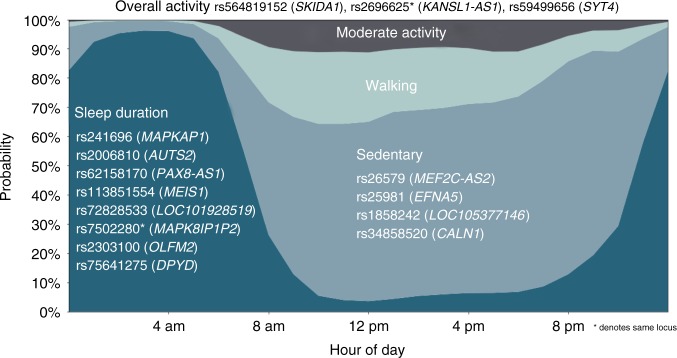
- The study identified 14 significant loci (p < 5 × 10⁻⁹, separated by ≥400 kb), 7 of them novel: one for overall activity (rs564819152 near SKIDA1), two for sleep duration (rs2416963 near MAPKAP1; rs2006810 near AUTS2), and four for sedentary time (near MEF2C-AS2, EFNA5, LOC105377146, CALN1); no loci were identified for walking or moderate intensity activity. These loci account for 0.06% of activity and 0.39% of sleep duration variation.
- Heritability was modest, ranging from 10% for moderate intensity activity to 21% for overall activity; genome-wide estimates of ~15% phenotypic variation indicated high polygenicity. Heritability was higher in women than men for overall activity (23% vs. 20%, p = 1.5 × 10⁻⁴) and sedentary behaviours (18% vs. 15%, p = 9.7 × 10⁻⁴).
- Mendelian randomisation suggested increased overall activity might causally lower diastolic blood pressure (beta mmHg/SD: −0.91, SE = 0.18, p = 8.2 × 10⁻⁷), odds of hypertension (OR/SD: 0.84, SE = 0.03, p = 4.9 × 10⁻⁸), and BMI (beta SD of BMI per SD higher activity: −0.14, SE = 0.015, p = 8.7 × 10⁻²⁰); evidence also indicated a bi-directional relationship between adiposity and overall activity.
- Heritability partitioning, enrichment, and pathway analyses indicated a role for the central nervous system in activity behaviours, with significant tissue enrichments for all traits apart from moderate activity and brain tissue enrichment (p < 1.8 × 10⁻⁴) at cerebellum, frontal cortex, brain cortex, and anterior cingulate cortex.
Methods
- Design and sample: GWAS in 91,105 UK Biobank participants of European descent with 9,926,106 SNPs after QC; participants wore an Axivity AX3 wrist-worn triaxial accelerometer for 7 days. Machine-learning models (balanced random forests with hidden Markov model smoothing) classified 30-s epochs into sleep, sedentary, walking, or moderate intensity, achieving kappa = 0.68 in 153 free-living validation participants.
- Main genetic analysis: BOLT-LMM linear mixed models with covariates including assessment centre, genotyping array, age, age squared, and season; genome-wide significance was set at p < 5 × 10⁻⁹. Downstream analyses included LD score regression, partitioned heritability, GCTA conditional analysis, FUMA/MAGMA gene-based and tissue/pathway analyses, FINEMAP, and PRSice.
- Mendelian randomisation: two-sample MR used 278,374 UK Biobank participants not included in the discovery analysis plus publicly available GWAS summary data from MR-Base; instruments were selected at p < 5 × 10⁻⁶, pruned for LD (r2 < 0.001), and >10,000 kb apart, with sensitivity analyses including weighted median, weighted mode, MR-Egger, leave-one-out, Steiger, and bi-directional tests.
Limitations
- Stated: the cohort age range was 45–80 years and included only European ancestry individuals, so results cannot necessarily be generalised to other age groups or ancestral populations; replication in non-European populations with genetic and accelerometer measures is needed.
- Stated: machine-learned sleep duration relied on self-reported sleep diaries rather than polysomnography, which can be prone to measurement error; the free-living training dataset was not a random subsample of UK Biobank. Sleep MR assumed a linear relationship, whereas future work is needed for the likely U-shape relationship between sleep and disease outcomes.
- Evident from the text: variance explained by genome-wide significant loci was calculated in the discovery dataset, and the high polygenicity of these traits makes precise replication sample-size estimation difficult; the paper states both points.
Model-written summary. Check it against the paper before relying on it.
Integrity signals
Registry
Cites
Statistics
Figures
Verification
Claims the paper makes
17 Valid · 1 Not valid · 13 Not checked · 52 Own results and interpretations
At least one cited source doesn’t support this claim or points to a different paper, and none confirmed it — see the verdicts below.
In the paper
“This allowed us to train a model using all free-living ground truth data, achieving 79% accuracy (kappa = 0.68) across classes of interest14 (Supplementary Table 1).”
§ GWAS identifies 14 loci for device-measured physical activity and sleep duration > Methods > Development and validation of machine-learned phenotypes
What the sources say
- Disputedcites [14] Willetts M Hollowell S Aslett L Holmes C Doherty A Statistical machine learning of sleep and physical activity phenotypes from sensor data in 96,220 UK Biobank participants Sci. Rep. 2018 8 7961 10.1038/s41598-018-26174-1 29784928 PMC5962537 sourceExperimental — accuracy not yet measured
Our copy of Willetts et al. (2018) reports different performance figures for the same model: the Results section states that in leave-one-subject-out cross validation over 132 participants 'our model obtained a mean accuracy of 87% with a kappa inter-rater agreement score of 0.81 over all the behaviour types in 30-second windows', and the Discussion repeats 'overall classification score of kappa = 0.81' and 'overall crude accuracy of 87%'. The only figure near those quoted is the base random-forest kappa of 0.69, which HMM time smoothing raised to 0.81 (Table S1) — no 79% accuracy or kappa = 0.68 appears anywhere in our copy (searched: 'accuracy 79% kappa 0.68', 'mean accuracy 87% kappa 0.81'). The citing sentence therefore attributes to this source accuracy and kappa values contrary to those the source itself reports. (LLM, conf=0.80)
Checked by a reasoning model — may be wrong.
plain- Asserted: passes — The authors put it forward as true.
- Checkable: passes — It can be checked against evidence.
- Load-bearing: passes — The paper’s conclusions depend on it.
- Based: passes — The paper gives a reason why it holds.
- Disputed
The cited sources support only part of this claim — read each source’s verdict below.
In the paper
“the machine-learned phenotypes demonstrated face validity14 with clear and expected differences in sleep duration by self-reported chronotype status (Supplementary Fig. 1).”
§ GWAS identifies 14 loci for device-measured physical activity and sleep duration > Results > Statistical machine learning of behaviours from sensor data
What the sources say
- Partly supportedcites [14] Willetts M Hollowell S Aslett L Holmes C Doherty A Statistical machine learning of sleep and physical activity phenotypes from sensor data in 96,220 UK Biobank participants Sci. Rep. 2018 8 7961 10.1038/s41598-018-26174-1 29784928 PMC5962537 sourceExperimental — accuracy not yet measured
Our copy supports the face-validity framing and a chronotype-related sleep difference: the Results state 'To assess the face validity of our activity recognition method in a large prospective dataset, we applied our model to 103,712 UK Biobank participants... Figure 1a shows self-reported "evening" people were more likely to be classified as sleeping at 8am on weekends vs. "morning" people (55% vs. 22%, p < 10^-100)', and the Discussion concludes the method 'shows face validity in a large health dataset'. However, the source reports this as a time-of-day probability of being asleep (sleeping at 8am on weekends), not a difference in total sleep duration; its sleep-duration/total-time comparisons (Table 2) are stratified by age, sex, self-rated health, weekday/weekend and season, with no chronotype breakdown. The unsupported part of the claim attributed to this source is therefore the specific 'sleep duration' metric by chronotype. (LLM, conf=0.72)
boostedstates an association- Asserted: passes — The authors put it forward as true.
- Checkable: passes — It can be checked against evidence.
- Load-bearing: unclear — It is unclear whether the paper’s conclusions depend on it.
- Based: passes — The paper gives a reason why it holds.
- Partly supported
The cited sources support only part of this claim — read each source’s verdict below.
In the paper
“We found concordance for loci previously reported using UK Biobank data for overall (near PML) and moderate intensity activity8 (near LINC02210-CRHR1, and SYT4), sleep duration12,19,23,24 (near PUM1, CHCHD5, SAMMSON, BTBD9-AS1, LRP12, EBLN3P, BSX, KCNH5, PRKCB, and RPGRIP1L), and sedentary time (near LINC01930 and LY6H) (Supplementary Data 3).”
§ GWAS identifies 14 loci for device-measured physical activity and sleep duration > Results > Loci associated with physical activity and sleep duration
What the sources say
- Partly supportedcites [8] Klimentidis YC Genome-wide association study of habitual physical activity in over 377,000 UK Biobank participants identifies multiple variants including CADM2 and APOE Int. J. Obes. 2018 42 1161 1176 10.1038/s41366-018-0120-3 PMC6195860 29899525 sourceExperimental — accuracy not yet measured
Our copy confirms this is a UK Biobank physical-activity GWAS reporting these loci: CRHR1 is a hit for MVPA (moderate-to-vigorous) and average acceleration and remained genome-wide significant in the fully adjusted Model 3 (Results > Consistent loci across self-report and accelerometry; Results > Accelerometer-based PA in UK Biobank). However, SYT4 is reported only as the 'RIT2/SYT4' locus associated with average acceleration in Model 1 alone — i.e. an overall intensity measure, not moderate-intensity activity — and the PML locus the citing sentence files under 'overall' was significant for fraction of accelerations >425 mg (a vigorous-intensity proxy, 6 METs cutoff) in Models 1 and 2. So the loci are this paper's UK Biobank hits, but the trait labels attached to SYT4 (and PML) overstate/mis-specify what the source reports. (LLM, conf=0.78)
- Not checked yetcites [12] Jansen, P. R. et al. Genome-wide analysis of insomnia (N=1,331,010) identifies novel loci and functional pathways. bioRxiv 214973, 10.1101/214973 (2018). source
- Partly supportedcites [19] Jones SE Genome-wide association analyses in 128,266 individuals identifies new morningness and sleep duration loci PLoS Genet. 2016 12 e1006125 10.1371/journal.pgen.1006125 27494321 PMC4975467 sourceExperimental — accuracy not yet measured
Jones et al. (2016) is indeed a UK Biobank GWAS that reports previously-identified and novel sleep-duration loci, so the broad point — that sleep duration loci were previously reported using UK Biobank data — is in our copy (Results, 'Three loci associated with sleep duration', and Table 2; Abstract). However, the loci this paper reports for sleep duration are only PAX8 (rs62158211) and two conditionally independent VRK2 signals (rs17190618, rs1380703); none of the genes the citing sentence lists for sleep duration (PUM1, CHCHD5, SAMMSON, BTBD9-AS1, LRP12, EBLN3P, BSX, KCNH5, PRKCB, RPGRIP1L) appear anywhere in our copy, and the paper's other UK Biobank loci (Table 1: RGS16, PER2, HCRTR2, INADL, etc.) are chronotype/morningness, not sleep duration. The paper also reports nothing on physical activity or sedentary time, so only the sleep-duration part of the attribution is covered, and even there the specific loci credited are not this paper's. (LLM, conf=0.75)
- Supportedcites [23] Jones, S. E. et al. Genetic studies of accelerometer-based sleep measures in 85,670 individuals yield new insights into human sleep behaviour. bioRxiv 303925, 10.1101/303925 (2018). PMC6451011 30952852 source
The citation is offered for the part of the sentence asserting previously reported UK Biobank sleep-duration loci. Our copy is exactly such a report: the INTRODUCTION and Results ('Ten novel sleep duration loci identified from accelerometer-derived sleep duration GWAS') state a GWAS of accelerometer-derived sleep duration in 85,670 UK Biobank participants yielding 11 loci, and Table 2 lists those sleep-duration loci, including LRP12/ZFPM2 (rs2880370) and KCNH5 (rs10138240), two of the gene regions named in the citing sentence. The remaining loci in the shared list are covered by the co-cited references (12,19,23,24), not by this source alone, and the 'concordance' finding itself is the citing authors' own result rather than an attribution. (LLM, conf=0.85)
- Supportedcites [24] Dashti, H. et al. GWAS in 446,118 European adults identifies 78 genetic loci for self-reported habitual sleep duration supported by accelerometer-derived estimates. bioRxiv 274977, 10.1101/274977 (2018). PMC6405943 30846698 source
Our copy of Dashti et al. (2018) is exactly the UK Biobank sleep-duration GWAS the citing sentence identifies: the Abstract (p. 1) states that in UK Biobank participants of European ancestry (n=446,118) a GWAS 'identified 78 loci for self-reported habitual sleep duration (P<5x10^-8)', and the Population and study design / Genotyping sections confirm the UK Biobank European-ancestry sample. The gene neighbourhoods listed in the citing sentence (PUM1, CHCHD5, SAMMSON, BTBD9-AS1, LRP12, EBLN3P, BSX, KCNH5, PRKCB, RPGRIP1L) are credited jointly to four references and are tabulated in this paper's Supplementary Table 2, which our copy references but does not reproduce, so individual locus names could not be checked here; nothing in our copy contradicts the attribution. (LLM, conf=0.82)
plainstates an association- Asserted: passes — The authors put it forward as true.
- Checkable: passes — It can be checked against evidence.
- Load-bearing: passes — The paper’s conclusions depend on it.
- Based: passes — The paper gives a reason why it holds.
- Partly supported
Every source the paper cites for this claim was checked and supports it.
In the paper
“Estimation of the LD Score intercepts, using LD score regression26, revealed intercepts near 1.00 (range: 0.98–1.02), indicating that the genomic inflation was due to a polygenic architecture rather than inflation due to uncorrected population structure.”
§ GWAS identifies 14 loci for device-measured physical activity and sleep duration > Results > Loci associated with physical activity and sleep duration
What the sources say
- Supportedcites [26] Bulik-Sullivan BK LD Score regression distinguishes confounding from polygenicity in genome-wide association studies Nat. Genet. 2015 47 291 295 10.1038/ng.3211 25642630 PMC4495769 source
The citation is attached to the method identification ('using LD score regression'), and our copy is that method: the Abstract states LD Score regression 'quantifies the contribution of each' of polygenicity and confounding biases 'such as cryptic relatedness and population stratification', and the Results (Simulations with Confounding) show the intercept is 'approximately equal to λGC in simulations with population stratification ... and near 1 in simulations with polygenicity', with Real Data and the Discussion treating a low intercept as evidence that inflation is mostly polygenic. The specific intercept range 0.98–1.02 is the citing authors' own analysis and is not attributed to this source, so nothing here overreaches. (LLM, conf=0.90)
hedgedstates a cause- Asserted: passes — The authors put it forward as true.
- Checkable: passes — It can be checked against evidence.
- Load-bearing: passes — The paper’s conclusions depend on it.
- Based: passes — The paper gives a reason why it holds.
- Supported
Every source the paper cites for this claim was checked and supports it.
In the paper
“Genetic correlations32 of trait architectures as measured using LD score regression26 showed strong correlation between men and women; correlations ranged from 0.92 for overall activity to 0.97 for sleep duration (Supplementary Fig. 6).”
§ GWAS identifies 14 loci for device-measured physical activity and sleep duration > Results > Sexual dimorphism in physical activity and sleep duration
What the sources say
- Supportedcites [32] Bulik-Sullivan B An atlas of genetic correlations across human diseases and traits Nat. Genet. 2015 47 1236 1241 10.1038/ng.3406 26414676 PMC4797329 source
The citation is attached to “genetic correlations,” not to the male–female estimates. The source’s Results > Overview of Methods defines genetic correlation and explains its estimation using LD Score regression. The 0.92–0.97 range is presented as a result in the citing paper’s Supplementary Fig. 6, not as a finding attributed to this source. (LLM, conf=0.88)
- Supportedcites [26] Bulik-Sullivan BK LD Score regression distinguishes confounding from polygenicity in genome-wide association studies Nat. Genet. 2015 47 291 295 10.1038/ng.3211 25642630 PMC4495769 source
Citation 26 is attached to “LD score regression,” identifying the method used, not to the reported men–women correlations. The Introduction describes regressing GWAS statistics against LD Score and calls this LD Score regression. The correlation values are not attributed to this source. (LLM, conf=0.93)
boostedstates an association- Asserted: passes — The authors put it forward as true.
- Checkable: passes — It can be checked against evidence.
- Load-bearing: passes — The paper’s conclusions depend on it.
- Based: passes — The paper gives a reason why it holds.
- Supported
50 more claims · 9 with their cited sources checked
Create a free account to see all 83 claims and to verify the 19 references still open.
- Probably not a substantial claim. 10
- It may state two separate claims as one. 21
Claims other papers make about this one
Each is checked against this paper’s own text: does it say what the citing paper says it does?
In the citing paper
“existing actigraphy-based sleep studies on large health datasets have only focused on the differentiation between sleep and wakefulness4,9–11 without evaluating variations in the stages of sleep.”
From Self-supervised learning of accelerometer data provides new insights for sleep and its association with mortality (2024) · cites this paper as [9]
Self-check
Percentages, sums and reported differences re-computed from the paper’s own numbers.
Each contradiction between two passages listed here was confirmed by an independent check.
Rated major: it would touch a result — a value a result rests on, reported and recomputed p-values on opposite sides of the significance level, two passages that conflict with no sign which is right, or a cited work retracted before this paper was published.
In the paper
§ GWAS identifies 14 loci for device-measured physical activity and sleep duration > Results > Loci associated with physical activity and sleep duration
“rs564819152 near SKIDA1, p = 1.9 × 10⁻⁹”
§ GWAS identifies 14 loci for device-measured physical activity and sleep duration > Results > Loci associated with physical activity and sleep duration
“| Novel | Overall activity | 1 | 10 | rs564819152 | 21,820,650 | SKIDA1 | A/G | 0.679 | 0.028 | 0.005 | 4.20E-09 |”
Rated major: it would touch a result — a value a result rests on, reported and recomputed p-values on opposite sides of the significance level, two passages that conflict with no sign which is right, or a cited work retracted before this paper was published.
In the paper
§ GWAS identifies 14 loci for device-measured physical activity and sleep duration > Abstract
“These loci account for 0.06% of activity and 0.39% of sleep duration variation.”
§ GWAS identifies 14 loci for device-measured physical activity and sleep duration > Results > Genetic architecture of physical activity and sleep duration
“Genome-wide significant loci account for 0.06% (overall activity) to 0.33% (sleep duration) of phenotypic variance across the traits”
Rated minor: it would not touch a result — a value no result rests on, a p-value that stays on the same side of the significance level, or a conflict that is clerical, resolved elsewhere in the paper, or outside its own findings.
In the paper
§ GWAS identifies 14 loci for device-measured physical activity and sleep duration > Results > Genetic architecture of physical activity and sleep duration
“p < 4.7 × 10⁻⁴, accounting for 21 functional categories and five traits”
§ GWAS identifies 14 loci for device-measured physical activity and sleep duration > Methods > Genetic architecture of physical activity and sleep duration
“p < 3.57 × 10⁻⁴ for functional categories (i.e., p < 0.05/28 categories/5 traits)”
Rated minor: it would not touch a result — a value no result rests on, a p-value that stays on the same side of the significance level, or a conflict that is clerical, resolved elsewhere in the paper, or outside its own findings.
In the paper
§ GWAS identifies 14 loci for device-measured physical activity and sleep duration > Results > Loci associated with physical activity and sleep duration
“After quality control, 91,105 participants of European descent and 9,926,106 single-nucleotide polymorphisms (SNPs) remained for subsequent genetic association analysis (Methods).”
§ GWAS identifies 14 loci for device-measured physical activity and sleep duration > Methods > Association of physical activity and sleep with other traits
“We removed participants from the accelerometer discovery sample (n = 91,112)”
Citations
Cites
Breiman, L. (2001) · Machine Learning · doi:10.1023/a:1010933404324 · Cited by 133,538
Sudlow, C., Gallacher, J., Allen, N., Beral, V., Burton, P., Danesh, J., Downey, P., Elliott, P., Green, J., Landray, M., et al. (2015) · PLOS Medicine · doi:10.1371/journal.pmed.1001779 · Cited by 12,728
Second-generation PLINK: rising to the challenge of larger and richer datasets
Chang, C. C., Chow, C. C., Tellier, L. C., Vattikuti, S., Purcell, S. M., & Lee, J. J. (2015) · Gigascience · doi:10.1186/s13742-015-0047-8 · Cited by 12,709
Bowden, J., Davey Smith, G., & Burgess, S. (2015) · International Journal of Epidemiology · doi:10.1093/ije/dyv080 · Cited by 9,816
Bowden, J., Davey Smith, G., Haycock, P. C., & Burgess, S. (2016) · Genetic Epidemiology · doi:10.1002/gepi.21965 · Cited by 8,922
The UK Biobank resource with deep phenotyping and genomic data
Bycroft, C., Freeman, C., Petkova, D., Band, G., Elliott, L. T., Sharp, K., Motyer, A., Vukcevic, D., Delaneau, O., O’Connell, J., et al. (2018) · Nature · doi:10.1038/s41586-018-0579-z · Cited by 8,876
Lee, I.-M., Shiroma, E. J., Lobelo, F., Puska, P., Blair, S. N., & Katzmarzyk, P. T. (2012) · The Lancet · doi:10.1016/s0140-6736(12)61031-9 · Cited by 8,215
The MR-Base platform supports systematic causal inference across the human phenome
Hemani, G., Zheng, J., Elsworth, B., Wade, K. H., Haberland, V., Baird, D., Laurin, C., Burgess, S., Bowden, J., Langdon, R., et al. (2018) · eLife · doi:10.7554/elife.34408 · Cited by 7,959
Mendelian Randomization Analysis With Multiple Genetic Variants Using Summarized Data
Burgess, S., Butterworth, A., & Thompson, S. G. (2013) · Genetic Epidemiology · doi:10.1002/gepi.21758 · Cited by 6,050
LD Score regression distinguishes confounding from polygenicity in genome-wide association studies
Schizophrenia Working Group of the Psychiatric Genomics Consortium, Bulik-Sullivan, B. K., Loh, P.-R., Finucane, H. K., Ripke, S., Yang, J., Patterson, N., Daly, M. J., Price, A. L., & Neale, B. M. (2015) · Nature Genetics · doi:10.1038/ng.3211 · Cited by 5,559
Research works printed but not linked: 3
- Lane JM Genome-wide association analysis identifies novel loci for chronotype in 100,420 individuals from the UK Biobank Nat. Commun. 2016 7 10889 10.1038/ncomms10889 26955885 PMC4786869 · DOI · Paper page
- Topouzi, M., Grunewald, P., Gershuny, J. & Harms, T. Everyday household practices and electricity use: early findings from a mixed-method approach to assign demand flexibility. in 4th European Conference on Behaviour and Energy Efficiency (Springer Verlag, Berlin, 2016).
- Fernández-Delgado M Cernadas E Barro S Amorim D Do we need hundreds of classifiers to solve real world classification problems? J. Mach. Learn. Res. 2014 15 3133 3181
Cited by
Items 201–300 of 412
Bergstedt, J., Pasman, J. A., Ma, Z., Harder, A., Yao, S., Parker, N., Treur, J. L., Smit, D. J. A., Frei, O., Shadrin, A. A., et al. (2023) · medRxiv · doi:10.1101/2023.09.01.23294931 · Cited by 7
Zi, Y., & de Geus, E. J. C. (2025) · Frontiers in Psychology · doi:10.3389/fpsyg.2025.1480631 · Cited by 13
Sun, J., Qiao, Y., Li, F., Lin, R., Yu, Y., Wang, M., Zhao, M., & Xi, B. (2025) · Journal of sport and health science/Journal of Sport and Health Science · doi:10.1016/j.jshs.2025.101099 · Cited by 8
HMG-Coenzyme A Reductase as a Drug Target for the Prevention of Ankylosing Spondylitis
Zhong, Z., Feng, X., Su, G., Du, L., Liao, W., Liu, S., Li, F., Zuo, X., & Yang, P. (2021) · Frontiers in Cell and Developmental Biology · doi:10.3389/fcell.2021.731072 · Cited by 6
Actigraphic sleep and cortisol in middle childhood: A multivariate behavioral genetics model
Runze, J., Euser, S., Oosterman, M., Dolan, C. V., Koopman‐Verhoeff, M. E., & Bakermans‐Kranenburg, M. J. (2021) · Comprehensive Psychoneuroendocrinology · doi:10.1016/j.cpnec.2021.100094 · Cited by 7
“Genome-wide association studies have predominantly focused on finding loci for sleep duration, and the PAX8 locus was consistently found to be associated with sleep duration [45,46].”
BackgroundMa, M., Guo, L., Liu, X., Zheng, Y., Gu, C., & Li, B. (2022) · Health Science Reports · doi:10.1002/hsr2.797 · Cited by 7
“exercises is generally poor between subjective and objective measures.(38) Interindividual variation is likely to exist in relevant studies.”
BackgroundSun, Y., Ma, D., Jiang, Z., Han, Q., Liu, Y., & Chen, G. (2024) · Cerebral Cortex · doi:10.1093/cercor/bhae119 · Cited by 7
The Importance of Sleep Phenotypes in Bipolar Disorders
Plante, D. T. (2019) · JAMA Psychiatry · doi:10.1001/jamapsychiatry.2019.3747 · Cited by 6
Hanscombe, K. B., Persyn, E., Traylor, M., Glanville, K. P., Hamer, M., Coleman, J. R. I., & Lewis, C. M. (2020) · medRxiv · doi:10.1101/2020.12.08.20243337 · Cited by 6
Lee, H., & Han, B. (2021) · medRxiv · doi:10.1101/2021.08.12.21261943 · Cited by 6
Wu, C., Li, H., Zhao, S., Liu, J., Ruijie, L., Sun, H., Bao, S., Li, M., & Peng, Y. (2025) · Cardiology Research and Practice · doi:10.1155/crp/7778063 · Cited by 5
Can genetics guide exercise prescriptions in osteoarthritis?
Espin‐Garcia, O., Baghel, M., Brar, N., Whittaker, J. L., & Ali, S. A. (2022) · Frontiers in Rehabilitation Sciences · doi:10.3389/fresc.2022.930421 · Cited by 6
“Notably, among the six GWAS, one high-quality study leveraging accelerometer data from 91,105 participants from the UK Biobank is consistent with previous findings on the role played by the central nervous system in activity behaviors (42).”
ResultLin, Y., Li, X., Hu, M., Zhao, J., & Zhu, C. (2024) · Medicine & Science in Sports & Exercise · doi:10.1249/mss.0000000000003601 · Cited by 7
Xiao, X., Tang, C., Zhai, X., Li, S., Ma, W., Liu, K., Shirai, K., Sheerah, H. A., Zhu, H., & Cao, J. (2022) · Nutrients · doi:10.3390/nu14234974 · Cited by 5
Personalizing treatments for patients based on cardiovascular phenotyping
Leopold, J. A. (2022) · Expert Review of Precision Medicine and Drug Development · doi:10.1080/23808993.2022.2028548 · Cited by 4
“believed to account for up to 18% of the variation in physical activity and sleep duration among participants [20].”
BackgroundHow to establish causality between physical inactivity and mortality?
Bahls, M., Baurecht, H., Hanssen, H., & Craenenbroeck, E. M. V. (2022) · European Journal of Preventive Cardiology · doi:10.1093/eurjpc/zwac021 · Cited by 5
Towards Customizable Foundation Models for Human Activity Recognition with Wearable Devices
Qiu, M., Weng, C., Fan, M., & Wu, K. (2025) · Proceedings of the ACM on Interactive Mobile Wearable and Ubiquitous Technologies · doi:10.1145/3749479 · Cited by 4
Acquah, A., Creagh, A. P., Hamy, V., Shreves, A. H., Zisou, C., Harper, C., van Duijvenboden, S., Antoniades, C. A., Bennett, D., Clifton, D. A., et al. (2025) · npj Parkinson's Disease · doi:10.1038/s41531-025-01214-6 · Cited by 6
Self-citationAdam, R., Lotankar, Y., Sas, C., Powell, D., Martinez, V., Green, S. A., Cooper, J. M., Bradbury, K. J., Sive, J. I., & Hill, D. (2024) · BMJ Open · doi:10.1136/bmjopen-2023-081416 · Cited by 5
Lü, S., Zhu, Y., Cui, M., Guo, Z., Li, X., & Song, Y. (2025) · Health Science Reports · doi:10.1002/hsr2.70479 · Cited by 8
“Further information regarding the PA data are available in the published GWAS meta ‐ analysis [28, 29].”
Genetic versus stress and mood determinants of sleep in the Amish
Bruce, H. A., Kochunov, P., Chiappelli, J., Savransky, A., Carino, K., Sewell, J., Marshall, W., Kvarta, M. D., McMahon, F. J., Ament, S. A., et al. (2021) · American Journal of Medical Genetics Part B Neuropsychiatric Genetics · doi:10.1002/ajmg.b.32840 · Cited by 5
“…for insomnia (Hammerschlag et al., 2017; Lane et al., 2017), although most significant findings in one study typically fail to replicate in others (Dashti et al., 2019; Doherty et al., 2018; Gottlieb et al., 2015; Jansen et al., 2019; Jones et al., 2019; Kalmbach et al., 2017; Stein et al., 2018).”
BackgroundLeveraging genetic data for predicting consumer choices of alcoholic products
Zhu, C., Beatty, T. K. M., Zhao, Q., Si, W., & Chen, Q. (2023) · China Agricultural Economic Review · doi:10.1108/caer-09-2022-0214 · Cited by 5
Physical Activities and Parkinson's Disease Progression: A Two‐Sample Mendelian Randomization Study
Luo, X., Cheng, X., Pan, Y., Wei, W., Hao, Z., Liu, Z., Zheng, Z., Lu, G., Xiao, Z. J., Li, M., et al. (2025) · CNS Neuroscience & Therapeutics · doi:10.1111/cns.70296 · Cited by 7
“For the assessment of PA through accelerometry, a wrist-worn accelerometer, Axivity Ax3, was used to monitor daily movement data [22].”
Marin‐Couture, É., Përusse, L., & Tremblay, A. (2021) · Applied Physiology, Nutrition, and Metabolism · doi:10.1139/apnm-2020-1109 · Cited by 4
Gao, Y., Li, C., Li, J., & Li, L. (2024) · Archives of Gerontology and Geriatrics · doi:10.1016/j.archger.2024.105364 · Cited by 6
Liu, J., Richmond, R. C., Anderson, E. L., Bowden, J., Barry, C.-J. S., Dashti, H. S., Daghlas, I., Lane, J. M., Kyle, S. D., Vetter, C., et al. (2024) · Scientific Reports · doi:10.1038/s41598-024-58007-9 · Cited by 6
“Recent MR studies suggested causal effects of accelerometer-derived shorter sleep duration and lower efficiency on higher waist-hip ratio but not T2D or other hyperglycaemic outcomes in the UK Biobank (UKB) 17,18 .”
BackgroundSalerno, E. A., Dart, H., & Colditz, G. A. (2023) · Elsevier eBooks · doi:10.1016/b978-0-323-99967-0.00002-8 · Cited by 5
Verdiesen, R. M. G., Shokouhi, M., Burgess, S., Canisius, S., Chang-Claude, J. C., Bojesen, S. E., & Schmidt, M. K. (2025) · Cancer Epidemiology Biomarkers & Prevention · doi:10.1158/1055-9965.epi-24-1440 · Cited by 4
“For physical activity, we received female-specific betas from the GWAS authors (33).”
Chen, J., Lü, Y., Yao, J., Zhang, X., & Pan, Y. (2024) · Frontiers in Public Health · doi:10.3389/fpubh.2024.1406303 · Cited by 5
“Overall activity, MPA, and SB were from another GWAS on PA and SB measured using wrist-worn accelerometers ( N = 91,105); participants were asked to wear activity trackers over 7 days (32).”
MethodWang, J., & Yang, G. (2024) · Frontiers in Neurology · doi:10.3389/fneur.2024.1434433 · Cited by 3
Flaaten, M., Skarpsno, E. S., Kongsvold, A., Åsvold, B. O., Carslake, D., Mork, P. J., & Nilsen, T. I. L. (2024) · British Journal of Sports Medicine · doi:10.1136/bjsports-2024-108197 · Cited by 4
“14 Twin studies have reported genetic heritability of physical activity ranging from 48% to 71%, 15 whereas a polygenic risk score (PRS) derived from genome-wide association studies 16 17 was reported to explain 1.4% of the variation in physical activity.”
InfluentialWearable Accelerometers in Cancer Patients
Dadhania, S., & Williams, M. (2021) · Intelligent systems reference library · doi:10.1007/978-3-030-83620-7_5 · Cited by 3
Engineering Large Wearable Sensor Data towards Digital Measures
Zhang, H., Ruan, G., Giesting, R., Miller, L., Patel, N., Ji, J., Yang, Y. L., & Yang, J. (2023) · IEEE International Conference on Big Data Analytics (ICBDA) · doi:10.1109/icbda57405.2023.10104923 · Cited by 5
Overview of methods and available tools used in complex brain disorders
Ilias, L., Doukas, G. S., Kontoulis, M., Alexakis, K., Michalitsi-Psarrou, A., Ntanos, C., & Askounis, D. (2023) · Open Research Europe · doi:10.12688/openreseurope.16244.1 · Cited by 3
Timmins, I. R., Zaccardi, F., Yates, T. E., & Dudbridge, F. (2024) · Scientific Reports · doi:10.1038/s41598-024-60398-8 · Cited by 4
“…physical activity metrics is also an important direction for future work 59 , though as yet there are still relatively few SNPs associated with device-measured metrics 60 which means limited statistical power is currently available for performing such Mendelian randomisation analyses.”
Wei, M., Meng, D., He, S., Guo, H., Yang, G., & Wang, Z. (2024) · Alcohol · doi:10.1016/j.alcohol.2024.05.002 · Cited by 3
Li, Y., Zhuang, Z., Si, H., Liu, Q., Yu, J., Zhou, W., Huang, T., & Wang, C. (2024) · Biological Research For Nursing · doi:10.1177/10998004241274271 · Cited by 3
“…al., 2018), occupational attainment (Ko et al., 2022), self-reported moderate-to-vigorous intensity physical activity during leisure time (MVPA; Wang et al., 2022), and device-measured overall physical activity (PA; Doherty et al., 2018), all of which were the largest GWAS data published to date.”
Chan, I. N., Nouraie, S. M., Chan, S. Y., & Kelly, N. J. (2025) · SLEEP · doi:10.1093/sleep/zsaf209 · Cited by 3
“Notably,the strongest associations with total sleep identifiedinthisstudyalignwithpreviouswearable-basedreports [19, 23].”
Bright, U., Overstreet, C. M., Levey, D. F., & Gelernter, J. E. (2025) · Psychological Medicine · doi:10.1017/s0033291725101293 · Cited by 5
“For Prescription Stimulants, we found an effect for the noncoding RNA MEF2C-AS2 , previously associated with sleep duration, physical activity (Doherty et al., 2018), and educational attainment (Okbay et al., 2022).”
Lü, H., Wu, P.-F., Li, R., Zhang, W., & Huang, G. (2021) · Neurological Sciences · doi:10.1007/s10072-020-04953-x · Cited by 3
“have identified 5 genomewide significant (P < 5 × 10) risk loci for accelerometermeasured PA [16].”
BackgroundMethodThe role of sleep in the human brain and body: insights from multi-organ imaging geneticsPreprint
Fan, Z., Yang, Y., Guo, Y., Li, Y., Shu, J., Yang, X., Li, B., Lin, J., Wang, Q., Gibson, C., et al. (2022) · medRxiv · doi:10.1101/2022.09.08.22279719 · Cited by 3
Yuan, H., Plekhanova, T., Walmsley, R., Reynolds, A. C., Maddison, K. J., Bucan, M., Gehrman, P., Rowlands, A., Ray, D. W., Bennett, D., et al. (2023) · doi:10.1101/2023.07.07.23292251 · Cited by 3
Self-citationKLIMENTIDIS, Y. C., NEWELL, M., VAN DER ZEE, M. D., BLAND, V. L., MAY-WILSON, S., ARANI, G., MENNI, C., MANGINO, M., ARORA, A., RAICHLEN, D. A., et al. (2022) · Medicine & Science in Sports & Exercise · doi:10.1249/mss.0000000000002907 · Cited by 6
“Of all 19 loci identified for PAliking, only APOE, CADM2, HIST1H1D, and SKIDA1 have been previously found to be associated with self-reported or accelerometry-measured PA (8,9).”
BackgroundAffective response to physical activity as a deep phenotype in a non-randomized pilot study
Lee, H., McGeary, J. E., DUNSIGER, S. I., Emerson, J. A., Bock, B. C., McCaffery, J. M., Dwyer, K., Bryan, A. D., & Williams, D. M. (2022) · Scientific Reports · doi:10.1038/s41598-022-09662-3 · Cited by 2
“ActiGraphs were worn on each participant’s hip over 4-7 day periods at baseline and at the end of the intervention, for at least 10 hours per day, consistent with standard practice in the field (15).”
MethodChalitsios, C. V., Markozannes, G., Aglago, E. K., Berndt, S. I., Buchanan, D. D., Campbell, P. T., Cao, Y., Chan, A. T., Dimou, N. L., Drew, D. A., et al. (2025) · JNCI Cancer Spectrum · doi:10.1093/jncics/pkaf095 · Cited by 2
“47 Physical activity was objectively measured using a wrist-worn accelerometer worn continuously for 7 days.”
Qiu, B., Wang, Q., Ling, Z., Wen, S., Yao, Q., Xiao, Y., Xu, X., Li, Z., Long, S., Yang, T., et al. (2025) · Blood Pressure · doi:10.1080/08037051.2025.2569387 · Cited by 3
“Methodologically, genetic instruments for PA primarily reflect lifelong activity propensities [33], in contrast to self-reported questionnaire data that capture shorter-term behavioural patterns.”
Zi, Y., van de Ven, S. R. B., de Geus, E. J. C., & Chen, P. (2026) · Interactive Journal of Medical Research · doi:10.2196/76601 · Cited by 5
“…On the positive side, the proliferation of public datasets (accounting to 25%, 10/40 studies), including Capture-24 [31,33,53,57,75,76], Energy-24 [57], UOULU (University of Oulu) [60], OSU (Oregon State University) [60], the PAMAP2 Physical Activity Monitoring dataset (University of California,…”
InfluentialFelesina, T. (2025) · Evolution and Human Behavior · doi:10.1016/j.evolhumbehav.2025.106773 · Cited by 2
Dai, S., Chen, Y., Huang, S., Long, G., Huang, H., & Xu, C. (2026) · Journal of Proteome Research · doi:10.1021/acs.jproteome.5c00555 · Cited by 2
Genetic architecture of sleep in a genome wide association study of device measured sleep traits
Portas, L., Yuan, H., Cai, L., Smith-Byrne, K., van Duijvenboden, S., Kyle, S. D., Ray, D. W., Howson, J. M. M., & Doherty, A. (2026) · Nature Communications · doi:10.1038/s41467-026-71252-y · Cited by 2
Self-citationYuan, Y., Hu, W., Zhang, X., Borchert, G., Wang, W., Zhu, Z., & He, M. (2022) · Asia-Pacific Journal of Ophthalmology · doi:10.1097/apo.0000000000000578 · Cited by 2
Sibling Resemblance in Physical Activity Levels: The Peruvian Sibling Study on Growth and Health
Santos, C., Maia, J. A. R., Pereira, S., Vasconcelos, O., Garganta, R., Lightfoot, J. T., Tani, G., Hedeker, D., Katzmarzyk, P. T., & Bustamante, A. (2023) · International Journal of Environmental Research and Public Health · doi:10.3390/ijerph20054210 · Cited by 4
“[42] uncovering 14 loci for device-measured PA, while Klimentidis, et al.”
BackgroundZagkos, L., Drenos, F., Emmett, P. M., Blakemore, A. I. F., Nordström, T., Hurtig, T. M., Järvelin, M., & Dovey, T. M. (2023) · Appetite · doi:10.1016/j.appet.2023.107036 · Cited by 4
“SNPs for staple food eating had previously been reported as associated with physical activity (Doherty et al., 2018), being a morning person (Jones et al., 2019), and loneliness (Lim et al., 2018).”
BackgroundSedentary Behaviour and Cancer
Swain, C. T. V., Boyle, T., Mahmood, S., & Lynch, B. M. (2023) · Springer series on epidemiology and public health · doi:10.1007/978-3-031-41881-5_9 · Cited by 2
Mendelian randomization analyses clarify the effects of height on cardiovascular diseases
Hui, D., Sanford, E., Lorenz, K., Damrauer, S. M., Assimes, T. L., Thom, C. S., & Voight, B. F. (2024) · PLoS ONE · doi:10.1371/journal.pone.0298786 · Cited by 2
“…lipid levels (low density lipoprotein and triglycerides) [15], systolic and diastolic blood pressure [16], waist-hip ratio [17], smoking initiation [18], alcohol consumption (drinks per week [18]), educational attainment [19], birth weight [20], physical activity [21], and type 2 diabetes [22].”
BackgroundMethodQiu, P., Wu, J., Li, M., Zhao, Z., & Wang, Q. (2024) · Sports Medicine and Health Science · doi:10.1016/j.smhs.2024.09.002 · Cited by 2
Liu, P. Z., Raizen, D. M., Skarke, C., Brooks, T. G., & Anafi, R. C. (2024) · SLEEP · doi:10.1093/sleep/zsae243 · Cited by 2
Carpena, M. X., Sánchez, K., Xavier, M. O., Santos, I. S., Matijasevich, A., Wendt, A. T., Crochemore‐Silva, I., & Tovo‐Rodrigues, L. (2024) · SLEEP · doi:10.1093/sleep/zsae256 · Cited by 4
Ho, J., Mak, C. C. H., Lau, L. C., To, K., & Khan, W. S. (2025) · Current Rheumatology Reviews · doi:10.2174/0115733971335445241203054553 · Cited by 2
Lin, C., Yang, C., Li, C., Liu, C.-S., Lin, C., Yang, S.-Y., & Lin, C. (2025) · Diabetology & Metabolic Syndrome · doi:10.1186/s13098-025-01643-6 · Cited by 4
Bürki, C., Tian, C., Westerman, K. E., & Patel, C. J. (2025) · JMIR mhealth and uhealth · doi:10.2196/54820 · Cited by 3
“The measured PA data values were extracted and categorized from the freely available software [12,13,19].”
Genetic risk factors modulate the association between physical activity and colorectal cancer
Peoples, A. R., Obón‐Santacana, M., Kim, A. E., Kawaguchi, E. S., Fu, Y., Qu, C., Moratalla-Navarro, F., Morrison, J., Lin, Y., Arndt, V., et al. (2026) · BMC Medicine · doi:10.21203/rs.3.rs-7350654/v1 · Cited by 2
“There are only a small number of GWAS studies that have identi�ed genetic loci associated with physical activity [93, 94], with one preclinical study suggesting that exercise training epigenetically reprograms GREM1 expression [95].”
Reducing annotation burden in physical activity research using vision language models
Schönfeldt, A., Maylor, B. D., Chen, X., Clark, R., & Doherty, A. (2025) · Scientific Reports · doi:10.1038/s41598-025-21350-6 · Cited by 7
“…they are the primary source of labelled data used to validate the measurements conducted in large scale health studies such as the UK and China Kadoorie Biobank (Doherty et al., 2017; Willetts et al., 2018; Doherty et al., 2018; Walmsley et al., 2022), comprising tens of thousands of participants.”
Self-citationLee, H., McGeary, J. E., DUNSIGER, S. I., Baker, L. D., Balasubramanyam, A., Knowler, W. C., & Williams, D. M. (2021) · Psychosomatic Medicine · doi:10.1097/psy.0000000000000930 · Cited by 2
“1 After receiving relevant genotype data from Look AHEAD team, four additional GWASs of PA came out from the UK Biobank (17,18), the Japan Multi-Institutional Collaborative Cohort (19), and the aggregation of the Framingham Heart Study, Women’s Health Initiative, and Jackson Heart Study (20), which were not included i…”
BackgroundMethodInfluentialThe Human Genome, Physical Activity, Fitness, and Health
Bouchard, C. (2021) · Kinesiology Review · doi:10.1123/kr.2021-0057 · Cited by 2
Evaluating the role of rare genetic variation in sleep duration
Meng, P., Pan, C., Cheng, S., Li, C., Yao, Y., Liu, L., Cheng, B., Yang, X., Zhang, Z., Chen, Y., et al. (2022) · Sleep Health · doi:10.1016/j.sleh.2022.05.007 · Cited by 2
Genome‐wide assessment reveals a significant association between ACSS3 and physical activity
Jo, J., Song, Y., Yoon, D., Lee, C. G., & Won, S. (2022) · Genes Brain & Behavior · doi:10.1111/gbb.12834 · Cited by 3
Tao, Y., Qin, Y., Chen, S., Xu, T., Lin, J., Su, D., Yu, W., & Chen, X. (2023) · Frontiers in Neurology · doi:10.3389/fneur.2023.1264177 · Cited by 3
Papadimitriou, N., Kazmi, N., Dimou, N. L., Tsilidis, K. K., Martin, R. M., Lewis, S. J., Lynch, B. M., Hoffmeister, M., Kweon, S., Li, L., et al. (2023) · Cancer Medicine · doi:10.1002/cam4.6732 · Cited by 4
“46,47 However, a current limitation is that the number of genetic instruments is comparatively small as the GWAS on accelerometer data was analysed in a subset of 91,000 participants.”
BackgroundMonitoring Depression in Bipolar Disorder using Circadian Measures from Smartphone AccelerometersPreprint
Carr, O., Andreotti, F., Saunders, K., Palmius, N., Goodwin, G. M., & Vos, M. D. (2020) · arXiv (Cornell University) · doi:10.48550/arxiv.2007.02064 · Cited by 5
“settings [22], [23].”
A Life Course Approach to Body Weight
Hardy, R., & Howe, L. D. (2023) · Oxford University Press eBooks · doi:10.1093/oso/9780192864642.003.0016 · Cited by 2
Zi, Y., van der Ploeg, H. P., & de Geus, E. J. C. (2023) · Springer series on epidemiology and public health · doi:10.1007/978-3-031-41881-5_6 · Cited by 2
Moratalla-Navarro, F., Carreras‐Torres, R., Díez‐Obrero, V., Devall, M. A. M., Obón‐Santacana, M., Díez-Villanueva, A., Guinó, E., Casey, G., Li, L., & Moreno, V. R. (2024) · International Journal of Molecular Sciences · doi:10.3390/ijms252111395 · Cited by 1
“Finally, genetic instruments for overall physical activity were identified from a genetic study on the UK Biobank [70].”
Sun, Y., & Hao, S. (2024) · International Journal of Molecular Sciences · doi:10.3390/ijms252413485 · Cited by 1
Kim, S., Ko, H., Myung, W., Yoon, J., Kim, K., Jung, S., Shim, I., Cha, S., Kim, B., Kang, J. M., et al. (2025) · Nature Cardiovascular Research · doi:10.1038/s44161-024-00581-2 · Cited by 5
“For this analysis, we used the IVW method, which provides an estimate of effect under the assumption that all genetic variants are valid as IVs 18,48 .”
Associations between plasma proteomic signatures and secondary sleep in older adults
Madhawa, K., Svensson, T., Nt, H., Chung, U., & Svensson, A. K. (2025) · GeroScience · doi:10.1007/s11357-025-01565-1 · Cited by 2
Flaaten, M., Kongsvold, A., Skarpsno, E. S., Åsvold, B. O., Carslake, D., Mork, P. J., & Nilsen, T. I. L. (2025) · BMJ Open Sport & Exercise Medicine · doi:10.1136/bmjsem-2025-002504 · Cited by 1
“Past or present chronic condition(s) (no, yes) was defined based on self-reported diabetes, angina, cardiac infarction, apoplexy or use of blood pressure medication.”
InfluentialHsu, L., Wu, S., TRAN, N. Y., Chou, H., & Ko, Y. (2025) · Medicine & Science in Sports & Exercise · doi:10.1249/mss.0000000000003815 · Cited by 1
Ma, K., Mao, X., Zhuang, H., Cheng, L., & Chen, B. (2025) · Discover Oncology · doi:10.1007/s12672-025-03261-0 · Cited by 2
“…(BMI [27], BMI-adjusted waist-to-hip ratio [WHR adjBMI ] [28], weight at birth [29], height [27]), lifestyle factors (physical activity [30], alcohol consumption [31], smoking behavior [32], type two diabetes mellitus [33]), sleep characteristics (insomnia [34], sleep duration [35],…”
Genome-Wide Association Study for Milk Protein Content in Romanian Dual-Purpose Cattle
Bratu, D. G., Blaga, Ș., Zanfira, B. C., MIRCU, C., Spătaru, I.-I., Torda, I., Mizeranschi, A. E., Ilie, D. E., Cziszter, L. T., Vizitiu, D. A., et al. (2025) · Life · doi:10.3390/life15111668 · Cited by 1
“…genomic inflation factor of λ = 1.124 observed in our study falls within the moderate range (1.1–1.2) as classified by Panagiotou et al. (2016) and Doherty et al. (2018), where such values indicate moderate influence on statistical power in meta-analyses of genome-wide association studies [17,40].”
InfluentialMaylor, B. D., Small, S. R., Plekhanova, T., Brocklebank, L. A., van Duijvenboden, S., Sharman, R. L., Hill, E. A., Karpe, F., Kyle, S. D., & Doherty, A. (2025) · JMIR Research Protocols · doi:10.2196/78779 · Cited by 1
“…size of 160 will provide 80% power to detect a difference of 0.05 in Cohen κ score (effect size=0.25, assuming an SD of 0.25 from previous studies [20] • Unable to speak or understand English • Self-reported neurological conditions or diagnosed sleep impairment • Self-reported clinicians,…”
InfluentialSelf-citationKafyra, M., Symianakis, P., Kalafati, I. P., Moulos, P., & Dedoussis, G. V. (2026) · Genes · doi:10.3390/genes17020155 · Cited by 1
Rødevand, L. N., Rahman, Z., Jahołkowski, P., Parker, N., Valdimarsdóttir, U. A., Smeland, O. B., Tesfaye, M., Parekh, P., Frei, O., Djurovic, S., et al. (2026) · EBioMedicine · doi:10.1016/j.ebiom.2026.106304 · Cited by 1
“Due to the nature of the data (summarised daily measures per person and not raw accelerometers signals), we could not perform the calibration that was used in the UKB GWAS.”
InfluentialAbdalla, O. H. M. H., Dunlop, E., Wilson, T. S., Reardon, P. K., Iqbal, M., Tam, S. K. E., Vyazovskiy, V. V., Ray, D. W., Brown, L. A., Cheng, H. M., et al. (2026) · Neurobiology of Sleep and Circadian Rhythms · doi:10.1016/j.nbscr.2026.100149 · Cited by 1
The indigenous populations as the model by nature to understand human genomic‐phenomics interactions
Hoh, B., & Rahman, T. H. A. (2022) · Quantitative Biology · doi:10.15302/j-qb-021-0251 · Cited by 1
Genetics of physical activity and physical fitness
Zi, Y., Bartels, M., & de Geus, E. J. C. (2023) · Oxford University Press eBooks · doi:10.1093/med/9780192843968.003.0017 · Cited by 4
Mechanical efficiency: associations with body composition and glycemic profile in healthy adults
Marin‐Couture, É., Përusse, L., Bouchard, C., Schrauwen, P., Joanisse, D. R., & Tremblay, A. (2024) · European Journal of Applied Physiology · doi:10.1007/s00421-024-05528-w · Cited by 1
“It is well documented that both physical activity (PA) practice and cardiorespiratory fitness (CRF) are influenced by genetic factors (De Moor et al. 2009; Doherty et al. 2018; Klimentidis et al. 2018).”
Liu, J., Huang, Y., Fu, X., Wei, J., & Wei, P. (2024) · Clinical and Experimental Gastroenterology · doi:10.2147/ceg.s485504 · Cited by 1
Genetics, Fitness, and Left Ventricular Remodelling: The Current State of Play
Rowe, S. J., Bekhuis, Y., Mitchell, A. M., Janssens, K., D’Ambrosio, P., Spencer, L. W., Paratz, E. D., Claessen, G., Fatkin, D., & Gerche, A. L. (2024) · Canadian Journal of Cardiology · doi:10.1016/j.cjca.2024.12.017 · Cited by 2
Kuroda, H., Yeung, S. L. A., Fujii, R., Iwagami, M., & Goto, A. (2025) · Journal of Diabetes Investigation · doi:10.1111/jdi.70039 · Cited by 4
“…or accelerometer-derived sleep duration in European individuals and the subsequent selection criteria, we used 85 single nucleotide polymorphisms (SNPs) associated with questionnaire-based sleep duration 31 – 36 and 20 SNPs associated with accelerometer-derived sleep duration 34, 35, 37, 38 .”
Integrative genetic analysis to decode the causal effect of air pollution on accelerated aging
Xiao, P., Yan, Y., Xiong, J., & Mi, J. (2025) · QJM · doi:10.1093/qjmed/hcaf093 · Cited by 2
AYDIN, İ., & Akay, B. (2025) · International Journal of Developmental Disabilities · doi:10.1080/20473869.2025.2499858 · Cited by 3
Meng, D., Wei, M., He, S., Lv, Z., Zhang, H., Yang, G., & Wang, Z. (2025) · Journal of Addictive Diseases · doi:10.1080/10550887.2025.2516290 · Cited by 1
Polygenic Score For Physical Activity Provides Odds For Multiple Common Diseases
Sillanpää, E., Palviainen, T., Gen, F., Ripatti, S., Kujala, U. M., & Kaprio, J. A. (2021) · Medicine & Science in Sports & Exercise · doi:10.1249/01.mss.0000761316.78359.5b · Cited by 2
FINEMAP: a statistical method for identifying causal genetic variants
Benner, C. (2019) · Helda - University of Helsinki Institutional Repository · Cited by 2
Physical activity and risk of breast and endometrial cancers: a Mendelian randomization studyPreprint
Baurecht, H., Leitzmann, M. F., O’Mara, T. A., Thompson, D. J., Teumer, A., & Baumeister, S. E. (2019) · medRxiv · doi:10.1101/19005892 · Cited by 2
Millard, L. A. C., Tilling, K. M., Gaunt, T. R., Carslake, D., & Lawlor, D. A. (2020) · medRxiv · doi:10.1101/2020.05.22.20108795 · Cited by 1
“only 58% of MVPA minutes were predicted 166 correctly as MVPA (20)), and 2) the allocation of minutes to a separate walking category when brisk walking 167 is considered to be moderate activity and slow walking would be light activity.”
BackgroundMethodPredicting age from 100,000 one week-long 100Hz wrist accelerometer records of physical activityPreprint
Goallec, A. L., Collin, S., Jabri, M., Diai, S., Vincent, T., & Patel, C. J. (2021) · medRxiv · doi:10.1101/2021.06.21.21259265 · Cited by 1
Benchmarking Polygenic Risk Score Model Assumptions: towards more accurate risk assessmentPreprint
Kulm, S., Mezey, J. G., & Elemento, O. (2022) · bioRxiv (Cold Spring Harbor Laboratory) · doi:10.1101/2022.02.18.480983 · Cited by 2
Liu, S., Yang, Y., Song, Y., Ma, P., Han, M., Hao, D., Ma, B., & Zhou, X. (2023) · Research Square · doi:10.21203/rs.3.rs-2779109/v1 · Cited by 1
Metadata
- Authors
- Doherty, A., Smith-Byrne, K., Ferreira, T., Holmes, M. V., Holmes, C., Pulit, S. L., & Lindgren, C. M.
- Affiliations
- John Radcliffe Hospital (GB)
- University of Oxford (GB)
- Centre for Human Genetics (GB)
- Broad Institute (US)
- Corresponding author
- Doherty, Aiden
- ORCID
- Venue
- Nature Communications
- Published
- 2018-12-10
- Volume
- 9
- Issue
- 1
- Pages
- 5257-5257
- ISSN
- 2041-1723 (ISSN-L)
- PMC
- PMC6288145
- OpenAlex
- W2903445830
- Semantic Scholar
- a670c44b7f7794dd2eb1fb67583dc37c7e54a5b7
- Cited by
- 408
- References
- 88
- Citations by year
- 2026: 28 · 2025: 45 · 2024: 66 · 2023: 50 · 2022: 68 · 2021: 76 · 2020: 48 · 2019: 21 · 2018: 5
- FWCI
- 23.00
- Type
- journal article
- Language
- en
- Open access
- gold
- doi.org
- Licence
- cc-by
- creativecommons.org/licenses/by/4.0 (tdm)
- creativecommons.org/licenses/by/4.0 (vor)
- Locations
- Nature Communications (publishedVersion, cc-by)
- bioRxiv (Cold Spring Harbor Laboratory) (acceptedVersion, other-oa)
- Europe PMC (PubMed Central) (publishedVersion, other-oa)
- PubMed Central (publishedVersion, cc-by)
- PubMed (publishedVersion)
- RePEc: Research Papers in Economics (submittedVersion)
- DOAJ (DOAJ: Directory of Open Access Journals) (submittedVersion)
- DOAJ (DOAJ: Directory of Open Access Journals) (submittedVersion, cc-by-sa)
- Funders
- Li Ka Shing Foundation
- Wellcome Trust (RE/13/1/30181)
- Broad Institute
- National Institute for Health and Care Research
- British Heart Foundation (18/23/33512, RE/13/1/30181, FS/18/23/33512)
- University of Oxford (RE/13/1/30181)
- European Commission (HORIZON2020)
- National Institutes of Health (FS/18/23/33512, CR00.01, CRR00070 CR00.01, CRR00070)
- Medical Research Council (13/1/30181, RE/13/1/30181, MC_PC_17228)
- Economic and Social Research Council (ES/L011662/1)
- National Center for Research Resources (M01RR000070)
- Topics
- Life Sciences › Biochemistry, Genetics and Molecular Biology › Genetics › Genetic Associations and Epidemiology
- Life Sciences › Biochemistry, Genetics and Molecular Biology › Genetics › Genetics and Physical Performance
- Health Sciences › Medicine › Public Health, Environmental and Occupational Health › Physical Activity and Health
- Keywords
- physical activity, sleep duration, device-measured activity, heritability, sedentary behavior, central nervous system, diastolic blood pressure, hypertension, Mendelian randomization, genetic architecture
- MeSH terms
- Adolescent, Adult, Aged, Aged, 80 and over, Female, Humans, Male, Middle Aged, Sex Factors, Sleep, Exercise, Polymorphism, Single Nucleotide, Genome-Wide Association Study, Young Adult, Genetic Loci, Accelerometry
About these checks
Registry, retraction, Cites and statistics results are computed, not judged, with one exception: a printed reference that no index lists is read once by a model before it counts as a citation error. Claims are extracted by a model and kept only when their quote appears verbatim in the text; each cited source is then checked, with a model’s help, for whether it says what the claim relies on. Those verdicts can be wrong — read the claim’s quote and the cited source before relying on one.
The claim verdicts this report counts are experimental: their accuracy is not yet measured.
A language model drew the claims from the paper on 2026-10-05, under version 3 of the claim definition (model deepseek-v4.1-flash, prompt extract-v3).
A second model labelled each claim on 2026-10-05 (model jev-1.13-20260917, definition revision gold-guideline-v0.2).
Cited sources are checked with a language model’s help (qwen3.8-omni-flash and gpt-6-sol).
Statistics and arithmetic are recomputed, not judged.
Confidence bands are shown only for fields calibrated on our annotated test set. None is calibrated yet, so no band is shown.
What counts as a claim ›How we measure confidence ›How we check this ›
Are you an author, or do you see a problem with this page? Request a review
Data sources
Bibliographic data: Semantic Scholar, OpenAlex, Crossref.
Contains information from the Semantic Scholar Academic Graph Datasets, made available under the ODC Attribution License (ODC-BY 1.0).
Semantic Scholar’s data is described in: Kinney, R., et al. (2023). The Semantic Scholar Open Data Platform. arXiv:2301.10140.
