

The DOI matches its Crossref record; 46 of the 46 references it cites were found in a registry or an index.
High-resolution genome-wide functional dissection of transcriptional regulatory regions and nucleotides in human
Open accessPublished version of a preprint
Abstract
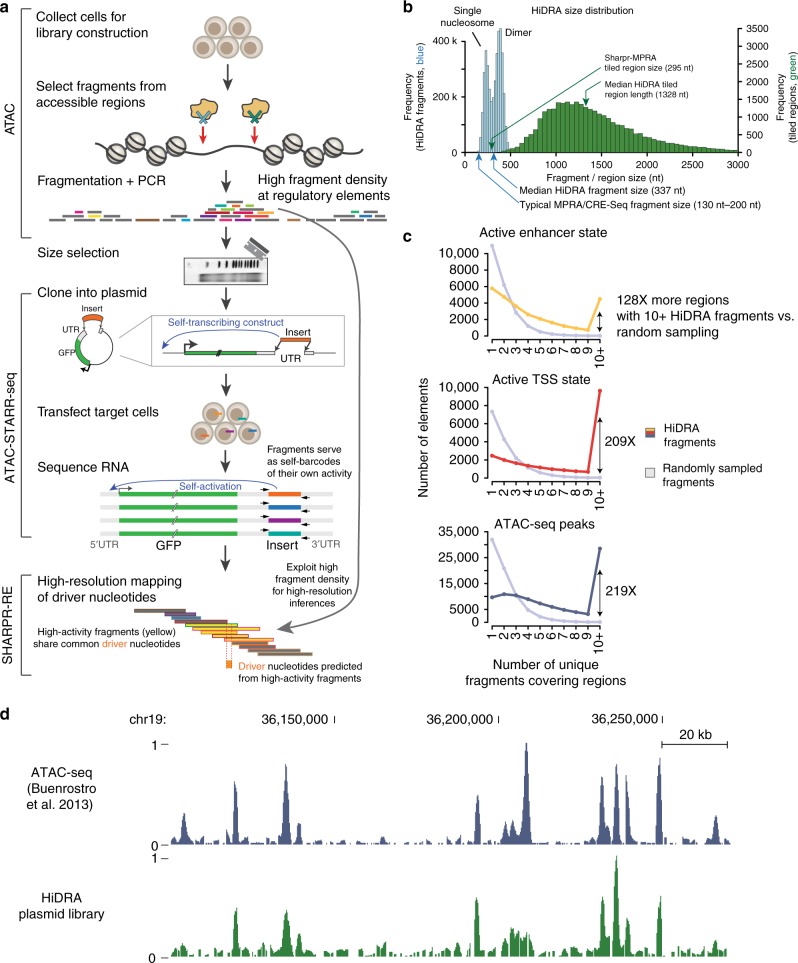
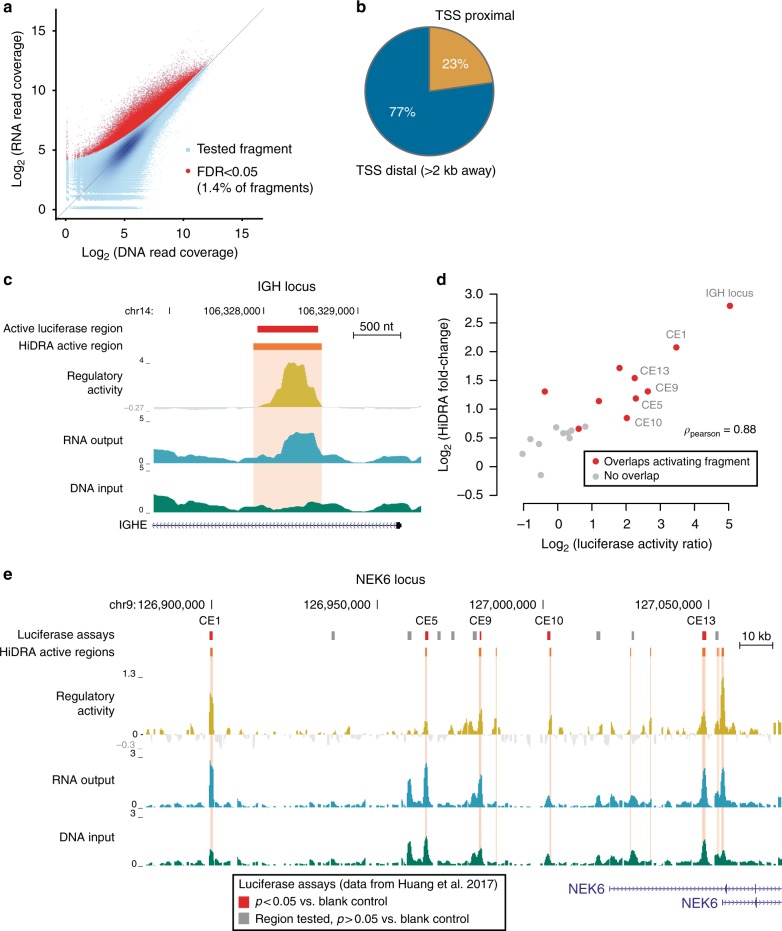
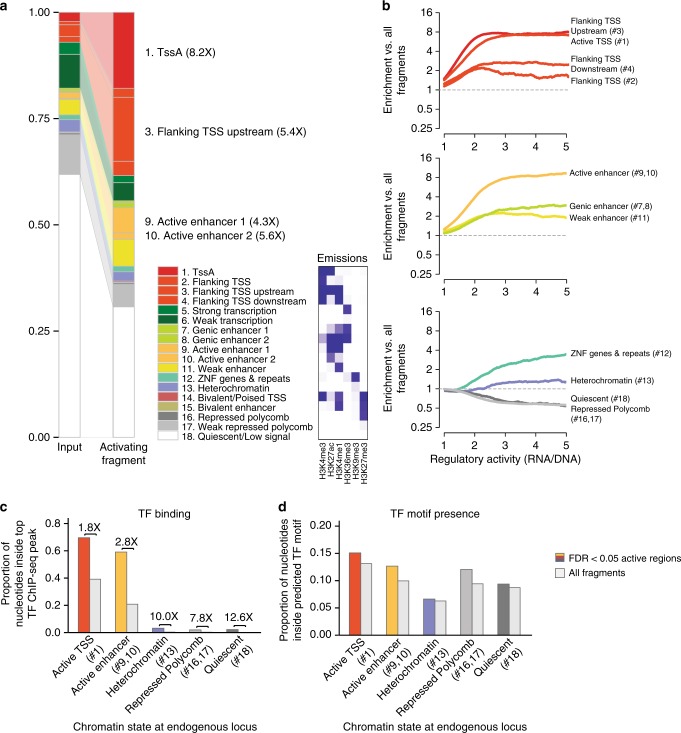
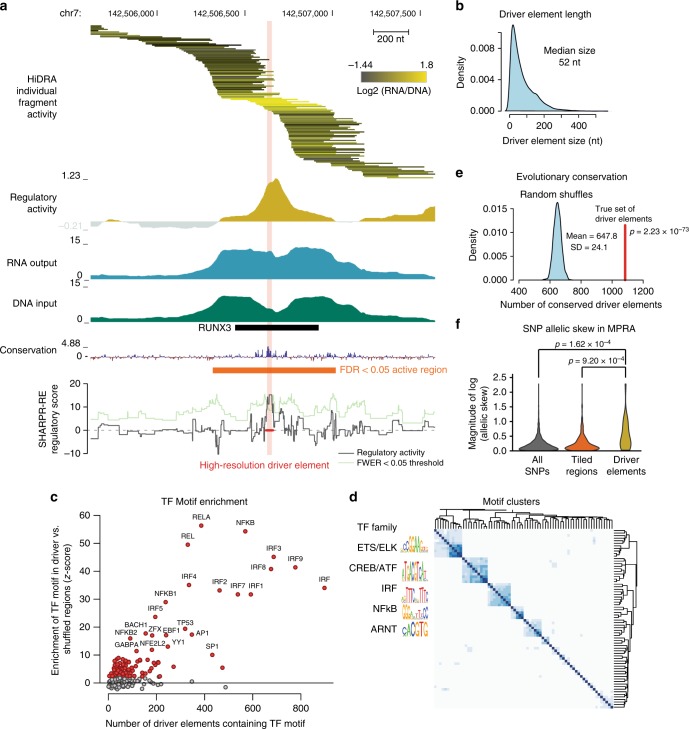
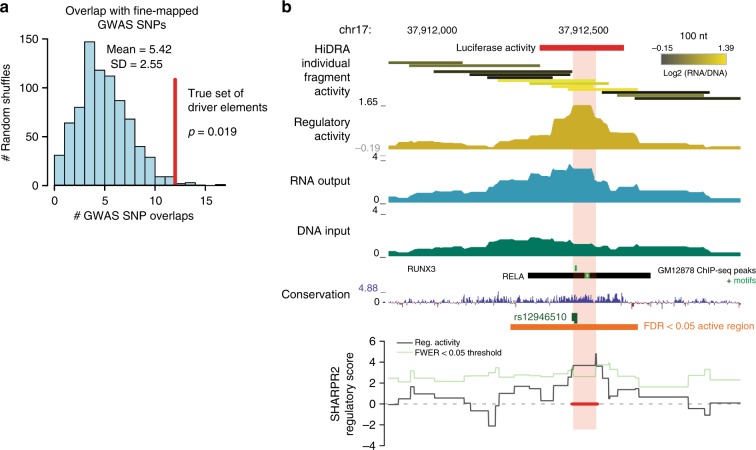
Genome-wide epigenomic maps have revealed millions of putative enhancers and promoters, but experimental validation of their function and high-resolution dissection of their driver nucleotides remain limited. Here, we present HiDRA (High-resolution Dissection of Regulatory Activity), a combined experimental and computational method for high-resolution genome-wide testing and dissection of putative regulatory regions. We test ~7 million accessible DNA fragments in a single experiment, by coupling accessible chromatin extraction with self-transcribing episomal reporters (ATAC-STARR-seq). By design, fragments are highly overlapping in densely-sampled accessible regions, enabling us to pinpoint driver regulatory nucleotides by exploiting differences in activity between partially-overlapping fragments using a machine learning model (SHARPR-RE). In GM12878 lymphoblastoid cells, we find ~65,000 regions showing enhancer function, and pinpoint ~13,000 high-resolution driver elements. These are enriched for regulatory motifs, evolutionarily-conserved nucleotides, and disease-associated genetic variants from genome-wide association studies. Overall, HiDRA provides a high-throughput, high-resolution approach for dissecting regulatory regions and driver nucleotides.
Overview
The claims and statistics of this paper haven’t been checked yet.
Run the check — free, no account needed. It reads the open-access text and checks the sources it cites.
Integrity signals
Registry
Cites
Statistics
Figures
Verification
Claims the paper makes
The claims and statistics of this paper haven’t been checked yet.
Run the check — free, no account needed. It reads the open-access text and checks the sources it cites.
Claims other papers make about this one
Each is checked against this paper’s own text: does it say what the citing paper says it does?
The source backs part of the claim, not all of it — or backs it for a different population, condition or comparison.
In the citing paper
“Although enriched, histone modification and cofactor binding is not completely predictive of enhancer activity54,58,72,77,105.”
From Towards a comprehensive catalogue of validated and target-linked human enhancers (2020) · cites this paper as [77]
Experimental — accuracy not yet measuredThe source backs part of the claim, not all of it — or backs it for a different population, condition or comparison.
In the citing paper
“In fact, it remains entirely possible that many biochemically identified enhancers may not be enhancing transcription of anything77.”
From Towards a comprehensive catalogue of validated and target-linked human enhancers (2020) · cites this paper as [77]
Experimental — accuracy not yet measuredThe source backs part of the claim, not all of it — or backs it for a different population, condition or comparison.
In the citing paper
“MPRAs have been applied to assess biochemically annotated candidate enhancers77,176-178, candidate enhancers harbouring variants that potentially mediate eQTLs179-182, and even scans of the entire human genome108,183.”
From Towards a comprehensive catalogue of validated and target-linked human enhancers (2020) · cites this paper as [77]
Experimental — accuracy not yet measuredIn the citing paper
“To address this, there has been rapid maturation of technologies, such as massively parallel reporter assays121–123 and CRISPR genome editing, to support functional characterization of targeted sequence perturbations at scale.”
From A brief history of human disease genetics (2020) · cites this paper as [123]
Self-check
Percentages, sums and reported differences re-computed from the paper’s own numbers.
The self-check needs the paper’s full text.
Citations
Cites
Moderated estimation of fold change and dispersion for RNA-seq data with DESeq2
Love, M. I., Huber, W., & Anders, S. (2014) · Genome Biology · doi:10.1186/s13059-014-0550-8 · Cited by 95,106
BEDTools: a flexible suite of utilities for comparing genomic features
Quinlan, A. R., & Hall, I. M. (2010) · Bioinformatics · doi:10.1093/bioinformatics/btq033 · Cited by 27,437
An integrated encyclopedia of DNA elements in the human genome
The ENCODE Project Consortium (2012) · Nature · doi:10.1038/nature11247 · Cited by 18,072
Self-citationBuenrostro, J. D., Giresi, P. G., Zaba, L. C., Chang, H. Y., & Greenleaf, W. J. (2013) · Nature Methods · doi:10.1038/nmeth.2688 · Cited by 6,422
Integrative analysis of 111 reference human epigenomes
Roadmap Epigenomics Consortium, Kundaje, A., Meuleman, W., Ernst, J., Bilenky, M., Yen, A., Heravi-Moussavi, A., Kheradpour, P., Zhang, Z., Wang, J., et al. (2015) · Nature · doi:10.1038/nature14248 · Cited by 6,368
Self-citationThe Genotype-Tissue Expression (GTEx) pilot analysis: Multitissue gene regulation in humans
The GTEx Consortium, Ardlie, K. G., Deluca, D. S., Segrè, A. V., Sullivan, T. J., Young, T. R., Gelfand, E. T., Trowbridge, C. A., Maller, J. B., Tukiainen, T., et al. (2015) · Science · doi:10.1126/science.1262110 · Cited by 5,062
Self-citationHost–microbe interactions have shaped the genetic architecture of inflammatory bowel disease
The International IBD Genetics Consortium (IIBDGC), Jostins, L., Ripke, S., Weersma, R. K., Duerr, R. H., McGovern, D. P., Hui, K. Y., Lee, J. C., Philip Schumm, L., Sharma, Y., et al. (2012) · Nature · doi:10.1038/nature11582 · Cited by 4,722
Systematic Localization of Common Disease-Associated Variation in Regulatory DNA
Maurano, M. T., Humbert, R., Rynes, E., Thurman, R. E., Haugen, E., Wang, H., Reynolds, A. P., Sandstrom, R., Qu, H., Brody, J., et al. (2012) · Science · doi:10.1126/science.1222794 · Cited by 3,716
Mapping and analysis of chromatin state dynamics in nine human cell types
Ernst, J., Kheradpour, P., Mikkelsen, T. S., Shoresh, N., Ward, L. D., Epstein, C. B., Zhang, X., Wang, L., Issner, R., Coyne, M., et al. (2011) · Nature · doi:10.1038/nature09906 · Cited by 2,898
Self-citationA unique chromatin signature uncovers early developmental enhancers in humans
Rada-Iglesias, A., Bajpai, R., Swigut, T., Brugmann, S. A., Flynn, R. A., & Wysocka, J. (2011) · Nature · doi:10.1038/nature09692 · Cited by 2,233
Cited by
Sorted by citations
Items 101–171 of 171
Super-silencers are crucial for development and carcinogenesis in B cells
Huang, D., Petrykowska, H. M., Kumar, D., Kardava, L., Moir, S. L., Afzali, B., Elnitski, L. L., & Ovcharenko, I. (2025) · Nature Communications · doi:10.1038/s41467-025-63329-x · Cited by 3
Optimizing sequence design strategies for perturbation MPRAs: a computational evaluation framework
Liu, J., Ashuach, T., Inoue, F., Ahituv, N., Yosef, N., & Kreimer, A. (2024) · Nucleic Acids Research · doi:10.1093/nar/gkae012 · Cited by 3
Characterization of caffeine response regulatory variants in vascular endothelial cells
Boye, C., Kalita, C. A., Findley, A. S., Alazizi, A., Wei, J., Wen, X., Piqué-Regi, R., & Luca, F. (2024) · eLife · doi:10.7554/elife.85235 · Cited by 2
Davidson, B. S. A., Arcila-Galvis, J. E., Trevisán-Herraz, M., Mikulášová, A., Brackley, C. A., Russell, L. J., & Rico, D. (2024) · Frontiers in Cell and Developmental Biology · doi:10.3389/fcell.2024.1294510 · Cited by 4
Sakamoto, F., Kanamori, S., Díaz, L. M., Cádiz, A., Ishii, Y., Yamaguchi, K., Shigenobu, S., Nakayama, T., Makino, T., & Kawata, M. (2024) · Ecology and Evolution · doi:10.1002/ece3.11117 · Cited by 4
Dincer, T. U., & Ernst, J. (2025) · Genome biology · doi:10.1186/s13059-025-03579-6 · Cited by 3
Hansen, T. J., & Hodges, E. C. (2022) · bioRxiv (Cold Spring Harbor Laboratory) · doi:10.1101/2022.03.25.485870 · Cited by 4
Functional genomics of psychiatric disease risk using genome engineering
García, M. F., Powell, S. K., LaMarca, E. A., Fernando, M. B., Cohen, S., Fang, G., Akbarian, S., & Brennand, K. (2021) · Elsevier eBooks · doi:10.1016/b978-0-12-823577-5.00021-0 · Cited by 2
Integration of Count Difference and Curve Similarity in Negative Regulatory Element Detection
He, N., Wang, W., Fang, C., Tan, Y., Li, L., & Hou, C. (2022) · Frontiers in Genetics · doi:10.3389/fgene.2022.818344 · Cited by 2
AAV Deployment of Enhancer-Based Expression Constructs In Vivo in Mouse Brain
Warren, T. L., Lambert, J. T., & Nord, A. S. (2022) · Journal of Visualized Experiments · doi:10.3791/62650 · Cited by 4
Glaser, L. V., Steiger, M., Fuchs, A., van Bömmel, A., Einfeldt, E., Chung, H. R., Vingron, M., & Meijsing, S. H. (2021) · MDC Repository (Max-Delbrueck-Center for Molecular Medicine) · Cited by 2
An Autoimmune Transcriptional Circuit Driving Foxp3 + Regulatory T cell DysfunctionPreprint
Sumida, T. S., Lincoln, M. R., He, L., Park, Y., Ota, M., Stillwell, H. A., Leissa, G. A., Fujio, K., Kulminski, A. M., Epstein, C. B., et al. (2022) · bioRxiv (Cold Spring Harbor Laboratory) · doi:10.1101/2022.12.02.518871 · Cited by 2
Self-citationYuan, S., Ni, P., & Su, Z. (2024) · bioRxiv (Cold Spring Harbor Laboratory) · doi:10.1101/2024.05.07.592879 · Cited by 2
Daigle, A., Marsh, J., Kay, A., & Johri, P. (2026) · bioRxiv (Cold Spring Harbor Laboratory) · doi:10.64898/2026.03.01.708907 · Cited by 2
Massively parallel reporter assays identify enhancer elements in oesophageal Adenocarcinoma
Yang, S., Ahmed, I., Li, Y., Bleaney, C. W., & Sharrocks, A. D. (2024) · NAR Cancer · doi:10.1093/narcan/zcae041 · Cited by 1
Alberti, B., Vincent, S., Stévant, I., Lajoignie, D., Tarayre, H., Mendes, J., Sarnataro, S., Villoutreix, P., & Ghavi-Helm, Y. (2025) · Nucleic Acids Research · doi:10.1093/nar/gkaf684 · Cited by 1
Diff-ATAC-STARR-Seq: A Method for Genome-Wide Functional Screening of Enhancer Activity in Vivo
Nagayasu, K., Andoh, C., Shirakawa, H., & Kaneko, S. (2022) · Biological and Pharmaceutical Bulletin · doi:10.1248/bpb.b22-00400 · Cited by 1
Artificial Intelligence in Microbiology
Juhas, M. (2023) · Springer eBooks · doi:10.1007/978-3-031-29544-7_8 · Cited by 1
Using Synthetic DNA Libraries to Investigate Chromatin and Gene Regulation
Kleinschmidt, H., Xu, C., & Bai, L. (2023) · Chromosoma · doi:10.1007/s00412-023-00796-5 · Cited by 2
ATAC-seq and psychiatric disorders
Fullard, J. F., Bendl, J. M., & Roussos, P. (2021) · Elsevier eBooks · doi:10.1016/b978-0-12-823577-5.00036-2 · Cited by 1
A general framework for predicting the transcriptomic consequences of non-coding variationPreprint
Abdalla, M., Abdalla, M., McCarthy, M. I., & Holmes, C. C. (2018) · bioRxiv (Cold Spring Harbor Laboratory) · doi:10.1101/279323 · Cited by 1
Khetan, S., Kales, S., Kursawe, R., Jillette, A., Reilly, S. K., Ucar, D., Tewhey, R., & Stitzel, M. L. (2020) · bioRxiv (Cold Spring Harbor Laboratory) · doi:10.1101/2020.02.12.939348 · Cited by 1
A transcription start site map in human pancreatic islets reveals functional regulatory signaturesPreprint
Varshney, A., Kyono, Y., Elangovan, V. R., Wang, C., Erdos, M. R., Narisu, N., Albanus, R. D., Orchard, P., Stitzel, M. L., Collins, F. S., et al. (2019) · bioRxiv (Cold Spring Harbor Laboratory) · doi:10.1101/812552 · Cited by 1
Davidson, B. S. A., Arcila-Galvis, J. E., Trevisán-Herraz, M., Mikulášová, A., Brackley, C. A., Russell, L. J., & Rico, D. (2023) · bioRxiv (Cold Spring Harbor Laboratory) · doi:10.1101/2023.09.18.558245 · Cited by 1
Histone H4 lysine 20 monomethylation is not a mark of transcriptional silencersPreprint
Segert, J. A., Mizgier, N. A., Adelman, K., & Bulyk, M. L. (2025) · bioRxiv (Cold Spring Harbor Laboratory) · doi:10.1101/2025.01.09.632211 · Cited by 1
Multi-scale dissection, compaction and derivatization of mammalian developmental enhancersPreprint
Lalanne, J., Li, T., Kajiwara, E. A. N., Huynh, C., Do, T. V., Martin, B. K., Regalado, S. G., & Shendure, J. (2026) · bioRxiv (Cold Spring Harbor Laboratory) · doi:10.64898/2026.04.20.719625 · Cited by 1
Matjusaitis, M., Tedesco, D., & Ciukas, A. (2020) · bioRxiv (Cold Spring Harbor Laboratory) · doi:10.1101/2020.06.24.169714
Renganaath, K., Cheung, R., Day, L., Kosuri, S., Kruglyak, L., & Albert, F. (2020) · bioRxiv · doi:10.1101/2020.08.31.276337
Functional Analysis of Haplotypes and Promoter Activity at the 5’ Region of the ADH7 GenePreprint
Zeng, K., Li, Y., Gao, M., Liu, Y., Xu, F., Xia, X., Yao, J., & Wang, B. (2021) · Research Square · doi:10.21203/rs.3.rs-157005/v1
Author response: Analysis of long and short enhancers in melanoma cell states
Mauduit, D., Taskiran, I. I., Minnoye, L., Waegeneer, M. D., Christiaens, V., Hulselmans, G. J., Demeulemeester, J., Wouters, J., & Aerts, S. (2021) · eLife · doi:10.7554/elife.71735.sa2
Spicuglia, S. (2020) · Faculty Opinions – Post-Publication Peer Review of the Biomedical Literature · doi:10.3410/f.737669738.793580246
Mefford, H. C. (2020) · Faculty Opinions – Post-Publication Peer Review of the Biomedical Literature · doi:10.3410/f.736437709.793571951
Sharrocks, A. D. (2020) · Faculty Opinions – Post-Publication Peer Review of the Biomedical Literature · doi:10.3410/f.738702238.793579142
Non-coding variants impact cis -regulatory coordination in a cell type-specific mannerPreprint
Pushkarev, O., van Mierlo, G., Kribelbauer-Swietek, J. F., Saelens, W., Gardeux, V., & Deplancke, B. (2023) · bioRxiv (Cold Spring Harbor Laboratory) · doi:10.1101/2023.10.11.561870
sharpr2: Estimating Regulatory Scores and Identifying ATAC-STARR Data
He, L. (2017) · doi:10.32614/cran.package.sharpr2
Self-citationUvarova, A. N., Tkachenko, E. A., Stasevich, E. M., Zheremyan, E. A., Korneev, K. V., & Kuprash, D. V. (2024) · Biochemistry (Moscow) · doi:10.31857/s0320972524060023
High-resolution dissection of human cell type-specific enhancers in cis and trans activities
Wang, M., Yang, X., & Wu, Q. (2025) · Genomics · doi:10.1016/j.ygeno.2025.110985
Liu, Y., Liu, B., & Liu, J. (2025) · Genome Research · doi:10.1101/gr.279647.124
Functional interrogation of candidate cis -regulatory elements at the LDLR locusPreprint
Leix, K., Serrano-Zayas, C., Graham, S. E., & Emmer, B. T. (2025) · bioRxiv (Cold Spring Harbor Laboratory) · doi:10.1101/2025.03.20.644385
Scott, T. J., Hansen, T. J., McArthur, E., & Hodges, E. C. (2024) · Figshare · doi:10.6084/m9.figshare.26629078
Scott, T. J., Hansen, T. J., McArthur, E., & Hodges, E. C. (2024) · Figshare · doi:10.6084/m9.figshare.26629048
Scott, T. J., Hansen, T. J., McArthur, E., & Hodges, E. C. (2024) · Figshare · doi:10.6084/m9.figshare.26629069
Additional file 4 of Cis-regulatory atlas of primary human CD4+ T cells
Stefan, K., & Barski, A. (2024) · Figshare · doi:10.6084/m9.figshare.26588769
Scott, T. J., Hansen, T. J., McArthur, E., & Hodges, E. C. (2024) · Figshare · doi:10.6084/m9.figshare.26629036
Scott, T. J., Hansen, T. J., McArthur, E., & Hodges, E. C. (2024) · Figshare · doi:10.6084/m9.figshare.26629042
Scott, T. J., Hansen, T. J., McArthur, E., & Hodges, E. C. (2024) · Figshare · doi:10.6084/m9.figshare.26629051
Sheng, T., Ho, S. W. T., Ooi, W. F., Xu, C., Xing, M., Padmanabhan, N., Huang, K. K., Ma, L., Ray, M., Guo, Y. A., et al. (2021) · Figshare · doi:10.6084/m9.figshare.16786857
Scott, T. J., Hansen, T. J., McArthur, E., & Hodges, E. C. (2024) · Figshare · doi:10.6084/m9.figshare.24406916
Scott, T. J., Hansen, T. J., McArthur, E., & Hodges, E. C. (2024) · Figshare · doi:10.6084/m9.figshare.26629057
Additional file 5 of Cis-regulatory atlas of primary human CD4+ T cells
Stefan, K., & Barski, A. (2024) · Figshare · doi:10.6084/m9.figshare.26588772
Scott, T. J., Hansen, T. J., McArthur, E., & Hodges, E. C. (2024) · Figshare · doi:10.6084/m9.figshare.26629072
Additional file 3 of Cis-regulatory atlas of primary human CD4+ T cells
Stefan, K., & Barski, A. (2024) · Figshare · doi:10.6084/m9.figshare.26588766
Additional file 2 of Cis-regulatory atlas of primary human CD4+ T cells
Stefan, K., & Barski, A. (2024) · Figshare · doi:10.6084/m9.figshare.26588763
Sheng, T., Ho, S. W. T., Ooi, W. F., Xu, C., Xing, M., Padmanabhan, N., Huang, K. K., Ma, L., Ray, M., Guo, Y. A., et al. (2021) · Figshare · doi:10.6084/m9.figshare.16786860
Scott, T. J., Hansen, T. J., McArthur, E., & Hodges, E. C. (2024) · Figshare · doi:10.6084/m9.figshare.26629063
Scott, T. J., Hansen, T. J., McArthur, E., & Hodges, E. C. (2024) · Figshare · doi:10.6084/m9.figshare.26629060
Scott, T. J., Hansen, T. J., McArthur, E., & Hodges, E. C. (2023) · Figshare · doi:10.6084/m9.figshare.24406640
Scott, T. J., Hansen, T. J., McArthur, E., & Hodges, E. C. (2024) · Figshare · doi:10.6084/m9.figshare.26629045
Scott, T. J., Hansen, T. J., McArthur, E., & Hodges, E. C. (2024) · Figshare · doi:10.6084/m9.figshare.26629087
Ni, P., Moe, J., & Su, Z. (2022) · Figshare · doi:10.6084/m9.figshare.21285818
Scott, T. J., Hansen, T. J., McArthur, E., & Hodges, E. C. (2024) · Figshare · doi:10.6084/m9.figshare.26629039
Scott, T. J., Hansen, T. J., McArthur, E., & Hodges, E. C. (2024) · Figshare · doi:10.6084/m9.figshare.26629084
Additional file 1 of Cis-regulatory atlas of primary human CD4+ T cells
Stefan, K., & Barski, A. (2024) · Figshare · doi:10.6084/m9.figshare.26588760
Scott, T. J., Hansen, T. J., McArthur, E., & Hodges, E. C. (2024) · Figshare · doi:10.6084/m9.figshare.26629075
Functional interrogation of candidate cis-regulatory elements at the LDLR locus
Leix, K., Serrano-Zayas, C., Vyas, H., Graham, S. E., & Emmer, B. T. (2026) · PLoS Genetics · doi:10.1371/journal.pgen.1012082 · Cited by 1
High-throughput study of silencer elements in T cells
Hussain, S. (2019) · theses.fr (ABES) · doi:10.70675/76751597z8779z4919z9882z87ac3dea2dc4
Annotation et hiérarchisation de variants non-codants dans le contexte de maladies humaines
Moyon, L. (2019) · theses.fr (ABES) · doi:10.70675/208b20dcz3942z4342z8908z65691180bec0
Caractérisation des enhancers dérégulés dans la leucémie aiguë lymphoblastique de type T
España, A. P. (2019) · theses.fr (ABES) · doi:10.70675/5c13bdf2zac72z45c4z91e7z396bdaa5ddc4
Dissection of coordinated interferon response by promoter elements with enhancer activity
Santiago‐Algarra, D. (2020) · theses.fr (ABES) · doi:10.70675/a064ee17zbea2z412azb9b6z12839deb2851
Multi-enhancer regulatory hubs control Th17 cell identityPreprint
Siklenka, K., Zhang, C., Li, L., Parker, M. E., Mehta, N. U., Barrera, A., Venukuttan, R., Crawford, G. E., Gersbach, C. A., Ciofani, M., et al. (2026) · bioRxiv (Cold Spring Harbor Laboratory) · doi:10.64898/2026.04.02.715458 · Cited by 1
Comprehensive mapping of human genetic variation at Epromoters
Wan, J. (2024) · theses.fr (ABES) · doi:10.70675/a2e4bbffze012z41baz8c31z2f84f271295e
Metadata
- Authors
- Wang, X., He, L., Goggin, S. M., Saadat, A., Wang, L., Sinnott-Armstrong, N., Claussnitzer, M., & Kellis, M.
- Affiliations
- Broad Institute (US)
- Corresponding author
- Claussnitzer, Melina
- Kellis, Manolis
- ORCID
- Venue
- Nature Communications
- Published
- 2018-12-19
- Volume
- 9
- Issue
- 1
- Pages
- 5380-5380
- ISSN
- 2041-1723 (ISSN-L)
- PMC
- PMC6300699
- OpenAlex
- W2903823332
- Cited by
- 159
- References
- 45
- Citations by year
- 2026: 5 · 2025: 16 · 2024: 27 · 2023: 18 · 2022: 18 · 2021: 23 · 2020: 30 · 2019: 12 · 2018: 7
- FWCI
- 6.46
- Type
- journal article
- Language
- en
- Open access
- gold
- doi.org
- Locations
- Nature Communications (publishedVersion, cc-by)
- bioRxiv (Cold Spring Harbor Laboratory) (acceptedVersion)
- Europe PMC (PubMed Central) (publishedVersion, cc-by)
- PubMed Central (publishedVersion, cc-by)
- PubMed (publishedVersion)
- RePEc: Research Papers in Economics (submittedVersion)
- DOAJ (DOAJ: Directory of Open Access Journals) (submittedVersion, cc-by-sa)
- DOAJ (DOAJ: Directory of Open Access Journals) (submittedVersion)
- DSpace@MIT (Massachusetts Institute of Technology) (submittedVersion, cc-by-nc)
- Nature
- Funders
- National Institutes of Health (GM12878, NIH-R01)
- McDonnell Center for Systems Neuroscience
- National Human Genome Research Institute (U01HG007610, R01HG008155, U01HG009088)
- National Institute of General Medical Sciences (R01GM113708)
- Topics
- Life Sciences › Biochemistry, Genetics and Molecular Biology › Molecular Biology › Genomics and Chromatin Dynamics
- Life Sciences › Biochemistry, Genetics and Molecular Biology › Molecular Biology › Chromatin Remodeling and Cancer
- Life Sciences › Biochemistry, Genetics and Molecular Biology › Molecular Biology › Epigenetics and DNA Methylation
- Keywords
- HIDRA, enhancer function, transcriptional regulatory sequences, chromatin accessibility, machine learning, regulatory motifs, disease-associated variants
- MeSH terms
- Gene Expression Regulation, Genetic Techniques, Humans, Regulatory Sequences, Nucleic Acid, Genome, Human, Polymorphism, Single Nucleotide, Genome-Wide Association Study
About these checks
Registry, retraction, Cites and statistics results are computed, not judged, with one exception: a printed reference that no index lists is read once by a model before it counts as a citation error. Claims are extracted by a model and kept only when their quote appears verbatim in the text; each cited source is then checked, with a model’s help, for whether it says what the claim relies on. Those verdicts can be wrong — read the claim’s quote and the cited source before relying on one.
Statistics and arithmetic are recomputed, not judged.
Confidence bands are shown only for fields calibrated on our annotated test set. None is calibrated yet, so no band is shown.
What counts as a claim ›How we measure confidence ›How we check this ›
Are you an author, or do you see a problem with this page? Request a review
