

Spike-timing-dependent plasticity learning of coincidence detection with passively integrated memristive circuits
Open accessThe DOI matches its Crossref record; 45 of the 45 references it cites were found in a registry or an index.
Abstract
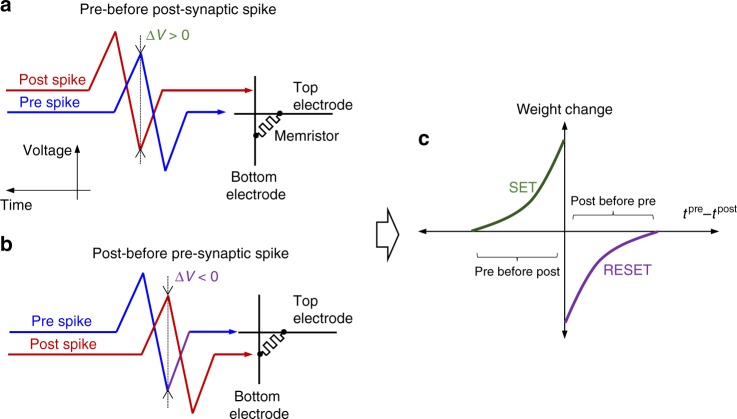
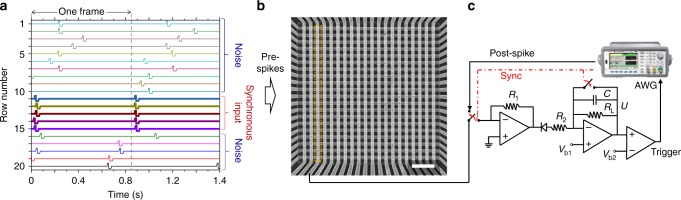
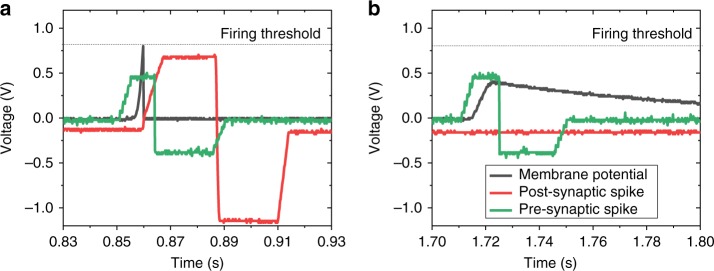
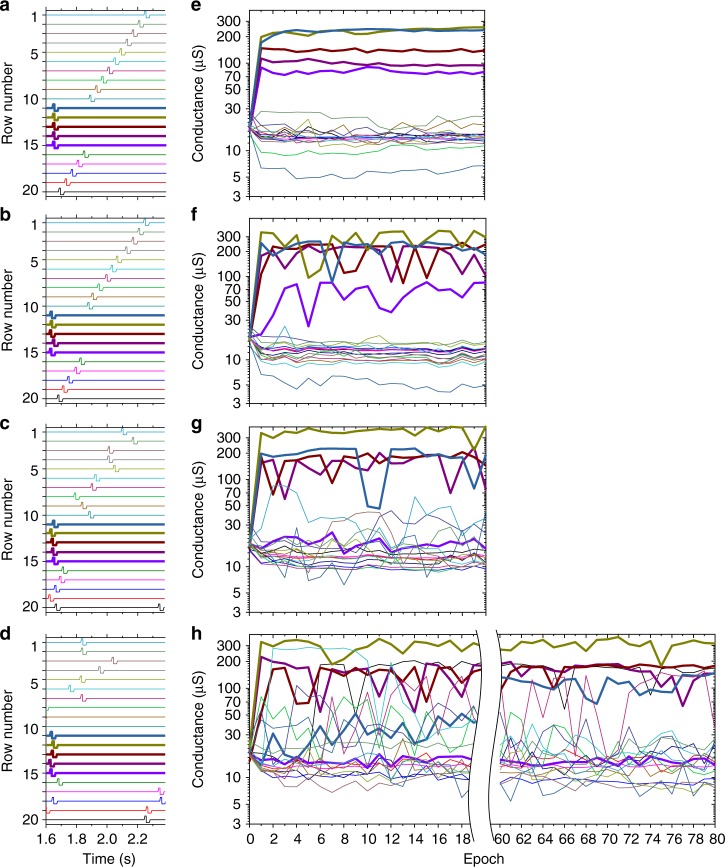
Spiking neural networks, the most realistic artificial representation of biological nervous systems, are promising due to their inherent local training rules that enable low-overhead online learning, and energy-efficient information encoding. Their downside is more demanding functionality of the artificial synapses, notably including spike-timing-dependent plasticity, which makes their compact efficient hardware implementation challenging with conventional device technologies. Recent work showed that memristors are excellent candidates for artificial synapses, although reports of even simple neuromorphic systems are still very rare. In this study, we experimentally demonstrate coincidence detection using a spiking neural network, implemented with passively integrated metal-oxide memristive synapses connected to an analogue leaky-integrate-and-fire silicon neuron. By employing spike-timing-dependent plasticity learning, the network is able to robustly detect the coincidence by selectively increasing the synaptic efficacies corresponding to the synchronized inputs. Not surprisingly, our results indicate that device-to-device variation is the main challenge towards realization of more complex spiking networks.
Overview
The claims and statistics of this paper haven’t been checked yet.
Free: it reads the open-access text and checks the first 5 claims that cite a source we can check. Create a free account to check every claim.
Integrity signals
Registry
Cites
Statistics
Figures
Verification
Claims the paper makes
The claims and statistics of this paper haven’t been checked yet.
Free: it reads the open-access text and checks the first 5 claims that cite a source we can check. Create a free account to check every claim.
Claims other papers make about this one
Each is checked against this paper’s own text: does it say what the citing paper says it does?
The source backs part of the claim, not all of it — or backs it for a different population, condition or comparison.
In the citing paper
“Crossbar arrays of two-terminal metal/insulator/metal (MIM) memristive devices can be fabricated easily using standard lithography and deposition techniques; this has been readily achieved by multiple groups57,64,68–70,85,93,105,216,217.”
From Hardware implementation of memristor-based artificial neural networks (2024) · cites this paper as [216]
Experimental — accuracy not yet measured
Self-check
Percentages, sums and reported differences re-computed from the paper’s own numbers.
The self-check needs the paper’s full text.
Citations
Cites
Bi, G.-Q., & Poo, M.-M. (1998) · The Journal of Neuroscience · doi:10.1523/jneurosci.18-24-10464.1998 · Cited by 4,744
Nanoscale Memristor Device as Synapse in Neuromorphic Systems
Jo, S. H., Chang, T., Ebong, I., Bhadviya, B. B., Mazumder, P., & Lu, W. (2010) · Nano Letters · doi:10.1021/nl904092h · Cited by 4,174
A million spiking-neuron integrated circuit with a scalable communication network and interface
Merolla, P. A., Arthur, J. V., Alvarez-Icaza, R., Cassidy, A. S., Sawada, J., Akopyan, F., Jackson, B. L., Imam, N., Guo, C., Nakamura, Y., et al. (2014) · Science · doi:10.1126/science.1254642 · Cited by 4,147
Memristive devices for computing
Yang, J. J., Strukov, D. B., & Stewart, D. R. (2013) · Nature Nanotechnology · doi:10.1038/nnano.2012.240 · Cited by 3,885
Self-citationNetworks of spiking neurons: The third generation of neural network models
Maass, W. (1997) · Neural Networks · doi:10.1016/s0893-6080(97)00011-7 · Cited by 3,481
Spiking Neuron Models: Single Neurons, Populations, Plasticity
Gerstner, W., & Kistler, W. M. (2002) · Cambridge University Press eBooks · doi:10.1017/cbo9780511815706 · Cited by 3,080
Training and operation of an integrated neuromorphic network based on metal-oxide memristors
Prezioso, M., Merrikh-Bayat, F., Hoskins, B. D., Adam, G. C., Likharev, K. K., & Strukov, D. B. (2015) · Nature · doi:10.1038/nature14441 · Cited by 3,001
Self-citationMemristors with diffusive dynamics as synaptic emulators for neuromorphic computing
Wang, Z., Joshi, S., Savel’ev, S. E., Jiang, H., Midya, R., Lin, P., Hu, M., Ge, N., Strachan, J. P., Li, Z., et al. (2017) · Nature Materials · doi:10.1038/nmat4756 · Cited by 2,358
Spike Timing–Dependent Plasticity: A Hebbian Learning Rule
Caporale, N., & Dan, Y. (2008) · Annual Review of Neuroscience · doi:10.1146/annurev.neuro.31.060407.125639 · Cited by 1,997
Reliability of spike timing in neocortical neurons
Mainen, Z. F., & Sejnowski, T. J. (1995) · Science · doi:10.1126/science.7770778 · Cited by 1,950
Cited by
Items 101–200 of 215
Experimental Demonstrations of Security Primitives With Nonvolatile Memories
Mahmoodi, M. R., Strukov, D. B., & Kavehei, O. (2019) · IEEE Transactions on Electron Devices · doi:10.1109/ted.2019.2948950 · Cited by 22
Self-citationPanda, D., Hui, Y.-F., & Tseng, T. (2024) · Nanoscale · doi:10.1039/d4nr01155d · Cited by 21
Voltage Divider for Self-Limited Analog State Programing of Memristors
Gomez, J. T., Vourkas, I., Hoffman, A. C. A., Sirakoulis, G. C., & Rubio, A. (2019) · IEEE Transactions on Circuits & Systems II Express Briefs · doi:10.1109/tcsii.2019.2923716 · Cited by 24
“ical features such as small integration area and post-CMOS processing compatibility, have given rise to several potential applications of memristors [4], [5].”
BackgroundNonlinear Ion Dynamics Enable Spike Timing Dependent Plasticity of Electrochemical Ionic Synapses
Huang, M., Xu, L., del Alamo, J. A., Li, J., & Yildiz, B. (2025) · Advanced Materials · doi:10.1002/adma.202418484 · Cited by 19
Amorphous boron nitride: synthesis, properties and device application
Sattari‐Esfahlan, S. M., Mirzaei, S., Josline, M. J., Moon, J., Hyun, S.-H., Jang, H., & Lee, J. (2025) · Nano Convergence · doi:10.1186/s40580-025-00486-1 · Cited by 19
“Oxygen vacancies or metal ions are key in generating these multiple resistance states by forming conductive filaments (CFs) [129, 130].”
High-performance artificial neurons based on Ag/MXene/GST/Pt threshold switching memristors
Lian, X., Fu, J., Gao, Z., Gu, S., & Wang, L. (2022) · Chinese Physics B · doi:10.1088/1674-1056/ac673f · Cited by 19
Song, H., Kim, Y. S., Park, J., & Kim, K. M. (2019) · Advanced Electronic Materials · doi:10.1002/aelm.201800740 · Cited by 18
Neuromorphic computing: From devices to integrated circuits
Saxena, V. (2020) · Journal of Vacuum Science & Technology B Nanotechnology and Microelectronics Materials Processing Measurement and Phenomena · doi:10.1116/6.0000591 · Cited by 21
Nikiruy, K. E., Surazhevsky, I. A., Demin, V. A., & Emelyanov, A. V. (2020) · physica status solidi (a) · doi:10.1002/pssa.201900938 · Cited by 18
Peng, L., Li, X., Bi, D., Xie, X., & Xie, Y. (2021) · Neural Networks · doi:10.1016/j.neunet.2021.08.029 · Cited by 17
Dang, B., Zhang, T., Meng, F., Liu, K., Yu, L., Zhang, Q., Wu, S., Gu, L. ‐., Huang, R., & Yang, Y. (2026) · Nature Electronics · doi:10.1038/s41928-025-01554-4 · Cited by 21
“Implementations of STDP have been reported using a variety of hardware, including complementary metal–oxide–semiconductor (CMOS) circuits 2,5 , resistive random-access memory 6,7 , ferroelectric memory 8 , phase-change memory 9 and spintronic devices 10 .”
Bianchi, S., Pedretti, G., Muñoz-Martín, I., Calderoni, A., Ramaswamy, N., Ambrogio, S., & Ielmini, D. (2020) · IEEE Transactions on Electron Devices · doi:10.1109/ted.2020.2992386 · Cited by 16
“Artificial synapses capable of learning via STDP were proposed by using CMOS technology [7], [8] and memristive devices such as resistive switching memory (RRAM) [9]–[13] and phase change memory (PCM) [14]–[17].”
MethodPlasticity of parylene memristors: Compact phenomenological model and synaptic properties
Yuklyaevskikh, G. A., Shvetsov, B. S., Emelyanov, A. V., Kulagin, V. A., Rylkov, V. V., & Demin, V. A. (2024) · Chaos Solitons & Fractals · doi:10.1016/j.chaos.2024.115784 · Cited by 18
A Survey of Intelligent Chip Design Research Based on Spiking Neural Networks
Chen, L., Xiong, X., & Liu, J. (2022) · IEEE Access · doi:10.1109/access.2022.3200454 · Cited by 21
“In addition to their advantages in computing and integration, memristors are considered devices with synaptic plasticity [146], [147].”
BackgroundAn, Y.-J., Yan, H., Yeom, C.-M., Jeong, J.-K., Eadi, S. B., Lee, H., & Kwon, H.-M. (2024) · Nanoscale · doi:10.1039/d3nr04917e · Cited by 15
Yoo, S., Wu, Y., Park, Y., & Lu, W. D. (2022) · Advanced Electronic Materials · doi:10.1002/aelm.202101025 · Cited by 18
Effect of weight overlap region on neuromorphic system with memristive synaptic devices
Lee, G. H., Kim, T., Song, M. S., Park, J., Kim, S., Hong, K., Kim, Y., Park, B., & Kim, H. (2022) · Chaos Solitons & Fractals · doi:10.1016/j.chaos.2022.111999 · Cited by 17
Self-citationTechnology Roadmap of Bioinspired Computing Hardware
Wang, S., Li, Z., Pei, M., Ren, Q., Deng, M., Kah-Wee, A., Ascoli, A., Banerjee, S., Bonnin, M., van de Burgt, Y., et al. (2026) · ACS Nano · doi:10.1021/acsnano.5c17087 · Cited by 20
Neuromorphic behaviors of N-type locally-active memristor
Wang, S., Lü, Z., Liang, Y., & Wang, G. (2022) · Acta Physica Sinica · doi:10.7498/aps.71.20212017 · Cited by 15
Dissolvable Memristors for Physically Transient Neuromorphic Computing Applications
Luo, Z., Yang, M., & Alexe, M. (2019) · ACS Applied Electronic Materials · doi:10.1021/acsaelm.9b00670 · Cited by 16
Shin, U., Ishii, M., Okazaki, A., Ito, M., Rasch, M. J., Kim, W., Nomura, A., Choi, W., Koh, D., Hosokawa, K., et al. (2022) · Advanced Intelligent Systems · doi:10.1002/aisy.202200034 · Cited by 13
Hardware software co-design for leveraging STDP in a memristive neuroprocessor
Chakraborty, N. N., Ameli, S. O., Das, H., Schuman, C. D., & Rose, G. S. (2024) · Neuromorphic Computing and Engineering · doi:10.1088/2634-4386/ad462b · Cited by 14
Memristive Logic Design of Multifunctional Spiking Neural Network with Unsupervised Learning
Andreeva, N. V., Ryndin, E. A., & Gerasimova, M. I. (2020) · BioNanoScience · doi:10.1007/s12668-020-00778-2 · Cited by 14
Neural Functional Connectivity Reconstruction with Second‐Order Memristor Network
Wu, Y., Moon, J., Zhu, X., & Lu, W. D. (2021) · Advanced Intelligent Systems · doi:10.1002/aisy.202000276 · Cited by 16
Redox memristors with volatile threshold switching behavior for neuromorphic computing
Wang, Y., Gong, T., Ding, Y., Li, Y., Wang, W. J., Chen, Z., Du, N., Covi, E., Farronato, M., Ielmini, D., et al. (2022) · Journal of Electronic Science and Technology · doi:10.1016/j.jnlest.2022.100177 · Cited by 18
Huo, J., Yin, H., Zhang, Y., Tan, X., Mao, Y., Zhang, C., Zhang, F., Zhan, G., Zhang, Z., Zhang, Q., et al. (2022) · ACS Applied Materials & Interfaces · doi:10.1021/acsami.2c18561 · Cited by 14
Emerging Devices for Biologically Accurate Neuron
Wan, C., He, Y., Jiang, S., Li, J., & Wan, Q. (2019) · ACS Applied Electronic Materials · doi:10.1021/acsaelm.9b00702 · Cited by 14
Deep Spiking Quantum Neural Network for Noisy Image Classification
Konar, D., Aggarwal, V., Sarma, A. D., Bhandary, S., Bhattacharyya, S., & Cangi, A. (2023) · International Joint Conference on Neural Networks (IJCNN) · doi:10.1109/ijcnn54540.2023.10191509 · Cited by 13
“Non-leaky integrate-and-fire (LIF) [52] neurons are frequently utilized in DSNNs.”
BackgroundAn emergent attractor network in a passive resistive switching circuit
Li, Y., Wang, S., Ke, Y., Yang, Y., & Sun, Z. (2024) · Nature Communications · doi:10.1038/s41467-024-52132-9 · Cited by 16
“By exploiting the switching dynamics or simply the programmable resistance attribute, resistive memory enables highly ef fi cient computations, such as stateful logic 6 , temporal information processing 7 , and analog matrix computing 8 .”
BackgroundUnsupervised learning in hexagonal boron nitride memristor-based spiking neural networks
Afshari, S., Xie, J., Musisi‐Nkambwe, M., Radhakrishnan, S., & Esqueda, I. S. (2023) · Nanotechnology · doi:10.1088/1361-6528/acebf5 · Cited by 12
Peng, L., Bi, D., Li, X., Li, H., Tang, Y., & Xie, Y. (2024) · Expert Systems with Applications · doi:10.1016/j.eswa.2024.124501 · Cited by 10
Chaudhary, M., Shih, Y., Tang, S., Yang, T., Kuo, T., Chung, C., Shen, Y., Anbalagan, A. K., Lee, C., Hou, T., et al. (2023) · ACS Applied Materials & Interfaces · doi:10.1021/acsami.3c05384 · Cited by 10
Gomez, J. T., Vourkas, I., Hoffman, A. C. A., Rodriguez, R., Martin-Martinez, J., Nafria, M., & Rubio, A. (2019) · Solid-State Electronics · doi:10.1016/j.sse.2019.107748 · Cited by 12
“Such properties render memristors promising candidates for use in several applications including memory [9], logic [10] and unconventional computing [11], [12].”
BackgroundSynaptic Response of Fluidic Nanopores: The Connection of Potentiation with Hysteresis
Bisquert, J., Sánchez‐Mateu, M., Bou, A., Law, C. S., & Santos, A. (2024) · ChemPhysChem · doi:10.1002/cphc.202400265 · Cited by 9
Neural Network Training Acceleration With RRAM-Based Hybrid Synapses
Choi, W., Kwak, M., Kim, S., & Hwang, H. (2021) · Frontiers in Neuroscience · doi:10.3389/fnins.2021.690418 · Cited by 13
“Recently, several groups have reported SNNs utilizing multiple devices as a single synapse to secure a higher multilevel conductance state (Werner et al., 2016; Shukla et al., 2018; Valentian et al., 2019).”
BackgroundMehta, S. K., Mondal, I., Yadav, B., & Kulkarni, G. U. (2024) · Nanoscale · doi:10.1039/d4nr02748e · Cited by 9
Interface engineering for enhanced memristive devices and neuromorphic computing applications
Xiao, M., Shen, D., & Huang, J. (2025) · International Materials Reviews · doi:10.1177/09506608251318108 · Cited by 9
Maity, I., Bharti, R., Mukherjee, A. K., & Thakur, A. D. (2025) · Applied Physics Letters · doi:10.1063/5.0235922 · Cited by 10
Towards A Self-Organizing Neuronal Network Based on Guided Axon-Growth
Michaelis, D., Ochs, K., Beattie, B. A., & Jenderny, S. (2022) · IEEE International Midwest Symposium on Circuits and Systems (MWSCAS) · doi:10.1109/mwscas54063.2022.9859299 · Cited by 10
“Here, we make use of a STDP-driven memristor, which is a popular approach for modeling synapses [2].”
MethodOptimizing BCPNN Learning Rule for Memory Access
Yang, Y., Stathis, D., Jordão, R., Hemani, A., & Lansner, A. (2020) · Frontiers in Neuroscience · doi:10.3389/fnins.2020.00878 · Cited by 8
“Serrano-Gotarredona et al. (2013) and Prezioso et al. (2018) used memristors to merge computation and storage, thus eliminating the need for memory access.”
MethodSynapse design based on memristor
Elhamdaoui, M., Mbarek, K., Ghédira, S., Rziga, F. O., & Besbes, K. (2020) · IEEE International Conference on Design & Test of Integrated Micro & Nano-Systems (DTS) · doi:10.1109/dts48731.2020.9196061 · Cited by 7
“Several complex tasks have been successfully performed using the STDP learning based-memristors such as pattern recognition [15], data classification [16] and unsupervised learning [14].”
BackgroundMethodEffect of Hydrogen Migration in SiO2/Al2O3 Stacked Gate Insulator of InGaZnO Thin-Film Transistors
Park, S., Youn, S., Jang, J. T., Kim, H., & Kim, D. H. (2022) · Crystals · doi:10.3390/cryst12050594 · Cited by 9
Self-citationSide‐Gated Iontronic Memtransistor: A Fast and Energy‐Efficient Neuromorphic Building Block
Muhammed Sahad, E., Bej, S., & Das, B. C. (2025) · Small · doi:10.1002/smll.202408175 · Cited by 8
Spike-time-dependent plasticity rule in memristor models for circuit design
Elhamdaoui, M., Rziga, F. O., Mbarek, K., & Besbes, K. (2022) · Journal of Computational Electronics · doi:10.1007/s10825-022-01895-9 · Cited by 9
“Several complex tasks have been effectively performed using the memristor-based STDP learning rule, such as unsupervised learning [12], data classification [13], and pattern recognition [14].”
MethodThe Impact of Device Uniformity on Functionality of Analog Passively-Integrated Memristive Circuits
Fahimi, Z., Mahmoodi, M. R., Klachko, M., Nili, H., & Strukov, D. B. (2021) · IEEE Transactions on Circuits and Systems I Regular Papers · doi:10.1109/tcsi.2021.3097282 · Cited by 13
“[19]).”
Self-citationA survey on Memristor and CMOS based Spiking Neural Networks
Gupta, J., & Koppad, D. (2020) · International Conference on Inventive Research in Computing Applications (ICIRCA) · doi:10.1109/icirca48905.2020.9183111 · Cited by 6
“[19],2018 Synapse implemented with Pt/Al2O3/T iO2-x/Pt Memristor Integrate and Fire (I &F) Circuit level STDP MNIST -Neuron implemented with a combination of custom printed board consisting of Op-Amp TL074CN [20] , 2012 4X4 array of memristor Integrate and Fire (I &F) Circuit level STDP Tested for 5 digits (0,1,2,3,4)…”
MethodInfluentialA Memristive Circuit for Gait Pattern Classification Based on Self-Organized Axon Growth
Michaelis, D., Ochs, K., & Jenderny, S. (2021) · IEEE International Midwest Symposium on Circuits and Systems (MWSCAS) · doi:10.1109/mwscas47672.2021.9531806 · Cited by 6
Toward Hardware Spiking Neural Networks with Mixed-Signal Event-Based Learning Rules
Lewden, P., Vincent, A. F., Meyer, C., Tomas, J., & Saïghi, S. (2020) · International Joint Conference on Neural Networks (IJCNN) · doi:10.1109/ijcnn48605.2020.9206736 · Cited by 9
“In particular, the principle of Spike Timing-Dependent Plasticity (STDP), a learning rule inspired from biology [5], naturally fits such hardware event-based systems [6], which could pave the way for energy-efficient embedded online learning.”
BackgroundSelf-citationThe precision principle: driving biological self-organization
Roy, R., Sidhu, K., Byczynski, G., D’Angiulli, A., & Dresp, B. (2025) · Frontiers in Network Physiology · doi:10.3389/fnetp.2025.1678473 · Cited by 7
Yang, F., Lou, S., He, Z., Liu, B., Li, D., Hu, B., & Wang, W. (2024) · ACS Applied Electronic Materials · doi:10.1021/acsaelm.3c01740 · Cited by 7
Emerging functions of two-dimensional materials in memristive neurons
Hong, Y., Liu, Y., Li, R., & Tian, H. (2024) · Journal of Physics Materials · doi:10.1088/2515-7639/ad467b · Cited by 5
SPIKA: an energy-efficient time-domain hybrid CMOS-RRAM compute-in-memory macro
Humood, K., Pan, Y., Reynolds, G., Mughal, W., Wang, S., Serb, A., & Prodromakis, T. (2025) · Frontiers in Electronics · doi:10.3389/felec.2025.1567562 · Cited by 5
Contemporary implementations of spiking bio-inspired neural networks
Schegolev, A. E., Bastrakova, M. V., Sergeev, M. A., Maksimovskaya, A. A., Klenov, N. V., & Soloviev, I. I. (2024) · Mesoscience & nanotechnology · doi:10.64214/jmsn.01.01005 · Cited by 6
Current/Voltage Dual-Modal Hybrid Ionotronic Oxide Dendrite Transistor for Neuromorphic Computing
Wang, W. S., Huang, X., Huang, Y. J., Gong, B. C., Zhou, S. Y., Di, J. K., Xiao, H. J., & Zhu, L. Q. (2025) · ACS Applied Materials & Interfaces · doi:10.1021/acsami.5c10311 · Cited by 5
Computing with nonvolatile memories for artificial intelligence
Pedretti, G., & Ielmini, D. (2022) · Elsevier eBooks · doi:10.1016/b978-0-12-820758-1.00009-1 · Cited by 7
He, N., Yan, J., Zhang, Z., Ye, F., Qin, H., Hu, E., Wang, X., Chen, P., Sheng, Y., Tong, Y., et al. (2023) · Applied Physics Letters · doi:10.1063/5.0163124 · Cited by 5
Implementation of Multiple-Step Quantized STDP Based on Novel Memristive Synapses
Liu, Y., Wang, D., Dong, Z., Xie, H., & Zhao, W. (2024) · IEEE Transactions on Very Large Scale Integration (VLSI) Systems · doi:10.1109/tvlsi.2024.3393923 · Cited by 7
“The complex input signal could make the design of wave generators difficult and deteriorate neurons’ robustness and compatibility with digital processing units [19].”
BackgroundMethodInfluentialBianchi, S., Muñoz-Martín, I., Covi, E., Bricalli, A., Piccoloni, G., Regev, A., Molas, G., Nodin, J.-F., Andrieu, F., & Ielmini, D. (2021) · IEEE Journal on Exploratory Solid-State Computational Devices and Circuits · doi:10.1109/jxcdc.2021.3118061 · Cited by 6
Gong, B., Wei, C., Yang, H. Y., Yu, Z., Wang, L., Xiong, L., Xiong, R., Lu, Z., Zhang, Y., & Liu, Q. (2023) · Nanoscale · doi:10.1039/d2nr06498g · Cited by 5
Hardware Spiking Neural Networks: Slow Tasks Resilient Learning with Longer Term-Memory Bits
Lewden, P., Vincent, A. F., Meyer, C., Tomas, J., Siami, S., & Saïghi, S. (2019) · IEEE Biomedical Circuits and Systems Conference (BioCAS) · doi:10.1109/biocas.2019.8918992 · Cited by 6
“[7], with neurons that are however still implemented with discrete electronics and large capacitor values (∼ 100 nF).”
BackgroundSelf-citationLi, W., Wang, F., Zhang, J., Li, C., Wei, J., Shen, J., Shan, X., Ren, T., Zhao, J., Song, Z., et al. (2019) · physica status solidi (a) · doi:10.1002/pssa.201900555 · Cited by 5
Myoung, S. J., Shin, D. H., Cho, J. R., Kim, S., Jeon, S. H., Kim, W., Lee, J., Kim, C., Bae, J., Choi, S., et al. (2025) · Materials Science in Semiconductor Processing · doi:10.1016/j.mssp.2025.109897 · Cited by 5
Rameshkumar, R., Chandrasekhar, A., & Selvaprabhu, P. (2025) · Advanced Energy and Sustainability Research · doi:10.1002/aesr.202500346 · Cited by 4
Kuramoto Model with Hebbian Learning Mimics Spatial Correlations Causing an Optical Illusion
Ochs, K., Michaelis, D., Jenderny, S., & Szymendera, M.-K. (2021) · IEEE International Midwest Symposium on Circuits and Systems (MWSCAS) · doi:10.1109/mwscas47672.2021.9531847 · Cited by 4
A Self-Organizing Gait Pattern Generator Exploiting an Electrical Circuit for Axon Growth
Michaelis, D., Jenderny, S., & Ochs, K. (2021) · IEEE International Midwest Symposium on Circuits and Systems (MWSCAS) · doi:10.1109/mwscas47672.2021.9531834 · Cited by 4
“Until now, most hardware realizations focus on the learning associated with synaptic weight changes often based on spike-timingdependent plasticity (STDP) [1], [2].”
BackgroundR(t)-Based Spike-Timing-Dependent Plasticity in Memristive Neural Networks
Afrin, F., & Cantley, K. D. (2023) · IEEE Workshop on Microelectronics and Electron Devices (WMED) · doi:10.1109/wmed58543.2023.10097441 · Cited by 4
“However, multiple studies reveal that calcium-based plasticity in hippocampal culture and the visual cortex regions in the brain depend on both spike rate and timing [3,4,5,6].”
BackgroundTopological hysteretic winding for temporal anti-lasing
Qin, H., Zhang, Z., Wang, J., & Fleury, R. (2025) · Nature Communications · doi:10.1038/s41467-025-61282-3 · Cited by 4
Ghafoor, F., Kim, H., Zhang, H., Ghafoor, B., Lee, M., Shi, T., & Kim, D. (2026) · Advanced Composites and Hybrid Materials · doi:10.1007/s42114-025-01566-w · Cited by 4
“To address these issues, alter - native approaches like reservoir computing (RC) have been proposed, offering potential solutions to these challenges [12, 14 ]. reservoir computing (RC) systems are composed of two main elements: a reservoir and a readout layer.”
Self-citationKesterite CZTS-based RRAM device for neuromorphic applications
Yadav, A. K., Prakash, C., Pandey, A., & Dixit, A. (2025) · Journal of Applied Physics · doi:10.1063/5.0275026 · Cited by 3
Printing polyaniline based organic memristive devices for neuromorphic computing applications
Battistoni, S., Matsukatova, A. N., Carcione, R., Ferrucci, L., Parmeggiani, M., Cocuzza, M., Marasso, S. L., Emelyanov, A. V., Demin, V. A., & Erokhin, V. V. (2026) · Materials Today Chemistry · doi:10.1016/j.mtchem.2026.103500 · Cited by 3
Gong, B., Wang, L., Wang, S., Yu, Z., Xiong, L., Xiong, R., Liu, Q., & Zhang, Y. (2024) · Physical Chemistry Chemical Physics · doi:10.1039/d3cp05340g · Cited by 3
Yuklyaevskikh, G. A., Emelyanov, A. V., Iliasov, A. I., Grishchenko, Y., Несмелов, А. А., Patsaev, T. D., & Shvetsov, B. S. (2025) · BioNanoScience · doi:10.1007/s12668-025-02024-z · Cited by 3
Nikiruy, K. E., Emelyanov, A. V., Ситников, А. В., Rylkov, V. V., & Demin, V. A. (2021) · Nanobiotechnology Reports · doi:10.1134/s2635167621060161 · Cited by 3
State Detection of Electric Energy Metering Device Using Computer Neural Network
Sun, Y., Zhai, X., Dong, X., Xing, Y., & Sun, K. (2022) · IEEE International Conference on Data Science and Computer Application (ICDSCA) · doi:10.1109/icdsca56264.2022.9988429 · Cited by 3
“After the completion of the system, the monitoring and management mode of the power supply bureau will be greatly improved [12].”
BackgroundReconfigurable Mott electronics for homogeneous neuromorphic platform
杨, Z. 振. Y., 路, Y.-M. 英. L., & 杨, Y.-C. 玉. Y. (2023) · Chinese Physics B · doi:10.1088/1674-1056/ad02e8 · Cited by 3
Emelyanov, A. V., Nikiruy, K. E., Iliasov, A. I., Цывкунова, Е. А., Surazhevsky, I. A., Demin, V. A., Lin, Y., Tao, Y., & Rylkov, V. V. (2023) · Nanobiotechnology Reports · doi:10.1134/s2635167623601535 · Cited by 3
Angervo, I., Antola, A., Schulman, A., Huhtinen, H., & Paturi, P. (2024) · AIP Advances · doi:10.1063/5.0185499 · Cited by 5
Ilyasov, A. I., Emelyanov, A. V., Никируй, К. Э., Minnekhanov, A. A., Kukueva, E. V., Surazhevsky, I. A., Ситников, А. В., Rylkov, V. V., & Demin, V. A. (2021) · Technical Physics Letters · doi:10.1134/s1063785021070075 · Cited by 4
Iliasov, A. I., Minnekhanov, A. A., Vdovichenko, A. Y., Rylkov, V. V., & Demin, V. A. (2023) · Nanobiotechnology Reports · doi:10.1134/s2635167623601067 · Cited by 2
A memristor-based spiking neural network circuit with hardware-optimized unsupervised STDP
Zhang, D., Zhang, D., Wang, J., Liu, S., Jiang, H., Wang, Z., & Qi, X. (2025) · Microelectronics Journal · doi:10.1016/j.mejo.2025.106916 · Cited by 4
Circuit Cost Reduction for Online STDP using NIPIN Selector as Timekeeping Device in RRAM Synapse
Lele, A. S., Naik, A., Bandhu, L., Das, B., & Ganguly, U. (2020) · IEEE International Symposium on Circuits and Systems proceedings · doi:10.1109/iscas45731.2020.9180803 · Cited by 2
Wake-Up Effects on Improving Gradual Switching and Variation in Al2O3-Based RRAM
Oh, B., Shim, W., & Kim, T. (2025) · Electronics · doi:10.3390/electronics14101921 · Cited by 2
Luthfiyah, I. (2025) · Universal Education Journal of Teaching and Learning · doi:10.63081/uejtl.v2i1.41 · Cited by 5
Impact of Non-Idealities in RRAMs on Hardware Spiking Neural Networks
Ketkar, T., & Sahay, S. (2021) · IEEE Electron Devices Technology & Manufacturing Conference (EDTM) · doi:10.1109/edtm50988.2021.9420991 · Cited by 2
“Modeling and Simulation Methodology First, we segregated the different experimentally observed unbalanced STDP learning windows in the RRAM crossbar array [4] into five representative categories: STDP window with dominant potentiation (Figs.”
BackgroundMethodInfluentialFully Circuit Implementation of a two-layer Memristive Neural Network for Pattern Recognition
Li, M., Wang, X., & Chen, Z. (2021) · International Conference on Information Science and Technology · doi:10.1109/icist52614.2021.9440557 · Cited by 3
Memristor models for synapse component
Elhamdaoui, M., Mbarek, K., Rziga, F. O., & Besbes, K. (2021) · IEEE International Conference on Design & Test of Integrated Micro & Nano-Systems (DTS) · doi:10.1109/dts52014.2021.9497940 · Cited by 2
Modeling and Simulation of Spiking Neural Networks with Resistive Switching Synapses
Milo, V. (2019) · SpringerBriefs in applied sciences and technology · doi:10.1007/978-3-030-32094-2_4 · Cited by 2
Modeling of Gate Tunable Synaptic Device for Neuromorphic Applications
Shen, Y., Tian, H., Liu, Y., Wu, F., Yan, Z., Hirtz, T., Wang, X., & Ren, T. (2021) · Frontiers in Physics · doi:10.3389/fphy.2021.777691 · Cited by 2
“To further improve the performance and energy efficiency, in recent years, emerging nonvolatile memory (NVM) based hardware for neuromorphic computing, which can emulate synapse function in a single device, has attractedmuch attention [5,6].”
BackgroundInductive nanopore synapse element for iontronic neuromorphic computingPreprint
Bisquert, J., Ramírez, P., Bou, A., & Cervera, J. (2023) · Research Square · doi:10.21203/rs.3.rs-3399146/v1 · Cited by 2
Dudkin, A. P., Ryndin, E. A., & Andreeva, N. V. (2025) · Russian Microelectronics · doi:10.1134/s106373972560044x · Cited by 2
Improved Memristor Control using Device Physics and Deep Reinforcement Learning
Yang, M.-J., Yu, Z., Pedretti, G., Neftci, E., & Strachan, J. P. (2025) · IEEE International Conference on Artificial Intelligence Circuits and Systems (AICAS) · doi:10.1109/aicas64808.2025.11173161 · Cited by 3
“Specifically, hardware-fitted tuning algorithms employing active feedback schemes have been investigated to fine-tune passive memristive arrays [16] and neuromorphic learning circuits [5].”
Myoung, S. J., Shin, D. H., Yang, T. J., Lee, J. W., Eo, S., Kim, W. C., Kim, C., Lee, Y. J., Choi, S., Kim, D. H., et al. (2026) · IEEE Transactions on Electron Devices · doi:10.1109/ted.2026.3671238 · Cited by 2
Kumar, A., & Tseng, T.-Y. (2026) · Nanomaterials · doi:10.3390/nano16110657 · Cited by 2
“The magnitude of the weight update increases as the absolute time difference | ∆ t | decreases, as shown in Figure 11c [139].”
Kovaleva, N. S., Koryazhkina, M. N., Guseinov, D. V., Mikhaylov, A. N., & Mishchenko, M. A. (2026) · The European Physical Journal Special Topics · doi:10.1140/epjs/s11734-026-02572-9 · Cited by 1
Investigating R(t) Functions for Spike-Timing-Dependent Plasticity in Memristive Neural Networks
Afrin, F., & Cantley, K. D. (2023) · IEEE International Midwest Symposium on Circuits and Systems (MWSCAS) · doi:10.1109/mwscas57524.2023.10405895 · Cited by 1
“Previously, some non-classical STDPs have been demonstrated using passively-integrated 1T1R (One Transistor-One Resistor) synaptic elements [14,16].”
Erokhin, V. V. (2021) · Springer eBooks · doi:10.1007/978-3-030-79492-7_6 · Cited by 1
2022 roadmap on neuromorphic computing and engineering
Christensen, D. V., Dittmann, R., Linares-Barranco, B., Sebastian, A., Le Gallo, M., Redaelli, A., Slesazeck, S., Mikolajick, T., Spiga, S., Menzel, S., et al. (2022) · Neuromorphic Computing and Engineering · doi:10.1088/2634-4386/ac4a83
Large-scale neuromorphic computing hardware for analog AI enabled by epitaxial random access memory
Choi, C. (2019) · DSpace@MIT (Massachusetts Institute of Technology) · Cited by 1
Adaptive Extreme Edge Computing for Wearable DevicesPreprint
Covi, E., Donati, E., Heidari, H., Kappel, D., Liang, X., Payvand, M., & Wang, W. J. (2020) · Zurich Open Repository and Archive (University of Zurich) · doi:10.5167/uzh-200278
Ильясов, А. И., Емельянов, А. В., Никируй, К. Э., Minnekhanov, A. A., Kukueva, E. V., Суражевский, И. А., Ситников, А. В., Rylkov, V. V., & Demin, V. A. (2021) · Письма в журнал технической физики · doi:10.21883/pjtf.2021.13.51112.18750 · Cited by 1
Metadata
- Authors
- Prezioso, M., Mahmoodi, M. R., Bayat, F. M., Nili, H., Kim, H., Vincent, A., & Strukov, D. B.
- Affiliations
- University of California, Santa Barbara (US)
- Corresponding author
- Strukov, D. B.
- Venue
- Nature Communications
- Published
- 2018-12-14
- Volume
- 9
- Issue
- 1
- Pages
- 5311-5311
- ISSN
- 2041-1723 (ISSN-L)
- PMC
- PMC6294012
- OpenAlex
- W2904302621
- Cited by
- 215
- References
- 45
- Citations by year
- 2026: 12 · 2025: 25 · 2024: 26 · 2023: 23 · 2022: 44 · 2021: 34 · 2020: 34 · 2019: 17
- FWCI
- 8.13
- Type
- journal article
- Language
- en
- Open access
- gold
- doi.org
- Licence
- cc-by
- creativecommons.org/licenses/by/4.0 (tdm)
- creativecommons.org/licenses/by/4.0 (vor)
- Locations
- Nature Communications (publishedVersion, cc-by)
- Europe PMC (PubMed Central) (publishedVersion, other-oa)
- PubMed Central (publishedVersion, cc-by)
- PubMed (publishedVersion)
- HAL (submittedVersion, cc-by)
- RePEc: Research Papers in Economics (submittedVersion)
- DOAJ (DOAJ: Directory of Open Access Journals) (submittedVersion)
- DOAJ (DOAJ: Directory of Open Access Journals) (submittedVersion, cc-by-sa)
- eScholarship (California Digital Library) (submittedVersion)
- eScholarship (California Digital Library) (submittedVersion, cc-by)
- Funders
- Defense Advanced Research Projects Agency (HR0011-13-C-0051UPSIDE)
- Army Research Office
- Topics
- Physical Sciences › Engineering › Electrical and Electronic Engineering › Advanced Memory and Neural Computing
- Life Sciences › Neuroscience › Cognitive Neuroscience › Neural dynamics and brain function
- Physical Sciences › Computer Science › Artificial Intelligence › Neural Networks and Reservoir Computing
- Keywords
- spike-timing-dependent plasticity, coincidence detection, spiking neural networks, memristors, artificial synapses, neuromorphic hardware, leaky integrate-and-fire neurons, metal-oxide memristors, device-to-device variation, synaptic plasticity
About these checks
Registry, retraction, Cites and statistics results are computed, not judged, with one exception: a printed reference that no index lists is read once by a model before it counts as a citation error. Claims are extracted by a model and kept only when their quote appears verbatim in the text; each cited source is then checked, with a model’s help, for whether it says what the claim relies on. Those verdicts can be wrong — read the claim’s quote and the cited source before relying on one.
Statistics and arithmetic are recomputed, not judged.
Confidence bands are shown only for fields calibrated on our annotated test set. None is calibrated yet, so no band is shown.
What counts as a claim ›How we measure confidence ›How we check this ›
Are you an author, or do you see a problem with this page? Request a review
Data sources
Bibliographic data: Semantic Scholar, OpenAlex, Crossref.
Contains information from the Semantic Scholar Academic Graph Datasets, made available under the ODC Attribution License (ODC-BY 1.0).
Semantic Scholar’s data is described in: Kinney, R., et al. (2023). The Semantic Scholar Open Data Platform. arXiv:2301.10140.
