

Spike-timing-dependent plasticity learning of coincidence detection with passively integrated memristive circuits
Open accessThe DOI matches its Crossref record; 45 of the 45 references it cites were found in a registry or an index.
Abstract
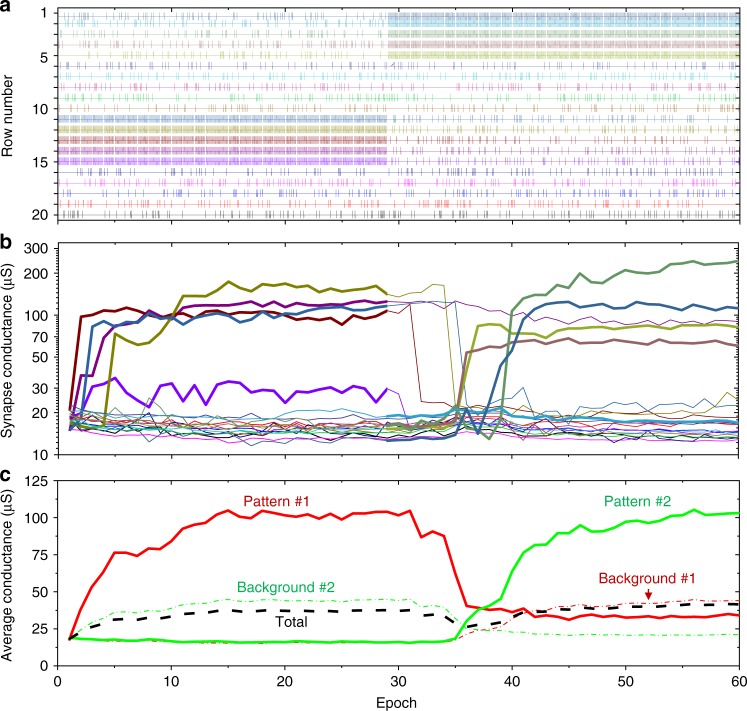
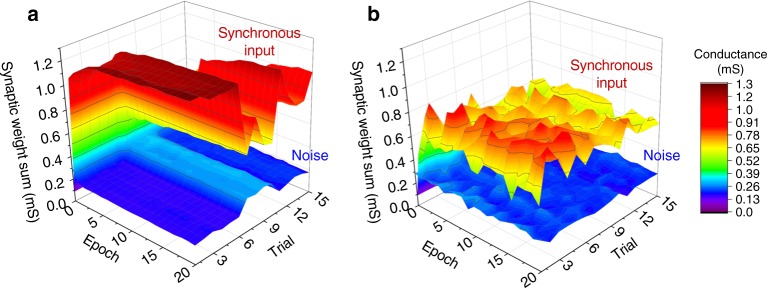
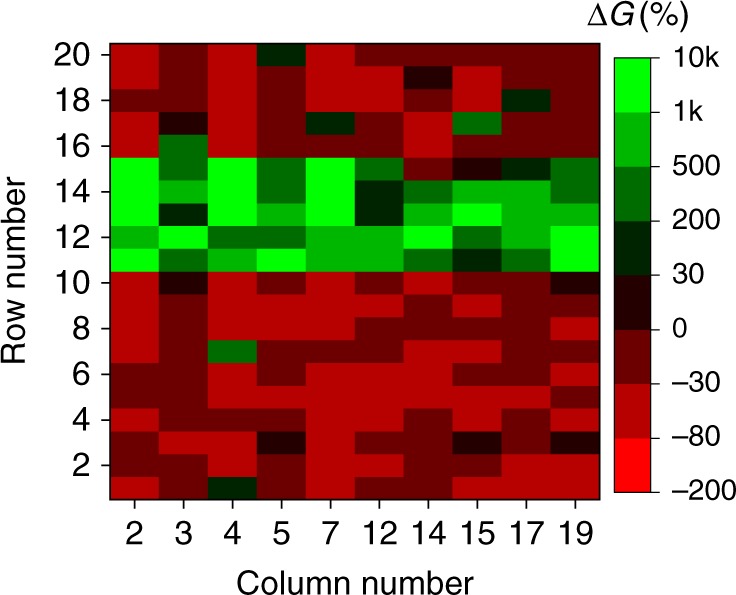
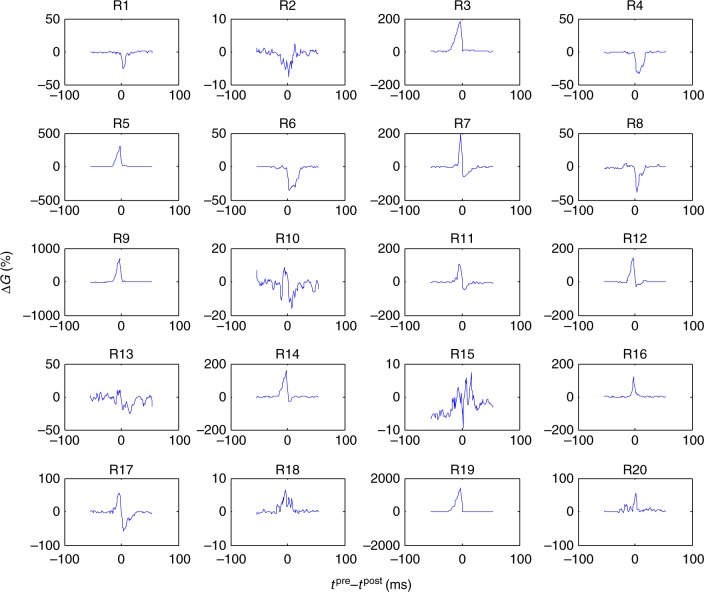
Spiking neural networks, the most realistic artificial representation of biological nervous systems, are promising due to their inherent local training rules that enable low-overhead online learning, and energy-efficient information encoding. Their downside is more demanding functionality of the artificial synapses, notably including spike-timing-dependent plasticity, which makes their compact efficient hardware implementation challenging with conventional device technologies. Recent work showed that memristors are excellent candidates for artificial synapses, although reports of even simple neuromorphic systems are still very rare. In this study, we experimentally demonstrate coincidence detection using a spiking neural network, implemented with passively integrated metal-oxide memristive synapses connected to an analogue leaky-integrate-and-fire silicon neuron. By employing spike-timing-dependent plasticity learning, the network is able to robustly detect the coincidence by selectively increasing the synaptic efficacies corresponding to the synchronized inputs. Not surprisingly, our results indicate that device-to-device variation is the main challenge towards realization of more complex spiking networks.
Overview
The claims and statistics of this paper haven’t been checked yet.
Free: it reads the open-access text and checks the first 5 claims that cite a source we can check. Create a free account to check every claim.
Integrity signals
Registry
Cites
Statistics
Figures
Verification
Claims the paper makes
The claims and statistics of this paper haven’t been checked yet.
Free: it reads the open-access text and checks the first 5 claims that cite a source we can check. Create a free account to check every claim.
Claims other papers make about this one
Each is checked against this paper’s own text: does it say what the citing paper says it does?
The source backs part of the claim, not all of it — or backs it for a different population, condition or comparison.
In the citing paper
“Crossbar arrays of two-terminal metal/insulator/metal (MIM) memristive devices can be fabricated easily using standard lithography and deposition techniques; this has been readily achieved by multiple groups57,64,68–70,85,93,105,216,217.”
From Hardware implementation of memristor-based artificial neural networks (2024) · cites this paper as [216]
Experimental — accuracy not yet measured
Self-check
Percentages, sums and reported differences re-computed from the paper’s own numbers.
The self-check needs the paper’s full text.
Citations
Cites
Bi, G.-Q., & Poo, M.-M. (1998) · The Journal of Neuroscience · doi:10.1523/jneurosci.18-24-10464.1998 · Cited by 4,744
Nanoscale Memristor Device as Synapse in Neuromorphic Systems
Jo, S. H., Chang, T., Ebong, I., Bhadviya, B. B., Mazumder, P., & Lu, W. (2010) · Nano Letters · doi:10.1021/nl904092h · Cited by 4,174
A million spiking-neuron integrated circuit with a scalable communication network and interface
Merolla, P. A., Arthur, J. V., Alvarez-Icaza, R., Cassidy, A. S., Sawada, J., Akopyan, F., Jackson, B. L., Imam, N., Guo, C., Nakamura, Y., et al. (2014) · Science · doi:10.1126/science.1254642 · Cited by 4,147
Memristive devices for computing
Yang, J. J., Strukov, D. B., & Stewart, D. R. (2013) · Nature Nanotechnology · doi:10.1038/nnano.2012.240 · Cited by 3,885
Self-citationNetworks of spiking neurons: The third generation of neural network models
Maass, W. (1997) · Neural Networks · doi:10.1016/s0893-6080(97)00011-7 · Cited by 3,481
Spiking Neuron Models: Single Neurons, Populations, Plasticity
Gerstner, W., & Kistler, W. M. (2002) · Cambridge University Press eBooks · doi:10.1017/cbo9780511815706 · Cited by 3,080
Training and operation of an integrated neuromorphic network based on metal-oxide memristors
Prezioso, M., Merrikh-Bayat, F., Hoskins, B. D., Adam, G. C., Likharev, K. K., & Strukov, D. B. (2015) · Nature · doi:10.1038/nature14441 · Cited by 3,001
Self-citationMemristors with diffusive dynamics as synaptic emulators for neuromorphic computing
Wang, Z., Joshi, S., Savel’ev, S. E., Jiang, H., Midya, R., Lin, P., Hu, M., Ge, N., Strachan, J. P., Li, Z., et al. (2017) · Nature Materials · doi:10.1038/nmat4756 · Cited by 2,358
Spike Timing–Dependent Plasticity: A Hebbian Learning Rule
Caporale, N., & Dan, Y. (2008) · Annual Review of Neuroscience · doi:10.1146/annurev.neuro.31.060407.125639 · Cited by 1,997
Reliability of spike timing in neocortical neurons
Mainen, Z. F., & Sejnowski, T. J. (1995) · Science · doi:10.1126/science.7770778 · Cited by 1,950
Cited by
Items 201–215 of 215
Spike-time dependent plasticity rule in memristor models for circuits designPreprint
Elhamdaoui, M., Rziga, F. O., Mbarek, K., & Besbes, K. (2021) · Research Square · doi:10.21203/rs.3.rs-164635/v1
Memristive/CMOS Devices for Neuromorphic Applications
Milo, V., Malavena, G., Compagnoni, C. M., & Ielmini, D. (2022) · Springer handbooks · doi:10.1007/978-3-030-79827-7_32 · Cited by 1
Spatiotemporal Spike Pattern Detection with Second-order Memristive Synapses
Wu, Y., Yoo, S., Meng, F.-H., & Lu, W. D. (2022) · IEEE International Symposium on Circuits and Systems proceedings · doi:10.1109/iscas48785.2022.9937414 · Cited by 1
Electrical and Wave Digital Modeling of CMOS-Based Ring Oscillators
Beattie, B. A., Muralidhar, B. K. S., Uhlmann, M., Kahmen, G., Rieger, R., & Ochs, K. (2023) · IEEE International Conference on Electronics, Circuits and Systems (ICECS) · doi:10.1109/icecs58634.2023.10382939
Raj, J. V., Archana, T., & Jinesh, K. B. (2026) · Journal of Vacuum Science & Technology B Nanotechnology and Microelectronics Materials Processing Measurement and Phenomena · doi:10.1116/6.0005462
Energy-efficient analog-domain aggregator circuit for RRAM-based neural network accelerators
Humood, K., Pan, Y., Wang, S., Serb, A., & Prodromakis, T. (2025) · Frontiers in Electronics · doi:10.3389/felec.2025.1513127 · Cited by 2
Laser-guided ion dynamics in a dual-mode memristor for bioinspired neuronal and synaptic integration
Jeong, Y. J., Lee, G., Kim, K., Kim, Y. B., Shin, H., Oh, J. W., Sung, S. H., An, J., Kim, K., & Lee, K. J. (2026) · Materials Today · doi:10.21203/rs.3.rs-6140700/v1
Luo, J., Liu, K., Fu, B., Yu, Z., Huang, Q., & Huang, R. (2025) · IEEE Electron Device Letters · doi:10.1109/led.2025.3618975
“This behavior has been emulated by various non-volatile devices such as memristors [4], ferroelectric FETs (FeFET) [5], among others.”
NeoHebbian synapses to accelerate online training of neuromorphic hardware
Pande, S. R., Bezugam, S. S., Bhattacharya, T., Wlaźlak, E., Chakravorty, A., Chakrabarti, B., & Strukov, D. B. (2026) · Scientific Reports · doi:10.1038/s41598-026-35641-z
“Several experimental demonstrations have shown that SNNs trained with the STDP algorithm can learn to detect temporal correlations within spike trains in an unsupervised manner 26–28 .”
Self-citationUnifying experimental heterogeneity in a geometrical synaptic plasticity model
Rodrigues, Y. E. (2021) · theses.fr (ABES) · doi:10.70675/62ca5e06zd2c0z4133za51ez04d3f2ee6023 · Cited by 1
Artificial neural networks with radio-frequency spintronic nano-devices
Leroux, N. (2022) · theses.fr (ABES) · doi:10.70675/acc48b6dzf6c5z436dzbb4az611c0b52d106 · Cited by 1
Palhares, J. H. Q. (2024) · theses.fr (ABES) · doi:10.70675/48a36fbcze95ez430dzbd4bz985b904d48d3
Computing inspired by the brain: a journey from algorithms to organoids
Brown, P., & Varghese, S. (2026) · Nature Computational Science · doi:10.1038/s43588-026-01012-x · Cited by 5
“Emerging approaches, including surrogate gradient techniques 74 and biologically inspired algorithms such as spike-timing-dependent plasticity (STDP) 75 , show promise but currently lack the versatility and performance of conventional deep learning methods 76,77 .”
Dembitskaya, Y., Valtcheva, S., Cui, Y., Zheng, Z., Ostojic, S., Graupner, M., & Venance, L. (2026) · iScience · doi:10.1016/j.isci.2026.117052
“99 Naturalistic STDP and associated expressed plasticity could also be of importance in field of memristive synapses and artificial neural networks implemented with brain-inspired STDP 15,80,100 to extend the performance of neuromorphic computing.”
In-Memory Computing Enabled by 32 × 8 1T1R Memristive Crossbar Arrays
Mikhaylov, A. N., Shchanikov, S., Koryazhkina, M. N., Bordanov, I., Lukoyanov, V., Belov, A. I., Zharkov, G. D., Серов, Д. А., Antonov, I. N., Kotina, A., et al. (2026) · Electronics · doi:10.3390/electronics15184267
Metadata
- Authors
- Prezioso, M., Mahmoodi, M. R., Bayat, F. M., Nili, H., Kim, H., Vincent, A., & Strukov, D. B.
- Affiliations
- University of California, Santa Barbara (US)
- Corresponding author
- Strukov, D. B.
- Venue
- Nature Communications
- Published
- 2018-12-14
- Volume
- 9
- Issue
- 1
- Pages
- 5311-5311
- ISSN
- 2041-1723 (ISSN-L)
- PMC
- PMC6294012
- OpenAlex
- W2904302621
- Semantic Scholar
- 11f6dc080fa4355c2ab248b610eab34217ddae4c
- Cited by
- 215
- References
- 45
- Citations by year
- 2026: 12 · 2025: 25 · 2024: 26 · 2023: 23 · 2022: 44 · 2021: 34 · 2020: 34 · 2019: 17
- FWCI
- 8.13
- Type
- journal article
- Language
- en
- Open access
- gold
- doi.org
- Licence
- cc-by
- creativecommons.org/licenses/by/4.0 (tdm)
- creativecommons.org/licenses/by/4.0 (vor)
- Locations
- Nature Communications (publishedVersion, cc-by)
- Europe PMC (PubMed Central) (publishedVersion, other-oa)
- PubMed Central (publishedVersion, cc-by)
- PubMed (publishedVersion)
- HAL (submittedVersion, cc-by)
- RePEc: Research Papers in Economics (submittedVersion)
- DOAJ (DOAJ: Directory of Open Access Journals) (submittedVersion)
- DOAJ (DOAJ: Directory of Open Access Journals) (submittedVersion, cc-by-sa)
- eScholarship (California Digital Library) (submittedVersion)
- eScholarship (California Digital Library) (submittedVersion, cc-by)
- Funders
- Defense Advanced Research Projects Agency (HR0011-13-C-0051UPSIDE)
- Army Research Office
- Topics
- Physical Sciences › Engineering › Electrical and Electronic Engineering › Advanced Memory and Neural Computing
- Life Sciences › Neuroscience › Cognitive Neuroscience › Neural dynamics and brain function
- Physical Sciences › Computer Science › Artificial Intelligence › Neural Networks and Reservoir Computing
- Keywords
- spike-timing-dependent plasticity, coincidence detection, spiking neural networks, memristors, artificial synapses, neuromorphic hardware, leaky integrate-and-fire neurons, metal-oxide memristors, device-to-device variation, synaptic plasticity
About these checks
Registry, retraction, Cites and statistics results are computed, not judged, with one exception: a printed reference that no index lists is read once by a model before it counts as a citation error. Claims are extracted by a model and kept only when their quote appears verbatim in the text; each cited source is then checked, with a model’s help, for whether it says what the claim relies on. Those verdicts can be wrong — read the claim’s quote and the cited source before relying on one.
Statistics and arithmetic are recomputed, not judged.
Confidence bands are shown only for fields calibrated on our annotated test set. None is calibrated yet, so no band is shown.
What counts as a claim ›How we measure confidence ›How we check this ›
Are you an author, or do you see a problem with this page? Request a review
Data sources
Bibliographic data: Semantic Scholar, OpenAlex, Crossref.
Contains information from the Semantic Scholar Academic Graph Datasets, made available under the ODC Attribution License (ODC-BY 1.0).
Semantic Scholar’s data is described in: Kinney, R., et al. (2023). The Semantic Scholar Open Data Platform. arXiv:2301.10140.
