

Optogenetic stimulation of medial prefrontal cortex Drd1 neurons produces rapid and long-lasting antidepressant effects
Open accessThe DOI matches its Crossref record; 56 of the 56 references it cites were found in a registry or an index.
Abstract
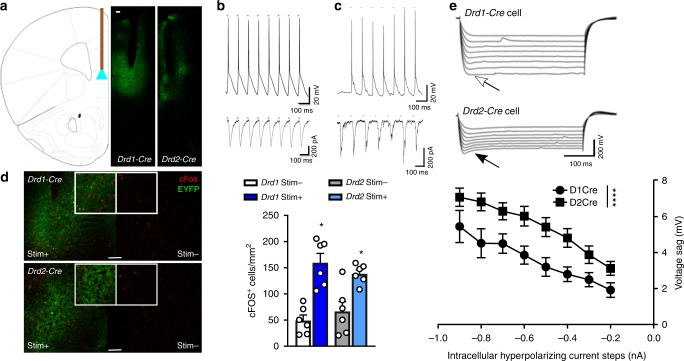
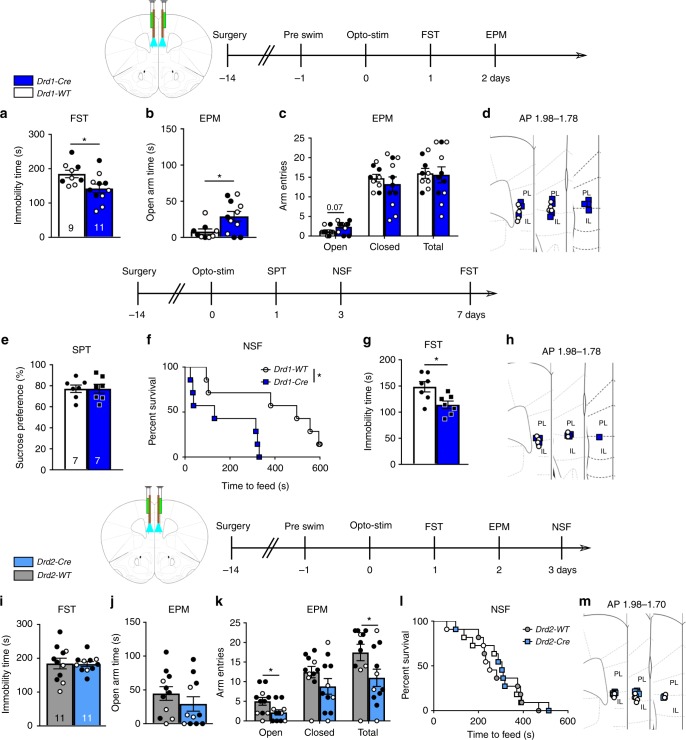
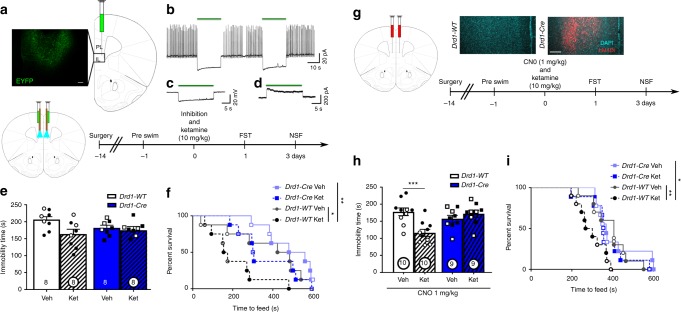
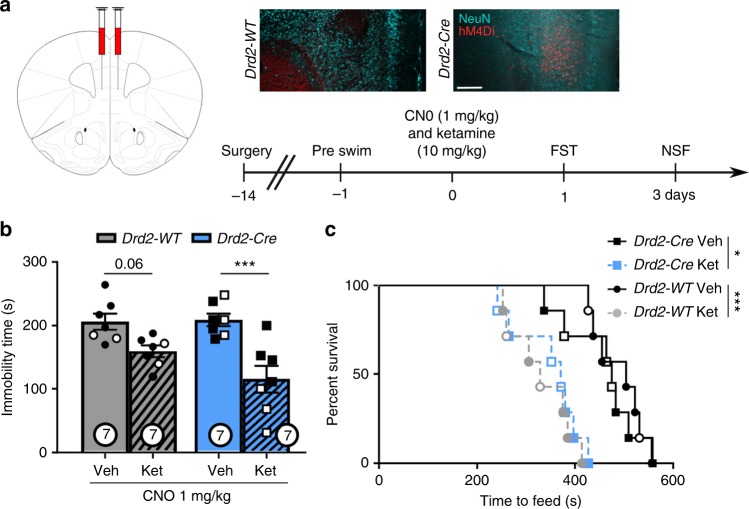
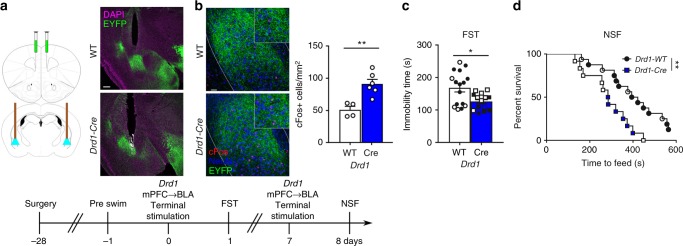
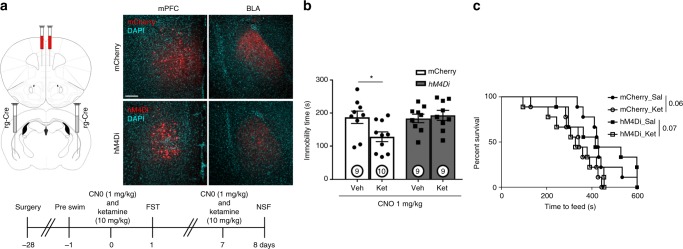
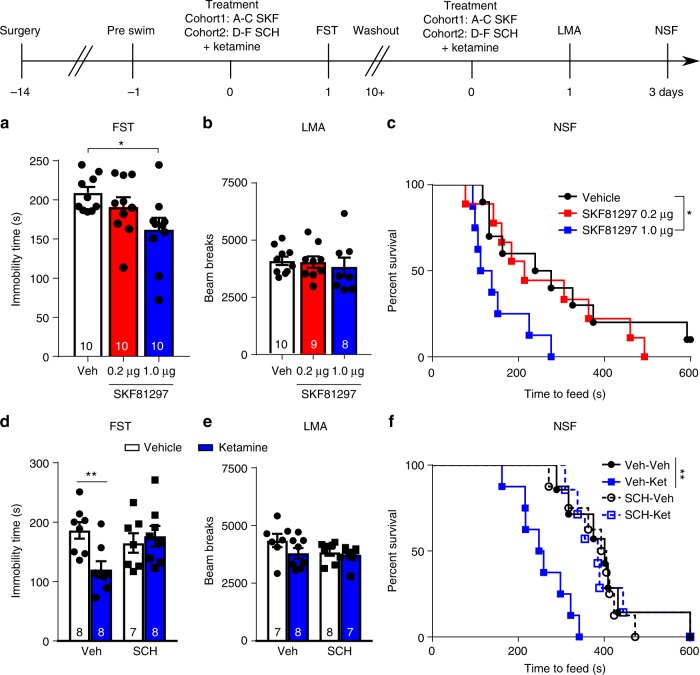
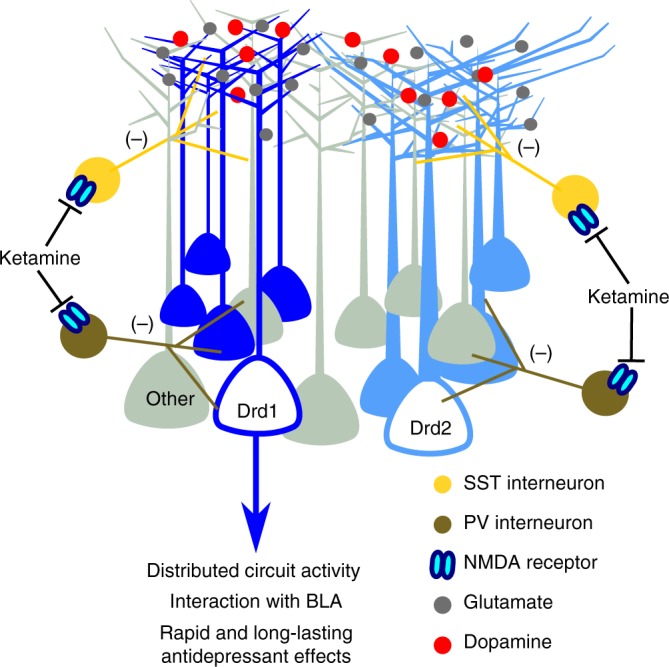
Impaired function in the medial prefrontal cortex (mPFC) contributes to depression, and the therapeutic response produced by novel rapid-acting antidepressants such as ketamine are mediated by mPFC activity. The mPFC contains multiple types of pyramidal cells, but it is unclear whether a particular subtype mediates the rapid antidepressant actions of ketamine. Here we tested two major subtypes, Drd1 and Drd2 dopamine receptor expressing pyramidal neurons and found that activating Drd1 expressing pyramidal cells in the mPFC produces rapid and long-lasting antidepressant and anxiolytic responses. In contrast, photostimulation of Drd2 expressing pyramidal cells was ineffective across anxiety-like and depression-like measures. Disruption of Drd1 activity also blocked the rapid antidepressant effects of ketamine. Finally, we demonstrate that stimulation of mPFC Drd1 terminals in the BLA recapitulates the antidepressant effects of somatic stimulation. These findings aid in understanding the cellular target neurons in the mPFC and the downstream circuitry involved in rapid antidepressant responses.
Overview
The claims and statistics of this paper haven’t been checked yet.
Free: it reads the open-access text and checks the first 5 claims that cite a source we can check. Create a free account to check every claim.
Integrity signals
Registry
Cites
Statistics
Figures
Verification
Claims the paper makes
The claims and statistics of this paper haven’t been checked yet.
Free: it reads the open-access text and checks the first 5 claims that cite a source we can check. Create a free account to check every claim.
Claims other papers make about this one
Each is checked against this paper’s own text: does it say what the citing paper says it does?
The source backs part of the claim, not all of it — or backs it for a different population, condition or comparison.
In the citing paper
“Our findings build upon prior studies showing that non-selective activation of the mPFC can reverse behavioral deficits in depression models [36–39]”
From A nucleus accumbens-projecting prefrontal cortex circuit underlies chronic social stress-induced depression-like behaviors (2026) · cites this paper as [38]
Experimental — accuracy not yet measuredThe cited source says what the claim attributes to it.
In the citing paper
“Moreover, an optogenetic study reveals that activating D1R-, but not D2R-, expressing PFC pyramidal neurons produces rapid and long-lasting antidepressant and anxiolytic responses, and disruption of D1R activity blocks the rapid antidepressant effects of ketamine 212.”
From Mechanisms of synaptic transmission dysregulation in the prefrontal cortex: pathophysiological implications (2022) · cites this paper as [212]
The cited source says what the claim attributes to it.
In the citing paper
“Moreover, an optogenetic study reveals that activating D1R-, but not D2R-, expressing PFC pyramidal neurons produces rapid and long-lasting antidepressant and anxiolytic responses, and disruption of D1R activity blocks the rapid antidepressant effects of ketamine 212.”
From Mechanisms of synaptic transmission dysregulation in the prefrontal cortex: pathophysiological implications (2022) · cites this paper as [212]
Self-check
Percentages, sums and reported differences re-computed from the paper’s own numbers.
The self-check needs the paper’s full text.
Citations
Cites
Molecular Mechanisms of Depression: Perspectives on New Treatment Strategies
Lang, U. E., & Borgwardt, S. (2013) · Cellular Physiology and Biochemistry · doi:10.1159/000350094 · Cited by 8,475
Antidepressant effects of ketamine in depressed patients
Berman, R. M., Cappiello, A., Anand, A., Oren, D. A., Heninger, G. R., Charney, D. S., & Krystal, J. H. (2000) · Biological Psychiatry · doi:10.1016/s0006-3223(99)00230-9 · Cited by 3,856
A randomized trial of an N-methyl-D-aspartate antagonist in treatment-resistant major depression.
Zarate, C. A., Singh, J. B., Carlson, P. J., Brutsche, N. E., Ameli, R., Luckenbaugh, D. A., Charney, D. S., & Manji, H. K. (2006) · Archives of General Psychiatry · doi:10.1001/archpsyc.63.8.856 · Cited by 3,766
mTOR-Dependent Synapse Formation Underlies the Rapid Antidepressant Effects of NMDA Antagonists
Li, N., Lee, B., Liu, R.-J., Banasr, M., Dwyer, J. M., Iwata, M., Li, X.-Y., Aghajanian, G., & Duman, R. S. (2010) · Science · doi:10.1126/science.1190287 · Cited by 2,881
Self-citationMoghaddam, B., Adams, B., Verma, A., & Daly, D. (1997) · The Journal of Neuroscience · doi:10.1523/jneurosci.17-08-02921.1997 · Cited by 1,793
Vyas, A., Mitra, R., Shankaranarayana Rao, B. S., & Chattarji, S. (2002) · The Journal of Neuroscience · doi:10.1523/jneurosci.22-15-06810.2002 · Cited by 1,662
Amygdala circuitry mediating reversible and bidirectional control of anxiety
Tye, K. M., Prakash, R., Kim, S.-Y., Fenno, L. E., Grosenick, L., Zarabi, H., Thompson, K. R., Gradinaru, V., Ramakrishnan, C., & Deisseroth, K. (2011) · Nature · doi:10.1038/nature09820 · Cited by 1,289
Rapid regulation of depression-related behaviours by control of midbrain dopamine neurons
Chaudhury, D., Walsh, J. J., Friedman, A. K., Juarez, B., Ku, S. M., Koo, J. W., Ferguson, D., Tsai, H.-C., Pomeranz, L., Christoffel, D. J., et al. (2013) · Nature · doi:10.1038/nature11713 · Cited by 1,156
Li, N., Liu, R.-J., Dwyer, J. M., Banasr, M., Lee, B., Son, H., Li, X.-Y., Aghajanian, G., & Duman, R. S. (2011) · Biological Psychiatry · doi:10.1016/j.biopsych.2010.12.015 · Cited by 1,082
Self-citationKetamine blocks bursting in the lateral habenula to rapidly relieve depression
Yang, Y., Cui, Y., Sang, K., Dong, Y., Ni, Z., Ma, S., & Hu, H. (2018) · Nature · doi:10.1038/nature25509 · Cited by 1,036
Cited by
Items 201–217 of 217
Optogenetics Research and the Recent Development in Pain Mechanisms
Liu, L. (2019) · Cited by 1
Hales, C., Bartlett, J., Arban, R., Hengerer, B., & Robinson, E. S. J. (2020) · bioRxiv (Cold Spring Harbor Laboratory) · doi:10.1101/2020.01.22.915132
Cortical Hemodynamic Response to Multi-afferent Stimulation: an optical imaging study
Bo, B., Li, Y., Li, W., Wang, Y., & Tong, S. (2020) · Annual International Conference of the IEEE Engineering in Medicine and Biology Society (EMBC) · doi:10.1109/embc44109.2020.9175284
“For example, optogenetic stimulation of glutamatergic neurons in the medial prefrontal cortex (mPFC) enhanced recognition memory in rats [6].”
Background(R)-Ketamine: A New Rapid-Acting Antidepressant
Zhang, K., & Hashimoto, K. (2021) · Contemporary clinical neuroscience · doi:10.1007/978-3-030-79790-4_1 · Cited by 1
Neural circuit mechanisms of rapid antidepressant actions of ketamine
Shinohara, R. (2022) · Folia Pharmacologica Japonica · doi:10.1254/fpj.22064
Self-citationLiu, Y., Zhou, X., Xue, K., Sun, R., Tang, Y., & Tang, C. (2023) · Research Square · doi:10.21203/rs.3.rs-2855251/v1
Optogenetics in Mood Disorders
Kumar, P., Kumari, T., Mateen, R., & Bhandarı, S. S. (2024) · Current Behavioral Neuroscience Reports · doi:10.1007/s40473-024-00285-8
“Continuous optogenetic modeling experiments revealed that the foundation for quick and potent antidepressant effects is the long-term neuroplasticity of dopamine receptor D1-expressing neurons (103).”
HEAVY METAL MUSIC, HIP-HOP MUSIC AND CONSTRUCTION NOISE INDUCES DEPRESSIVE SYMPTOMS IN MICE
Ren, J., & Lu, J. (2024) · ASEAN Journal of Psychiatry · doi:10.54615/2231-7805.47377 · Cited by 1
Ketamine’s Multifaceted Neuropharmacological and Neurobiological Actions
Kohtala, S., & Annala, I. (2025) · Neuromethods · doi:10.1007/978-1-0716-4603-8_2
OptoBrain: A Wireless Sensory Interface for Optogenetics
Andrade, R. D. A. P., Oshiro, H. E., Ginja, G. A., Colombari, E., Dias, M. C., Afonso, J. A., & Carmo, J. P. (2025) · Future Internet · doi:10.3390/fi17100465
Lewandrowski, K. U., Blum, K., Schmidt, S., Fiorelli, R. K. A., Gold, M. S., Mohankumar, K., Sharafshah, A., Bagchi, D., Pinhasov, A., Lorio, M. P., et al. (2026) · Substance Use & Misuse · doi:10.1080/10826084.2025.2612330
“In line with this, Hare et al. (Hare et al., 2019) found that optogenetic stimulation of D1 receptor-expressing neurons in the medial prefrontal cortex mimicked ketamine’s rapid anti-depressant action, but produced longer-lasting effects.”
Ketamine induces synaptic and monoaminergic remodeling in human iPSC-derived neuronsPreprint
Sala, C., Pagano, J., Mangano, E., Eminente, S., Marcatili, M., Krivosova, M., Tritto, V., Bordoni, R., Boeckers, T. M., & Conti, L. (2026) · Research Square · doi:10.21203/rs.3.rs-9096293/v1
Pan, Y. P., Zhang, J.-Y., Li, A., Zhu, X.-M., Lv, P., Zhang, F.-T., Bai, Y., Li, Y., Wei, J., & Yao, J. (2026) · Schizophrenia Bulletin · doi:10.1093/schbul/sbag063 · Cited by 1
Shi, A., Zhu, Z., Zhang, S., Guo, W., Li, M., Wu, Q., Sun, L., Hu, J., & Wang, G. (2026) · The Innovation Medicine · doi:10.59717/j.xinn-med.2026.100240
Spin Hall effect in van der Waals ferromagnet Fe 5 GeTe 2
Ohta, T., Samukawa, Y., Jiang, N., Niimi, Y., Yamagami, K., Okada, Y., Otani, Y., & Kondou, K. (2026) · Physical Review Materials · doi:10.1103/j2k1-vrvh
Metadata
- Authors
- Hare, B. D., Shinohara, R., Liu, R. J., Pothula, S., DiLeone, R. J., & Duman, R. S.
- Affiliations
- Yale University (US)
- Corresponding author
- Duman, Ronald S.
- Venue
- Nature Communications
- Published
- 2019-01-15
- Volume
- 10
- Issue
- 1
- Pages
- 223-223
- ISSN
- 2041-1723 (ISSN-L)
- PMC
- PMC6333924
- OpenAlex
- W2909539449
- Cited by
- 217
- References
- 54
- Citations by year
- 2026: 13 · 2025: 32 · 2024: 29 · 2023: 21 · 2022: 29 · 2021: 32 · 2020: 39 · 2019: 22
- FWCI
- 18.90
- Type
- journal article
- Language
- en
- Open access
- gold
- doi.org
- Licence
- cc-by
- creativecommons.org/licenses/by/4.0 (tdm)
- creativecommons.org/licenses/by/4.0 (vor)
- Locations
- Nature Communications (publishedVersion, cc-by)
- Europe PMC (PubMed Central) (publishedVersion, other-oa)
- PubMed Central (publishedVersion, cc-by)
- PubMed (publishedVersion)
- RePEc: Research Papers in Economics (submittedVersion)
- DOAJ (DOAJ: Directory of Open Access Journals) (submittedVersion, cc-by-sa)
- DOAJ (DOAJ: Directory of Open Access Journals) (submittedVersion)
- Funders
- Brain and Behavior Research Foundation (24593)
- National Alliance for Research on Schizophrenia and Depression
- National Institutes of Health
- National Institute of Mental Health (MH105910, MH093897, R01MH093897, RO1 MH093897-06A1, R01MH105910)
- National Institute of Diabetes and Digestive and Kidney Diseases (R01DK098994)
- Topics
- Health Sciences › Medicine › Pharmacology (medical) › Treatment of Major Depression
- Life Sciences › Neuroscience › Cellular and Molecular Neuroscience › Neurotransmitter Receptor Influence on Behavior
- Life Sciences › Neuroscience › Cellular and Molecular Neuroscience › Neuroscience and Neuropharmacology Research
- Keywords
- medial prefrontal cortex, pyramidal neurons, optogenetic stimulation, rapid-acting antidepressants, ketamine, depression, anxiety, anxiolytic effects, basolateral amygdala
- MeSH terms
- Animals, Antidepressive Agents, Female, Ketamine, Male, Mice, Inbred C57BL, Prefrontal Cortex, Receptors, Dopamine D1, Receptors, Dopamine D2, Dopamine Agonists, Optogenetics, Basolateral Nuclear Complex
About these checks
Registry, retraction, Cites and statistics results are computed, not judged, with one exception: a printed reference that no index lists is read once by a model before it counts as a citation error. Claims are extracted by a model and kept only when their quote appears verbatim in the text; each cited source is then checked, with a model’s help, for whether it says what the claim relies on. Those verdicts can be wrong — read the claim’s quote and the cited source before relying on one.
Statistics and arithmetic are recomputed, not judged.
Confidence bands are shown only for fields calibrated on our annotated test set. None is calibrated yet, so no band is shown.
What counts as a claim ›How we measure confidence ›How we check this ›
Are you an author, or do you see a problem with this page? Request a review
Data sources
Bibliographic data: Semantic Scholar, OpenAlex, Crossref.
Contains information from the Semantic Scholar Academic Graph Datasets, made available under the ODC Attribution License (ODC-BY 1.0).
Semantic Scholar’s data is described in: Kinney, R., et al. (2023). The Semantic Scholar Open Data Platform. arXiv:2301.10140.
