

Optogenetic stimulation of medial prefrontal cortex Drd1 neurons produces rapid and long-lasting antidepressant effects
Open accessThe DOI matches its Crossref record; 56 of the 56 references it cites were found in a registry or an index.
Abstract
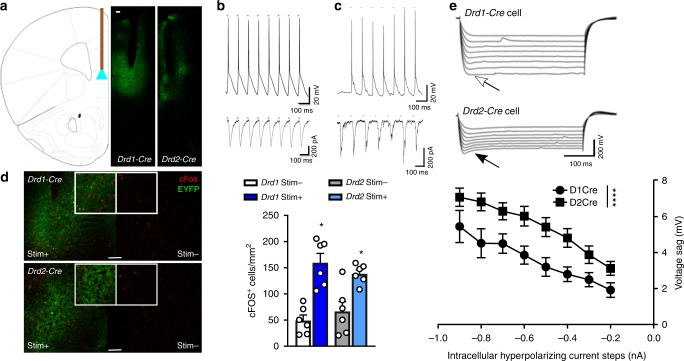
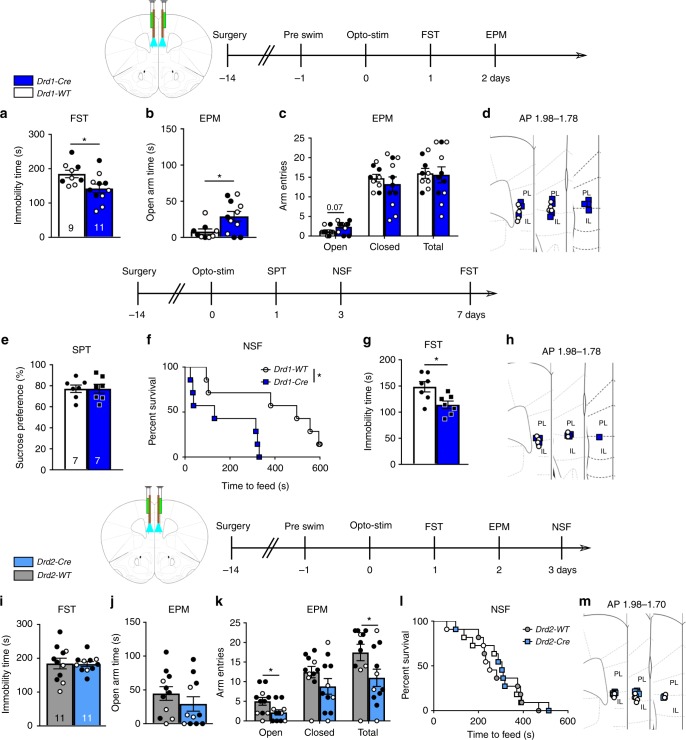
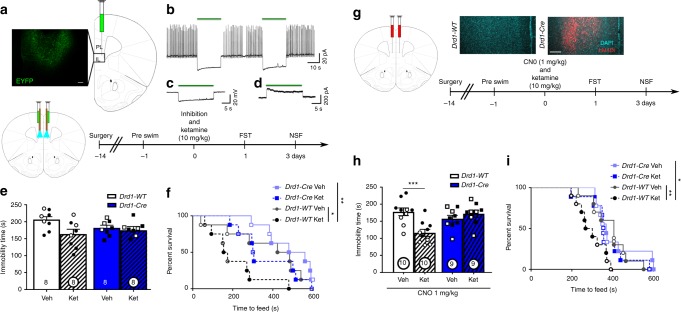
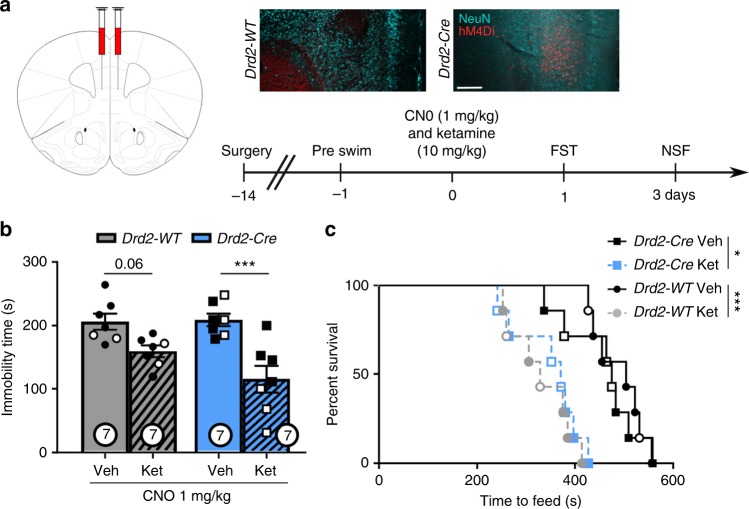
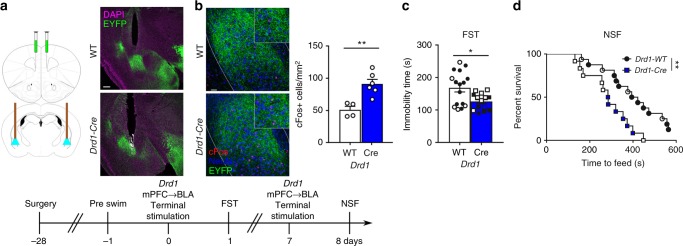
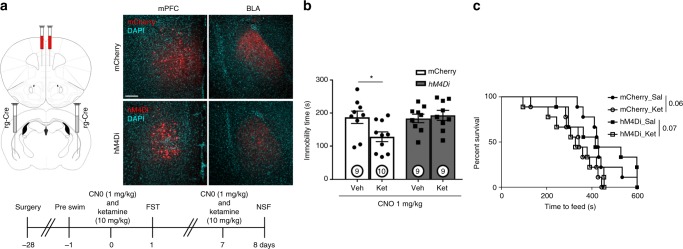
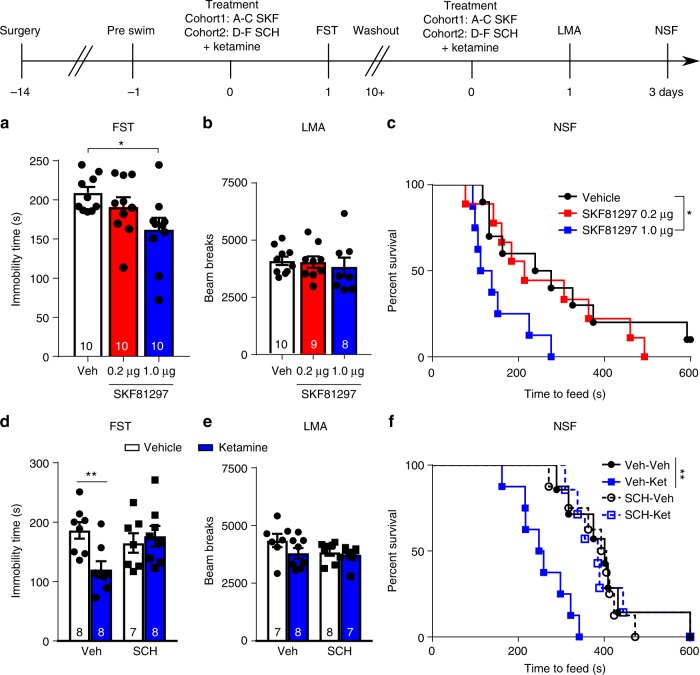
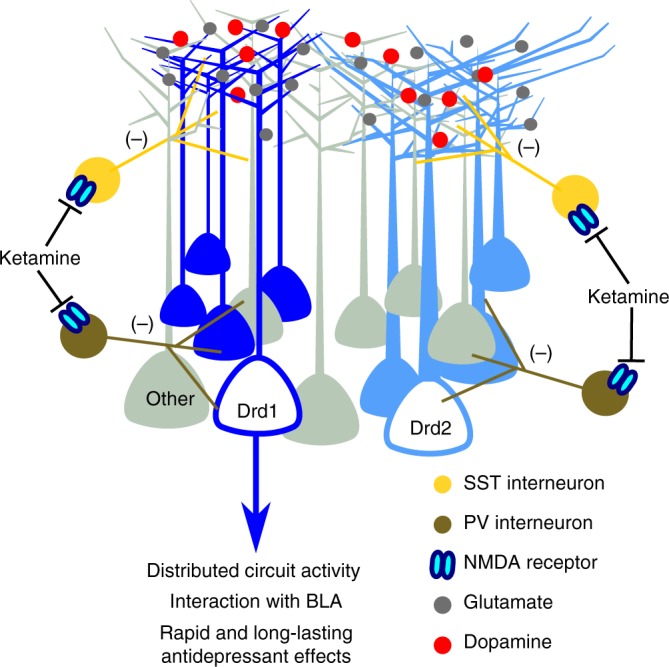
Impaired function in the medial prefrontal cortex (mPFC) contributes to depression, and the therapeutic response produced by novel rapid-acting antidepressants such as ketamine are mediated by mPFC activity. The mPFC contains multiple types of pyramidal cells, but it is unclear whether a particular subtype mediates the rapid antidepressant actions of ketamine. Here we tested two major subtypes, Drd1 and Drd2 dopamine receptor expressing pyramidal neurons and found that activating Drd1 expressing pyramidal cells in the mPFC produces rapid and long-lasting antidepressant and anxiolytic responses. In contrast, photostimulation of Drd2 expressing pyramidal cells was ineffective across anxiety-like and depression-like measures. Disruption of Drd1 activity also blocked the rapid antidepressant effects of ketamine. Finally, we demonstrate that stimulation of mPFC Drd1 terminals in the BLA recapitulates the antidepressant effects of somatic stimulation. These findings aid in understanding the cellular target neurons in the mPFC and the downstream circuitry involved in rapid antidepressant responses.
Overview
The claims and statistics of this paper haven’t been checked yet.
Free: it reads the open-access text and checks the first 5 claims that cite a source we can check. Create a free account to check every claim.
Integrity signals
Registry
Cites
Statistics
Figures
Verification
Claims the paper makes
The claims and statistics of this paper haven’t been checked yet.
Free: it reads the open-access text and checks the first 5 claims that cite a source we can check. Create a free account to check every claim.
Claims other papers make about this one
Each is checked against this paper’s own text: does it say what the citing paper says it does?
The source backs part of the claim, not all of it — or backs it for a different population, condition or comparison.
In the citing paper
“Our findings build upon prior studies showing that non-selective activation of the mPFC can reverse behavioral deficits in depression models [36–39]”
From A nucleus accumbens-projecting prefrontal cortex circuit underlies chronic social stress-induced depression-like behaviors (2026) · cites this paper as [38]
Experimental — accuracy not yet measuredThe cited source says what the claim attributes to it.
In the citing paper
“Moreover, an optogenetic study reveals that activating D1R-, but not D2R-, expressing PFC pyramidal neurons produces rapid and long-lasting antidepressant and anxiolytic responses, and disruption of D1R activity blocks the rapid antidepressant effects of ketamine 212.”
From Mechanisms of synaptic transmission dysregulation in the prefrontal cortex: pathophysiological implications (2022) · cites this paper as [212]
The cited source says what the claim attributes to it.
In the citing paper
“Moreover, an optogenetic study reveals that activating D1R-, but not D2R-, expressing PFC pyramidal neurons produces rapid and long-lasting antidepressant and anxiolytic responses, and disruption of D1R activity blocks the rapid antidepressant effects of ketamine 212.”
From Mechanisms of synaptic transmission dysregulation in the prefrontal cortex: pathophysiological implications (2022) · cites this paper as [212]
Self-check
Percentages, sums and reported differences re-computed from the paper’s own numbers.
The self-check needs the paper’s full text.
Citations
Cites
Molecular Mechanisms of Depression: Perspectives on New Treatment Strategies
Lang, U. E., & Borgwardt, S. (2013) · Cellular Physiology and Biochemistry · doi:10.1159/000350094 · Cited by 8,475
Antidepressant effects of ketamine in depressed patients
Berman, R. M., Cappiello, A., Anand, A., Oren, D. A., Heninger, G. R., Charney, D. S., & Krystal, J. H. (2000) · Biological Psychiatry · doi:10.1016/s0006-3223(99)00230-9 · Cited by 3,856
A randomized trial of an N-methyl-D-aspartate antagonist in treatment-resistant major depression.
Zarate, C. A., Singh, J. B., Carlson, P. J., Brutsche, N. E., Ameli, R., Luckenbaugh, D. A., Charney, D. S., & Manji, H. K. (2006) · Archives of General Psychiatry · doi:10.1001/archpsyc.63.8.856 · Cited by 3,766
mTOR-Dependent Synapse Formation Underlies the Rapid Antidepressant Effects of NMDA Antagonists
Li, N., Lee, B., Liu, R.-J., Banasr, M., Dwyer, J. M., Iwata, M., Li, X.-Y., Aghajanian, G., & Duman, R. S. (2010) · Science · doi:10.1126/science.1190287 · Cited by 2,881
Self-citationMoghaddam, B., Adams, B., Verma, A., & Daly, D. (1997) · The Journal of Neuroscience · doi:10.1523/jneurosci.17-08-02921.1997 · Cited by 1,793
Vyas, A., Mitra, R., Shankaranarayana Rao, B. S., & Chattarji, S. (2002) · The Journal of Neuroscience · doi:10.1523/jneurosci.22-15-06810.2002 · Cited by 1,662
Amygdala circuitry mediating reversible and bidirectional control of anxiety
Tye, K. M., Prakash, R., Kim, S.-Y., Fenno, L. E., Grosenick, L., Zarabi, H., Thompson, K. R., Gradinaru, V., Ramakrishnan, C., & Deisseroth, K. (2011) · Nature · doi:10.1038/nature09820 · Cited by 1,289
Rapid regulation of depression-related behaviours by control of midbrain dopamine neurons
Chaudhury, D., Walsh, J. J., Friedman, A. K., Juarez, B., Ku, S. M., Koo, J. W., Ferguson, D., Tsai, H.-C., Pomeranz, L., Christoffel, D. J., et al. (2013) · Nature · doi:10.1038/nature11713 · Cited by 1,156
Li, N., Liu, R.-J., Dwyer, J. M., Banasr, M., Lee, B., Son, H., Li, X.-Y., Aghajanian, G., & Duman, R. S. (2011) · Biological Psychiatry · doi:10.1016/j.biopsych.2010.12.015 · Cited by 1,082
Self-citationKetamine blocks bursting in the lateral habenula to rapidly relieve depression
Yang, Y., Cui, Y., Sang, K., Dong, Y., Ni, Z., Ma, S., & Hu, H. (2018) · Nature · doi:10.1038/nature25509 · Cited by 1,036
Repeated Stress Induces Dendritic Spine Loss in the Rat Medial Prefrontal Cortex
Radley, J. J., Rocher, A. B., Miller, M., Janssen, W. G. M., Liston, C., Hof, P. R., McEwen, B. S., & Morrison, J. H. (2006) · Cerebral Cortex · doi:10.1093/cercor/bhi104 · Cited by 820
Stress weakens prefrontal networks: molecular insults to higher cognition
Arnsten, A. F. T. (2015) · Nature Neuroscience · doi:10.1038/nn.4087 · Cited by 752
Effects of Chronic Fluoxetine in Animal Models of Anxiety and Depression
Dulawa, S. C., Holick, K. A., Gundersen, B., & Hen, R. (2004) · Neuropsychopharmacology · doi:10.1038/sj.npp.1300433 · Cited by 671
Diverging neural pathways assemble a behavioural state from separable features in anxiety
Kim, S.-Y., Adhikari, A., Lee, S. Y., Marshel, J. H., Kim, C. K., Mallory, C. S., Lo, M., Pak, S., Mattis, J., Lim, B. K., et al. (2013) · Nature · doi:10.1038/nature12018 · Cited by 666
A prefrontal cortex–brainstem neuronal projection that controls response to behavioural challenge
Warden, M. R., Selimbeyoglu, A., Mirzabekov, J. J., Lo, M., Thompson, K. R., Kim, S.-Y., Adhikari, A., Tye, K. M., Frank, L. M., & Deisseroth, K. (2012) · Nature · doi:10.1038/nature11617 · Cited by 645
Silencing Neurons: Tools, Applications, and Experimental Constraints
Wiegert, J. S., Mahn, M., Prigge, M., Printz, Y., & Yizhar, O. (2017) · Neuron · doi:10.1016/j.neuron.2017.06.050 · Cited by 312
Sun, X., Zhao, Y., & Wolf, M. E. (2005) · The Journal of Neuroscience · doi:10.1523/jneurosci.4603-04.2005 · Cited by 299
The Neuropeptide Tac2 Controls a Distributed Brain State Induced by Chronic Social Isolation Stress
Zelikowsky, M., Hui, M., Karigo, T., Choe, A., Yang, B., Blanco, M. R., Beadle, K., Gradinaru, V., Deverman, B. E., & Anderson, D. J. (2018) · Cell · doi:10.1016/j.cell.2018.03.037 · Cited by 286
Projection-Specific Neuromodulation of Medial Prefrontal Cortex Neurons
Dembrow, N. C., Chitwood, R. A., & Johnston, D. (2010) · The Journal of Neuroscience · doi:10.1523/jneurosci.3644-10.2010 · Cited by 285
Fuchikami, M., Thomas, A., Liu, R., Wohleb, E. S., Land, B. B., DiLeone, R. J., Aghajanian, G. K., & Duman, R. S. (2015) · Proceedings of the National Academy of Sciences · doi:10.1073/pnas.1414728112 · Cited by 265
Self-citationVoleti, B., Navarria, A., Liu, R.-J., Banasr, M., Li, N., Terwilliger, R., Sanacora, G., Eid, T., Aghajanian, G., & Duman, R. S. (2013) · Biological Psychiatry · doi:10.1016/j.biopsych.2013.04.025 · Cited by 264
Self-citationSantana, N., Mengod, G., & Artigas, F. (2009) · Cerebral Cortex · doi:10.1093/cercor/bhn134 · Cited by 231
The effects of ketamine on prefrontal glutamate neurotransmission in healthy and depressed subjects
Abdallah, C. G., De Feyter, H. M., Averill, L. A., Jiang, L., Averill, C. L., Chowdhury, G. M. I., Purohit, P., de Graaf, R. A., Esterlis, I., Juchem, C., et al. (2018) · Neuropsychopharmacology · doi:10.1038/s41386-018-0136-3 · Cited by 229
Gee, S., Ellwood, I., Patel, T., Luongo, F., Deisseroth, K., & Sohal, V. S. (2012) · The Journal of Neuroscience · doi:10.1523/jneurosci.5835-11.2012 · Cited by 214
Carreno, F. R., Donegan, J. J., Boley, A. M., Shah, A., DeGuzman, M., Frazer, A., & Lodge, D. J. (2016) · Molecular Psychiatry · doi:10.1038/mp.2015.176 · Cited by 205
Chowdhury, G. M. I., Zhang, J., Thomas, M., Banasr, M., Ma, X., Pittman, B., Bristow, L., Schaeffer, E., Duman, R. S., Rothman, D. L., et al. (2017) · Molecular Psychiatry · doi:10.1038/mp.2016.34 · Cited by 197
Self-citationMedial prefrontal D1 dopamine neurons control food intake
Land, B. B., Narayanan, N. S., Liu, R.-J., Gianessi, C. A., Brayton, C. E., M Grimaldi, D., Sarhan, M., Guarnieri, D. J., Deisseroth, K., Aghajanian, G. K., et al. (2014) · Nature Neuroscience · doi:10.1038/nn.3625 · Cited by 180
Self-citationAgís-Balboa, R. C., Pinna, G., Pibiri, F., Kadriu, B., Costa, E., & Guidotti, A. (2007) · Proceedings of the National Academy of Sciences · doi:10.1073/pnas.0709419104 · Cited by 175
Prefrontal Cortex Drives Distinct Projection Neurons in the Basolateral Amygdala
McGarry, L. M., & Carter, A. G. (2017) · Cell Reports · doi:10.1016/j.celrep.2017.10.046 · Cited by 142
Martinović, J., Todorović, N., Bošković, M., Pajović, S. B., Demajo, M., & Filipović, D. (2014) · Molecular and Cellular Biochemistry · doi:10.1007/s11010-014-2045-z · Cited by 139
Soumier, A., & Sibille, E. (2014) · Neuropsychopharmacology · doi:10.1038/npp.2014.76 · Cited by 136
Stamatakis, A. M., Sparta, D. R., Jennings, J. H., McElligott, Z. A., Decot, H., & Stuber, G. D. (2014) · Neuropharmacology · doi:10.1016/j.neuropharm.2013.05.046 · Cited by 132
Tanaka, K., Furuyashiki, T., Kitaoka, S., Senzai, Y., Imoto, Y., Segi-Nishida, E., Deguchi, Y., Breyer, R. M., Breyer, M. D., & Narumiya, S. (2012) · The Journal of Neuroscience · doi:10.1523/jneurosci.5952-11.2012 · Cited by 131
Subcircuit-specific neuromodulation in the prefrontal cortex
Dembrow, N., & Johnston, D. (2014) · Frontiers in Neural Circuits · doi:10.3389/fncir.2014.00054 · Cited by 131
Modulation of medial prefrontal cortical activity using in vivo recordings and optogenetics
Ji, G., & Neugebauer, V. (2012) · Molecular Brain · doi:10.1186/1756-6606-5-36 · Cited by 128
Perova, Z., Delevich, K., & Li, B. (2015) · The Journal of Neuroscience · doi:10.1523/jneurosci.2670-14.2015 · Cited by 118
Ma, X.-C., Dang, Y.-H., Jia, M., Ma, R., Wang, F., Wu, J., Gao, C.-G., & Hashimoto, K. (2013) · PLoS ONE · doi:10.1371/journal.pone.0056053 · Cited by 114
Shinohara, R., Taniguchi, M., Ehrlich, A. T., Yokogawa, K., Deguchi, Y., Chérasse, Y., Lazarus, M., Urade, Y., Ogawa, A., Kitaoka, S., et al. (2017) · Molecular Psychiatry · doi:10.1038/mp.2017.177 · Cited by 112
Self-citationLiu, X., & Carter, A. G. (2018) · The Journal of Neuroscience · doi:10.1523/jneurosci.0378-18.2018 · Cited by 112
Kim, Y.-C., Han, S.-W., Alberico, S. L., Ruggiero, R. N., Corte, B. J. D., Chen, K., & Narayanan, N. S. (2016) · Current Biology · doi:10.1016/j.cub.2016.11.029 · Cited by 102
Seong, H. J., & Carter, A. G. (2012) · Journal of Neuroscience · doi:10.1523/jneurosci.1367-12.2012 · Cited by 100
D3 Receptors Regulate Excitability in a Unique Class of Prefrontal Pyramidal Cells
Clarkson, R. L., Liptak, A. T., Gee, S. M., Sohal, V. S., & Bender, K. J. (2017) · The Journal of Neuroscience · doi:10.1523/jneurosci.0310-17.2017 · Cited by 91
Amat, J., Dolzani, S. D., Tilden, S., Christianson, J. P., Kubala, K. H., Bartholomay, K., Sperr, K., Ciancio, N., Watkins, L. R., & Maier, S. F. (2016) · The Journal of Neuroscience · doi:10.1523/jneurosci.3114-15.2016 · Cited by 79
Dembrow, N. C., Zemelman, B. V., & Johnston, D. (2015) · The Journal of Neuroscience · doi:10.1523/jneurosci.4673-14.2015 · Cited by 76
Jett, J. D., Boley, A. M., Girotti, M., Shah, A., Lodge, D. J., & Morilak, D. A. (2015) · Psychopharmacology · doi:10.1007/s00213-015-3957-3 · Cited by 75
Calu, D. J., Kawa, A. B., Marchant, N. J., Navarre, B. M., Henderson, M. J., Chen, B., Yau, H.-J., Bossert, J. M., Schoenbaum, G., Deisseroth, K., et al. (2013) · The Journal of Neuroscience · doi:10.1523/jneurosci.2016-12.2013 · Cited by 74
Rapid Acting Antidepressants in Chronic Stress Models: Molecular and Cellular Mechanisms
Hare, B. D., Ghosal, S., & Duman, R. S. (2017) · Chronic Stress · doi:10.1177/2470547017697317 · Cited by 67
Self-citationD'Aquila, P. S., Collu, M., Pani, L., Gessa, G. L., & Serra, G. (1994) · European Journal of Pharmacology · doi:10.1016/0014-2999(94)90033-7 · Cited by 63
Liu, R.-J., Ota, K. T., Dutheil, S., Duman, R. S., & Aghajanian, G. K. (2015) · Neuropsychopharmacology · doi:10.1038/npp.2015.70 · Cited by 62
Self-citationBurgdorf, J., Kroes, R. A., Zhang, X.-L., Gross, A. L., Schmidt, M., Weiss, C., Disterhoft, J. F., Burch, R. M., Stanton, P. K., & Moskal, J. R. (2015) · Behavioural Brain Research · doi:10.1016/j.bbr.2015.07.039 · Cited by 59
Siuda, E. R., Al‐Hasani, R., McCall, J. G., Bhatti, D. L., & Bruchas, M. R. (2016) · Neuropsychopharmacology · doi:10.1038/npp.2015.371 · Cited by 53
Total sleep deprivation decreases immobility in the forced-swim test
Lopez-Rodriguez, F., Kim, J., & Poland, R. E. (2004) · Neuropsychopharmacology · doi:10.1038/sj.npp.1300406 · Cited by 49
Haj‐Mirzaian, A., Amini-Khoei, H., Haj‐Mirzaian, A., Amiri, S., Ghesmati, M., Zahir, M., Shafaroodi, H., & Dehpour, A. R. (2017) · Brain Research Bulletin · doi:10.1016/j.brainresbull.2017.01.018 · Cited by 41
Björkholm, C., Marcus, M. M., Konradsson‐Geuken, Å., Jardemark, K. E., & Svensson, T. H. (2017) · European Neuropsychopharmacology · doi:10.1016/j.euroneuro.2017.01.014 · Cited by 35
Louderback, K. M., Wills, T. A., Muglia, L. J., & Winder, D. G. (2013) · Translational Psychiatry · doi:10.1038/tp.2013.103 · Cited by 24
High fidelity optogenetic control of individual prefrontal cortical pyramidal neurons in vivo
Nakamura, S., Baratta, M. V., Pomrenze, M. B., Dolzani, S. D., & Cooper, D. (2012) · F1000Research · doi:10.12688/f1000research.1-7.v1 · Cited by 11
Cited by
Prefrontal cortex and depression
Pizzagalli, D. A., & Roberts, A. C. (2022) · Neuropsychopharmacology · doi:10.1038/s41386-021-01101-7 · Cited by 667
Hare, B. D., & Duman, R. S. (2020) · Molecular Psychiatry · doi:10.1038/s41380-020-0685-9 · Cited by 366
“ACC Anterior cingulate cortex, BLA basolateral amygdala, BMA basomedial amygdala, DRN dorsal raphe nucleus, IL infralimbic, LHB lateral habenula, MDT medial dorsal thalamus, mPFC medial prefrontal cortex, NAc nucleus accumbens, PL prelimbic, SST somatostatin, vHIPP ventral hippocampus, vmPFC ventral medial prefrontal…”
BackgroundSelf-citationGABA interneurons are the cellular trigger for ketamine's rapid antidepressant actions
Gerhard, D. M., Pothula, S., Liu, R.-J., Wu, M., Li, X.-Y., Girgenti, M. J., Taylor, S. R., Duman, C. H., Delpire, E., Picciotto, M., et al. (2020) · Journal of Clinical Investigation · doi:10.1172/jci130808 · Cited by 345
“infusion of a dose in the therapeutic range (18) and a concentration that blocks approximately 50% of NMDA-induced currents (19); or 10 μM, a concentration that is sufficient to block approximately 80% of NMDA-induced currents (20).”
BackgroundSelf-citationYan, Z., & Rein, B. (2022) · Molecular Psychiatry · doi:10.1038/s41380-021-01092-3 · Cited by 300
“Moreover, an optogenetic study reveals that activating D1R-, but not D2R-, expressing PFC pyramidal neurons produces rapid and long-lasting antidepressant and anxiolytic responses, and disruption of D1R activity blocks the rapid antidepressant effects of ketamine [212].”
BackgroundKetamine: A tale of two enantiomers
Jelen, L. A., Young, A. H., & Stone, J. M. (2021) · Journal of Psychopharmacology · doi:10.1177/0269881120959644 · Cited by 246
“Additional research findings indicate that dopamine D1 receptor activity in the mPFC are necessary for the rapid antidepressant actions of (R,S)-ketamine using optogenetic stimulation in a mouse model (Hare et al., 2019).”
Background
Metadata
- Authors
- Hare, B. D., Shinohara, R., Liu, R. J., Pothula, S., DiLeone, R. J., & Duman, R. S.
- Affiliations
- Yale University (US)
- Corresponding author
- Duman, Ronald S.
- Venue
- Nature Communications
- Published
- 2019-01-15
- Volume
- 10
- Issue
- 1
- Pages
- 223-223
- ISSN
- 2041-1723 (ISSN-L)
- PMC
- PMC6333924
- OpenAlex
- W2909539449
- Cited by
- 217
- References
- 54
- Citations by year
- 2026: 13 · 2025: 32 · 2024: 29 · 2023: 21 · 2022: 29 · 2021: 32 · 2020: 39 · 2019: 22
- FWCI
- 18.90
- Type
- journal article
- Language
- en
- Open access
- gold
- doi.org
- Licence
- cc-by
- creativecommons.org/licenses/by/4.0 (tdm)
- creativecommons.org/licenses/by/4.0 (vor)
- Locations
- Nature Communications (publishedVersion, cc-by)
- Europe PMC (PubMed Central) (publishedVersion, other-oa)
- PubMed Central (publishedVersion, cc-by)
- PubMed (publishedVersion)
- RePEc: Research Papers in Economics (submittedVersion)
- DOAJ (DOAJ: Directory of Open Access Journals) (submittedVersion, cc-by-sa)
- DOAJ (DOAJ: Directory of Open Access Journals) (submittedVersion)
- Funders
- Brain and Behavior Research Foundation (24593)
- National Alliance for Research on Schizophrenia and Depression
- National Institutes of Health
- National Institute of Mental Health (MH105910, MH093897, R01MH093897, RO1 MH093897-06A1, R01MH105910)
- National Institute of Diabetes and Digestive and Kidney Diseases (R01DK098994)
- Topics
- Health Sciences › Medicine › Pharmacology (medical) › Treatment of Major Depression
- Life Sciences › Neuroscience › Cellular and Molecular Neuroscience › Neurotransmitter Receptor Influence on Behavior
- Life Sciences › Neuroscience › Cellular and Molecular Neuroscience › Neuroscience and Neuropharmacology Research
- Keywords
- medial prefrontal cortex, pyramidal neurons, optogenetic stimulation, rapid-acting antidepressants, ketamine, depression, anxiety, anxiolytic effects, basolateral amygdala
- MeSH terms
- Animals, Antidepressive Agents, Female, Ketamine, Male, Mice, Inbred C57BL, Prefrontal Cortex, Receptors, Dopamine D1, Receptors, Dopamine D2, Dopamine Agonists, Optogenetics, Basolateral Nuclear Complex
About these checks
Registry, retraction, Cites and statistics results are computed, not judged, with one exception: a printed reference that no index lists is read once by a model before it counts as a citation error. Claims are extracted by a model and kept only when their quote appears verbatim in the text; each cited source is then checked, with a model’s help, for whether it says what the claim relies on. Those verdicts can be wrong — read the claim’s quote and the cited source before relying on one.
Statistics and arithmetic are recomputed, not judged.
Confidence bands are shown only for fields calibrated on our annotated test set. None is calibrated yet, so no band is shown.
What counts as a claim ›How we measure confidence ›How we check this ›
Are you an author, or do you see a problem with this page? Request a review
Data sources
Bibliographic data: Semantic Scholar, OpenAlex, Crossref.
Contains information from the Semantic Scholar Academic Graph Datasets, made available under the ODC Attribution License (ODC-BY 1.0).
Semantic Scholar’s data is described in: Kinney, R., et al. (2023). The Semantic Scholar Open Data Platform. arXiv:2301.10140.
