

Scale-free networks are rare
Open accessThe DOI matches its Crossref record; 69 of the 70 references it cites were found in a registry or an index.
Abstract
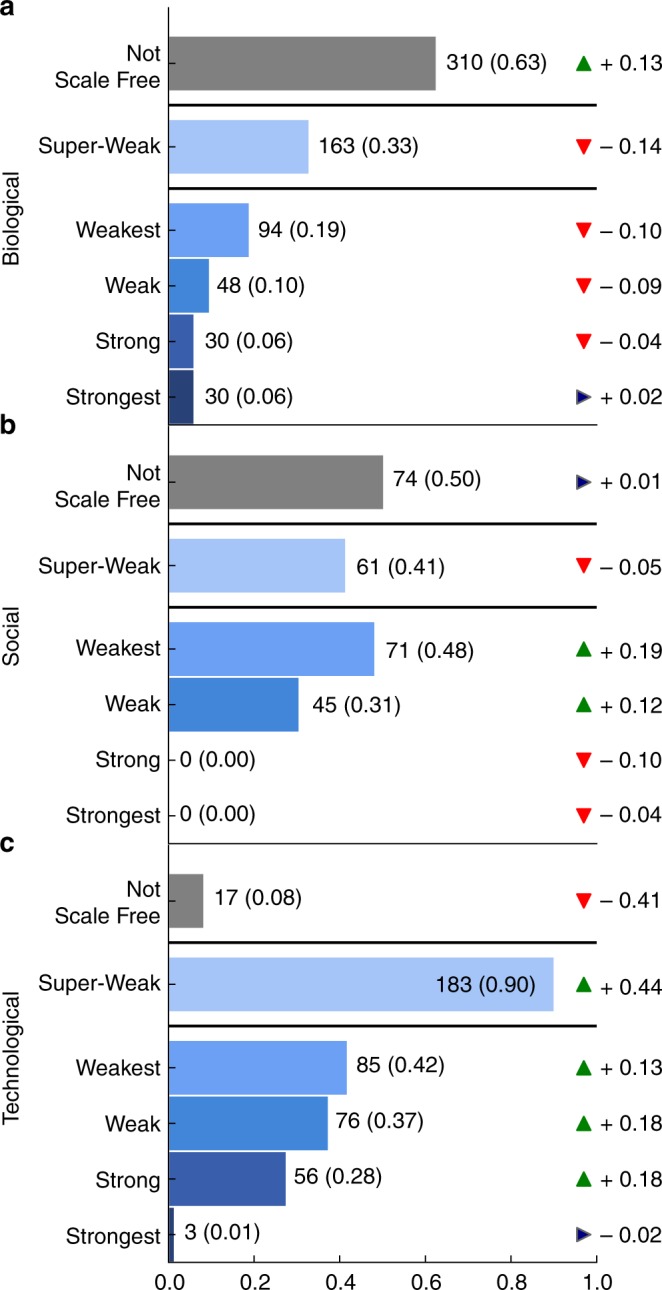
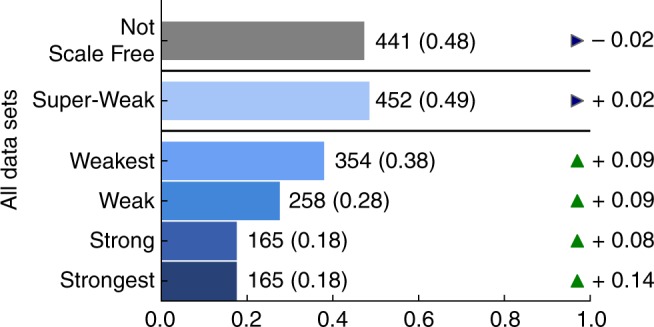
Real-world networks are often claimed to be scale free, meaning that the fraction of nodes with degree k follows a power law k − α , a pattern with broad implications for the structure and dynamics of complex systems. However, the universality of scale-free networks remains controversial. Here, we organize different definitions of scale-free networks and construct a severe test of their empirical prevalence using state-of-the-art statistical tools applied to nearly 1000 social, biological, technological, transportation, and information networks. Across these networks, we find robust evidence that strongly scale-free structure is empirically rare, while for most networks, log-normal distributions fit the data as well or better than power laws. Furthermore, social networks are at best weakly scale free, while a handful of technological and biological networks appear strongly scale free. These findings highlight the structural diversity of real-world networks and the need for new theoretical explanations of these non-scale-free patterns.
Overview
The claims and statistics of this paper haven’t been checked yet.
Free: it reads the open-access text and checks the first 5 claims that cite a source we can check. Create a free account to check every claim.
Integrity signals
Registry
Cites
Statistics
Figures
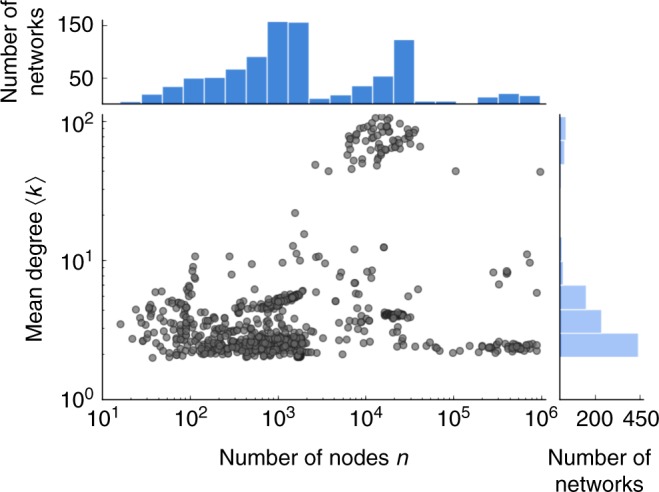
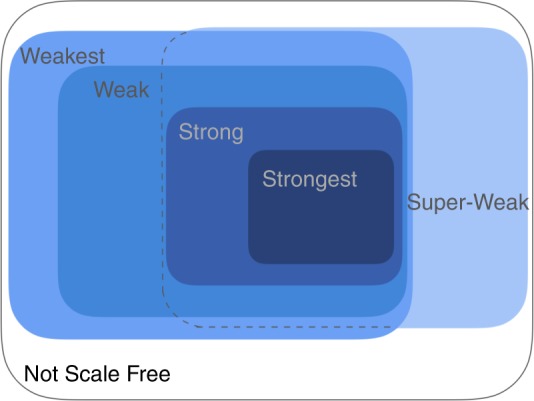
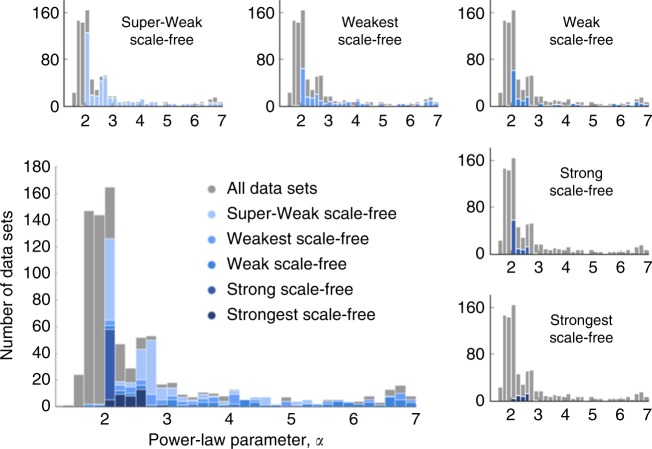
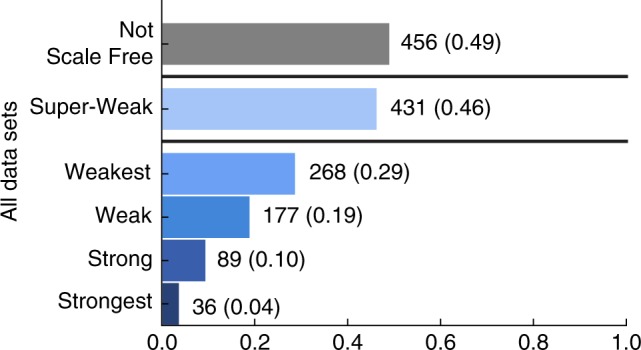
Verification
Claims the paper makes
The claims and statistics of this paper haven’t been checked yet.
Free: it reads the open-access text and checks the first 5 claims that cite a source we can check. Create a free account to check every claim.
Claims other papers make about this one
Each is checked against this paper’s own text: does it say what the citing paper says it does?
The cited source says what the claim attributes to it.
In the citing paper
“A power law connectivity degree distribution is the defining feature of a scale-free network46,47”
From Descending networks transform command signals into population motor control (2024) · cites this paper as [47]
In the citing paper
“meanwhile, serious criticisms [47,48] regarding the statistical significance and mechanistic interpretation of purported scaling laws in a variety of contexts not limited to biochemistry have also been raised.”
From Prebiotic Reaction Networks in Water (2020) · cites this paper as [48]
Self-check
Percentages, sums and reported differences re-computed from the paper’s own numbers.
The self-check needs the paper’s full text.
Citations
Cites
Collective dynamics of ‘small-world’ networks
Watts, D. J., & Strogatz, S. H. (1998) · Nature · doi:10.1038/30918 · Cited by 43,060
Emergence of Scaling in Random Networks
Barabási, A.-L., & Albert, R. (1999) · Science · doi:10.1126/science.286.5439.509 · Cited by 36,135
Community structure in social and biological networks
Girvan, M., & Newman, M. E. J. (2002) · Proceedings of the National Academy of Sciences · doi:10.1073/pnas.122653799 · Cited by 15,502
Power-Law Distributions in Empirical Data
Clauset, A., Shalizi, C. R., & Newman, M. E. J. (2009) · SIAM Review · doi:10.1137/070710111 · Cited by 8,019
Self-citationError and attack tolerance of complex networks
Albert, R., Jeong, H., & Barabási, A.-L. (2000) · Nature · doi:10.1038/35019019 · Cited by 7,534
Likelihood Ratio Tests for Model Selection and Non-Nested Hypotheses
Vuong, Q. H. (1989) · Econometrica · doi:10.2307/1912557 · Cited by 5,929
Newman (2005) · doi:10.1080/00107510500052444 · Cited by 5,749
Epidemic Spreading in Scale-Free Networks
Pastor-Satorras, R., & Vespignani, A. (2001) · Physical Review Letters · doi:10.1103/physrevlett.86.3200 · Cited by 5,731
Lethality and centrality in protein networks
Jeong, H., Mason, S. P., Barabási, A.-L., & Oltvai, Z. N. (2001) · Nature · doi:10.1038/35075138 · Cited by 5,287
Diameter of the World-Wide Web
Albert, R., Jeong, H., & Barabási, A.-L. (1999) · Nature · doi:10.1038/43601 · Cited by 4,260
Research works printed but not linked: 8
- Willinger W Alderson D Doyle JC Mathematics and the internet: a source of enormous confusion and great potential Not. AMS 2009 56 586 599
- Newman, M. Networks: An Introduction (Oxford Univerity Press, Oxford, 2010).
- Gamermann, D., Triana, J. & Jaime, R. A comprehensive statistical study of metabolic and protein-protein interaction network properties. https://arxiv.org/abs/1712.07683 (2017). · arXiv
- A. Barabasi, Network Science (Cambridge University Press, Cambridge, UK, 2016).
- Eikmeier, N. & Gleich, D. F. Proc. 23rd ACM SIGKDD Internat. Conference on Knowledge Discovery and Data Mining (KDD). 817–826 (Halifax, NS, Canada, 2017).
- Mayo, D. G. Error and the Growth of Experimental Knowledge (Science and Its Conceptual Foundations series) (University of Chicago Press, Chicago, IL,1996).
- Lee SH Fricker MD Porter MA Mesoscale analyses of fungal networks as an approach for quantifying phenotypic traits J. Complex Netw. 2017 5 145 159
- Pastor-Satorras R Vespignani A Epidemic dynamics in finite size scale-free networks Phys. Rev. E 2002 65 1 4 11909143
Cited by
Items 101–106 of 106
Niu, W., Xia, H., Wang, R., Pan, L., Meng, Q., Qin, Y., Li, R., Zhao, X., Bian, X., & Zhao, W. (2020) · ISPRS International Journal of Geo-Information · doi:10.3390/ijgi10010005 · Cited by 31
Darius, P. (2022) · Social Network Analysis and Mining · doi:10.1007/s13278-022-00958-w · Cited by 22
“To account for the skewed distribution of being retweeted, the study uses a log-transformation that works for most social network data and also produces acceptable results for social media data (Broido and Clauset 2019).”
MethodJiang, J., Chen, S., Tsou, T., McGinnis, C. S., Khazaei, T., Zhu, Q., Park, J. H., Strazhnik, I.-M., Vielmetter, J., Gong, Y., et al. (2023) · doi:10.1101/2023.04.19.537364 · Cited by 21
A Network Approach to Link Visibility and Urban Activity Location
Natapov, A., Czamanski, D., & Fisher-Gewirtzman, D. (2018) · Networks and Spatial Economics · doi:10.1007/s11067-018-9411-4 · Cited by 13
“For a long time spatial networks were believed to be scale-free, however recent works have shown that such distributions are much rarer than previously believed (Broido and Clauset 2018).”
BackgroundLasri, A., Shahrezaei, V., & Sturrock, M. (2022) · BMC Bioinformatics · doi:10.1186/s12859-022-04778-9 · Cited by 5
“The second topology considered in this study is a scale free (SF) network topology [44].”
BackgroundEstimating the Total Volume of Queries to a Search Engine
Lillo, F., & Ruggieri, S. (2022) · IEEE Transactions on Knowledge and Data Engineering · doi:10.1109/tkde.2021.3054668 · Cited by 4
“, city sizes) there is an ongoing debate about the accuracy of power law distribution in explaining empirical data (see [16, Figure 1] for cities and more generally [17], [18], [19]).”
Background
Metadata
- Authors
- Broido, A. D., & Clauset, A.
- Affiliations
- University of Colorado Boulder (US)
- Santa Fe Institute (US)
- Corresponding author
- Broido, Anna D.
- Clauset, Aaron
- ORCID
- Clauset, Aaron
- Venue
- Nature Communications
- Published
- 2019-03-04
- Volume
- 10
- Issue
- 1
- Pages
- 1017-1017
- ISSN
- 2041-1723 (ISSN-L)
- PMC
- PMC6399239
- OpenAlex
- W2784007581
- Semantic Scholar
- f1b4361a1978e93018c5fdfe4856250152676ffb
- Cited by
- 875
- References
- 65
- Citations by year
- 2026: 67 · 2025: 113 · 2024: 109 · 2023: 103 · 2022: 131 · 2021: 190 · 2020: 117 · 2019: 37
- FWCI
- 54.97
- Type
- journal article
- Language
- en
- Open access
- gold
- doi.org
- Licence
- cc-by
- creativecommons.org/licenses/by/4.0 (tdm)
- creativecommons.org/licenses/by/4.0 (vor)
- Locations
- Nature Communications (publishedVersion, cc-by)
- Europe PMC (PubMed Central) (publishedVersion, cc-by)
- PubMed Central (publishedVersion, cc-by)
- PubMed (publishedVersion)
- arXiv (Cornell University) (submittedVersion)
- CU Scholar (University of Colorado Boulder) (submittedVersion, cc-by)
- DOAJ (DOAJ: Directory of Open Access Journals) (submittedVersion, cc-by-sa)
- DOAJ (DOAJ: Directory of Open Access Journals) (submittedVersion)
- arXiv (Cornell University)
- Funders
- National Science Foundation (1452718)
- National Institutes of Health (1s10od012300-01)
- University of Colorado Boulder
- Topics
- Physical Sciences › Physics and Astronomy › Statistical and Nonlinear Physics › Complex Network Analysis Techniques
- Social Sciences › Economics, Econometrics and Finance › Economics and Econometrics › Complex Systems and Time Series Analysis
- Physical Sciences › Physics and Astronomy › Condensed Matter Physics › Theoretical and Computational Physics
- Keywords
- scale-free networks, power-law degree distribution, lognormal distribution, degree distribution, social networks, technological networks, biological networks, transportation networks, information networks, complex networks
- MeSH terms
- Computer Simulation, Humans, Information Services, Models, Biological, Models, Theoretical, Models, Statistical, Social Networking
About these checks
Registry, retraction, Cites and statistics results are computed, not judged, with one exception: a printed reference that no index lists is read once by a model before it counts as a citation error. Claims are extracted by a model and kept only when their quote appears verbatim in the text; each cited source is then checked, with a model’s help, for whether it says what the claim relies on. Those verdicts can be wrong — read the claim’s quote and the cited source before relying on one.
Statistics and arithmetic are recomputed, not judged.
Confidence bands are shown only for fields calibrated on our annotated test set. None is calibrated yet, so no band is shown.
What counts as a claim ›How we measure confidence ›How we check this ›
Are you an author, or do you see a problem with this page? Request a review
Data sources
Bibliographic data: Semantic Scholar, OpenAlex, Crossref.
Contains information from the Semantic Scholar Academic Graph Datasets, made available under the ODC Attribution License (ODC-BY 1.0).
Semantic Scholar’s data is described in: Kinney, R., et al. (2023). The Semantic Scholar Open Data Platform. arXiv:2301.10140.
