

The DOI matches its Crossref record; 26 of the 26 references it cites were found in a registry or an index.
Nuclei multiplexing with barcoded antibodies for single-nucleus genomics
Published version of a preprint
Abstract
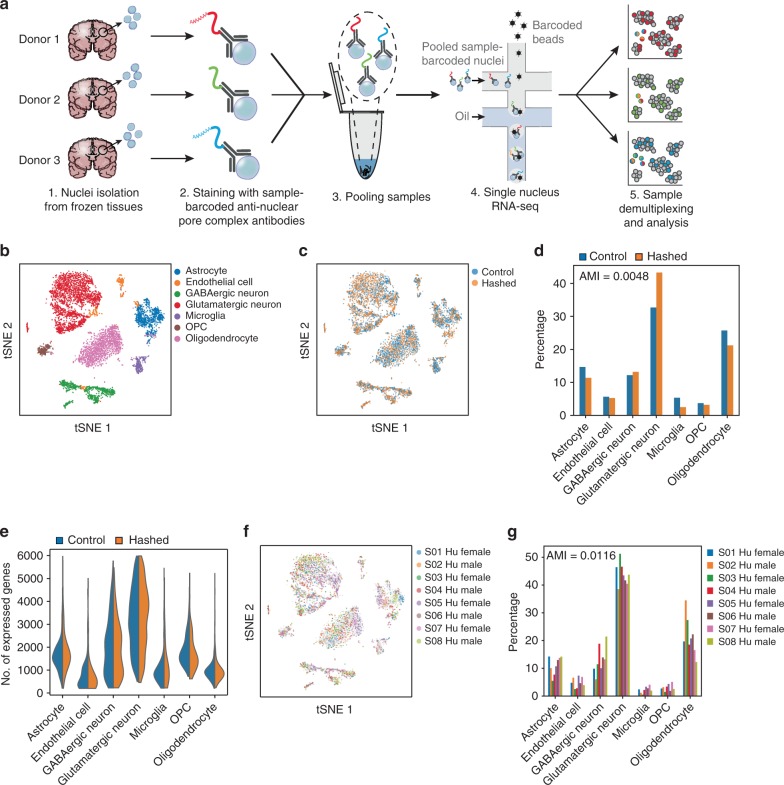
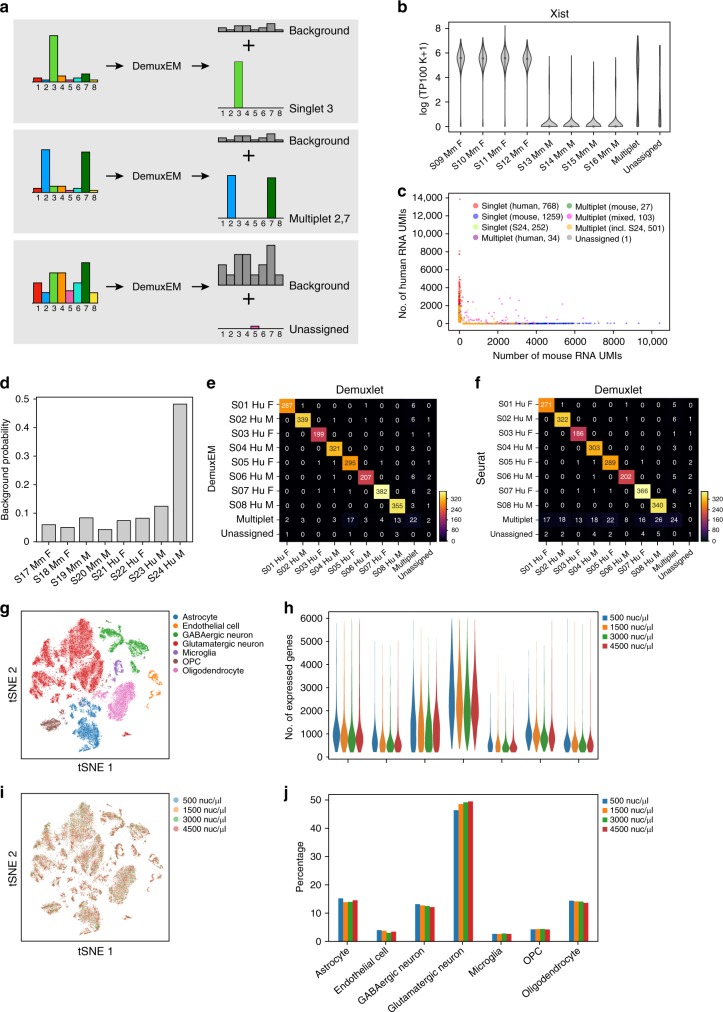
Single-nucleus RNA-seq (snRNA-seq) enables the interrogation of cellular states in complex tissues that are challenging to dissociate or are frozen, and opens the way to human genetics studies, clinical trials, and precise cell atlases of large organs. However, such applications are currently limited by batch effects, processing, and costs. Here, we present an approach for multiplexing snRNA-seq, using sample-barcoded antibodies to uniquely label nuclei from distinct samples. Comparing human brain cortex samples profiled with or without hashing antibodies, we demonstrate that nucleus hashing does not significantly alter recovered profiles. We develop DemuxEM, a computational tool that detects inter-sample multiplets and assigns singlets to their sample of origin, and validate its accuracy using sex-specific gene expression, species-mixing and natural genetic variation. Our approach will facilitate tissue atlases of isogenic model organisms or from multiple biopsies or longitudinal samples of one donor, and large-scale perturbation screens.
Overview
The claims and statistics of this paper haven’t been checked yet.
Run the check — free, no account needed. It reads the open-access text and checks the sources it cites.
Integrity signals
Registry
Cites
Statistics
Figures
Verification
Claims the paper makes
The claims and statistics of this paper haven’t been checked yet.
Run the check — free, no account needed. It reads the open-access text and checks the sources it cites.
Claims other papers make about this one
Each is checked against this paper’s own text: does it say what the citing paper says it does?
The cited source says what the claim attributes to it.
In the citing paper
“Using public single-cell transcriptomic (single-cell RNA sequencing (scRNA-seq)) datasets from mouse brain19 (Extended Data Fig. 1e,f) and human brain20 samples (Extended Data Fig. 1g), we found that these immune-checkpoint molecules are highly and specifically expressed in microglia compared with other cell types in the CNS, including perivascular macrophages (PVMs).”
From Immune checkpoint TIM-3 regulates microglia and Alzheimer’s disease (2025) · cites this paper as [20]
Self-check
Percentages, sums and reported differences re-computed from the paper’s own numbers.
The self-check needs the paper’s full text.
Citations
Cites
Controlling the False Discovery Rate: A Practical and Powerful Approach to Multiple Testing
Benjamini, Y., & Hochberg, Y. (1995) · Journal of the Royal Statistical Society Series B: Statistical Methodology · doi:10.1111/j.2517-6161.1995.tb02031.x · Cited by 109,482
(2008) · Journal of Machine Learning Research · Cited by 33,051
The Genome Analysis Toolkit: A MapReduce framework for analyzing next-generation DNA sequencing data
McKenna, A., Hanna, M., Banks, E., Sivachenko, A., Cibulskis, K., Kernytsky, A., Garimella, K., Altshuler, D., Gabriel, S., Daly, M., et al. (2010) · Genome Research · doi:10.1101/gr.107524.110 · Cited by 27,895
Integrating single-cell transcriptomic data across different conditions, technologies, and species
Butler, A., Hoffman, P., Smibert, P., Papalexi, E., & Satija, R. (2018) · Nature Biotechnology · doi:10.1038/nbt.4096 · Cited by 13,174
A framework for variation discovery and genotyping using next-generation DNA sequencing data
DePristo, M. A., Banks, E., Poplin, R., Garimella, K. V., Maguire, J. R., Hartl, C., Philippakis, A. A., del Angel, G., Rivas, M. A., Hanna, M., et al. (2011) · Nature Genetics · doi:10.1038/ng.806 · Cited by 11,456
SCANPY: large-scale single-cell gene expression data analysis
Wolf, F. A., Angerer, P., & Theis, F. J. (2018) · Genome Biology · doi:10.1186/s13059-017-1382-0 · Cited by 8,881
Massively parallel digital transcriptional profiling of single cells
Zheng, G. X. Y., Terry, J. M., Belgrader, P., Ryvkin, P., Bent, Z. W., Wilson, R., Ziraldo, S. B., Wheeler, T. D., McDermott, G. P., Zhu, J., et al. (2017) · Nature Communications · doi:10.1038/ncomms14049 · Cited by 7,353
Highly parallel genome-wide expression profiling of individual cells using nanoliter droplets.
Macosko, E. Z., Basu, A., Satija, R., Nemesh, J., Shekhar, K., Goldman, M., Tirosh, I., Bialas, A. R., Kamitaki, N., Martersteck, E. M., et al. (2015) · Cell · doi:10.1016/j.cell.2015.05.002 · Cited by 7,110
Self-citationVan der Auwera, G. A., Carneiro, M. O., Hartl, C., Poplin, R., del Angel, G., Levy‐Moonshine, A., Jordan, T., Shakir, K., Roazen, D., Thibault, J., et al. (2013) · Current Protocols in Bioinformatics · doi:10.1002/0471250953.bi1110s43 · Cited by 6,687
Religious Orders Study and Rush Memory and Aging Project
Bennett, D. A., Buchman, A. S., Boyle, P. A., Barnes, L. L., Wilson, R. S., & Schneider, J. A. (2018) · Journal of Alzheimer's Disease · doi:10.3233/jad-179939 · Cited by 1,260
Research works printed but not linked: 1
- Nagy, C. et al. Single-nucleus RNA sequencing shows convergent evidence from different cell types for altered synaptic plasticity in major depressive disorder. BioRxiv, https://doi.org/10.1101/384479 (2018). · DOI · Paper page
Cited by
McGinnis, C. S., Murrow, L. M., & Gartner, Z. J. (2019) · Cell Systems · doi:10.1016/j.cels.2019.03.003 · Cited by 4,521
Disease-associated astrocytes in Alzheimer’s disease and aging
Habib, N., McCabe, C., Medina, S., Varshavsky, M., Kitsberg, D., Dvir-Szternfeld, R., Green, G., Dionne, D., Nguyen, L., Marshall, J. L., et al. (2020) · Nature Neuroscience · doi:10.1038/s41593-020-0624-8 · Cited by 1,009
Self-citationMULTI-seq: sample multiplexing for single-cell RNA sequencing using lipid-tagged indices
McGinnis, C. S., Patterson, D. M., Winkler, J., Conrad, D. N., Hein, M. Y., Srivastava, V., Hu, J. L., Murrow, L. M., Weissman, J. S., Werb, Z., et al. (2019) · Nature Methods · doi:10.1038/s41592-019-0433-8 · Cited by 643
Mimitou, E. P., Lareau, C. A., Chen, K. Y., Zorzetto-Fernandes, A. L., Hao, Y., Takeshima, Y., Luo, W., Huang, T.-S., Yeung, B. Z., Papalexi, E., et al. (2021) · Nature Biotechnology · doi:10.1038/s41587-021-00927-2 · Cited by 529
Self-citationBenchmarking single-cell RNA-sequencing protocols for cell atlas projects
Mereu, E., Lafzi, A., Moutinho, C., Ziegenhain, C., McCarthy, D. J., Álvarez-Varela, A., Batlle, E., Sagar, Grün, D., Lau, J. K., et al. (2020) · Nature Biotechnology · doi:10.1038/s41587-020-0469-4 · Cited by 499
Self-citation
Metadata
- Authors
- Gaublomme, J. T., Li, B., McCabe, C., Knecht, A., Yang, Y., Drokhlyansky, E., Van Wittenberghe, N., Waldman, J., Dionne, D., Nguyen, L., De Jager, P. L., Yeung, B., Zhao, X., Habib, N., Rozenblatt-Rosen, O., & Regev, A.
- Venue
- Nature Communications
- Published
- 2019-07-02
- Volume
- 10
- Issue
- 1
- ISSN
- 2041-1723
- PMC
- PMC6606589
- Cited by
- 199
- References
- 26
- Language
- en
- Update notices
- correction (2020-11-02)
- Licence
- creativecommons.org/licenses/by/4.0 (tdm)
- creativecommons.org/licenses/by/4.0 (vor)
About these checks
Registry, retraction, Cites and statistics results are computed, not judged, with one exception: a printed reference that no index lists is read once by a model before it counts as a citation error. Claims are extracted by a model and kept only when their quote appears verbatim in the text; each cited source is then checked, with a model’s help, for whether it says what the claim relies on. Those verdicts can be wrong — read the claim’s quote and the cited source before relying on one.
Statistics and arithmetic are recomputed, not judged.
Confidence bands are shown only for fields calibrated on our annotated test set. None is calibrated yet, so no band is shown.
What counts as a claim ›How we measure confidence ›How we check this ›
Are you an author, or do you see a problem with this page? Request a review
How to cite
Cite CoChat for the checks on this page, and the paper for its own findings.
- This page
- CoChat. (2026). Citation check: Nuclei multiplexing with barcoded antibodies for single-nucleus genomics. https://app.cochat.ai/papers/10.1038/s41467-019-10756-2
- The paper
- Gaublomme, J. T., Li, B., McCabe, C., Knecht, A., Yang, Y., Drokhlyansky, E., Van Wittenberghe, N., Waldman, J., Dionne, D., Nguyen, L., De Jager, P. L., Yeung, B., Zhao, X., Habib, N., Rozenblatt-Rosen, O., & Regev, A. (2019). Nuclei multiplexing with barcoded antibodies for single-nucleus genomics. Nature Communications. https://doi.org/10.1038/s41467-019-10756-2
Data sources
Bibliographic data: Semantic Scholar, OpenAlex, Crossref.
Contains information from the Semantic Scholar Academic Graph Datasets, made available under the ODC Attribution License (ODC-BY 1.0).
Semantic Scholar’s data is described in: Kinney, R., et al. (2023). The Semantic Scholar Open Data Platform. arXiv:2301.10140.
