

Estimating the success of re-identifications in incomplete datasets using generative models
Open accessThe DOI matches its Crossref record; 59 of the 59 references it cites were found in a registry or an index.
Abstract
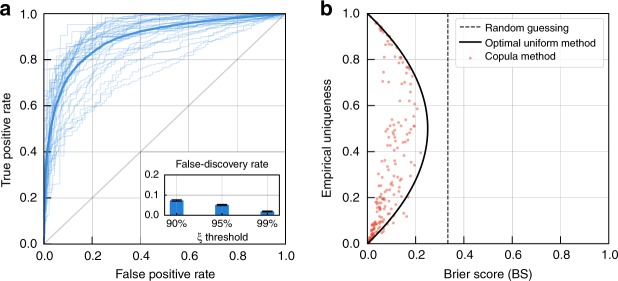
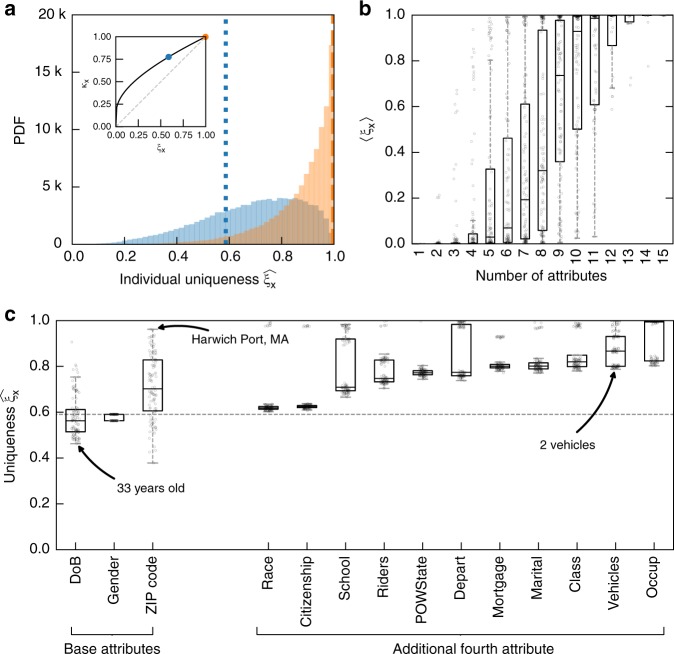
While rich medical, behavioral, and socio-demographic data are key to modern data-driven research, their collection and use raise legitimate privacy concerns. Anonymizing datasets through de-identification and sampling before sharing them has been the main tool used to address those concerns. We here propose a generative copula-based method that can accurately estimate the likelihood of a specific person to be correctly re-identified, even in a heavily incomplete dataset. On 210 populations, our method obtains AUC scores for predicting individual uniqueness ranging from 0.84 to 0.97, with low false-discovery rate. Using our model, we find that 99.98% of Americans would be correctly re-identified in any dataset using 15 demographic attributes. Our results suggest that even heavily sampled anonymized datasets are unlikely to satisfy the modern standards for anonymization set forth by GDPR and seriously challenge the technical and legal adequacy of the de-identification release-and-forget model.
Overview
The claims and statistics of this paper haven’t been checked yet.
Free: it reads the open-access text and checks the first 5 claims that cite a source we can check. Create a free account to check every claim.
Integrity signals
Registry
Cites
Statistics
Figures
Verification
Claims the paper makes
The claims and statistics of this paper haven’t been checked yet.
Free: it reads the open-access text and checks the first 5 claims that cite a source we can check. Create a free account to check every claim.
Claims other papers make about this one
Each is checked against this paper’s own text: does it say what the citing paper says it does?
The source backs part of the claim, not all of it — or backs it for a different population, condition or comparison.
In the citing paper
“Existing medical data is not fully exploited by ML primarily because it sits in data silos and privacy concerns restrict access to this data.”
From The future of digital health with federated learning (2020) · cites this paper as [7]
Experimental — accuracy not yet measuredThe source backs part of the claim, not all of it — or backs it for a different population, condition or comparison.
In the citing paper
“Centralising or releasing data, however, poses not only regulatory, ethical and legal challenges, related to privacy and data protection, but also technical ones.”
From The future of digital health with federated learning (2020) · cites this paper as [7]
Experimental — accuracy not yet measuredThe source backs part of the claim, not all of it — or backs it for a different population, condition or comparison.
In the citing paper
“Beyond these considerations, a required step for multimodal AI is the appropriate linking of all data types available in the datasets, which represents another challenge owing to the increasing risk of identification of individuals and regulatory constraints 146”
From Multimodal biomedical AI (2022) · cites this paper as [146]
Experimental — accuracy not yet measuredThe cited source says what the claim attributes to it.
In the citing paper
“Data anonymization alone does not provide sufficient protection (Rocher et al., 2019) since parts of the training data can be reconstructed by inversion of model parameters (Carlini et al., 2019; Zhang et al., 2020), gradients (Zhu et al., 2019; Geiping et al., 2020), or through adversarial attacks (Wang et al., 2019; Hitaj et al., 2017).”
From Federated learning for computational pathology on gigapixel whole slide images (2022) · cites this paper as Rocher et al., 2019
The cited source says what the claim attributes to it.
In the citing paper
“Even if data anonymisation could bypass these limitations, it is now well understood that removing metadata such as patient name or date of birth is often not enough to preserve privacy7.”
From The future of digital health with federated learning (2020) · cites this paper as [7]
1 more claim about this paper
Create a free account to see every claim other papers make about this one.
Self-check
Percentages, sums and reported differences re-computed from the paper’s own numbers.
The self-check needs the paper’s full text.
Citations
Cites
k-ANONYMITY: A MODEL FOR PROTECTING PRIVACY
SWEENEY, L. (2002) · International Journal of Uncertainty, Fuzziness and Knowledge-Based Systems · doi:10.1142/s0218488502001648 · Cited by 8,571 · cited 1×
“While more advanced guarantees like k -anonymity 57 would give every individual in the dataset some protection, they have been shown to be NP-Hard 58 , hard to achieve in modern high-dimensional datasets 59 , and not always suf fi cient 60 .”
BackgroundBig Data : The Management Revolution
マカフィー, ア., ブリニョルフソン, エ., & 有賀, 裕. (2013) · Harvard business review · Cited by 3,550
t-Closeness: Privacy Beyond k-Anonymity and l-Diversity
Li, N., Li, T., & Venkatasubramanian, S. (2007) · 2007 IEEE 23rd International Conference on Data Engineering · doi:10.1109/icde.2007.367856 · Cited by 3,451
Lazer, D., Pentland, A., Adamic, L., Aral, S., Barabási, A.-L., Brewer, D., Christakis, N., Contractor, N., Fowler, J., Gutmann, M., et al. (2009) · Science · doi:10.1126/science.1167742 · Cited by 3,365
The real-time city? Big data and smart urbanism
Kitchin, R. (2014) · GeoJournal · doi:10.1007/s10708-013-9516-8 · Cited by 2,794 · cited 5×
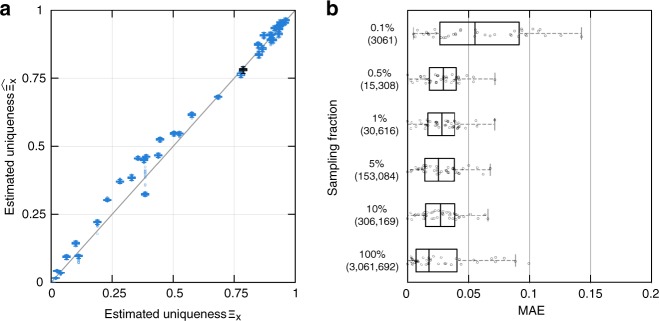
“Table 1 and Supplementary Note 7 show that, at very small sampling fraction (below 0.1%), where the error is the largest, the error is mostly determined by the marginals, and converges after few hundred records when the exact marginals are known.”
BackgroundInfluentialThe Real-Time City? Big Data and Smart Urbanism
Kitchin, R. (2013) · SSRN Electronic Journal · doi:10.2139/ssrn.2289141 · Cited by 2,794
(2012) · PubMed · Cited by 2,326
Cherubini, U., Luciano, E., & Vecchiato, W. (2004) · Wiley eBooks · doi:10.1002/9781118673331 · Cited by 2,009
Vinh, N. X., Epps, J., & Bailey, J. (2010) · Minerva Access (University of Melbourne) · doi:10.5555/1756006.1953024 · Cited by 1,781
The Unreasonable Effectiveness of Data
Halevy, A., Norvig, P., & Pereira, F. (2009) · IEEE Intelligent Systems · doi:10.1109/mis.2009.36 · Cited by 1,767
The Inevitable Application of Big Data to Health Care
Murdoch, T. B., & Detsky, A. S. (2013) · JAMA · doi:10.1001/jama.2013.393 · Cited by 1,664
Unique in the Crowd: The privacy bounds of human mobility
de Montjoye, Y.-A., Hidalgo, C. A., Verleysen, M., & Blondel, V. D. (2013) · Scientific Reports · doi:10.1038/srep01376 · Cited by 1,645
The sampling theory of selectively neutral alleles
Ewens, W. J. (1972) · Theoretical Population Biology · doi:10.1016/0040-5809(72)90035-4 · Cited by 1,640 · cited 1×
“4, P 0.05 in 78 cases out of 80 using Wilcoxon ’ s signed-rank test) 61 – 66 and consistently better than previous attempts to estimate individual uniqueness 67,68 .”
ResultInfluentialEverything You Always Wanted to Know about Copula Modeling but Were Afraid to Ask
Genest, C., & Favre, A.-C. (2007) · Journal of Hydrologic Engineering · doi:10.1061/(asce)1084-0699(2007)12:4(347 · Cited by 1,618
Bennett, J. R., & Lanning, S. (2007) · Cited by 1,466
Numerical Computation of Multivariate Normal Probabilities
Genz, A. (1992) · Journal of Computational and Graphical Statistics · doi:10.1080/10618600.1992.10477010 · Cited by 1,020
Broken Promises of Privacy: Responding to the Surprising Failure of AnonymizationPreprint
Ohm, P. (2009) · SSRN Electronic Journal · Cited by 997
Computation of Multivariate Normal and t Probabilities
Genz, A., & Bretz, F. (2009) · Lecture Notes in Statistics · doi:10.1007/978-3-642-01689-9 · Cited by 902
On the complexity of optimal K-anonymity
Meyerson, A., & Williams, R. (2004) · Proceedings of the twenty-third ACM SIGMOD-SIGACT-SIGART symposium on Principles of database systems · doi:10.1145/1055558.1055591 · Cited by 821 · cited 1×
“While more advanced guarantees like k -anonymity 57 would give every individual in the dataset some protection, they have been shown to be NP-Hard 58 , hard to achieve in modern high-dimensional datasets 59 , and not always suf fi cient 60 .”
BackgroundThe Joy of Copulas: Bivariate Distributions with Uniform Marginals
Genest, C., & Mackay, J. (1986) · The American Statistician · doi:10.1080/00031305.1986.10475414 · Cited by 790 · cited 1×
“We model the joint distribution of X 1 , X 2 , … X d using a latent Gaussian copula 43 .”
MethodSimple Demographics Often Identify People Uniquely
Sweeney, L. (2000) · Figshare · doi:10.1184/r1/6625769.v1 · Cited by 664 · cited 1×
“Using socio-demographic, survey, and health datasets, we show that our model exhibits a mean absolute error (MAE) of 0.018 on average in estimating population uniqueness 42 and an MAE of 0.041 in estimating population uniqueness when the model is trained on only a 1% population sample.”
MethodInfluentialOn k -anonymity and the curse of dimensionality
Aggarwal, C. C. (2005) · Cited by 614
Unique in the shopping mall: On the reidentifiability of credit card metadata
de Montjoye, Y.-A., Radaelli, L., Singh, V. K., & Pentland, A. “. (2015) · Science · doi:10.1126/science.1256297 · Cited by 570
Simple Demographics Often Identify People Uniquely
Sweeney, L. (2018) · Figshare · doi:10.1184/r1/6625769 · Cited by 455
Standards for privacy of individually identifiable health information. Final rule.
(2002) · PubMed · Cited by 405
Weaving Technology and Policy Together to Maintain Confidentiality
Sweeney, L. (1997) · Journal of Law, Medicine & Ethics · doi:10.1111/j.1748-720x.1997.tb01885.x · Cited by 375 · cited 2×
“Yet, our analysis of the re-identi fi cation of Gov. Weld by Latanya Sweeney shows that few attributes are often enough to render the likelihood of correct re-identi fi cation very high.”
MethodStandards for Privacy of Individually Identifiable Health Information
(2001) · Best Practices · doi:10.1201/9781420000177.ch38 · Cited by 284
Model Selection and Semiparametric Inference for Bivariate Failure-Time Data
Wang, W., & Wells, M. T. (2000) · Journal of the American Statistical Association · doi:10.1080/01621459.2000.10473899 · Cited by 255 · cited 1×
“Copulas have been used to study a wide range of dependence structures in fi nance 44 , geology 45 , and biomedicine 46 and allow us to model the density of X by specifying separately the marginal distributions, easy to infer from limited samples, and the dependency structure.”
MethodRevisiting the uniqueness of simple demographics in the US population
Golle, P. (2006) · Proceedings of the 5th ACM workshop on Privacy in electronic society · doi:10.1145/1179601.1179615 · Cited by 254 · cited 1×
“We train our model on the 5% Public Use Microdata Sample (PUMS) fi les using ZIP code, date of birth, and gender and validate it using the last national estimate 50 .”
MethodIs Deidentification Sufficient to Protect Health Privacy in Research?
Rothstein, M. A. (2010) · The American Journal of Bioethics · doi:10.1080/15265161.2010.494215 · Cited by 253
Big data in global health: improving health in low- and middle-income countries
Wyber, R., Vaillancourt, S., Perry, W., Mannava, P., Folaranmi, T., & Celi, L. A. (2015) · Bulletin of the World Health Organization · doi:10.2471/blt.14.139022 · Cited by 238
The Risk of Disclosure for Microdata
Duncan, G., & Lambert, D. (1989) · Journal of Business & Economic Statistics · doi:10.1080/07350015.1989.10509729 · Cited by 221
Secure genome-wide association analysis using multiparty computation
Cho, H., Wu, D. J., & Berger, B. (2018) · Nature Biotechnology · doi:10.1038/nbt.4108 · Cited by 207 · cited 1×
“…risk of re-identi fi cation and the lack of plausible deniability — even if the dataset is incomplete — , as well as legally recognize the broad range of provable privacy-enhancing systems and security measures that would allow data to be used while effectively preserving people ’ s privacy 54,55 .”
BackgroundDisclosure Control of Microdata
Bethlehem, J. G., Keller, W. J., & Pannekoek, J. (1990) · Journal of the American Statistical Association · doi:10.1080/01621459.1990.10475304 · Cited by 183
Customer Data : Designing for Transparency and Trust
モリー, テ., フォーバス, セ., & シュープ, ア. (2015) · Harvard business review · Cited by 163
Random discrete distributions invariant under size-biased permutation
Pitman, J. (1996) · Advances in Applied Probability · doi:10.2307/1428070 · Cited by 150 · cited 1×
“4, P 0.05 in 78 cases out of 80 using Wilcoxon ’ s signed-rank test) 61 – 66 and consistently better than previous attempts to estimate individual uniqueness 67,68 .”
ResultInfluentialHrynaszkiewicz, I., Norton, M. L., Vickers, A. J., & Altman, D. G. (2010) · BMJ · doi:10.1136/bmj.c181 · Cited by 146
The disclosure of diagnosis codes can breach research participants' privacy
Loukides, G., Denny, J. C., & Malin, B. (2010) · Journal of the American Medical Informatics Association · doi:10.1136/jamia.2009.002725 · Cited by 140
Health Data in an Open WorldPreprint
Culnane, C., Rubinstein, B. I. P., & Teague, V. (2017) · arXiv (Cornell University) · doi:10.48550/arxiv.1712.05627 · Cited by 132 · cited 1×
“%) hospital data using complete population frequencies 24 .”
MethodEstimating Risks of Identification Disclosure in Microdata
Reiter, J. P. (2005) · Journal of the American Statistical Association · doi:10.1198/016214505000000619 · Cited by 129
Disclosure Control of Microdata
Bethlehem, J. G., Keller, W. J., & Pannekoek, J. (1990) · Journal of the American Statistical Association · doi:10.2307/2289523 · Cited by 125
Malin, B., Benitez, K., & Masys, D. (2011) · Journal of the American Medical Informatics Association · doi:10.1136/jamia.2010.004622 · Cited by 104
Estimating the re-identification risk of clinical data sets
Dankar, F. K., El Emam, K., Neisa, A., & Roffey, T. (2012) · BMC Medical Informatics and Decision Making · doi:10.1186/1472-6947-12-66 · Cited by 103
Matthews, G. J., & Harel, O. (2011) · Statistics Surveys · doi:10.1214/11-ss074 · Cited by 99
Estimating the re-identification risk per record in microdata
Skinner, C. J., & Holmes, D. J. (1998) · London School of Economics and Political Science Research Online (London School of Economics and Political Science) · Cited by 95
Barth-Jones, D. C. (2012) · SSRN Electronic Journal · doi:10.2139/ssrn.2076397 · Cited by 85
Assessing Identification Risk in Survey Microdata Using Log-Linear Models
Skinner, C., & Shlomo, N. (2008) · Journal of the American Statistical Association · doi:10.1198/016214507000001328 · Cited by 85
D’Acquisto, G., Domingo‐Ferrer, J., Kikiras, P., Torra, V., de Montjoye, Y.-A., & Bourka, A. (2015) · arXiv (Cornell University) · doi:10.48550/arxiv.1512.06000 · Cited by 82 · cited 1×
“…risk of re-identi fi cation and the lack of plausible deniability — even if the dataset is incomplete — , as well as legally recognize the broad range of provable privacy-enhancing systems and security measures that would allow data to be used while effectively preserving people ’ s privacy 54,55 .”
BackgroundAnonymizing NYC Taxi Data: Does It Matter?
Marie, D., Doraiswamy, H., Freire, J., & Silva, C. T. (2016) · IEEE International Conference on Data Science and Advanced Analytics (DSAA) · doi:10.1109/dsaa.2016.21 · Cited by 79
Comment on “Unique in the shopping mall: On the reidentifiability of credit card metadata”
Sánchez, D., Mart́ınez, S., & Domingo‐Ferrer, J. (2016) · Science · doi:10.1126/science.aad9295 · Cited by 44
Ruggles, S., King, M. L., Levison, D., McCaa, R., & Sobek, M. (2003) · Historical Methods A Journal of Quantitative and Interdisciplinary History · doi:10.1080/01615440309601215 · Cited by 42
Applying Pitman's Sampling Formula to Microdata Disclosure Risk Assessment
Hoshino, N. (2001) · Journal of Official Statistics · Cited by 36
Privacy violations in Riga open data public transport system
Lavrenovs, A., & Podins, K. (2016) · IEEE Workshop on Advances in Information, Electronic and Electrical Engineering (AIEEE) · doi:10.1109/aieee.2016.7821808 · Cited by 20
How to Avoid Reidentification with Proper AnonymizationPreprint
Sánchez, D., Mart́ınez, S., & Domingo‐Ferrer, J. (2018) · arXiv (Cornell University) · doi:10.48550/arxiv.1808.01113 · Cited by 15
Gustafson, D. L. (2013) · doi:10.4324/9781315044101-10 · Cited by 4
Setting the Record Straight: De-Identification Does Work
Cavoukian, A., & Daniel, C. (2014) · Cited by 2
Waterfield, P., & Revell, T. (2018) · The New Scientist · doi:10.1016/s0262-4079(18)30858-3 · Cited by 1
VERIFICATION OF FORECASTS EXPRESSED IN TERMS OF PROBABILITY
BRIER, G. W. (1950) · Monthly Weather Review · doi:10.1175/1520-0493(1950)078<0001:vofeit>2.0.co;2 · cited 1×
“We use the Brier Score (BS) 49 to measure the calibration of (cid:2) (cid”
MethodVerification of forecasts expressed in terms of probability
BRIER, G. W. (1950) · Monthly Weather Review · doi:10.1175/1520-0493(1950)078%3c0001:vofeit%3e2.0.co;2 · cited 1×
“We use the Brier Score (BS) 49 to measure the calibration of (cid:2) (cid”
Method
Research works printed but not linked: 4
- Cadwalladr, C. & Graham-Harrison, E. Revealed: 50 million facebook profiles harvested for Cambridge Analytica in major data breach. The Guardian (17 Mar 2018).
- Polonetsky J Tene O Finch K Shades of gray: seeing the full spectrum of practical data De-Identification St. Clara Law Rev. 2016 56 593 629
- Fienberg SE Sanil AP A Bayesian approach to data disclosure: optimal intruder behavior for continuous data J. Stat. 1997 13 75
- Chen G Keller-McNulty S Estimation of identification disclosure risk in microdata J. Stat. 1998 14 79
Cited by
The future of digital health with federated learning
Rieke, N., Hancox, J., Li, W., Milletarì, F., Roth, H. R., Albarqouni, S., Bakas, S., Galtier, M. N., Landman, B. A., Maier-Hein, K., et al. (2020) · npj Digital Medicine · doi:10.1038/s41746-020-00323-1 · Cited by 4,015
The Future of Digital Health with Federated Learning
Rieke, N., Hancox, J., Li, W., Milletari, F., Roth, H., Albarqouni, S., Bakas, S., Galtier, M. N., Landman, B., Maier-Hein, K., et al. (2020) · arXiv · doi:10.48550/arxiv.2003.08119 · Cited by 3,495
Acosta, J. N., Falcone, G. J., Rajpurkar, P., & Topol, E. J. (2022) · Nature Medicine · doi:10.1038/s41591-022-01981-2 · Cited by 1,365
“Beyond these considerations, a required step for multimodal AI is the appropriate linking of all data types available in the datasets, which represents another challenge owing to the increasing risk of identification of individuals and regulatory constraints 146 .”
Considerations for diagnostic COVID-19 tests
Vandenberg, O., Martiny, D., Rochas, O., van Belkum, A., & Kozlakidis, Z. (2021) · Nature Reviews Microbiology · doi:10.1038/s41579-020-00461-z · Cited by 803
Trustworthy Artificial Intelligence: A Review
Kaur, D., Uslu, S., Rittichier, K. J., & Durresi, A. (2023) · ACM Computing Surveys · doi:10.1145/3491209 · Cited by 709
“[164] show that they can be insufficient.”
Metadata
- Authors
- Rocher, L., Hendrickx, J. M., & de Montjoye, Y.-A.
- Affiliations
- Imperial College London (GB)
- UCLouvain (BE)
- Venue
- Nature Communications
- Published
- 2019-07-23
- Volume
- 10
- Issue
- 1
- Pages
- 3069-3069
- ISSN
- 2041-1723 (ISSN-L)
- PMC
- PMC6650473
- OpenAlex
- W2963693643
- Cited by
- 816
- References
- 57
- Citations by year
- 2026: 86 · 2025: 99 · 2024: 111 · 2023: 105 · 2022: 154 · 2021: 120 · 2020: 124 · 2019: 16
- FWCI
- 47.23
- Type
- journal article
- Language
- en
- Open access
- gold
- doi.org
- Licence
- cc-by
- creativecommons.org/licenses/by/4.0 (tdm)
- creativecommons.org/licenses/by/4.0 (vor)
- Locations
- Nature Communications (publishedVersion, cc-by)
- PubMed Central (publishedVersion, cc-by)
- PubMed (publishedVersion)
- RePEc: Research Papers in Economics (submittedVersion)
- Digital Access to Libraries (Université catholique de Louvain (UCL), l'Université de Namur (UNamur) and the Université Saint-Louis (USL-B)) (submittedVersion, other-oa)
- DOAJ (DOAJ: Directory of Open Access Journals) (submittedVersion)
- DOAJ (DOAJ: Directory of Open Access Journals) (submittedVersion, cc-by-sa)
- Spiral (Imperial College London) (submittedVersion, cc-by)
- Funders
- Fonds De La Recherche Scientifique - FNRS
- Wallonie-Bruxelles International
- Imperial College London
- Topics
- Physical Sciences › Computer Science › Artificial Intelligence › Privacy-Preserving Technologies in Data
- Physical Sciences › Computer Science › Information Systems › Data Quality and Management
- Physical Sciences › Computer Science › Artificial Intelligence › Internet Traffic Analysis and Secure E-voting
- Keywords
- re-identification risk, data anonymization, de-identification, missing data, privacy, demographic factors, data sharing
- MeSH terms
- Data Anonymization, Personally Identifiable Information, Data Analysis, Normal Distribution, Likelihood Functions, Datasets as Topic
About these checks
Registry, retraction, Cites and statistics results are computed, not judged, with one exception: a printed reference that no index lists is read once by a model before it counts as a citation error. Claims are extracted by a model and kept only when their quote appears verbatim in the text; each cited source is then checked, with a model’s help, for whether it says what the claim relies on. Those verdicts can be wrong — read the claim’s quote and the cited source before relying on one.
Statistics and arithmetic are recomputed, not judged.
Confidence bands are shown only for fields calibrated on our annotated test set. None is calibrated yet, so no band is shown.
What counts as a claim ›How we measure confidence ›How we check this ›
Are you an author, or do you see a problem with this page? Request a review
Data sources
Bibliographic data: Semantic Scholar, OpenAlex, Crossref.
Contains information from the Semantic Scholar Academic Graph Datasets, made available under the ODC Attribution License (ODC-BY 1.0).
Semantic Scholar’s data is described in: Kinney, R., et al. (2023). The Semantic Scholar Open Data Platform. arXiv:2301.10140.
