

Estimating the success of re-identifications in incomplete datasets using generative models
Open accessThe DOI matches its Crossref record; 59 of the 59 references it cites were found in a registry or an index.
Abstract
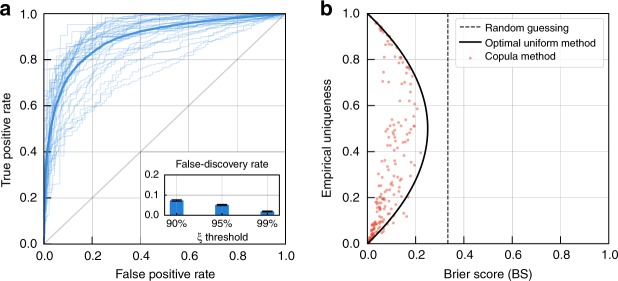
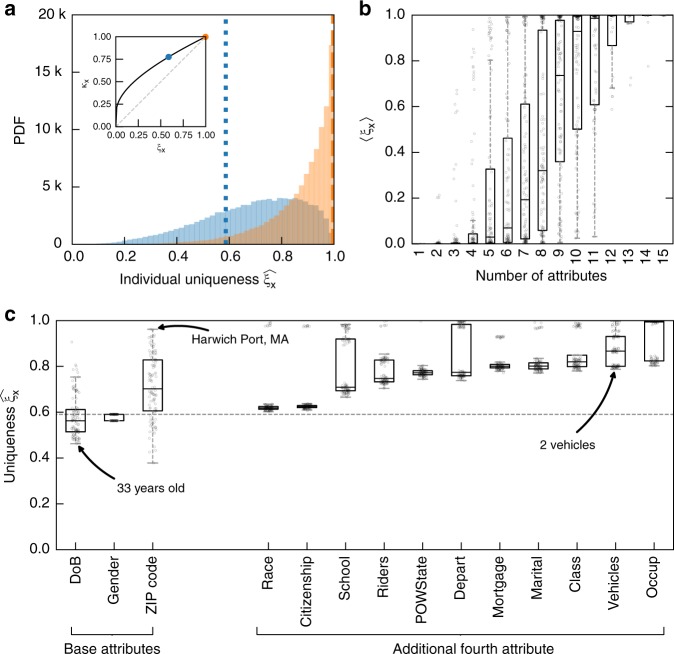
While rich medical, behavioral, and socio-demographic data are key to modern data-driven research, their collection and use raise legitimate privacy concerns. Anonymizing datasets through de-identification and sampling before sharing them has been the main tool used to address those concerns. We here propose a generative copula-based method that can accurately estimate the likelihood of a specific person to be correctly re-identified, even in a heavily incomplete dataset. On 210 populations, our method obtains AUC scores for predicting individual uniqueness ranging from 0.84 to 0.97, with low false-discovery rate. Using our model, we find that 99.98% of Americans would be correctly re-identified in any dataset using 15 demographic attributes. Our results suggest that even heavily sampled anonymized datasets are unlikely to satisfy the modern standards for anonymization set forth by GDPR and seriously challenge the technical and legal adequacy of the de-identification release-and-forget model.
Overview
The claims and statistics of this paper haven’t been checked yet.
Free: it reads the open-access text and checks the first 5 claims that cite a source we can check. Create a free account to check every claim.
Integrity signals
Registry
Cites
Statistics
Figures
Verification
Claims the paper makes
The claims and statistics of this paper haven’t been checked yet.
Free: it reads the open-access text and checks the first 5 claims that cite a source we can check. Create a free account to check every claim.
Claims other papers make about this one
Each is checked against this paper’s own text: does it say what the citing paper says it does?
The source backs part of the claim, not all of it — or backs it for a different population, condition or comparison.
In the citing paper
“Existing medical data is not fully exploited by ML primarily because it sits in data silos and privacy concerns restrict access to this data.”
From The future of digital health with federated learning (2020) · cites this paper as [7]
Experimental — accuracy not yet measuredThe source backs part of the claim, not all of it — or backs it for a different population, condition or comparison.
In the citing paper
“Centralising or releasing data, however, poses not only regulatory, ethical and legal challenges, related to privacy and data protection, but also technical ones.”
From The future of digital health with federated learning (2020) · cites this paper as [7]
Experimental — accuracy not yet measuredThe source backs part of the claim, not all of it — or backs it for a different population, condition or comparison.
In the citing paper
“Beyond these considerations, a required step for multimodal AI is the appropriate linking of all data types available in the datasets, which represents another challenge owing to the increasing risk of identification of individuals and regulatory constraints 146”
From Multimodal biomedical AI (2022) · cites this paper as [146]
Experimental — accuracy not yet measuredThe cited source says what the claim attributes to it.
In the citing paper
“Data anonymization alone does not provide sufficient protection (Rocher et al., 2019) since parts of the training data can be reconstructed by inversion of model parameters (Carlini et al., 2019; Zhang et al., 2020), gradients (Zhu et al., 2019; Geiping et al., 2020), or through adversarial attacks (Wang et al., 2019; Hitaj et al., 2017).”
From Federated learning for computational pathology on gigapixel whole slide images (2022) · cites this paper as Rocher et al., 2019
The cited source says what the claim attributes to it.
In the citing paper
“Even if data anonymisation could bypass these limitations, it is now well understood that removing metadata such as patient name or date of birth is often not enough to preserve privacy7.”
From The future of digital health with federated learning (2020) · cites this paper as [7]
1 more claim about this paper
Create a free account to see every claim other papers make about this one.
Self-check
Percentages, sums and reported differences re-computed from the paper’s own numbers.
The self-check needs the paper’s full text.
Citations
Cites
k-ANONYMITY: A MODEL FOR PROTECTING PRIVACY
SWEENEY, L. (2002) · International Journal of Uncertainty, Fuzziness and Knowledge-Based Systems · doi:10.1142/s0218488502001648 · Cited by 8,571 · cited 1×
“While more advanced guarantees like k -anonymity 57 would give every individual in the dataset some protection, they have been shown to be NP-Hard 58 , hard to achieve in modern high-dimensional datasets 59 , and not always suf fi cient 60 .”
BackgroundBig Data : The Management Revolution
マカフィー, ア., ブリニョルフソン, エ., & 有賀, 裕. (2013) · Harvard business review · Cited by 3,550
t-Closeness: Privacy Beyond k-Anonymity and l-Diversity
Li, N., Li, T., & Venkatasubramanian, S. (2007) · 2007 IEEE 23rd International Conference on Data Engineering · doi:10.1109/icde.2007.367856 · Cited by 3,451
Lazer, D., Pentland, A., Adamic, L., Aral, S., Barabási, A.-L., Brewer, D., Christakis, N., Contractor, N., Fowler, J., Gutmann, M., et al. (2009) · Science · doi:10.1126/science.1167742 · Cited by 3,365
The real-time city? Big data and smart urbanism
Kitchin, R. (2014) · GeoJournal · doi:10.1007/s10708-013-9516-8 · Cited by 2,794 · cited 5×
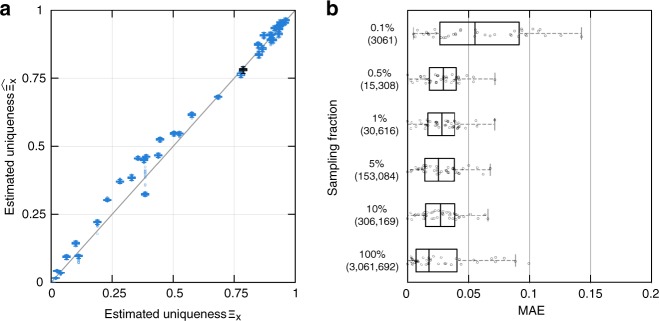
“Table 1 and Supplementary Note 7 show that, at very small sampling fraction (below 0.1%), where the error is the largest, the error is mostly determined by the marginals, and converges after few hundred records when the exact marginals are known.”
BackgroundInfluentialThe Real-Time City? Big Data and Smart Urbanism
Kitchin, R. (2013) · SSRN Electronic Journal · doi:10.2139/ssrn.2289141 · Cited by 2,794
(2012) · PubMed · Cited by 2,326
Cherubini, U., Luciano, E., & Vecchiato, W. (2004) · Wiley eBooks · doi:10.1002/9781118673331 · Cited by 2,009
Vinh, N. X., Epps, J., & Bailey, J. (2010) · Minerva Access (University of Melbourne) · doi:10.5555/1756006.1953024 · Cited by 1,781
The Unreasonable Effectiveness of Data
Halevy, A., Norvig, P., & Pereira, F. (2009) · IEEE Intelligent Systems · doi:10.1109/mis.2009.36 · Cited by 1,767
Research works printed but not linked: 4
- Cadwalladr, C. & Graham-Harrison, E. Revealed: 50 million facebook profiles harvested for Cambridge Analytica in major data breach. The Guardian (17 Mar 2018).
- Polonetsky J Tene O Finch K Shades of gray: seeing the full spectrum of practical data De-Identification St. Clara Law Rev. 2016 56 593 629
- Fienberg SE Sanil AP A Bayesian approach to data disclosure: optimal intruder behavior for continuous data J. Stat. 1997 13 75
- Chen G Keller-McNulty S Estimation of identification disclosure risk in microdata J. Stat. 1998 14 79
Cited by
The future of digital health with federated learning
Rieke, N., Hancox, J., Li, W., Milletarì, F., Roth, H. R., Albarqouni, S., Bakas, S., Galtier, M. N., Landman, B. A., Maier-Hein, K., et al. (2020) · npj Digital Medicine · doi:10.1038/s41746-020-00323-1 · Cited by 4,015
The Future of Digital Health with Federated Learning
Rieke, N., Hancox, J., Li, W., Milletari, F., Roth, H., Albarqouni, S., Bakas, S., Galtier, M. N., Landman, B., Maier-Hein, K., et al. (2020) · arXiv · doi:10.48550/arxiv.2003.08119 · Cited by 3,495
Acosta, J. N., Falcone, G. J., Rajpurkar, P., & Topol, E. J. (2022) · Nature Medicine · doi:10.1038/s41591-022-01981-2 · Cited by 1,365
“Beyond these considerations, a required step for multimodal AI is the appropriate linking of all data types available in the datasets, which represents another challenge owing to the increasing risk of identification of individuals and regulatory constraints 146 .”
Considerations for diagnostic COVID-19 tests
Vandenberg, O., Martiny, D., Rochas, O., van Belkum, A., & Kozlakidis, Z. (2021) · Nature Reviews Microbiology · doi:10.1038/s41579-020-00461-z · Cited by 803
Trustworthy Artificial Intelligence: A Review
Kaur, D., Uslu, S., Rittichier, K. J., & Durresi, A. (2023) · ACM Computing Surveys · doi:10.1145/3491209 · Cited by 709
“[164] show that they can be insufficient.”
Trustworthy AI: From Principles to Practices
Li, B., Qi, P., Liu, B., Di, S., Liu, J., Pei, J., Yi, J., & Zhou, B. (2023) · ACM Computing Surveys · doi:10.1145/3555803 · Cited by 612
“In practical scenarios, the empirical evaluation of the risk of leakage of privacy is usually considered [283, 360].”
BackgroundEthical and Bias Considerations in Artificial Intelligence/Machine Learning
Hanna, M. G., Pantanowitz, L., Jackson, B., Palmer, O., Visweswaran, S., Pantanowitz, J., Deebajah, M., & Rashidi, H. H. (2025) · Modern Pathology · doi:10.1016/j.modpat.2024.100686 · Cited by 535
Cheong, B. C. (2024) · Frontiers in Human Dynamics · doi:10.3389/fhumd.2024.1421273 · Cited by 445
Shifting machine learning for healthcare from development to deployment and from models to data
Zhang, A., Xing, L., Zou, J., & Wu, J. C. (2022) · Nature Biomedical Engineering · doi:10.1038/s41551-022-00898-y · Cited by 420
“Even if privacy protocols are followed, patient characteristics can sometimes be inferred from the ML model and its outputs 47,48 .”
BackgroundThapa, C., & Camtepe, S. (2021) · Computers in Biology and Medicine · doi:10.1016/j.compbiomed.2020.104130 · Cited by 393
Jozani, M., Ayaburi, E., Ko, M., & Choo, K.-K. R. (2020) · Computers in Human Behavior · doi:10.1016/j.chb.2020.106260 · Cited by 303
A Survey on Intelligent Internet of Things: Applications, Security, Privacy, and Future Directions
Aouedi, O., Vu, T.-H., Sacco, A., Nguyen, D. C., Piamrat, K., Marchetto, G., & Pham, Q.-V. (2025) · IEEE Communications Surveys & Tutorials · doi:10.1109/comst.2024.3430368 · Cited by 277
Federated learning in a medical context: A systematic literature review
Pfitzner, B., Steckhan, N., & Arnrich, B. (2021) · ACM Transactions on Internet Technology · doi:10.1145/3412357 · Cited by 288
Privacy challenges and research opportunities for genomic data sharing
Bonomi, L., Huang, Y., & Ohno-Machado, L. (2020) · Nature Genetics · doi:10.1038/s41588-020-0651-0 · Cited by 285
Artificial Intelligence in Cardiology: Present and Future
Lopez-Jimenez, F., Attia, Z., Arruda-Olson, A. M., Carter, R., Chareonthaitawee, P., Jouni, H., Kapa, S., Lerman, A., Luong, C., Medina-Inojosa, J. R., et al. (2020) · Mayo Clinic Proceedings · doi:10.1016/j.mayocp.2020.01.038 · Cited by 280
Federated learning for computational pathology on gigapixel whole slide images
Lu, M. Y., Chen, R. J., Kong, D., Lipkova, J., Singh, R., Williamson, D. F. K., Chen, T. Y., & Mahmood, F. (2022) · Medical Image Analysis · doi:10.1016/j.media.2021.102298 · Cited by 267
“Data anonymization alone does not provide sufficient protection (Rocher et al., 2019) since parts of the training data can be reconstructed by inversion of model parameters (Carlini et al.”
BackgroundThoral, P. J., Peppink, J. M., Driessen, R. H., Sijbrands, E. J. G., Kompanje, E. J. O., Kaplan, L., Bailey, H., Kesecioglu, J., Cecconi, M., Churpek, M., et al. (2021) · Critical Care Medicine · doi:10.1097/ccm.0000000000004916 · Cited by 257
“” And indeed, some may argue that no deidentification strategy is able to guarantee zero risk of reidentification and that individual critical care patient data could never be released (23, 32).”
BackgroundLarge image datasets: A pyrrhic win for computer vision?
Birhane, A., & Prabhu, V. U. (2021) · 2021 IEEE Winter Conference on Applications of Computer Vision (WACV) · doi:10.1109/wacv48630.2021.00158 · Cited by 257
“Institutions, academia, and industry alike, amass millions of images of people without consent and often for unstated purposes under the guise of anonymization, a claim that is both ephemeral [57, 68] and vacuous [30].”
BackgroundAdvances in human intracranial electroencephalography research, guidelines and good practices
Mercier, M. R., Dubarry, A.-S., Tadel, F., Avanzini, P., Axmacher, N., Cellier, D., Vecchio, M. D., Hamilton, L. S., Hermes, D., Kahana, M. J., et al. (2022) · NeuroImage · doi:10.1016/j.neuroimage.2022.119438 · Cited by 229
Generating high-fidelity synthetic patient data for assessing machine learning healthcare software
Tucker, A., Wang, Z., Rotalinti, Y., & Myles, P. (2020) · npj Digital Medicine · doi:10.1038/s41746-020-00353-9 · Cited by 228
An Agenda for Open Science in Communication
Dienlin, T., Johannes, N., Bowman, N. D., Masur, P. K., Engesser, S., Kümpel, A. S., Lukito, J., Bier, L. M., Zhang, R., Johnson, B. K., et al. (2021) · Journal of Communication · doi:10.1093/joc/jqz052 · Cited by 209
“As a result, nonsignificant results often remain unpublished, creating the so-called “file-drawer problem” (Rosenthal, 1979, p. 638).”
BackgroundWhite, T., Blok, E., & Calhoun, V. D. (2022) · Human Brain Mapping · doi:10.1002/hbm.25120 · Cited by 176
Handling privacy-sensitive medical data with federated learning: Challenges and future directions
Aouedi, O., Sacco, A., Piamrat, K., & Marchetto, G. (2023) · IEEE Journal of Biomedical and Health Informatics · doi:10.1109/jbhi.2022.3185673 · Cited by 165
“For example, even if data is anonymized, gathering just a few data attributes may allow patient re-identification [8].”
BackgroundEthical issues in using ambient intelligence in health-care settings
Martinez-Martin, N., Luo, Z., Kaushal, A., Adeli, E., Haque, A., Kelly, S. S., Wieten, S., Cho, M. K., Magnus, D., Fei-Fei, L., et al. (2021) · The Lancet Digital Health · doi:10.1016/s2589-7500(20)30275-2 · Cited by 165
“34,35 Personal information is increasingly available in large online databases, and trends towards data aggregation and data analytics make it more likely that data can be reidentified.”
BackgroundThe Not Yet Exploited Goldmine of OSINT: Opportunities, Open Challenges and Future Trends
Pastor-Galindo, J., Nespoli, P., Gomez Marmol, F., & Martinez Perez, G. (2020) · IEEE Access · doi:10.1109/access.2020.2965257 · Cited by 163
“Recently, an algorithm [75] has been published allowing 99.”
MethodWang, Y. (2021) · Studies in Educational Evaluation · doi:10.1016/j.stueduc.2020.100872 · Cited by 162
Oswald, F. L., Behrend, T. S., Putka, D. J., & Sinar, E. (2020) · Annual Review of Organizational Psychology and Organizational Behavior · doi:10.1146/annurev-orgpsych-032117-104553 · Cited by 162
Interaction data from the Copenhagen Networks Study
Sapiezynski, P., Stopczynski, A., Lassen, D. D., & Lehmann, S. (2019) · Scientific Data · doi:10.1038/s41597-019-0325-x · Cited by 161
“The data is presented as a temporal, weighted edge list, and each edge is described using (1) the timestamp of the beginning of the timebin in seconds (because of the quantization of time into five minute bins the timestamp is reported in the multiples of 300 seconds), (2, 3) the IDs of users who discovered each other…”
MethodAnalyzing Leakage of Personally Identifiable Information in Language Models
Lukas, N., Salem, A., Sim, R., Tople, S., Wutschitz, L., & Zanella-Béguelin, S. (2023) · 2023 IEEE Symposium on Security and Privacy (SP) · doi:10.1109/sp46215.2023.10179300 · Cited by 154
“Prior work studied the leakage of PII in masked language models [36, 61], large language models [26, 54] and Smart Reply classification models [32].”
BackgroundTesting for COVID-19: A way to lift confinement restrictions
OECD (2020) · OECD policy responses to coronavirus (Covid-19) · doi:10.1787/89756248-en · Cited by 219
Quintana, D. S. (2020) · eLife · doi:10.7554/elife.53275 · Cited by 142
“Despite these anonymization efforts, specific individuals can still be identified in anonymized datasets with high accuracy (Ohm, 2009; Rocher et al., 2019).”
BackgroundResultShreve, J. T., Khanani, S. A., & Haddad, T. C. (2022) · American Society of Clinical Oncology Educational Book · doi:10.1200/edbk_350652 · Cited by 172
Aggarwal, R., Farag, S., Martin, G., Ashrafian, H., & Darzi, A. W. (2021) · Journal of Medical Internet Research · doi:10.2196/26162 · Cited by 160
“In an attempt to mitigate this concern, the Information Commissioner’s Office (ICO), the United Kingdom’s independent statutory body for information rights, has issued a code of practice on anonymization [31].”
BackgroundVlahou, A., Hallinan, D., Apweiler, R., Argiles, A., Beige, J., Benigni, A., Bischoff, R., Black, P. C., Boehm, F., Céraline, J., et al. (2021) · Hypertension · doi:10.1161/hypertensionaha.120.16340 · Cited by 133
Synthetic data as an enabler for machine learning applications in medicine
Rajotte, J.-F., Bergen, R., Buckeridge, D. L., El Emam, K., Ng, R., & Strome, E. (2022) · iScience · doi:10.1016/j.isci.2022.105331 · Cited by 124
“However, these methods have proven to be vulnerable to privacy leaks (Swee-ney, 2002), (Rocher et al., 2019), (Mandl and Perakslis, 2021).”
Why Is the Electronic Health Record So Challenging for Research and Clinical Care?
Holmes, J. H., Beinlich, J., Boland, M. R., Bowles, K. H., Chen, Y., Cook, T. S., Demiris, G., Draugelis, M., Fluharty, L., Gabriel, P. E., et al. (2021) · Methods of Information in Medicine · doi:10.1055/s-0041-1731784 · Cited by 117
“63 Because anonymization can decrease information content of the dataset, differential privacy methods are sometimes used in research because they divulge insightful characteristics of cohorts while not disclosing information about any particular individual.”
MethodMemory-aware curriculum federated learning for breast cancer classification
Jiménez-Sánchez, A., Tardy, M., González Ballester, M. A., Mateus, D., & Piella, G. (2023) · Computer Methods and Programs in Biomedicine · doi:10.1016/j.cmpb.2022.107318 · Cited by 114
“However, remaining data elements may allow for patient reidentification [51].”
BackgroundAlgorithmic fairness datasets: the story so far
Fabris, A., Messina, S., Silvello, G., & Susto, G. A. (2022) · Data mining and knowledge discovery · doi:10.1007/s10618-022-00854-z · Cited by 164
Ethical Development of Digital Phenotyping Tools for Mental Health Applications: Delphi Study
Martinez-Martin, N., Greely, H. T., & Cho, M. K. (2021) · JMIR mHealth and uHealth · doi:10.2196/27343 · Cited by 111
“Increasingly, owing to advances in data science and the availability of massive public databases, personal data can be reidentified [99].”
BackgroundBrain simulation as a cloud service: The Virtual Brain on EBRAINS
Schirner, M., Domide, L., Perdikis, D., Triebkorn, P., Stefanovski, L., Pai, R. K., Prodan, P., Valean, B., Palmer, J., Langford, C., et al. (2022) · NeuroImage · doi:10.1016/j.neuroimage.2022.118973 · Cited by 150
Ethical Issues in Patient Data Ownership
Chiruvella, V., & Guddati, A. K. (2021) · Interactive Journal of Medical Research · doi:10.2196/22269 · Cited by 140
“98% of Americans in deidentified data sets using 15 demographic attributes [22].”
BackgroundHealth Policy and Privacy Challenges Associated With Digital Technology
Grande, D., Marti, X. L., Feuerstein-Simon, R., Merchant, R. M., Asch, D. A., Lewson, A. B., & Cannuscio, C. C. (2020) · JAMA Network Open · doi:10.1001/jamanetworkopen.2020.8285 · Cited by 129
Glasze, G., Odzuck, E. H., & Staples, R. (2022) · Politik in der digitalen Gesellschaft · doi:10.1515/9783839458273 · Cited by 131
Anonymization: The imperfect science of using data while preserving privacy
Gadotti, A., Rocher, L., Houssiau, F., Creţu, A.-M., & de Montjoye, Y.-A. (2024) · Science Advances · doi:10.1126/sciadv.adn7053 · Cited by 184
“This argument has been rebutted by Rocher et al. ( 53 ), who showed that the probability that a certain record is unique in the whole population—and therefore correctly identified in anonymous data—can be accurately estimated using only a small sample of records.”
BackgroundSelf-citationUnpacking the role of AI ethics online education for science and engineering students
Usher, M., & Barak, M. (2024) · International Journal of STEM Education · doi:10.1186/s40594-024-00493-4 · Cited by 100
“This approach is consistent with strategies recommended in the literature for preserving privacy by anonymizing data sets (Rocher et al., 2019).”
ResultA Comprehensive Survey on Security and Privacy for Electronic Health Data
Oh, S.-R., Seo, Y.-D., Lee, E., & Kim, Y. (2021) · International Journal of Environmental Research and Public Health · doi:10.3390/ijerph18189668 · Cited by 126
A Multifaceted benchmarking of synthetic electronic health record generation models
Yan, C., Yan, Y., Wan, Z., Zhang, Z., Omberg, L., Guinney, J., Mooney, S. D., & Malin, B. A. (2022) · Nature Communications · doi:10.1038/s41467-022-35295-1 · Cited by 95
Zuiderwijk, A., Shinde, R., & Jeng, W. (2020) · PLoS ONE · doi:10.1371/journal.pone.0239283 · Cited by 142
“Data can be anonymized, but anonymization techniques cannot guarantee that individuals will not still be identified using certain re-identification techniques [60].”
BackgroundPrivacy-preserving data sharing infrastructures for medical research: systematization and comparison
Wirth, F. N., Meurers, T., Johns, M., & Praßer, F. (2021) · BMC Medical Informatics and Decision Making · doi:10.1186/s12911-021-01602-x · Cited by 137
Kishore, N., Kiang, M. V., Engø‐Monsen, K., Vembar, N., Schroeder, A., Balsari, S., & Buckee, C. O. (2020) · The Lancet Digital Health · doi:10.1016/s2589-7500(20)30193-x · Cited by 113
“19,20 23”
Big data, privacy and COVID-19 – learning from humanitarian expertise in data protection
Zwitter, A., & Gstrein, O. J. (2020) · Journal of International Humanitarian Action · doi:10.1186/s41018-020-00072-6 · Cited by 132
“…again and again that the combination of the production of unprecedented amounts of data and improving techniques to analyse large data sets are rendering most – if not all – state of the art practices to pseudonymize/ anonymize datasets meaningless, at least as time moves on (Rocher et al. 2019).”
BackgroundProtecting Data Privacy in the Age of AI-Enabled Ophthalmology
Tom, E., Keane, P. A., Blazes, M., Pasquale, L. R., Chiang, M. F., Lee, A. Y., Lee, C. S., & and AAO Artificial Intelligence Task Force (2020) · Translational Vision Science & Technology · doi:10.1167/tvst.9.2.36 · Cited by 92
Grekousis, G., & Liu, Y. (2021) · Sustainable Cities and Society · doi:10.1016/j.scs.2021.102995 · Cited by 106
“However, studies have shown that, even with anonymized data, there are techniques to identify the actual individuals (Rocher, Hendrickx, & de Montjoye, 2019).”
BackgroundCordeiro, J. V. (2021) · Frontiers in Medicine · doi:10.3389/fmed.2021.647897 · Cited by 89
Data Anonymization for Pervasive Health Care: Systematic Literature Mapping Study
Zuo, Z., Watson, M., Budgen, D., Hall, R., Kennelly, C., & Moubayed, N. A. (2021) · JMIR Medical Informatics · doi:10.2196/29871 · Cited by 125
McCradden, M. D., Sarker, T., & Paprica, P. A. (2020) · BMJ Open · doi:10.1136/bmjopen-2020-039798 · Cited by 90
Zhui, L., Fenghe, L., Xuehu, W., Qining, F., & Wei, R. (2024) · Journal of Medical Internet Research · doi:10.2196/60083 · Cited by 91
“Rocher et al [11] reported that LLMs could use as few as 15 demographic attributes to reidentify 99.98% of personal data in any anonymized data set.”
InfluentialSynthetic data in biomedicine via generative artificial intelligence
van Breugel, B., Liu, T., Oglić, D., & van der Schaar, M. (2024) · Nature Reviews Bioengineering · doi:10.1038/s44222-024-00245-7 · Cited by 152
“In addition, typical anonymi zation and deidentification procedures may leak information about individuals if secondary datasets are used 33 .”
Molldrem, S., & Smith, A. K. J. (2020) · The American Journal of Bioethics · doi:10.1080/15265161.2020.1806373 · Cited by 100
The impact of commercial health datasets on medical research and health-care algorithms
Alberto, I. R. I., Alberto, N. R. I., Ghosh, A. K., Jain, B., Jayakumar, S., Martinez-Martin, N., McCague, N., Moukheiber, D., Moukheiber, L., Moukheiber, M., et al. (2023) · The Lancet Digital Health · doi:10.1016/s2589-7500(23)00025-0 · Cited by 86
“2,37 However, privacy is a concept that is context-dependent and often should be considered in trade-off with other societal rights and values.”
BackgroundTrustworthy AI: Securing Sensitive Data in Large Language Models
Feretzakis, G., & Verykios, V. S. (2024) · AI · doi:10.3390/ai5040134 · Cited by 83
“Compliance challenges include ensuring data minimization [12], obtaining informed consent for data processing [105], and implementing techniques such as anonymization and pseudonymization to protect personal data [29, 111, 112].”
Synthetic Data -- Anonymisation Groundhog DayPreprint
Stadler, T., Oprisanu, B., & Troncoso, C. (2020) · arXiv (Cornell University) · doi:10.48550/arxiv.2011.07018 · Cited by 229
“Finally, previous studies have shown that the privacy risks of data sharing are not uniformly distributed across the population [36,38,54].”
BackgroundA Unified Framework for Quantifying Privacy Risk in Synthetic Data
Giomi, M., Boenisch, F., Wehmeyer, C., & Tasnádi, B. (2023) · Proceedings on Privacy Enhancing Technologies · doi:10.56553/popets-2023-0055 · Cited by 161
The Ethics of Artificial Intelligence in Pathology and Laboratory Medicine: Principles and Practice
Jackson, B. R., Ye, Y., Crawford, J. M., Becich, M. J., Roy, S., Botkin, J. R., de Baca, M. E., & Pantanowitz, L. (2021) · Academic Pathology · doi:10.1177/2374289521990784 · Cited by 96
“21 A strict application of respect for persons might require informed consent on the part of patients before their personal information is used for training AI systems, whether de-identified or not.”
BackgroundChung, C. T., Lee, S., King, E., Liu, T., Armoundas, A. A., Bazoukis, G., & Tse, G. (2022) · International Journal of Arrhythmia · doi:10.1186/s42444-022-00075-x · Cited by 79
“As the size of the ECG data set increases, existing anonymization techniques may not be effective [63, 64].”
Harnessing the potential of artificial intelligence for humanitarian action: Opportunities and risks
Beduschi, A. (2022) · International Review of the Red Cross · doi:10.1017/s1816383122000261 · Cited by 132
Petersen, E., Potdevin, Y., Mohammadi, E., Zidowitz, S., Breyer, S., Nowotka, D., Henn, S., Pechmann, L., Leucker, M., Rostalski, P., et al. (2022) · IEEE Access · doi:10.1109/access.2022.3178382 · Cited by 113
“To provide two recent examples, Rocher et al. [100] demonstrate that using publicly available, supposedly anonymized datasets, a large fraction of the U.S. population could be re-identified (thereby defeating the purpose of anonymization).”
BackgroundSurvey: Leakage and Privacy at Inference Time
Jegorova, M., Kaul, C., Mayor, C., O'Neil, A. Q., Weir, A., Murray-Smith, R., & Tsaftaris, S. A. (2022) · IEEE Transactions on Pattern Analysis and Machine Intelligence · doi:10.1109/tpami.2022.3229593 · Cited by 77
“in the query dataset, that have been correctly identified by MIA, or some modification of this metric [42, 44].”
BackgroundGuillaudeux, M., Rousseau, O., Petot, J., Bennis, Z., Dein, C.-A., Goronflot, T., Vince, N., Limou, S., Karakachoff, M., Wargny, M., et al. (2023) · npj Digital Medicine · doi:10.1038/s41746-023-00771-5 · Cited by 111
“, standardization, number of dimensions used in neighbor identification and variables custom weighting for projection) and (2) parameters affecting how stochastic an avatar generation can be: the weights distribution law over neighbors (equal or unbalanced contribution) and the percentage of perturbation applied to th…”
BackgroundMethodInfluentialDevelopments in Privacy and Data Ownership in Mobile Health Technologies, 2016-2019
Galvin, H. K., & DeMuro, P. R. (2020) · Yearbook of Medical Informatics · doi:10.1055/s-0040-1701987 · Cited by 78
Joint Imaging Platform for Federated Clinical Data Analytics
Scherer, J., Nolden, M., Kleesiek, J., Metzger, J., Kades, K., Schneider, V., Bach, M., Sedlaczek, O., Bucher, A. M., Vogl, T. J., et al. (2020) · JCO Clinical Cancer Informatics · doi:10.1200/cci.20.00045 · Cited by 70
“Current research strongly indicates that data anonymization is not only difficult to perform but also generally ineffective in practice.(9-11) De-identification or anonymization methods considered safe today might potentially fail in the future.”
BackgroundIntegrating Qualitative Methods and Open Science: Five Principles for More Trustworthy Research*
Humphreys, L., Lewis, N. A., Sender, K., & Won, A. S. (2021) · Journal of Communication · doi:10.1093/joc/jqab026 · Cited by 69
Palaniappan, K., Lin, E. Y. T., Vogel, S., & Lim, J. C. W. (2024) · Healthcare · doi:10.3390/healthcare12171730 · Cited by 98
“However, with the advancement of technology, many studies have shown that it is quite possible to re-identify individuals from anonymised data and hence the privacy of the individuals is at stake in such cases [14].”
BackgroundBukowski, M., Farkas, R., Beyan, O., Moll, L., Hahn, H., Kiessling, F., & Schmitz-Rode, T. (2020) · European Radiology · doi:10.1007/s00330-020-06874-x · Cited by 67
Data anonymization evaluation for big data and IoT environment
Ni, C., Li, S., Gope, P., & Min, G. (2022) · Information Sciences · doi:10.1016/j.ins.2022.05.040 · Cited by 75
Padhi, A., Agarwal, A., Saxena, S. K., & Katoch, C. D. S. (2023) · VirusDisease · doi:10.1007/s13337-023-00841-y · Cited by 98
“Machine learning algorithms can sometimes decipher de-identified data, making anonymity a challenge [19].”
BackgroundShow evidence that apps for COVID-19 contact-tracing are secure and effective
(2020) · Nature · doi:10.1038/d41586-020-01264-1 · Cited by 67
Artificial intelligence and urology: ethical considerations for urologists and patients
Cacciamani, G. E., Chen, A. W., Gill, I. S., & Hung, A. J. (2023) · Nature Reviews Urology · doi:10.1038/s41585-023-00796-1 · Cited by 80
“Any new standards for anonymization must be robust and address attempts at de-anonymization 34 .”
The relationship between text message sentiment and self-reported depression
Liu, T., Meyerhoff, J., Eichstaedt, J. C., Karr, C. J., Kaiser, S. M., Kording, K. P., Mohr, D. C., & Ungar, L. (2021) · Journal of Affective Disorders · doi:10.1016/j.jad.2021.12.048 · Cited by 84
Federated Learning in Dentistry: Chances and Challenges
Rischke, R., Schneider, L., Müller, K. R., Samek, W., Schwendicke, F., & Krois, J. (2022) · Journal of Dental Research · doi:10.1177/00220345221108953 · Cited by 85
“Yet, it has been shown that this is not sufficient to protect patients’ privacy (Rocher et al. 2019).”
BackgroundThe spectrum of data sharing policies in neuroimaging data repositories
Jwa, A. S., & Poldrack, R. A. (2022) · Human Brain Mapping · doi:10.1002/hbm.25803 · Cited by 73
“For example, one study showed that by using a generative graphical model, individuals can be accurately re-identified with high likelihood even from heavily incomplete de-identified socio-demographic, survey, and health datasets (Rocher, Hendrickx, & de Montjoye, 2019).”
MethodBannier, É., Barker, G. J., Borghesani, V., Broeckx, N., Clement, P., Emblem, K. E., Ghosh, S., Glerean, E., Gorgolewski, K. J., Havu, M., et al. (2021) · Human Brain Mapping · doi:10.1002/hbm.25351 · Cited by 82
“By contrast, Rocher, Hendrickx, and de Montjoye (2019) (Rocher et al., 2019) estimated the likelihood of re-identification of individuals at around 95% by combining biomedical data and information from postcodes and census using relatively simple statistical models available in open source packages…”
Exploring the Privacy Risks of Adversarial VR Game Design
Nair, V. C., Garrido, G. M., Song, D. X., & O’Brien, J. F. (2023) · Proceedings on Privacy Enhancing Technologies · doi:10.56553/popets-2023-0108 · Cited by 130
Fold-stratified cross-validation for unbiased and privacy-preserving federated learning
Bey, R., Goussault, R., Grolleau, F., Benchoufi, M., & Porcher, R. (2020) · Journal of the American Medical Informatics Association · doi:10.1093/jamia/ocaa096 · Cited by 71
“These concerns are not unfounded as re-identification attacks have regularly broken the anonymity of large datasets [10–13].”
BackgroundFox, J., Pearce, K. E., Massanari, A. L., Riles, J. M., Szulc, Ł., Ranjit, Y. S., Trevisan, F., Soriano, C. R., Vitak, J., Arora, P., et al. (2021) · Journal of Communication · doi:10.1093/joc/jqab029 · Cited by 98
Advocating for neurodata privacy and neurotechnology regulation
Yuste, R. (2023) · Nature Protocols · doi:10.1038/s41596-023-00873-0 · Cited by 98
Ford, E., Oswald, M., Hassan, L., Bozentko, K., Nenadic, G., & Cassell, J. (2020) · Journal of Medical Ethics · doi:10.1136/medethics-2019-105472 · Cited by 59
How NFTs could transform health information exchange
Kostick, K. M., Mandl, K. D., Minssen, T., Cohen, I. G., Gasser, U., Kohane, I. S., & McGuire, A. L. (2022) · Science · doi:10.1126/science.abm2004 · Cited by 65
Ebert, I., Wildhaber, I., & Adams-Prassl, J. (2021) · Big Data & Society · doi:10.1177/20539517211013051 · Cited by 56
Offner, K. L., Sitnikova, E., Joiner, K. F., & MacIntyre, C. R. (2020) · Intelligence & National Security · doi:10.1080/02684527.2020.1752459 · Cited by 69
Dyda, A., Purcell, M., Curtis, S. J., Field, E. J., Pillai, P., Ricardo, K., Weng, H., Moore, J. C., Hewett, M., Williams, G., et al. (2021) · Patterns · doi:10.1016/j.patter.2021.100366 · Cited by 82
A comprehensive review of federated learning for COVID‐19 detection
Naz, S., Phan, K. T., & Chen, Y. P. (2021) · International Journal of Intelligent Systems · doi:10.1002/int.22777 · Cited by 68
“Data privacy could be preserved by removing meta data but not anymore, 51 as CT or MRI data can possibly restructure the patient's face.”
BackgroundPreservação da privacidade no enfrentamento da COVID-19: dados pessoais e a pandemia global
Almeida, B. D. A., Doneda, D. C. M., Ichihara, M. Y., Barral‐Netto, M., Matta, G. C., Rabello, E. T., Gouveia, F. C., & Barreto, M. L. (2020) · Ciência & Saúde Coletiva · doi:10.1590/1413-81232020256.1.11792020 · Cited by 53
Using Big Data and Machine Learning in Personality Measurement: Opportunities and Challenges
Alexander, L., Mulfinger, E., & Oswald, F. L. (2020) · European Journal of Personality · doi:10.1002/per.2305 · Cited by 64
“Ethical sensitivity should certainly accompany all psychological big data research (Mansour, 2016), especially considering that only a small subset of characteristics may be necessary to re ‐ identify individuals within an anonymized data set (Rocher, Hendrickx, & de Montjoye, 2019).”
BackgroundComputational Audiology: New Approaches to Advance Hearing Health Care in the Digital Age
Wasmann, J.-W. A., Lanting, C., Huinck, W. J., Mylanus, E. A. M., van der Laak, J. A. W. M., Govaerts, P., Swanepoel, D. W., Moore, D. R., & Barbour, D. L. (2021) · Ear and Hearing · doi:10.1097/aud.0000000000001041 · Cited by 62
Glicksberg, B. S., Burns, S., Currie, R., Griffin, A., Wang, Z. J., Haussler, D., Goldstein, T., & Collisson, E. (2020) · Journal of Medical Internet Research · doi:10.2196/16810 · Cited by 51
Cooper, D. A., Yalcin, T., Nistor, C., Macrini, M., & Pehlivan, E. (2021) · Journal of Consumer Marketing · doi:10.1108/jcm-04-2021-4577 · Cited by 82
When AI Meets Information Privacy: The Adversarial Role of AI in Data Sharing Scenario
Majeed, A., & Hwang, S. O. (2023) · IEEE Access · doi:10.1109/access.2023.3297646 · Cited by 71
“From the results, it can be seen that the proposed method yielded a higher re-identification risk than the Rocher et al. [59] method owing to high quality T s curation.”
MethodResultInfluentialDetecting model misconducts in decentralized healthcare federated learning
Kuo, T.-T., & Pham, A. (2022) · International Journal of Medical Informatics · doi:10.1016/j.ijmedinf.2021.104658 · Cited by 51
Genomics: data sharing needs an international code of conduct
Phillips, M. A., Molnár‐Gábor, F., Korbel, J. O., Thorogood, A., Joly, Y., Chalmers, D., Townend, D. M. R., & Knoppers, B. M. (2020) · Nature · doi:10.1038/d41586-020-00082-9 · Cited by 63
Metadata
- Authors
- Rocher, L., Hendrickx, J. M., & de Montjoye, Y.-A.
- Affiliations
- Imperial College London (GB)
- UCLouvain (BE)
- Venue
- Nature Communications
- Published
- 2019-07-23
- Volume
- 10
- Issue
- 1
- Pages
- 3069-3069
- ISSN
- 2041-1723 (ISSN-L)
- PMC
- PMC6650473
- OpenAlex
- W2963693643
- Semantic Scholar
- f34b6423878090c7422c078a3dd6a3db80fb7532
- Cited by
- 816
- References
- 57
- Citations by year
- 2026: 86 · 2025: 99 · 2024: 111 · 2023: 105 · 2022: 154 · 2021: 120 · 2020: 124 · 2019: 16
- FWCI
- 47.23
- Type
- journal article
- Language
- en
- Open access
- gold
- doi.org
- Licence
- cc-by
- creativecommons.org/licenses/by/4.0 (tdm)
- creativecommons.org/licenses/by/4.0 (vor)
- Locations
- Nature Communications (publishedVersion, cc-by)
- PubMed Central (publishedVersion, cc-by)
- PubMed (publishedVersion)
- RePEc: Research Papers in Economics (submittedVersion)
- Digital Access to Libraries (Université catholique de Louvain (UCL), l'Université de Namur (UNamur) and the Université Saint-Louis (USL-B)) (submittedVersion, other-oa)
- DOAJ (DOAJ: Directory of Open Access Journals) (submittedVersion)
- DOAJ (DOAJ: Directory of Open Access Journals) (submittedVersion, cc-by-sa)
- Spiral (Imperial College London) (submittedVersion, cc-by)
- Funders
- Fonds De La Recherche Scientifique - FNRS
- Wallonie-Bruxelles International
- Imperial College London
- Topics
- Physical Sciences › Computer Science › Artificial Intelligence › Privacy-Preserving Technologies in Data
- Physical Sciences › Computer Science › Information Systems › Data Quality and Management
- Physical Sciences › Computer Science › Artificial Intelligence › Internet Traffic Analysis and Secure E-voting
- Keywords
- re-identification risk, data anonymization, de-identification, missing data, privacy, demographic factors, data sharing
- MeSH terms
- Data Anonymization, Personally Identifiable Information, Data Analysis, Normal Distribution, Likelihood Functions, Datasets as Topic
About these checks
Registry, retraction, Cites and statistics results are computed, not judged, with one exception: a printed reference that no index lists is read once by a model before it counts as a citation error. Claims are extracted by a model and kept only when their quote appears verbatim in the text; each cited source is then checked, with a model’s help, for whether it says what the claim relies on. Those verdicts can be wrong — read the claim’s quote and the cited source before relying on one.
Statistics and arithmetic are recomputed, not judged.
Confidence bands are shown only for fields calibrated on our annotated test set. None is calibrated yet, so no band is shown.
What counts as a claim ›How we measure confidence ›How we check this ›
Are you an author, or do you see a problem with this page? Request a review
Data sources
Bibliographic data: Semantic Scholar, OpenAlex, Crossref.
Contains information from the Semantic Scholar Academic Graph Datasets, made available under the ODC Attribution License (ODC-BY 1.0).
Semantic Scholar’s data is described in: Kinney, R., et al. (2023). The Semantic Scholar Open Data Platform. arXiv:2301.10140.
