

The DOI matches its Crossref record; 31 of the 32 references it cites were found in a registry or an index.
DNA assembly for nanopore data storage readout
Open accessAbstract
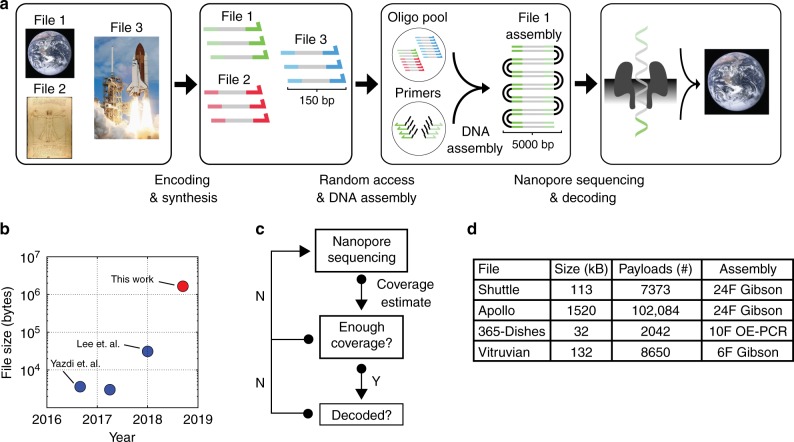
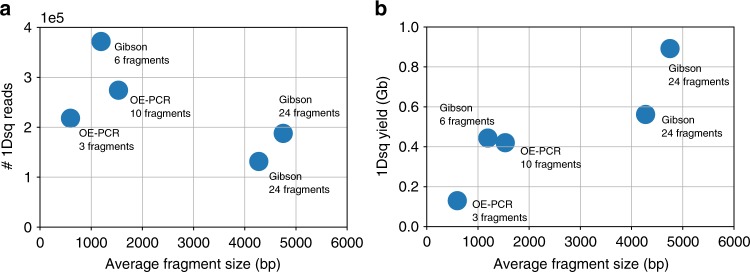
Synthetic DNA is becoming an attractive substrate for digital data storage due to its density, durability, and relevance in biological research. A major challenge in making DNA data storage a reality is that reading DNA back into data using sequencing by synthesis remains a laborious, slow and expensive process. Here, we demonstrate successful decoding of 1.67 megabytes of information stored in short fragments of synthetic DNA using a portable nanopore sequencing platform. We design and validate an assembly strategy for DNA storage that drastically increases the throughput of nanopore sequencing. Importantly, this assembly strategy is generalizable to any application that requires nanopore sequencing of small DNA amplicons.
Overview
The claims and statistics of this paper haven’t been checked yet.
Run the check — free, no account needed. It reads the open-access text and checks the sources it cites.
Integrity signals
Registry
Cites
Statistics
Figures
Verification
Claims the paper makes
The claims and statistics of this paper haven’t been checked yet.
Run the check — free, no account needed. It reads the open-access text and checks the sources it cites.
Claims other papers make about this one
Each is checked against this paper’s own text: does it say what the citing paper says it does?
In the citing paper
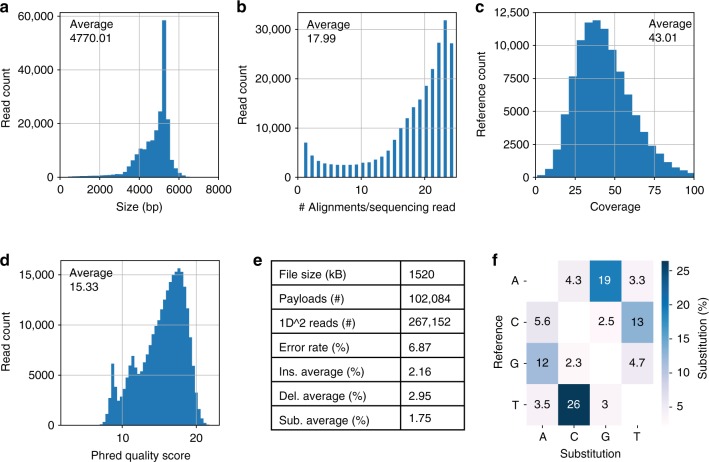
“The error rate of the second-generation synthesis and sequencing technology is less than 5%, while that of the third-generation is about 10–15% [31, 32].”
From Study of the error correction capability of multiple sequence alignment algorithm (MAFFT) in DNA storage (2023) · cites this paper as [31]
In the citing paper
“Lopez et al. (2019) established a DNA assembly strategy to overcome the problem in reading short DNA strands by Nanopore sequencer.”
From Large-Scale de Novo Oligonucleotide Synthesis for Whole-Genome Synthesis and Data Storage: Challenges and Opportunities (2021) · cites this paper as Lopez et al., 2019
In the citing paper
“sequencing using protein nanopores, commercialized by Oxford Nanopore Technologies, has been used because of its ease of implementation, automation, and portability”
From Emerging Approaches to DNA Data Storage: Challenges and Prospects (2022) · cites this paper as [86]
In the citing paper
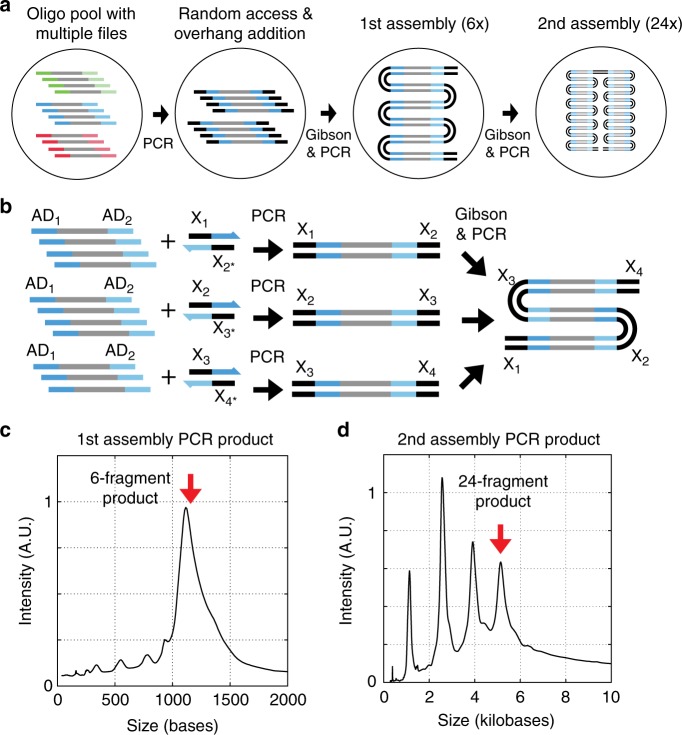
“sufficient pore utilization for high sequencing throughput can only be realized for long fragments (>1 kb).”
From Emerging Approaches to DNA Data Storage: Challenges and Prospects (2022) · cites this paper as [86]
In the citing paper
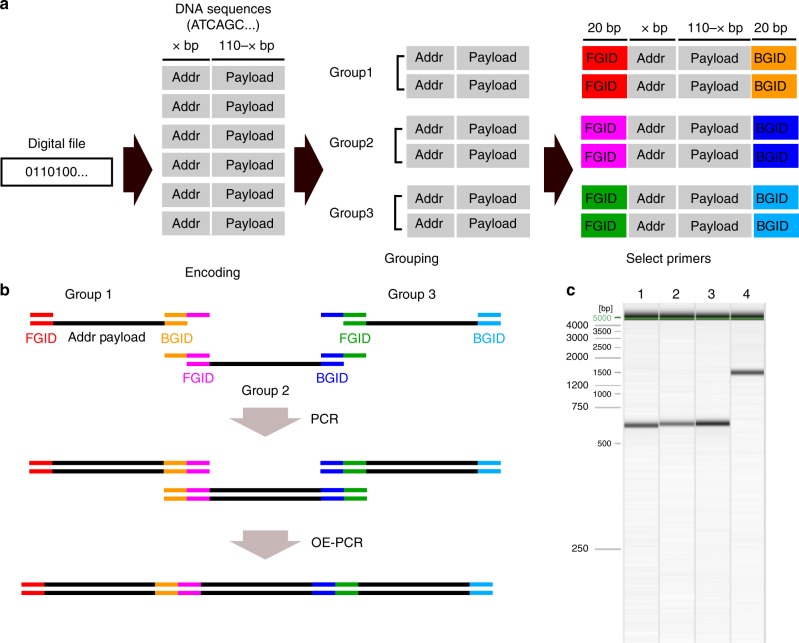
“This process, usually performed via Gibson assembly or overlap extension PCR,70,81,86 reintroduces several difficult-to-automatize steps into the sequencing workflow, which calls the approach’s claims of improved portability and ease of automation over SBS into question.”
From Emerging Approaches to DNA Data Storage: Challenges and Prospects (2022) · cites this paper as [86]
In the citing paper
“necessitates the clustering of sequence information, and thus, higher sequencing coverage and additional postprocessing of sequencing data.”
From Emerging Approaches to DNA Data Storage: Challenges and Prospects (2022) · cites this paper as [86]
In the citing paper
“the largest data size retrieved using the technology is currently about 1.67 MB, compared with around 200 MB for SBS.”
From Emerging Approaches to DNA Data Storage: Challenges and Prospects (2022) · cites this paper as [86]
Self-check
Percentages, sums and reported differences re-computed from the paper’s own numbers.
The self-check needs the paper’s full text.
Citations
Cites
Enzymatic assembly of DNA molecules up to several hundred kilobases
Gibson, D. G., Young, L., Chuang, R.-Y., Venter, J. C., Hutchison, C. A., & Smith, H. O. (2009) · Nature Methods · doi:10.1038/nmeth.1318 · Cited by 10,088
Engineering hybrid genes without the use of restriction enzymes: gene splicing by overlap extension
Horton, R. M., Hunt, H. D., Ho, S. N., Pullen, J. K., & Pease, L. R. (1989) · Gene · doi:10.1016/0378-1119(89)90359-4 · Cited by 3,020
Nanopore sequencing and assembly of a human genome with ultra-long reads
Jain, M., Koren, S., Miga, K. H., Quick, J., Rand, A. C., Sasani, T. A., Tyson, J. R., Beggs, A. D., Dilthey, A. T., Fiddes, I. T., et al. (2018) · Nature Biotechnology · doi:10.1038/nbt.4060 · Cited by 1,892
NUPACK: Analysis and design of nucleic acid systems
Zadeh, J. N., Steenberg, C. D., Bois, J. S., Wolfe, B. R., Pierce, M. B., Khan, A. R., Dirks, R. M., & Pierce, N. A. (2011) · Journal of Computational Chemistry · doi:10.1002/jcc.21596 · Cited by 1,670
Next-Generation Digital Information Storage in DNA
Church, G. M., Gao, Y., & Kosuri, S. (2012) · Science · doi:10.1126/science.1226355 · Cited by 1,441
Towards Practical, High-Capacity, Low-Maintenance Information Storage in Synthesized DNA
Goldman, N., Bertone, P., Chen, S., Dessimoz, C., LeProust, E. M., Sipos, B., & Birney, E. (2013) · Nature · doi:10.1038/nature11875 · Cited by 1,220
DNA sequencing at 40: past, present and future
Shendure, J., Balasubramanian, S., Church, G. M., Gilbert, W., Rogers, J., Schloss, J. A., & Waterston, R. (2017) · Nature · doi:10.1038/nature24286 · Cited by 1,166
DNA Fountain enables a robust and efficient storage architecture
Erlich, Y., & Zielinski, D. (2017) · Science · doi:10.1126/science.aaj2038 · Cited by 898
Random access in large-scale DNA data storage
Organick, L., Ang, S. D., Chen, Y.-J., Lopez, R., Yekhanin, S., Makarychev, K., Racz, M. Z., Kamath, G., Gopalan, P., Nguyen, B., et al. (2018) · Nature Biotechnology · doi:10.1038/nbt.4079 · Cited by 775
Self-citationRobust Chemical Preservation of Digital Information on DNA in Silica with Error-Correcting Codes
Grass, R. N., Heckel, R., Puddu, M., Paunescu, D., & Stark, W. J. (2015) · Angewandte Chemie International Edition · doi:10.1002/anie.201411378 · Cited by 754
Research works printed but not linked: 1
- Gopalan, Parikshit S., et al. Trace reconstruction from noisy polynucleotide sequencer reads. U.S. Patent Application No. 15/536, 115 (2018).
Cited by
Sorted by citations
Emerging Approaches to DNA Data Storage: Challenges and Prospects
Doricchi, A., Platnich, C. M., Gimpel, A., Horn, F., Earle, M., Lanzavecchia, G., Cortajarena, A. L., Liz-Marzán, L. M., Liu, N., Heckel, R., et al. (2022) · ACS Nano · doi:10.1021/acsnano.2c06748 · Cited by 235
An Artificial Chromosome for Data Storage
Chen, W., Han, M., Zhou, J., Ge, Q., Wang, P., Zhang, X., Zhu, S., Song, L., & Yuan, Y. (2021) · National Science Review · doi:10.1093/nsr/nwab028 · Cited by 136
Welzel, M., Schwarz, P. M., Löchel, H. F., Kabdullayeva, T., Clemens, S., Becker, A., Freisleben, B., & Heider, D. (2023) · Nature Communications · doi:10.1038/s41467-023-36297-3 · Cited by 100
Hao, Y., Li, Q., Fan, C., & Wang, F. (2021) · Small Structures · doi:10.1002/sstr.202000046 · Cited by 90
DNA-BOT: a low-cost, automated DNA assembly platform for synthetic biology
Storch, M., Haines, M., & Baldwin, G. S. (2020) · Synthetic Biology · doi:10.1093/synbio/ysaa010 · Cited by 84
Metadata
- Authors
- Lopez, R., Chen, Y.-J., Dumas Ang, S., Yekhanin, S., Makarychev, K., Racz, M. Z., Seelig, G., Strauss, K., & Ceze, L.
- Affiliations
- University of Washington (US)
- Microsoft (United States) (US)
- Venue
- Nature Communications
- Published
- 2019-07-03
- Volume
- 10
- Issue
- 1
- Pages
- 2933-2933
- ISSN
- 2041-1723 (ISSN-L)
- PMC
- PMC6610119
- OpenAlex
- W2955617048
- Cited by
- 142
- References
- 32
- Citations by year
- 2026: 13 · 2025: 27 · 2024: 17 · 2023: 28 · 2022: 17 · 2021: 25 · 2020: 14 · 2019: 1
- FWCI
- 4.71
- Type
- journal article
- Language
- en
- Open access
- gold
- doi.org
- Locations
- Nature Communications (publishedVersion, cc-by)
- PubMed Central (publishedVersion, cc-by)
- PubMed (publishedVersion)
- RePEc: Research Papers in Economics (submittedVersion)
- DOAJ (DOAJ: Directory of Open Access Journals) (submittedVersion, cc-by-sa)
- DOAJ (DOAJ: Directory of Open Access Journals) (submittedVersion)
- Funders
- United States Department of Defense | Defense Advanced Research Projects Agency (Molecular Informatics)
- Microsoft
- Topics
- Physical Sciences › Mathematics › Theoretical Computer Science › DNA and Biological Computing
- Physical Sciences › Engineering › Biomedical Engineering › Nanopore and Nanochannel Transport Studies
- Life Sciences › Biochemistry, Genetics and Molecular Biology › Molecular Biology › Genomics and Phylogenetic Studies
- Keywords
- DNA data storage, nanopore sequencing, synthetic DNA, data readout, sequencing throughput
- MeSH terms
- DNA, Information Storage and Retrieval, Sequence Analysis, DNA, Databases, Genetic, Nanotechnology, Nanopores
About these checks
Registry, retraction, Cites and statistics results are computed, not judged, with one exception: a printed reference that no index lists is read once by a model before it counts as a citation error. Claims are extracted by a model and kept only when their quote appears verbatim in the text; each cited source is then checked, with a model’s help, for whether it says what the claim relies on. Those verdicts can be wrong — read the claim’s quote and the cited source before relying on one.
Statistics and arithmetic are recomputed, not judged.
Confidence bands are shown only for fields calibrated on our annotated test set. None is calibrated yet, so no band is shown.
What counts as a claim ›How we measure confidence ›How we check this ›
Are you an author, or do you see a problem with this page? Request a review
