

The DOI matches its Crossref record; 43 of the 43 references it cites were found in a registry or an index.
DNA origami cryptography for secure communication
Open accessAbstract
Biomolecular cryptography exploiting specific biomolecular interactions for data encryption represents a unique approach for information security. However, constructing protocols based on biomolecular reactions to guarantee confidentiality, integrity and availability (CIA) of information remains a challenge. Here we develop DNA origami cryptography (DOC) that exploits folding of a M13 viral scaffold into nanometer-scale self-assembled braille-like patterns for secure communication, which can create a key with a size of over 700 bits. The intrinsic nanoscale addressability of DNA origami additionally allows for protein binding-based steganography, which further protects message confidentiality in DOC. The integrity of a transmitted message can be ensured by establishing specific linkages between several DNA origamis carrying parts of the message. The versatility of DOC is further demonstrated by transmitting various data formats including text, musical notes and images, supporting its great potential for meeting the rapidly increasing CIA demands of next-generation cryptography.
Overview
The claims and statistics of this paper haven’t been checked yet.
Run the check — free, no account needed. It reads the open-access text and checks the sources it cites.
Integrity signals
Registry
Cites
Statistics
Figures
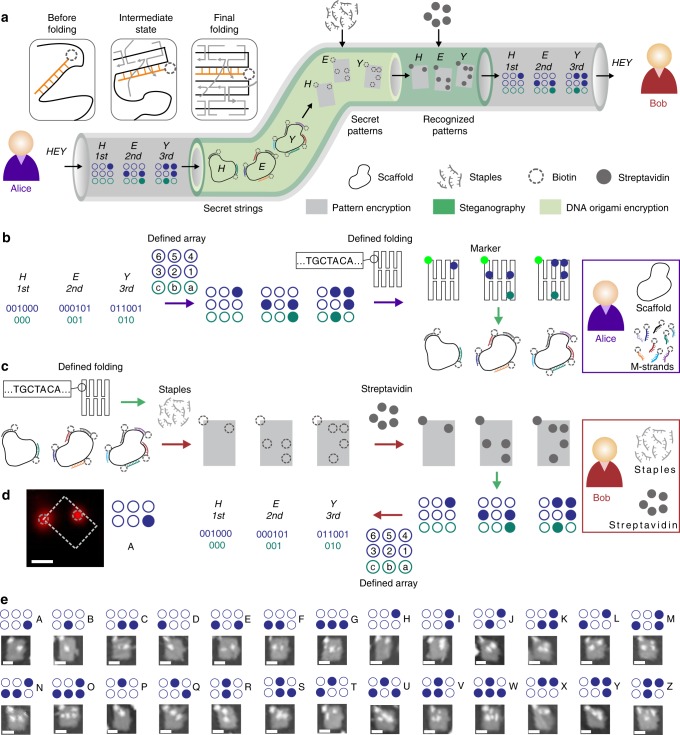
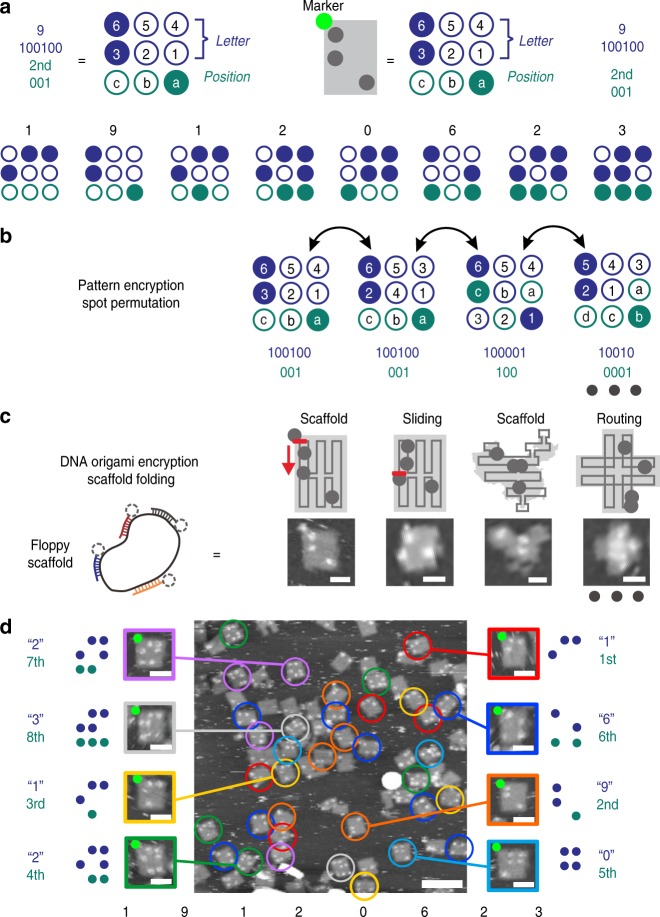
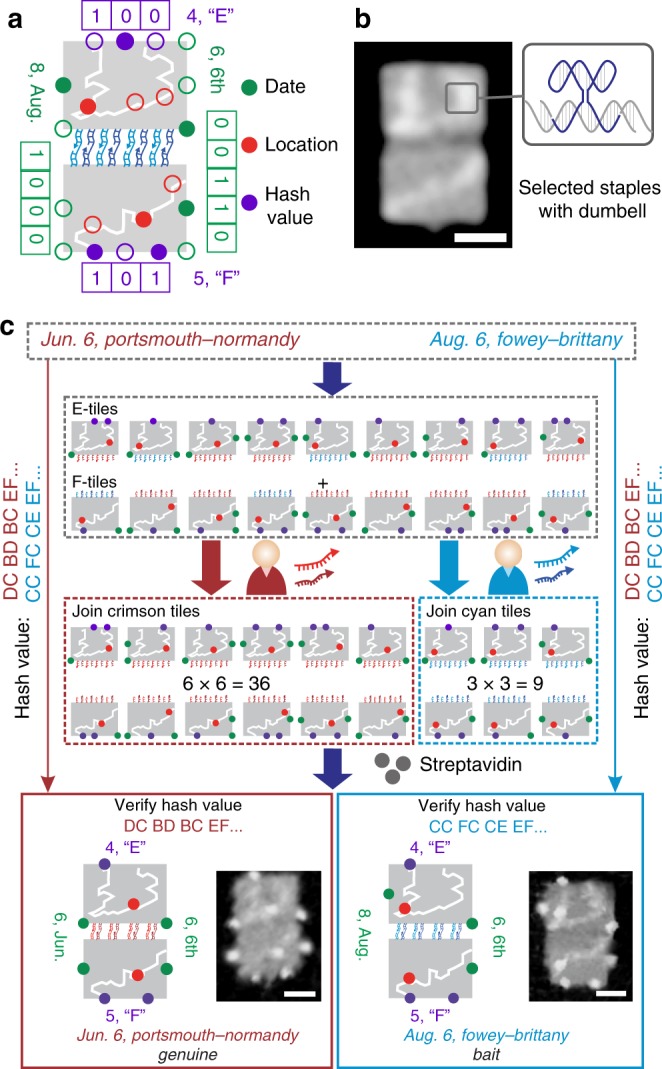
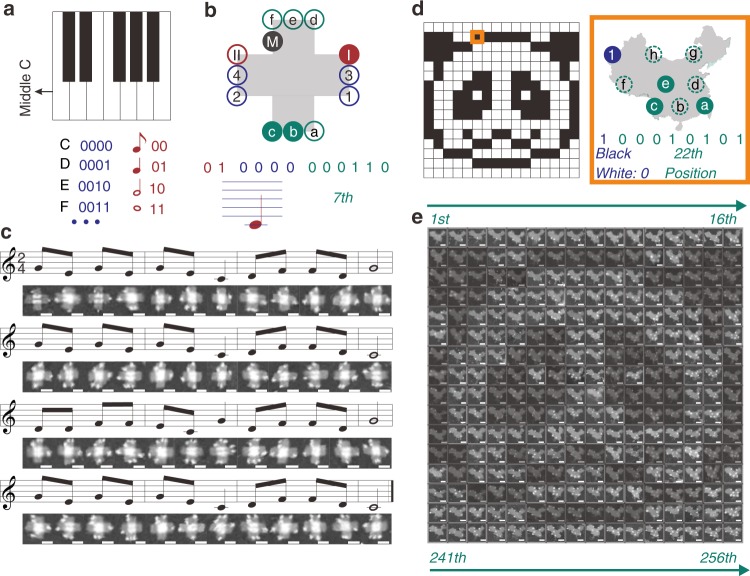
Verification
Claims the paper makes
The claims and statistics of this paper haven’t been checked yet.
Run the check — free, no account needed. It reads the open-access text and checks the sources it cites.
Claims other papers make about this one
Each is checked against this paper’s own text: does it say what the citing paper says it does?
The source backs part of the claim, not all of it — or backs it for a different population, condition or comparison.
In the citing paper
“Similarly, Fan et al. used AFM to decode information stored in DNA domino arrays.127”
From Emerging Approaches to DNA Data Storage: Challenges and Prospects (2022) · cites this paper as [127]
Experimental — accuracy not yet measuredIn the citing paper
“The decryption time for this method is 1–2 h, including sample processing, imaging, and readout—this time could be reduced by using high-speed AFM methods and fully automated image analysis algorithms.”
From Emerging Approaches to DNA Data Storage: Challenges and Prospects (2022) · cites this paper as [127]
In the citing paper
“In the context of DNA data storage, Zhang et al. demonstrated in 2019127 a “DNA braille” system, which was prepared by patterning biotinylated overhangs onto DNA origami.”
From Emerging Approaches to DNA Data Storage: Challenges and Prospects (2022) · cites this paper as [127]
In the citing paper
“The data in this system are encrypted; only when streptavidin is added and binds to biotin does the pattern become readable by AFM.”
From Emerging Approaches to DNA Data Storage: Challenges and Prospects (2022) · cites this paper as [127]
Self-check
Percentages, sums and reported differences re-computed from the paper’s own numbers.
The self-check needs the paper’s full text.
Citations
Cites
A method for obtaining digital signatures and public-key cryptosystems
Rivest, R. L., Shamir, A., & Adleman, L. (1978) · Communications of the ACM · doi:10.1145/359340.359342 · Cited by 13,462
A method for obtaining digital signatures and public-key cryptosystems
Rivest, R. L., Shamir, A., & Adleman, L. (1983) · Communications of the ACM · doi:10.1145/357980.358017 · Cited by 13,012
Quantum cryptography based on Bell’s theorem
Ekert, A. K. (1991) · Physical Review Letters · doi:10.1103/physrevlett.67.661 · Cited by 10,777
Folding DNA to create nanoscale shapes and patterns
Rothemund, P. W. K. (2006) · Nature · doi:10.1038/nature04586 · Cited by 7,474
A silicon-based nuclear spin quantum computer
Kane, B. E. (1998) · Nature · doi:10.1038/30156 · Cited by 3,779
Self-assembly of DNA into nanoscale three-dimensional shapes
Douglas, S. M., Dietz, H., Liedl, T., Högberg, B., Graf, F., & Shih, W. M. (2009) · Nature · doi:10.1038/nature08016 · Cited by 2,617
Introduction to Modern Cryptography
Katz, J. I., & Lindell, Y. (2014) · Chapman & Hall/CRC eBooks · doi:10.1201/b17668 · Cited by 1,881
Introduction to Modern Cryptography
Katz, J., & Lindell, Y. (2007) · doi:10.1201/9781420010756 · Cited by 1,238
The Economics of Information Security
Anderson, R., & Moore, T. (2006) · Science · doi:10.1126/science.1130992 · Cited by 859
THE ADVANCED ENCRYPTION STANDARD
Stallings, W. (2002) · Cryptologia · doi:10.1080/0161-110291890876 · Cited by 770
Cited by
Sorted by citations
Nucleic Acid Tests for Clinical Translation
Li, M., Yin, F., Song, L., Mao, X., Li, F., Fan, C., Zuo, X., & Xia, Q. (2021) · Chemical Reviews · doi:10.1021/acs.chemrev.1c00241 · Cited by 274
Self-citationEmerging Approaches to DNA Data Storage: Challenges and Prospects
Doricchi, A., Platnich, C. M., Gimpel, A., Horn, F., Earle, M., Lanzavecchia, G., Cortajarena, A. L., Liz-Marzán, L. M., Liu, N., Heckel, R., et al. (2022) · ACS Nano · doi:10.1021/acsnano.2c06748 · Cited by 235
Engineered microbial consortia: strategies and applications
Duncker, K. E., Holmes, Z. A., & You, L. (2021) · Microbial Cell Factories · doi:10.1186/s12934-021-01699-9 · Cited by 196
Zhao, Y., Zuo, X., Li, Q., Chen, F., Chen, Y.-R., Deng, J., Han, D., Hao, C., Huang, F., Huang, Y., et al. (2020) · Science China Chemistry · doi:10.1007/s11426-020-9864-7 · Cited by 167
Self-citationDNA as a universal chemical substrate for computing and data storage
Yang, S., Bögels, B. W. A., Wang, F., Xu, C., Dou, H., Mann, S., Fan, C., & de Greef, T. F. A. (2024) · Nature Reviews Chemistry · doi:10.1038/s41570-024-00576-4 · Cited by 144
Self-citation
Metadata
- Authors
- Zhang, Y., Wang, F., Chao, J., Xie, M., Liu, H., Pan, M., Kopperger, E., Liu, X., Li, Q., Shi, J., Wang, L., Hu, J., Wang, L., Simmel, F. C., & Fan, C.
- Affiliations
- Shanghai Jiao Tong University (CN)
- Nanjing University of Posts and Telecommunications (CN)
- Chinese Academy of Sciences (CN)
- Tongji University (CN)
- Technical University of Munich (DE)
- Corresponding author
- Liu, Huajie
- Fan, Chunhai
- ORCID
- Venue
- Nature Communications
- Published
- 2019-11-29
- Volume
- 10
- Issue
- 1
- Pages
- 5469-5469
- ISSN
- 2041-1723 (ISSN-L)
- PMC
- PMC6884444
- OpenAlex
- W2989620465
- Cited by
- 163
- References
- 43
- Citations by year
- 2026: 24 · 2025: 31 · 2024: 21 · 2023: 31 · 2022: 29 · 2021: 19 · 2020: 8
- FWCI
- 4.63
- Type
- journal article
- Language
- en
- Open access
- gold
- doi.org
- Locations
- Nature Communications (publishedVersion, cc-by)
- PubMed Central (publishedVersion, cc-by)
- PubMed (publishedVersion)
- RePEc: Research Papers in Economics (submittedVersion)
- DOAJ (DOAJ: Directory of Open Access Journals) (submittedVersion, cc-by-sa)
- DOAJ (DOAJ: Directory of Open Access Journals) (submittedVersion)
- mediaTUM – the media and publications repository of the Technical University Munich (Technical University Munich) (submittedVersion, other-oa)
- Funders
- National Natural Science Foundation of China (21675167, 21603262)
- Topics
- Physical Sciences › Mathematics › Theoretical Computer Science › DNA and Biological Computing
- Life Sciences › Biochemistry, Genetics and Molecular Biology › Molecular Biology › Advanced biosensing and bioanalysis techniques
- Physical Sciences › Computer Science › Computer Networks and Communications › Cryptography and Data Security
- Keywords
- DNA origami, secure communication, self-assembled nanostructures, message integrity, confidentiality, message transmission, DNA nanotechnology
- MeSH terms
- Communication, Confidentiality, DNA, Humans, Computer Security, Bacteriophage M13, Computers, Molecular
About these checks
Registry, retraction, Cites and statistics results are computed, not judged, with one exception: a printed reference that no index lists is read once by a model before it counts as a citation error. Claims are extracted by a model and kept only when their quote appears verbatim in the text; each cited source is then checked, with a model’s help, for whether it says what the claim relies on. Those verdicts can be wrong — read the claim’s quote and the cited source before relying on one.
Statistics and arithmetic are recomputed, not judged.
Confidence bands are shown only for fields calibrated on our annotated test set. None is calibrated yet, so no band is shown.
What counts as a claim ›How we measure confidence ›How we check this ›
Are you an author, or do you see a problem with this page? Request a review
