

The DOI matches its Crossref record; 43 of the 43 references it cites were found in a registry or an index.
DNA origami cryptography for secure communication
Open accessAbstract
Biomolecular cryptography exploiting specific biomolecular interactions for data encryption represents a unique approach for information security. However, constructing protocols based on biomolecular reactions to guarantee confidentiality, integrity and availability (CIA) of information remains a challenge. Here we develop DNA origami cryptography (DOC) that exploits folding of a M13 viral scaffold into nanometer-scale self-assembled braille-like patterns for secure communication, which can create a key with a size of over 700 bits. The intrinsic nanoscale addressability of DNA origami additionally allows for protein binding-based steganography, which further protects message confidentiality in DOC. The integrity of a transmitted message can be ensured by establishing specific linkages between several DNA origamis carrying parts of the message. The versatility of DOC is further demonstrated by transmitting various data formats including text, musical notes and images, supporting its great potential for meeting the rapidly increasing CIA demands of next-generation cryptography.
Overview
The claims and statistics of this paper haven’t been checked yet.
Run the check — free, no account needed. It reads the open-access text and checks the sources it cites.
Integrity signals
Registry
Cites
Statistics
Figures
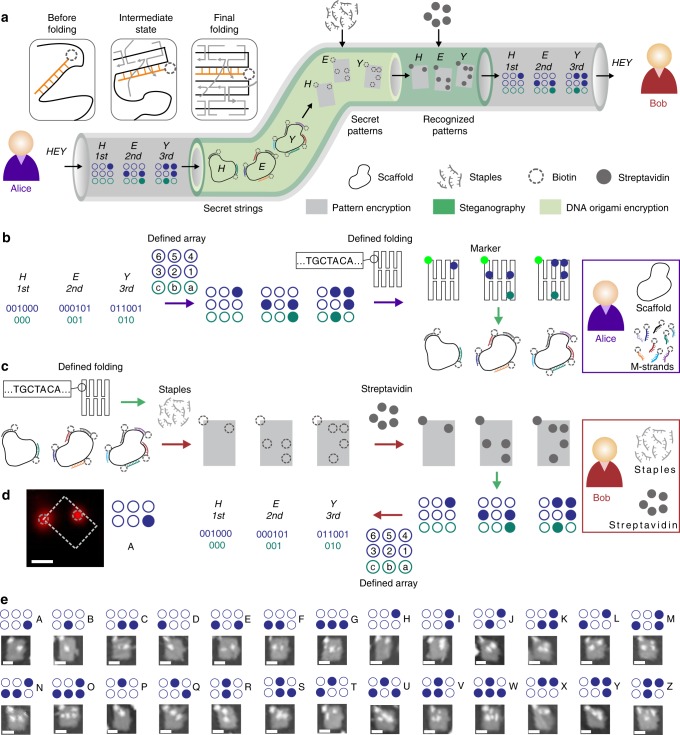
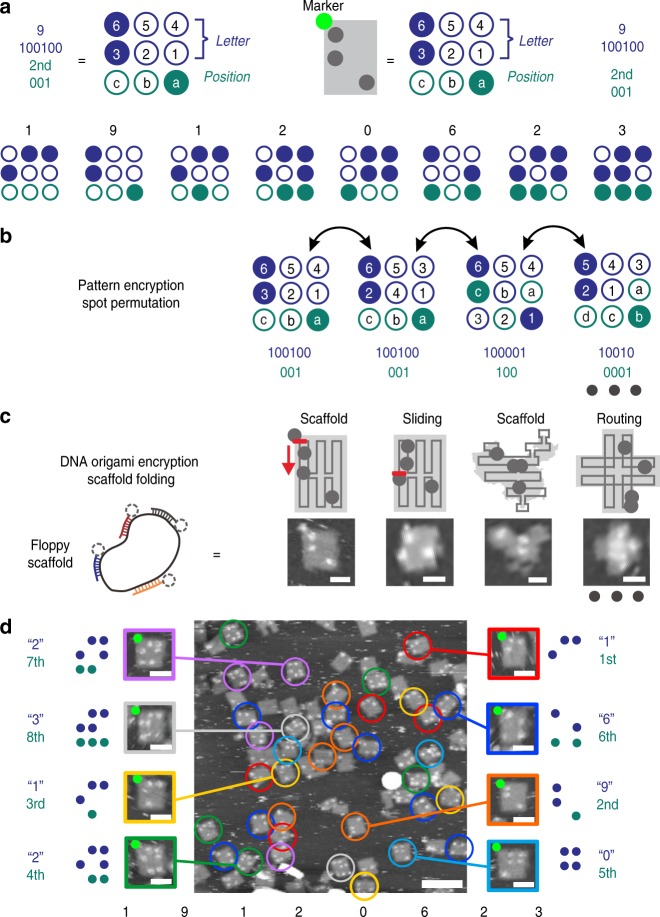
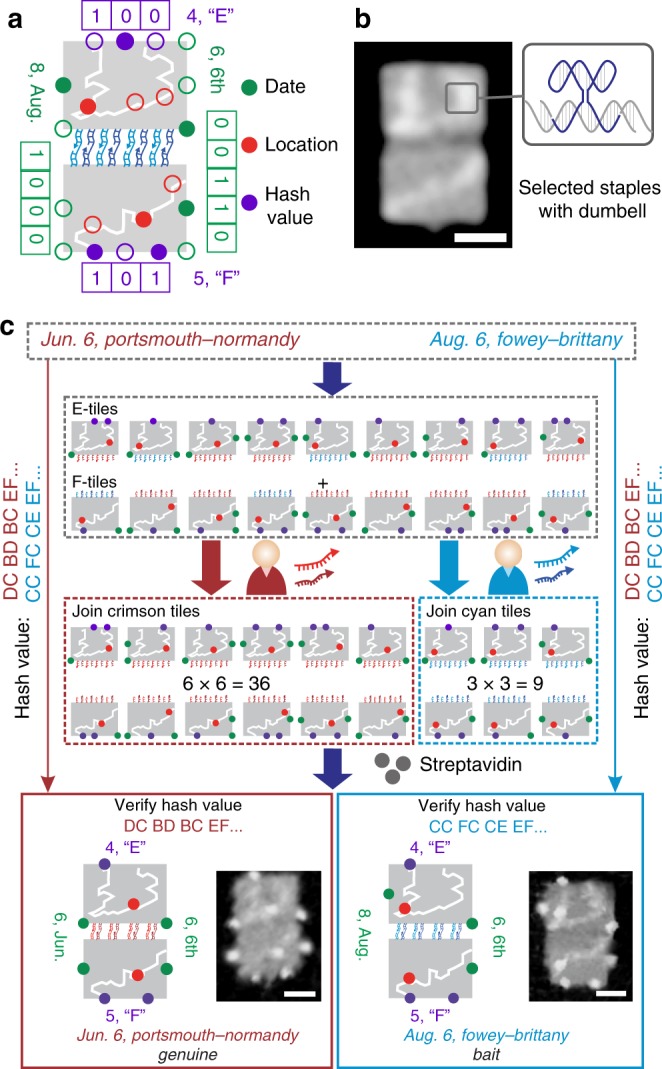
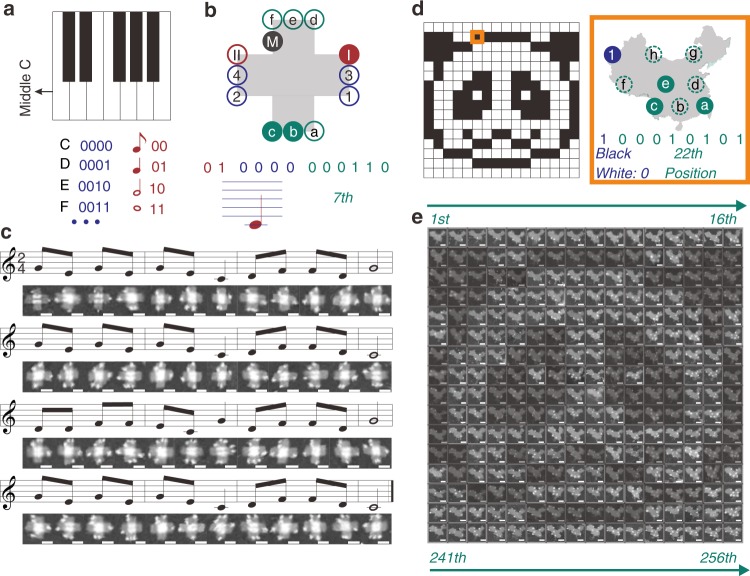
Verification
Claims the paper makes
The claims and statistics of this paper haven’t been checked yet.
Run the check — free, no account needed. It reads the open-access text and checks the sources it cites.
Claims other papers make about this one
Each is checked against this paper’s own text: does it say what the citing paper says it does?
In the citing paper
“The decryption time for this method is 1–2 h, including sample processing, imaging, and readout—this time could be reduced by using high-speed AFM methods and fully automated image analysis algorithms.”
From Emerging Approaches to DNA Data Storage: Challenges and Prospects (2022) · cites this paper as [127]
In the citing paper
“In the context of DNA data storage, Zhang et al. demonstrated in 2019127 a “DNA braille” system, which was prepared by patterning biotinylated overhangs onto DNA origami.”
From Emerging Approaches to DNA Data Storage: Challenges and Prospects (2022) · cites this paper as [127]
In the citing paper
“Similarly, Fan et al. used AFM to decode information stored in DNA domino arrays.127”
From Emerging Approaches to DNA Data Storage: Challenges and Prospects (2022) · cites this paper as [127]
In the citing paper
“The data in this system are encrypted; only when streptavidin is added and binds to biotin does the pattern become readable by AFM.”
From Emerging Approaches to DNA Data Storage: Challenges and Prospects (2022) · cites this paper as [127]
Self-check
Percentages, sums and reported differences re-computed from the paper’s own numbers.
The self-check needs the paper’s full text.
Citations
Cites
A method for obtaining digital signatures and public-key cryptosystems
Rivest, R. L., Shamir, A., & Adleman, L. (1978) · Communications of the ACM · doi:10.1145/359340.359342 · Cited by 13,462
A method for obtaining digital signatures and public-key cryptosystems
Rivest, R. L., Shamir, A., & Adleman, L. (1983) · Communications of the ACM · doi:10.1145/357980.358017 · Cited by 13,012
Quantum cryptography based on Bell’s theorem
Ekert, A. K. (1991) · Physical Review Letters · doi:10.1103/physrevlett.67.661 · Cited by 10,777
Folding DNA to create nanoscale shapes and patterns
Rothemund, P. W. K. (2006) · Nature · doi:10.1038/nature04586 · Cited by 7,474
A silicon-based nuclear spin quantum computer
Kane, B. E. (1998) · Nature · doi:10.1038/30156 · Cited by 3,779
Self-assembly of DNA into nanoscale three-dimensional shapes
Douglas, S. M., Dietz, H., Liedl, T., Högberg, B., Graf, F., & Shih, W. M. (2009) · Nature · doi:10.1038/nature08016 · Cited by 2,617
Introduction to Modern Cryptography
Katz, J. I., & Lindell, Y. (2014) · Chapman & Hall/CRC eBooks · doi:10.1201/b17668 · Cited by 1,881
Introduction to Modern Cryptography
Katz, J., & Lindell, Y. (2007) · doi:10.1201/9781420010756 · Cited by 1,238
The Economics of Information Security
Anderson, R., & Moore, T. (2006) · Science · doi:10.1126/science.1130992 · Cited by 859
THE ADVANCED ENCRYPTION STANDARD
Stallings, W. (2002) · Cryptologia · doi:10.1080/0161-110291890876 · Cited by 770
Cited by
Sorted by citations
Nucleic Acid Tests for Clinical Translation
Li, M., Yin, F., Song, L., Mao, X., Li, F., Fan, C., Zuo, X., & Xia, Q. (2021) · Chemical Reviews · doi:10.1021/acs.chemrev.1c00241 · Cited by 274
Self-citationEmerging Approaches to DNA Data Storage: Challenges and Prospects
Doricchi, A., Platnich, C. M., Gimpel, A., Horn, F., Earle, M., Lanzavecchia, G., Cortajarena, A. L., Liz-Marzán, L. M., Liu, N., Heckel, R., et al. (2022) · ACS Nano · doi:10.1021/acsnano.2c06748 · Cited by 235
Engineered microbial consortia: strategies and applications
Duncker, K. E., Holmes, Z. A., & You, L. (2021) · Microbial Cell Factories · doi:10.1186/s12934-021-01699-9 · Cited by 196
Zhao, Y., Zuo, X., Li, Q., Chen, F., Chen, Y.-R., Deng, J., Han, D., Hao, C., Huang, F., Huang, Y., et al. (2020) · Science China Chemistry · doi:10.1007/s11426-020-9864-7 · Cited by 167
Self-citationDNA as a universal chemical substrate for computing and data storage
Yang, S., Bögels, B. W. A., Wang, F., Xu, C., Dou, H., Mann, S., Fan, C., & de Greef, T. F. A. (2024) · Nature Reviews Chemistry · doi:10.1038/s41570-024-00576-4 · Cited by 144
Self-citationSynthetic DNA applications in information technology
Meiser, L. C., Nguyen, B. H., Chen, Y.-J., Nivala, J., Strauß, K., Ceze, L., & Grass, R. N. (2022) · Nature Communications · doi:10.1038/s41467-021-27846-9 · Cited by 134
Information Coding in a Reconfigurable DNA Origami Domino Array
Fan, S., Wang, D., Cheng, J. Q., Liu, Y., Luo, T., Cui, D., Ke, Y., & Song, J. (2020) · Angewandte Chemie International Edition · doi:10.1002/anie.202003823 · Cited by 95
A Novel Chaos-Based Privacy-Preserving Deep Learning Model for Cancer Diagnosis
Rehman, M. U., Shafique, A., Ghadi, Y. Y., Boulila, W., Jan, S. U., Gadekallu, T. R., Driss, M., & Ahmad, J. E. (2022) · IEEE Transactions on Network Science and Engineering · doi:10.1109/tnse.2022.3199235 · Cited by 95
Hao, Y., Li, Q., Fan, C., & Wang, F. (2021) · Small Structures · doi:10.1002/sstr.202000046 · Cited by 90
Self-citationParallel molecular data storage by printing epigenetic bits on DNA
Zhang, C., Wu, R., Sun, F., Lin, Y., Liang, Y., Liang, Y., Chen, Y., Teng, J., Song, Z., Liu, N., et al. (2024) · Nature · doi:10.1038/s41586-024-08040-5 · Cited by 97
Wang, S., Mao, X., Wang, F., Zuo, X., & Fan, C. (2023) · Advanced Materials · doi:10.1002/adma.202307499 · Cited by 89
Self-citationAn alternative approach to nucleic acid memory
Dickinson, G. D., Mortuza, G. M., Clay, W., Piantanida, L., Green, C. M., Watson, C., Hayden, E. J., Andersen, T., Kuang, W., Graugnard, E., et al. (2021) · Nature Communications · doi:10.1038/s41467-021-22277-y · Cited by 82
Wu, Y. H., Xu, J., Qin, X., Xu, J., & Liu, X. (2021) · Nature Communications · doi:10.1038/s41467-021-22387-7 · Cited by 77
Self-citationPrescribing Silver Chirality with DNA Origami
Zhang, Y., Qu, Z., Chu, J., Liu, Y., Narayanan, R. P., Williams, D., Zuo, X., Wang, L., Yan, H., Liu, H., et al. (2021) · Journal of the American Chemical Society · doi:10.1021/jacs.1c00363 · Cited by 72
Self-citationHe, Z., Shi, K., Li, J., & Chao, J. (2023) · iScience · doi:10.1016/j.isci.2023.106638 · Cited by 72
Self-citationA Novel Image Encryption Scheme for DNA Storage Systems Based on DNA Hybridization and Gene Mutation
Yao, X., Xie, R., Zan, X., Su, Y., Xu, P., & Liu, W. (2023) · Interdisciplinary Sciences Computational Life Sciences · doi:10.1007/s12539-023-00565-z · Cited by 64
Kulachenkov, N. K., Barsukova, M. O., Alekseevskiy, P. V., Sapianik, A. A., Sergeev, M. M., Yankin, A. N., Krasilin, A. A., Bachinin, S. V., Shipilovskikh, S. A., Poturaev, P., et al. (2022) · Nano Letters · doi:10.1021/acs.nanolett.2c01770 · Cited by 53
A new image encryption algorithm based on the OF-LSTMS and chaotic sequences
He, Y., Zhang, Y., He, X. J., & Wang, X. (2021) · Scientific Reports · doi:10.1038/s41598-021-85377-1 · Cited by 56
Self-citationManipulating energy migration in nanoparticles toward tunable photochromic upconversion
Huang, J., Tu, L., Huang, H., Wei, H., Zhang, Q., & Zhou, B. (2024) · Nature Communications · doi:10.1038/s41467-024-55258-y · Cited by 52
Zheng, L. L., Li, J. Z., Wen, M., Xi, D., Zhu, Y., Wei, Q. L., Zhang, X., Ke, G., Xia, F., & Gao, Z. F. (2023) · Science Advances · doi:10.1126/sciadv.adf5868 · Cited by 50
Recent Advances of DNA Nanostructure‐Based Cell Membrane Engineering
Feng, L., Li, J., Sun, J., Wang, L., Fan, C., & Shen, J. (2021) · Advanced Healthcare Materials · doi:10.1002/adhm.202001718 · Cited by 50
Self-citationToehold-Mediated Cascade Catalytic Assembly for Mycotoxin Detection and Its Logic Applications
Pan, J., Deng, F., Liu, Z., Shi, G., & Chen, J. (2022) · Analytical Chemistry · doi:10.1021/acs.analchem.1c05485 · Cited by 48
A Deniable Encryption Method for Modulation-Based DNA Storage
Chu, L., Su, Y., Zan, X., Lin, W., Yao, X., Xu, P., & Liu, W. (2024) · Interdisciplinary Sciences Computational Life Sciences · doi:10.1007/s12539-024-00648-5 · Cited by 46
Makino, K., Susaki, E. A., Endo, M., Asanuma, H., & Kashida, H. (2022) · Journal of the American Chemical Society · doi:10.1021/jacs.1c09844 · Cited by 45
Recent Progress of Magnetically Actuated DNA Micro/Nanorobots
Liu, F., Liu, X., Huang, Q., & Arai, T. (2022) · Cyborg and Bionic Systems · doi:10.34133/2022/9758460 · Cited by 45
Self-citationMachine Learning in Chaos-Based Encryption: Theory, Implementations, and Applications
Hwang, J., Kale, G., Patel, P. P., Vishwakarma, R., Aliasgari, M., Hedayatipour, A., Rezaei, A., & Sayadi, H. (2023) · IEEE Access · doi:10.1109/access.2023.3331320 · Cited by 46
A primordial DNA store and compute engine
Lin, K. N., Volkel, K., Cao, C., Hook, P. W., Polak, R. E., Clark, A. S., San‐Miguel, A., Timp, W., Tuck, J. M., Velev, O. D., et al. (2024) · Nature Nanotechnology · doi:10.1038/s41565-024-01771-6 · Cited by 41
Artificial Intelligence in Medicine Using Quantum Computing in the Future of Healthcare
Davids, J., Lidströmer, N., & Ashrafian, H. (2022) · Springer eBooks · doi:10.1007/978-3-030-64573-1_338 · Cited by 38
Pharmaceutical applications of framework nucleic acids
Chen, L., Zhang, J., Lin, Z., Zhang, Z., Mao, M., Wu, J., Li, Q., Zhang, Y., & Fan, C. (2021) · Acta Pharmaceutica Sinica B · doi:10.1016/j.apsb.2021.05.022 · Cited by 32
Self-citationLu, J., Guo, Z., Huang, W. T., Bao, M., He, B., Li, G., Lei, J., & Lei, J. (2023) · Talanta · doi:10.1016/j.talanta.2023.125261 · Cited by 33
Peptide-Based Sensing, Logic Computing, and Information Security on the Antimonene Platform
Bu, Z. Q., Yao, Q. F., Liu, Q. Y., Quan, M. X., Lu, J., & Huang, W. T. (2022) · ACS Applied Materials & Interfaces · doi:10.1021/acsami.1c23814 · Cited by 32
How close are we to storing data in DNA?
Gervásio, J. H. D. B., Oliveira, H. D. C., Costa-Martins, A. G., Pesquero, J. B., Verona, B. M., & Cerize, N. N. P. (2023) · Trends in biotechnology · doi:10.1016/j.tibtech.2023.08.001 · Cited by 36
A molecular device: A DNA molecular lock driven by the nicking enzymes
Zhang, X., Zhang, Q., Liu, Y., Wang, B., & Zhou, S. (2020) · Computational and Structural Biotechnology Journal · doi:10.1016/j.csbj.2020.08.004 · Cited by 29
Preservation and Encryption in DNA Digital Data Storage
Zhang, Y., Ren, Y., Liu, Y., Wang, F., Zhang, H., & Liu, K. (2022) · ChemPlusChem · doi:10.1002/cplu.202200183 · Cited by 28
Self-citationGold‐Nanoparticle‐Mediated Assembly of High‐Order DNA Nano‐Architectures
Yin, J., Xie, M., Wang, J., Cui, M.-R., Zhu, D., Su, S., Fan, C., Chao, J., Li, Q., & Wang, L. (2022) · Small · doi:10.1002/smll.202200824 · Cited by 28
Self-citationLiu, Q. Y., Bu, Z. Q., Quan, M. X., Wu, Y., Ding, X., Xia, L. Q., Lu, J., & Huang, W. T. (2022) · Biosensors and Bioelectronics · doi:10.1016/j.bios.2022.114260 · Cited by 27
Efficient data reconstruction: The bottleneck of large-scale application of DNA storage
Cao, B., Zheng, Y., Shao, Q., Liu, Z., Xie, L., Zhao, Y., Wang, B., Zhang, Q., & Wei, X. (2024) · Cell Reports · doi:10.1016/j.celrep.2024.113699 · Cited by 33
Islam, Y. M., Li, C., Sun, K., & He, S. (2024) · Multimedia Tools and Applications · doi:10.1007/s11042-024-18107-0 · Cited by 26
Circular single-stranded DNA as switchable vector for gene expression in mammalian cells
Tang, L., Tian, Z., Cheng, J. Q., Zhang, Y., Song, Y., Liu, Y., Wang, J., Zhang, P., Ke, Y., Simmel, F. C., et al. (2023) · Nature Communications · doi:10.1038/s41467-023-42437-6 · Cited by 31
Self-citationRana, A., Gautam, D., Kumar, P., & Das, A. K. (2024) · IEEE Communications Surveys & Tutorials · doi:10.1109/comst.2024.3423477 · Cited by 30
Empowering DNA-Based Information Processing: Computation and Data Storage
Li, K., Chen, H., Li, D., Yang, C. J., Zhang, H., & Zhu, Z. (2024) · ACS Applied Materials & Interfaces · doi:10.1021/acsami.4c13948 · Cited by 26
Chu, L., Su, Y., Yao, X., Xu, P., & Liu, W. (2024) · Intelligent Computing · doi:10.34133/icomputing.0106 · Cited by 24
Information Coding in a Reconfigurable DNA Origami Domino Array
Fan, S., Wang, D., Cheng, J. Q., Liu, Y., Luo, T., Cui, D., Ke, Y., & Song, J. (2020) · Angewandte Chemie · doi:10.1002/ange.202003823 · Cited by 20
Biomolecule-Driven Two-Factor Authentication Strategy for Access Control of Molecular Devices
Zhang, X., Liu, Y., Wang, B., Zhou, S., Shi, P., Cao, B., Zheng, Y., Zhang, Q., & Kasabov, N. K. (2023) · ACS Nano · doi:10.1021/acsnano.3c05070 · Cited by 19
DNA storage: The future direction for medical cold data storage
Shen, P., Zheng, Y., Zhang, C., Li, S., Chen, Y., Chen, Y., Liu, Y., & Cai, Z. (2025) · Synthetic and Systems Biotechnology · doi:10.1016/j.synbio.2025.03.006 · Cited by 18
Sequential DNA Coding for Programmable Information Encryption
Fu, W., Zhao, Y., Cao, J., Zhao, X., Chen, F., Fan, C., & Zhao, Y. (2025) · Advanced Materials · doi:10.1002/adma.202418688 · Cited by 17
Self-citationLi, J. Z., Dong, L. M., Zheng, L. L., Fu, W. L., Zhang, J., Zhang, L., Hu, Q., Chen, P., Gao, Z. F., & Xia, F. (2022) · ACS Applied Materials & Interfaces · doi:10.1021/acsami.2c11532 · Cited by 17
A Double-Layer Image Encryption Scheme Based on Chaotic Maps and DNA Strand Displacement
Tang, Z., Yin, Z., Wang, R., Wang, X., Yang, J., & Cui, J. (2022) · Journal of Chemistry · doi:10.1155/2022/3906392 · Cited by 16
RetractedLiu, Q. Y., Wu, Y., Bu, Z. Q., Quan, M. X., Lu, J., & Huang, W. T. (2023) · Small · doi:10.1002/smll.202207436 · Cited by 16
40Gb/s Secure Optical Communication Based on Symbol-by-Symbol Optical Phase Encryption
Gao, Z., An, Y., Wang, A., Li, P., Qin, Y., Wang, Y., & Wang, X. (2020) · IEEE Photonics Technology Letters · doi:10.1109/lpt.2020.3000215 · Cited by 16
Han, Y., You, Y., Xu, X., Li, X., Liu, G.-Z., & Lai, G.-S. (2024) · ACS Sensors · doi:10.1021/acssensors.3c02594 · Cited by 15
Prescribing DNA Origami Patterns via Scaffold Decoration
Zhang, Y., Li, Q., Liu, X., Fan, C., Liu, H., & Wang, L. (2020) · Small · doi:10.1002/smll.202000793 · Cited by 15
Self-citationResearch Progress in Construction and Application of Enzyme-Based DNA Logic Gates
Liu, J., Liu, S., Zou, C., Xu, S., & Zhou, C. (2022) · IEEE Transactions on NanoBioscience · doi:10.1109/tnb.2022.3181615 · Cited by 14
Mechanical DNA Origami to Investigate Biological Systems
Mills, A. T., Aissaoui, N., Finkel, J., Elezgaray, J., & Bellot, G. (2022) · Advanced Biology · doi:10.1002/adbi.202200224 · Cited by 14
Towards next-generation DNA encryption via an expanded genetic system
Huang, X., Hou, Z., Qiang, W., Wang, H., Wang, X., Chen, X., Hu, X., Dai, J., Li, L., & Zhao, G. (2024) · National Science Review · doi:10.1093/nsr/nwae469 · Cited by 15
Emerging preservation materials for long-term DNA-based data storage
Huang, Q., Duan, J., Xi, M., Fei, S., Xie, S., Hu, C., Chen, C. Q., & Deng, Z. (2025) · Chemical Engineering Journal · doi:10.1016/j.cej.2025.161245 · Cited by 13
Reconfiguration of DNA nanostructures induced by enzymatic ligation treatment
Bai, T., Zhang, J., Huang, K., Wang, W., Chen, B., Li, Y., Zhao, M., Zhang, S., Zhu, C., Liu, D., et al. (2022) · Nucleic Acids Research · doi:10.1093/nar/gkac606 · Cited by 12
Controllable dynamics of complex DNA nanostructures
Wang, W., Shen, Y., & Wei, B. (2023) · Nanoscale · doi:10.1039/d2nr05872c · Cited by 12
Zhang, X., Dong, Y., Wang, Y., Zhang, Z., Zhang, X., Zhu, J., Tian, Y., & Min, Q. (2023) · Angewandte Chemie International Edition · doi:10.1002/anie.202313446 · Cited by 12
Subtraction‐based DNA Origami Cryptography by using Structural Defects for Information Encryption
Chu, J., Tan, R., Li, W., Zhang, Y., & Liu, H. (2024) · Small · doi:10.1002/smll.202406470 · Cited by 12
Self-citationTime‐Controlled Authentication Strategies for Molecular Information Transfer
Hu, M., Yang, M., Cheng, X., & Wu, T. (2024) · Small · doi:10.1002/smll.202400261 · Cited by 11
Data Readout Techniques for DNA‐Based Information Storage
Liu, B., Wang, F., Fan, C., & Li, Q. (2025) · Advanced Materials · doi:10.1002/adma.202412926 · Cited by 12
Self-citationThe art of molecular computing: Whence and whither
Gangadharan, S., & Raman, K. (2021) · BioEssays · doi:10.1002/bies.202100051 · Cited by 11
Lu, J., Jiang, Q., Lei, J. J., He, Y. X., & Huang, W. T. (2022) · Analytica Chimica Acta · doi:10.1016/j.aca.2022.340483 · Cited by 10
Gu, Z., Xie, R., Liu, H., Liu, Y., Wang, X., Zhang, H., Gao, J., YOSIDA, T. H., Chen, S., & Ding, J. (2024) · Nanophotonics · doi:10.1515/nanoph-2024-0314 · Cited by 10
Self-citationDiverse applications of DNA origami as a cross-disciplinary tool
Xiao, L., Hu, X., Zhou, Z., Xie, X., Huang, S., Ji, M., Xu, A., & Tian, Y. (2025) · Nanoscale · doi:10.1039/d4nr04490h · Cited by 10
A six-plex switchable DNA origami cipher disk for tandem-in-time cryptography
Dong, Y., Jin, Z., Zhang, X., Tang, Y., Tian, Y., Zhu, J., & Min, Q. (2022) · Chemical Communications · doi:10.1039/d2cc01349e · Cited by 10
Li, X., Dai, X., Pan, Y., Sun, Y., Yang, B., Chen, K., Wang, Y., Xu, J., Dong, Y., Yang, Y. R., et al. (2022) · Journal of the American Chemical Society · doi:10.1021/jacs.2c08930 · Cited by 9
An image cryptography method by highly error-prone DNA storage channel
Zan, X., Xie, R., Chu, L., Su, Y., Yao, X., Xu, P., & Liu, W. (2023) · Frontiers in Bioengineering and Biotechnology · doi:10.3389/fbioe.2023.1173763 · Cited by 11
Spike Learning Based Privacy Preservation of Internet of Medical Things in Metaverse
Khowaja, S. A., Dahri, K., Jarwar, M. A., & Lee, I. H. (2023) · IEEE Journal of Biomedical and Health Informatics · doi:10.1109/jbhi.2023.3306704 · Cited by 9
Current and emerging opportunities in biological medium‐based computing and digital data storage
Bennet, D., Vo‐Dinh, T., & Zenhausern, F. (2021) · Nano Select · doi:10.1002/nano.202100275 · Cited by 9
Exploring DNA Computers: Advances in Storage, Cryptography and Logic Circuits
Xie, X., Wang, S., Chen, Z., Yu, Y., Hu, X., Ma, N., Ji, M., & Tian, Y. (2024) · ChemBioChem · doi:10.1002/cbic.202400670 · Cited by 9
Instruction-responsive programmable assemblies with DNA origami block pieces
Wang, F., Shi, X., Chen, X., Deng, D., Li, S., Sun, S., Kou, Z., Xu, J. B., & Qiang, X. (2024) · Nucleic Acids Research · doi:10.1093/nar/gkae1193 · Cited by 8
Self-citationTransmembrane capability of DNA origami sheet enhanced by 3D configurational changes
Liu, F., Liu, X., Gao, W., Zhao, L., Huang, Q., & Arai, T. (2023) · iScience · doi:10.1016/j.isci.2023.106208 · Cited by 8
Self-citationPreparation of DNA Origami Belt and Effect of pH on Its Stability
Qing, T. A. O., Chen, Q., Bian, X., Liu, G., & Yan, J. (2021) · Chinese Journal of Analytical Chemistry · doi:10.1016/s1872-2040(21)60098-1 · Cited by 8
Nawaz, M., Khan, W. U., Ali, Z., Ihsan, A., Waqar, O., & Sidhu, G. A. S. (2021) · IEEE Open Journal of Antennas and Propagation · doi:10.1109/ojap.2021.3078233 · Cited by 8
Lu, J., Bu, Z. Q., & Huang, W. T. (2022) · Microchemical Journal · doi:10.1016/j.microc.2022.108198 · Cited by 7
Recent Advances in Dynamic DNA Nanodevice
Fan, Q., Yang, L., & Chao, J. (2023) · Chemistry · doi:10.3390/chemistry5030122 · Cited by 7
Self-citationHigh-speed 3D DNA PAINT and unsupervised clustering for unlocking 3D DNA origami cryptography
Wisna, G. B. M., Sukhareva, D., Zhao, J., Chopade, P., Satyabola, D., Matthies, M., Roy, S., Wang, C., Šulc, P., Yan, H., et al. (2025) · Nature Communications · doi:10.1038/s41467-025-66338-y · Cited by 10
A DNA origami framework cryptosystem with nanoconfinement control of fluorescence logic permutations
Hou, X., Zhang, Y., Liu, Y., Xia, Q., Zhang, Y., Wang, J., Li, J., Wang, F., Wang, L., Liu, H., et al. (2025) · Science Advances · doi:10.1126/sciadv.aea7518 · Cited by 7
Self-citationFan, Q., Zhao, X., Li, J., Liu, R., Liu, M., Feng, Q., Long, Y., Fu, Y., Zhai, J., Pan, Q., et al. (2025) · Nature Communications · doi:10.1038/s41467-025-59357-2 · Cited by 9
Wang, J., Yuan, J., Liu, J., Zou, H., Yang, L., Chen, H., & Qu, X. (2023) · Small · doi:10.1002/smll.202207622 · Cited by 7
Ji, H., Chen, H.-H., Mao, T., Zhao, L., Zhang, K., Yang, M., Zhou, X., Wang, Q., Wu, L. J., & Qin, Y. (2023) · Advanced Optical Materials · doi:10.1002/adom.202300991 · Cited by 7
DNA computing: DNA circuits and data storage
Xu, H., Yu, Y., Li, P.-X., Liu, S., Yan, X., Zhou, Z., & Tian, Y. (2025) · Nanoscale Horizons · doi:10.1039/d5nh00459d · Cited by 7
Rapid Information Retrieval from DNA Storage with Microfluidic Very Large‐Scale Integration Platform
Liu, D., & Cheow, L. F. (2023) · Small · doi:10.1002/smll.202309867 · Cited by 8
Multifunctional Exo III-assisted scalability strategy for constructing DNA molecular logic circuits
Zeng, C., Liu, X., Wang, B., Qin, R., & Zhang, Q. (2023) · The Analyst · doi:10.1039/d3an00086a · Cited by 6
Self-citationToward high-density streptavidin arrays on DNA origami nanostructures
Rabbe, L., Tomm, E., Grundmeier, G., & Keller, A. (2025) · RSC Advances · doi:10.1039/d5ra03393d · Cited by 5
DNA Origami‐Based Protein Manipulation Systems: From Function Regulation to Biological Application
Xu, Z., Huang, Y., Yin, H., Zhu, X., Tian, Y., & Min, Q. (2021) · ChemBioChem · doi:10.1002/cbic.202100597 · Cited by 5
A CRISPR-Cas and Argonaute-Driven Two-Factor Authentication Strategy for Information Security
Fu, R., Hou, J., Wang, Z., Zhu, C., & Xianyu, Y. (2025) · ACS Nano · doi:10.1021/acsnano.4c17560 · Cited by 5
Liu, Y., Zhang, X., Zhang, X., Liu, X., Wang, B., Zhang, Q., & Wei, X. (2023) · RSC Advances · doi:10.1039/d3ra03995a · Cited by 5
Self-citationRecent Advances in DNA‐Templated Protein Patterning
Xia, Q., Zhou, M., Jiao, K., Li, B., Guo, L., Wang, L., & Li, J. (2025) · Small Methods · doi:10.1002/smtd.202401835 · Cited by 5
Self-citationEncryption technique based on fuzzy neural network hiding module and effective distortion method
Al-Muhammed, M. J., & Al-Daraiseh, A. A. (2022) · Neural Computing and Applications · doi:10.1007/s00521-022-06950-x · Cited by 5
Mapping Temporally Ordered Inputs to Binary Message Outputs with a DNA Temporal Logic Circuit
Zhao, S., Liu, Y., Zhang, X., Qin, R., Wang, B., & Zhang, Q. (2023) · Nanomaterials · doi:10.3390/nano13050903 · Cited by 5
Toward Smart Information Processing with Synthetic DNA Molecules
Chu, J., Zhang, Y., Wang, F., & Liu, H. (2021) · Macromolecular Rapid Communications · doi:10.1002/marc.202100084 · Cited by 6
Self-citationAlgorithm-empowered DNA molecular machines
Wang, J., Wang, L., & Chao, J. (2026) · Cell Reports Physical Science · doi:10.1016/j.xcrp.2026.103165 · Cited by 4
Self-citationConcept, development and applications of DNA computation
Zhang, M., & Han, D. (2023) · Fundamental Research · doi:10.1016/j.fmre.2023.06.015 · Cited by 4
The controllable patterning of tannic acid on DNA origami
Luo, Y., Niu, L., Hao, P., Sun, X., Zhao, Y., & Wu, N. (2023) · Nanoscale · doi:10.1039/d3nr04715f · Cited by 4
Lu, J., Xie, Z. X., Zhou, J., Wu, M. Y., Tian, Y. Q., Fu, T. T., Wang, D. H., He, B. S., & Huang, W. T. (2025) · Advanced Composites and Hybrid Materials · doi:10.1007/s42114-025-01334-w · Cited by 4
DNA Origami Nanodevices for Therapeutic Delivery Applications
Halley, P. D., Lucas, C. R., Roki, N., Vantangoli, N. J., Chenoweth, K. P., & Castro, C. E. (2022) · Springer eBooks · doi:10.1007/978-3-030-93333-3_8 · Cited by 4
Distributed information encoding and decoding using self-organized spatial patterns
Lu, J. G., Tsoi, R., Luo, N., Ha, Y., Wang, S., Kwak, M., Baig, Y., Moiseyev, N., Tian, S., Zhang, A., et al. (2022) · Patterns · doi:10.1016/j.patter.2022.100590 · Cited by 4
Metadata
- Authors
- Zhang, Y., Wang, F., Chao, J., Xie, M., Liu, H., Pan, M., Kopperger, E., Liu, X., Li, Q., Shi, J., Wang, L., Hu, J., Wang, L., Simmel, F. C., & Fan, C.
- Affiliations
- Shanghai Jiao Tong University (CN)
- Nanjing University of Posts and Telecommunications (CN)
- Chinese Academy of Sciences (CN)
- Tongji University (CN)
- Technical University of Munich (DE)
- Corresponding author
- Liu, Huajie
- Fan, Chunhai
- ORCID
- Venue
- Nature Communications
- Published
- 2019-11-29
- Volume
- 10
- Issue
- 1
- Pages
- 5469-5469
- ISSN
- 2041-1723 (ISSN-L)
- PMC
- PMC6884444
- OpenAlex
- W2989620465
- Cited by
- 163
- References
- 43
- Citations by year
- 2026: 24 · 2025: 31 · 2024: 21 · 2023: 31 · 2022: 29 · 2021: 19 · 2020: 8
- FWCI
- 4.63
- Type
- journal article
- Language
- en
- Open access
- gold
- doi.org
- Locations
- Nature Communications (publishedVersion, cc-by)
- PubMed Central (publishedVersion, cc-by)
- PubMed (publishedVersion)
- RePEc: Research Papers in Economics (submittedVersion)
- DOAJ (DOAJ: Directory of Open Access Journals) (submittedVersion, cc-by-sa)
- DOAJ (DOAJ: Directory of Open Access Journals) (submittedVersion)
- mediaTUM – the media and publications repository of the Technical University Munich (Technical University Munich) (submittedVersion, other-oa)
- Funders
- National Natural Science Foundation of China (21675167, 21603262)
- Topics
- Physical Sciences › Mathematics › Theoretical Computer Science › DNA and Biological Computing
- Life Sciences › Biochemistry, Genetics and Molecular Biology › Molecular Biology › Advanced biosensing and bioanalysis techniques
- Physical Sciences › Computer Science › Computer Networks and Communications › Cryptography and Data Security
- Keywords
- DNA origami, secure communication, self-assembled nanostructures, message integrity, confidentiality, message transmission, DNA nanotechnology
- MeSH terms
- Communication, Confidentiality, DNA, Humans, Computer Security, Bacteriophage M13, Computers, Molecular
About these checks
Registry, retraction, Cites and statistics results are computed, not judged, with one exception: a printed reference that no index lists is read once by a model before it counts as a citation error. Claims are extracted by a model and kept only when their quote appears verbatim in the text; each cited source is then checked, with a model’s help, for whether it says what the claim relies on. Those verdicts can be wrong — read the claim’s quote and the cited source before relying on one.
Statistics and arithmetic are recomputed, not judged.
Confidence bands are shown only for fields calibrated on our annotated test set. None is calibrated yet, so no band is shown.
What counts as a claim ›How we measure confidence ›How we check this ›
Are you an author, or do you see a problem with this page? Request a review
