

Impact of commonly used drugs on the composition and metabolic function of the gut microbiota
Open accessThe DOI matches its Crossref record; 45 of the 47 references it cites were found in a registry or an index.
Abstract
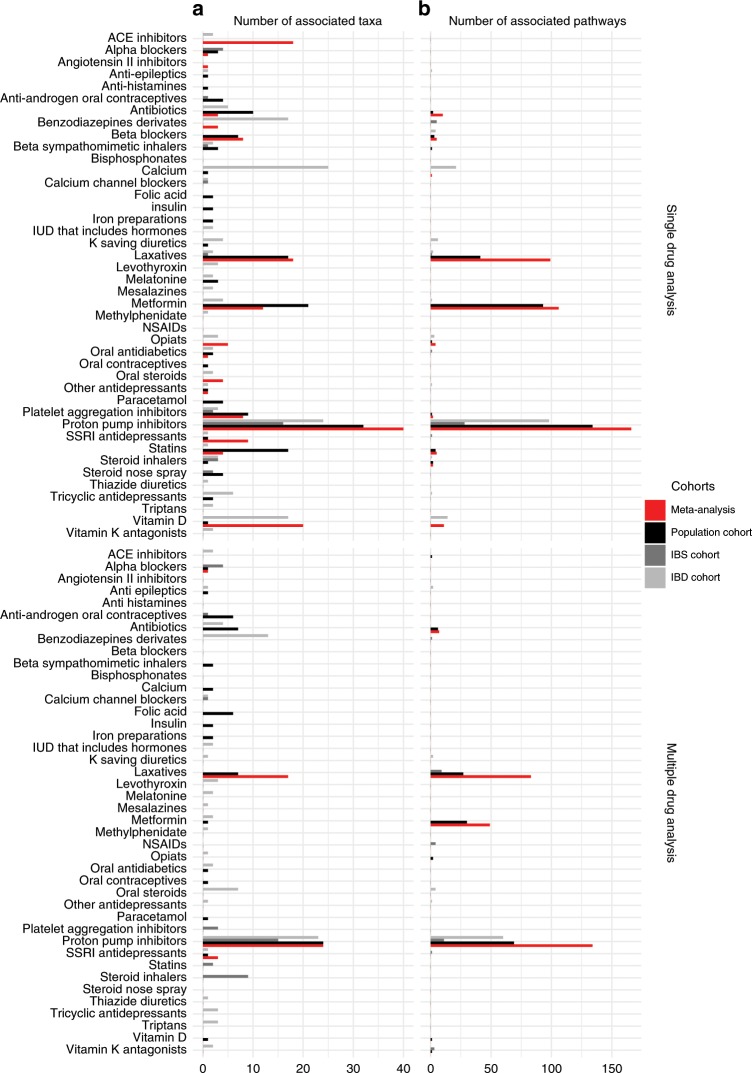
The human gut microbiota has now been associated with drug responses and efficacy, while chemical compounds present in these drugs can also impact the gut bacteria. However, drug–microbe interactions are still understudied in the clinical context, where polypharmacy and comorbidities co-occur. Here, we report relations between commonly used drugs and the gut microbiome. We performed metagenomics sequencing of faecal samples from a population cohort and two gastrointestinal disease cohorts. Differences between users and non-users were analysed per cohort, followed by a meta-analysis. While 19 of 41 drugs are found to be associated with microbial features, when controlling for the use of multiple medications, proton-pump inhibitors, metformin, antibiotics and laxatives show the strongest associations with the microbiome. We here provide evidence for extensive changes in taxonomy, metabolic potential and resistome in relation to commonly used drugs. This paves the way for future studies and has implications for current microbiome studies by demonstrating the need to correct for multiple drug use.
Overview
The claims and statistics of this paper haven’t been checked yet.
Free: it reads the open-access text and checks the first 5 claims that cite a source we can check. Create a free account to check every claim.
Integrity signals
Registry
Cites
Statistics
Figures
Verification
Claims the paper makes
The claims and statistics of this paper haven’t been checked yet.
Free: it reads the open-access text and checks the first 5 claims that cite a source we can check. Create a free account to check every claim.
Claims other papers make about this one
Each is checked against this paper’s own text: does it say what the citing paper says it does?
In the citing paper
“Broad surveys identify antibiotics,16 proton-pump inhibitors (PPIs),89 benzodiazepine derivatives,90 antidiabetics, non-steroidal anti-inflammatories, and immunosuppressants as major drivers of microbial richness, diversity, and composition.43,58,70,91”
From Gut dysbiosis in oncology: a risk factor for immunoresistance (2026) · doi:10.1038/s41422-025-01212-6 · cites this paper as [91]
Self-check
Percentages, sums and reported differences re-computed from the paper’s own numbers.
The self-check needs the paper’s full text.
Citations
Cites
METAL: fast and efficient meta-analysis of genomewide association scans
Willer, C. J., Li, Y., & Abecasis, G. R. (2010) · Bioinformatics · doi:10.1093/bioinformatics/btq340 · Cited by 5,205
Ford Alexander, C., Paul, M., Hanauer Steven, B., 谭蓓, & Dong, W. Z. (2001) · Cited by 3,021
Population-level analysis of gut microbiome variation
Falony, G., Joossens, M., Vieira-Silva, S., Wang, J., Darzi, Y., Faust, K., Kurilshikov, A., Bonder, M. J., Valles-Colomer, M., Vandeputte, D., et al. (2016) · Science · doi:10.1126/science.aad3503 · Cited by 2,400
Self-citationMetaPhlAn2 for enhanced metagenomic taxonomic profiling
Truong, D. T., Franzosa, E. A., Tickle, T. L., Scholz, M., Weingart, G., Pasolli, E., Tett, A., Huttenhower, C., & Segata, N. (2015) · Nature Methods · doi:10.1038/nmeth.3589 · Cited by 2,185
Baumgart, D. C., & Sandborn, W. J. (2012) · The Lancet · doi:10.1016/s0140-6736(12)60026-9 · Cited by 2,154
Disentangling type 2 diabetes and metformin treatment signatures in the human gut microbiota
MetaHIT consortium, Forslund, K., Hildebrand, F., Nielsen, T., Falony, G., Le Chatelier, E., Sunagawa, S., Prifti, E., Vieira-Silva, S., Gudmundsdottir, V., et al. (2015) · Nature · doi:10.1038/nature15766 · Cited by 2,116
Ordás, I., Eckmann, L., Talamini, M., Baumgart, D. C., & Sandborn, W. J. (2012) · The Lancet · doi:10.1016/s0140-6736(12)60150-0 · Cited by 2,078
Gut microbiome structure and metabolic activity in inflammatory bowel disease
Franzosa, E. A., Sirota-Madi, A., Avila-Pacheco, J., Fornelos, N., Haiser, H. J., Reinker, S., Vatanen, T., Hall, A. B., Mallick, H., McIver, L. J., et al. (2018) · Nature Microbiology · doi:10.1038/s41564-018-0306-4 · Cited by 1,995
Self-citationPopulation-based metagenomics analysis reveals markers for gut microbiome composition and diversity
Zhernakova, A., Kurilshikov, A., Bonder, M. J., Tigchelaar, E. F., Schirmer, M., Vatanen, T., Mujagic, Z., Vila, A. V., Falony, G., Vieira-Silva, S., et al. (2016) · Science · doi:10.1126/science.aad3369 · Cited by 1,914
Self-citationExtensive impact of non-antibiotic drugs on human gut bacteria
Maier, L., Pruteanu, M., Kuhn, M., Zeller, G., Telzerow, A., Anderson, E. E., Brochado, A. R., Fernandez, K. C., Dose, H., Mori, H., et al. (2018) · Nature · doi:10.1038/nature25979 · Cited by 1,905
Cited by
Items 101–200 of 793
Stem Cells for Next Level Toxicity Testing in the 21st Century
Fritsche, E., Haarmann‐Stemmann, T., Kapr, J., Galanjuk, S., Hartmann, J., Mertens, P. R., Kämpfer, A. A. M., Schins, R. P. F., Tigges, J., & Koch, K. (2021) · Small · doi:10.1002/smll.202006252 · Cited by 75
Probiotic-Based Intervention in the Treatment of Ulcerative Colitis: Conventional and New Approaches
Štofilová, J., Kvaková, M., Kamlárová, A., Hijová, E., Bertková, I., & Guľašová, Z. (2022) · Biomedicines · doi:10.3390/biomedicines10092236 · Cited by 81
“The direct effect of antibiotics on gut microbiota composition is undisputed, but population-based studies have found a relationship between several groups of drugs, including drugs for UC, and changes in gut microbiota [35].”
BackgroundApproach to the diagnosis and management of dysbiosis
Alagiakrishnan, K., Morgadinho, J., & Halverson, T. (2024) · Frontiers in Nutrition · doi:10.3389/fnut.2024.1330903 · Cited by 93
Schamarek, I., Anders, L., Chakaroun, R., Kovacs, P. L., & Rohde‐Zimmermann, K. (2023) · Nutrition Journal · doi:10.1186/s12937-023-00856-7 · Cited by 77
Gut microbiome: A potential indicator for predicting treatment outcomes in major depressive disorder
Dong, Z., Shen, X., Hao, Y., Li, J., Xu, H., Li, Y., & Kuang, W. (2022) · Frontiers in Neuroscience · doi:10.3389/fnins.2022.813075 · Cited by 75
Gut Microbiota Composition Associated with Clostridioides difficile Colonization and Infection
Martínez, E. D., Taminiau, B., Rodriguez, C., & Daube, G. (2022) · Pathogens · doi:10.3390/pathogens11070781 · Cited by 75
Li, M., Liu, J., Zhu, J., Wang, H., Sun, C., Gao, N. L., Zhao, X.-M., & Chen, W.-H. (2023) · Gut Microbes · doi:10.1080/19490976.2023.2205386 · Cited by 66
Liang, Y., Liu, C., Cheng, M., Geng, L., Li, J., Du, W., Song, M., Chen, N., Yeleen, T. A. N., Li, S., et al. (2024) · Alzheimer s & Dementia · doi:10.1002/alz.14057 · Cited by 84
Microbe-based therapies for colorectal cancer: Advantages and limitations
Saeed, M., Shoaib, A., Kandimalla, R., Javed, S., Almatroudi, A., Gupta, R. C., & Aqil, F. (2021) · Seminars in Cancer Biology · doi:10.1016/j.semcancer.2021.05.018 · Cited by 75
Xiao, X., Zhang, X., Wang, J., Liu, Y., Yan, H., Xing, X., & Yang, J. (2024) · Gut · doi:10.1136/gutjnl-2023-330883 · Cited by 79
Understanding the Effects of Antipsychotics on Appetite Control
Mukherjee, S., Skrede, S., Milbank, E., Andriantsitohaina, R., López, M., & Fernø, J. (2022) · Frontiers in Nutrition · doi:10.3389/fnut.2021.815456 · Cited by 84
“Thus, confirming APDs can alter gutmicrobiota metabolism, thereby contributing to eating behavior and weight gain mediated by the gut-brain axis (195, 196).”
BackgroundThe potential role of the microbiota in prostate cancer pathogenesis and treatment
Pernigoni, N., Guo, C. W., Gallagher, L., Yuan, W., Colucci, M., Troiani, M., Liu, L., Maraccani, L., Guccini, I., Migliorini, D., et al. (2023) · Nature Reviews Urology · doi:10.1038/s41585-023-00795-2 · Cited by 77
“…— such as steroids, antibiotics and proton pump inhibitors — that might be coadministered in a patient on anticancer therapy, have been shown to change the gut microbiota, so it is crucial to bear in mind these potential confounders when interpreting retrospective, correlative studies 53 .”
BackgroundOne population, multiple lifestyles: Commensalism and pathogenesis in the human mycobiome
Proctor, D. M., Drummond, R. A., Lionakis, M. S., & Segre, J. A. (2023) · Cell Host & Microbe · doi:10.1016/j.chom.2023.02.010 · Cited by 68
Bai, X., Fu, R., Duan, Z., Wang, P., Zhu, C., & Fan, D. (2021) · Food Research International · doi:10.1016/j.foodres.2021.110465 · Cited by 67
Chen, Y.-C., Lin, H.-Y., Chien, Y., Tung, Y.-H., Ni, Y.-H., & Gau, S. S.-F. (2022) · Brain, Behavior, and Immunity · doi:10.1016/j.bbi.2022.08.015 · Cited by 67
Huang, H., Jiang, J., Wang, X., Jiang, K., & Cao, H. (2024) · EClinicalMedicine · doi:10.1016/j.eclinm.2024.102428 · Cited by 78
“37,38 Nevertheless, whether their exposure early in life altered the development of intestinal microbiome has not been reported, and the in fl uence of maternal genetic factors on disease risk needs to be seriously considered.”
BackgroundThe Gut Microbiome, Metformin, and Aging
Induri, S. N. R., Kansara, P., Thomas, S. C., Xu, F., Saxena, D. B., & Li, X. (2021) · The Annual Review of Pharmacology and Toxicology · doi:10.1146/annurev-pharmtox-051920-093829 · Cited by 71
Meta-analysis of the effects of proton pump inhibitors on the human gut microbiota
Zhang, J., Zhang, C., Zhang, Q., Yu, L., Chen, W., Xue, Y., & Zhai, Q. (2023) · BMC Microbiology · doi:10.1186/s12866-023-02895-w · Cited by 74
Gut inflammation associated with age and Alzheimer’s disease pathology: a human cohort study
Heston, M. B., Hanslik, K. L., Zarbock, K. R., Harding, S. J., Davenport‐Sis, N. J., Kerby, R. L., Chin, N. A., Sun, Y., Hoeft, A., Deming, Y. K., et al. (2023) · Scientific Reports · doi:10.1038/s41598-023-45929-z · Cited by 73
Peiffer, L. B., White, J. R., Jones, C. B., Slottke, R., Ernst, S. E., Moran, A. E., Graff, J. N., & Sfanos, K. S. (2022) · Neoplasia · doi:10.1016/j.neo.2022.100822 · Cited by 63
Omics and Multi-Omics in IBD: No Integration, No Breakthroughs
Fiocchi, C. (2023) · International Journal of Molecular Sciences · doi:10.3390/ijms241914912 · Cited by 68
Gut Dysbiosis and Heart Failure: Navigating the Universe Within
Madan, S., & Mehra, M. R. (2020) · European Journal of Heart Failure · doi:10.1002/ejhf.1792 · Cited by 65
Integrating the gut microbiome and pharmacology
Verdegaal, A. A., & Goodman, A. L. (2024) · Science Translational Medicine · doi:10.1126/scitranslmed.adg8357 · Cited by 72
“Proton pump inhibitors also alter the gut microbiome ( 105 ), with one study correlating proton pump inhibitors with changes in taxa associated with Clostridium difficile infections ( 109 ).”
BackgroundInfluentialNon-antibiotics disrupt colonization resistance against enteropathogens
Grießhammer, A., de la Cuesta‐Zuluaga, J., Müller, P., Gekeler, C., Homolak, J., Chang, H., Schmitt, K., Planker, C., Schmidtchen, V., Gallage, S., et al. (2025) · Nature · doi:10.1038/s41586-025-09217-2 · Cited by 71
“Although it is well established that antibiotics can disrupt this community property 11,18,20 , the effects of non-antibiotics on colonization resistance were largely unknown.”
Thomann, A., Wüstenberg, T., Wirbel, J., Knoedler, L.-L., Thomann, P. A., Zeller, G., Ebert, M., Lis, S., & Reindl, W. (2022) · BMC Medicine · doi:10.1186/s12916-022-02550-7 · Cited by 63
Pellanda, P., Ghosh, T. S., & O’Toole, P. W. (2020) · Current Opinion in Biotechnology · doi:10.1016/j.copbio.2020.11.001 · Cited by 65
Physical activity, sedentary behavior and microbiome: A systematic review and meta-analysis
Pérez‐Prieto, I., Plaza‐Florido, A., Ubago‐Guisado, E., Ortega, F. B., & Altmäe, S. (2024) · Journal of science and medicine in sport · doi:10.1016/j.jsams.2024.07.003 · Cited by 65
Nguyen, C. L., Markey, K. A., Miltiadous, O., Dai, A., Waters, N. R., Sadeghi, K. D., Fei, T., Shouval, R., Taylor, B. P., Liao, C., et al. (2023) · Cell · doi:10.1016/j.cell.2023.05.007 · Cited by 64
Kamath, S., Stringer, A. M., Prestidge, C. A., & Joyce, P. M. (2023) · Expert Opinion on Drug Delivery · doi:10.1080/17425247.2023.2233900 · Cited by 60
“An array of drugs modulates the gut microbiome through direct antimicrobial properties, as suggested in a study by Vila et al. which explored 41 commonly prescribed drugs and found nearly 50% possess antimicrobial capacity [20].”
BackgroundPsycho-Pharmacomicrobiomics: A Systematic Review and Meta-Analysis
Minichino, A., Preston, T., Fanshawe, J. B., Fusar‐Poli, P., McGuire, P. K., Burnet, P. W. J., & Lennox, B. (2023) · Biological Psychiatry · doi:10.1016/j.biopsych.2023.07.019 · Cited by 66
“104 About one in four human-targeted medications can inhibit the growth of gut bacteria, and a 105 large proportion of these are antipsychotics (1, 2).”
BackgroundThe Use of Fecal Microbiome Transplant in Treating Human Diseases: Too Early for Poop?
Ser, H., Letchumanan, V., Goh, B. H., Wong, S. H., & Lee, L. (2021) · Frontiers in Microbiology · doi:10.3389/fmicb.2021.519836 · Cited by 63
“Consequently, it is totally reasonable to acknowledge that the gut microbiome represents a highly dynamic environment in which changes can be induced through diet, medication intake, or even emotional stress (Voreades et al., 2014; Ma et al., 2018; Yu et al., 2018; Lee S.H. et al., 2020; Morrison et al., 2020; Vila et…”
BackgroundRaoul, J., Moreau-Bachelard, C., Gilabert, M., Edeline, J., & Frenel, J. (2023) · ESMO Open · doi:10.1016/j.esmoop.2023.100880 · Cited by 58
“All PPIs had a similar effect on the gut microbiome.(27) The functional changes induced by these modifications are not well known.”
BackgroundTargeting the Gut Microbiota in Kidney Disease: The Future in Renal Nutrition and Metabolism
Lambert, K., Rinninella, E., Biruete, A., Sumida, K., Stanford, J., Raoul, P. C., Mele, M. C., Wang, A. Y.-M., & Mafra, D. (2023) · Journal of Renal Nutrition · doi:10.1053/j.jrn.2022.12.004 · Cited by 64
Phage therapy: Targeting intestinal bacterial microbiota for the treatment of liver diseases
Fujiki, J., & Schnabl, B. (2023) · JHEP Reports · doi:10.1016/j.jhepr.2023.100909 · Cited by 58
The Gut Microbiome and Bone Strength
Castaneda, M., Strong, J. M., Alabi, D. A., & Hernandez, C. J. (2020) · Current Osteoporosis Reports · doi:10.1007/s11914-020-00627-x · Cited by 63
Brand, E. C., Klaassen, M. A. Y., Gaćeša, R., Vila, A. V., Ghosh, H., de Zoete, M. R., Boomsma, D. I., Hoentjen, F., Horje, C. S. H. T., van de Meeberg, P. C., et al. (2021) · Gastroenterology · doi:10.1053/j.gastro.2021.01.030 · Cited by 63
Self-citationRathour, D., Shah, S., Khan, S., Singh, P. K., Srivastava, S., Singh, S. B., & Khatri, D. K. (2022) · Behavioural Brain Research · doi:10.1016/j.bbr.2022.114081 · Cited by 61
Bai, X., Fu, R., Duan, Z., Liu, Y., Zhu, C., & Fan, D. (2021) · Food & Function · doi:10.1039/d1fo00242b · Cited by 60
A data-driven approach for predicting the impact of drugs on the human microbiome
Algavi, Y. M., & Borenstein, E. (2023) · Nature Communications · doi:10.1038/s41467-023-39264-0 · Cited by 54
Microbiota of the gastrointestinal tract: Friend or foe?
Senchukova, M. A. (2023) · World Journal of Gastroenterology · doi:10.3748/wjg.v29.i1.19 · Cited by 62
Gut feelings: the relations between depression, anxiety, psychotropic drugs and the gut microbiome
Brushett, S., Gaćeša, R., Vila, A. V., Gois, M. F. B., Andreu‐Sánchez, S., Swarte, J. C., Klaassen, M. A. Y., Collij, V., Sinha, T., Bolte, L. A., et al. (2023) · Gut Microbes · doi:10.1080/19490976.2023.2281360 · Cited by 59
“For bacterial metabolic pathways, the most significant associations were observed for AnyDep and dysthymia (FDR 0.05, Tables S13–15), with the associated pathways mainly involved in sugar metabolism and synthesis of vitamins and amino acids.”
BackgroundInfluentialSelf-citationWirbel, J., Essex, M., Forslund, S. K., & Zeller, G. (2024) · Genome biology · doi:10.1186/s13059-024-03390-9 · Cited by 73
Aasmets, O., Krigul, K. L., Lüll, K., Metspalu, A., & Org, E. (2022) · Nature Communications · doi:10.1038/s41467-022-28464-9 · Cited by 61
Liu, J., Dai, Q., Qu, T., Ma, J., Lv, C., Wang, H., & Yu, Y. (2024) · Neurobiology of Disease · doi:10.1016/j.nbd.2024.106440 · Cited by 57
Optimal Design of Clinical Trials of Dietary Interventions in Disorders of Gut-Brain Interaction
Staudacher, H. M., Yao, C. K., Chey, W. D., & Whelan, K. (2022) · American Journal of Gastroenterology · doi:10.14309/ajg.0000000000001732 · Cited by 52
“In particular, trials including microbiome end points must consider the rapidity of dietinduced microbiome changes and the length of time required for diet-induced microbiome changes to stabilize in a new state of ecological homeostasis (19,20), the substantial temporal intraindividual variability in microbiome compos…”
BackgroundCeccarani, C., Bassanini, G., Montanari, C., Casiraghi, M. C., Ottaviano, E., Morace, G., Biasucci, G., Paci, S., Borghi, E., & Verduci, E. (2020) · Metabolites · doi:10.3390/metabo10040133 · Cited by 60
“Indeed, multi-drug usage has been reported to impact microbial composition and richness, but it is difficult to assess whether the observed alterations are caused by the high number of drugs or by the disease itself, forcing the patient to take all these medications [47].”
BackgroundMicrobiome in Death and Beyond: Current Vistas and Future Trends
Roy, D., Tomo, S., Purohit, P., & Setia, P. (2021) · Frontiers in Ecology and Evolution · doi:10.3389/fevo.2021.630397 · Cited by 61
“Additionally, Bacteroides and Alistipes were found abundantly in the gut of individuals on laxatives (Vila et al., 2020).”
BackgroundClostridioides difficile and Gut Microbiota: From Colonization to Infection and Treatment
Spigaglia, P. (2024) · Pathogens · doi:10.3390/pathogens13080646 · Cited by 60
Bakinowska, E., Olejnik-Wojciechowska, J., Kiełbowski, K., Skoryk, A., & Pawlik, A. (2024) · International Journal of Molecular Sciences · doi:10.3390/ijms25158474 · Cited by 56
Kaczmarczyk, O., Dąbek, A., Woźniakiewicz, M., Paśko, P., Dobrowolska‐Iwanek, J., Woźniakiewicz, A., Piątek-Guziewicz, A., Zagrodzki, P., Mach, T., & Zwolinska-Wcislo, M. M. (2021) · Journal of Clinical Medicine · doi:10.3390/jcm10204701 · Cited by 55
Gut microbiota and their metabolites in cardiovascular disease
Jansen, V. L. B. I., Gerdes, V. E. A., Middeldorp, S., & van Mens, T. E. (2021) · Best Practice & Research Clinical Endocrinology & Metabolism · doi:10.1016/j.beem.2021.101492 · Cited by 54
Manipulation of Gut Microbiota as a Key Target for Crohn's Disease
Rashed, R. T., Valcheva, R. S., & Dieleman, L. A. (2022) · Frontiers in Medicine · doi:10.3389/fmed.2022.887044 · Cited by 59
“Visbiome contains eight different bacterial strains from wellknown probiotic species Lactobacillus plantarum DSM24730, Streptococcus thermophilus DSM24731, Bifidobacterium breve DSM24732, L. paracasei DSM24733, L. delbrueckii subsp. bulgaricus DSM24734, L. acidophilus DSM24735, B. longum DSM24736, and B. infantis DSM2…”
BackgroundInfluentialEffects of Proton Pump Inhibitors on the Small Bowel and Stool Microbiomes
Weitsman, S. R., Celly, S., Leite, G., Mathur, R., Sedighi, R., Barlow, G. M., Morales, W., Sanchez, M., Parodi, G., Villanueva-Millán, M. J., et al. (2021) · Digestive Diseases and Sciences · doi:10.1007/s10620-021-06857-y · Cited by 50
Cross-talk between immune system and microbiota in COVID-19
Ghavami, S. B., Pourhamzeh, M., Farmani, M., Raftar, S. K. A., Shahrokh, S., Shpichka, A. I., Aghdaei, H. A., Hakemi-Vala, M., Hossein‐Khannazer, N., Timashev, P. S., et al. (2021) · Expert Review of Gastroenterology & Hepatology · doi:10.1080/17474124.2021.1991311 · Cited by 53
“observed if the number of co-administered drugs increases [200].”
BackgroundShouval, R., Waters, N. R., Gomes, A. L. C., Brambilla, C. Z., Fei, T., Devlin, S. M., Nguyen, C. L., Markey, K. A., Dai, A., Slingerland, J. B., et al. (2022) · Clinical Cancer Research · doi:10.1158/1078-0432.ccr-22-1254 · Cited by 56
The Gut Microbiome: a New Frontier in Musculoskeletal Research
Li, R., Boer, C. G., Oei, L., & Medina‐Gómez, C. (2021) · Current Osteoporosis Reports · doi:10.1007/s11914-021-00675-x · Cited by 55
“Besides this, the GM strongly interacts with certain drugs and influences their action [9].”
BackgroundThe Gut Bacterial Community Potentiates Clostridioides difficile Infection Severity
Lesniak, N. A., Schubert, A. M., Flynn, K. J., Leslie, J. L., Sinani, H., Bergin, I. L., Young, V. B., & Schloss, P. D. (2022) · mBio · doi:10.1128/mbio.01183-22 · Cited by 53
Current Capabilities of Gut Microbiome–Based Diagnostics and the Promise of Clinical Application
Damhorst, G. L., Adelman, M. W., Woodworth, M. H., & Kraft, C. S. (2021) · The Journal of Infectious Diseases · doi:10.1093/infdis/jiaa689 · Cited by 47
“The effect of pharmaceuticals on the resistome was quantified by determining the number of AR genes present in each microbiome—proton pump inhibitors and metformin were associated with an increase in a general cohort, while opiates and tricyclic antidepressants were associated with increased number of AR genes in a co…”
BackgroundMethodGut Microbiota and Microbial Metabolism in Early Risk of Cardiometabolic Disease
Gabriel, C. L., & Ferguson, J. F. (2023) · Circulation Research · doi:10.1161/circresaha.123.322055 · Cited by 55
Khaledi, M., Poureslamfar, B., Alsaab, H. O., Tafaghodi, S., Hjazi, A. M., Singh, R., Alawadi, A. H., Alsaalamy, A. H., Qasim, Q. A., & Sameni, F. (2024) · Annals of Microbiology · doi:10.1186/s13213-023-01744-5 · Cited by 59
“A Dutch cohort study examining how various medications affected the composition and metabolic activity of the gut microbiota found that laxatives had one of the strongest connections with the microbiome (Vich Vila et al. 2020).”
BackgroundBaldanzi, G., Larsson, A. H., Sayols-Baixeras, S., Dekkers, K. F., Hammar, U., Nguyen, D., Graells, T., Ahmad, S., Volpiano, C. G., Méric, G., et al. (2026) · Nature Medicine · doi:10.1038/s41591-026-04284-y · Cited by 58
“These are commonly used medications, except for antipsychotics, and have been shown by us and others to be associated with the gut microbiome composition 26,29,30,32–34 .”
Filling in the Gaps in Metformin Biodegradation: a New Enzyme and a Metabolic Pathway for Guanylurea
Tassoulas, L. J., Robinson, A., Martínez-Vaz, B. M., Aukema, K. G., & Wackett, L. P. (2021) · Applied and Environmental Microbiology · doi:10.1128/aem.03003-20 · Cited by 44
Interplays between drugs and the gut microbiome
Wan, Y., & Zuo, T. (2022) · Gastroenterology report · doi:10.1093/gastro/goac009 · Cited by 48
Lung and Gut Microbiome in COPD
Karakasidis, E., Kotsiou, O. S., & Gourgoulianis, K. I. (2023) · Journal of Personalized Medicine · doi:10.3390/jpm13050804 · Cited by 52
The gut microbiome and antipsychotic treatment response
Seeman, M. V. (2020) · Behavioural Brain Research · doi:10.1016/j.bbr.2020.112886 · Cited by 47
A Role for Gut Microbiome Fermentative Pathways in Fatty Liver Disease Progression
Iruzubieta, P., Medina, J. M., Fernández-López, R., Crespo, J., & de la Cruz, F. (2020) · Journal of Clinical Medicine · doi:10.3390/jcm9051369 · Cited by 47
“These inconsistent results may be attributed to the lack of control and regularization for factors known to severely impact the GM, such as weight, diet, and drug intake [33,34].”
BackgroundMitigation mechanisms of Hizikia fusifarme polysaccharide consumption on type 2 diabetes in rats
Jia, R., Li, Z., Wu, J., Ou, Z.-R., Liao, B., Sun, B., Lin, L., & Zhao, M. (2020) · International Journal of Biological Macromolecules · doi:10.1016/j.ijbiomac.2020.08.154 · Cited by 47
Slykerman, R. F., Davies, N., Vlčková, K., O’Riordan, K. J., Bassett, S. A., Dekker, J., Schellekens, H., Hyland, N. P., Clarke, G. A., & Patterson, E. (2025) · Microbial Biotechnology · doi:10.1111/1751-7915.70079 · Cited by 50
Modulation of Gut Microbiota for the Prevention and Treatment of COVID-19
Chen, J., & Vitetta, L. (2021) · Journal of Clinical Medicine · doi:10.3390/jcm10132903 · Cited by 44
“Explicitly, butyrate could be administered in those cases with severe intestinal SARS-CoV-2 infections and/or the extensive use of antibiotics or other therapeutic agents that affect gut microbiota, such as proton pump inhibitors, antidepressants, laxatives, and statins [27,28], which makes it difficult for probiotics…”
BackgroundBorgiani, G., Possidente, C., Fabbri, C., Oliva, V., Bloemendaal, M., Vásquez, A. A., Dinan, T. G., Vieta, E., Menchetti, M., Ronchi, D. D., et al. (2024) · International Clinical Psychopharmacology · doi:10.1097/yic.0000000000000533 · Cited by 49
“…pathways, including lyxose degradation (Zhernakova et al. , 2016), methylerythritol phosphate (Zhernakova et al. , 2016), peptidoglycan maturation (Vich Vila et al. , 2020), membrane transport (Shen et al. , 2021; Zhang et al. , 2021), as well as the GABAergic and the glutamatergic metabolic…”
InfluentialIntegrating multi-omics data to reveal the host-microbiota interactome in inflammatory bowel disease
Su, F., Su, M., Wei, W., Wu, J., Chen, L., Sun, X., Liu, M., Sun, S., Mao, R., Bourgonje, A. R., et al. (2025) · Gut Microbes · doi:10.1080/19490976.2025.2476570 · Cited by 44
“128 Another study has revealed person-specific nutrients associated with clinical outcomes that were potentially mediated by pro-or anti-inflammatory gut microbial species, providing suggestive reference for diet intervention trials.”
Self-citationGroenewegen, B., Ruissen, M. M., Crossette, E. M., Menon, R., Prince, A., Norman, J. M., Ballieux, B. E. P. B., Lamb, H. J., Terveer, E. M., Keller, J. J., et al. (2025) · Gut Microbes · doi:10.1080/19490976.2025.2541035 · Cited by 49
Si, J., Lee, G., You, H. J., Joo, S. K., Lee, D. H., Ku, B. J., Park, S., Kim, W. K., & Ko, G. (2021) · Computational and Structural Biotechnology Journal · doi:10.1016/j.csbj.2021.10.032 · Cited by 44
“The impact of medications on the gut microbiome has been thoroughly studied [58,59].”
BackgroundNoh, Y., Jeong, H. E., Choi, A., Choi, E., Pasternak, B., Nordeng, H., Bliddal, M., Man, K. K. C., Wong, I. C. K., Yon, D. K., et al. (2023) · Archives of Pediatrics and Adolescent Medicine · doi:10.1001/jamapediatrics.2022.5193 · Cited by 43
Microbiota-bone axis in ageing-related bone diseases
Fu, L., Zhang, P., Wang, Y., & Liu, X. (2024) · Frontiers in Endocrinology · doi:10.3389/fendo.2024.1414350 · Cited by 44
Chambers, L., Kuznicki, M. L., Yao, M., Chichura, A. M., Gruner, M., Reizes, O., Debernardo, R. L., Rose, P. G., Michener, C. M., & Vargas, R. (2020) · Gynecologic Oncology · doi:10.1016/j.ygyno.2020.09.010 · Cited by 44
Ecological memory of prior nutrient exposure in the human gut microbiome
Letourneau, J., Holmes, Z. C., Dallow, E. P., Durand, H. K., Jiang, S., Carrion, V. M., Gupta, S. K., Mincey, A., Muehlbauer, M. J., Bain, J. R., et al. (2022) · The ISME Journal · doi:10.1038/s41396-022-01292-x · Cited by 47
“Our finding of ecological memory in human gut microbial systems also suggests avenues for the rational design of treatments that alter how the gut microbiome harvests energy [44] or metabolizes drugs [45, 46].”
BackgroundThe gut microbiome across the cardiovascular risk spectrum
Prins, F. M., Collij, V., Groot, H. E., Björk, J. R., Swarte, J. C., Andreu‐Sánchez, S., Jansen, B. H., Fu, J., Harmsen, H. J. M., Zhernakova, A., et al. (2023) · European Journal of Preventive Cardiology · doi:10.1093/eurjpc/zwad377 · Cited by 40
Self-citationRoles of Gut Microbiome in Bone Homeostasis and Its Relationship with Bone-Related Diseases
Zemanová, N., Omelka, R., Mondočková, V., Kováčová, V., & Martiniaková, M. (2022) · Biology · doi:10.3390/biology11101402 · Cited by 46
Pharmacomicrobiomics: The Role of the Gut Microbiome in Immunomodulation and Cancer Therapy
Bolte, L. A., Björk, J. R., Gaćeša, R., & Weersma, R. K. (2025) · Gastroenterology · doi:10.1053/j.gastro.2025.04.025 · Cited by 43
Self-citationZhu, Z., Cheng, Y., Liu, X., Xu, X., Ding, W., Ling, Z., Liu, J., & Cai, G. (2025) · Frontiers in Immunology · doi:10.3389/fimmu.2025.1644160 · Cited by 60
Seeking the Psilocybiome: Psychedelics meet the microbiota-gut-brain axis
Kelly, J. R., Clarke, G. A., Harkin, A., Corr, S. C., Galvin, S. D., Pradeep, V., Cryan, J. F., O’Keane, V., & Dinan, T. G. (2022) · International Journal of Clinical and Health Psychology · doi:10.1016/j.ijchp.2022.100349 · Cited by 45
Alav, I., & Buckner, M. M. C. (2023) · Critical Reviews in Microbiology · doi:10.1080/1040841x.2023.2233603 · Cited by 50
“…used drugs and food additives can also impact the composition and metabolic function of the gut microbiota (walsh et al. 2018; Brusselaers 2019; vich vila et al. 2020; weersma et al. 2020; chassaing et al. 2022). the gut microbiome has been described as a hotspot for the horizontal transfer of…”
BackgroundBarton, W., Cronin, O., García‐Pérez, I., Whiston, R., Holmes, E. C., Woods, T., Molloy, C. B., Molloy, M. G., Shanahan, F., Cotter, P. D., et al. (2020) · Translational Sports Medicine · doi:10.1002/tsm2.215 · Cited by 44
“It has previously been shown that a wide range of pharmaceutical 425 compounds can interact with components of the intestinal microbiome [44, 45], but we believe that 426 this short term medication use was unlikely to account for the concurrent increase in alpha diversity.”
BackgroundGut Microbiota in Bone Health and Diabetes
Knudsen, J. K., Leutscher, P., & Sørensen, S. (2021) · Current Osteoporosis Reports · doi:10.1007/s11914-020-00629-9 · Cited by 42
Gröbner, E., Zeiler, M. D., Fischmeister, F. P. S., Kollndorfer, K., Schmelz, S., Schneider, A. E., Haid-Stecher, N., Sevecke, K., Wagner, G., Keller, L., et al. (2021) · European Eating Disorders Review · doi:10.1002/erv.2876 · Cited by 41
Mousa, S., Sarfraz, M., & Mousa, W. K. (2023) · Metabolites · doi:10.3390/metabo13050674 · Cited by 41
Caldarelli, M., Rio, P., Marrone, A., Giambra, V., Gasbarrini, A., Gambassi, G., & Cianci, R. (2024) · Biomedicines · doi:10.3390/biomedicines12081716 · Cited by 48
The Microbiota‐Gut‐Brain Connection: A New Horizon in Neurological and Neuropsychiatric Disorders
Faysal, M. F., Zehravi, M., Sutradhar, B., Amin, M. A., Shanmugarajan, T. S., Arjun, U. V. N. V., Ethiraj, S., Durairaj, A., Dayalan, G., Ahamad, S. K., et al. (2025) · CNS Neuroscience & Therapeutics · doi:10.1111/cns.70593 · Cited by 49
“Laxatives, metformin, antibiotics, and proton pump inhibitors exhibited the most significant correlations between the gut microbiome and cerebral function [36].”
Influence of immunomodulatory drugs on the gut microbiota
Cohen, I., Ruff, W. E., & Longbrake, E. E. (2021) · Translational research · doi:10.1016/j.trsl.2021.01.009 · Cited by 39
Balvers, M., Deschasaux, M., van den Born, B. H., Zwinderman, A. H., Nieuwdorp, M., & Levin, E. (2021) · Nutrients · doi:10.3390/nu13093289 · Cited by 44
“[22,64] However, the effect of Met-T2D on the abundance of these pathways was less robust against the adjustment for confounders in our study.”
BackgroundVariation of Serum Uric Acid Is Associated With Gut Microbiota in Patients With Diabetes Mellitus
Zhang, W., Wang, T., Guo, R., Cui, W., Yu, W., Wang, Z., Jiang, Y., Jiang, M., Wang, X., Liu, C., et al. (2022) · Frontiers in Cellular and Infection Microbiology · doi:10.3389/fcimb.2021.761757 · Cited by 47
Gemikonakli, G., Mach, J., Zhang, F., Bullock, M., Tran, T., El-Omar, E. M., & Hilmer, S. N. (2022) · The Journals of Gerontology Series A · doi:10.1093/gerona/glac195 · Cited by 42
“Furthermore, polypharmacy, independent of the type of medications used in combination, is associated with changes in the microbiome (20,21).”
BackgroundChallenges of Repurposing Tetracyclines for the Treatment of Alzheimer’s and Parkinson’s Disease
Markulin, I., Matasin, M., Turk, V. E., & Salković-Petrisic, M. (2022) · Journal of Neural Transmission · doi:10.1007/s00702-021-02457-2 · Cited by 36
DeClercq, V., Nearing, J. T., & Langille, M. G. I. (2021) · PLoS ONE · doi:10.1371/journal.pone.0261032 · Cited by 40
“Much of the current research on medication use and the gut microbiome focus on a hand full of medications such as antibiotics, diabetes medication, and protein pump inhibitors (PPIs) [4–8].”
BackgroundInfluentialGastrointestinal Dysfunction in Parkinson’s Disease
Safarpour, D., Sharzehi, K., & Pfeiffer, R. F. (2022) · Drugs · doi:10.1007/s40265-021-01664-1 · Cited by 41
“Regression analysis to correct for polypharmacy showed that proton pump inhibitors, metformin, antibiotics, and laxatives had the most significant association with microbial features [61].”
BackgroundSpeckmann, B., Ehring, E., Hu, J., & Rodriguez‐Mateos, A. (2024) · Gut Microbes · doi:10.1080/19490976.2024.2305716 · Cited by 43
Jiang, P., Wu, S., Luo, Q., Zhao, X., & Chen, W.-H. (2021) · mSystems · doi:10.1128/msystems.00112-21 · Cited by 42
Factors that influence clinical efficacy of live biotherapeutic products
Pot, B., & Vandenplas, Y. (2021) · European journal of medical research · doi:10.1186/s40001-021-00509-7 · Cited by 43
Microbial-driven genetic variation in holobionts
Zilber‐Rosenberg, I., & ROSENBERG, E. B. (2021) · FEMS Microbiology Reviews · doi:10.1093/femsre/fuab022 · Cited by 40
Metadata
- Authors
- Vich Vila, A., Collij, V., Sanna, S., Sinha, T., Imhann, F., Bourgonje, A. R., Mujagic, Z., Jonkers, D. M. A. E., Masclee, A. A. M., Fu, J., Kurilshikov, A., Wijmenga, C., Zhernakova, A., & Weersma, R. K.
- Affiliations
- University Medical Center Groningen (NL)
- Maastricht University Medical Centre (NL)
- Corresponding author
- Weersma, Rinse K.
- ORCID
- Venue
- Nature Communications
- Published
- 2020-01-17
- Volume
- 11
- Issue
- 1
- Pages
- 362-362
- ISSN
- 2041-1723 (ISSN-L)
- PMC
- PMC6969170
- OpenAlex
- W3000095198
- Semantic Scholar
- de95d51a7f72bd924b7150f57110e3a883ea9e44
- Cited by
- 791
- References
- 47
- Citations by year
- 2026: 127 · 2025: 116 · 2024: 131 · 2023: 118 · 2022: 131 · 2021: 114 · 2020: 54
- FWCI
- 33.91
- Type
- journal article
- Language
- en
- Open access
- gold
- doi.org
- Licence
- cc-by
- creativecommons.org/licenses/by/4.0 (tdm)
- creativecommons.org/licenses/by/4.0 (vor)
- Locations
- Nature Communications (publishedVersion, cc-by)
- PubMed Central (publishedVersion, cc-by)
- PubMed (publishedVersion)
- Research Publications (Maastricht University) (publishedVersion, cc-by)
- RePEc: Research Papers in Economics (submittedVersion)
- DOAJ (DOAJ: Directory of Open Access Journals) (submittedVersion)
- DOAJ (DOAJ: Directory of Open Access Journals) (submittedVersion, cc-by-sa)
- University of Groningen research database (University of Groningen / Centre for Information Technology) (submittedVersion, cc-by)
- University of Groningen research database (University of Groningen / Centre for Information Technology) (submittedVersion)
- Research Publications (Maastricht University) (submittedVersion, other-oa)
- Funders
- Nederlandse Organisatie voor Wetenschappelijk Onderzoek (016.136.308)
- Maag Lever Darm Stichting (D16-14)
- Topics
- Life Sciences › Biochemistry, Genetics and Molecular Biology › Molecular Biology › Gut microbiota and health
- Health Sciences › Medicine › Gastroenterology › Gastrointestinal motility and disorders
- Health Sciences › Medicine › Microbiology (medical) › Antibiotic Resistance in Bacteria
- Keywords
- gut microbiota, drug-microbiome interactions, polypharmacy, proton pump inhibitors, metformin, antibiotics, laxatives, resistome, microbial metabolic potential, gastrointestinal diseases
- MeSH terms
- Gastrointestinal Microbiome, Adult, Anti-Bacterial Agents, Antidepressive Agents, Bacteria, Feces, Female, Humans, Male, Metformin, Middle Aged, Cohort Studies, Body Mass Index, Case-Control Studies, Ecosystem, Computational Biology, Irritable Bowel Syndrome, Proton Pump Inhibitors, Laxatives, Metagenomics, Microbial Interactions
About these checks
Registry, retraction, Cites and statistics results are computed, not judged, with one exception: a printed reference that no index lists is read once by a model before it counts as a citation error. Claims are extracted by a model and kept only when their quote appears verbatim in the text; each cited source is then checked, with a model’s help, for whether it says what the claim relies on. Those verdicts can be wrong — read the claim’s quote and the cited source before relying on one.
Statistics and arithmetic are recomputed, not judged.
Confidence bands are shown only for fields calibrated on our annotated test set. None is calibrated yet, so no band is shown.
What counts as a claim ›How we measure confidence ›How we check this ›
Are you an author, or do you see a problem with this page? Request a review
Data sources
Bibliographic data: Semantic Scholar, OpenAlex, Crossref.
Contains information from the Semantic Scholar Academic Graph Datasets, made available under the ODC Attribution License (ODC-BY 1.0).
Semantic Scholar’s data is described in: Kinney, R., et al. (2023). The Semantic Scholar Open Data Platform. arXiv:2301.10140.
