

The DOI matches its Crossref record; 71 of the 71 references it cites were found in a registry or an index.
Identification of region-specific astrocyte subtypes at single cell resolution
Open accessPublished version of a preprint
Abstract
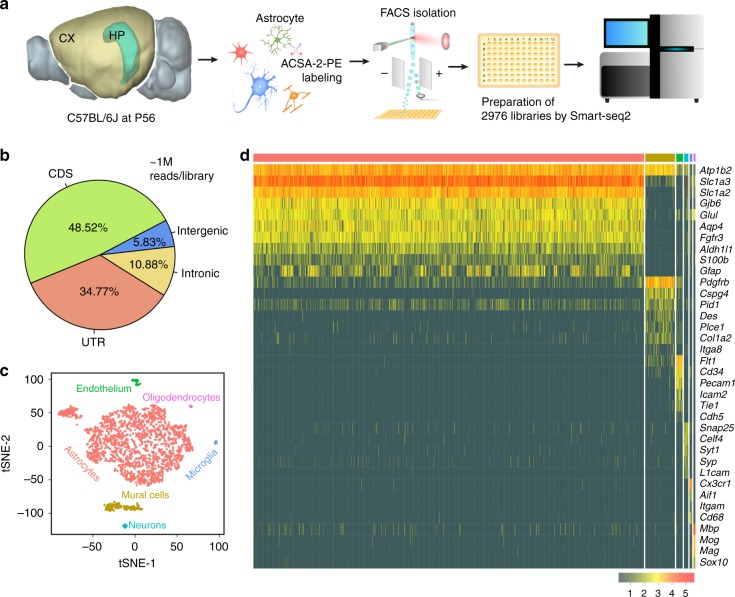
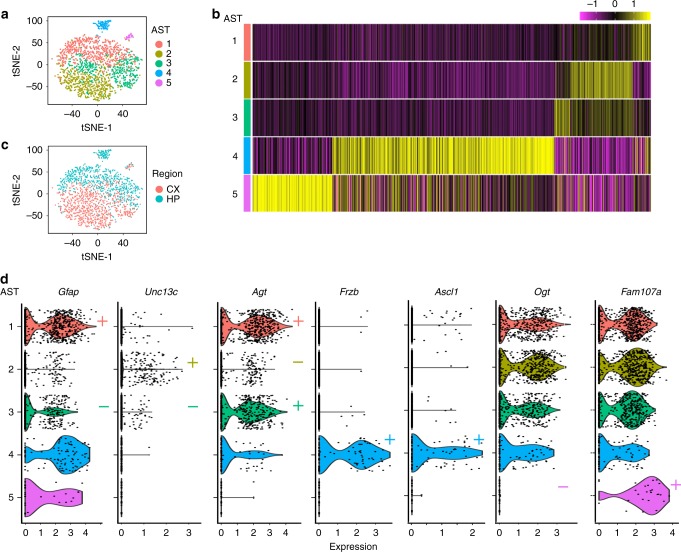
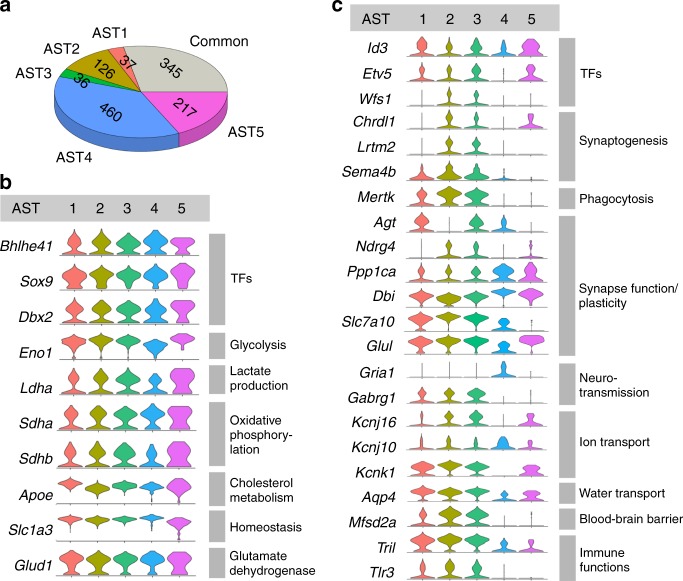
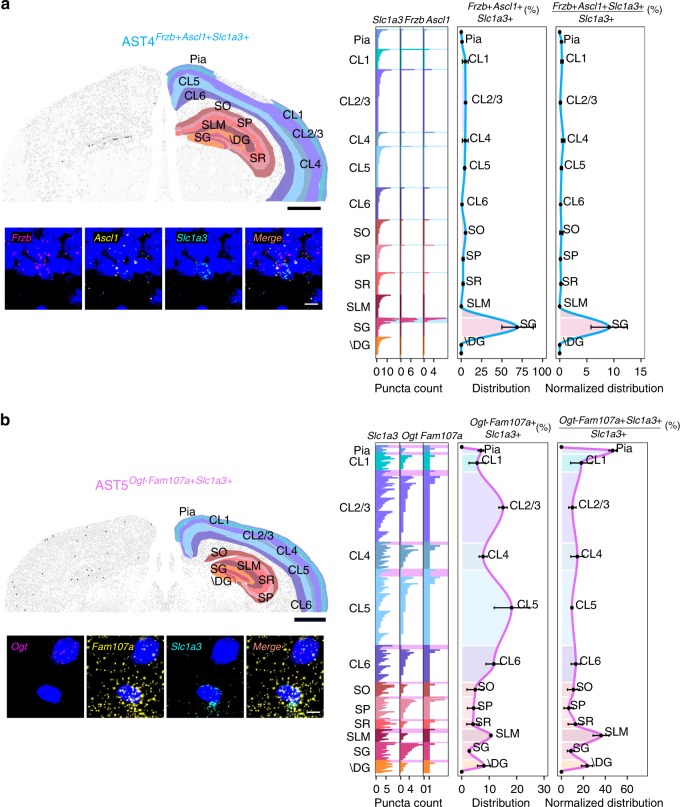
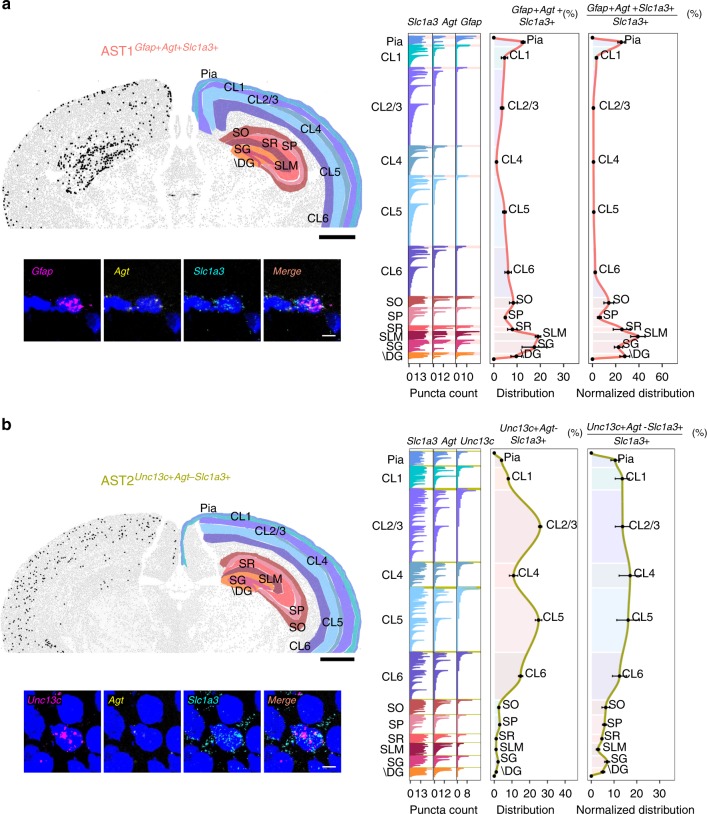
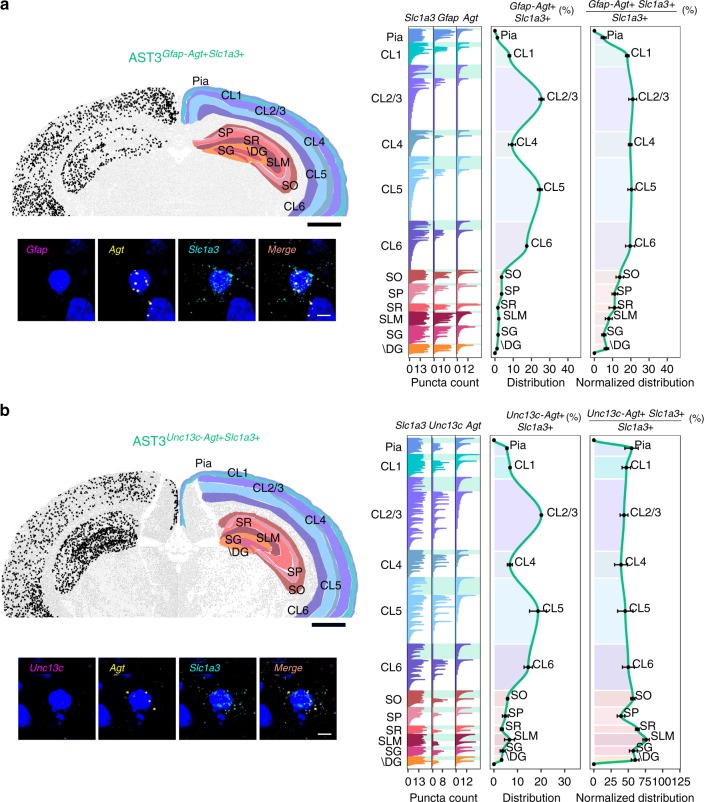
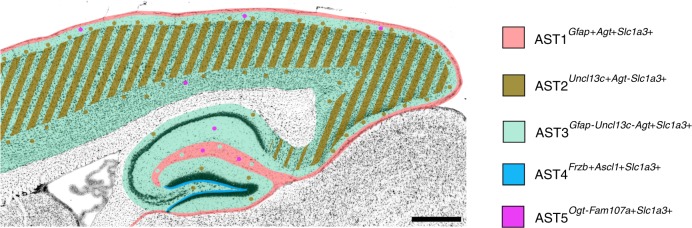
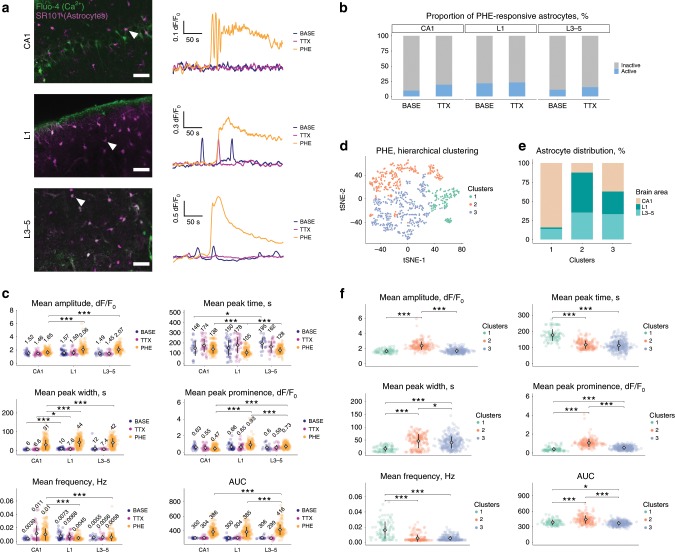
Astrocytes, a major cell type found throughout the central nervous system, have general roles in the modulation of synapse formation and synaptic transmission, blood-brain barrier formation, and regulation of blood flow, as well as metabolic support of other brain resident cells. Crucially, emerging evidence shows specific adaptations and astrocyte-encoded functions in regions, such as the spinal cord and cerebellum. To investigate the true extent of astrocyte molecular diversity across forebrain regions, we used single-cell RNA sequencing. Our analysis identifies five transcriptomically distinct astrocyte subtypes in adult mouse cortex and hippocampus. Validation of our data in situ reveals distinct spatial positioning of defined subtypes, reflecting the distribution of morphologically and physiologically distinct astrocyte populations. Our findings are evidence for specialized astrocyte subtypes between and within brain regions. The data are available through an online database (https://holt-sc.glialab.org/), providing a resource on which to base explorations of local astrocyte diversity and function in the brain.
Overview
The claims and statistics of this paper haven’t been checked yet.
Run the check — free, no account needed. It reads the open-access text and checks the sources it cites.
Integrity signals
Registry
Cites
Statistics
Figures
Verification
Claims the paper makes
The claims and statistics of this paper haven’t been checked yet.
Run the check — free, no account needed. It reads the open-access text and checks the sources it cites.
Claims other papers make about this one
Each is checked against this paper’s own text: does it say what the citing paper says it does?
The source backs part of the claim, not all of it — or backs it for a different population, condition or comparison.
In the citing paper
“A possible explanation for this phenomenon is that we analyzed the cortex and hippocampus together, while it is well established that both astrocytes and microglia show regional heterogeneity at the transcriptome level (Batiuk et al., 2020;Tan et al., 2020).”
From Single-cell resolution analysis of the crosstalk between chemogenically activated astrocytes and microglia (2020) · cites this paper as Batiuk et al., 2020
Experimental — accuracy not yet measuredThe source backs part of the claim, not all of it — or backs it for a different population, condition or comparison.
In the citing paper
“The cells projected on the UMAP space were annotated using canonical marker genes for neurons, progenitors, intermediate progenitors, astrocytes, other glial cells, and monocytes (17, 84, 85).”
From Understanding monocyte-driven neuroinflammation in Alzheimer’s disease using human cortical organoid microphysiological systems (2025) · cites this paper as [84]
Experimental — accuracy not yet measuredThe source backs part of the claim, not all of it — or backs it for a different population, condition or comparison.
In the citing paper
“ScRNAseq and snRNAseq are becoming established as valuable tools to gain insight into basal94 and reactive-astrocyte heterogeneity (Fig. 1e)40,78,95.”
From Reactive astrocyte nomenclature, definitions, and future directions (2021) · cites this paper as [94]
Experimental — accuracy not yet measuredThe source backs part of the claim, not all of it — or backs it for a different population, condition or comparison.
In the citing paper
“but less is known about the transcriptomic heterogeneity of astrocytes across different cortical areas in the aging human brain.”
From Astrocyte transcriptomic changes along the spatiotemporal progression of Alzheimer’s disease (2024) · cites this paper as [31]
Experimental — accuracy not yet measuredThe cited source says what the claim attributes to it.
In the citing paper
“These astrocytes seem to be enriched in cortical layers 2/3 and 5, and in the dentate gyrus of the hippocampus (Batiuk et al., 2020).”
From Single-cell resolution analysis of the crosstalk between chemogenically activated astrocytes and microglia (2020) · cites this paper as Batiuk et al., 2020
The cited source says what the claim attributes to it.
In the citing paper
“Furthermore, a recent study (Batiuk et al., 2020) determined the transcriptomic profile of astrocytes in the hippocampus and cortex of C57BL/6J mice at post-natal day 56 and showed the existence of five transcriptionally different astrocytic clusters.”
From Single-cell resolution analysis of the crosstalk between chemogenically activated astrocytes and microglia (2020) · cites this paper as Batiuk et al., 2020
Self-check
Percentages, sums and reported differences re-computed from the paper’s own numbers.
The self-check needs the paper’s full text.
Citations
Cites
Systematic and integrative analysis of large gene lists using DAVID bioinformatics resources
Huang, D. W., Sherman, B. T., & Lempicki, R. A. (2009) · Nature Protocols · doi:10.1038/nprot.2008.211 · Cited by 35,890
UniProt: the Universal Protein knowledgebase
Apweiler, R. (2003) · Nucleic Acids Research · doi:10.1093/nar/gkh131 · Cited by 7,593
Spatial reconstruction of single-cell gene expression data
Satija, R., Farrell, J. A., Gennert, D., Schier, A. F., & Regev, A. (2015) · Nature Biotechnology · doi:10.1038/nbt.3192 · Cited by 7,055
Genome-wide atlas of gene expression in the adult mouse brain
Lein, E. S., Hawrylycz, M. J., Ao, N., Ayres, M., Bensinger, A., Bernard, A., Boe, A. F., Boguski, M. S., Brockway, K. S., Byrnes, E. J., et al. (2007) · Nature · doi:10.1038/nature05453 · Cited by 5,572
UniProt: the universal protein knowledgebase
The UniProt Consortium (2017) · Nucleic Acids Research · doi:10.1093/nar/gkw1099 · Cited by 4,436
Full-length RNA-seq from single cells using Smart-seq2
Picelli, S., Faridani, O. R., Björklund, Å. K., Winberg, G., Sagasser, S., & Sandberg, R. (2014) · Nature Protocols · doi:10.1038/nprot.2014.006 · Cited by 4,137
Cahoy, J. D., Emery, B., Kaushal, A., Foo, L. C., Zamanian, J. L., Christopherson, K. S., Xing, Y., Lubischer, J. L., Krieg, P. A., Krupenko, S. A., et al. (2008) · The Journal of Neuroscience · doi:10.1523/jneurosci.4178-07.2008 · Cited by 3,129
Cell types in the mouse cortex and hippocampus revealed by single-cell RNA-seq
Zeisel, A., Muñoz-Manchado, A. B., Codeluppi, S., Lönnerberg, P., La Manno, G., Juréus, A., Marques, S., Munguba, H., He, L., Betsholtz, C., et al. (2015) · Science · doi:10.1126/science.aaa1934 · Cited by 3,124
Molecular Architecture of the Mouse Nervous System
Zeisel, A., Hochgerner, H., Lönnerberg, P., Johnsson, A., Memic, F., van der Zwan, J., Häring, M., Braun, E., Borm, L. E., La Manno, G., et al. (2018) · Cell · doi:10.1016/j.cell.2018.06.021 · Cited by 2,552
Thyroid Hormone Regulation of Metabolism
Mullur, R., Liu, Y.-Y., & Brent, G. A. (2014) · Physiological Reviews · doi:10.1152/physrev.00030.2013 · Cited by 2,421
Cited by
Sorted by citations
Items 801–809 of 809
Advances in the role of astrocytes in glioma progression and therapy
Xu, X.-H., Wu, R., Fan, J., & Chen, X. (2026) · Acta Pharmacologica Sinica · doi:10.1038/s41401-026-01934-2
Oon, C. H., Levitt, E. M., Shapiro, D. A., O’Brien, C. A., Davis, M. R., Shestova, O., Axsom, J., Yaqoob, F., Lomeikaitė, V., Koumadorakis, D., et al. (2026) · Research Square · doi:10.21203/rs.3.rs-10963419/v1
Gesteira-Perez, N., Maele, P. V., Frizzi, B., Bosch, L. V. D., Rué, L., & Dewilde, M. (2026) · Antibodies · doi:10.3390/antib15050089
Arion, D., Enwright, J. F., Krienen, F. M., Burgos, G.-G., & Lewis, D. A. (2026) · American Journal of Psychiatry · doi:10.1176/appi.ajp.20251018
Astrocyte Structure–Function Relationship in Senescence and Neurodegeneration
Serebryanaya, D. V., Kolgaeva, K. A., Dya, G. A., Ermakov, I. M., & Belousov, V. V. (2026) · Biochemistry (Moscow) · doi:10.1134/s000629792660208x
Martins, D., Mariani, N., Schubert, J. J., Eiff, B., Rota, S., Nicholson, T. R., Hampshire, A., Veronese, M., Williams, S., Mondelli, V., et al. (2026) · Brain Behavior and Immunity · doi:10.1016/j.bbi.2026.107038
Astrocyte maturation creates a stage-specific niche that instructs hippocampal neurogenesis
Masouti, E., Casares-Crespo, L., Sagner, A., Gessner, A., Fromm, M. F., Mira, H., & Beckervordersandforth, R. (2026) · Frontiers in Cellular Neuroscience · doi:10.3389/fncel.2026.1966983
Does ABO Blood Group Contribute to Glial Function?
Gazerani, P. (2026) · Neuroglia · doi:10.3390/neuroglia7040038
Emerging technologies for studying immunometabolism in neurodegenerative disorders
Bisht, S., Prakash, S., Singh, D., & Jaiswal, V. (2026) · Elsevier eBooks · doi:10.1016/b978-0-443-44253-7.00008-4
Metadata
- Authors
- Batiuk, M. Y., Martirosyan, A., Wahis, J., de Vin, F., Marneffe, C., Kusserow, C., Koeppen, J., Viana, J. F., Oliveira, J. F., Voet, T., Ponting, C. P., Belgard, T. G., & Holt, M. G.
- Affiliations
- VIB-KU Leuven Center for Brain & Disease Research (BE)
- University of Minho (PT)
- Universidade Politécnica do Cávado e do Ave (PT)
- Wellcome Sanger Institute (GB)
- University of Oxford (GB)
- Corresponding author
- Holt, Matthew G.
- ORCID
- Venue
- Nature Communications
- Published
- 2020-03-05
- Volume
- 11
- Issue
- 1
- Pages
- 1220-1220
- ISSN
- 2041-1723 (ISSN-L)
- PMC
- PMC7058027
- OpenAlex
- W3009790191
- Cited by
- 805
- References
- 71
- Citations by year
- 2026: 102 · 2025: 135 · 2024: 137 · 2023: 132 · 2022: 139 · 2021: 112 · 2020: 46
- FWCI
- 34.80
- Type
- journal article
- Language
- en
- Open access
- gold
- doi.org
- Locations
- Nature Communications (publishedVersion, cc-by)
- bioRxiv (Cold Spring Harbor Laboratory) (acceptedVersion, cc-by-nc-nd)
- PubMed Central (publishedVersion, cc-by)
- PubMed (publishedVersion)
- Lirias (KU Leuven) (submittedVersion, other-oa)
- RePEc: Research Papers in Economics (submittedVersion)
- DOAJ (DOAJ: Directory of Open Access Journals) (submittedVersion, cc-by-sa)
- Edinburgh Research Explorer (University of Edinburgh) (submittedVersion, cc-by)
- Funders
- European Commission (604102, 2007–2013, FP7 2007-2013, FP7/2007)
- Fonds Wetenschappelijk Onderzoek (12V7519N, G066715N, AKUL/13/39, I001818N)
- KU Leuven
- Fondation contre le Cancer (2015-143)
- Medical Research Council (FP7/20072013, MC_UU_00007/15)
- FP7 Ideas: European Research Council (281961)
- Topics
- Life Sciences › Biochemistry, Genetics and Molecular Biology › Molecular Biology › Single-cell and spatial transcriptomics
- Life Sciences › Neuroscience › Cellular and Molecular Neuroscience › Neuroscience and Neuropharmacology Research
- Life Sciences › Neuroscience › Neurology › Neuroinflammation and Neurodegeneration Mechanisms
- Keywords
- astrocytes, astrocyte subtypes, forebrain, cerebral cortex, hippocampus, single-cell transcriptomics, mouse brain
- MeSH terms
- Animals, Astrocytes, Gene Expression Regulation, Mice, Inbred C57BL, Organ Specificity, RNA, Messenger, Calcium Signaling, Cell Shape, Neurogenesis, Single-Cell Analysis
About these checks
Registry, retraction, Cites and statistics results are computed, not judged, with one exception: a printed reference that no index lists is read once by a model before it counts as a citation error. Claims are extracted by a model and kept only when their quote appears verbatim in the text; each cited source is then checked, with a model’s help, for whether it says what the claim relies on. Those verdicts can be wrong — read the claim’s quote and the cited source before relying on one.
Statistics and arithmetic are recomputed, not judged.
Confidence bands are shown only for fields calibrated on our annotated test set. None is calibrated yet, so no band is shown.
What counts as a claim ›How we measure confidence ›How we check this ›
Are you an author, or do you see a problem with this page? Request a review
