

Sexual-dimorphism in human immune system aging
Open accessPublished version of a preprint
The DOI matches its Crossref record; 66 of the 67 references it cites were found in a registry or an index.
Abstract
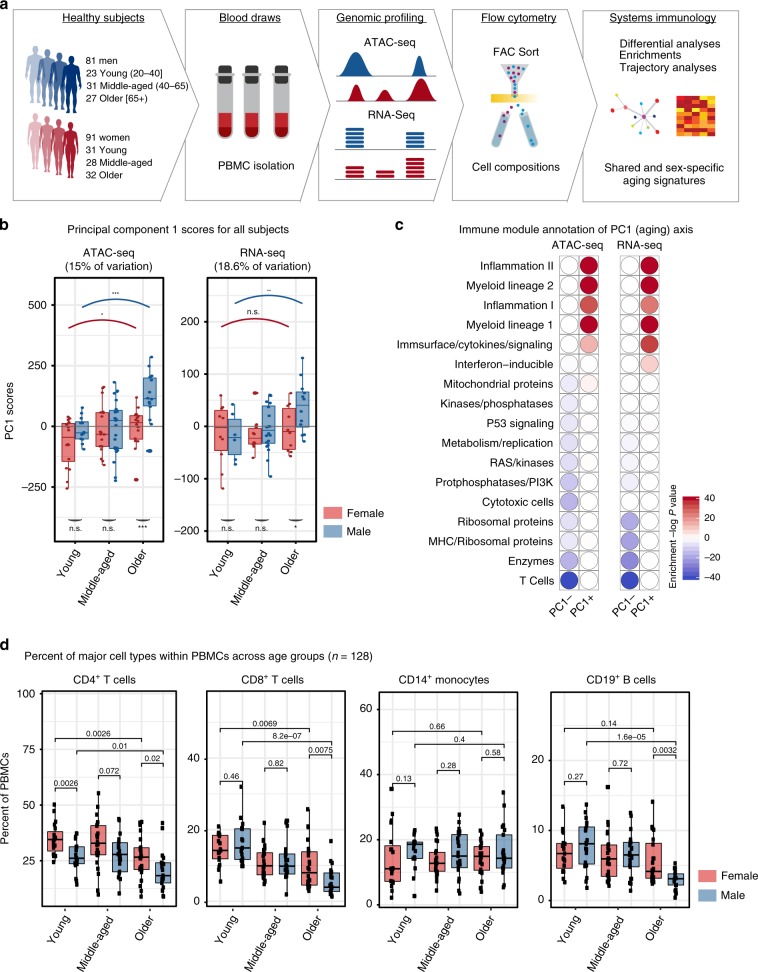
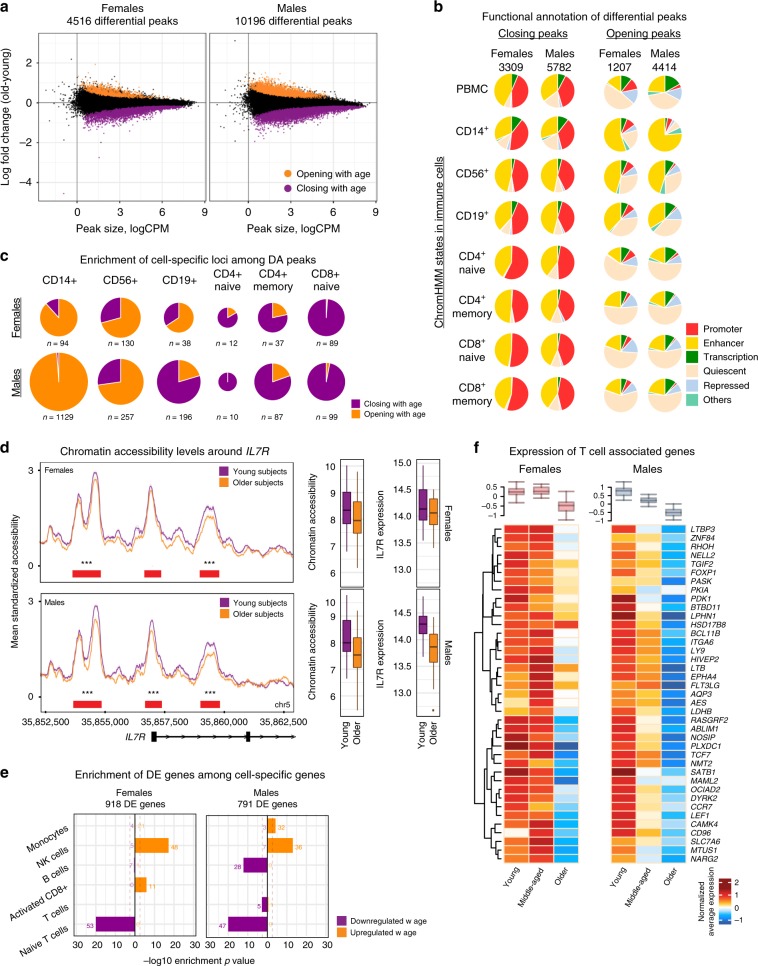
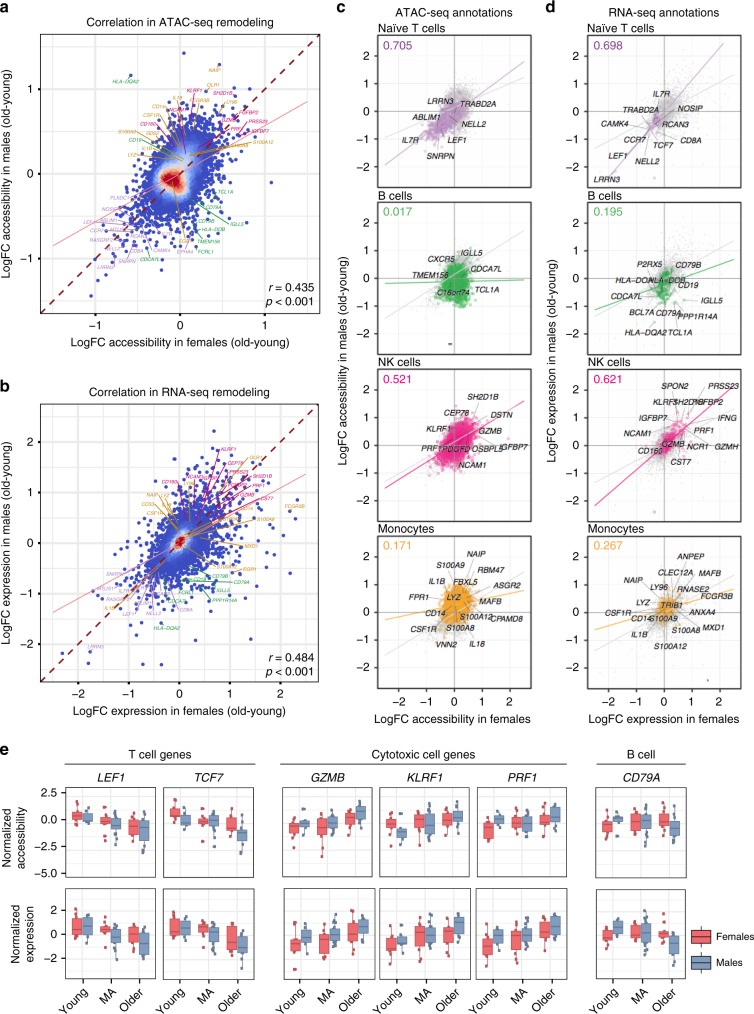
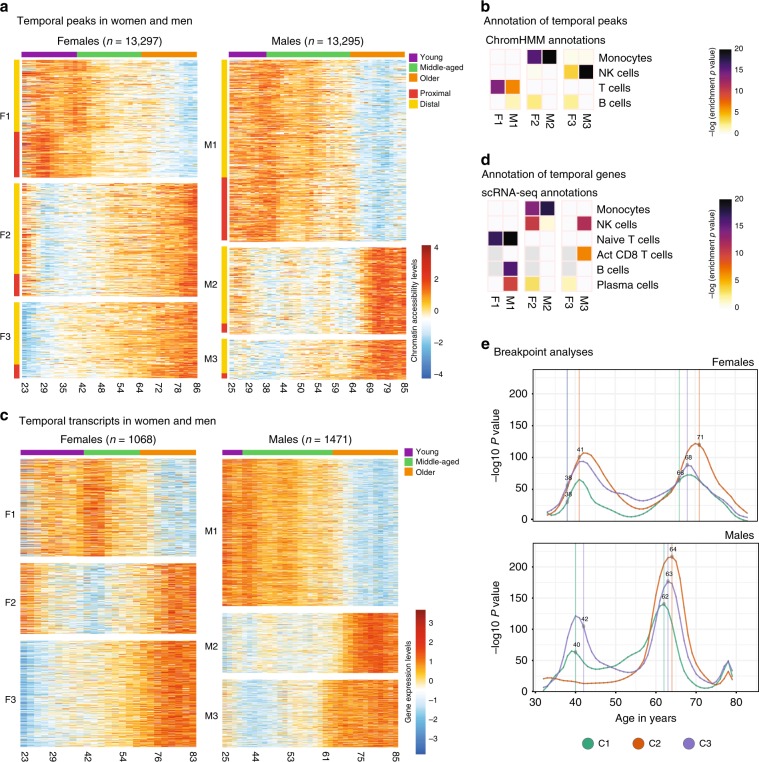
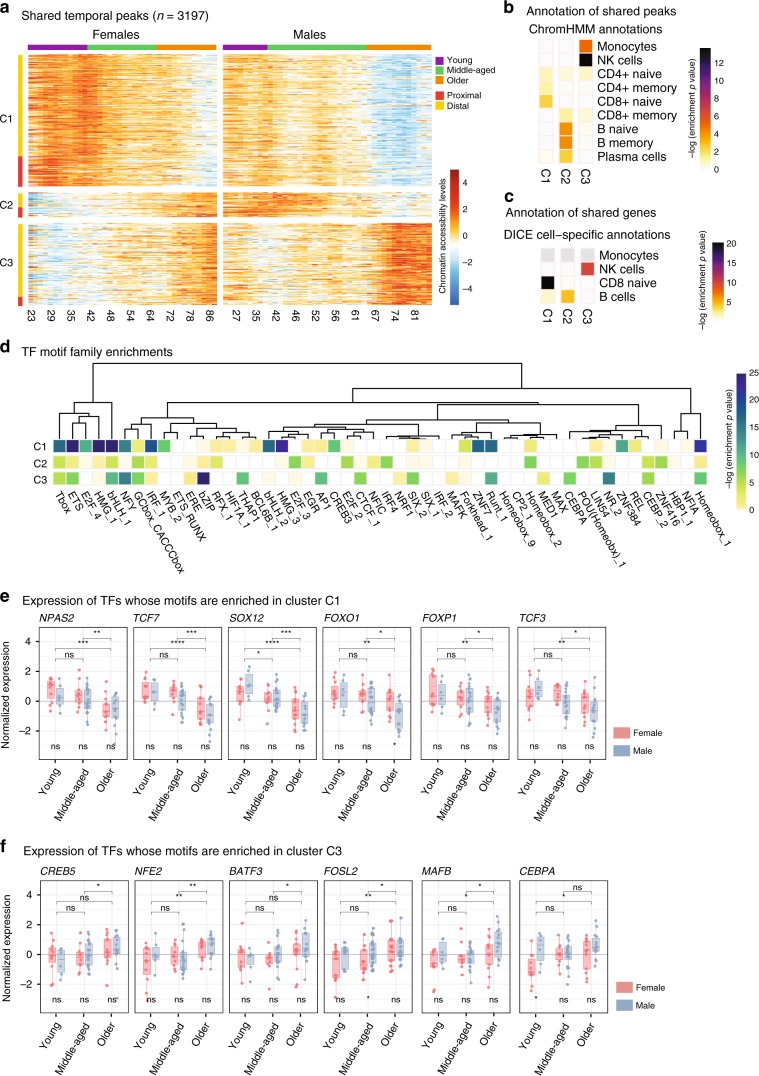
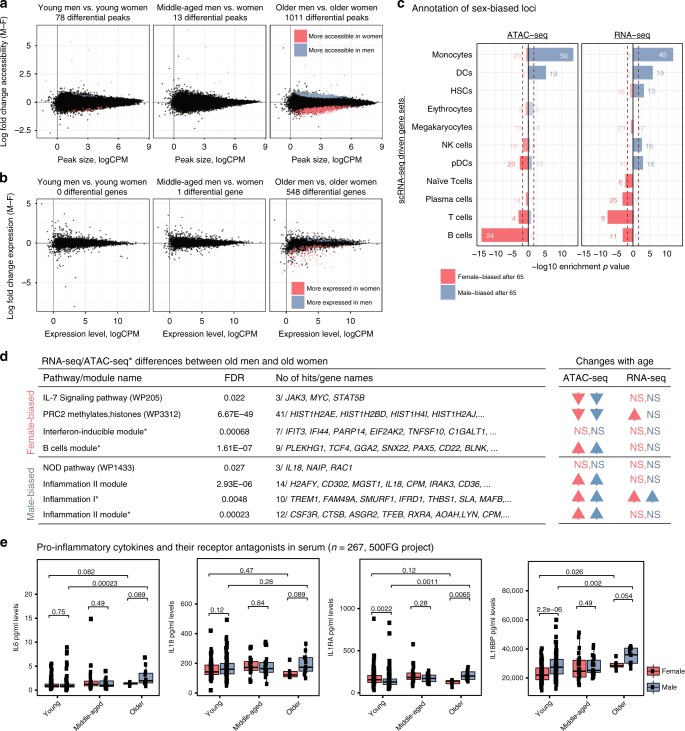
Differences in immune function and responses contribute to health- and life-span disparities between sexes. However, the role of sex in immune system aging is not well understood. Here, we characterize peripheral blood mononuclear cells from 172 healthy adults 22–93 years of age using ATAC-seq, RNA-seq, and flow cytometry. These data reveal a shared epigenomic signature of aging including declining naïve T cell and increasing monocyte and cytotoxic cell functions. These changes are greater in magnitude in men and accompanied by a male-specific decline in B-cell specific loci. Age-related epigenomic changes first spike around late-thirties with similar timing and magnitude between sexes, whereas the second spike is earlier and stronger in men. Unexpectedly, genomic differences between sexes increase after age 65, with men having higher innate and pro-inflammatory activity and lower adaptive activity. Impact of age and sex on immune phenotypes can be visualized at https://immune-aging.jax.org to provide insights into future studies.
Overview
The claims and statistics of this paper haven’t been checked yet.
Free: it reads the open-access text and checks the first 5 claims that cite a source we can check. Create a free account to check every claim.
Integrity signals
Registry
Cites
Statistics
Figures
Verification
Claims the paper makes
The claims and statistics of this paper haven’t been checked yet.
Free: it reads the open-access text and checks the first 5 claims that cite a source we can check. Create a free account to check every claim.
Claims other papers make about this one
Each is checked against this paper’s own text: does it say what the citing paper says it does?
The cited source says what the claim attributes to it.
In the citing paper
“In line with this, (older) men appear more likely than women to exhibit chronically raised levels of pro-inflammatory mediators but less adaptive immune activity (M ´ arquez et al., 2020; Huang et al., 2021).”
From Gene Therapy-Associated Uveitis (GTAU): Understanding and mitigating the adverse immune response in retinal gene therapy (2025) · cites this paper as Márquez et al., 2020
In the citing paper
“similarly, epigenetic and other molecular features in blood cells177 or skin178 change in distinct undulating patterns across the lifespan.”
From Measuring biological age using omics data (2022) · cites this paper as [177]
In the citing paper
“Peripheral blood mononuclear cells exhibit two distinct peaks of rapid epigenomic changes in humans, one around 40 years of age and another around 60–70 years of age.36”
From Asynchronous, contagious and digital aging (2021) · cites this paper as [36]
Self-check
Percentages, sums and reported differences re-computed from the paper’s own numbers.
The self-check needs the paper’s full text.
Citations
Cites
Trimmomatic: a flexible trimmer for Illumina sequence data
Bolger, A. M., Lohse, M., & Usadel, B. (2014) · Bioinformatics · doi:10.1093/bioinformatics/btu170 · Cited by 65,548
Fast and accurate short read alignment with Burrows-Wheeler transform
Li, H., & Durbin, R. (2009) · Bioinformatics · doi:10.1093/bioinformatics/btp324 · Cited by 58,607
Robinson, M. D., McCarthy, D. J., & Smyth, G. K. (2010) · Bioinformatics · doi:10.1093/bioinformatics/btp616 · Cited by 41,364
Wickham, H. (2016) · Use R! · doi:10.1007/978-3-319-24277-4 · Cited by 33,115
BEDTools: a flexible suite of utilities for comparing genomic features
Quinlan, A. R., & Hall, I. M. (2010) · Bioinformatics · doi:10.1093/bioinformatics/btq033 · Cited by 27,437
RSEM: accurate transcript quantification from RNA-Seq data with or without a reference genome
Li, B., & Dewey, C. N. (2011) · BMC Bioinformatics · doi:10.1186/1471-2105-12-323 · Cited by 22,179
Model-based Analysis of ChIP-Seq (MACS)
Zhang, Y., Liu, T., Meyer, C. A., Eeckhoute, J., Johnson, D. S., Bernstein, B. E., Nusbaum, C., Myers, R. M., Brown, M., Li, W., et al. (2008) · Genome Biology · doi:10.1186/gb-2008-9-9-r137 · Cited by 18,386
ggplot2: Elegant Graphics for Data Analysis
Wickham, H. (2009) · doi:10.1007/978-0-387-98141-3 · Cited by 14,447
The Timed “Up & Go”: A Test of Basic Functional Mobility for Frail Elderly Persons
Podsiadlo, D., & Richardson, S. (1991) · Journal of the American Geriatrics Society · doi:10.1111/j.1532-5415.1991.tb01616.x · Cited by 14,418
Heinz, S., Benner, C., Spann, N., Bertolino, E., Lin, Y. C., Laslo, P., Cheng, J. X., Murre, C., Singh, H., & Glass, C. K. (2010) · Molecular Cell · doi:10.1016/j.molcel.2010.05.004 · Cited by 13,382
Research works printed but not linked: 2
- Kleiveland, C. R. In: (eds Verhoeckx, K., Cotter, P., López-Expósito, I., Kleiveland, C., Lea, T., Mackie, A., Requena, T., Swiatecka, D. & Wichers, H.) The Impact of Food Bioactives on Health (eds). (Springer, Cham, 2015).
- Buenrostro, J. D., Giresi, P. G., Zaba, L. C., Chang, H. Y. & Greenleaf, W. J. Transposition of native chromatin for fast and sensitive epigenomic profiling of open chromatin, DNA-binding proteins and nucleosome position. Nat. Methods 10, 1213-1218 (2013). · DOI · Paper page
Cited by
Items 101–200 of 591
Ageing, immune fitness and cancer
Dolan, M., Libby, K. A., Ringel, A. E., van Galen, P., & McAllister, S. S. (2025) · Nature reviews. Cancer · doi:10.1038/s41568-025-00858-z · Cited by 62
“Flow cytometric analysis of human PBMCs shows an increase in monocytes with age in some studies 105–107 but not in others 101,108,109 .”
The landscape of expression and alternative splicing variation across human traits
García-Pérez, R., Ramírez, J. M., Ripoll-Cladellas, A., Chazarra-Gil, R., Oliveros, W., Soldatkina, O., Bosio, M., Rognon, P. J., Capella-Gutiérrez, S., Calvo, M., et al. (2022) · Cell Genomics · doi:10.1016/j.xgen.2022.100244 · Cited by 61
“Similarly, it has been shown that gene expression varies between males and females during immune cell aging.(26) However, beyond immune cell types, little is known about how different traits simultaneously interplay to define tissue, organ, and individual phenotypes.”
BackgroundHealthy aging and the human gut microbiome: why we cannot just turn back the clock
Wilmanski, T. M., Gibbons, S. M., & Price, N. D. (2022) · Nature Aging · doi:10.1038/s43587-022-00294-w · Cited by 58
Aging unconventionally: γδ T cells, iNKT cells, and MAIT cells in aging
Kurioka, A., & Klenerman, P. (2023) · Seminars in Immunology · doi:10.1016/j.smim.2023.101816 · Cited by 51
Immune surveillance of senescence: potential application to age-related diseases
Wang, T., & Nakanishi, M. (2024) · Trends in Cell Biology · doi:10.1016/j.tcb.2024.06.007 · Cited by 54
SARS‐CoV‐2 and the possible connection to ERs, ACE2, and RAGE: Focus on susceptibility factors
Stilhano, R. S., Costa, A. J., Nishino, M. S., Shams, S., Bartolomeo, C. S., Breithaupt‐Faloppa, A. C., Silva, E. A., López, A., Prado, C. M., & Ureshino, R. P. (2020) · The FASEB Journal · doi:10.1096/fj.202001394rr · Cited by 50
Ligotti, M. E., Aiello, A., Accardi, G., Aprile, S., Bonura, F., Bulati, M., Gervasi, F., Giammanco, G. M., Pojero, F., Zareian, N., et al. (2021) · Clinical & Experimental Immunology · doi:10.1111/cei.13606 · Cited by 48
“Older males, in contrast, have higher activity for monocytes and inflammation (49).”
BackgroundDuijster, J. W., Lieber, T., Pacelli, S., van Balveren, L., Ruijs, L. S., Raethke, M., Kant, A. C., & van Hunsel, F. P. A. M. (2023) · Frontiers in Immunology · doi:10.3389/fimmu.2023.1078736 · Cited by 49
The immune response to COVID ‐19: Does sex matter?
Ho, J. Q., Sepand, M. R., Bigdelou, B., Shekarian, T., Esfandyarpour, R., Chauhan, P. S., Serpooshan, V., Beura, L. K., Hütter, G., & Zanganeh, S. (2022) · Immunology · doi:10.1111/imm.13487 · Cited by 50
“notable decline in certain naïve T cells with ageing,(24) and only males exhibit a notable decrease in B cells after age 65.(77) On the other hand, females exhibit large epigenetic changes in immune cells about 5–6 years later than males.”
BackgroundHamade, A., Li, D., Tyryshkin, K., Xu, M., Conseil, G., Yolmo, P., Hamilton, J., Chenard, S. W., Siemens, D. R., & Koti, M. (2022) · Biology of Sex Differences · doi:10.1186/s13293-022-00428-0 · Cited by 43
“In both humans and mice, B cells are known to exhibit age-related sex differences [12, 32].”
BackgroundImmunosenescence and multiple sclerosis: inflammaging for prognosis and therapeutic consideration
Thakolwiboon, S., Mills, E. A., Yang, J., Doty, J., Belkin, M., Cho, T., Schultz, C., & Mao‐Draayer, Y. (2023) · Frontiers in Aging · doi:10.3389/fragi.2023.1234572 · Cited by 50
“The fi rst period occurs between 30 and 40 years, while the second typically occurs in the 60s for men and in the 70s for women (Márquez et al., 2020).”
BackgroundResultInfluentialKarpuzoglu, E., Holladay, S. D., & Gogal, R. M. (2025) · Frontiers in Immunology · doi:10.3389/fimmu.2025.1704203 · Cited by 66
Kellogg, C., & Equils, O. (2020) · Human Vaccines & Immunotherapeutics · doi:10.1080/21645515.2020.1818519 · Cited by 56
“immune activity regardless of the decline of B cell frequencies.(59) These observations are persistent in different ethnic groups, which suggest that endocrine factors may be mediating these differences.”
BackgroundInfluentialFunctional genomics of inflamm-aging and immunosenescence
Lu, R. J., Wang, E. K., & Benayoun, B. A. (2021) · Briefings in Functional Genomics · doi:10.1093/bfgp/elab009 · Cited by 47
“Indeed, a pioneer study has revealed that peripheral immune cells are differentially regulated with aging in men and women [125].”
BackgroundLi, X., Hou, M., Zhang, F., Ji, Z., Cai, Y., & Shi, Y. (2025) · Environmental Science & Technology · doi:10.1021/acs.est.4c08701 · Cited by 52
The Role of Immunogenetics in COVID-19
Pojero, F., Candore, G., Caruso, C., Bona, D. D., Groneberg, D. A., Ligotti, M. E., Accardi, G., & Aiello, A. (2021) · International Journal of Molecular Sciences · doi:10.3390/ijms22052636 · Cited by 44
Microbial Reconstitution Improves Aging-Driven Lacrimal Gland Circadian Dysfunction
Jiao, X., Pei, X., Lu, D., Qi, D., Huang, S., He, S., & Li, Z. (2021) · American Journal Of Pathology · doi:10.1016/j.ajpath.2021.08.006 · Cited by 43
Chenard, S. W., Jackson, C. L., Vidotto, T., Chen, L., Hardy, C., Jamaspishvilli, T., Berman, D. M., Siemens, D. R., & Koti, M. (2021) · European Urology Open Science · doi:10.1016/j.euros.2021.05.002 · Cited by 41
“However, given the older age of patients with NMIBC, it is possible that a reduced naïve B-cell pool in the periphery [33] compromises the desired responses in the NMIBC scenario following local BCG administration in contrast to responses associated with infant vaccination.”
BackgroundA Distinct Innate Immune Signature of Early Onset Colorectal Cancer
Gardner, I. H., Siddharthan, R. V., Watson, K. M., Dewey, E. N., Ruhl, R. A., Khou, S., Guan, X., Xia, Z., Tsikitis, V. L., & Anand, S. (2021) · ImmunoHorizons · doi:10.4049/immunohorizons.2000092 · Cited by 45
“SAA1 is an acute phase reactant produced by the liver but is also present in multiple cancers and can be used as a biomarker for disease burden (34, 38, 39).”
Sex hormones in SARS-CoV-2 susceptibility: key players or confounders?
Lott, N., Gebhard, C. E., Bengs, S., Haider, A., Kuster, G. M., Regitz‐Zagrosek, V., & Gebhard, C. (2022) · Nature Reviews Endocrinology · doi:10.1038/s41574-022-00780-6 · Cited by 46
“Several mechanisms could account for these sex differences, including an imbalance in the expression of genes encoded on the X and Y chromosomes 85 , polymorphism in autosomal genes 86 , epigenetic modifications 87 , and direct effects of sex hormones on immunological pathways.”
The central role of DNA damage in immunosenescence
Kell, L., Simon, A. K., Alsaleh, G., & Cox, L. S. (2023) · Frontiers in Aging · doi:10.3389/fragi.2023.1202152 · Cited by 49
“Furthermore, the age-related shifts in other immune cell subsets, particularly with a bias from anti-inflammatory to pro-inflammatory cells, may contribute to immune dysfunction consistent with immunosenescence (Marquez et al., 2020).”
BackgroundTerekhova, M., Boháčová, P., & Artyomov, M. N. (2025) · Immunity · doi:10.1016/j.immuni.2025.10.009 · Cited by 47
Aging, Social Distancing, and COVID-19 Risk: Who is more Vulnerable and Why?
Faraji, J., & Metz, G. A. S. (2021) · Aging and Disease · doi:10.14336/ad.2021.0319 · Cited by 47
Human immune phenotyping reveals accelerated aging in type 1 diabetes
Shapiro, M. R., Dong, X., Perry, D. J., McNichols, J., Thirawatananond, P., Posgai, A. L., Peters, L. D., Motwani, K., Musca, R. S., MUIR, A. B., et al. (2023) · JCI Insight · doi:10.1172/jci.insight.170767 · Cited by 37
“170767 The impact of aging on immune phenotypes is well established (22, 23); environmental exposures, particularly infection by CMV, are known to drive expansion of a large circulating pool of antigen-specific memory T cells (24, 25).”
Kane, A. E., Bisset, E. S., Heinze-Milne, S., Keller, K. M., Grandy, S. A., & Howlett, S. E. (2020) · The Journals of Gerontology Series A · doi:10.1093/gerona/glaa212 · Cited by 37
“The reasons for these male–female differences in inflammation and cardiac aging are not well understood, although there is emerging evidence that sex plays a major role in the aging human immune system (58) and that immunosenescence may occur earlier and at faster rates in males than in females (59).”
Microglial heterogeneity in aging and Alzheimer's disease: Is sex relevant?
Delage, C. I., Šimončičová, E., & Tremblay, M.-È. (2021) · Journal of Pharmacological Sciences · doi:10.1016/j.jphs.2021.03.006 · Cited by 35
Are sex hormones promising candidates to explain sex disparities in the COVID-19 pandemic?
Brandi, M. L. (2021) · Reviews in Endocrine and Metabolic Disorders · doi:10.1007/s11154-021-09692-8 · Cited by 40
Aiello, A., Ligotti, M. E., Garnica, M., Accardi, G., Calabrò, A., Pojero, F., Arasanz, H., Bocanegra, A., Blanco, E., Chocarro, L., et al. (2022) · International Journal of Molecular Sciences · doi:10.3390/ijms23179880 · Cited by 37
“A recent paper, which profiled blood mononuclear cells from healthy men and women by carefully matching their age, has demonstrated that, although the CD16+ monocytes increase with age in both sexes, monocyte-specific loci appear to be more activated in men than in women [53].”
BackgroundImmunoengineering Biomaterials for Musculoskeletal Tissue Repair across Lifespan
Han, J., Rindone, A. N., & Elisseeff, J. H. (2024) · Advanced Materials · doi:10.1002/adma.202311646 · Cited by 38
Rio, P., Caldarelli, M., Miccoli, E., Guazzarotti, G., Gasbarrini, A., Gambassi, G., & Cianci, R. (2025) · Diseases · doi:10.3390/diseases13060179 · Cited by 46
Crowe, J., Lumb, F. E., Doonan, J., Broussard, M., Tarafdar, A., Pineda, M. A., Landabaso, C., Mulvey, L., Hoskisson, P. A., Babayan, S. A., et al. (2020) · PLoS Pathogens · doi:10.1371/journal.ppat.1008391 · Cited by 37
Genetic and phenotypic analysis of the causal relationship between aging and COVID-19
Ying, K., Zhai, R., Pyrkov, T. V., Shindyapina, A. V., Mariotti, M., Fedichev, P. O., Shen, X., & Gladyshev, V. N. (2021) · Communications Medicine · doi:10.1038/s43856-021-00033-z · Cited by 41
Monocytes are the main source of STING-mediated IFN-α production
Congy‐Jolivet, N., Cénac, C., Dellacasagrande, J., Puissant‐Lubrano, B., Apoil, P. A., Guedj, K., Abbas, F., Laffont, S., Sourdet, S., Guyonnet, S., et al. (2022) · EBioMedicine · doi:10.1016/j.ebiom.2022.104047 · Cited by 39
Implications of innate immune sexual dimorphism for MASLD pathogenesis and treatment
Booijink, R. S., Ramachandran, P., & Bansal, R. (2024) · Trends in Pharmacological Sciences · doi:10.1016/j.tips.2024.05.004 · Cited by 37
Understanding Sex Differences in Autoimmune Diseases: Immunologic Mechanisms
Kim, Y., Jung, Y., Kang, I., & Yeo, E. (2025) · International Journal of Molecular Sciences · doi:10.3390/ijms26157101 · Cited by 46
Buttle, T. S., Hummerstone, C. Y., Billahalli, T., Ward, R. J., Barnes, K. E., Marshall, N. J., Spong, V. C., & Bothamley, G. H. (2021) · PLoS ONE · doi:10.1371/journal.pone.0247745 · Cited by 38
“Transcriptomic data investigating the pathogenesis of active TB disease show sex-specific responses [43, 44].”
Sex-biased adaptive immune regulation in cancer development and therapy
Schafer, J. M., Xiao, T., Kwon, H., Collier, K. A., Chang, Y., Abdel-Hafiz, H. A., Bolyard, C. M., Chung, D., Yang, Y., Sundi, D., et al. (2022) · iScience · doi:10.1016/j.isci.2022.104717 · Cited by 34
Maternal effects on early-life gut microbiota maturation in a wild nonhuman primate
Baniel, A., Petrullo, L. A., Mercer, A., Reitsema, L. J., Sams, S. N., Beehner, J. C., Bergman, T. J., Snyder‐Mackler, N., & Lu, A. (2022) · Current Biology · doi:10.1016/j.cub.2022.08.037 · Cited by 42
Stefanizzi, P., Nitto, S. D., Spinelli, G., Lattanzio, S., Stella, P., Ancona, D., Dell’Aera, M., Padovano, M., Soldano, S., Tafuri, S., et al. (2021) · Vaccines · doi:10.3390/vaccines9050456 · Cited by 31
“Sexual and age dimorphism in the human immune system are known [23], confirming the reliability of our results.”
ResultSex dimorphism in the tumor microenvironment – From bench to bedside and back
He, F., Furones, A. R., Landegren, N., Fuxe, J., & Sarhan, D. (2022) · Seminars in Cancer Biology · doi:10.1016/j.semcancer.2022.03.007 · Cited by 38
Ligotti, M. E., Accardi, G., Aiello, A., Aprile, S., Calabrò, A., Caldarella, R., Caruso, C., Ciaccio, M., Corsale, A. M., Dieli, F., et al. (2023) · Clinical & Experimental Immunology · doi:10.1093/cei/uxad074 · Cited by 34
Yang, Q., Kennicott, K., Zhu, R., Kim, J., Wakefield, H., Studener, K., & Liang, Y. (2023) · Frontiers in Pediatrics · doi:10.3389/fped.2023.1051624 · Cited by 45
“Continuing with the theme, B-cells show a larger increase in males during puberty relative to the total percentage of leukocytes (28, 31), though this difference once again appears to equalize into adulthood and even reverse in old age (40).”
BackgroundBarros, P. R., Costa, T. J. D., Akamine, E. H., & Tostes, R. C. (2021) · Frontiers in Aging · doi:10.3389/fragi.2021.727604 · Cited by 34
AnthropoAge, a novel approach to integrate body composition into the estimation of biological age
Fermín‐Martínez, C. A., Márquez‐Salinas, A., Guerra, E. C., Zavala‐Romero, L., Antonio‐Villa, N. E., Fernández‐Chirino, L., Sandoval-Colin, D. E., Barquera‐Guevara, D. A., Muñoz, A. C., Vargas‐Vázquez, A., et al. (2022) · Aging Cell · doi:10.1111/acel.13756 · Cited by 32
“…been reported to have less muscle mitochondrial content and activity (Rosa- Caldwell & Greene, 2019) and greater systemic proinflammatory responses (Márquez et al., 2020), which may increase their susceptibility for inflammation- induced muscle loss as seen in several age- related diseases…”
BackgroundChang, S.-T., Chuang, Y., Li, A., Fan, Y., Liao, M.-R., Chen, I., Hung, R., Yang, T. O., & Chiu, Y. (2024) · Immunity & Ageing · doi:10.1186/s12979-024-00480-x · Cited by 38
“A total of 363 healthy Taiwanese adults (median age 42 years [IQR 30, 62], age range 21 to 87 years, 43.3% male) were recruited, including 158 individuals under 40 years old, 127 between 40–64 years old, and 78 over 64 years old.”
BackgroundInfluentialInfluence of biological sex on neuroinflammatory dynamics in the aging brain
Müller, L., Benedetto, S. D., & Müller, V. (2025) · Frontiers in Aging Neuroscience · doi:10.3389/fnagi.2025.1670175 · Cited by 42
“In general, men exhibit a more rapid decline in naïve T cells, decreased CD4 + /CD8 + ratios, and increased accumulation of senescent T cells, contributing to diminished adaptive immunity (Márquez et al., 2020; Di Benedetto et al., 2015).”
Inflammation in Alzheimer’s Disease: Do Sex and APOE Matter?
Duarte‐Guterman, P., Initiative, O. B. O. T. A. D. N., Albert, A., Inkster, A. M., Barha, C. K., & Galea, L. A. M. (2020) · Journal of Alzheimer s Disease · doi:10.3233/jad-200982 · Cited by 33
Sex Differences in the Immune System in Relation to Hypertension and Vascular Disease
Comeau, K., Shokoples, B. G., & Schiffrin, E. L. (2022) · Canadian Journal of Cardiology · doi:10.1016/j.cjca.2022.05.010 · Cited by 34
Sex-bias in COVID-19: a meta-analysis and review of sex differences in disease and immunityPreprint
Peckham, H., de Gruijter, N. M., Raine, C., Radziszewska, A., Ciurtin, C., Wedderburn, L. R., Rosser, E. C., Deakin, C. T., & Webb, K. (2020) · Research Square · doi:10.21203/rs.3.rs-23651/v2 · Cited by 31
Pangrazzi, L., & Meryk, A. (2024) · Biology · doi:10.3390/biology14010017 · Cited by 41
“This may contribute to more robust vaccine responses in elderly women but also increases their risk of T cell-mediated autoimmune diseases [25].”
The ageing immune system as a driver of systemic ageing
Jang, I. H., Niedernhofer, L. J., Robbins, P. D., & Camell, C. D. (2026) · Nature reviews. Immunology · doi:10.1038/s41577-026-01269-3 · Cited by 45
“For example, monocytes from both male and female older humans show increased chromatin accessibility to inflammation-related genes, such as IL18 , IL1B , and S100A8 and S100A9 , but a greater overall increase is seen in male monocytes 105 .”
InfluentialA gendered magnifying glass on COVID-19
Salvati, L., Biagioni, B., Vivarelli, E., & Parronchi, P. (2020) · Clinical and Molecular Allergy · doi:10.1186/s12948-020-00129-2 · Cited by 34
“Along with this, IL18BP and IL-6 levels, even if increasing with age, were always higher in men than females [88].”
BackgroundThe role of extracellular DNA in COVID-19: Clues from inflamm-aging
Storci, G., Bonifazi, F., Garagnani, P., Olivieri, F., & Bonafè, M. (2020) · Ageing Research Reviews · doi:10.1016/j.arr.2020.101234 · Cited by 32
Association of Premature Immune Aging and Cytomegalovirus After Solid Organ Transplant
Higdon, L. E., Gustafson, C. E., Ji, X., Sahoo, M. K., Pinsky, B. A., Margulies, K. B., Maecker, H. T., Goronzy, J. J., & Maltzman, J. S. (2021) · Frontiers in Immunology · doi:10.3389/fimmu.2021.661551 · Cited by 31
Immuno-Endocrinology of COVID-19: The Key Role of Sex Hormones
Tramontana, F., Battisti, S., Napoli, N., & Strollo, R. (2021) · Frontiers in Endocrinology · doi:10.3389/fendo.2021.726696 · Cited by 30
“This may partially counterbalance the age dependent decline in adaptive immune responses (24).”
BackgroundAlterations of circulating lymphocyte subsets in patients with colorectal carcinoma
Waidhauser, J., Nerlinger, P., Arndt, T. T., Schiele, S., Sommer, F., Wolf, S., Löhr, P., Eser, S., Müller, G., Claus, R., et al. (2021) · Cancer Immunology Immunotherapy · doi:10.1007/s00262-021-03127-8 · Cited by 31
“The gender dependent differences with higher values of total T helper cells and CD4/CD8 ratio in women are consistent with prior analyses [8, 23].”
ResultImmune phenotype of the CD4+ T cells in the aged lymphoid organs and lacrimal glands
Trujillo-Vargas, C. M., Mauk, K. E., Hernandez, H., de Souza, R. G., Yu, Z., Galletti, J. G., Dietrich, J., Paulsen, F. P., & de Paiva, C. S. (2022) · GeroScience · doi:10.1007/s11357-022-00529-z · Cited by 29
“Aging changes are not unfamiliar for the immune system; evidence has demonstrated structural alterations in lymphoid organs, redistribution in the different cell subpopulation, and adjustments in the primary and secondary responses to antigens [1, 2].”
BackgroundReliable Hallmarks and Biomarkers of Senescent Lymphocytes
Сергеевна, М. Ю., Tereshchenko, V., Bogdanova, D. A., & Александрович, Р. С. (2023) · International Journal of Molecular Sciences · doi:10.3390/ijms242115653 · Cited by 32
Fuellen, G., Liesenfeld, O., Kowald, A., Barrantes, I., Bastian, M., Simm, A., Jansen, L., Tietz-Latza, A., Quandt, D., Franceschi, C., et al. (2020) · Ageing Research Reviews · doi:10.1016/j.arr.2020.101091 · Cited by 31
“, 2001) could explain, in part, the higher vulnerability of males to COVID-19 (Marquez et al., 2020).”
Hallmarks of Severe COVID-19 Pathogenesis: A Pas de Deux Between Viral and Host Factors
Rovito, R., Augello, M., Ben-Haim, A., Bono, V., Monforte, A. D., & Marchetti, G. C. (2022) · Frontiers in Immunology · doi:10.3389/fimmu.2022.912336 · Cited by 35
The sex gap in bladder cancer survival — a missing link in bladder cancer care?
Toren, P., Wilkins, A. C., Patel, K., Burley, A., Gris, T., Kockelbergh, R. C., Lodhi, T., Choudhury, A., & Bryan, R. T. (2023) · Nature Reviews Urology · doi:10.1038/s41585-023-00806-2 · Cited by 30
“Immunological ageing or immunosenescence is known to have sex-specific biological characteristics 105 .”
Immunological biomarkers of aging
Wu, F., Mu, W., Markov, N. T., Fuentealba, M., Halaweh, H., Senchyna, F., Manwaring-Mueller, M., Winer, D. A., & Furman, D. (2025) · The Journal of Immunology · doi:10.1093/jimmun/vkae036 · Cited by 41
Mishra, A., Shang, Y., Wang, Y., Bacon, E. R., Yin, F., & Brinton, R. D. (2020) · iScience · doi:10.1016/j.isci.2020.101829 · Cited by 30
Exploration of sex-specific and age-dependent COVID-19 fatality rate in Bangladesh population
Al‐Bari, M. A. A., Hossain, S., & Kudrat‐E‐Zahan, M. (2021) · World Journal of Radiology · doi:10.4329/wjr.v13.i1.1 · Cited by 33
Schultze-Florey, C. R., Chukhno, E., Goudeva, L., Blasczyk, R., Ganser, A., Prinz, I., Förster, R., Koenecke, C., & Odak, I. (2021) · Leukemia · doi:10.1038/s41375-021-01348-5 · Cited by 26
“Based on recent transcriptomic data addressing age-dependent effects on immune cell subpopulations [10], the cohort analyzed in the present study was split into two groups: young (18–40 years: 61 females, 52 males) and middle-aged (41–69 years: 59 females, 72 males) participants.”
BackgroundLigotti, M. E., Pojero, F., Accardi, G., Aiello, A., Caruso, C., Duro, G., & Candore, G. (2021) · Frontiers in Cell and Developmental Biology · doi:10.3389/fcell.2021.725606 · Cited by 26
Is Sex as a Biological Variable Still Being Ignored in Preclinical Aging Research?
Carmody, C., Duesing, C., Kane, A. E., & Mitchell, S. J. (2022) · The Journals of Gerontology Series A · doi:10.1093/gerona/glac042 · Cited by 32
Schmunk, L. J., Call, T. P., McCartney, D. L., Javaid, H., Hastings, W. J., Jovičević, V., Kojadinović, D., Tomkinson, N., Zlamalova, E., McGee, K. C., et al. (2025) · Aging Cell · doi:10.1111/acel.14444 · Cited by 29
“Overall, our results suggest that InflammAge has potential to monitor the impact of lifestyle factors on SCI.”
Purdy, R., John, M., Bray, A., Clare, A. J., Copland, D. A., Chan, Y. K., Henderson, R. H., Nerinckx, F., Leroy, B. P., Yang, P., et al. (2025) · Progress in Retinal and Eye Research · doi:10.1016/j.preteyeres.2025.101354 · Cited by 24
“In line with this, (older) men appear more likely than women to exhibit chronically raised levels of pro-inflammatory mediators but less adaptive immune activity (M ´ arquez et al., 2020; Huang et al., 2021).”
SLC29A1 and SLC29A2 are human nicotinamide cell membrane transporters
Chen, M., Yuan, L., Chen, B., Chang, H., Luo, J., Zhang, H., Chen, Z., Kong, J., Yi, Y., Bai, M., et al. (2025) · Nature Communications · doi:10.1038/s41467-025-56402-y · Cited by 30
“In addition, considering that SLC12A8 expression does not decrease during aging 13 , NMN has a better antiaging effect than NAM.”
Mechanistic insights and biomarker discovery in immune cell aging and age-associated diseases
Upadhyay, P., Suhail, A., Khanal, P., & Kumar, S. (2025) · Frontiers in Immunology · doi:10.3389/fimmu.2025.1637191 · Cited by 32
Serre-Miranda, C., Roque, S., Barreira‐Silva, P., Nóbrega, C., Vieira, N., Costa, P., Palha, J. A., & Correia‐Neves, M. (2021) · The Journals of Gerontology Series A · doi:10.1093/gerona/glab330 · Cited by 30
“On the other hand, men present a higher proportion of effector T cells than women (47), mostly at young ages (11).”
InfluentialCentenarians born before 1919 are resistant to COVID-19
Caruso, C., Accardi, G., Aiello, A., Calabrò, A., Ligotti, M. E., & Candore, G. (2022) · Aging Clinical and Experimental Research · doi:10.1007/s40520-022-02287-6 · Cited by 24
“So, men have higher pro-inflammatory activity and lower acquired activity than observed in women [9, 12].”
BackgroundYang, K., Li, J., Sun, Z., Bai, C., & Zhao, L. (2023) · Clinical and Experimental Medicine · doi:10.1007/s10238-023-01055-8 · Cited by 26
“For example, sex is an important demographic factor that influences immune responses and aging processes [62].”
BackgroundDemography, life-history trade-offs, and the gastrointestinal virome of wild chimpanzees
Negrey, J. D., Thompson, M. E., Langergraber, K. E., Machanda, Z. P., Mitani, J. C., Muller, M. N., Otali, E., Owens, L. A., Wrangham, R. W., & Goldberg, T. L. (2020) · Philosophical Transactions of the Royal Society B Biological Sciences · doi:10.1098/rstb.2019.0613 · Cited by 25
Tadount, F., Kiely, M., Assi, A., Rafferty, E., Sadarangani, M., MacDonald, S. E., & Quach, C. (2024) · Open Forum Infectious Diseases · doi:10.1093/ofid/ofae222 · Cited by 30
“Although not fully understood, the sexual dimorphism in immune functions seems to persist during immunosenescence [54].”
BackgroundThe multiomics blueprint of the individual with the most extreme lifespan
Santos-Pujol, E., Noguera‐Castells, A., Casado-Peláez, M., García-Prieto, C. A., Vasallo, C., Campillo‐Marcos, I., Quero-Dotor, C., Crespo-García, E., Bueno-Costa, A., Setién, F., et al. (2025) · Cell Reports Medicine · doi:10.1016/j.xcrm.2025.102368 · Cited by 35
Caldwell, J., Kinney, J. W., Ritter, A. R., Salazar, A., Wong, C. G., Cordes, D., & Slavich, G. M. (2020) · Brain Behavior and Immunity · doi:10.1016/j.bbi.2020.12.001 · Cited by 25
Metabolic Sex Dimorphism of the Brain at the Gene, Cell, and Tissue Level
Lee, J. W., Profant, M. R., & Wang, C. (2022) · The Journal of Immunology · doi:10.4049/jimmunol.2100853 · Cited by 26
Blanton, L. V., Roman, A. K. S., Wood, G., Buscetta, A. J., Banks, N., Skaletsky, H., Godfrey, A. K., Pham, T. T., Hughes, J. F., Brown, L. G., et al. (2024) · Cell Genomics · doi:10.1016/j.xgen.2024.100628 · Cited by 27
Ligotti, M. E., Accardi, G., Aiello, A., Calabrò, A., Caruso, C., Corsale, A. M., Dieli, F., Simone, M. D., Meraviglia, S., & Candore, G. (2023) · Clinical & Experimental Immunology · doi:10.1093/cei/uxad132 · Cited by 24
Huang, Y., Li, H., Liang, R., Chen, J., & Tang, Q. (2024) · Biogerontology · doi:10.1007/s10522-024-10121-x · Cited by 24
“After the age of 65, genomic differences between the sexes widen, with males exhibiting higher innate and proinflammatory activities and lower adaptive immune responses (Márquez et al. 2020).”
Backgroundvan der Heiden, M., Shetty, S. A., Bijvank, E., Beckers, L., Çevirgel, A., van Sleen, Y., Tcherniaeva, I., Ollinger, T., Burny, W., van Binnendijk, R. S., et al. (2024) · Nature Communications · doi:10.1038/s41467-024-50760-9 · Cited by 23
“Previously, sex has been described as an important parameter in vaccine responsiveness 51 as well as immune ageing 14,15,52 .”
BackgroundSex differences in sepsis outcomes across the lifespan: a population-based cohort study in Germany
Rose, N., Agrama, I., Nachtigall, I., Pletz, M. W., Rosendahl, J., Chung, H., Zielinski, C. E., Dudziak, D., Spoden, M., Dröge, P., et al. (2025) · Critical Care · doi:10.1186/s13054-025-05657-4 · Cited by 24
“Such a summative analysis may not adequately reflect the inter-play between age and sex, e.g. in terms of hormonal changes and sex-specific aging processes of the immune system [18].”
Fang, Y., Doyle, M. F., Chen, J., Mez, J., Satizábal, C. L., Alosco, M. L., Qiu, W. Q., Lunetta, K. L., & Murabito, J. M. (2023) · Aging · doi:10.18632/aging.204686 · Cited by 24
“Finally, we also observed lower levels of B cells in men compared to women consistent with other reports [8, 33] and higher levels of NK cells, as previously reported [34].”
Rosa, M. D., Sabbatinelli, J., Giuliani, A., Carella, M., Magro, D., Biscetti, L., Soraci, L., Spannella, F., Fedecostante, M., Lenci, F., et al. (2024) · Immunity & Ageing · doi:10.1186/s12979-024-00471-y · Cited by 27
“Furthermore, a comprehensive epigenetic study showed a higher innate immune and pro-inflammatory activity and lower adaptive immune activity in men aged > 65 years compared to age-matched women [48].”
BackgroundAge- and sex-associated differences in immune cell populations
Gheitasi, R., Baumgart, S., Roell, D., Rose, N., Watzl, C., Dudziak, D., Andreas, N., Makarewicz, O., Drube, S., Schnizer, C., et al. (2025) · iScience · doi:10.1016/j.isci.2025.113092 · Cited by 27
“33 Monocytes are key players in innate immune defense.”
InfluentialAre we fully exploiting type I Interferons in today's fight against COVID-19 pandemic?
Aricò, E., Bracci, L., Castiello, L., Gessani, S., & Belardelli, F. (2020) · Cytokine & Growth Factor Reviews · doi:10.1016/j.cytogfr.2020.07.010 · Cited by 22
Let’s talk about sex: A biological variable in immune response against melanoma
Dakup, P., Greer, A. J., & Gaddameedhi, S. (2022) · Pigment Cell & Melanoma Research · doi:10.1111/pcmr.13028 · Cited by 23
Estrogen, the Peripheral Immune System and Major Depression – A Reproductive Lifespan Perspective
Engler-Chiurazzi, E. B., Chastain, W. H., Citron, K. K., Lambert, L. E., Kikkeri, D. N., & Shrestha, S. S. (2022) · Frontiers in Behavioral Neuroscience · doi:10.3389/fnbeh.2022.850623 · Cited by 22
“, and Nakajima, K. (2019). Role of the immune system in the development of the central nervous system.”
BackgroundKonwar, C., Asiimwe, R., Inkster, A. M., Merrill, S. M., Negri, G. L., Aristizabal, M. J., Rider, C. F., MacIsaac, J. L., Carlsten, C., & Kobor, M. S. (2021) · Epigenetics & Chromatin · doi:10.1186/s13072-021-00428-1 · Cited by 22
“Furthermore, aging-related epigenetic changes in immune cell types were different between males and females over 65 years of age, suggesting a plausible role of sex in immune system aging [26], which may contribute to the sex differences observed in immune responses against viral infections.”
BackgroundBaseline immune states (BIS) associated with vaccine responsiveness and factors that shape the BIS
Nehar-Belaid, D., Sokolowski, M. J., Ravichandran, S., Banchereau, J., Chaussabel, D., & Ucar, D. (2023) · Seminars in Immunology · doi:10.1016/j.smim.2023.101842 · Cited by 20
Self-citationUnderstanding T cell aging to improve anti-viral immunity
Zhang, H., Weyand, C. M., Goronzy, J. J., & Gustafson, C. E. (2021) · Current Opinion in Virology · doi:10.1016/j.coviro.2021.09.017 · Cited by 20
The biological roots of the sex-frailty paradox
Arosio, B., & Picca, A. (2024) · Experimental Gerontology · doi:10.1016/j.exger.2024.112619 · Cited by 22
The personalized application of biomaterials based on age and sexuality specific immune responses
Xu, J., Nie, N., Wu, B., Li, Y., Gong, L., Yao, X., Zou, X., & Ouyang, H. (2021) · Biomaterials · doi:10.1016/j.biomaterials.2021.121177 · Cited by 21
Long‐term sex differences in all‐cause and infection‐specific mortality post hip fracture
Bajracharya, R., Guralnik, J. M., Shardell, M. D., Rathbun, A. M., Yamashita, T., Hochberg, M. C., Gruber‐Baldini, A. L., Magaziner, J. S., & Orwig, D. (2022) · Journal of the American Geriatrics Society · doi:10.1111/jgs.17800 · Cited by 23
“A higher rate of infectionspecific mortality in men compared to women may be explained by sex-based differences in the immune system.(21) Immunosenescence occurs with normal aging; however, research has shown a greater male-specific decline of B cells than in women after 65 years of age.”
BackgroundWong, M. C. S., Zhang, L., Ching, J. Y. L., Mak, J. W. Y., Huang, J., Wang, S., Mok, C. K. P., Wong, A., Chiu, O.-L., Fung, Y.-T., et al. (2023) · Nutrients · doi:10.3390/nu15081982 · Cited by 21
Mechanism of Chinese yam for the treatment of aging-related diseases based on network pharmacology
Chen, G., Huang, C., Shi, P., Xu, H., Gao, S., Luo, D., Chen, T., Xie, Y., Huang, R., Song, H., et al. (2020) · European Journal of Integrative Medicine · doi:10.1016/j.eujim.2020.101254 · Cited by 18
Garnica, M., Aiello, A., Ligotti, M. E., Accardi, G., Arasanz, H., Bocanegra, A., Blanco, E., Calabrò, A., Chocarro, L., Echaide, M., et al. (2022) · International Journal of Molecular Sciences · doi:10.3390/ijms23179797 · Cited by 21
“The first breakpoint manifests itself in both sexes similarly, whereas the second, latter breakpoint affects men more strongly and earlier than women [39].”
BackgroundA Review of the Consequences of Gut Microbiota in Neurodegenerative Disorders and Aging
Menezes, A. A., & Shah, Z. A. (2024) · Brain Sciences · doi:10.3390/brainsci14121224 · Cited by 24
“However, concerns about safety, logistics, and feasibility remain with clinical FMT, particularly in populations where immunodeficiency and fragility are common [79,80].”
Metadata
- Authors
- Márquez, E. J., Chung, C.-H., Marches, R., Rossi, R. J., Nehar-Belaid, D., Eroglu, A., Mellert, D. J., Kuchel, G. A., Banchereau, J., & Ucar, D.
- Affiliations
- The Jackson Laboratory for Genomic Medicine (US)
- University of Connecticut (US)
- Corresponding author
- Ucar, Duygu
- ORCID
- Venue
- Nature Communications
- Published
- 2020-02-06
- Volume
- 11
- Issue
- 1
- Pages
- 751-751
- ISSN
- 2041-1723 (ISSN-L)
- PMC
- PMC7005316
- OpenAlex
- W3004442407
- Semantic Scholar
- f82cdf8fa7f9d9a4608804410d4d2a9a997f43be
- Cited by
- 584
- References
- 67
- Citations by year
- 2026: 98 · 2025: 88 · 2024: 80 · 2023: 75 · 2022: 81 · 2021: 100 · 2020: 59
- FWCI
- 26.87
- Type
- journal article
- Language
- en
- Open access
- gold
- doi.org
- Licence
- cc-by
- creativecommons.org/licenses/by/4.0 (tdm)
- creativecommons.org/licenses/by/4.0 (vor)
- Locations
- Nature Communications (publishedVersion, cc-by)
- bioRxiv (Cold Spring Harbor Laboratory) (acceptedVersion, other-oa)
- PubMed Central (publishedVersion, cc-by)
- PubMed (publishedVersion)
- RePEc: Research Papers in Economics (submittedVersion)
- DOAJ (DOAJ: Directory of Open Access Journals) (submittedVersion)
- DOAJ (DOAJ: Directory of Open Access Journals) (submittedVersion, cc-by-sa)
- The Mouseion at the JAXlibrary (Jackson Laboratory) (submittedVersion)
- Funders
- U.S. Department of Health & Human Services | NIH | National Institute of General Medical Sciences (GM124922)
- Topics
- Life Sciences › Biochemistry, Genetics and Molecular Biology › Aging › Genetics, Aging, and Longevity in Model Organisms
- Life Sciences › Immunology and Microbiology › Immunology › T-cell and B-cell Immunology
- Life Sciences › Biochemistry, Genetics and Molecular Biology › Molecular Biology › Genomics and Chromatin Dynamics
- Keywords
- immunosenescence, sex differences, peripheral blood mononuclear cells, naive T cells, monocytes, cytotoxic T lymphocytes, innate immunity, pro-inflammatory activity, adaptive immunity
- MeSH terms
- Chromatin Immunoprecipitation Sequencing, RNA-Seq, Adult, Aged, Aged, 80 and over, Aging, B-Lymphocytes, Female, Flow Cytometry, Humans, Leukocytes, Mononuclear, Male, Middle Aged, Monocytes, Sex Characteristics, Models, Immunological, Epigenesis, Genetic, Young Adult, Transcriptome
About these checks
Registry, retraction, Cites and statistics results are computed, not judged, with one exception: a printed reference that no index lists is read once by a model before it counts as a citation error. Claims are extracted by a model and kept only when their quote appears verbatim in the text; each cited source is then checked, with a model’s help, for whether it says what the claim relies on. Those verdicts can be wrong — read the claim’s quote and the cited source before relying on one.
Statistics and arithmetic are recomputed, not judged.
Confidence bands are shown only for fields calibrated on our annotated test set. None is calibrated yet, so no band is shown.
What counts as a claim ›How we measure confidence ›How we check this ›
Are you an author, or do you see a problem with this page? Request a review
Data sources
Bibliographic data: Semantic Scholar, OpenAlex, Crossref.
Contains information from the Semantic Scholar Academic Graph Datasets, made available under the ODC Attribution License (ODC-BY 1.0).
Semantic Scholar’s data is described in: Kinney, R., et al. (2023). The Semantic Scholar Open Data Platform. arXiv:2301.10140.
