

The DOI matches its Crossref record; 76 of the 76 references it cites were found in a registry or an index.
Maturation of the human striatal dopamine system revealed by PET and quantitative MRI
Open accessAbstract
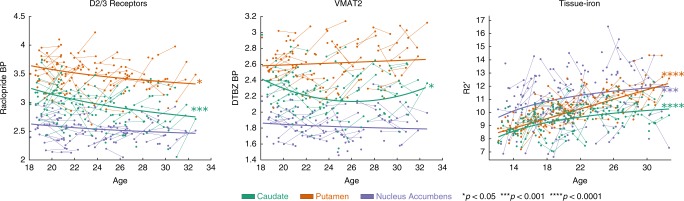
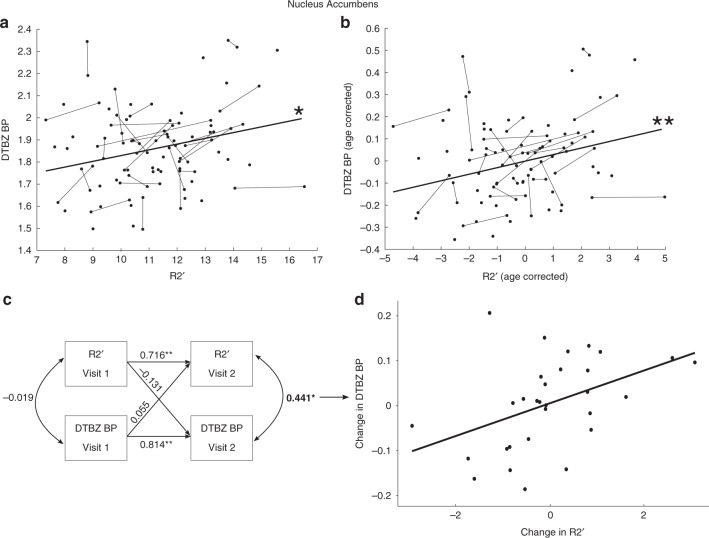
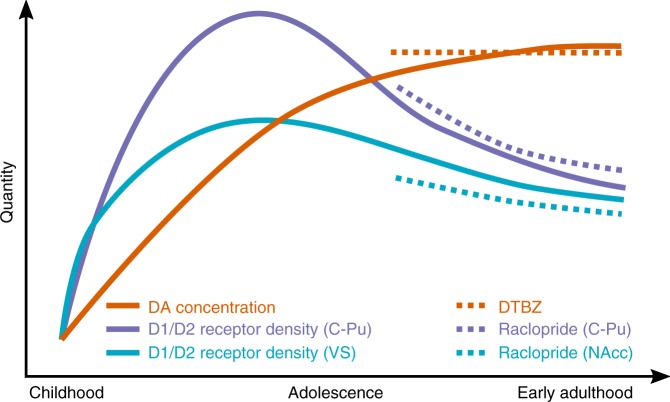
The development of the striatum dopamine (DA) system through human adolescence, a time of increased sensation seeking and vulnerability to the emergence of psychopathology, has been difficult to study due to pediatric restrictions on direct in vivo assessments of DA. Here, we applied neuroimaging in a longitudinal sample of n = 146 participants aged 12–30. R2′, an MR measure of tissue iron which co-localizes with DA vesicles and is necessary for DA synthesis, was assessed across the sample. In the 18–30 year-olds (n = 79) we also performed PET using [11C]dihydrotetrabenazine (DTBZ), a measure of presynaptic vesicular DA storage, and [11C]raclopride (RAC), an indicator of D2/D3 receptor availability. We observed decreases in D2/D3 receptor availability with age, while presynaptic vesicular DA storage (as measured by DTBZ), which was significantly associated with R2′ (standardized coefficient = 0.29, 95% CI = [0.11, 0.48]), was developmentally stable by age 18. Our results provide new evidence for maturational specialization of the striatal DA system through adolescence.
Overview
The claims and statistics of this paper haven’t been checked yet.
Run the check — free, no account needed. It reads the open-access text and checks the sources it cites.
Integrity signals
Registry
Cites
Statistics
Figures
Verification
Claims the paper makes
The claims and statistics of this paper haven’t been checked yet.
Run the check — free, no account needed. It reads the open-access text and checks the sources it cites.
Claims other papers make about this one
Each is checked against this paper’s own text: does it say what the citing paper says it does?
The cited source says what the claim attributes to it.
In the citing paper
“Functional imaging studies further indicate that significant changes occur in the function of subcortical structures and in their relationship with cortical regions, notably in nuclei associated with reward and motivation [26–29].”
From Adolescent nicotine exposure and persistent neurocircuitry changes: unveiling lifelong psychiatric risks (2025) · cites this paper as [29]
Self-check
Percentages, sums and reported differences re-computed from the paper’s own numbers.
The self-check needs the paper’s full text.
Citations
Cites
(1998) · Cited by 36,049
AFNI: Software for analysis and visualization of functional magnetic resonance neuroimages
Cox, R. W. (1996) · Computers and Biomedical Research · doi:10.1006/cbmr.1996.0014 · Cited by 10,913
Fischl, B. (2012) · NeuroImage · doi:10.1016/j.neuroimage.2012.01.021 · Cited by 9,526
The adolescent brain and age-related behavioral manifestations
Spear, L. P. (2000) · Neuroscience & Biobehavioral Reviews · doi:10.1016/s0149-7634(00)00014-2 · Cited by 5,433
The reward circuit: linking primate anatomy and human imaging
Haber, S. N., & Knutson, B. (2010) · Neuropsychopharmacology · doi:10.1038/npp.2009.129 · Cited by 3,718
Why do many psychiatric disorders emerge during adolescence?
Paus, T., Keshavan, M., & Giedd, J. N. (2008) · Nature Reviews Neuroscience · doi:10.1038/nrn2513 · Cited by 3,123
Simplified Reference Tissue Model for PET Receptor Studies
Lammertsma, A. A., & Hume, S. P. (1996) · NeuroImage · doi:10.1006/nimg.1996.0066 · Cited by 2,025
The role of iron in brain ageing and neurodegenerative disorders
Ward, R. J., Zucca, F. A., Duyn, J. H., Crichton, R. R., & Zecca, L. (2014) · The Lancet Neurology · doi:10.1016/s1474-4422(14)70117-6 · Cited by 1,819
Schizophrenia: Caused by a fault in programmed synaptic elimination during adolescence?
Feinberg, I. (1982) · Journal of Psychiatric Research · doi:10.1016/0022-3956(82)90038-3 · Cited by 1,395
Importance of investing in adolescence from a developmental science perspective
Dahl, R. E., Allen, N. B., Wilbrecht, L., & Suleiman, A. B. (2018) · Nature · doi:10.1038/nature25770 · Cited by 1,196
Research works printed but not linked: 1
- Gunn, R., Coello, C. & Searle, G. Molecular Imaging And Kinetic Analysis Toolbox (MIAKAT)—a quantitative software package for the analysis of PET neuroimaging data. J. Nucl. Med 57, 1928–1928 (2016).
Cited by
Sorted by citations
Items 101–106 of 106
Differential local synchronization in human nucleus accumbens vs. caudate and putamen
Christova, P. S., & Georgopoulos, A. P. (2026) · Journal of Neurophysiology · doi:10.1152/jn.00178.2026
Chen, C., Chen, I.-F., Chang, W.-C., Liu, C., Hsieh, M. H., Hwang, T., Hai-Gwo, H., Lin, Y.-T., Tu, P.-C., & Liu, C. (2026) · Journal of Psychopharmacology · doi:10.1177/02698811261464518
Heritage, L. A., Chat, I. K.-Y., Ahern, J., Loughnan, R. J., Aupperle, R. L., Fan, C. C., Paulus, M. P., Thompson, W. K., & Zheng, H. (2026) · Brain Behavior and Immunity · doi:10.1016/j.bbi.2026.106970
Sohn, B., Kim, J. R., Heo, H., Song, S., Kim, E. Y., & Joo, E. Y. (2026) · Frontiers in Neurology · doi:10.3389/fneur.2026.1756028
Emergent blink rate in early childhood is associated with neural origins of executive function
Kuwamizu, R., Yamamoto, N., Otani, K., & Moriguchi, Y. (2026) · Communications Psychology · doi:10.1038/s44271-026-00524-6 · Cited by 1
Clinical Pharmacology of Antipsychotics in Children and Adolescents
Lorberg, B. A., Hyndych, A., & Findling, R. L. (2026) · Child and Adolescent Psychiatric Clinics of North America · doi:10.1016/j.chc.2026.08.006
Metadata
- Authors
- Larsen, B., Olafsson, V., Calabro, F., Laymon, C., Tervo-Clemmens, B., Campbell, E., Minhas, D., Montez, D., Price, J., & Luna, B.
- Affiliations
- University of Pittsburgh (US)
- Northeastern University (US)
- Harvard University (US)
- Corresponding author
- Larsen, Bart
- ORCID
- Venue
- Nature Communications
- Published
- 2020-02-12
- Volume
- 11
- Issue
- 1
- Pages
- 846-846
- ISSN
- 2041-1723 (ISSN-L)
- PMC
- PMC7015913
- OpenAlex
- W3005739685
- Cited by
- 107
- References
- 76
- Citations by year
- 2026: 16 · 2025: 20 · 2024: 16 · 2023: 17 · 2022: 17 · 2021: 16 · 2020: 5
- FWCI
- 6.26
- Type
- journal article
- Language
- en
- Open access
- gold
- doi.org
- Locations
- Nature Communications (publishedVersion, cc-by)
- PubMed Central (publishedVersion, cc-by)
- PubMed (publishedVersion)
- RePEc: Research Papers in Economics (submittedVersion)
- DOAJ (DOAJ: Directory of Open Access Journals) (submittedVersion, cc-by-sa)
- Funders
- U.S. Department of Health & Human Services | NIH | U.S. National Library of Medicine (5R01MH080243-07)
- Topics
- Life Sciences › Neuroscience › Cellular and Molecular Neuroscience › Neurotransmitter Receptor Influence on Behavior
- Life Sciences › Neuroscience › Cognitive Neuroscience › Neural and Behavioral Psychology Studies
- Health Sciences › Medicine › Radiology, Nuclear Medicine and Imaging › Advanced MRI Techniques and Applications
- Keywords
- adolescence, dihydrotetrabenazine, raclopride, R2* MRI, tissue iron, brain maturation, longitudinal neuroimaging
- MeSH terms
- Cognitive Neuroscience, Adolescent, Adult, Age Factors, Child, Corpus Striatum, Dopamine, Female, Humans, Kinetics, Magnetic Resonance Imaging, Male, Models, Biological, Tetrabenazine, Receptors, Dopamine D2, Raclopride, Positron-Emission Tomography, Receptors, Dopamine D3, Young Adult, Neuroimaging
About these checks
Registry, retraction, Cites and statistics results are computed, not judged, with one exception: a printed reference that no index lists is read once by a model before it counts as a citation error. Claims are extracted by a model and kept only when their quote appears verbatim in the text; each cited source is then checked, with a model’s help, for whether it says what the claim relies on. Those verdicts can be wrong — read the claim’s quote and the cited source before relying on one.
Statistics and arithmetic are recomputed, not judged.
Confidence bands are shown only for fields calibrated on our annotated test set. None is calibrated yet, so no band is shown.
What counts as a claim ›How we measure confidence ›How we check this ›
Are you an author, or do you see a problem with this page? Request a review
