

The DOI matches its Crossref record; 76 of the 76 references it cites were found in a registry or an index.
Maturation of the human striatal dopamine system revealed by PET and quantitative MRI
Open accessAbstract
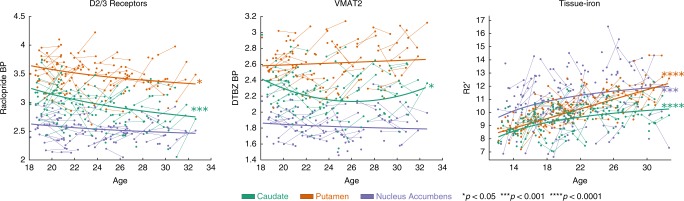
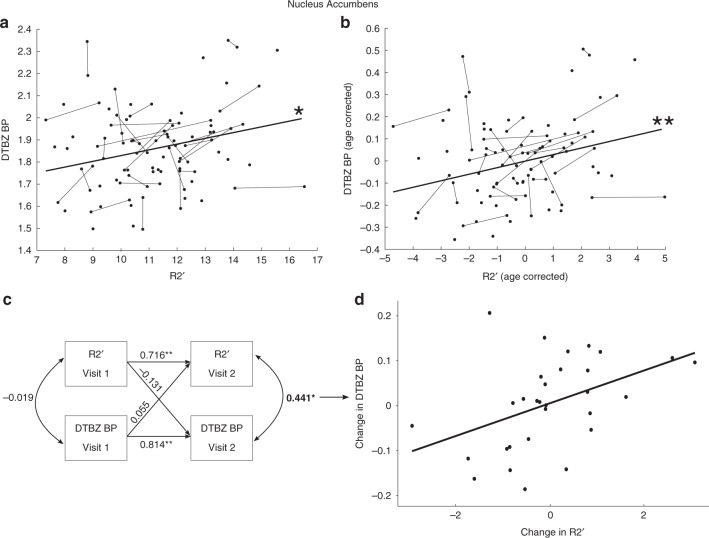
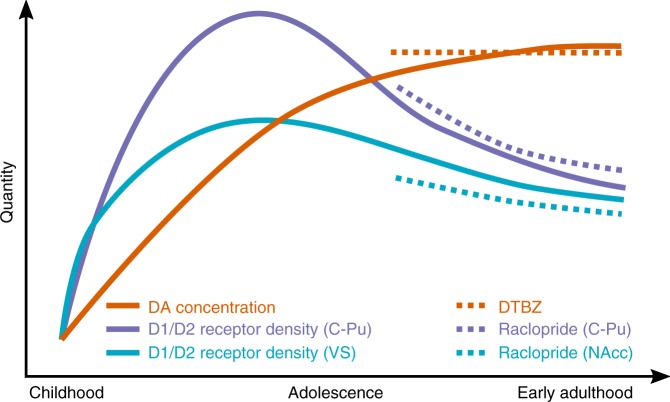
The development of the striatum dopamine (DA) system through human adolescence, a time of increased sensation seeking and vulnerability to the emergence of psychopathology, has been difficult to study due to pediatric restrictions on direct in vivo assessments of DA. Here, we applied neuroimaging in a longitudinal sample of n = 146 participants aged 12–30. R2′, an MR measure of tissue iron which co-localizes with DA vesicles and is necessary for DA synthesis, was assessed across the sample. In the 18–30 year-olds (n = 79) we also performed PET using [11C]dihydrotetrabenazine (DTBZ), a measure of presynaptic vesicular DA storage, and [11C]raclopride (RAC), an indicator of D2/D3 receptor availability. We observed decreases in D2/D3 receptor availability with age, while presynaptic vesicular DA storage (as measured by DTBZ), which was significantly associated with R2′ (standardized coefficient = 0.29, 95% CI = [0.11, 0.48]), was developmentally stable by age 18. Our results provide new evidence for maturational specialization of the striatal DA system through adolescence.
Overview
The claims and statistics of this paper haven’t been checked yet.
Run the check — free, no account needed. It reads the open-access text and checks the sources it cites.
Integrity signals
Registry
Cites
Statistics
Figures
Verification
Claims the paper makes
The claims and statistics of this paper haven’t been checked yet.
Run the check — free, no account needed. It reads the open-access text and checks the sources it cites.
Claims other papers make about this one
Each is checked against this paper’s own text: does it say what the citing paper says it does?
The cited source says what the claim attributes to it.
In the citing paper
“Functional imaging studies further indicate that significant changes occur in the function of subcortical structures and in their relationship with cortical regions, notably in nuclei associated with reward and motivation [26–29].”
From Adolescent nicotine exposure and persistent neurocircuitry changes: unveiling lifelong psychiatric risks (2025) · cites this paper as [29]
Self-check
Percentages, sums and reported differences re-computed from the paper’s own numbers.
The self-check needs the paper’s full text.
Citations
Cites
(1998) · Cited by 36,049
AFNI: Software for analysis and visualization of functional magnetic resonance neuroimages
Cox, R. W. (1996) · Computers and Biomedical Research · doi:10.1006/cbmr.1996.0014 · Cited by 10,913
Fischl, B. (2012) · NeuroImage · doi:10.1016/j.neuroimage.2012.01.021 · Cited by 9,526
The adolescent brain and age-related behavioral manifestations
Spear, L. P. (2000) · Neuroscience & Biobehavioral Reviews · doi:10.1016/s0149-7634(00)00014-2 · Cited by 5,433
The reward circuit: linking primate anatomy and human imaging
Haber, S. N., & Knutson, B. (2010) · Neuropsychopharmacology · doi:10.1038/npp.2009.129 · Cited by 3,718
Why do many psychiatric disorders emerge during adolescence?
Paus, T., Keshavan, M., & Giedd, J. N. (2008) · Nature Reviews Neuroscience · doi:10.1038/nrn2513 · Cited by 3,123
Simplified Reference Tissue Model for PET Receptor Studies
Lammertsma, A. A., & Hume, S. P. (1996) · NeuroImage · doi:10.1006/nimg.1996.0066 · Cited by 2,025
The role of iron in brain ageing and neurodegenerative disorders
Ward, R. J., Zucca, F. A., Duyn, J. H., Crichton, R. R., & Zecca, L. (2014) · The Lancet Neurology · doi:10.1016/s1474-4422(14)70117-6 · Cited by 1,819
Schizophrenia: Caused by a fault in programmed synaptic elimination during adolescence?
Feinberg, I. (1982) · Journal of Psychiatric Research · doi:10.1016/0022-3956(82)90038-3 · Cited by 1,395
Importance of investing in adolescence from a developmental science perspective
Dahl, R. E., Allen, N. B., Wilbrecht, L., & Suleiman, A. B. (2018) · Nature · doi:10.1038/nature25770 · Cited by 1,196
Research works printed but not linked: 1
- Gunn, R., Coello, C. & Searle, G. Molecular Imaging And Kinetic Analysis Toolbox (MIAKAT)—a quantitative software package for the analysis of PET neuroimaging data. J. Nucl. Med 57, 1928–1928 (2016).
Cited by
Sorted by citations
Mesocorticolimbic Dopamine Pathways Across Adolescence: Diversity in Development
Reynolds, L. M., & Flores, C. (2021) · Frontiers in Neural Circuits · doi:10.3389/fncir.2021.735625 · Cited by 137
Adolescent brain development and contextual influences: a decade in review
Galván, A. (2021) · Journal of Research on Adolescence · doi:10.1111/jora.12687 · Cited by 77
Koirala, S., Grimsrud, G. J., Mooney, M. A., Larsen, B., Feczko, E., Elison, J. T., Nelson, S. M., Nigg, J. T., Tervo‐Clemmens, B., & Fair, D. A. (2024) · Nature reviews. Neuroscience · doi:10.1038/s41583-024-00869-z · Cited by 78
Self-citationChinese Color Nest Project : An accelerated longitudinal brain-mind cohort
Liu, S., Wang, Y., Zhang, Q., Zhou, Q., Cao, L., Jiang, C., Zhang, Z., Yang, N., Dong, Q., & Zuo, X. (2021) · Developmental Cognitive Neuroscience · doi:10.1016/j.dcn.2021.101020 · Cited by 67
Parr, A. C., Calabro, F., Larsen, B., Tervo-Clemmens, B., Elliot, S., Foran, W., Olafsson, V., & Luna, B. (2021) · Progress in Neurobiology · doi:10.1016/j.pneurobio.2021.101997 · Cited by 60
Self-citationSensitivity and specificity in affective and social learning in adolescence
Towner, E., Chierchia, G., & Blakemore, S. (2023) · Trends in Cognitive Sciences · doi:10.1016/j.tics.2023.04.002 · Cited by 66
Transdiagnostic neuroimaging of reward system phenotypes in ADHD and comorbid disorders
Grimm, O., van Rooij, D., Hoogman, M., Klein, M., Buitelaar, J. K., Franke, B., Reif, A., & Plichta, M. M. (2021) · Neuroscience & Biobehavioral Reviews · doi:10.1016/j.neubiorev.2021.06.025 · Cited by 62
Striatal dopamine supports reward expectation and learning: A simultaneous PET/fMRI study
Calabro, F. J., Montez, D. F., Larsen, B., Laymon, C. M., Foran, W., Hallquist, M. N., Price, J. C., & Luna, B. (2022) · NeuroImage · doi:10.1016/j.neuroimage.2022.119831 · Cited by 56
Self-citationPark, A. T., Tooley, U. A., Leonard, J., Boroshok, A. L., McDermott, C. L., Tisdall, M. D., & Mackey, A. P. (2020) · Developmental Cognitive Neuroscience · doi:10.1016/j.dcn.2020.100909 · Cited by 48
Multi-scale neural decoding and analysis
Lu, H., Lorenc, E. S., Zhu, H., Kilmarx, J., Sulzer, J. S., Xie, C., Tobler, P. N., Watrous, A. J., Orsborn, A. L., Lewis‐Peacock, J. A., et al. (2021) · Journal of Neural Engineering · doi:10.1088/1741-2552/ac160f · Cited by 47
Goal-directed learning in adolescence: neurocognitive development and contextual influences
Wilbrecht, L., & Davidow, J. Y. (2024) · Nature reviews. Neuroscience · doi:10.1038/s41583-023-00783-w · Cited by 47
Neurobehavioral changes arising from early life dopamine signaling perturbations
Areal, L. B., & Blakely, R. (2020) · Neurochemistry International · doi:10.1016/j.neuint.2020.104747 · Cited by 45
The beautiful adolescent brain: An evolutionary developmental perspective
Casey, B. J., Cohen, A. O., & Galván, A. (2025) · Annals of the New York Academy of Sciences · doi:10.1111/nyas.15314 · Cited by 44
Elevated iron concentration in putamen and cortical speech motor network in developmental stuttering
Cler, G. J., Krishnan, S., Papp, D. S., Wiltshire, C. E. E., Chesters, J., & Watkins, K. E. (2021) · Brain · doi:10.1093/brain/awab283 · Cited by 34
Li, G., Shi, S., Tan, J., He, L., Liu, Q., Fěng, F., Fu, H., Zhong, M., Mai, Z., Sun, R., et al. (2024) · Advanced Science · doi:10.1002/advs.202309464 · Cited by 35
Interpretable Machine Learning Model for Predicting Postpartum Depression: Retrospective Study
Zhang, R., Liu, Y., Zhang, Z., Luo, R., & Lv, B. (2025) · JMIR Medical Informatics · doi:10.2196/58649 · Cited by 32
Amphetamine disrupts dopamine axon growth in adolescence by a sex-specific mechanism in mice
Reynolds, L. M., Hernandez, G., MacGowan, D., Popescu, C., Nouel, D., Cuesta, S., Burke, S., Savell, K. E., Zhao, J., Restrepo-Lozano, J. M., et al. (2023) · Nature Communications · doi:10.1038/s41467-023-39665-1 · Cited by 30
Expecting the unexpected: a review of learning under uncertainty across development
Topel, S., Ma, I., Sleutels, J. J. M., van Steenbergen, H., de Bruijn, E. R. A., & van Duijvenvoorde, A. C. K. (2023) · Cognitive Affective & Behavioral Neuroscience · doi:10.3758/s13415-023-01098-0 · Cited by 37
Parr, A. C., Calabro, F. J., Tervo‐Clemmens, B., Larsen, B., Foran, W., & Luna, B. (2022) · Developmental Cognitive Neuroscience · doi:10.1016/j.dcn.2022.101100 · Cited by 32
Self-citationMcCutcheon, R. A., Brown, K., Nour, M. M., Smith, S. M., Veronese, M., Zelaya, F. O., Osugo, M., Jauhar, S., Hallett, W. A., Mehta, M. A., et al. (2021) · Science Advances · doi:10.1126/sciadv.abg1512 · Cited by 27
Parr, A. C., Sydnor, V. J., Calabro, F. J., & Luna, B. (2024) · Current Opinion in Behavioral Sciences · doi:10.1016/j.cobeha.2024.101399 · Cited by 30
Self-citationLeveraging ultra-high field (7T) MRI in psychiatric research
Calabro, F. J., Parr, A. C., Sydnor, V. J., Hetherington, H. P., Prasad, K. M. R., Ibrahim, T. S., Sarpal, D. K., Famalette, A., Verma, P., & Luna, B. (2024) · Neuropsychopharmacology · doi:10.1038/s41386-024-01980-6 · Cited by 29
Self-citationReynolds, L. M., Faure, P., & Barik, J. (2025) · Molecular Psychiatry · doi:10.1038/s41380-025-03110-0 · Cited by 26
“Functional imaging studies further indicate that signi fi cant changes occur in the function of subcortical structures and in their relationship with cortical regions, notably in nuclei associated with reward and motivation [26 – 29].”
Biphasic patterns of age-related differences in dopamine D1 receptors across the adult lifespan
Johansson, J. J., Nordin, K., Pedersen, R., Karalija, N., Papenberg, G., Andersson, M., Korkki, S. M., Riklund, K., Guitart‐Masip, M., Rieckmann, A., et al. (2023) · Cell Reports · doi:10.1016/j.celrep.2023.113107 · Cited by 33
Parr, A. C., Perica, M. I., Calabro, F. J., Foran, W., Moon, C., Hetherington, H. P., & Luna, B. (2024) · Molecular Psychiatry · doi:10.1038/s41380-024-02860-7 · Cited by 23
Self-citationSubcortical brain iron deposition in individuals with schizophrenia
Sonnenschein, S. F., Parr, A. C., Larsen, B., Calabro, F. J., Foran, W., Eack, S. M., Luna, B., & Sarpal, D. K. (2022) · Journal of Psychiatric Research · doi:10.1016/j.jpsychires.2022.04.013 · Cited by 24
Self-citationConsiderations When Characterizing Adolescent Neurocognitive Development
Luna, B., Tervo‐Clemmens, B., & Calabro, F. J. (2020) · Biological Psychiatry · doi:10.1016/j.biopsych.2020.04.026 · Cited by 23
Self-citationDopaminergic Perturbation in the Aetiology of Neurodevelopmental Disorders
Ijomone, O. K., Oria, R. S., Ijomone, O. M., Aschner, M., & Bornhorst, J. (2024) · Molecular Neurobiology · doi:10.1007/s12035-024-04418-8 · Cited by 22
Sui, Y. V., McKenna, F., Bertisch, H. C., Storey, P., Anthopolos, R., GOFF, D. C., Samsonov, A. A., & Lazar, M. (2022) · Molecular Psychiatry · doi:10.1038/s41380-022-01740-2 · Cited by 21
Brain iron content and cognitive function in patients with β-thalassemia
Bu, M., Deng, X., Zhang, Y., Chen, S. W., Jiang, M., & Chen, B. T. (2023) · Therapeutic Advances in Hematology · doi:10.1177/20406207231167050 · Cited by 21
Adolescent neurocognitive development and decision-making abilities regarding gender-affirming care
Ravindranath, O., Perica, M. I., Parr, A. C., Ojha, A., McKeon, S. D., Montano, G. T., Ullendorff, N., Luna, B., & Edmiston, E. K. (2024) · Developmental Cognitive Neuroscience · doi:10.1016/j.dcn.2024.101351 · Cited by 31
Self-citationChen, Z., Liao, C., Cao, X., Poser, B. A., Xu, Z., Lo, W., Wen, M., Cho, J., Tian, Q., Wang, Y., et al. (2023) · Magnetic Resonance in Medicine · doi:10.1002/mrm.29578 · Cited by 20
Larsen, B., Baller, E. B., Boucher, A. A., Calkins, M. E., Laney, N. C., Moore, T. M., Roalf, D. R., Ruparel, K., Gur, R. C., Gur, R. E., et al. (2023) · American Journal of Clinical Nutrition · doi:10.1016/j.ajcnut.2023.05.005 · Cited by 20
Self-citationWenger, M. J., Murray‐Kolb, L. E., Scott, S., Boy, E., & Haas, J. D. (2022) · BMC Public Health · doi:10.1186/s12889-022-13612-z · Cited by 19
Neuromelanin-sensitive MRI for mechanistic research and biomarker development in psychiatry
Wengler, K., Trujillo, P., Cassidy, C., & Horga, G. (2024) · Neuropsychopharmacology · doi:10.1038/s41386-024-01934-y · Cited by 18
Shvarzman, R., Crocetti, D., Rosch, K. S., Li, X., & Mostofsky, S. H. (2022) · Experimental Brain Research · doi:10.1007/s00221-022-06484-7 · Cited by 19
Fiani, D., Engler, S., Fields, S. A., & Calarge, C. A. (2023) · Child and Adolescent Psychiatric Clinics of North America · doi:10.1016/j.chc.2022.08.015 · Cited by 16
Cascone, A., Calabro, F. J., Foran, W., Larsen, B., Nugiel, T., Parr, A. C., Tervo‐Clemmens, B., Luna, B., & Cohen, J. R. (2023) · Developmental Cognitive Neuroscience · doi:10.1016/j.dcn.2023.101274 · Cited by 18
Self-citationBiobehavioral correlates of an fMRI index of striatal tissue iron in depressed patients
Price, R. B., Tervo‐Clemmens, B., Panny, B., Degutis, M., Griffo, A., & Woody, M. L. (2021) · Translational Psychiatry · doi:10.1038/s41398-021-01553-x · Cited by 19
Self-citationPark, A. T., & Mackey, A. P. (2021) · Mind Brain and Education · doi:10.1111/mbe.12304 · Cited by 18
Millevert, C., Vidas-Guscic, N., Vanherp, L., Jonckers, E., Verhoye, M., Staelens, S. G., Bertoglio, D., & Weckhuysen, S. (2023) · Journal of Neuroscience · doi:10.1523/jneurosci.1043-23.2023 · Cited by 17
Vano, L. J., McCutcheon, R. A., Sedlacik, J., Rutigliano, G., Kaar, S. J., Finelli, V., Lobo, M. C., Berry, A., Statton, B. K., Fazlollahi, A., et al. (2025) · Molecular Psychiatry · doi:10.1038/s41380-025-03195-7 · Cited by 14
Investigating hierarchical critical periods in human neurodevelopment
Sydnor, V. J., Ojha, A., Larsen, B., Martínez, Á., Calabro, F. J., & Luna, B. (2025) · Neuropsychopharmacology · doi:10.1038/s41386-025-02246-5 · Cited by 19
Self-citationVano, L. J., McCutcheon, R. A., Sedlacik, J., Kaar, S. J., Rutigliano, G., Nordio, G., Finelli, V., Townsend, L., Berry, A., Statton, B. K., et al. (2025) · American Journal of Psychiatry · doi:10.1176/appi.ajp.20240512 · Cited by 13
Kanaan, A. S., Yu, D., Metere, R., Schäfer, A., Schlumm, T., Bilgiç, B., Anwander, A., Mathews, C. A., Scharf, J. M., Müller‐Vahl, K., et al. (2023) · Neurobiology of Disease · doi:10.1016/j.nbd.2023.106252 · Cited by 13
Eckstrand, K., Lenniger, C. J., & Forbes, E. E. (2022) · Annual Review of Developmental Psychology · doi:10.1146/annurev-devpsych-120920-040820 · Cited by 13
Wu, P., You, T., Ren, Q.-Y., Xi, H., Liu, Q., Qin, F., Gu, H., Wang, Y., Yan, W., Gao, Y., et al. (2022) · Nano Research · doi:10.1007/s12274-022-5038-3 · Cited by 12
The iron-dopamine D1 coupling modulates neural signatures of working memory across adult lifespan
Gustavsson, J., Johansson, J. J., Falahati, F., Andersson, M., Papenberg, G., Avelar‐Pereira, B., Bäckman, L., Kalpouzos, G., & Salami, A. (2023) · NeuroImage · doi:10.1016/j.neuroimage.2023.120323 · Cited by 11
Iron content affects age group differences in associative learning-related fMRI activity
Petok, J. R., Merenstein, J. L., & Bennett, I. J. (2023) · NeuroImage · doi:10.1016/j.neuroimage.2023.120478 · Cited by 11
Woody, M. L., Panny, B., Degutis, M., Griffo, A., & Price, R. B. (2021) · Behaviour Research and Therapy · doi:10.1016/j.brat.2021.103960 · Cited by 10
Developmental coupling of brain iron and intrinsic activity in infants during the first 150 days
Ji, L., Yoon, Y. B., Hendrix, C. L., Kennelly, E., Majbri, A., Bhatia, T., Taylor, A., & Thomason, M. E. (2023) · Developmental Cognitive Neuroscience · doi:10.1016/j.dcn.2023.101326 · Cited by 10
Kendricks, D. R., Boomhower, S. R., & Newland, M. C. (2020) · NeuroToxicology · doi:10.1016/j.neuro.2020.07.009 · Cited by 11
Mas‐Cuesta, L., Baltruschat, S., Cándido, A., Verdejo-Lucas, C., Catena-Verdejo, E., & Catena, A. (2024) · Behavioural Brain Research · doi:10.1016/j.bbr.2024.114859 · Cited by 9
Hagan, K. E., Lloyd, E. C., & Gorrell, S. (2025) · Journal of Child Psychology and Psychiatry · doi:10.1111/jcpp.70029 · Cited by 9
Xu, J., Guan, X., Wen, J., Wang, T., Zhang, M., & Xu, X. (2021) · European Journal of Neuroscience · doi:10.1111/ejn.15532 · Cited by 10
Nakhid, D., McMorris, C. A., Sun, H., Gibbard, W. B., Tortorelli, C., & Lebel, C. A. (2022) · Alcoholism Clinical and Experimental Research · doi:10.1111/acer.14928 · Cited by 9
Associations between mesolimbic connectivity, and alcohol use from adolescence to adulthood
Morales, A. M., Jones, S. A., Carlson, B., Kliamovich, D., Dehoney, J., Simpson, B. L., Dominguez-Savage, K. A., Hernandez, K. O., Lopez, D. A., Baker, F. C., et al. (2024) · Developmental Cognitive Neuroscience · doi:10.1016/j.dcn.2024.101478 · Cited by 7
Self-citationAnimal Models of Relevance to the Schizophrenia Prodrome
Petty, A. E., Howes, O. D., & Eyles, D. W. (2021) · Biological Psychiatry Global Open Science · doi:10.1016/j.bpsgos.2021.12.001 · Cited by 8
Brain Iron Alteration in Pediatric Tourette Syndrome: A Quantitative Susceptibility Mapping Study
Lin, L., Ruan, Z., Li, Y. B., Qiu, H., Deng, C., Qian, L., Cui, W., Tang, W., Yang, Z., Cheng, Y., et al. (2025) · European Journal of Neurology · doi:10.1111/ene.70054 · Cited by 7
Gkotsoulias, D., Rullmann, M., Schmitt, S., Bujanow, A., Zientek, F., Messerschmidt, K., Pampel, A., Büttner, A.-P., Schildan, A., Sabri, O., et al. (2025) · Brain Communications · doi:10.1093/braincomms/fcaf104 · Cited by 6
Adolescence as a sensitive period for neurotoxicity: Lifespan developmental effects of methylmercury
Kendricks, D. R., Boomhower, S. R., & Newland, M. C. (2022) · Pharmacology Biochemistry and Behavior · doi:10.1016/j.pbb.2022.173389 · Cited by 9
Hemochromatosis neural archetype reveals iron disruption in motor circuits
Loughnan, R. J., Ahern, J., Boyle, M. E. T., Jernigan, T. L., Hagler, D. J., Iversen, J. R., Frei, O., Smith, D. M. Y., Andreassen, O. A., Zaitlen, N., et al. (2024) · Science Advances · doi:10.1126/sciadv.adp4431 · Cited by 6
Flannery, J. S., Parr, A. C., Lindquist, K. A., & Telzer, E. H. (2025) · Developmental Cognitive Neuroscience · doi:10.1016/j.dcn.2025.101594 · Cited by 7
Newbolds, S. F., & Wenger, M. J. (2024) · Nutritional Neuroscience · doi:10.1080/1028415x.2024.2304943 · Cited by 6
Unlocking the age-old secrets of reward and substance use
Liu, C., & Filbey, F. M. (2024) · Pharmacology Biochemistry and Behavior · doi:10.1016/j.pbb.2024.173766 · Cited by 7
Assessment of motion and model bias on the detection of dopamine response to behavioral challenge
Levine, M. A., Mandeville, J. B., Calabro, F. J., Izquierdo‐Garcia, D., Chonde, D. B., Chen, K. T., Hong, I., Price, J. C., Luna, B., & Catana, C. (2022) · Journal of Cerebral Blood Flow & Metabolism · doi:10.1177/0271678x221078616 · Cited by 5
Self-citationSantoni, M., Mastio, A., Pistis, M., & Sagheddu, C. (2026) · Frontiers in Cellular Neuroscience · doi:10.3389/fncel.2026.1782731 · Cited by 4
Nuclear Medicine Imaging Biomarkers in Parkinson’s Disease: Past, Present, and Future Directions
Martini, A. L., Sestini, S., Guarino, D. S., & Feraco, P. (2025) · Medical Sciences · doi:10.3390/medsci13040308 · Cited by 4
Giacco, A. C. D., Morales, A. M., Jones, S. A., Barnes, S. J., & Nagel, B. J. (2024) · Journal of Affective Disorders · doi:10.1016/j.jad.2024.08.028 · Cited by 4
Striatal and hippocampal contributions to value-based learning in adolescence
Niemiec, E., Insel, C., & Davidow, J. Y. (2025) · Neuropsychopharmacology · doi:10.1038/s41386-025-02260-7 · Cited by 3
Linking brain entropy to molecular and cellular architecture in psychosis
Li, Q., Liu, J., & Calhoun, V. D. (2025) · NeuroImage · doi:10.1016/j.neuroimage.2025.121537 · Cited by 4
Gray Matter Iron and Neuromelanin in Psychosis: A Systematic Review and Meta-Analysis of MRI Studies
Vano, L. J., Sedlacik, J., Carr, R. W., Bukala, B. R., Howes, O. D., & McCutcheon, R. (2026) · American Journal of Psychiatry · doi:10.1176/appi.ajp.20251257 · Cited by 3
Keifman, E., Coll, C., Tubert, C., Paz, R. M., Belforte, J. E., Murer, M. G., & Braz, B. Y. (2022) · Journal of Neuroscience · doi:10.1523/jneurosci.1992-21.2022 · Cited by 3
Multivariate and regional age-related change in basal ganglia iron in neonates
Cabral, L. M., Calabro, F. J., Foran, W., Parr, A. C., Ojha, A., Rasmussen, J. M., Ceschin, R. C., Panigrahy, A., & Luna, B. (2023) · Cerebral Cortex · doi:10.1093/cercor/bhad456 · Cited by 3
Self-citationGriffith, J. M., Wears, A., Mcdonald, N., Silk, J. S., Price, R. B., & Woody, M. L. (2025) · Developmental Cognitive Neuroscience · doi:10.1016/j.dcn.2025.101579 · Cited by 2
Neuroimaging Human Dopamine-Related Neurophysiology Across Development
Parr, A. C., Larsen, B., Calabro, F. J., Tervo‐Clemmens, B., & Luna, B. (2022) · Neuromethods · doi:10.1007/978-1-0716-2799-0_13 · Cited by 2
Self-citationSerum iron status and risk of Tourette’s syndrome: a Mendelian randomization study
Zhang, H., Zhang, K., Jiao, F., & Xu, C. (2025) · European Journal of Pediatrics · doi:10.1007/s00431-025-06287-2 · Cited by 2
Normal development of the brain: a survey of joint structural–functional brain studies
Namiranian, R., Malakshan, S. R., Moghaddam, H. A., Khadem, A. A., & Jafari, R. (2022) · Reviews in the Neurosciences · doi:10.1515/revneuro-2022-0017 · Cited by 4
Wenger, M. J., Murray‐Kolb, L. E., Scott, S., Boy, E., & Haas, J. D. (2021) · Research Square · doi:10.21203/rs.3.rs-882215/v1 · Cited by 2
Adolescent neurocognitive development
Ravindranath, O., Parr, A. C., Perica, M. I., Elliott, S., & Luna, B. (2022) · Elsevier eBooks · doi:10.1016/b978-0-12-818872-9.00105-9 · Cited by 4
Self-citationMaturation of striatal dopamine supports the development of habitual behavior through adolescencePreprint
Petrie, D. J., Parr, A. C., Sydnor, V. J., Ojha, A., Foran, W., Tervo‐Clemmens, B., Calabro, F. J., & Luna, B. (2025) · bioRxiv (Cold Spring Harbor Laboratory) · doi:10.1101/2025.01.06.631527 · Cited by 3
Self-citationMun, J., Jackson, S., Prounis, G. S., Phumsatitpong, C., Motahari, N., Kriegsfeld, L. J., Landry, M. P., & Wilbrecht, L. (2025) · eNeuro · doi:10.1523/eneuro.0212-25.2025 · Cited by 2
Parr, A. C., Ojha, A., Petrie, D. J., Calabro, F. J., Tervo‐Clemmens, B., Foran, W., Fitzgerald, D., Tapert, S. F., Nooner, K. B., Thompson, W., et al. (2026) · Nature Communications · doi:10.1038/s41467-026-73611-1 · Cited by 4
Self-citationMechanisms underlying the enduring addiction vulnerability conferred by nicotine in adolescence
Reynolds, L. M. (2026) · Addiction Neuroscience · doi:10.1016/j.addicn.2026.100272 · Cited by 1
Calabro, F. J., & Parr, A. C. (2024) · American Journal of Psychiatry · doi:10.1176/appi.ajp.20240853 · Cited by 1
Self-citationImpact of Amphetamine Exposure During Adolescence on Neurobehavioral Endpoints
Boomhower, S. R. (2022) · Springer eBooks · doi:10.1007/978-3-030-92392-1_107 · Cited by 1
Iron content affects age group differences in associative learning-related fMRI activityPreprint
Petok, J. R., Merenstein, J. L., & Bennett, I. J. (2023) · doi:10.31234/osf.io/v7m6g · Cited by 1
Chat, I. K.-Y., Murrough, J. W., Russo, S. J., Calabro, F. J., Luna, B., Tripathy, K., Gupta, T., Brodnick, Z. M., Julien, M. M., Jones, N., et al. (2025) · Research Square · doi:10.21203/rs.3.rs-8442008/v1 · Cited by 1
Self-citationLevine, M. A., Mandeville, J. B., Calabro, F. J., Izquierdo‐Garcia, D., Price, J. C., Luna, B., & Catana, C. (2021) · medRxiv · doi:10.1101/2021.06.29.21259715
Self-citationImpact of Amphetamine Exposure During Adolescence on Neurobehavioral Endpoints
Boomhower, S. R. (2021) · Springer eBooks · doi:10.1007/978-3-030-67928-6_107-1
Iron content affects age group differences in associative learning-related fMRI activityPreprint
Petok, J. R., Merenstein, J. L., & Bennett, I. J. (2023) · doi:10.31234/osf.io/vwxbt
Mun, J., Jackson, S., Prounis, G. S., Phumsatitpong, C., Motahari, N., Kriegsfeld, L. J., Landry, M. P., & Wilbrecht, L. (2025) · bioRxiv (Cold Spring Harbor Laboratory) · doi:10.1101/2025.05.16.654596
Chen, M. X., Hing, B. W. Q., Taylor, R. J., & Stevens, H. E. (2025) · bioRxiv (Cold Spring Harbor Laboratory) · doi:10.1101/2025.11.06.687006
Wenger, M. J., Murray‐Kolb, L. E., Scott, S. P., Boy, E., & Haas, J. D. (2022) · Figshare · doi:10.6084/m9.figshare.20252795
Clinical and cognitive profile of nigral iron content in children with ADHD
Morandini, H. A. E., Vos, S. B., Bhoyroo, R., Jacques, A., & Rao, P. (2026) · Journal of Affective Disorders · doi:10.1016/j.jad.2026.121329
Disruption of Dopamine Homeostasis by Psychostimulants
Torres, J., Bredenkamp, C., Vazquez, A., & Chivero, E. T. (2026) · Molecular Neurobiology · doi:10.1007/s12035-026-05769-0
Sartoris, T.-M., Atkinson-Clément, C., Béranger, B., Tarrano, C., Jegatheesan, P., Lejeune, F., Valabrègue, R., Hartmann, A., Czernecki, V., Roze, E. F., et al. (2026) · Biological Psychiatry Cognitive Neuroscience and Neuroimaging · doi:10.1016/j.bpsc.2026.03.017
Morandini, H. A. E., Vos, S. B., Chivers, P., Silk, T. J., & Rao, P. (2026) · Brain Research · doi:10.1016/j.brainres.2026.150354
Chen, M. X., Hing, B. W. Q., Taylor, R. J., & Stevens, H. E. (2026) · Biological Psychiatry · doi:10.1016/j.biopsych.2026.05.003
Thomas, S. A., Gonsalves, M. A., LeBlanc, G. L., Lorenc, E., Metrik, J., Frank, M. J., Ryan, S., Olenik, E., Brick, L., Spirito, A., et al. (2026) · Neuropsychopharmacology · doi:10.1038/s41386-026-02444-9
Metadata
- Authors
- Larsen, B., Olafsson, V., Calabro, F., Laymon, C., Tervo-Clemmens, B., Campbell, E., Minhas, D., Montez, D., Price, J., & Luna, B.
- Affiliations
- University of Pittsburgh (US)
- Northeastern University (US)
- Harvard University (US)
- Corresponding author
- Larsen, Bart
- ORCID
- Venue
- Nature Communications
- Published
- 2020-02-12
- Volume
- 11
- Issue
- 1
- Pages
- 846-846
- ISSN
- 2041-1723 (ISSN-L)
- PMC
- PMC7015913
- OpenAlex
- W3005739685
- Cited by
- 107
- References
- 76
- Citations by year
- 2026: 16 · 2025: 20 · 2024: 16 · 2023: 17 · 2022: 17 · 2021: 16 · 2020: 5
- FWCI
- 6.26
- Type
- journal article
- Language
- en
- Open access
- gold
- doi.org
- Locations
- Nature Communications (publishedVersion, cc-by)
- PubMed Central (publishedVersion, cc-by)
- PubMed (publishedVersion)
- RePEc: Research Papers in Economics (submittedVersion)
- DOAJ (DOAJ: Directory of Open Access Journals) (submittedVersion, cc-by-sa)
- Funders
- U.S. Department of Health & Human Services | NIH | U.S. National Library of Medicine (5R01MH080243-07)
- Topics
- Life Sciences › Neuroscience › Cellular and Molecular Neuroscience › Neurotransmitter Receptor Influence on Behavior
- Life Sciences › Neuroscience › Cognitive Neuroscience › Neural and Behavioral Psychology Studies
- Health Sciences › Medicine › Radiology, Nuclear Medicine and Imaging › Advanced MRI Techniques and Applications
- Keywords
- adolescence, dihydrotetrabenazine, raclopride, R2* MRI, tissue iron, brain maturation, longitudinal neuroimaging
- MeSH terms
- Cognitive Neuroscience, Adolescent, Adult, Age Factors, Child, Corpus Striatum, Dopamine, Female, Humans, Kinetics, Magnetic Resonance Imaging, Male, Models, Biological, Tetrabenazine, Receptors, Dopamine D2, Raclopride, Positron-Emission Tomography, Receptors, Dopamine D3, Young Adult, Neuroimaging
About these checks
Registry, retraction, Cites and statistics results are computed, not judged, with one exception: a printed reference that no index lists is read once by a model before it counts as a citation error. Claims are extracted by a model and kept only when their quote appears verbatim in the text; each cited source is then checked, with a model’s help, for whether it says what the claim relies on. Those verdicts can be wrong — read the claim’s quote and the cited source before relying on one.
Statistics and arithmetic are recomputed, not judged.
Confidence bands are shown only for fields calibrated on our annotated test set. None is calibrated yet, so no band is shown.
What counts as a claim ›How we measure confidence ›How we check this ›
Are you an author, or do you see a problem with this page? Request a review
