

Metagenome-wide association of gut microbiome features for schizophrenia
Open accessPublished version of a preprint
The DOI matches its Crossref record; 81 of the 81 references it cites were found in a registry or an index.
Abstract
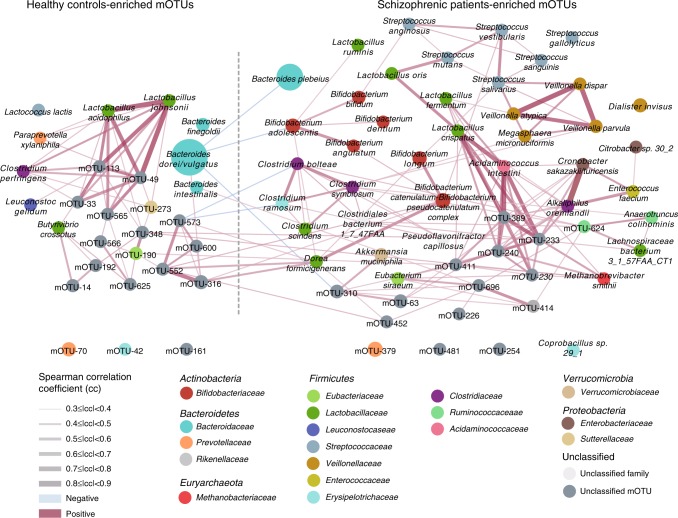
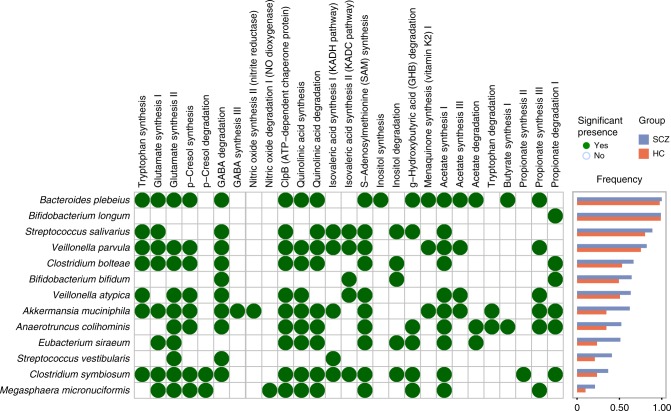
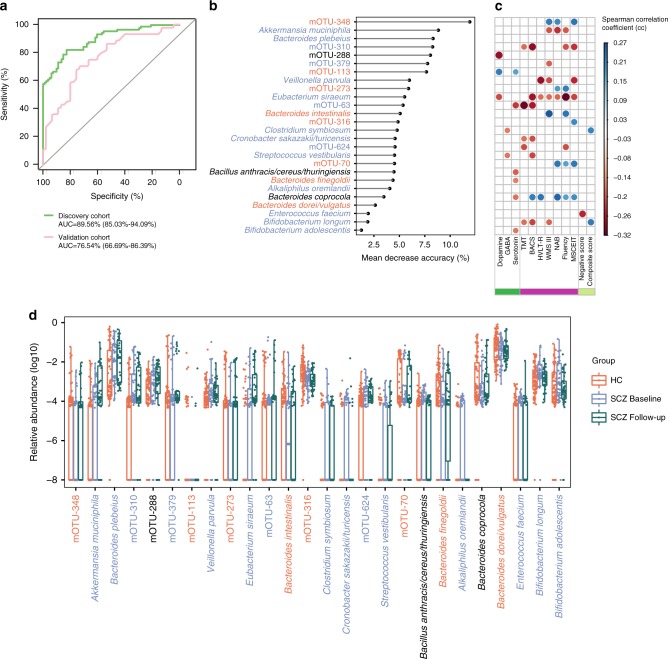
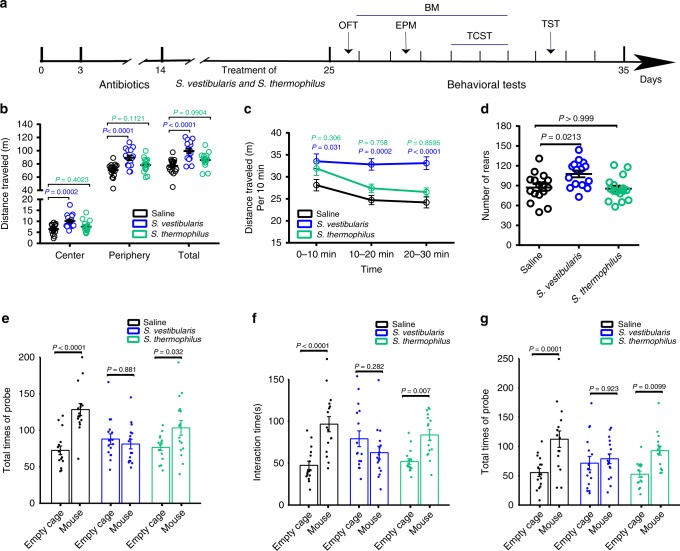
Evidence is mounting that the gut-brain axis plays an important role in mental diseases fueling mechanistic investigations to provide a basis for future targeted interventions. However, shotgun metagenomic data from treatment-naïve patients are scarce hampering comprehensive analyses of the complex interaction between the gut microbiota and the brain. Here we explore the fecal microbiome based on 90 medication-free schizophrenia patients and 81 controls and identify a microbial species classifier distinguishing patients from controls with an area under the receiver operating characteristic curve (AUC) of 0.896, and replicate the microbiome-based disease classifier in 45 patients and 45 controls (AUC = 0.765). Functional potentials associated with schizophrenia include differences in short-chain fatty acids synthesis, tryptophan metabolism, and synthesis/degradation of neurotransmitters. Transplantation of a schizophrenia-enriched bacterium, Streptococcus vestibularis, appear to induces deficits in social behaviors, and alters neurotransmitter levels in peripheral tissues in recipient mice. Our findings provide new leads for further investigations in cohort studies and animal models.
Overview
The claims and statistics of this paper haven’t been checked yet.
Free: it reads the open-access text and checks the first 5 claims that cite a source we can check. Create a free account to check every claim.
Integrity signals
Registry
Cites
Statistics
Figures
Verification
Claims the paper makes
The claims and statistics of this paper haven’t been checked yet.
Free: it reads the open-access text and checks the first 5 claims that cite a source we can check. Create a free account to check every claim.
Claims other papers make about this one
Each is checked against this paper’s own text: does it say what the citing paper says it does?
The cited source says what the claim attributes to it.
In the citing paper
“In the brain, reduced tryptophan level was reported in the prefrontal cortex [176].”
From The Role of Microbiota-Gut-Brain Axis in Neuropsychiatric and Neurological Disorders (2021) · cites this paper as [176]
In the citing paper
“a metagenome-wide association study showed that gut microbiota diversity based on genus level taxonomy and annotated genes was much higher in patients with schizophrenia than in healthy controls [176].”
From The Role of Microbiota-Gut-Brain Axis in Neuropsychiatric and Neurological Disorders (2021) · cites this paper as [176]
In the citing paper
“Thus, altered tryptophan-kynurenine metabolism may be an important link between gut microbiota and the pathogenesis of schizophrenia [175,176].”
From The Role of Microbiota-Gut-Brain Axis in Neuropsychiatric and Neurological Disorders (2021) · cites this paper as [176]
Self-check
Percentages, sums and reported differences re-computed from the paper’s own numbers.
The self-check needs the paper’s full text.
Citations
Cites
The Positive and Negative Syndrome Scale (PANSS) for schizophrenia.
Kay, S. R., Fiszbein, A., & Opler, L. A. (1987) · Schizophrenia Bulletin · doi:10.1093/schbul/13.2.261 · Cited by 21,378
A metagenome-wide association study of gut microbiota in type 2 diabetes
Qin, J., Li, Y., Cai, Z., Li, S., Zhu, J., Zhang, F., Liang, S., Zhang, W., Guan, Y., Shen, D., et al. (2012) · Nature · doi:10.1038/nature11450 · Cited by 6,762
Self-citationSOAP2: an improved ultrafast tool for short read alignment
Li, R., Yu, C., Li, Y., Lam, T.-W., Yiu, S.-M., Kristiansen, K., & Wang, J. (2009) · Bioinformatics · doi:10.1093/bioinformatics/btp336 · Cited by 3,760
Self-citationGut microbiota regulate motor deficits and neuroinflammation in a model of Parkinson's disease
Sampson, T. R., Debelius, J. W., Thron, T., Janssen, S., Shastri, G. G., Ilhan, Z. E., Challis, C., Schretter, C. E., Rocha, S., Gradinaru, V., et al. (2016) · Cell · doi:10.1016/j.cell.2016.11.018 · Cited by 3,622
Hsiao, E. Y., McBride, S. W., Hsien, S., Sharon, G., Hyde, E. R., McCue, T., Codelli, J. A., Chow, J., Reisman, S. E., Petrosino, J. F., et al. (2013) · Cell · doi:10.1016/j.cell.2013.11.024 · Cited by 3,283
The MATRICS Consensus Cognitive Battery, part 1: test selection, reliability, and validity
Nuechterlein, K. H., Green, M. F., Kern, R. S., Baade, L. E., Barch, D. M., Cohen, J. D., Essock, S., Fenton, W. S., Frese, F. J., Gold, J. M., et al. (2008) · American Journal of Psychiatry · doi:10.1176/appi.ajp.2007.07010042 · Cited by 2,342
Zheng, P., Zeng, B., Zhou, C., Liu, M., Fang, Z., Xu, X., Zeng, L., Chen, J., Fan, S., Du, X., et al. (2016) · Molecular Psychiatry · doi:10.1038/mp.2016.44 · Cited by 2,023
Self-citationvan Os, J., & Kapur, S. (2009) · The Lancet · doi:10.1016/s0140-6736(09)60995-8 · Cited by 1,971
The neuroactive potential of the human gut microbiota in quality of life and depression
Valles-Colomer, M., Falony, G., Darzi, Y., Tigchelaar, E. F., Wang, J., Tito, R. Y., Schiweck, C., Kurilshikov, A., Joossens, M., Wijmenga, C., et al. (2019) · Nature Microbiology · doi:10.1038/s41564-018-0337-x · Cited by 1,963
Self-citationThe gut microbiome in atherosclerotic cardiovascular disease
Jie, Z., Xia, H., Zhong, S.-L., Feng, Q., Li, S., Liang, S., Zhong, H., Liu, Z., Gao, Y., Zhao, H., et al. (2017) · Nature Communications · doi:10.1038/s41467-017-00900-1 · Cited by 1,638
Self-citation
Cited by
Items 201–300 of 484
Cerebrospinal Fluid from Healthy Pregnant Women Does Not Harbor a Detectable Microbial Community
Kang, Y., Ji, X., Guo, L., Xia, H., Yang, X., Xie, Z., Shi, X., Wu, R., Feng, D., Wang, C., et al. (2021) · Microbiology Spectrum · doi:10.1128/spectrum.00769-21 · Cited by 14
Self-citationHuang, Z., Chen, P., Rong, Z., Jiang, L., Li, Y., Feng, Y., Chen, S., Xie, C., & Jiang, C. (2024) · Environmental Science & Technology · doi:10.1021/acs.est.3c09379 · Cited by 14
Gupta, V. K., Bakshi, U., Chang, D., Lee, A. R., Davis, J. M., Chandrasekaran, S., Jin, Y., Freeman, M. F., & Sung, J. (2022) · mSystems · doi:10.1128/msystems.00925-22 · Cited by 14
Translating Molecular Psychiatry: From Biomarkers to Personalized Therapies—A Narrative Review
Capatina, T.-F., Oatu, A., Babasan, C., & Trifu, S. C. (2025) · International Journal of Molecular Sciences · doi:10.3390/ijms26094285 · Cited by 13
Nita, I.-B., Ilie, O., Ciobica, A. S., Hrițcu, L. D., Dobrin, I., Doroftei, B., & Dobrin, R. (2022) · International Journal of Molecular Sciences · doi:10.3390/ijms232416129 · Cited by 13
“[54] performed a metagenome-wide association study (MWAS) aiming to explore the differences between microbial communities and found that medicationfree patients harbor many facultative anaerobes entities such as Lactobacillus fermentum, Enterococcus faecium, Alkaliphilus oremlandii, Cronobacter sakazakii, and Cronobac…”
BackgroundAmdanee, N., Shao, M., Hu, X., Fang, X., Zhou, C., Chen, J., Chattun, M. R., Wen, L., Pan, X., Zhang, X., et al. (2023) · Schizophrenia Bulletin · doi:10.1093/schbul/sbac202 · Cited by 13
Liu, L., Deng, Z., Liu, W., Liu, R., Ma, T., Zhou, Y., Wang, E., & Tang, Y. (2023) · Frontiers in Cellular and Infection Microbiology · doi:10.3389/fcimb.2023.1257073 · Cited by 13
The role of the microbiota-gut-brain axis in schizophrenia: an immunological perspective
Su, B.-W., Li, Y., Yang, L.-Y., Yang, H., Wang, W., Ren, H., Bao, Y.-N., Lao, J.-Y., & Luan, Z. (2025) · Frontiers in Immunology · doi:10.3389/fimmu.2025.1711756 · Cited by 12
Self-citationMohammadzadeh, R., Mahnert, A., Zurabishvili, T., Wink, L., Kumpitsch, C., Habisch, H., Sprengel, J., Filek, K., Mertelj, P., Pernitsch, D., et al. (2026) · Nature Communications · doi:10.1038/s41467-026-69711-7 · Cited by 13
Intestinal mycobiota dysbiosis associated inflammation activation in chronic schizophrenia
Yuan, X., Li, X., Hei, G., Zhang, X., & Song, X. (2024) · Behavioural Brain Research · doi:10.1016/j.bbr.2024.115149 · Cited by 13
Tao, S., Wu, Y., Xiao, L., Huang, Y., Wang, H., Tang, Y., Liu, S., Liu, Y., Ma, Q., Yin, Y., et al. (2025) · Translational Psychiatry · doi:10.1038/s41398-025-03239-0 · Cited by 12
Self-citationDuan, D., Wang, Y., Hu, X. Y., Wang, Y., Wang, Y., Hu, Y., Zhou, X., & Dong, X. (2024) · Neuroscience · doi:10.1016/j.neuroscience.2024.08.005 · Cited by 12
“In recent years, studies have shown that gut microbiome can affect the occurrence and development of mental diseases through the brain, such as anxiety, depression, schizophrenia and neurodegenerative diseases (Zhu et al., 2020; Casertano et al., 2022).”
BackgroundRevealing multiple biological subtypes of schizophrenia through a data-driven approach
Wang, Y., Feng, S., Huang, Y., Peng, R., Liang, L., Wang, W., Guo, M., Zhu, B., Zhang, H., Liao, J., et al. (2025) · Journal of Translational Medicine · doi:10.1186/s12967-025-06503-5 · Cited by 11
Self-citationHong, F., Chen, Q., Luo, X., Xie, S., Wei, Y., Li, X., Li, K., Lebeau, B., Ling, C. C. Y., Dao, F., et al. (2025) · International Journal of Molecular Sciences · doi:10.3390/ijms26157640 · Cited by 11
Gut virome plays an extended role with bacteriome in neurological health and disease
Shrivastav, K., Pandey, M., Gor, H., & Nema, V. (2026) · Journal of the Neurological Sciences · doi:10.1016/j.jns.2026.125754 · Cited by 12
The Role of Gut Dysbiosis in the Pathophysiology of Tinnitus: A Literature Review
Megantara, I., Wikargana, G. L., Dewi, Y. A., Permana, A. D., & Sylviana, N. (2022) · The International Tinnitus Journal · doi:10.5935/0946-5448.20220005 · Cited by 11
The gut microbiome and sociability
Weber, K. T., Varian, B. J., & Erdman, S. E. (2024) · Frontiers in Neuroscience · doi:10.3389/fnins.2024.1372274 · Cited by 11
Applied physiology: gut microbiota and antimicrobial therapy
Suslov, A. V., Panas, A., Sinelnikov, M. Y., Maslennikov, R. V., Trishina, A. S., Zharikova, T. S., Zharova, N. V., Kalinin, D. V., Pontes‐Silva, A., & Zharikov, Y. O. (2024) · European Journal of Applied Physiology · doi:10.1007/s00421-024-05496-1 · Cited by 11
“The presence of Streptococcus vestibularis has also been reported to induce schizophrenia-like behaviour in recipient mice (Zhu et al. 2020).”
Perturbations in gut microbiota composition in schizophrenia
Wang, Y., Bi, S., Li, X., Zhong, Y., & Qi, D. (2024) · PLoS ONE · doi:10.1371/journal.pone.0306582 · Cited by 11
“Streptococcus vestibularis , a member of the gut-brain module, synthesizes and degrades neurotransmitter such as including glutamate and GABA [21].”
BackgroundGut microbes: Therapeutic Target for neuropsychiatric disorders
Mallick, K., Khodve, G., Ruwatia, R., & Banerjee, S. (2025) · Journal of Psychiatric Research · doi:10.1016/j.jpsychires.2025.02.031 · Cited by 12
Zheng, L.-M., & Li, Y. (2024) · Nature and Science of Sleep · doi:10.2147/nss.s476691 · Cited by 10
“36 Previous studies have indicated that specific gut microbiota, such as Enterococcus faecalis, can influence dopamine metabolism and function.”
BackgroundAvila-Santos, A. P., Nata’ala, M. K., Kasmanas, J. C., Bartholomäus, A., Keller‐Costa, T., Jurburg, S. D., Tal, T. L., Camarinha‐Silva, A., Saraiva, J., de Carvalho, A. C. P. L. F., et al. (2023) · Animal Microbiome · doi:10.1186/s42523-023-00267-3 · Cited by 10
“Nevertheless, mining metagenomes of interest from public databases is timeconsuming and requires specialist knowledge in bioinformatics and microbiology, as metadata are not easily accessible for those with little experience in data science [25].”
BackgroundAssociation between the Oral Microbiome and Brain Resting State Connectivity in Schizophrenia
Lin, D., Fu, Z., Liu, J., Perrone‐Bizzozero, N. I., Hutchison, K. E., Bustillo, J., Du, Y., Pearlson, G. D., & Calhoun, V. D. (2023) · Schizophrenia Research · doi:10.1016/j.schres.2024.06.045 · Cited by 10
Zhu, F., Wang, W., Ma, Q., Yang, Z., Fan, Y., Ju, Y., Guo, R., Wang, Q., Mu, X., Zhao, B., et al. (2020) · bioRxiv (Cold Spring Harbor Laboratory) · doi:10.1101/2020.04.11.021915 · Cited by 10
Self-citationDeep learning-based differential gut flora for prediction of Parkinson’s
Yu, B., Zhang, H., & Zhang, M. (2025) · PLoS ONE · doi:10.1371/journal.pone.0310005 · Cited by 9
Gao, F., Wang, C., Cao, Z., Zhang, X., Xi, W., Liu, Y., Zhan, X., Jia, M., Gou, N., Yu, L., et al. (2025) · Brain Behavior and Immunity · doi:10.1016/j.bbi.2025.05.030 · Cited by 9
Self-citationTian, C., Yang, M., Chen, K., Luo, D., Yue, N.-N., Zhao, H., Zhang, Y., Lu, J., Liang, Y.-J., Song, Y., et al. (2025) · Journal of Inflammation Research · doi:10.2147/jir.s514838 · Cited by 9
Huang, Z., Huang, Z., Du, Z., Gao, X., Jiang, Y., Zhou, Z., & Zhu, H. (2025) · Gut Microbes · doi:10.1080/19490976.2025.2607817 · Cited by 9
O׳Donnell, M., Teasdale, S. B., Chua, X., Hardman, J. R., Wu, N., Curtis, J., Samaras, K., Bolton, P., Morris, M. J., Weickert, C. S., et al. (2022) · Pathogens · doi:10.3390/pathogens11111279 · Cited by 10
“Zhu et al. (2020) in a large comprehensive metagenome-wide association study (MWAS) of medication free patients, identified 11 different taxa, including Akkermansia, Bifidobacterium and Streptococcus vestibularis, to be significantly enhanced in patients with schizophrenia compared to healthy…”
BackgroundSfera, A., Osorio, C. P., Hazan, S., Kozlakidis, Z., Maldonado, J. C., del Campo, C. M. Z.-M., Anton, J. J., Rahman, L., Andronescu, C. V., & Nicolson, G. L. (2022) · Endocrines · doi:10.3390/endocrines3040058 · Cited by 9
Gubert, C., Kong, G., Shadani, S., Connell, S., Masson, B. A., van de Garde, N., Narayana, V. K., Renoir, T., & Hannan, A. J. (2025) · Schizophrenia Bulletin · doi:10.1093/schbul/sbaf056 · Cited by 9
Ashique, S., Paul, D., Debnath, B., Chellappan, D. K., Das, J., Bhui, U., Ramzan, M., Sharma, N., Kumar, B., Sridhar, S. B., et al. (2025) · Nutritional Neuroscience · doi:10.1080/1028415x.2025.2560658 · Cited by 8
“Specifically, microbiota transfer of individuals with schizophrenia to colonize GF mice generated behavioral and neurotransmitter levels in peripheral tissue change comparable to the findings in schizophrenia, hence providing causal evidence of microbiota-brain interaction [71].”
Dissecting the Ecological Structure of Health and Disease in the Global Gut Microbiome
Zhu, B., Chen, S., Diao, Y., Wang, W., Huang, Y., Liang, L., Lu, X., Han, R., Guo, M., Li, Z., et al. (2026) · Advanced Science · doi:10.1002/advs.202517087 · Cited by 8
Self-citationNeha, S. A., & Salazar-Bravo, J. A. (2023) · BMC Microbiology · doi:10.1186/s12866-023-02778-0 · Cited by 8
Prediction of BMI traits in the Chinese population based on the gut metagenome
Liang, Y., Dou, S., Zhao, G., Shen, J., Fu, G., Fu, L., Li, S., Cong, B., & Dong, C. (2023) · Microbial Cell Factories · doi:10.1186/s12934-023-02255-3 · Cited by 8
Singh, R., Panganiban, K. J., Au, E., Ravikumar, R., Pereira, S., Prévot, T. D., Müller, D. J., Remington, G. J., Agarwal, S. M., Verdu, E. F., et al. (2024) · Asian Journal of Psychiatry · doi:10.1016/j.ajp.2024.104285 · Cited by 8
Sopel, A., Szczuciński, W., Gosiewski, T., & Salamon, D. (2024) · Gastroenterology Review · doi:10.5114/pg.2024.146118 · Cited by 7
Understanding the role of gut microbiota in the pathogenesis of schizophrenia
Ghorbani, M., Rajandas, H., Parimannan, S., Joseph, G. B. S., Tew, M. M., Ramly, S. S., Rasat, M. A. M., & Lee, S. Y. (2020) · Psychiatric Genetics · doi:10.1097/ypg.0000000000000270 · Cited by 8
“Similarly, another study also found that the levels of 5-HT were increased in the intestinal contents of mice treated with Streptococcus vestibularis, which is a schizophrenia-enriched gut bacterial species, compared to the control mice (Zhu et al., 2020).”
BackgroundResultInfluentialAsbjornsdottir, B., Miranda-Ribera, A., Fiorentino, M. R., Konno, T., Çetinbaş, M., Lan, J., Sadreyev, R. I., Gudmundsson, L. S., Gottfreðsson, M., Lauth, B., et al. (2022) · Biomedicines · doi:10.3390/biomedicines11010091 · Cited by 8
Li, R., Fu, R., Cui, Z.-Q., Guo, L., Chen, Y.-H., Bai, J., Yang, J.-B., Tan, Q.-R., & Peng, Z. (2023) · Brain Research · doi:10.1016/j.brainres.2023.148539 · Cited by 8
Self-citationTang, A., Chen, Y., Si, K., Lai, J., Gong, W., & Hu, S. (2025) · Molecular Psychiatry · doi:10.1038/s41380-025-03398-y · Cited by 7
Self-citationZhao, J., & Fang, Z. (2024) · Frontiers in Microbiology · doi:10.3389/fmicb.2024.1420103 · Cited by 7
Cai, Z., Che, C., Li, D., Li, X., Yu, X., Yu, L., Sun, Q., Niu, Y., & Cao, A. (2025) · Autism Research · doi:10.1002/aur.70016 · Cited by 8
“…distinct composition of the gut microbiota in subjects with major depressive disorder (MDD) (Yang et al. 2020), bi-polar disorder (BD) (Zheng et al. 2020), schizophrenia (SCZ) (Shen et al. 2018; Zhu et al. 2020), and Alzheimer's disease (AD) (Hill et al. 2014) compared with that of healthy people.”
Self-citationLiu, S., Ding, L., Li, Z., Wang, Q., Xu, L., Ma, Q., Zhao, B. L., Liu, H., Guan, J., & Zhang, K. (2025) · Chemical Engineering Journal · doi:10.1016/j.cej.2025.162426 · Cited by 7
Self-citationMohammed, V., Muthuramamoorthy, M., Arasu, M. V., & Arockiaraj, J. (2025) · Neuroscience & Biobehavioral Reviews · doi:10.1016/j.neubiorev.2025.106371 · Cited by 7
Investigating the gut microbiome in schizophrenia cases versus controls: South Africa’s version
Rust, C., Asmal, L., O’Hare, M. A., Pretorius, E., Emsley, R. A., Seedat, S., & Hemmings, S. M. J. (2025) · Neurogenetics · doi:10.1007/s10048-025-00816-9 · Cited by 7
Unique Features of the Gut Microbiome Characterized in Animal Models of Angelman Syndrome
Beitnere, U., Vilanova-Cuevas, B., Christian, S., Taylor, C., Berg, E. L., Copping, N. A., Dindot, S. V., Silverman, J. L., Gareau, M. G., & Segal, D. J. (2023) · mSystems · doi:10.1128/msystems.00608-22 · Cited by 7
“disorders (12, 13), Alzheimer's disease (14, 15), Parkinson's disease (16–18), depression (19), 76 amyotrophic lateral sclerosis (20–22), schizophrenia (23, 24), and attention-deficit/hyperactivity 77 disorder (25).”
BackgroundYe, N., Song, X., Yu, J., Bao, X., Ye, M., & Jiang, L. (2025) · Frontiers in Microbiology · doi:10.3389/fmicb.2025.1681559 · Cited by 6
“Although cross-sectional metagenomic studies have reported correlations between microbial abundance (e.g., Lactobacillus) and PANSS positive scores (Zhu et al., 2020), interventional trials have not demonstrated consistent clinical benefits, suggesting that probiotic modulation alone is…”
Plesz, S. B., Adlan, L. G., Büki, A., Makra, N., Ligeti, B., Ágg, B., Szabó, D., Zádori, Z., Ferdinándy, P., Horváth, G., et al. (2025) · Progress in Neuro-Psychopharmacology and Biological Psychiatry · doi:10.1016/j.pnpbp.2025.111276 · Cited by 6
“We should also consider that only one study demonstrated differences at the level of bacteria species, which has led to controversies; an increase in relative abundance was observed in one, whereas a decrease was observed in other Lactobacillus species (Zhu et al., 2020b).”
InfluentialPhage-Microbiota Crosstalk: Implications for Central Nervous System Disorders
Salari, V., Parrella, E., Mengoni, F., Cintra, L., Bertini, G., & Fabene, P. F. (2025) · International Journal of Molecular Sciences · doi:10.3390/ijms26136183 · Cited by 6
“Despite several studies that have reported gut microbiota alterations in patients and animal models with schizophrenia [150–153], very little is known about the role of the virome in this disease.”
Chinese soy-based microbiome and associated microbial risks: a metagenomic investigation
Xiang, X., Li, Y., Ye, J., Li, B., He, G., Zhu, M., Zhang, J., Zhang, B., Miao, M., & Yang, Y. (2025) · npj Biofilms and Microbiomes · doi:10.1038/s41522-025-00768-w · Cited by 7
Metagenome-based characterization of the gut virome in patients with schizophrenia
Ren, Y., Zhang, P., Yu, H., Li, S., & Jiang, H. (2025) · Journal of Translational Medicine · doi:10.1186/s12967-025-06923-3 · Cited by 6
“To compare the gut virome between patients with SCZ and healthy controls, 90 untreated SCZ patients and 81 healthy controls (HC) were collected from the China National GeneBank (CNGB) Nucleotide Sequence Archive (CNSA) under accession code ERP111403 [7].”
Yan, L., He, B., Deng, Q., Qiu, Y., Lin, L., Shi, B., Wang, J., & Chen, F. (2025) · Journal of Oral Microbiology · doi:10.1080/20002297.2025.2574326 · Cited by 6
“The identification of differentially enriched functional pathways was based on the Reporter score [23], with a threshold of Reporter score ≥ 1.96 used for detecting differential enrichment in KEGG pathways.”
InfluentialSelf-citationHuang, S., Yang, P. C., Wang, X., Zhang, K., Li, L., Yao, S., Qian, L., Liu, C., Guo, J., Shi, L., et al. (2025) · Journal of Psychiatric Research · doi:10.1016/j.jpsychires.2025.11.029 · Cited by 6
High-resolution phage-host assignment through key proteins using large language models
Du, Z., Min, L., Lin, K.-C., Xing, B., Ou, Y., Lin, Z., Song, W., Chen, J., Li, J., Li, J., et al. (2026) · Nature Communications · doi:10.1038/s41467-026-70613-x · Cited by 6
Subbanna, M., Shivakumar, V., Bhalerao, G. V., Varambally, S., Venkatasubramanian, G., & Debnath, M. (2022) · Psychiatric Genetics · doi:10.1097/ypg.0000000000000315 · Cited by 6
“Abnormalities in gut microbiota were reported in schizophrenia patients (Zhu et al., 2020).”
BackgroundFaysal, M. F., Zehravi, M., Amin, M. A., Rab, S. O., Jahnavi, P., Arjun, U. V. N. V., Gupta, J. K., Billah, A. A. M., Vodeti, R., Prasad, P. D., et al. (2025) · Pathology - Research and Practice · doi:10.1016/j.prp.2025.156090 · Cited by 7
OMARU: a robust and multifaceted pipeline for metagenome-wide association study
Kishikawa, T., Tomofuji, Y., Inohara, H., & Okada, Y. (2022) · NAR Genomics and Bioinformatics · doi:10.1093/nargab/lqac019 · Cited by 6
“We adopted the two public fecal metagenomic data of schizophrenia (SCZ; 90 SCZ patients and 81 healthy controls) and type 2 diabetes (T2D; 170 T2D patients and 174 healthy controls) for a practical example of operation of OMARU (23,24).”
BackgroundMethodInfluentialGut Microbiome and its Role in the Development of Neurological Disorder (Schizophrenia)
Ameen, A., Akram, M. N., Farooq, S., Fatima, M., Raza, H., Naz, R., Aziz, U., Aziz, M., Tahir, S., & Hussain, A. (2023) · Pakistan Journal of Medical and Health Sciences · doi:10.53350/pjmhs2023175311 · Cited by 7
Gut Microbes: The Gut Brain Connection
Lynch, C. M. K., O’Riordan, K. J., Clarke, G. A., & Cryan, J. F. (2023) · Springer eBooks · doi:10.1007/978-3-031-46712-7_4 · Cited by 6
Gut Microbiota and Antipsychotics Induced Metabolic Alteration
Kan, D.-Y., Li, S., Liu, C., & Wu, R. (2019) · Global Clinical and Translational Research · doi:10.36316/gcatr.01.0020 · Cited by 6
Gut Microbiota and Interorgan Communication Among the Gut, Brain, and Beyond
Shigehara, A., Kiyohara, H., Teratani, T., Nakamoto, N., Mikami, Y., & Kanai, T. (2025) · Internal Medicine · doi:10.2169/internalmedicine.5318-25 · Cited by 5
“For example, in a mouse model, transplantation of Streptococcus vestibularis in patients with schizophrenia has been shown to worsen behavioral disorders and alter neurotransmitters (130).”
Host microbiota in clozapine-induced ileus and pneumonia among people with schizophrenia
Hashimoto, K. (2025) · The British Journal of Psychiatry · doi:10.1192/bjp.2024.255 · Cited by 5
Ling, Z., Cheng, Y., Lan, Z., Liu, X., Zhu, Z., Ding, W., Xu, X., Yu, P., Xu, X., Shao, L., et al. (2025) · Frontiers in Immunology · doi:10.3389/fimmu.2025.1652633 · Cited by 5
Self-citationHe, X., Gao, Y., Zhang, Y., Yang, Z., Wang, C., Ma, Q., Lei, P., Lu, Y., Fan, Y., Liu, R., et al. (2025) · Schizophrenia Bulletin · doi:10.1093/schbul/sbaf110 · Cited by 5
Self-citationGut microbial diversity moderates polygenic risk of schizophrenia
Zhang, L., Yuan, X., Li, X., Zhang, X., Mao, Y., Hu, S., Andreassen, O. A., Wang, Y., & Song, X. (2024) · Frontiers in Psychiatry · doi:10.3389/fpsyt.2024.1275719 · Cited by 5
Karska, J., Skonieczna‐Żydecka, K., Jakubiak, N., Czarnecka, W., & Misiak, B. (2025) · Progress in Neuro-Psychopharmacology and Biological Psychiatry · doi:10.1016/j.pnpbp.2025.111430 · Cited by 4
Xu, Z., Hu, C., & Luo, Y. (2025) · Frontiers in Microbiology · doi:10.3389/fmicb.2025.1667164 · Cited by 4
Gonçalves, A. R., Ranganathan, H., Valdes, C., Zhu, H., Zhang, B., Kok, C. R., Martí, J. M., Mulakken, N., Thissen, J. B., Jaing, C. J., et al. (2026) · Frontiers in Microbiology · doi:10.3389/fmicb.2025.1695501 · Cited by 4
Schizophrenia: from mechanism to therapy
Lu, Z., Sun, J., Zhao, G., Zhu, Y., Yuan, R., Zhou, J., Zhang, D., & Yue, W. (2026) · Science China Life Sciences · doi:10.1007/s11427-025-2990-0 · Cited by 4
“Interestingly, when the fecal microbiota from patients with mental disorders was transplanted into healthy animals, behavioral changes were induced, confirming that the gut microbiota plays a significant role in the development of mental disorders (Zhu et al., 2020).”
Dai, J., Li, M., He, J., Duan, L., Zhu, X., Liu, L., Meng, M., Shao, X., & Zhu, G. (2024) · Journal of Psychiatric Research · doi:10.1016/j.jpsychires.2024.12.041 · Cited by 4
An Overview of GABA Production by Microorganisms
Altaib, H., El‐Nouby, M. A. M., & Badr, Y. (2025) · Wiley eBooks · doi:10.1002/9781394241538.ch17 · Cited by 4
Lappas, A. S., Ιωάννου, Μ., Samara, M. T., & Christodoulou, G. N. (2025) · Schizophrenia Bulletin · doi:10.1093/schbul/sbaf130 · Cited by 5
The role of gut-brain axis in mood disorder
Sallem, C. C., Filho, L. B. D. A., da Costa, R. I., Lima, M. P. P., Pimentel, I. D. S., de Figueirêdo, L. R. B., Lima, N. M. P., Galvão, S. L., de Lima, G. M. D. S., Gomes, G. F., et al. (2022) · Journal of Neurology & Stroke · doi:10.15406/jnsk.2022.12.00516 · Cited by 4
Bioinformatics in Gene and Genome Analysis
Bui, N. L., Do, V. T., & Chu, D. (2024) · Springer eBooks · doi:10.1007/978-981-99-8401-5_4 · Cited by 4
Associations of Chronic Marijuana Use with Changes in Salivary Microbiome
Panee, J., Qin, Y., & Deng, Y. (2024) · Microorganisms · doi:10.3390/microorganisms12112244 · Cited by 4
“…with diverse health conditions, ranging from oral health (Bao et al. 2020 [12]) and viral infection (Tsang et al. 2020 [13]) to schizophrenia (Zhu et al. 2020 [14]) and chronic obstructive pulmonary disease (Bowerman et al. 2020 [15]), meriting further investigation into its role in MJ users.”
Microplastic toxicity and the gut microbiome
Karim, M. M., Shivappa, P., Dileep, N., Jhuma, T. A., & Hossain, A. (2022) · Elsevier eBooks · doi:10.1016/b978-0-12-822238-6.00019-4 · Cited by 4
Yang, J. C., Troutman, R., Buri, H., Gutta, A., Situ, J., Aja, E., & Jacobs, J. P. (2023) · Nutrients · doi:10.3390/nu15163631 · Cited by 4
“We selected the colon for sequencing, given the use of fecal samples in previous studies comparing the microbiomes of schizophrenia patients to healthy controls [30].”
MethodTan, S. M. X., Yee, J. Y., Budhraja, S., Singh, B., Doborjeh, Z., Doborjeh, M., Kasabov, N. K., Lai, E. M.-K., Sumich, A. L., Lee, J., et al. (2023) · Asian Journal of Psychiatry · doi:10.1016/j.ajp.2023.103796 · Cited by 4
Dysfunction of the Gut Microbiome and its Onset Progression of Chronic and Mental Health Disorders
Ameen, A., Amir, A., Aziz, M. N., Irshad, A., Maryam, M., & Hayat, S. (2023) · Pakistan Journal of Medical and Health Sciences · doi:10.53350/pjmhs2023175425 · Cited by 4
Exploring the intersection of the microbiome and the developing brain: Impacts on schizophrenia risk
Gupta, L., & Hoffman, K. W. (2021) · Schizophrenia Research · doi:10.1016/j.schres.2021.08.010 · Cited by 4
Exploring the omnigenic architecture of selected complex traits
Ratajczak, F., Heinig, M., & Falter‐Braun, P. (2025) · The American Journal of Human Genetics · doi:10.1016/j.ajhg.2025.07.006 · Cited by 3
Lai, J., Yang, B., Ju, P.-J., Sun, Y., Sun, X.-J., Cheng, W., & Chen, J. (2025) · World Journal of Pediatrics · doi:10.1007/s12519-025-00984-6 · Cited by 3
Chen, J.-Y., Chen, M., Liu, Y., Yao, M., Wang, X.-R., Chen, J., Zhang, J., Pan, M., Zhou, J., & Bai, Y.-P. (2026) · Acta Pharmacologica Sinica · doi:10.1038/s41401-025-01736-y · Cited by 3
“Eight Asian cohorts that included healthy participants with detailed age information were selected: ThomasAM_2019 [28], YachidaS_2019 [29], QinN_2014 [30], YeZ_2018 [31], YuJ_2015 [32], ZhuF_2020 [33], JieZ_2017 [34], and QinJ_2012 [35].”
Role of Gut Microbiota in Psychiatric Disorders: From Mechanistic Insights to Therapeutic Strategies
Kim, Y. S., Woo, S., Ha, E., Ahn, S., Kim, E., Kim, S. I., Lim, W., & Kim, S. (2026) · Journal of Korean Medical Science · doi:10.3346/jkms.2026.41.e78 · Cited by 3
Wang, Q., Zhai, Y., Zhang, Y., Li, Z., Wang, Q., & Liu, S. (2026) · International Dental Journal · doi:10.1016/j.identj.2026.109461 · Cited by 3
“41,42 Benjamini − Hochberg false discovery rate (FDR) was used for corrected in multiple testing, with q 0.05 considered significant.”
InfluentialSelf-citationKraeuter, A.-K., & Sarnyai, Z. (2026) · Food & Function · doi:10.1039/d6fo00213g · Cited by 3
Papacocea, R.-I., Iliuță, F. P., & Papacocea, I. R. (2026) · International Journal of Molecular Sciences · doi:10.3390/ijms27083372 · Cited by 3
“Beyond whole-community transplantation, targeted experiments have demonstrated that the administration of Streptococcus vestibularis (a taxon enriched in SSD) can induce behavioral alterations in recipient mice, including hyperactivity and social deficits [70,90].”
The Influence of Gut Microbiota in Psychosis
Murray, N., Ghomi, R. H., Nemani, K., & O’Connor, K. (2024) · Elsevier eBooks · doi:10.1016/b978-0-323-99971-7.00018-7 · Cited by 3
Meta2DB: curated shotgun metagenomic feature sets and metadata for health state prediction
Kok, C. R., Mulakken, N., Thissen, J. B., Martí, J. M., Lee, R., Trainer, J. B., Gonçalves, A. R., Ranganathan, H., Avila-Herrera, A., Jaing, C. J., et al. (2026) · Bioinformatics · doi:10.1093/bioinformatics/btag422 · Cited by 4
“2019, Zhu et al. 2020, Ghensi et al .”
Alterations in fatty acid metabolism in patients with schizophrenia in a multi-omics perspective
Chen, L., Wang, Z., Wang, Y., Jiang, H., Ding, Y., Xia, Q., Cheng, X., & Zhang, X. (2025) · Schizophrenia Research · doi:10.1016/j.schres.2025.03.036 · Cited by 3
Soltanian, M., Rajabalinejad, A., Rajabi, R., & Mousavi, M.-M. (2025) · Journal of Microbiota · doi:10.5812/jmb-159824 · Cited by 3
Characterized profiles of gut microbiota in morphine abstinence-induced depressive-like behavior
Ji, J., Yan, N., Zhang, Z., Li, B., Xue, R., & Dang, Y. (2022) · Neuroscience Letters · doi:10.1016/j.neulet.2022.136857 · Cited by 3
Self-citationGuest Editorial: Binning bugs and beyond: The state of the schizophrenia microbiome
Severance, E. G., & Yolken, R. H. (2021) · Schizophrenia Research · doi:10.1016/j.schres.2021.05.002 · Cited by 3
Hinton, A. L., & Mucha, P. J. (2021) · bioRxiv (Cold Spring Harbor Laboratory) · doi:10.1101/2021.12.08.471758 · Cited by 3
Ji, S., He, Q., Su, M., Wu, S., Liu, Y., Chen, J., Du, L., Li, D., Zhou, X., You, Y., et al. (2025) · medRxiv · doi:10.1101/2025.03.25.25324621 · Cited by 3
“A recent case-control study found that functional profiles from metagenomic data, including SCFAs biosynthesis, Trp metabolism and neurotransmitters synthesis/degradation, were associated with the schizophrenia [18].”
InfluentialJoshi, J., Cumbo, F., & Blankenberg, D. J. (2025) · bioRxiv (Cold Spring Harbor Laboratory) · doi:10.1101/2025.07.06.663394 · Cited by 3
“In the case of ZhuF_2020 [33], RFC achieved a higher F1 score than HDC, while LRC and DTC showed significantly lower performance than HDC. SVC performed almost similarly to HDC.”
Automatic Schizophrenia Detection Using Discrete Wavelet Transform from EEG Signal
Bhadra, S., & Kumar, C. J. (2024) · Lecture notes in networks and systems · doi:10.1007/978-981-97-3604-1_36 · Cited by 2
Factors supporting chronic inflammation in mental illness
Klyushnik, T. P., Generalov, V. O., Obodzinskaya, I. E., Larionov, G. V., & Aleksandrenkova, A. A. (2025) · S S Korsakov Journal of Neurology and Psychiatry · doi:10.17116/jnevro20251250817 · Cited by 2
Gut–Brain Axis in Mental Diseases
Kar, E., & Kar, F. (2025) · Springer eBooks · doi:10.1007/978-3-031-73368-0_5 · Cited by 2
Metadata
- Authors
- Zhu, F., Ju, Y., Wang, W., Wang, Q., Guo, R., Ma, Q., Sun, Q., Fan, Y., Xie, Y., Yang, Z., Jie, Z., Zhao, B., Xiao, L., Yang, L., Zhang, T., Feng, J., Guo, L., He, X., Chen, Y., Chen, C., Gao, C., Xu, X., Yang, H., Wang, J., Dang, Y., Madsen, L., Brix, S., Kristiansen, K., Jia, H., & Ma, X.
- Affiliations
- First Affiliated Hospital of Xi'an Jiaotong University (CN)
- BGI Group (China) (CN)
- Michigan State University (US)
- Xi'an Jiaotong University (CN)
- Corresponding author
- Kristiansen, Karsten
- Jia, Huijue
- Ma, Xiancang
- ORCID
- Venue
- Nature Communications
- Published
- 2020-03-31
- Volume
- 11
- Issue
- 1
- Pages
- 1612-1612
- ISSN
- 2041-1723 (ISSN-L)
- PMC
- PMC7109134
- OpenAlex
- W3014950179
- Semantic Scholar
- 88c2817df2df90533febdffc7f39b06b1e26eb9b
- Cited by
- 409
- References
- 81
- Citations by year
- 2026: 35 · 2025: 79 · 2024: 68 · 2023: 71 · 2022: 94 · 2021: 47 · 2020: 13
- FWCI
- 19.85
- Type
- journal article
- Language
- en
- Open access
- gold
- doi.org
- Licence
- cc-by
- creativecommons.org/licenses/by/4.0 (tdm)
- creativecommons.org/licenses/by/4.0 (vor)
- Locations
- Nature Communications (publishedVersion, cc-by)
- bioRxiv (Cold Spring Harbor Laboratory) (acceptedVersion, cc-by-nc-nd)
- PubMed Central (publishedVersion, cc-by)
- PubMed (publishedVersion)
- Research at the University of Copenhagen (University of Copenhagen) (publishedVersion, cc-by)
- RePEc: Research Papers in Economics (submittedVersion)
- DOAJ (DOAJ: Directory of Open Access Journals) (submittedVersion, cc-by-sa)
- NORA - Norwegian Open Research Archives (submittedVersion, other-oa)
- Technical University of Denmark, DTU Orbit (Technical University of Denmark, DTU) (submittedVersion, cc-by)
- Funders
- Xi’an Jiaotong University
- Government of Jiangxi Province
- Topics
- Life Sciences › Biochemistry, Genetics and Molecular Biology › Molecular Biology › Gut microbiota and health
- Health Sciences › Medicine › Psychiatry and Mental health › Schizophrenia research and treatment
- Life Sciences › Neuroscience › Biological Psychiatry › Tryptophan and brain disorders
- Keywords
- schizophrenia, gut microbiota, gut-brain axis, fecal microbiota, short-chain fatty acids, tryptophan metabolism, neurotransmitter synthesis, Streptococcus vestibularis, fecal microbiota transplantation, social behavior deficits, treatment-naive patients
- MeSH terms
- Gastrointestinal Microbiome, Fecal Microbiota Transplantation, Animals, Bacteria, Behavior, Animal, Disease Models, Animal, Feces, Humans, Male, Mice, Inbred C57BL, Risk Factors, RNA, Ribosomal, 16S, ROC Curve, Schizophrenia, Social Behavior, Streptococcus, Mice, Metagenome, Metagenomics
About these checks
Registry, retraction, Cites and statistics results are computed, not judged, with one exception: a printed reference that no index lists is read once by a model before it counts as a citation error. Claims are extracted by a model and kept only when their quote appears verbatim in the text; each cited source is then checked, with a model’s help, for whether it says what the claim relies on. Those verdicts can be wrong — read the claim’s quote and the cited source before relying on one.
Statistics and arithmetic are recomputed, not judged.
Confidence bands are shown only for fields calibrated on our annotated test set. None is calibrated yet, so no band is shown.
What counts as a claim ›How we measure confidence ›How we check this ›
Are you an author, or do you see a problem with this page? Request a review
Data sources
Bibliographic data: Semantic Scholar, OpenAlex, Crossref.
Contains information from the Semantic Scholar Academic Graph Datasets, made available under the ODC Attribution License (ODC-BY 1.0).
Semantic Scholar’s data is described in: Kinney, R., et al. (2023). The Semantic Scholar Open Data Platform. arXiv:2301.10140.
