

The DOI matches its Crossref record; 41 of the 41 references it cites were found in a registry or an index.
DNA punch cards for storing data on native DNA sequences via enzymatic nicking
Open accessAbstract
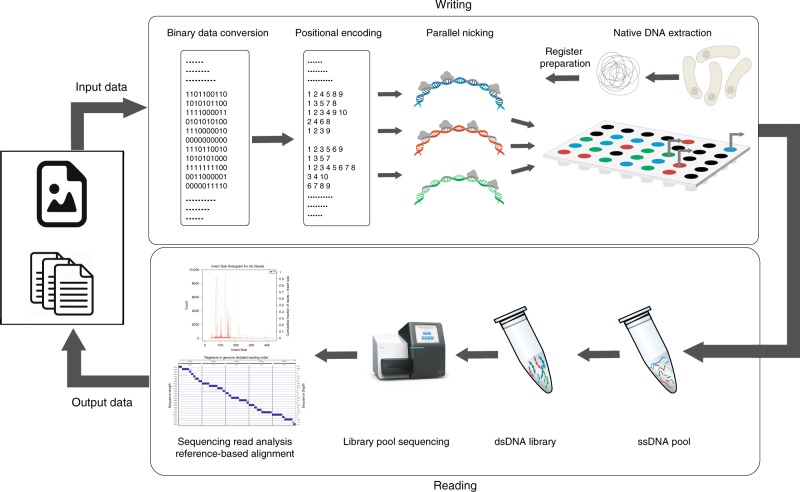
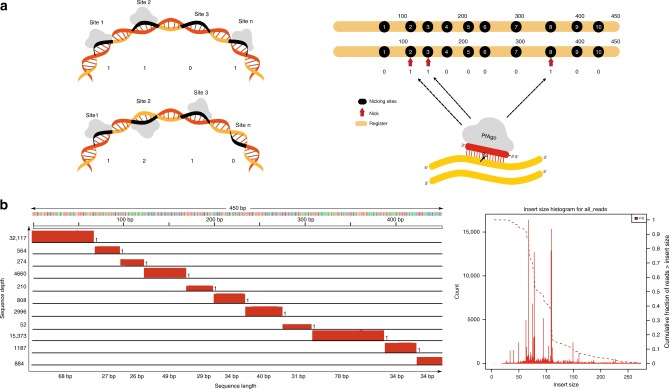
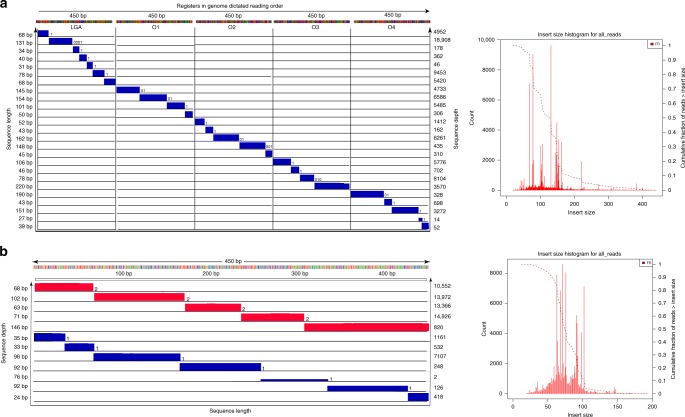
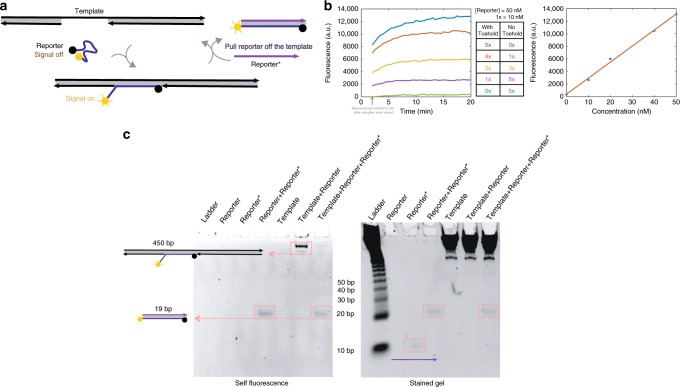
Synthetic DNA-based data storage systems have received significant attention due to the promise of ultrahigh storage density and long-term stability. However, all known platforms suffer from high cost, read-write latency and error-rates that render them noncompetitive with modern storage devices. One means to avoid the above problems is using readily available native DNA. As the sequence content of native DNA is fixed, one can modify the topology instead to encode information. Here, we introduce DNA punch cards, a macromolecular storage mechanism in which data is written in the form of nicks at predetermined positions on the backbone of native double-stranded DNA. The platform accommodates parallel nicking on orthogonal DNA fragments and enzymatic toehold creation that enables single-bit random-access and in-memory computations. We use Pyrococcus furiosus Argonaute to punch files into the PCR products of Escherichia coli genomic DNA and accurately reconstruct the encoded data through high-throughput sequencing and read alignment.
Overview
The claims and statistics of this paper haven’t been checked yet.
Run the check — free, no account needed. It reads the open-access text and checks the sources it cites.
Integrity signals
Registry
Cites
Statistics
Figures
Verification
Claims the paper makes
The claims and statistics of this paper haven’t been checked yet.
Run the check — free, no account needed. It reads the open-access text and checks the sources it cites.
Claims other papers make about this one
Each is checked against this paper’s own text: does it say what the citing paper says it does?
In the citing paper
“A strategy toward decreasing the costs of stored DNA data may be the enzymatic synthesis of DNA strands.”
From Emerging Approaches to DNA Data Storage: Challenges and Prospects (2022) · cites this paper as [72]
In the citing paper
“Indeed, a pattern of nicking positions was precisely realized on the backbone of native dsDNA, and here, information was encoded by means of absence (i.e., 0) or presence (i.e., 1) of nicks.”
From Emerging Approaches to DNA Data Storage: Challenges and Prospects (2022) · cites this paper as [72]
In the citing paper
“On the basis of enzymatic modification of DNA, nicks enable adding several functionalities to the storage system, for example, single-bit random access, pooling, and in-memory computation.”
From Emerging Approaches to DNA Data Storage: Challenges and Prospects (2022) · cites this paper as [72]
In the citing paper
“However, the DNA punch cards system was able to store only up to 14 kB of digital information.”
From Emerging Approaches to DNA Data Storage: Challenges and Prospects (2022) · cites this paper as [72]
In the citing paper
“The use of double-stranded DNA as a storage medium was also exploited in recent work by Tabatabaei et al.72 on DNA punch cards. This macromolecular storage technology was used to encode the information in the sequence of bases of the DNA strands by using their sugar–phosphate backbone, i.e., topologically.”
From Emerging Approaches to DNA Data Storage: Challenges and Prospects (2022) · cites this paper as [72]
Self-check
Percentages, sums and reported differences re-computed from the paper’s own numbers.
The self-check needs the paper’s full text.
Citations
Cites
VMD: visual molecular dynamics
Humphrey, W., Dalke, A., & Schulten, K. (1996) · Journal of Molecular Graphics · doi:10.1016/0263-7855(96)00018-5 · Cited by 66,952
Trimmomatic: a flexible trimmer for Illumina sequence data
Bolger, A. M., Lohse, M., & Usadel, B. (2014) · Bioinformatics · doi:10.1093/bioinformatics/btu170 · Cited by 65,548
The Sequence Alignment/Map format and SAMtools
Li, H., Handsaker, B., Wysoker, A., Fennell, T., Ruan, J., Homer, N., Marth, G., Abecasis, G., Durbin, R., & 1000 Genome Project Data Processing Subgroup (2009) · Bioinformatics · doi:10.1093/bioinformatics/btp352 · Cited by 62,041
Scalable molecular dynamics with NAMD
Phillips, J. C., Braun, R., Wang, W., Gumbart, J., Tajkhorshid, E., Villa, E., Chipot, C., Skeel, R. D., Kalé, L., & Schulten, K. (2005) · Journal of Computational Chemistry · doi:10.1002/jcc.20289 · Cited by 16,914
Integrative Genomics Viewer (IGV): high-performance genomics data visualization and exploration
Thorvaldsdottir, H., Robinson, J. T., & Mesirov, J. P. (2013) · Briefings in Bioinformatics · doi:10.1093/bib/bbs017 · Cited by 9,049
Constant pressure molecular dynamics simulation: The Langevin piston method
Feller, S., Zhang, Y., Pastor, R., & Brooks, B. (1995) · The Journal of Chemical Physics · doi:10.1063/1.470648 · Cited by 4,271
Nextflow enables reproducible computational workflows
Di Tommaso, P., Chatzou, M., Floden, E. W., Barja, P. P., Palumbo, E., & Notredame, C. (2017) · Nature Biotechnology · doi:10.1038/nbt.3820 · Cited by 4,001
A DNA-fuelled molecular machine made of DNA
Yurke, B., Turberfield, A. J., Mills, A. P., Simmel, F. C., & Neumann, J. L. (2000) · Nature · doi:10.1038/35020524 · Cited by 2,426
Sambamba: fast processing of NGS alignment formats
Tarasov, A., Vilella, A. J., Cuppen, E. P. J. G., Nijman, I. J., & Prins, P. (2015) · Bioinformatics · doi:10.1093/bioinformatics/btv098 · Cited by 2,426
BEDTools: The Swiss‐Army Tool for Genome Feature Analysis
Quinlan, A. R. (2014) · Current Protocols in Bioinformatics · doi:10.1002/0471250953.bi1112s47 · Cited by 2,286
Research works printed but not linked: 2
- Wang, B., Chalk, C. & Soloveichik, D. in DNA Computing and Molecular Programming. DNA 2019. Lecture Notes in Computer Science, Vol. 11648 (eds. Thachuk, C. & Liu, Y.) (Springer, Cham, 2019).
- Li, H. Aligning sequence reads, clone sequences and assembly contigs with BWA-MEM. ArXiv e-prints, 1303 (2013).
Cited by
Sorted by citations
Emerging Approaches to DNA Data Storage: Challenges and Prospects
Doricchi, A., Platnich, C. M., Gimpel, A., Horn, F., Earle, M., Lanzavecchia, G., Cortajarena, A. L., Liz-Marzán, L. M., Liu, N., Heckel, R., et al. (2022) · ACS Nano · doi:10.1021/acsnano.2c06748 · Cited by 235
An Artificial Chromosome for Data Storage
Chen, W., Han, M., Zhou, J., Ge, Q., Wang, P., Zhang, X., Zhu, S., Song, L., & Yuan, Y. (2021) · National Science Review · doi:10.1093/nsr/nwab028 · Cited by 136
DNA as a universal chemical substrate for computing and data storage
Yang, S., Bögels, B. W. A., Wang, F., Xu, C., Dou, H., Mann, S., Fan, C., & de Greef, T. F. A. (2024) · Nature Reviews Chemistry · doi:10.1038/s41570-024-00576-4 · Cited by 144
Dynamic and scalable DNA-based information storage
Lin, K. N., Volkel, K., Tuck, J. M., & Keung, A. J. (2020) · Nature Communications · doi:10.1038/s41467-020-16797-2 · Cited by 117
Robust data storage in DNA by de Bruijn graph-based de novo strand assembly
Song, L., Geng, F., Gong, Z.-Y., Chen, X., Tang, J., Gong, C., Zhou, L., Xia, R., Han, M., Xu, J.-Y., et al. (2022) · Nature Communications · doi:10.1038/s41467-022-33046-w · Cited by 98
Metadata
- Authors
- Tabatabaei, S. K., Wang, B., Athreya, N. B. M., Enghiad, B., Hernandez, A. G., Fields, C. J., Leburton, J.-P., Soloveichik, D., Zhao, H., & Milenkovic, O.
- Affiliations
- University of Illinois Urbana-Champaign (US)
- The University of Texas at Austin (US)
- Corresponding author
- Zhao, Huimin
- ORCID
- Venue
- Nature Communications
- Published
- 2020-04-08
- Volume
- 11
- Issue
- 1
- Pages
- 1742-1742
- ISSN
- 2041-1723 (ISSN-L)
- PMC
- PMC7142088
- OpenAlex
- W3015846461
- Cited by
- 120
- References
- 41
- Citations by year
- 2026: 13 · 2025: 15 · 2024: 12 · 2023: 25 · 2022: 15 · 2021: 25 · 2020: 14
- FWCI
- 6.41
- Type
- journal article
- Language
- en
- Open access
- gold
- doi.org
- Locations
- Nature Communications (publishedVersion, cc-by)
- PubMed Central (publishedVersion, cc-by)
- PubMed (publishedVersion)
- RePEc: Research Papers in Economics (submittedVersion)
- DOAJ (DOAJ: Directory of Open Access Journals) (submittedVersion, cc-by-sa)
- Funders
- United States Department of Defense | Defense Advanced Research Projects Agency (W911NF-18-2-0032)
- Topics
- Physical Sciences › Mathematics › Theoretical Computer Science › DNA and Biological Computing
- Life Sciences › Biochemistry, Genetics and Molecular Biology › Molecular Biology › Advanced biosensing and bioanalysis techniques
- Physical Sciences › Mathematics › Theoretical Computer Science › Algorithms and Data Compression
- Keywords
- DNA data storage, DNA nicking, Argonaute proteins, Pyrococcus furiosus, in-memory computing, DNA topology
- MeSH terms
- Base Sequence, DNA, Sequence Analysis, DNA, Pyrococcus furiosus, Argonaute Proteins
About these checks
Registry, retraction, Cites and statistics results are computed, not judged, with one exception: a printed reference that no index lists is read once by a model before it counts as a citation error. Claims are extracted by a model and kept only when their quote appears verbatim in the text; each cited source is then checked, with a model’s help, for whether it says what the claim relies on. Those verdicts can be wrong — read the claim’s quote and the cited source before relying on one.
Statistics and arithmetic are recomputed, not judged.
Confidence bands are shown only for fields calibrated on our annotated test set. None is calibrated yet, so no band is shown.
What counts as a claim ›How we measure confidence ›How we check this ›
Are you an author, or do you see a problem with this page? Request a review
