

Stress gates an astrocytic energy reservoir to impair synaptic plasticity
Open accessThe DOI matches its Crossref record; 72 of the 73 references it cites were found in a registry or an index.
Abstract
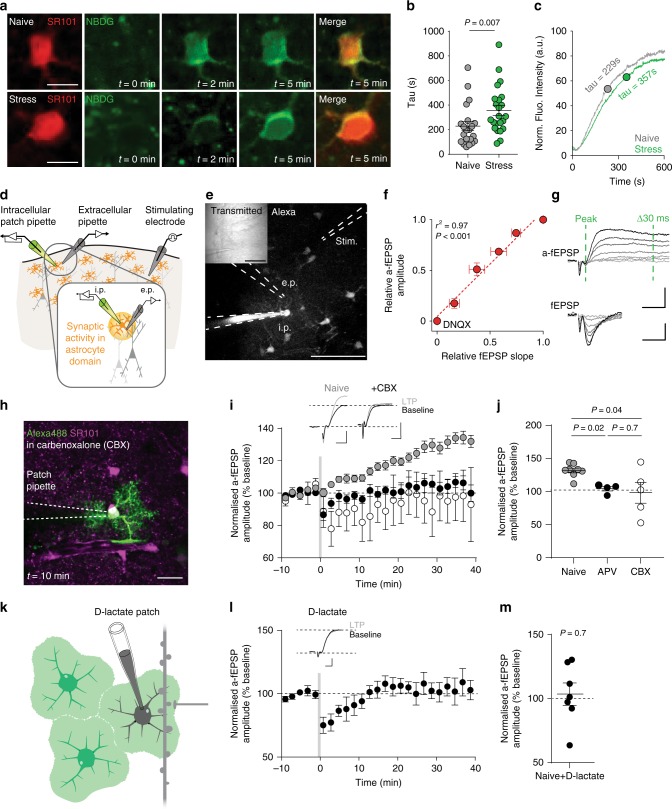
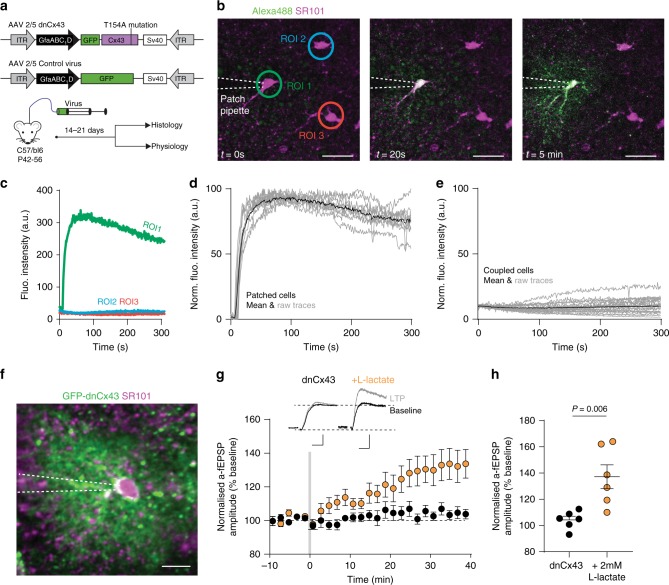
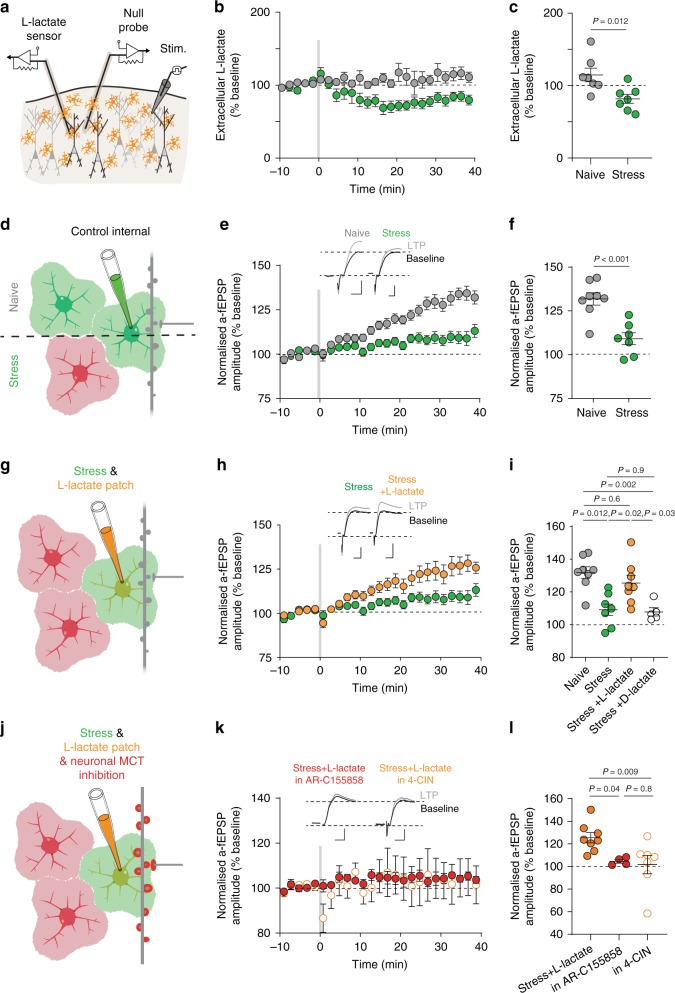
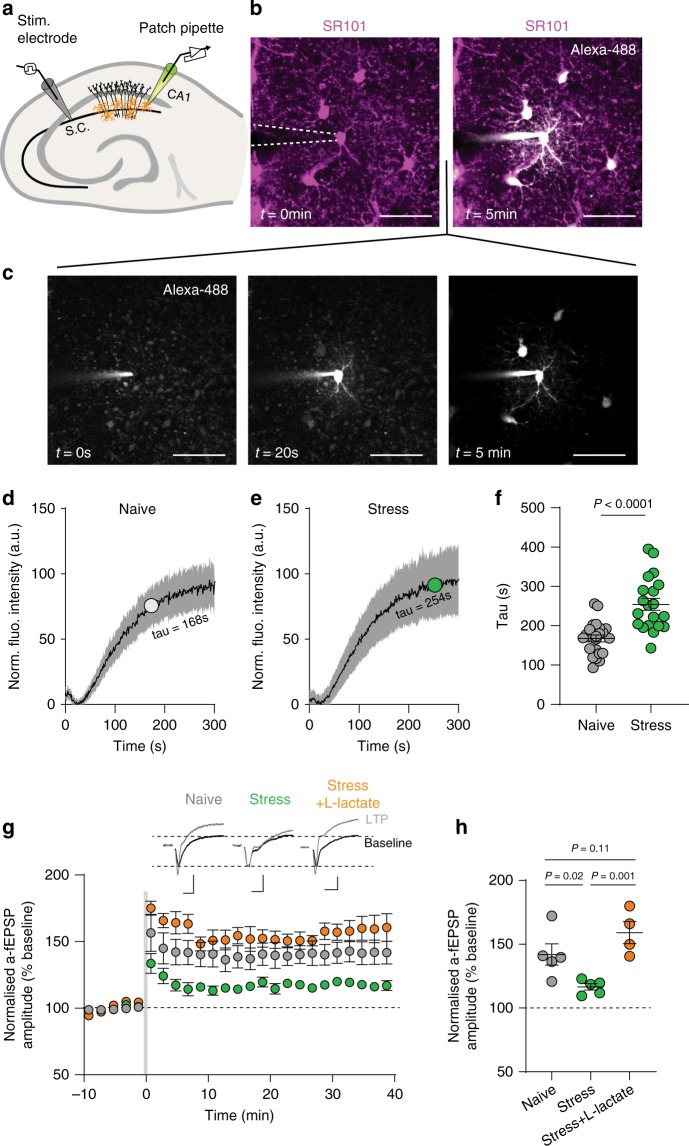
Astrocytes support the energy demands of synaptic transmission and plasticity. Enduring changes in synaptic efficacy are highly sensitive to stress, yet whether changes to astrocyte bioenergetic control of synapses contributes to stress-impaired plasticity is unclear. Here we show in mice that stress constrains the shuttling of glucose and lactate through astrocyte networks, creating a barrier for neuronal access to an astrocytic energy reservoir in the hippocampus and neocortex, compromising long-term potentiation. Impairing astrocytic delivery of energy substrates by reducing astrocyte gap junction coupling with dominant negative connexin 43 or by disrupting lactate efflux was sufficient to mimic the effects of stress on long-term potentiation. Furthermore, direct restoration of the astrocyte lactate supply alone rescued stress-impaired synaptic plasticity, which was blocked by inhibiting neural lactate uptake. This gating of synaptic plasticity in stress by astrocytic metabolic networks indicates a broader role of astrocyte bioenergetics in determining how experience-dependent information is controlled.
Overview
The claims and statistics of this paper haven’t been checked yet.
Free: it reads the open-access text and checks the first 5 claims that cite a source we can check. Create a free account to check every claim.
Integrity signals
Registry
Cites
Statistics
Figures
Verification
Claims the paper makes
The claims and statistics of this paper haven’t been checked yet.
Free: it reads the open-access text and checks the first 5 claims that cite a source we can check. Create a free account to check every claim.
Claims other papers make about this one
Each is checked against this paper’s own text: does it say what the citing paper says it does?
The source backs part of the claim, not all of it — or backs it for a different population, condition or comparison.
In the citing paper
“Chronic unpredictable stress (CUS) and acute stress both specifically reduce the expression of the gap junction-forming proteins Cx30 and Cx43, 164”
From Major depressive disorder: hypothesis, mechanism, prevention and treatment (2024) · cites this paper as [164]
Experimental — accuracy not yet measuredThe source backs part of the claim, not all of it — or backs it for a different population, condition or comparison.
In the citing paper
“Another study reported that inhibiting lactate transfer from astrocytes to neurons abolished hippocampal and cortical synaptic plasticity under stress conditions in mice.38”
From ApoE4-dependent lysosomal cholesterol accumulation impairs mitochondrial homeostasis and oxidative phosphorylation in human astrocytes (2023) · cites this paper as [38]
Experimental — accuracy not yet measured
Self-check
Percentages, sums and reported differences re-computed from the paper’s own numbers.
The self-check needs the paper’s full text.
Citations
Cites
Zhang, Y., Chen, K., Sloan, S. A., Bennett, M. L., Scholze, A. R., O'Keeffe, S., Phatnani, H. P., Guarnieri, P., Caneda, C., Ruderisch, N., et al. (2014) · The Journal of Neuroscience · doi:10.1523/jneurosci.1860-14.2014 · Cited by 4,875
Neural regulation of endocrine and autonomic stress responses
Ulrich-Lai, Y. M., & Herman, J. P. (2009) · Nature Reviews Neuroscience · doi:10.1038/nrn2647 · Cited by 3,318
Astrocyte-Neuron Lactate Transport Is Required for Long-Term Memory Formation
Suzuki, A., Stern, S. A., Bozdagi, O., Huntley, G. W., Walker, R. H., Magistretti, P. J., & Alberini, C. M. (2011) · Cell · doi:10.1016/j.cell.2011.02.018 · Cited by 1,711
Long-term potentiation depends on release of d-serine from astrocytes
Henneberger, C., Papouin, T., Oliet, S. H. R., & Rusakov, D. A. (2010) · Nature · doi:10.1038/nature08673 · Cited by 1,389
Astrocyte calcium signaling: the third wave
Bazargani, N., & Attwell, D. (2016) · Nature Neuroscience · doi:10.1038/nn.4201 · Cited by 944
Astroglial Metabolic Networks Sustain Hippocampal Synaptic Transmission
Rouach, N., Koulakoff, A., Abudara, V., Willecke, K., & Giaume, C. (2008) · Science · doi:10.1126/science.1164022 · Cited by 871
Astroglial networks: a step further in neuroglial and gliovascular interactions
Giaume, C., Koulakoff, A., Roux, L., Holcman, D., & Rouach, N. (2010) · Nature Reviews Neuroscience · doi:10.1038/nrn2757 · Cited by 777
Chai, H., Diaz-Castro, B., Shigetomi, E., Monte, E., Octeau, J. C., Yu, X., Cohn, W., Rajendran, P. S., Vondriska, T. M., Whitelegge, J. P., et al. (2017) · Neuron · doi:10.1016/j.neuron.2017.06.029 · Cited by 769
Self-citationImpaired Memory Retrieval after Psychosocial Stress in Healthy Young Men
Kuhlmann, S., Piel, M., & Wolf, O. T. (2005) · The Journal of Neuroscience · doi:10.1523/jneurosci.5139-04.2005 · Cited by 679
Ca2+ signaling in astrocytes from Ip3r2−/− mice in brain slices and during startle responses in vivo
Srinivasan, R., Huang, B. S., Venugopal, S., Johnston, A. D., Chai, H., Zeng, H., Golshani, P., & Khakh, B. S. (2015) · Nature Neuroscience · doi:10.1038/nn.4001 · Cited by 505
Self-citation
Cited by
Items 101–157 of 157
Homeostasis to Allostasis: Prefrontal Astrocyte Roles in Cognitive Flexibility and Stress Biology
Wulaer, B., Holtz, M., & Nagai, J. (2024) · Advances in neurobiology · doi:10.1007/978-3-031-64839-7_6 · Cited by 4
Hypothalamic Astrocytes Exhibit Glycolytic Features Making Them Prone for Glucose Sensing
Geller, S., Zanou, N., Lagarrigue, S., Zehnder, T., Gouelle, C., Santoro, T., Repond, C., Bezzi, P., Amati, F., Bouzier‐Sore, A., et al. (2025) · Glia · doi:10.1002/glia.70066 · Cited by 5
“Indeed, it is known that intracellular stress induces Ca 2+ rise in the hypothalamus as well as in astrocytes themselves (Gyengesi et al. 2012; Murphy-Royal et al. 2020) while Ca 2+ release increases AMPK activity in the hypothalamus (Lòpez et al. 2016).”
Glial lactate metabolism and transport in Alzheimer’s disease
Wang, Y., Feng, B., Hong, R., Qiu, D., Zhao, J., & Zhao, L. (2026) · Frontiers in Aging Neuroscience · doi:10.3389/fnagi.2026.1731089 · Cited by 5
Stress and the risk of Alzheimer dementia: Can deconstructed engrams be rebuilt?
Jeanneteau, F. D. (2023) · Journal of Neuroendocrinology · doi:10.1111/jne.13235 · Cited by 4
“84 Maintenance of collective synapses between engram neurons contributes to the retrieval of an excitable network.”
Jia, C., Gill, W. D., Lovins, C., Brown, R. W., & Hagg, T. (2024) · Neurobiology of Stress · doi:10.1016/j.ynstr.2024.100621 · Cited by 3
Neurovascular unit impairment in iron deficiency anemia
Isasi, E., & Olivera‐Bravo, S. (2024) · Neuroscience · doi:10.1016/j.neuroscience.2024.12.050 · Cited by 4
Aimiyekagbon, O. K., Bender, A., & Sextro, W. (2021) · Cited by 3
Kolotyeva, N. A., Gilmiyarova, F. N., Сергеевич, А. А., Baranich, T. I., Rozanova, N. A., Kukla, M. V., Tregub, P. P., & Salmina, A. B. (2023) · International Journal of Molecular Sciences · doi:10.3390/ijms241914709 · Cited by 3
“Lactate has been found to support cognitive functions, learning, and long-term memory formation [35], and may play a neuroprotective role against excitotoxicity [36], and ischemia [37].”
BackgroundIn Vitro Cell Line Culture for Brain Research and Its Limitations
Dabhekar, S. V., Dhokne, M. D., Dalal, V., Lokhande, S., Taksande, B. G., Nakhate, K. T., Umekar, M. J., & Mangrulkar, S. V. (2024) · Springer eBooks · doi:10.1007/978-981-97-2859-6_11 · Cited by 6
Molecular roadmap of the healthy stress response in the mouse hippocampusPreprint
von Ziegler, L., Floriou‐Servou, A., Waag, R., Gupta, R. R. D., Sturman, O., Gapp, K., Maat, C. A., Kockmann, T., Lin, H.-Y., Duss, S. N., et al. (2021) · bioRxiv (Cold Spring Harbor Laboratory) · doi:10.1101/2021.03.26.436970 · Cited by 3
“Indeed, an elegant translatome screen in astrocytes from the somatosensory cortex revealed robust translational changes 90 min following acute restraint stress (Murphy-Royal et al., 2020).”
BackgroundInfluentialNoradrenaline release from the locus coeruleus shapes stress-induced hippocampal gene expressionPreprint
Privitera, M., von Ziegler, L., Floriou‐Servou, A., Duss, S. N., Zhang, R., Waag, R., Leimbacher, S., Sturman, O., Roessler, F. K., Heylen, A., et al. (2023) · bioRxiv (Cold Spring Harbor Laboratory) · doi:10.1101/2023.02.02.526661 · Cited by 3
Hector, A., Caiado, M. J. D. C., Leduc, T., Delignat‐Lavaud, B., Dufort‐Gervais, J., Bourguignon, C., Lina, J., Fernandes, K. J. L., Brouillette, J., & Mongrain, V. (2024) · bioRxiv (Cold Spring Harbor Laboratory) · doi:10.1101/2024.03.01.582986 · Cited by 3
“Lipid-mediated dysregulation of astrocytic function could in parallel impact their regulatory role in synaptic plasticity (Murphy-Royal et al., 2020), which is relevant to the regulation of wake/sleep states and could also be rescued by inhibiting SCD.”
BackgroundEarly-life stress induces persistent astrocyte dysfunction resulting in fear generalisationPreprint
Guayasamin, M., Depaauw-Holt, L. R., Adedipe, I. I., Ghenissa, O., Vaugeois, J., Duquenne, M., Rogers, B., Latraverse-Arquilla, J., Peyrard, S., Bosson, A., et al. (2024) · eLife · doi:10.7554/elife.99988.1 · Cited by 4
Self-citationEstablished and emerging new approach methodologies in neuroscience
Imberechts, D., Ny, A., & Copmans, D. (2025) · Frontiers in Neuroscience · doi:10.3389/fnins.2025.1696937 · Cited by 7
Cerebellar astrocytic alterations in depression
Hercher, C., Abajian, G., Davoli, M. A., Turecki, G., & Mechawar, N. (2026) · Translational Psychiatry · doi:10.1038/s41398-026-03866-1 · Cited by 3
Zeng, Q., Liao, J., Ran, L., Shi, L., Chen, Y.-J., Zhang, C., Xiang, J.-J., Hong, S. L., & Kuang, L. (2023) · PubMed Central · doi:10.12182/20230360205 · Cited by 2
Li, X., Yin, X., Lu, J., Li, Q.-R., Xing, W., Han, Q., Ji, H. L., Li, S., Yang, H., Guo, J., et al. (2024) · Cells · doi:10.3390/cells13070570 · Cited by 4
Contextual guidance: An integrated theory for astrocytes function in brain circuits and behaviorPreprint
Murphy‐Royal, C., Ching, S., & Papouin, T. (2022) · arXiv (Cornell University) · doi:10.48550/arxiv.2211.09906 · Cited by 3
“In this three-step framework, astrocytes are stimulated by diffusive signals that are relevant to the function of the local circuit 15 and encode a change in the animal’s state 21 (Fig.”
BackgroundSelf-citationSpatial and single-cell transcriptomics reveal neuron-astrocyte interplay in long-term memoryPreprint
Sun, W., Liu, Z., Jiang, X., Chen, M. B., Dong, H., Liu, J. Z., Südhof, T. C., & Quake, S. R. (2023) · bioRxiv (Cold Spring Harbor Laboratory) · doi:10.1101/2023.03.20.533566 · Cited by 2
Moukarzel, E., Antoine, S., Guinoiseau, S., Rubino, B., Stinnakre, J., & Agulhon, C. (2024) · bioRxiv (Cold Spring Harbor Laboratory) · doi:10.1101/2024.04.16.589763 · Cited by 2
“Finally, astrocytes play critical roles in the progression and maintenance of brain inflammation by producing and responding to stress/inflammatory mediators 39 .”
BackgroundDiscovery of Glucose Metabolism-Associated Genes in Neuropathic Pain: Insights from Bioinformatics
Yu, Y., Cheung, Y.-T., & Cheung, C.-W. (2024) · International Journal of Molecular Sciences · doi:10.3390/ijms252413503 · Cited by 1
Acupuncture in depression treatment: Insights into astrocyte regulation
Xu, N., Huang, T., & Wang, L. (2025) · Journal of Chinese Integrative Medicine · doi:10.1016/j.joim.2025.09.003 · Cited by 2
Hector, A., Leduc, T., Caiado, M. J. D. C., Delignat‐Lavaud, B., Dufort‐Gervais, J., Daneault, C., Rosiers, C. D., Bourguignon, C., Lina, J., Fernandes, K. J. L., et al. (2026) · Neuropharmacology · doi:10.1016/j.neuropharm.2026.110835 · Cited by 5
From metabolism to mood regulation: astrocytes as a driver of depression
Nasu, Y., & Terunuma, M. (2026) · Frontiers in Cellular Neuroscience · doi:10.3389/fncel.2026.1776649 · Cited by 2
Anderson, G. (2026) · Exploration of neuroscience · doi:10.37349/en.2026.1006132 · Cited by 2
Qian, L., Deng, Y., Song, M., Zhang, Z., Cheng, J., Zhu, B., Wu, M., Zhang, H., & Hu, Y. (2026) · Translational Neurodegeneration · doi:10.1186/s40035-026-00562-4 · Cited by 3
“By responding to environmental changes, astrocytes play a crucial role in regulating the whole-body energy metabolism [2, 17].”
Faust, T. E., Saito, A., Ishikawa, S., Yang, K., Xin, W., Namkung, H., Agarwal, A., Ramos, A., Lee, B. J., Hayes, L. N., et al. (2026) · Science Advances · doi:10.1126/sciadv.aef6777 · Cited by 4
The role of stress in mediating inflammation in the context of neurodegeneration
Armstrong, A. M., Woodfield, A., Eccles, M. K., Groth, D. M., & Verdile, G. (2023) · Elsevier eBooks · doi:10.1016/b978-0-12-817558-3.00005-6 · Cited by 1
Depaauw-Holt, L. R., Peyrard, S., Bosson, A., & Murphy‐Royal, C. (2025) · Methods in molecular biology · doi:10.1007/978-1-0716-4366-2_16 · Cited by 1
Self-citationMorphological Investigation of Astrocytic Responses to Stress
Depaauw-Holt, L. R., Peyrard, S., Bosson, A., & Murphy‐Royal, C. (2025) · Methods in molecular biology · doi:10.1007/978-1-0716-4366-2_18 · Cited by 2
Self-citationHuntington, T. E., & Sriniv, R. (2020) · doi:10.21203/rs.3.rs-37291/v1 · Cited by 1
Noradrenaline release from the locus coeruleus shapes stress-induced hippocampal gene expressionPreprint
Privitera, M., von Ziegler, L., Floriou‐Servou, A., Duss, S. N., Zhang, R., Waag, R., Leimbacher, S., Sturman, O., Roessler, F. K., Heylen, A., et al. (2024) · eLife · doi:10.7554/elife.88559.2 · Cited by 1
Early-life stress induces persistent astrocyte dysfunction associated with fear generalisationPreprint
Guayasamin, M., Depaauw-Holt, L. R., Adedipe, I. I., Ghenissa, O., Vaugeois, J., Duquenne, M., Rogers, B., Latraverse-Arquilla, J., Peyrard, S., Bosson, A., et al. (2025) · eLife · doi:10.7554/elife.99988.2 · Cited by 3
Self-citationAstrocyte-neuron lactate shuttle and pain
Miyamoto, K., & Ohsawa, M. (2021) · Elsevier eBooks · doi:10.1016/b978-0-12-820589-1.00014-2 · Cited by 1
D-4-8 オブジェクトとメタオブジェクトの調和 : HOMEシステム方式
松本, 渉., 田淵, 勇., & 三浦, 孝. (1999) · 電子情報通信学会総合大会講演論文集
Noradrenaline release from the locus coeruleus shapes stress-induced hippocampal gene expressionPreprint
Privitera, M., von Ziegler, L., Floriou‐Servou, A., Duss, S. N., Zhang, R., Leimbacher, S., Sturman, O., Waag, R., Roessler, F. K., Heylen, A., et al. (2023) · eLife · doi:10.7554/elife.88559.1
Studying the Role of Astrocytes at Synapses Using Single-Cell Transcriptomics
Pestana, F., Belgard, T. G., Voet, T., & Holt, M. G. (2024) · Neuromethods · doi:10.1007/978-1-0716-3742-5_9
The resilient brain against childhood povertyPreprint
Hu, B., Yang, T., Hu, Y., & Qin, S. (2024) · medRxiv · doi:10.1101/2024.06.18.24308965
Editorial: Function and regulation of non-neuronal cells in the nervous system
Li, S., Cai, Y., & Xia, Z. (2025) · Frontiers in Cellular Neuroscience · doi:10.3389/fncel.2025.1550903 · Cited by 1
Yang, M. A., Kang, S., Hong, S., Lee, J., Bormann, N. L., Lee, S. W., & Choi, D. (2025) · eNeuro · doi:10.1523/eneuro.0552-24.2025 · Cited by 1
Functional Evaluation of Astrocytic Responses to Stress
Depaauw-Holt, L. R., Peyrard, S., Bosson, A., & Murphy‐Royal, C. (2025) · Methods in molecular biology · doi:10.1007/978-1-0716-4366-2_19
Self-citationJeong, Y. Y., Kim, Y., & Woo, D. H. (2025) · Molecular & Cellular Toxicology · doi:10.1007/s13273-025-00536-z
“…synapse, surrounding synapses and playing crucial roles in dopaminergic neurotransmission regulation (Petrelli et al. 2020), synaptic plasticity (Murphy-Royal et al. 2020), neurotransmitter homeostasis maintenance (Xin et al. 2019), and addiction-related behavior modulation (Bull et al. 2014).”
Zhao, Z., Wang, L., Zhang, X., Chen, Y., Zheng, X., & Wu, R. (2025) · Neurochemistry International · doi:10.1016/j.neuint.2025.106020 · Cited by 2
Sensory neurostimulation promotes stress resilience with frequency-specificityPreprint
Franklin, T., Bitarafan, S., King, A. T., Goodson, M. C., Rutledge, C., Gajelli, T., Prichard, A., Zepeda-López, H. M., Kye, N., Sloan, S. A., et al. (2025) · bioRxiv (Cold Spring Harbor Laboratory) · doi:10.1101/2025.07.12.664223 · Cited by 2
“Neuroimmune signaling, microglial activation, and astrocyte reactivity are critical mechanisms of stress-induced synaptic dysfunction, 7–10 emphasizing the need for immune-modulating interventions to counteract stress eMects.”
Astrocytes: Multiscale Molecular Targets for Glial Engineering and Interfaces
Konstantoulaki, A., Fabbri, R., Conte, G., Lazzarini, C., & Benfenati, V. (2025) · Springer eBooks · doi:10.1007/978-3-031-94215-0_1 · Cited by 1
Kherbouche, O., Henning, L., Niemann, P., Geisen, C., Seifert, G., Henneberger, C., Fleischmann, B. K., Steinhäuser, C., & Bedner, P. (2025) · Neurochemical Research · doi:10.1007/s11064-025-04558-w
“Inhibition of astrocytic coupling by expressing dominant-negative Cx43 impaired hippocampal LTP, which was rescued by lactate application, indicating that metabolic support via astrocytic GJs is critical for synaptic plasticity [10].”
Hu, Z., Ji, Q., Xiong, Q., Ning, Y., Rao, Y., Fu, J., Wang, L., Xiong, X., Ou, C., & Zhang, Y. (2026) · Frontiers in Pharmacology · doi:10.3389/fphar.2026.1786751 · Cited by 1
Xu, H., Li, M., Liu, Y., Nie, G., Li, M., & Meng, Z. (2026) · Toxicon · doi:10.1016/j.toxicon.2026.109152 · Cited by 1
Bai, Q., Wang, L., Lang, H., Yu, H., Wang, X., Wang, J., Zhu, J., Chen, K., & Mi, M. (2026) · CNS Neuroscience & Therapeutics · doi:10.1002/cns.70928
“…reflect activity-dependent glial adaptations to sustained metabolic stress, wherein acute stress affects distinct facets of astrocyte morphology, calcium signaling, and intercellular coupling [60], while the loss of hippocampal microglia was confirmed in depression induced by chronic stress [61].”
Amygdala astrocyte primary cilium mechanisms contribute to stress behaviours
Pelaz, S. G., Mitsui, K., Kołosowska, N., Fritch, H. A., Neupane, C., Hull, V. L., Alonso-Gardón, M., Pandey, V., Wang, L., Kawaguchi, R., et al. (2026) · Nature · doi:10.1038/s41586-026-10874-0 · Cited by 1
Self-citationDisrupted astrocyte-neuron metabolic coupling in amyotrophic lateral sclerosis
Heffernan, Á. B., Do, F., Carter, E. E., Al-Tameemi, F., Selvaraj, B. T., & Stavrou, M. (2026) · Frontiers in Cell and Developmental Biology · doi:10.3389/fcell.2026.1899307
Abrantes, H. D. C., Depaauw-Holt, L. R., Ülgen, D. H., Giulio, C. D., Barbetti, M., Gebara, E., Hollis, F., Solano, J. L., Schlotterose, L., Ménard, C., et al. (2026) · bioRxiv (Cold Spring Harbor Laboratory) · doi:10.64898/2026.09.03.749088
Metadata
- Authors
- Murphy-Royal, C., Johnston, A. D., Boyce, A. K. J., Diaz-Castro, B., Institoris, A., Peringod, G., Zhang, O., Stout, R. F., Spray, D. C., Thompson, R. J., Khakh, B. S., Bains, J. S., & Gordon, G. R.
- Affiliations
- University of California, Los Angeles (US)
- University of Calgary (CA)
- New York Institute of Technology (US)
- Albert Einstein College of Medicine (US)
- Corresponding author
- Gordon, Grant R.
- ORCID
- Venue
- Nature Communications
- Published
- 2020-04-24
- Volume
- 11
- Issue
- 1
- Pages
- 2014-2014
- ISSN
- 2041-1723 (ISSN-L)
- PMC
- PMC7181611
- OpenAlex
- W3018483640
- Semantic Scholar
- e27117621827d420a3eb5ecaaef832749ff31c36
- Cited by
- 158
- References
- 73
- Citations by year
- 2026: 17 · 2025: 26 · 2024: 26 · 2023: 23 · 2022: 24 · 2021: 31 · 2020: 10
- FWCI
- 10.08
- Type
- journal article
- Language
- en
- Update notices
- correction (2020-06-11)
- Open access
- gold
- doi.org
- Licence
- cc-by
- creativecommons.org/licenses/by/4.0 (tdm)
- creativecommons.org/licenses/by/4.0 (vor)
- Locations
- Nature Communications (publishedVersion, cc-by)
- PubMed Central (publishedVersion, cc-by)
- PubMed (publishedVersion)
- RePEc: Research Papers in Economics (submittedVersion)
- DOAJ (DOAJ: Directory of Open Access Journals) (submittedVersion, cc-by-sa)
- Funders
- University of Calgary
- McGill University
- Alberta Innovates
- National Institutes of Health
- Canadian Institutes of Health Research
- Topics
- Life Sciences › Neuroscience › Cellular and Molecular Neuroscience › Neuroscience and Neuropharmacology Research
- Life Sciences › Neuroscience › Neurology › Neuroinflammation and Neurodegeneration Mechanisms
- Life Sciences › Biochemistry, Genetics and Molecular Biology › Molecular Biology › Connexins and lens biology
- Keywords
- astrocytes, stress, synaptic plasticity, long-term potentiation, electrical coupling, connexin 43, lactate efflux, hippocampus, neocortex, astrocyte-neuron metabolic coupling
- MeSH terms
- Adaptation, Psychological, Animals, Astrocytes, Disease Models, Animal, Energy Metabolism, Female, Glucose, Hippocampus, Humans, Male, Neurons, Stress, Psychological, Long-Term Potentiation, Patch-Clamp Techniques, Lactic Acid, Neocortex, Mice, Metabolic Networks and Pathways
About these checks
Registry, retraction, Cites and statistics results are computed, not judged, with one exception: a printed reference that no index lists is read once by a model before it counts as a citation error. Claims are extracted by a model and kept only when their quote appears verbatim in the text; each cited source is then checked, with a model’s help, for whether it says what the claim relies on. Those verdicts can be wrong — read the claim’s quote and the cited source before relying on one.
Statistics and arithmetic are recomputed, not judged.
Confidence bands are shown only for fields calibrated on our annotated test set. None is calibrated yet, so no band is shown.
What counts as a claim ›How we measure confidence ›How we check this ›
Are you an author, or do you see a problem with this page? Request a review
Data sources
Bibliographic data: Semantic Scholar, OpenAlex, Crossref.
Contains information from the Semantic Scholar Academic Graph Datasets, made available under the ODC Attribution License (ODC-BY 1.0).
Semantic Scholar’s data is described in: Kinney, R., et al. (2023). The Semantic Scholar Open Data Platform. arXiv:2301.10140.
