

Accurate deep neural network inference using computational phase-change memory
Open accessThe DOI matches its Crossref record; 58 of the 58 references it cites were found in a registry or an index; 14 of the 29 sources its claims cite were checked for support.
Abstract
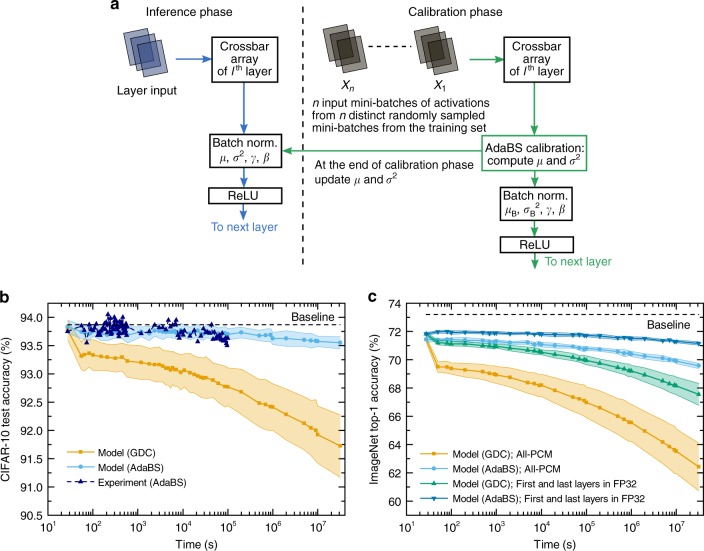
In-memory computing using resistive memory devices is a promising non-von Neumann approach for making energy-efficient deep learning inference hardware. However, due to device variability and noise, the network needs to be trained in a specific way so that transferring the digitally trained weights to the analog resistive memory devices will not result in significant loss of accuracy. Here, we introduce a methodology to train ResNet-type convolutional neural networks that results in no appreciable accuracy loss when transferring weights to phase-change memory (PCM) devices. We also propose a compensation technique that exploits the batch normalization parameters to improve the accuracy retention over time. We achieve a classification accuracy of 93.7% on CIFAR-10 and a top-1 accuracy of 71.6% on ImageNet benchmarks after mapping the trained weights to PCM. Our hardware results on CIFAR-10 with ResNet-32 demonstrate an accuracy above 93.5% retained over a one-day period, where each of the 361,722 synaptic weights is programmed on just two PCM devices organized in a differential configuration.
Overview
CoChat Summary
TL;DR
The paper shows that ResNet-style CNNs can be trained in software to tolerate phase-change memory (PCM) nonidealities, enabling accurate analog in-memory inference after weight transfer. With their training and compensation methods, they report 93.7% accuracy on CIFAR-10 and 71.6% top-1 on ImageNet after mapping weights to PCM, and 93.75% experimental accuracy on CIFAR-10 hardware that stayed above 92.6% for one day.
Key findings
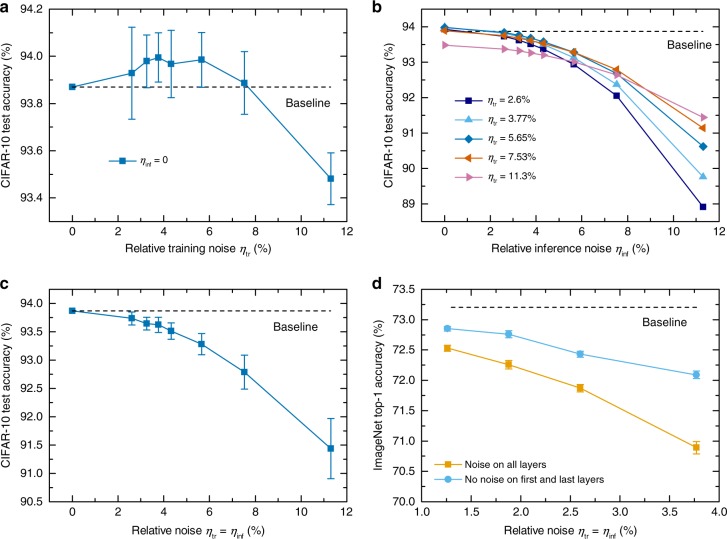
- Training ResNet-32 with injected Gaussian synaptic-weight noise yielded 93.7% test accuracy on CIFAR-10 after transfer to PCM, which was less than 0.2% below the FP32 baseline.
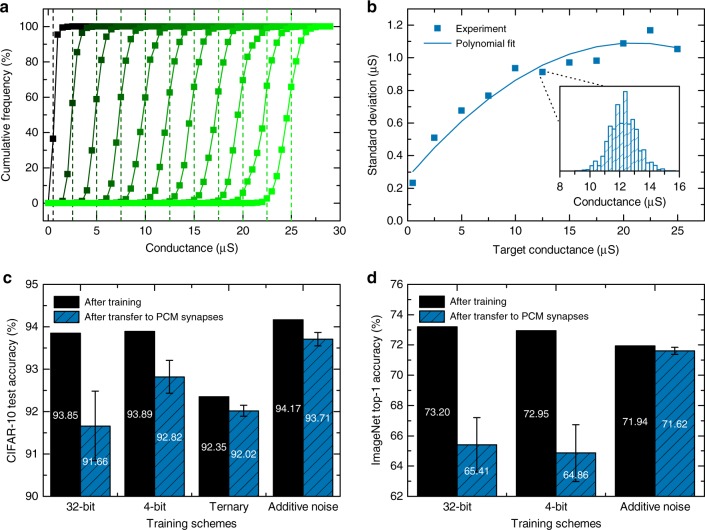
- For ResNet-34 on ImageNet, additive-noise training gave 71.6% top-1 accuracy after transfer to PCM, about 6% higher on PCM than FP32 and 4-bit training in their comparison.
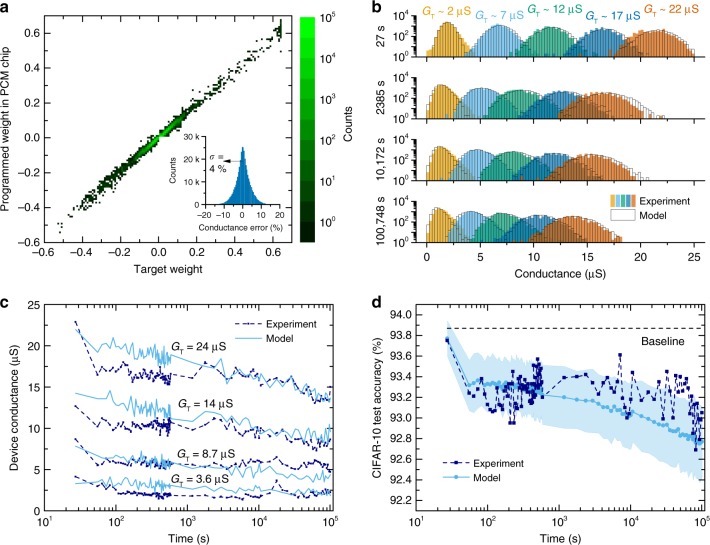
- In hardware/software CIFAR-10 experiments, all 361,722 synaptic weights of ResNet-32 were programmed on two PCM devices per weight; test accuracy was 93.75% at 25 s after programming and, with global drift compensation, stayed above 92.6% for 1 day.
- Adaptive batch normalization statistics update (AdaBS) improved drift retention further: on CIFAR-10 it kept accuracy above 93.5% over one day, an improvement of 0.9% over GDC; on ImageNet it improved one-year accuracy by 7% vs. GDC and retained above 71% for one year when combined with digital first/last layers.
Methods
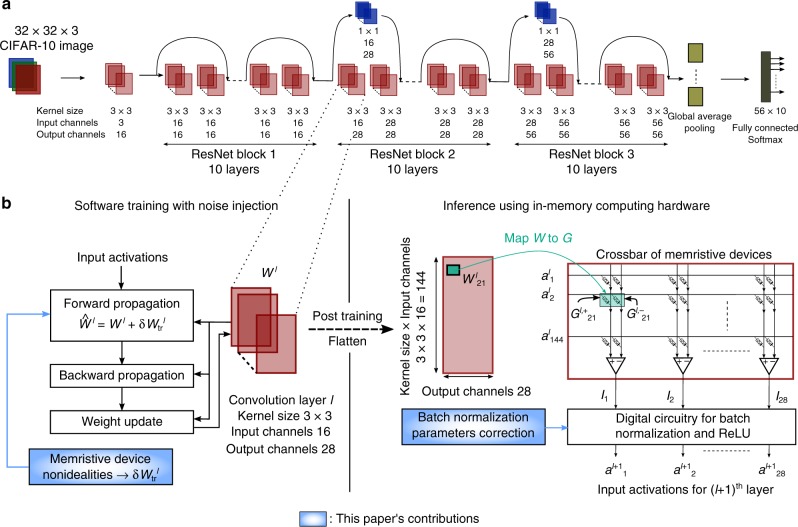
- The study used ResNet-32 on CIFAR-10 and ResNet-34 on ImageNet, both trained with stochastic gradient descent and then mapped to PCM crossbar synapses.
- For training, they injected Gaussian noise into synaptic weights during the forward pass to emulate hardware read/write noise, combined with weight initialization from a pretrained baseline, weight clipping, and learning-rate scheduling; the noise scale was estimated from a one-time hardware characterization.
- Hardware validation used a prototype PCM chip with 1 million devices for the main experiments and 3 million devices in the platform; PCM weights were programmed with an iterative program-and-verify procedure, then read over time and evaluated in software inference, with GDC and AdaBS used for drift compensation.
Limitations
- The paper states that AdaBS increases accuracy at the cost of additional digital computations during calibration and requires off-chip memory/data transfers for calibration images.
- It also states that the experiments were not done on a fully integrated chip that supports all functions of deep learning inference; this is an explicit limitation in the Discussion.
- Evident from the text: the hardware/software experiment covers the network weights on the PCM array, but some parts of the inference stack are still simulated in software, so the results do not reflect a complete end-to-end deployed system.
Model-written summary. Check it against the paper before relying on it.
Integrity signals
Registry
Cites
Statistics
Figures
Verification
Claims the paper makes
11 Valid · 1 Not valid · 9 Not checked · 88 Own results and interpretations
Every source the paper cites for this claim was checked and supports it.
In the paper
“Although a large body of efficient techniques to train DNNs with reduced digital precision has been reported32,33, it is unlikely that such procedures can generally be applied as-is to analog in-memory computing hardware due to the random nature of .”
§ Accurate deep neural network inference using computational phase-change memory > Results > Problem statement
What the sources say
- Supportedcites [32] Gupta, S., Agrawal, A., Gopalakrishnan, K. & Narayanan, P. Deep learning with limited numerical precision. In Proc. of the 32nd International Conference on Machine Learning (ICML-15) 1737–1746 (PMLR, 2015). source
The citations 32,33 are attached to the clause that a large body of efficient reduced-digital-precision DNN training techniques has been reported; our copy is exactly such a report — Introduction (p. 2) states deep networks can be trained with 16-bit fixed-point plus stochastic rounding at nearly 32-bit floating-point accuracy on MNIST/CIFAR10, and Related Work (p. 2) treats limited-precision data representation/computation as a topic with a 'rich body of literature', including earlier training studies (Iwata 1989; Hammerstrom 1990; Holt & Hwang 1993; Höhfeld & Fahlman 1992) and contemporaneous dynamic fixed-point work (Courbariaux et al., 2014, p. 7). The second clause of the citing sentence — inapplicability to analog in-memory hardware because of the random nature of δG — is the citing authors' own argument and is not attributed to this source; our copy indeed says nothing about analog in-memory conductance updates, mentioning analog hardware only in passing (Related Work, p. 2). (LLM, conf=0.85)
- Supportedcites [33] McKinstry, J. L. et al. Discovering low-precision networks close to full-precision networks for efficient embedded inference. Preprint at https://arxiv.org/abs/1809.04191 (2018). source
The citation is attached to the statement that techniques for training DNNs with reduced digital precision have been reported, not to the citing authors’ subsequent conclusion about analog in-memory hardware. The source describes a “vast diversity” of low-precision training approaches in §2.1 (p. 4) and presents its own method in §1.2 (p. 3). (LLM, conf=0.92)
hedgedstates a possible cause- Asserted: passes — The authors put it forward as true.
- Checkable: passes — It can be checked against evidence.
- Load-bearing: passes — The paper’s conclusions depend on it.
- Based: passes — The paper gives a reason why it holds.
- Supported
The cited sources support only part of this claim — read each source’s verdict below.
In the paper
“For existing memristive technologies, the magnitude of may range from 1 to 10% of the magnitude of 11, which in general is not tolerable by DNNs trained with FP32 without any constrains.”
§ Accurate deep neural network inference using computational phase-change memory > Results > Problem statement
What the sources say
- Partly supportedcites [11] Le Gallo M Mixed-precision in-memory computing Nat. Electron. 2018 1 246 253 10.1038/s41928-018-0054-8 sourceExperimental — accuracy not yet measured
The introduction (p. 1) describes variability and low precision in memristive devices, and Section II (p. 3) identifies conductance-programming inaccuracies as a possible source of computational error. The paper does not give a δG range of 1–10% of Gmax or establish that such errors are generally intolerable to unconstrained FP32-trained DNNs; its demonstrated application is solving linear equations, with deep learning listed as a future direction in the Conclusions (p. 6). (LLM, conf=0.83)
hedgedstates a possible cause- Asserted: passes — The authors put it forward as true.
- Checkable: passes — It can be checked against evidence.
- Load-bearing: passes — The paper’s conclusions depend on it.
- Based: passes — The paper gives a reason why it holds.
- Partly supported
The cited sources that could be checked couldn’t confirm or dispute this claim.
In the paper
“Training with additive noise increases the accuracy by approximately 6% on PCM compared with FP32 and 4-bit33 training.”
§ Accurate deep neural network inference using computational phase-change memory > Results > Weight transfer to PCM-based synapses
What the sources say
- Could not verifycites [33] McKinstry, J. L. et al. Discovering low-precision networks close to full-precision networks for efficient embedded inference. Preprint at https://arxiv.org/abs/1809.04191 (2018). sourceExperimental — accuracy not yet measured
The Discussion (p. 9) describes compensating for quantization-related noise while fine-tuning 4- and 8-bit networks, not training with additive noise. The ImageNet results in §1.1 (p. 2) compare quantized networks with FP32 baselines, but our copy gives no PCM result or approximately 6% accuracy increase. I searched for additive noise, PCM, and the stated comparison. (LLM, conf=0.75)
plainstates a cause- Asserted: passes — The authors put it forward as true.
- Checkable: passes — It can be checked against evidence.
- Load-bearing: passes — The paper’s conclusions depend on it.
- Based: passes — The paper gives a reason why it holds.
- Could not verify
The cited sources support only part of this claim — read each source’s verdict below.
In the paper
“the ResNet-32 implementation with 5PP can result in potentially 2× improvement in pipeline stage latency with similar bandwidth requirements compared with a standard 2D-mesh.”
§ Accurate deep neural network inference using computational phase-change memory > Discussion
What the sources say
- Partly supportedcites [48] Dazzi, M. et al. 5 Parallel prism: a topology for pipelined implementations of convolutional neural networks using computational memory. In Proc. NeurIPS MLSys Workshop (NeurIPS, 2019). sourceExperimental — accuracy not yet measured
The Quantitative Evaluation (p. 7) says that 5PP avoids pipeline stalls while 2D meshes stall for ResNet-32, supporting a latency advantage. It compares bandwidth requirements in Figure 7b, but the available text does not establish a 2× ResNet-32 latency improvement or similar bandwidth requirements for ResNet-32 and a 2D mesh. (LLM, conf=0.82)
hedgedstates a possible cause- Asserted: passes — The authors put it forward as true.
- Checkable: passes — It can be checked against evidence.
- Load-bearing: unclear — It is unclear whether the paper’s conclusions depend on it.
- Based: passes — The paper gives a reason why it holds.
- Partly supported
Every source the paper cites for this claim was checked and supports it.
In the paper
“The proposed 5PP topology allows the mapping of all the primary connectivities of state-of-the-art neural networks, including ResNet, DenseNet and Inception-style networks48.”
§ Accurate deep neural network inference using computational phase-change memory > Discussion
What the sources say
- Supportedcites [48] Dazzi, M. et al. 5 Parallel prism: a topology for pipelined implementations of convolutional neural networks using computational memory. In Proc. NeurIPS MLSys Workshop (NeurIPS, 2019). source
The Introduction (p. 2) says the authors prove that networks with feedforward, residual, Inception-style, and dense connectivity can be mapped onto 5PP. The Conclusions (p. 8) specifically state that ResNet, Inception, and DenseNet are executable on the topology. (LLM, conf=0.94)
plainstates a cause- Asserted: passes — The authors put it forward as true.
- Checkable: passes — It can be checked against evidence.
- Load-bearing: passes — The paper’s conclusions depend on it.
- Based: passes — The paper gives a reason why it holds.
- Supported
57 more claims · 1 with their cited sources checked
Create a free account to see all 109 claims and to verify the 3 references still open.
- It may state two separate claims as one. 40
- Probably not a substantial claim. 10
Claims other papers make about this one
Each is checked against this paper’s own text: does it say what the citing paper says it does?
The cited source says what the claim attributes to it.
In the citing paper
“These techniques can be more generally applied to other non-volatile resistive memory technologies such as phase-change memory8,17,21,23,24, magnetoresistive RAM48 and ferroelectric field-effect transistors49.”
From A compute-in-memory chip based on resistive random-access memory (2022) · cites this paper as [21]
The cited source says what the claim attributes to it.
In the citing paper
“A number of previous studies have shown that noise-aware training —simple injection of noise onto weights or activations during DNN training—can make DNNs more robust for AIMC deployment33,38–42.”
From Hardware-aware training for large-scale and diverse deep learning inference workloads using in-memory computing-based accelerators (2023) · cites this paper as [38]
The cited source says what the claim attributes to it.
In the citing paper
“We verified the effectiveness of our HWA training approach on the very same DNNs used in a previous study38 and found, on average, a >10% decrease in AIMC test error for long teval times.”
From Hardware-aware training for large-scale and diverse deep learning inference workloads using in-memory computing-based accelerators (2023) · cites this paper as [38]
The check wasn’t confident either way, so it gives no verdict — never disputed.
In the citing paper
“the NeuRRAM chip achieves 1.6-times to 2.3-times lower EDP and 7-times to 13-times higher computational density (measured by throughput per million of RRAMs) at various MVM input and output bit-precisions than previous state-of-the-art RRAM-based CIM chips, despite being fabricated at an older technology node17–27,36.”
From A compute-in-memory chip based on resistive random-access memory (2022) · cites this paper as [21]
Experimental — accuracy not yet measured
Citations
Cites
Deep Residual Learning for Image Recognition
He, K., Zhang, X., Ren, S., & Sun, J. (2016) · 2016 IEEE Conference on Computer Vision and Pattern Recognition (CVPR) · doi:10.1109/cvpr.2016.90 · Cited by 235,474
ImageNet Large Scale Visual Recognition Challenge
Russakovsky, O., Deng, J., Su, H., Krause, J., Satheesh, S., Ma, S., Huang, Z., Karpathy, A., Khosla, A., Bernstein, M., et al. (2015) · International Journal of Computer Vision · doi:10.1007/s11263-015-0816-y · Cited by 39,380
Delving Deep into Rectifiers: Surpassing Human-Level Performance on ImageNet Classification
He, K., Zhang, X., Ren, S., & Sun, J. (2015) · 2015 IEEE International Conference on Computer Vision (ICCV) · doi:10.1109/iccv.2015.123 · Cited by 19,741
Learning Deep Features for Discriminative Localization
Zhou, B., Khosla, A., Lapedriza, A., Oliva, A., & Torralba, A. (2016) · 2016 IEEE Conference on Computer Vision and Pattern Recognition (CVPR) · doi:10.1109/cvpr.2016.319 · Cited by 11,428
In-Datacenter Performance Analysis of a Tensor Processing Unit
Jouppi, N. P., Young, C., Patil, N., Patterson, D., Agrawal, G., Bajwa, R., Bates, S., Bhatia, S., Boden, N., Borchers, A., et al. (2017) · Proceedings of the 44th Annual International Symposium on Computer Architecture · doi:10.1145/3079856.3080246 · Cited by 4,537 · cited 1×
“Significant progress in this direction has been made with the introduction of specialized hardware for inference operating at reduced digital precision (4 to 8-bit), such as Google’s tensor processing unit (TPU) 1 and low-power graphical processing units (GPUs) such as NVIDIA T4 2 .”
MethodXNOR-Net: ImageNet Classification Using Binary Convolutional Neural Networks
Rastegari, M., Ordonez, V., Redmon, J., & Farhadi, A. (2016) · Lecture Notes in Computer Science · doi:10.1007/978-3-319-46493-0_32 · Cited by 4,408
Improved regularization of convolutional neural networks with cutout
DeVries, T., & Taylor, G. W. (2017) · arXiv · doi:10.48550/arxiv.1708.04552 · Cited by 2,776
Memory devices and applications for in-memory computing
Sebastian, A., Le Gallo, M., Khaddam-Aljameh, R., & Eleftheriou, E. (2020) · Nature Nanotechnology · doi:10.1038/s41565-020-0655-z · Cited by 2,289
Self-citationBinaryConnect: Training Deep Neural Networks with binary weights during propagations
Courbariaux, M., Bengio, Y., & David, J.-P. (2015) · arXiv · doi:10.48550/arxiv.1511.00363 · Cited by 2,180
Fully hardware-implemented memristor convolutional neural network
Yao, P., Wu, H., Gao, B., Tang, J., Zhang, Q., Zhang, W., Yang, J. J., & Qian, H. (2020) · Nature · doi:10.1038/s41586-020-1942-4 · Cited by 2,179
Research works printed but not linked: 4
- Blundell, C., Cornebise, J., Kavukcuoglu, K. & Wierstra, D. Weight uncertainty in neural networks. In Proc. of the 32nd International Conference on Machine Learning, Vol. 37 ofICML’15 1613–1622 (JMLR.org, 2015).
- Gulcehre C Moczulski M Denil M Bengio Y Noisy activation functions Proc. 33rd Int. Conf. Mach. Learn. 2016 48 3059 3068
- Jim, K., Horne, B. G. & Giles, C. L. Effects of noise on convergence and generalization in recurrent networks. In Proc. of the 7th International Conference on Neural Information Processing Systems 649–656 (MIT Press, 1994).
- Ioffe, S. & Szegedy, C. Batch normalization: accelerating deep network training by reducing internal covariate shift. In Proc. of the 32nd International Conference on Machine Learning, Vol. 37 ofICML’15 (ed. Bach, F. & Blei, D.) 448–456 (PMLR, 2015).
Cited by
Items 201–300 of 473
Novel Weight Mapping Method for Reliable NVM based Neural Network
Han, L. X., Xiang, Y., Huang, P. C., Yu, G., Han, R., Liu, X. Y., & Kang, J. (2021) · IEEE International Reliability Physics Symposium proceedings · doi:10.1109/irps46558.2021.9405200 · Cited by 13
Bhattacharjee, A., Moitra, A., Kim, Y., Venkatesha, Y., & Panda, P. (2023) · ACM Great Lakes Symposium on VLSI (GLSVLSI) · doi:10.1145/3583781.3590241 · Cited by 15
Improving DNN Hardware Accuracy by In-Memory Computing Noise Injection
Cherupally, S. K., Meng, J., Rakin, A. S., Yin, S., Seok, M., Fan, D., & Seo, J.-S. (2021) · IEEE Design and Test · doi:10.1109/mdat.2021.3139047 · Cited by 13
Yoon, H., Park, S., Kim, Y. K., Baek, J., Kim, K. H., Yun, S., Son, H., Choi, J.-H., Jang, B. C., & Kang, D. (2025) · Advanced Functional Materials · doi:10.1002/adfm.202519498 · Cited by 13
A Hardware Friendly Variation-Tolerant Framework for RRAM-Based Neuromorphic Computing
Gu, F.-Y., Yang, C., Lin, I.-C., Chang, D.-W., Lu, D. D., & Schlichtmann, U. (2024) · IEEE Transactions on Circuits and Systems I Regular Papers · doi:10.1109/tcsi.2024.3443180 · Cited by 12
Yang, P. H., Tong, P., Xu, H., Liu, S., Chen, C., Zhang, Y., Yu, S., Wang, W., Cao, R., Liu, H., et al. (2025) · Journal of Material Science and Technology · doi:10.1016/j.jmst.2024.12.078 · Cited by 11
Zhang, Z.-C., Li, Y., Yao, J., Chen, Z., Wang, F., Si, S.-H., Ding, Y., Qi, H.-L., Lu, T., Kang, L., et al. (2026) · Nature Communications · doi:10.1038/s41467-026-68402-7 · Cited by 16
Zhang, Y., Zhang, W., Wang, S., Lin, N., Yu, Y., He, Y., Wang, B., Jiang, H., Lin, P., Xu, X., et al. (2024) · Science Advances · doi:10.1126/sciadv.ado1058 · Cited by 12
Improving the Accuracy of Analog-Based In-Memory Computing Accelerators Post-Training
Lammie, C., Vasilopoulos, A., Büchel, J., Camposampiero, G., Gallo, M. L., Rasch, M. J., & Sebastian, A. (2024) · IEEE International Symposium on Circuits and Systems proceedings · doi:10.1109/iscas58744.2024.10558540 · Cited by 18
Self-citationA complementary resistive switching neuron
Wang, X., & Li, H. (2022) · Nanotechnology · doi:10.1088/1361-6528/ac7241 · Cited by 11
A lossless and fully parallel spintronic compute-in-memory macro for artificial intelligence chips
Li, H., Chai, Z., Dong, W.-K., He, J., Peng, R., Li, S., Kong, Z., Yuan, X., Wang, X., Yang, Z., et al. (2025) · Nature Electronics · doi:10.1038/s41928-025-01479-y · Cited by 23
Xpikeformer: Hybrid Analog-Digital Hardware Acceleration for Spiking Transformers
Song, Z., Katti, P., Simeone, O., & Rajendran, B. (2025) · IEEE Transactions on Very Large Scale Integration (VLSI) Systems · doi:10.1109/tvlsi.2025.3552534 · Cited by 19
Self-citationAntolini, A., Zavalloni, F., Lico, A., Vignali, R., Iannelli, L., Zurla, R., Bertolini, J., Calvetti, E., Pasotti, M., Scarselli, E. F., et al. (2024) · IEEE Transactions on Electron Devices · doi:10.1109/ted.2024.3496445 · Cited by 13
Neural Network Compression for Noisy Storage Devices
Isik, B., Choi, K., Zheng, X., Weissman, T., Ermon, S., Wong, H. ‐. P., & Alaghi, A. (2023) · ACM Transactions on Embedded Computing Systems · doi:10.1145/3588436 · Cited by 15
Investigating Series and Parallel Oxide Memtransistors for Tunable Weight Update Properties
Kang, S., Yang, S., Lee, D., Kim, S., Suh, J., & Lee, H. (2023) · ACS Applied Electronic Materials · doi:10.1021/acsaelm.3c00325 · Cited by 9
Yang, P. L., Xu, H. F., Yu, S., Liu, Y., Song, B., Liu, H., Liu, S., & Li, Q. (2024) · IEEE Transactions on Electron Devices · doi:10.1109/ted.2024.3456775 · Cited by 9
Optically Controlled P–CuxO-Based Artificial Synaptic Device for Neuromorphic Applications
Harisankar, R. S., Jetty, P., Mohanan, K. U., & Jammalamadaka, S. N. (2025) · ACS Applied Electronic Materials · doi:10.1021/acsaelm.4c02275 · Cited by 10
Brain‐Inspired In‐Memory Data Pruning and Computing with TaO x Mem‐Selectors
Li, Y., Lai, J., Wang, S., Lin, N., Zheng, X., Sun, W., Dong, D., Xu, X., Ma, H., Zhang, F., et al. (2025) · Advanced Materials · doi:10.1002/adma.202502168 · Cited by 10
Xu, Z., Su, X. Z., Hua, S., Zhai, J., Song, S., & Song, Z. (2021) · Nanotechnology · doi:10.1088/1361-6528/ac3613 · Cited by 8
Improving the Robustness of Neural Networks to Noisy Multi-Level Non-Volatile Memory-based Synapses
Dampfhoffer, M., Lopez, J. M., Mesquida, T., Valentian, A., & Anghel, L. (2023) · International Joint Conference on Neural Networks (IJCNN) · doi:10.1109/ijcnn54540.2023.10191804 · Cited by 10
OxRAM + OTS optimization for binarized neural network hardware implementation
Lopez, J. M., Hirtzlin, T., Dampfhoffer, M., Grenouillet, L., Reganaz, L., Navarro, G., Carabasse, C., Vianello, E., Magis, T., Deleruyelle, D., et al. (2021) · Semiconductor Science and Technology · doi:10.1088/1361-6641/ac31e2 · Cited by 10
Effect of Hydrogen Migration in SiO2/Al2O3 Stacked Gate Insulator of InGaZnO Thin-Film Transistors
Park, S., Youn, S., Jang, J. T., Kim, H., & Kim, D. H. (2022) · Crystals · doi:10.3390/cryst12050594 · Cited by 9
High-Accuracy Machine-Learned Interatomic Potentials for the Phase Change Material Ge3Sb6Te5
Yu, W., Zhang, Z., Wan, X., Su, J., Gui, Q., Guo, H., Zhong, H., Robertson, J., & Guo, Y. (2023) · Chemistry of Materials · doi:10.1021/acs.chemmater.3c00524 · Cited by 12
Impact of the local atomic structure on the thermal conductivity of amorphous Ge2Sb2Te5
Guerboub, M., Wendji, S. D. W., Massobrio, C., Bouzid, A., Boero, M., Ori, G., & Martin, É. (2023) · The Journal of Chemical Physics · doi:10.1063/5.0139590 · Cited by 10
Liu, C., Hsiang, K.-Y., Li, Z., Chang, F.-S., Lou, Z.-F., Lee, J.-Y., Liu, C. W., Su, P., Hou, T., & Lee, M. H. (2025) · ACS Applied Materials & Interfaces · doi:10.1021/acsami.4c14132 · Cited by 9
CiMBA: Accelerating Genome Sequencing Through On-Device Basecalling via Compute-in-Memory
Simon, W., Boybat, I., Kodra, R., Ferro, E., Singh, G., Alser, M., Jain, S., Tsai, H.-Y. S., Burr, G. W., Mutlu, O., et al. (2025) · IEEE Transactions on Parallel and Distributed Systems · doi:10.1109/tpds.2025.3550811 · Cited by 11
Self-citationPassive LiNbO₃ Memristor With Multilevel States for Neuromorphic Computing
Xie, Q., Pan, X., Wang, Y., Luo, W., Zhao, Z., Tong, J., Yang, X., Shuai, Y., Wu, C., & Zhang, W. (2024) · IEEE Transactions on Electron Devices · doi:10.1109/ted.2024.3450437 · Cited by 8
Bayesian Inference on Binary Spiking Networks Leveraging Nanoscale Device Stochasticity
Katti, P., Skatchkovsky, N., Simeone, O., Rajendran, B., & Al‐Hashimi, B. M. (2023) · IEEE International Symposium on Circuits and Systems proceedings · doi:10.1109/iscas46773.2023.10181438 · Cited by 9
Self-citationLin, Y., Yang, D., Wang, Z., Zhen, W., Yu, T., Xue, F., Wei, H., & Sun, L. (2026) · Nature Communications · doi:10.1038/s41467-026-70594-x · Cited by 24
Yook, C.-G., Kim, J. N., Kim, Y., & Shim, W. (2023) · Micromachines · doi:10.3390/mi14091753 · Cited by 8
Guirado, R., Rahimi, A., Karunaratne, G., Alarcón, E., Sebastian, A., & Abadal, S. (2023) · IEEE Journal on Emerging and Selected Topics in Circuits and Systems · doi:10.1109/jetcas.2023.3243064 · Cited by 16
Self-citationYang, L., Shu-guang, Z., Qian, L., Tao, Y., Jin, F., Li, H., Guo, Z., Tang, R., & Dong, K. (2025) · Applied Physics Letters · doi:10.1063/5.0245481 · Cited by 7
From commercial to emerging memory: Device and circuit perspectives for neuromorphic computing
Koo, R., Park, S., Ko, J., Im, J., & Lee, J. (2025) · Device · doi:10.1016/j.device.2025.100942 · Cited by 14
Memristive Artificial Synapses Based on Brownmillerite for Endurable Weight Modulation
Lee, Y. J., Choi, E. S., Baek, J. H., Yang, J., Kim, J., Kim, J. Y., Kim, B., Shin, D., Park, S. H., Im, I. H., et al. (2024) · Small · doi:10.1002/smll.202405749 · Cited by 9
Nguyen, T.-H., Imran, M., Choi, J., & Yang, J.-S. (2023) · IEEE Transactions on Computer-Aided Design of Integrated Circuits and Systems · doi:10.1109/tcad.2023.3240659 · Cited by 9
Frank, M. M., Li, N., Rasch, M. J., Jain, S., Chen, C.-T., Muralidhar, R., Han, J., Narayanan, V., Philip, T. M., Brew, K. W., et al. (2023) · IEEE International Reliability Physics Symposium proceedings · doi:10.1109/irps48203.2023.10117874 · Cited by 10
Self-citationNon von Neumann computing concepts
Syed, G. S., Gallo, M. L., & Sebastian, A. (2024) · Elsevier eBooks · doi:10.1016/b978-0-12-823491-4.00002-3 · Cited by 10
Self-citationMemristor based In-Memory Computing for Edge AI Applications
Joshi, P. K., & Rahaman, H. (2023) · International Symposium on Devices, Circuits and Systems (ISDCS) · doi:10.1109/isdcs58735.2023.10153553 · Cited by 7
The Impact of Device Uniformity on Functionality of Analog Passively-Integrated Memristive Circuits
Fahimi, Z., Mahmoodi, M. R., Klachko, M., Nili, H., & Strukov, D. B. (2021) · IEEE Transactions on Circuits and Systems I Regular Papers · doi:10.1109/tcsi.2021.3097282 · Cited by 13
Nguyen, T.-H., Imran, M., Choi, J., & Yang, J.-S. (2024) · IEEE Transactions on Computers · doi:10.1109/tc.2024.3404096 · Cited by 8
Memristive Bellman solver for decision-making
Feng, Z., Wu, Z., Zou, J., Cheng, L., Zhao, X., Zhang, X., Lü, J., Wang, C., Wang, Y., Wang, H., et al. (2025) · Nature Communications · doi:10.1038/s41467-025-60085-w · Cited by 11
Khan, A. A., Farzaneh, H., Friebel, K. F. A., Fournier, C., Chelini, L., & Castrillón, J. (2024) · International Conference on Architectural Support for Programming Languages and Operating Systems (ASPLOS) · doi:10.1145/3622781.3674189 · Cited by 40
Han, J., Rasch, M. J., Liu, Z., Solomon, P. M., Brew, K. W., Cheng, K., Ok, I., Chan, V., Longstreet, M., Kim, W., et al. (2022) · Advanced Intelligent Systems · doi:10.1002/aisy.202100179 · Cited by 9
Efficient and Robust Edge AI: Software, Hardware, and the Co-design
Kim, B., Li, S., Taylor, B., & Chen, Y. (2025) · ACM Transactions on Embedded Computing Systems · doi:10.1145/3724396 · Cited by 10
Multi-Beam Beamforming-Based ML Algorithm to Optimize the Routing of Drone Swarms
Myers, R. J., Perera, S. M., McLewee, G., Huang, D., & Song, H. (2024) · Drones · doi:10.3390/drones8020057 · Cited by 8
Error-aware probabilistic training for memristive neural networks
Liu, J., Lü, J., Tang, S., Zhou, R., Ma, H., Lyu, B., Tian, Y., Shi, T., & Liu, Q. (2025) · Nature Communications · doi:10.1038/s41467-025-66240-7 · Cited by 17
Memristive switching by bulk spin–orbit torque in symmetry-broken ferromagnetic films
Xie, R., Wang, S., Cai, L., Cui, X., Liu, S., Cao, Q., Zhang, C., Huang, Q., & Yan, S. (2022) · Applied Physics Letters · doi:10.1063/5.0092115 · Cited by 7
Ma, S., Brooks, D. M., & Wei, G.-Y. (2023) · IEEE Transactions on Emerging Topics in Computing · doi:10.1109/tetc.2023.3241004 · Cited by 9
Örnhag, M. V., Güler, P., Knyaginin, D., & Borg, M. (2023) · IEEE/CVF Winter Conference on Applications of Computer Vision Workshops (WACVW) · doi:10.1109/wacvw58289.2023.00054 · Cited by 11
High-density analog image storage in an analog-valued non-volatile memory array
Zheng, X., Zarcone, R. V., Levy, A., Khwa, W.-S., Raina, P., Olshausen, B. A., & Wong, H. ‐. P. (2022) · Neuromorphic Computing and Engineering · doi:10.1088/2634-4386/aca92c · Cited by 6
In-Sensor-Memory Computing for Post-Von Neumann Intelligence: A Perspective
Tang, H., Yu, N., Min, P., Guo, R., & Zhang, G. (2026) · Nano-Micro Letters · doi:10.1007/s40820-026-02191-y · Cited by 21
Analog-memory-based 14nm Hardware Accelerator for Dense Deep Neural Networks including Transformers
Okazaki, A., Narayanan, P., Ambrogio, S., Hosokawa, K., Tsai, H.-Y. S., Nomura, A., Yasuda, T., Mackin, C., Friz, A. M., Ishii, M., et al. (2022) · IEEE International Symposium on Circuits and Systems proceedings · doi:10.1109/iscas48785.2022.9937292 · Cited by 9
Towards Addressing Noise and Static Variations of Analog Computations Using Efficient Retraining
Klein, B., Kuhn, L., Weis, J., Emmel, A., Stradmann, Y., Schemmel, J., & Fröning, H. (2021) · Communications in computer and information science · doi:10.1007/978-3-030-93736-2_32 · Cited by 8
Design of projected phase-change memory mushroom cells for low-resistance drift
Philip, T. M., Brew, K. W., Li, N., Simon, A. H., Liu, Z., Ok, I., Adusumilli, P., Saraf, I., Conti, R., Ogundipe, O., et al. (2022) · MRS Bulletin · doi:10.1557/s43577-022-00391-6 · Cited by 7
Self-citationNVM in Data Storage: A Post-Optane Future
Karim, S., Wünsche, J., Kühn, M., Saake, G., & Broneske, D. (2025) · ACM Transactions on Storage · doi:10.1145/3731454 · Cited by 13
Gao, X., Wang, G., Zhou, Z., Li, J., Song, K., & Qi, J. (2025) · Crop Protection · doi:10.1016/j.cropro.2025.107236 · Cited by 5
Xiao, R., Zhang, Y., Wang, B., Xu, Y., Fan, J., Shen, H., & Huang, K. (2023) · IEEE Transactions on Very Large Scale Integration (VLSI) Systems · doi:10.1109/tvlsi.2023.3306376 · Cited by 12
Park, T., Kim, J., Kwon, Y. J., Kim, H., Yim, S., Shin, D. H., Kim, Y. R., Kim, H. J., & Hwang, C. S. (2024) · Advanced Materials Technologies · doi:10.1002/admt.202400965 · Cited by 6
Turning to Information Theory to Bring in-Memory Computing into Practice
Dupraz, E., Leduc-Primeau, F., Cai, K., & Dolecek, L. (2023) · IEEE BITS the Information Theory Magazine · doi:10.1109/mbits.2023.3333798 · Cited by 7
Wang, H., Zhong, W., Song, Z., Jin, H., Li, W., & Tao, J. (2021) · IEEE Sustainable Power and Energy Conference (iSPEC) · doi:10.1109/ispec53008.2021.9735787 · Cited by 6
In-Memory Acceleration of Hyperdimensional Genome Matching on Unreliable Emerging Technologies
Barkam, H. E., Yun, S., Genßler, P. R., Liu, C.-K., Zou, Z., Amrouch, H., & Imani, M. (2024) · IEEE Transactions on Circuits and Systems I Regular Papers · doi:10.1109/tcsi.2024.3351966 · Cited by 5
Enabling High-Speed, High-Resolution Space-based Focal Plane Arrays with Analog In-Memory Computing
Xiao, T. P., Wahby, W. S., Bennett, C. H., Hays, P., Agrawal, V., Marinella, M. J., & Agarwal, S. (2023) · IEEE Symposium on VLSI Technology and Circuits (VLSI Technology and Circuits) · doi:10.23919/vlsitechnologyandcir57934.2023.10185348 · Cited by 7
Approximations in Deep Learning
Dupuis, E., Filip, S.-I., Sentieys, O., Novo, D., O’Connor, I., & Bosio, A. (2022) · Springer eBooks · doi:10.1007/978-3-030-94705-7_15 · Cited by 7
End-to-end 100-TOPS/W Inference With Analog In-Memory Computing: Are We There Yet?
Ottavi, G., Karunaratne, G., Conti, F., Boybat, I., Benini, L., & Rossi, D. (2021) · IEEE International Conference on Artificial Intelligence Circuits and Systems (AICAS) · doi:10.1109/aicas51828.2021.9458409 · Cited by 9
Self-citationA Multi-Memristive Unit-Cell Array With Diagonal Interconnects for In-Memory Computing
Khaddam-Aljameh, R., Martemucci, M., Kersting, B., Gallo, M. L., Bruce, R. L., BrightSky, M. J., & Sebastian, A. (2021) · IEEE Transactions on Circuits & Systems II Express Briefs · doi:10.1109/tcsii.2021.3078614 · Cited by 5
Self-citationJang, J.-W., Nguyen, T.-H., & Yang, J.-S. (2023) · doi:10.1109/iccad57390.2023.10323803 · Cited by 5
Sarkar, P., Manamel, L. T., Saha, P., Jana, C., Sarmah, A., Mohanan, K. U., Das, B. C., & Mukherjee, C. (2024) · Materials Horizons · doi:10.1039/d4mh00928b · Cited by 6
Computing with nonvolatile memories for artificial intelligence
Pedretti, G., & Ielmini, D. (2022) · Elsevier eBooks · doi:10.1016/b978-0-12-820758-1.00009-1 · Cited by 7
Zhang, Y., Sun, H., Xie, M., Feng, Z., & Wu, Z. (2023) · Advanced Intelligent Systems · doi:10.1002/aisy.202300411 · Cited by 5
Xu, W., Luo, J., Fu, B., Fu, Z., Wang, K., Su, C., Huang, Q., & Huang, R. (2024) · IEEE Electron Devices Technology & Manufacturing Conference (EDTM) · doi:10.1109/edtm58488.2024.10512190 · Cited by 11
Noise-Resilient Photonic Analog Neural Networks
Varri, A., Brückerhoff‐Plückelmann, F., Dijkstra, J., Wendland, D., Bankwitz, R., Agnihotri, A., & Pernice, W. H. P. (2024) · Journal of Lightwave Technology · doi:10.1109/jlt.2024.3433454 · Cited by 10
Sharifipour, O., Keshavarzi, P., & Danaie, M. (2025) · Physica Scripta · doi:10.1088/1402-4896/adfa4d · Cited by 6
Noise tolerant ternary weight deep neural networks for analog in-memory inference
Doevenspeck, J., Vrancx, P., Laubeuf, N., Mallik, A., Debacker, P., Verkest, D., Lauwereins, R., & Dehaene, W. (2021) · International Joint Conference on Neural Networks (IJCNN) · doi:10.1109/ijcnn52387.2021.9533684 · Cited by 10
NORA: Noise-Optimized Rescaling of LLMs on Analog Compute-in-Memory Accelerators
Hou, Y. T., Tsai, H.-Y. S., Maghraoui, K. E., Gokmen, T., Burr, G. W., & Liu, L. (2025) · Design, Automation, and Test in Europe · doi:10.23919/date64628.2025.10993217 · Cited by 12
Accurate Weight Mapping in a Multi-Memristive Synaptic Unit
Martemucci, M., Kersting, B., Khaddam-Aljameh, R., Boybat, I., Nandakumar, S. R., Egger, U., BrightSky, M. J., Bruce, R. L., Gallo, M. L., & Sebastian, A. (2021) · IEEE International Symposium on Circuits and Systems proceedings · doi:10.1109/iscas51556.2021.9401558 · Cited by 5
Self-citationHigh-Precision Close-to-Analog Programming of PCM Cells as Devices for AiMC Edge-AI
Antolini, A., Lico, A., Zavalloni, F., Greco, L., Zurla, R., Bertolini, J., Vignali, R., Iannelli, L., Calvetti, E., Pasotti, M., et al. (2025) · IEEE Journal of Solid-State Circuits · doi:10.1109/esserc66193.2025.11214085 · Cited by 6
OML-PCM: optical multi-level phase change memory architecture for embedded computing systems
Mohseni, M., & Novin, A. H. (2023) · Engineering Research Express · doi:10.1088/2631-8695/ad0fc4 · Cited by 5
Lim, K., Go, S., Tan, C., Jiang, Y., Cai, K., Chong, T., Elliott, S. R., Lee, T. H., & Loke, D. K. (2024) · Advanced Physics Research · doi:10.1002/apxr.202300085 · Cited by 4
scList: A PCRAM-based Hybrid Memory Management Scheme
Wang, H., Tang, X., Liming, S., Li, W., Shen, J., & Tao, J. (2021) · IEEE International Conference on Computational Science and Engineering (CSE) and IEEE International Conference on Embedded and Ubiquitous Computing (EUC) · doi:10.1109/euc53437.2021.00010 · Cited by 4
Memory-induced excitability in optical cavities
Braeckeveldt, B., Peters, K. J. H., Verdonschot, B., Maes, B., & Rodríguez, S. R. K. (2024) · Physical Review Research · doi:10.1103/physrevresearch.6.023008 · Cited by 5
Learning Task-Based Trainable Neuromorphic ADCs via Power-Aware Distillation
Vol, T., Danial, L., & Shlezinger, N. (2025) · IEEE Transactions on Signal Processing · doi:10.1109/tsp.2025.3546458 · Cited by 7
Energy-Efficient, Scalable Single-Layer MoS2–Based Synaptic Field-Effect Transistors
Kim, J., 김병주, Ma, J., Lim, S.-Y., Choi, M.-H., Jeong, H., Ji, J., Kang, J., Chang, J., Kwon, J., et al. (2025) · ACS Applied Electronic Materials · doi:10.1021/acsaelm.5c00808 · Cited by 4
Reservoir computing with a random memristor crossbar array
Wang, X., & Li, H. (2024) · Nanotechnology · doi:10.1088/1361-6528/ad61ee · Cited by 6
Memristive In‐Memory Object Detection with 128 Mb C‐Doped Ge 2 Sb 2 Te 5 PCM Chip
Xie, C., Li, Y., Yan, L., Song, S., Chen, H., Qi, R., Li, X., Zhu, Y., Yu, L., Yan, B., et al. (2025) · Advanced Science · doi:10.1002/advs.202505678 · Cited by 5
Lightspeed Binary Neural Networks using Optical Phase-Change Materials
Shahroodi, T., Cardoso, R., Zahedi, M., Wong, S., Bosio, A., O’Connor, I., & Hamdioui, S. (2023) · Design, Automation, and Test in Europe · doi:10.23919/date56975.2023.10137229 · Cited by 4
Self-assembled magnetic heterostructure of Co/DLC films
Chow, Y.-T., Jiang, P., Chang, C.-H.-T., Shen, T.-S., Lee, Y.-S., Tsay, J.-S., & Lin, C.-R. (2021) · Nanotechnology · doi:10.1088/1361-6528/ac21ec · Cited by 4
Difficulties and approaches in enabling learning-in-memory using crossbar arrays of memristors
Wang, W. J., Li, Y., & Wang, M. (2024) · Neuromorphic Computing and Engineering · doi:10.1088/2634-4386/ad6732 · Cited by 6
Paolino, C., Antolini, A., Zavalloni, F., Lico, A., Scarselli, E. F., Mangia, M., Marchioni, A., Pareschi, F., Setti, G., Rovatti, R., et al. (2023) · Journal of Low Power Electronics and Applications · doi:10.3390/jlpea13010017 · Cited by 5
In-Memory Computing for AI Accelerators: Challenges and Solutions
Krishnan, G., Mandal, S. K., Chakrabarti, C., Seo, J.-S., Ogras, U. Y., & Cao, Y. K. (2023) · Springer eBooks · doi:10.1007/978-3-031-19568-6_7 · Cited by 4
Hosseinzadeh, S., Lancaster, S., Parvaresh, A., Silva, C., Mikolajick, T., Slesazeck, S., & Fey, D. (2024) · Euromicro Conference on Digital System Design (DSD) · doi:10.1109/dsd64264.2024.00010 · Cited by 7
Yamada, A., Misawa, N., Matsui, C., & Takeuchi, K. (2023) · doi:10.1109/iccad57390.2023.10323664 · Cited by 4
Kernel approximation using analogue in-memory computing
Büchel, J., Camposampiero, G., Vasilopoulos, A., Lammie, C., Gallo, M. L., Rahimi, A., & Sebastian, A. (2024) · Nature Machine Intelligence · doi:10.1038/s42256-024-00943-2 · Cited by 8
Self-citationKim, J., Im, J., & Lee, J. (2024) · IEEE Electron Device Letters · doi:10.1109/led.2024.3459615 · Cited by 4
Fast and Accurate Output Error Estimation for Memristor-Based Deep Neural Networks
Kern, J., Henwood, S., Mordido, G., Dupraz, E., Bey, A. A. E., Savaria, Y., & Leduc-Primeau, F. (2024) · IEEE Transactions on Signal Processing · doi:10.1109/tsp.2024.3369423 · Cited by 6
Metadata
- Authors
- Joshi, V., Le Gallo, M., Haefeli, S., Boybat, I., Nandakumar, S. R., Piveteau, C., Dazzi, M., Rajendran, B., Sebastian, A., & Eleftheriou, E.
- Affiliations
- King's College London (GB)
- ETH Zurich (CH)
- IBM Research - Zurich (CH)
- Corresponding author
- Sebastian, Abu
- ORCID
- Venue
- Nature Communications
- Published
- 2020-05-18
- Volume
- 11
- Issue
- 1
- Pages
- 2473-2473
- ISSN
- 2041-1723 (ISSN-L)
- PMC
- PMC7235046
- OpenAlex
- W2948661249
- Semantic Scholar
- 19c750a84f41de577efb7c30570658e66aa395d8
- Cited by
- 490
- References
- 51
- Citations by year
- 2026: 69 · 2025: 83 · 2024: 73 · 2023: 88 · 2022: 92 · 2021: 68 · 2020: 17
- FWCI
- 22.73
- Type
- journal article
- Language
- en
- Open access
- gold
- doi.org
- Licence
- cc-by
- creativecommons.org/licenses/by/4.0 (tdm)
- creativecommons.org/licenses/by/4.0 (vor)
- Locations
- Nature Communications (publishedVersion, cc-by)
- PubMed Central (publishedVersion, cc-by)
- PubMed (publishedVersion)
- arXiv (Cornell University) (submittedVersion)
- Infoscience (Ecole Polytechnique Fédérale de Lausanne) (submittedVersion, cc-by-nc-nd)
- DOAJ (DOAJ: Directory of Open Access Journals) (submittedVersion, cc-by-sa)
- Research Portal (King's College London) (submittedVersion, cc-by)
- arXiv (Cornell University)
- Funders
- European Commission (HORIZON2020, 682675)
- Topics
- Physical Sciences › Engineering › Electrical and Electronic Engineering › Advanced Memory and Neural Computing
- Physical Sciences › Computer Science › Computer Vision and Pattern Recognition › Advanced Neural Network Applications
- Physical Sciences › Computer Science › Artificial Intelligence › Neural Networks and Reservoir Computing
- Keywords
- phase-change memory, in-memory computing, resistive memory devices, deep neural network inference, weight mapping, device variability, ResNet, energy-efficient hardware, non-von Neumann architecture
About these checks
Registry, retraction, Cites and statistics results are computed, not judged, with one exception: a printed reference that no index lists is read once by a model before it counts as a citation error. Claims are extracted by a model and kept only when their quote appears verbatim in the text; each cited source is then checked, with a model’s help, for whether it says what the claim relies on. Those verdicts can be wrong — read the claim’s quote and the cited source before relying on one.
The claim verdicts this report counts are experimental: their accuracy is not yet measured.
A language model drew the claims from the paper on 2026-09-29, under version 3 of the claim definition (model deepseek-v4.1-flash, prompt extract-v3).
A second model labelled each claim on 2026-09-29 (model jev-1.13-20260917, definition revision gold-guideline-v0.2).
Cited sources are checked with a language model’s help (qwen3.8-omni-flash and gpt-6-sol).
Statistics and arithmetic are recomputed, not judged.
Confidence bands are shown only for fields calibrated on our annotated test set. None is calibrated yet, so no band is shown.
What counts as a claim ›How we measure confidence ›How we check this ›
Are you an author, or do you see a problem with this page? Request a review
Data sources
Bibliographic data: Semantic Scholar, OpenAlex, Crossref.
Contains information from the Semantic Scholar Academic Graph Datasets, made available under the ODC Attribution License (ODC-BY 1.0).
Semantic Scholar’s data is described in: Kinney, R., et al. (2023). The Semantic Scholar Open Data Platform. arXiv:2301.10140.
