

Accurate deep neural network inference using computational phase-change memory
Open accessThe DOI matches its Crossref record; 58 of the 58 references it cites were found in a registry or an index; 14 of the 29 sources its claims cite were checked for support.
Abstract
In-memory computing using resistive memory devices is a promising non-von Neumann approach for making energy-efficient deep learning inference hardware. However, due to device variability and noise, the network needs to be trained in a specific way so that transferring the digitally trained weights to the analog resistive memory devices will not result in significant loss of accuracy. Here, we introduce a methodology to train ResNet-type convolutional neural networks that results in no appreciable accuracy loss when transferring weights to phase-change memory (PCM) devices. We also propose a compensation technique that exploits the batch normalization parameters to improve the accuracy retention over time. We achieve a classification accuracy of 93.7% on CIFAR-10 and a top-1 accuracy of 71.6% on ImageNet benchmarks after mapping the trained weights to PCM. Our hardware results on CIFAR-10 with ResNet-32 demonstrate an accuracy above 93.5% retained over a one-day period, where each of the 361,722 synaptic weights is programmed on just two PCM devices organized in a differential configuration.
Overview
CoChat Summary
TL;DR
The paper shows that ResNet-style CNNs can be trained in software to tolerate phase-change memory (PCM) nonidealities, enabling accurate analog in-memory inference after weight transfer. With their training and compensation methods, they report 93.7% accuracy on CIFAR-10 and 71.6% top-1 on ImageNet after mapping weights to PCM, and 93.75% experimental accuracy on CIFAR-10 hardware that stayed above 92.6% for one day.
Key findings
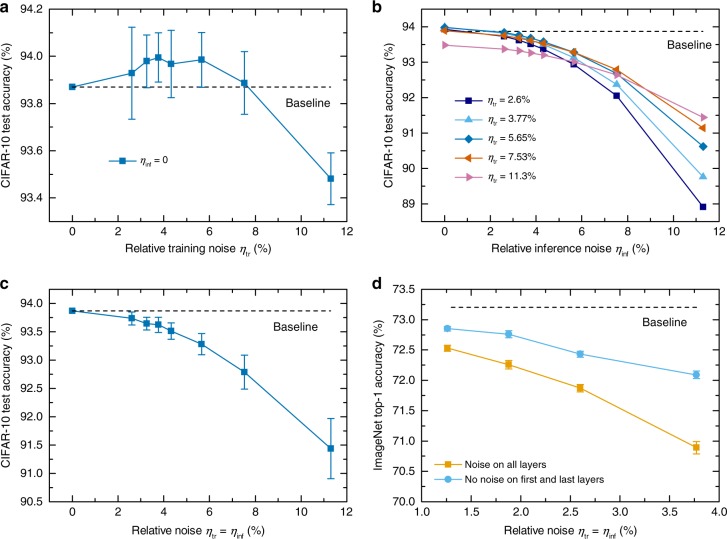
- Training ResNet-32 with injected Gaussian synaptic-weight noise yielded 93.7% test accuracy on CIFAR-10 after transfer to PCM, which was less than 0.2% below the FP32 baseline.
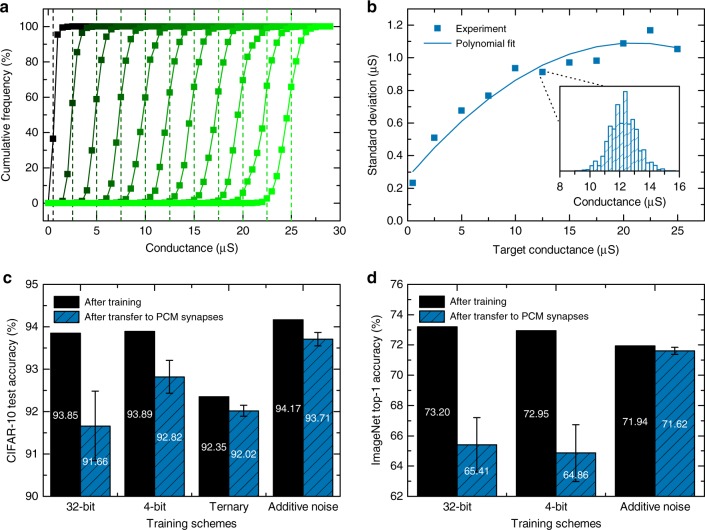
- For ResNet-34 on ImageNet, additive-noise training gave 71.6% top-1 accuracy after transfer to PCM, about 6% higher on PCM than FP32 and 4-bit training in their comparison.
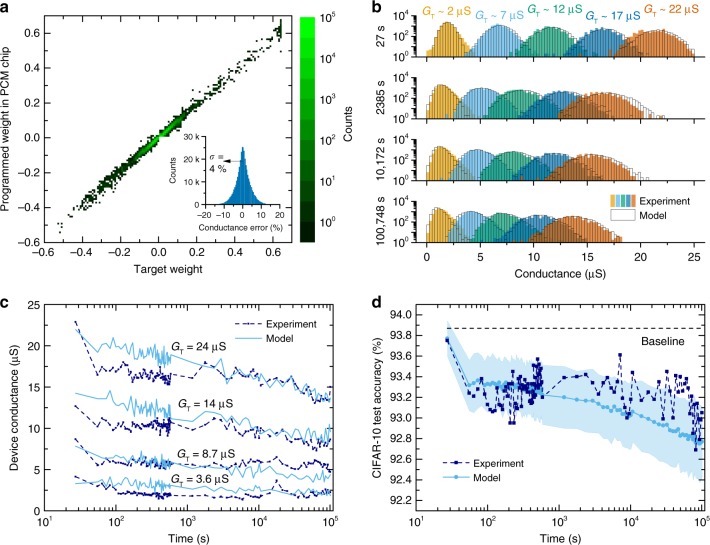
- In hardware/software CIFAR-10 experiments, all 361,722 synaptic weights of ResNet-32 were programmed on two PCM devices per weight; test accuracy was 93.75% at 25 s after programming and, with global drift compensation, stayed above 92.6% for 1 day.
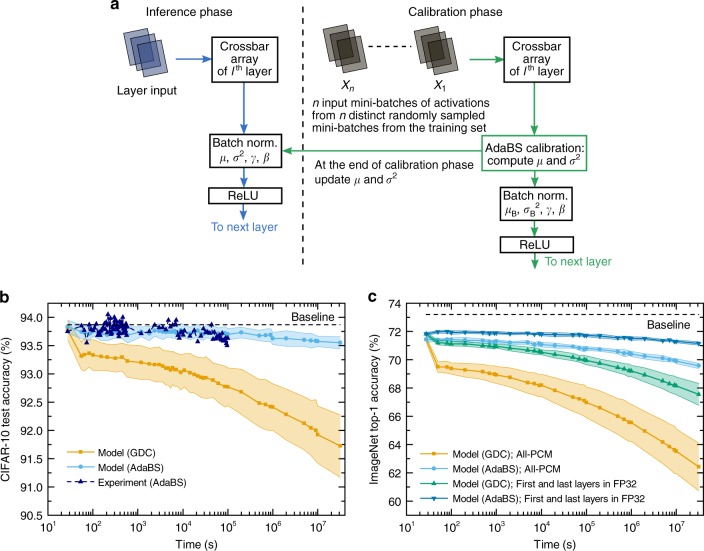
- Adaptive batch normalization statistics update (AdaBS) improved drift retention further: on CIFAR-10 it kept accuracy above 93.5% over one day, an improvement of 0.9% over GDC; on ImageNet it improved one-year accuracy by 7% vs. GDC and retained above 71% for one year when combined with digital first/last layers.
Methods
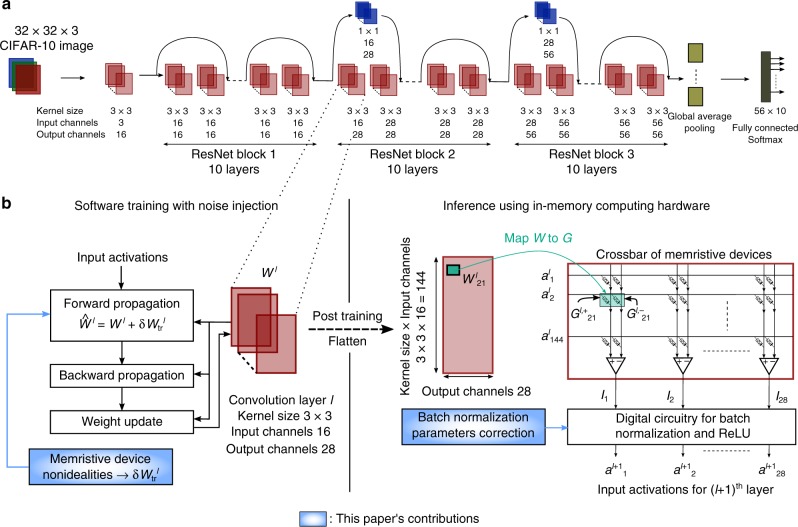
- The study used ResNet-32 on CIFAR-10 and ResNet-34 on ImageNet, both trained with stochastic gradient descent and then mapped to PCM crossbar synapses.
- For training, they injected Gaussian noise into synaptic weights during the forward pass to emulate hardware read/write noise, combined with weight initialization from a pretrained baseline, weight clipping, and learning-rate scheduling; the noise scale was estimated from a one-time hardware characterization.
- Hardware validation used a prototype PCM chip with 1 million devices for the main experiments and 3 million devices in the platform; PCM weights were programmed with an iterative program-and-verify procedure, then read over time and evaluated in software inference, with GDC and AdaBS used for drift compensation.
Limitations
- The paper states that AdaBS increases accuracy at the cost of additional digital computations during calibration and requires off-chip memory/data transfers for calibration images.
- It also states that the experiments were not done on a fully integrated chip that supports all functions of deep learning inference; this is an explicit limitation in the Discussion.
- Evident from the text: the hardware/software experiment covers the network weights on the PCM array, but some parts of the inference stack are still simulated in software, so the results do not reflect a complete end-to-end deployed system.
Model-written summary. Check it against the paper before relying on it.
Integrity signals
Registry
Cites
Statistics
Figures
Verification
Claims the paper makes
11 Valid · 1 Not valid · 9 Not checked · 88 Own results and interpretations
Every source the paper cites for this claim was checked and supports it.
In the paper
“Although a large body of efficient techniques to train DNNs with reduced digital precision has been reported32,33, it is unlikely that such procedures can generally be applied as-is to analog in-memory computing hardware due to the random nature of .”
§ Accurate deep neural network inference using computational phase-change memory > Results > Problem statement
What the sources say
- Supportedcites [32] Gupta, S., Agrawal, A., Gopalakrishnan, K. & Narayanan, P. Deep learning with limited numerical precision. In Proc. of the 32nd International Conference on Machine Learning (ICML-15) 1737–1746 (PMLR, 2015). source
The citations 32,33 are attached to the clause that a large body of efficient reduced-digital-precision DNN training techniques has been reported; our copy is exactly such a report — Introduction (p. 2) states deep networks can be trained with 16-bit fixed-point plus stochastic rounding at nearly 32-bit floating-point accuracy on MNIST/CIFAR10, and Related Work (p. 2) treats limited-precision data representation/computation as a topic with a 'rich body of literature', including earlier training studies (Iwata 1989; Hammerstrom 1990; Holt & Hwang 1993; Höhfeld & Fahlman 1992) and contemporaneous dynamic fixed-point work (Courbariaux et al., 2014, p. 7). The second clause of the citing sentence — inapplicability to analog in-memory hardware because of the random nature of δG — is the citing authors' own argument and is not attributed to this source; our copy indeed says nothing about analog in-memory conductance updates, mentioning analog hardware only in passing (Related Work, p. 2). (LLM, conf=0.85)
- Supportedcites [33] McKinstry, J. L. et al. Discovering low-precision networks close to full-precision networks for efficient embedded inference. Preprint at https://arxiv.org/abs/1809.04191 (2018). source
The citation is attached to the statement that techniques for training DNNs with reduced digital precision have been reported, not to the citing authors’ subsequent conclusion about analog in-memory hardware. The source describes a “vast diversity” of low-precision training approaches in §2.1 (p. 4) and presents its own method in §1.2 (p. 3). (LLM, conf=0.92)
hedgedstates a possible cause- Asserted: passes — The authors put it forward as true.
- Checkable: passes — It can be checked against evidence.
- Load-bearing: passes — The paper’s conclusions depend on it.
- Based: passes — The paper gives a reason why it holds.
- Supported
The cited sources support only part of this claim — read each source’s verdict below.
In the paper
“For existing memristive technologies, the magnitude of may range from 1 to 10% of the magnitude of 11, which in general is not tolerable by DNNs trained with FP32 without any constrains.”
§ Accurate deep neural network inference using computational phase-change memory > Results > Problem statement
What the sources say
- Partly supportedcites [11] Le Gallo M Mixed-precision in-memory computing Nat. Electron. 2018 1 246 253 10.1038/s41928-018-0054-8 sourceExperimental — accuracy not yet measured
The introduction (p. 1) describes variability and low precision in memristive devices, and Section II (p. 3) identifies conductance-programming inaccuracies as a possible source of computational error. The paper does not give a δG range of 1–10% of Gmax or establish that such errors are generally intolerable to unconstrained FP32-trained DNNs; its demonstrated application is solving linear equations, with deep learning listed as a future direction in the Conclusions (p. 6). (LLM, conf=0.83)
hedgedstates a possible cause- Asserted: passes — The authors put it forward as true.
- Checkable: passes — It can be checked against evidence.
- Load-bearing: passes — The paper’s conclusions depend on it.
- Based: passes — The paper gives a reason why it holds.
- Partly supported
The cited sources that could be checked couldn’t confirm or dispute this claim.
In the paper
“Training with additive noise increases the accuracy by approximately 6% on PCM compared with FP32 and 4-bit33 training.”
§ Accurate deep neural network inference using computational phase-change memory > Results > Weight transfer to PCM-based synapses
What the sources say
- Could not verifycites [33] McKinstry, J. L. et al. Discovering low-precision networks close to full-precision networks for efficient embedded inference. Preprint at https://arxiv.org/abs/1809.04191 (2018). sourceExperimental — accuracy not yet measured
The Discussion (p. 9) describes compensating for quantization-related noise while fine-tuning 4- and 8-bit networks, not training with additive noise. The ImageNet results in §1.1 (p. 2) compare quantized networks with FP32 baselines, but our copy gives no PCM result or approximately 6% accuracy increase. I searched for additive noise, PCM, and the stated comparison. (LLM, conf=0.75)
plainstates a cause- Asserted: passes — The authors put it forward as true.
- Checkable: passes — It can be checked against evidence.
- Load-bearing: passes — The paper’s conclusions depend on it.
- Based: passes — The paper gives a reason why it holds.
- Could not verify
The cited sources support only part of this claim — read each source’s verdict below.
In the paper
“the ResNet-32 implementation with 5PP can result in potentially 2× improvement in pipeline stage latency with similar bandwidth requirements compared with a standard 2D-mesh.”
§ Accurate deep neural network inference using computational phase-change memory > Discussion
What the sources say
- Partly supportedcites [48] Dazzi, M. et al. 5 Parallel prism: a topology for pipelined implementations of convolutional neural networks using computational memory. In Proc. NeurIPS MLSys Workshop (NeurIPS, 2019). sourceExperimental — accuracy not yet measured
The Quantitative Evaluation (p. 7) says that 5PP avoids pipeline stalls while 2D meshes stall for ResNet-32, supporting a latency advantage. It compares bandwidth requirements in Figure 7b, but the available text does not establish a 2× ResNet-32 latency improvement or similar bandwidth requirements for ResNet-32 and a 2D mesh. (LLM, conf=0.82)
hedgedstates a possible cause- Asserted: passes — The authors put it forward as true.
- Checkable: passes — It can be checked against evidence.
- Load-bearing: unclear — It is unclear whether the paper’s conclusions depend on it.
- Based: passes — The paper gives a reason why it holds.
- Partly supported
Every source the paper cites for this claim was checked and supports it.
In the paper
“The proposed 5PP topology allows the mapping of all the primary connectivities of state-of-the-art neural networks, including ResNet, DenseNet and Inception-style networks48.”
§ Accurate deep neural network inference using computational phase-change memory > Discussion
What the sources say
- Supportedcites [48] Dazzi, M. et al. 5 Parallel prism: a topology for pipelined implementations of convolutional neural networks using computational memory. In Proc. NeurIPS MLSys Workshop (NeurIPS, 2019). source
The Introduction (p. 2) says the authors prove that networks with feedforward, residual, Inception-style, and dense connectivity can be mapped onto 5PP. The Conclusions (p. 8) specifically state that ResNet, Inception, and DenseNet are executable on the topology. (LLM, conf=0.94)
plainstates a cause- Asserted: passes — The authors put it forward as true.
- Checkable: passes — It can be checked against evidence.
- Load-bearing: passes — The paper’s conclusions depend on it.
- Based: passes — The paper gives a reason why it holds.
- Supported
57 more claims · 1 with their cited sources checked
Create a free account to see all 109 claims and to verify the 3 references still open.
- It may state two separate claims as one. 40
- Probably not a substantial claim. 10
Claims other papers make about this one
Each is checked against this paper’s own text: does it say what the citing paper says it does?
The cited source says what the claim attributes to it.
In the citing paper
“These techniques can be more generally applied to other non-volatile resistive memory technologies such as phase-change memory8,17,21,23,24, magnetoresistive RAM48 and ferroelectric field-effect transistors49.”
From A compute-in-memory chip based on resistive random-access memory (2022) · cites this paper as [21]
The cited source says what the claim attributes to it.
In the citing paper
“A number of previous studies have shown that noise-aware training —simple injection of noise onto weights or activations during DNN training—can make DNNs more robust for AIMC deployment33,38–42.”
From Hardware-aware training for large-scale and diverse deep learning inference workloads using in-memory computing-based accelerators (2023) · cites this paper as [38]
The cited source says what the claim attributes to it.
In the citing paper
“We verified the effectiveness of our HWA training approach on the very same DNNs used in a previous study38 and found, on average, a >10% decrease in AIMC test error for long teval times.”
From Hardware-aware training for large-scale and diverse deep learning inference workloads using in-memory computing-based accelerators (2023) · cites this paper as [38]
The check wasn’t confident either way, so it gives no verdict — never disputed.
In the citing paper
“the NeuRRAM chip achieves 1.6-times to 2.3-times lower EDP and 7-times to 13-times higher computational density (measured by throughput per million of RRAMs) at various MVM input and output bit-precisions than previous state-of-the-art RRAM-based CIM chips, despite being fabricated at an older technology node17–27,36.”
From A compute-in-memory chip based on resistive random-access memory (2022) · cites this paper as [21]
Experimental — accuracy not yet measured
Citations
Cites
Deep Residual Learning for Image Recognition
He, K., Zhang, X., Ren, S., & Sun, J. (2016) · 2016 IEEE Conference on Computer Vision and Pattern Recognition (CVPR) · doi:10.1109/cvpr.2016.90 · Cited by 235,474
ImageNet Large Scale Visual Recognition Challenge
Russakovsky, O., Deng, J., Su, H., Krause, J., Satheesh, S., Ma, S., Huang, Z., Karpathy, A., Khosla, A., Bernstein, M., et al. (2015) · International Journal of Computer Vision · doi:10.1007/s11263-015-0816-y · Cited by 39,380
Delving Deep into Rectifiers: Surpassing Human-Level Performance on ImageNet Classification
He, K., Zhang, X., Ren, S., & Sun, J. (2015) · 2015 IEEE International Conference on Computer Vision (ICCV) · doi:10.1109/iccv.2015.123 · Cited by 19,741
Learning Deep Features for Discriminative Localization
Zhou, B., Khosla, A., Lapedriza, A., Oliva, A., & Torralba, A. (2016) · 2016 IEEE Conference on Computer Vision and Pattern Recognition (CVPR) · doi:10.1109/cvpr.2016.319 · Cited by 11,428
In-Datacenter Performance Analysis of a Tensor Processing Unit
Jouppi, N. P., Young, C., Patil, N., Patterson, D., Agrawal, G., Bajwa, R., Bates, S., Bhatia, S., Boden, N., Borchers, A., et al. (2017) · Proceedings of the 44th Annual International Symposium on Computer Architecture · doi:10.1145/3079856.3080246 · Cited by 4,537 · cited 1×
“Significant progress in this direction has been made with the introduction of specialized hardware for inference operating at reduced digital precision (4 to 8-bit), such as Google’s tensor processing unit (TPU) 1 and low-power graphical processing units (GPUs) such as NVIDIA T4 2 .”
MethodXNOR-Net: ImageNet Classification Using Binary Convolutional Neural Networks
Rastegari, M., Ordonez, V., Redmon, J., & Farhadi, A. (2016) · Lecture Notes in Computer Science · doi:10.1007/978-3-319-46493-0_32 · Cited by 4,408
Improved regularization of convolutional neural networks with cutout
DeVries, T., & Taylor, G. W. (2017) · arXiv · doi:10.48550/arxiv.1708.04552 · Cited by 2,776
Memory devices and applications for in-memory computing
Sebastian, A., Le Gallo, M., Khaddam-Aljameh, R., & Eleftheriou, E. (2020) · Nature Nanotechnology · doi:10.1038/s41565-020-0655-z · Cited by 2,289
Self-citationBinaryConnect: Training Deep Neural Networks with binary weights during propagations
Courbariaux, M., Bengio, Y., & David, J.-P. (2015) · arXiv · doi:10.48550/arxiv.1511.00363 · Cited by 2,180
Fully hardware-implemented memristor convolutional neural network
Yao, P., Wu, H., Gao, B., Tang, J., Zhang, Q., Zhang, W., Yang, J. J., & Qian, H. (2020) · Nature · doi:10.1038/s41586-020-1942-4 · Cited by 2,179
Research works printed but not linked: 4
- Blundell, C., Cornebise, J., Kavukcuoglu, K. & Wierstra, D. Weight uncertainty in neural networks. In Proc. of the 32nd International Conference on Machine Learning, Vol. 37 ofICML’15 1613–1622 (JMLR.org, 2015).
- Gulcehre C Moczulski M Denil M Bengio Y Noisy activation functions Proc. 33rd Int. Conf. Mach. Learn. 2016 48 3059 3068
- Jim, K., Horne, B. G. & Giles, C. L. Effects of noise on convergence and generalization in recurrent networks. In Proc. of the 7th International Conference on Neural Information Processing Systems 649–656 (MIT Press, 1994).
- Ioffe, S. & Szegedy, C. Batch normalization: accelerating deep network training by reducing internal covariate shift. In Proc. of the 32nd International Conference on Machine Learning, Vol. 37 ofICML’15 (ed. Bach, F. & Blei, D.) 448–456 (PMLR, 2015).
Cited by
Parallel convolutional processing using an integrated photonic tensor core
Feldmann, J., Youngblood, N., Karpov, M., Gehring, H., Li, X., Stappers, M., Le Gallo, M., Fu, X., Lukashchuk, A., Raja, A. S., et al. (2021) · Nature · doi:10.1038/s41586-020-03070-1 · Cited by 1,900
Self-citationA compute-in-memory chip based on resistive random-access memory
Wan, W., Kubendran, R., Schaefer, C., Eryilmaz, S. B., Zhang, W., Wu, D., Deiss, S., Raina, P., Qian, H., Gao, B., et al. (2022) · Nature · doi:10.1038/s41586-022-04992-8 · Cited by 943
“…results using a mixture of hardware characterization and software simulation, for example, emulate the array-level MVM process in software using measured device characteristics 3,5,21,24 , such an approach often fails to model the complete set of non-idealities existing in realistic hardware.”
InfluentialMemristive technologies for data storage, computation, encryption, and radio-frequency communication
Lanza, M., Sebastian, A., Lu, W. D., Le Gallo, M., Chang, M.-F., Akinwande, D., Puglisi, F. M., Alshareef, H. N., Liu, M., & Roldan, J. B. (2022) · Science · doi:10.1126/science.abj9979 · Cited by 708
“However, a critical aspect for IMC implementations is the custom offline training and/or on-chip retraining of the network needed to mitigate the effects of stuck-at devices, device noise, and circuit level non-ideality on network accuracy ( 61 ).”
BackgroundSelf-citationHardware implementation of memristor-based artificial neural networks
Aguirre, F., Sebastian, A., Le Gallo, M., Song, W., Wang, T., Yang, J. J., Lu, W., Chang, M.-F., Ielmini, D., Yang, Y., et al. (2024) · Nature Communications · doi:10.1038/s41467-024-45670-9 · Cited by 564
“To avoid this loss of accuracy, hardware-aware training methods, in which device non-idealities are incorporated during training have been proposed in the literature 189,190 .”
Self-citationEdge learning using a fully integrated neuro-inspired memristor chip
Zhang, W., Yao, P., Gao, B., Liu, Q., Wu, D., Zhang, Q., Li, Y., Qin, Q., Li, J., Zhu, Z., et al. (2023) · Science · doi:10.1126/science.ade3483 · Cited by 437
Mehonic, A., Sebastian, A., Rajendran, B., Simeone, O., Vasilaki, E., & Kenyon, A. J. (2020) · Advanced Intelligent Systems · doi:10.1002/aisy.202000085 · Cited by 331
Self-citationLe Gallo, M., Khaddam-Aljameh, R., Stanisavljevic, M., Vasilopoulos, A., Kersting, B., Dazzi, M., Karunaratne, G., Brändli, M., Singh, A., Müller, S. M., et al. (2023) · Nature Electronics · doi:10.1038/s41928-023-01010-1 · Cited by 310
Self-citationIn-memory hyperdimensional computing
Karunaratne, G., Le Gallo, M., Cherubini, G., Benini, L., Rahimi, A., & Sebastian, A. (2020) · Nature Electronics · doi:10.1038/s41928-020-0410-3 · Cited by 293
“PCM has also been successfully employed in novel computing paradigms such as neuromorphic computing 36–40 and computational memory 20,22,41,42 , which makes it a good candidate for realizing the in-memory HDC system.”
MethodSelf-citationAn analog-AI chip for energy-efficient speech recognition and transcription
Ambrogio, S., Narayanan, P., Okazaki, A., Fasoli, A., Mackin, C., Hosokawa, K., Nomura, A., Yasuda, T., Chen, A., Friz, A., et al. (2023) · Nature · doi:10.1038/s41586-023-06337-5 · Cited by 269
“To make the network more resilient to analog noise 23–26 , we retrained it while including weight and activation noise, weight clipping, L2 regularization and bias removal (https://aihwkit.readthedocs.io/en/latest/).”
MethodFerroelectric Transistors for Memory and Neuromorphic Device Applications
Kim, I., & Lee, J. (2023) · Advanced Materials · doi:10.1002/adma.202206864 · Cited by 256
Capra, M., Bussolino, B., Marchisio, A., Masera, G., Martina, M., & Shafique, M. (2020) · IEEE Access · doi:10.1109/access.2020.3039858 · Cited by 222
“Researchers are currently exploring new physical possibilities and a lot of effort is placed in the emerging memories, such as Phase Change Memories (PCMs) [324] [325], Spin-Torque-Transfer Magnetoresistive RAM (STT-MRAM) [326] [327], or Resistive RAM (ReRAM) [328] [327].”
BackgroundRasch, M. J., Mackin, C., Le Gallo, M., Chen, A., Fasoli, A., Odermatt, F., Li, N., Nandakumar, S. R., Narayanan, P., Tsai, H., et al. (2023) · Nature Communications · doi:10.1038/s41467-023-40770-4 · Cited by 213
“In previous studies, noise has been injected in multiple ways, such as output 38,40 , input 38 , or weight noise 38,41 .”
BackgroundMethodInfluentialSelf-citationMemristive Crossbar Arrays for Storage and Computing Applications
Li, H., Wang, S., Zhang, X., Wang, W., Yang, R., Sun, Z., Feng, W., Lin, P., Wang, Z., Sun, L., et al. (2021) · Advanced Intelligent Systems · doi:10.1002/aisy.202100017 · Cited by 205
Analog architectures for neural network acceleration based on non-volatile memory
Xiao, T. P., Bennett, C. H., Feinberg, B., Agarwal, S., & Marinella, M. J. (2020) · Applied Physics Reviews · doi:10.1063/1.5143815 · Cited by 193
Programming memristor arrays with arbitrarily high precision for analog computing
Song, W., Rao, M., Li, Y., Li, C., Zhuo, Y., Cai, F., Wu, M., Yin, W., Li, Z., Wei, Q., et al. (2024) · Science · doi:10.1126/science.adi9405 · Cited by 193
Sinangil, M. E., Erbagci, B., Naous, R., Akarvardar, K., Sun, D., Khwa, W.-S., Liao, H.-J., Wang, Y., & Chang, J. (2021) · IEEE Journal of Solid-State Circuits · doi:10.1109/jssc.2020.3031290 · Cited by 187
The growing memristor industry
Lanza, M., Pazos, S., Aguirre, F., Sebastian, A., Le Gallo, M., Alam, S. M., Ikegawa, S., Yang, J. J., Vianello, E., Chang, M.-F., et al. (2025) · Nature · doi:10.1038/s41586-025-08733-5 · Cited by 177
“…ANNs showed promising accuracy results in mixed hardware and software implementations, in which functionalities such as digital-to-analog and analog-to-digital conversions, activation functions and other necessary digital operations were implemented with off-chip software or hardware 94–96 .”
Self-citationA Flexible and Fast PyTorch Toolkit for Simulating Training and Inference on Analog Crossbar Arrays
Rasch, M. J., Moreda, D., Gokmen, T., Le Gallo, M., Carta, F., Goldberg, C., El Maghraoui, K., Sebastian, A., & Narayanan, V. (2021) · 2021 IEEE 3rd International Conference on Artificial Intelligence Circuits and Systems (AICAS) · doi:10.1109/aicas51828.2021.9458494 · Cited by 160
“It has become increasingly apparent that accuracy on chips that are designed for inference benefit greatly from “hardwareaware” training, where the DNN workload is trained (or finetuned) in software with some analog noise and non-idealities in the forward pass, but with otherwise perfect backward and update pass [3],…”
Self-citationZhou, H., Li, S., Ang, K., & Zhang, Y. (2024) · Nano-Micro Letters · doi:10.1007/s40820-024-01335-2 · Cited by 210
“Since then, researchers have made rapid progress in developing memristors based on differential metals such as titanium oxide, tantalum oxide, and hafnium oxide [22, 23], as well as phase-change materials such as germanium-antimony-tellurium [24, 25].”
BackgroundMemristor-based hardware accelerators for artificial intelligence
Huang, Y., Ando, T., Sebastian, A., Chang, M., Yang, J. J., & Xia, Q. (2024) · Nature Reviews Electrical Engineering · doi:10.1038/s44287-024-00037-6 · Cited by 196
“One approach is hardware-aware training, an ex situ training method incorporating hardware non-idealities into the software training phase of neural networks 99–101 .”
Self-citationKhaddam-Aljameh, R., Stanisavljevic, M., Fornt Mas, J., Karunaratne, G., Brändli, M., Liu, F., Singh, A., Müller, S. M., Egger, U., Petropoulos, A., et al. (2022) · IEEE Journal of Solid-State Circuits · doi:10.1109/jssc.2022.3140414 · Cited by 144
Self-citationRRAM for Compute-in-Memory: From Inference to Training
Yu, S., Shim, W., Peng, X., & Luo, Y. (2021) · IEEE Transactions on Circuits and Systems I Regular Papers · doi:10.1109/tcsi.2021.3072200 · Cited by 172
“Other eNVM devices such as phase change memory (PCM) [7], spin-torque-transfer magnetic random access memory (STT-MRAM) [8] and ferroelectric field-effect transistors (FeFET) [9] are also of interests for CIM.”
BackgroundAdvances in Emerging Memory Technologies: From Data Storage to Artificial Intelligence
Molas, G., & Nowak, E. (2021) · Applied Sciences · doi:10.3390/app112311254 · Cited by 171
“In IBM circuits, emerging memory is coupled to another device to perform inference and training tasks; a PCM is used for inference while training, which requires extensive endurance, and is insured by a capacitor [111] or by SRAM [112].”
MethodHänsch, W., Raghunathan, A., Roy, K., Chakrabarti, B., Phatak, C., Wang, C., & Guha, S. (2023) · Advanced Materials · doi:10.1002/adma.202204944 · Cited by 167
Roadmap to neuromorphic computing with emerging technologies
Mehonić, A., Ielmini, D., Roy, K., Mutlu, O., Kvatinsky, S., Serrano‐Gotarredona, T., Linares-Barranco, B., Spiga, S., Savel'ev, S. E., Balanov, A. G., et al. (2024) · APL Materials · doi:10.1063/5.0179424 · Cited by 201
Self-citationRotating neurons for all-analog implementation of cyclic reservoir computing
Liang, X., Zhong, Y., Tang, J., Liu, Z., Yao, P., Sun, K., Zhang, Q., Gao, B., Heidari, H., Qian, H., et al. (2022) · Nature Communications · doi:10.1038/s41467-022-29260-1 · Cited by 149
Recent Advances in Wearable Sensing Technologies
Pérez, A. J., & Zeadally, S. (2021) · Sensors · doi:10.3390/s21206828 · Cited by 158
“An example of hardware-based optimization for DL models is the IBM Fusion chip [244], which can encode an artificial neural network analogically using phase-change memory (PCM) circuits performing classification without using a microprocessor, thus accelerating a classification task while minimizing…”
MethodMixed-Precision Deep Learning Based on Computational Memory
Nandakumar, S. R., Le Gallo, M., Piveteau, C., Joshi, V., Mariani, G., Boybat, I., Karunaratne, G., Khaddam-Aljameh, R., Egger, U., Petropoulos, A., et al. (2020) · Frontiers in Neuroscience · doi:10.3389/fnins.2020.00406 · Cited by 120
“, 2016) and novel computing paradigms such as neuromorphic computing (Kuzum et al., 2011; Tuma et al., 2016; Sebastian et al., 2018; Joshi et al., 2020) and computational memory (Cassinerio et al.”
BackgroundSelf-citationSurrogate gradients for analog neuromorphic computing
Cramer, B., Billaudelle, S., Kanya, S., Leibfried, A., Grübl, A., Karasenko, V., Pehle, C., Schreiber, K., Stradmann, Y., Weis, J., et al. (2022) · Proceedings of the National Academy of Sciences · doi:10.1073/pnas.2109194119 · Cited by 182
“This approach is flexible with regard to the SNN training schemes used (23, 40–49), but to fully leverage recent advances in material sciences often requires dealing with analog or mixed-signal components (15, 19, 50, 51).”
MethodRobust high-dimensional memory-augmented neural networks
Karunaratne, G., Schmuck, M., Le Gallo, M., Cherubini, G., Benini, L., Sebastian, A., & Rahimi, A. (2021) · Nature Communications · doi:10.1038/s41467-021-22364-0 · Cited by 112
Self-citationShaban, A. S., Bezugam, S. S., & Suri, M. (2021) · Nature Communications · doi:10.1038/s41467-021-24427-8 · Cited by 140
Kim, M., Kim, I., & Lee, J. (2022) · Science Advances · doi:10.1126/sciadv.abm8537 · Cited by 124
Chalcogenide Ovonic Threshold Switching Selector
Zhao, Z., Clima, S., Garbin, D., Degraeve, R., Pourtois, G., Song, Z., & Zhu, M. (2024) · Nano-Micro Letters · doi:10.1007/s40820-023-01289-x · Cited by 131
“For a long time, the physical implementation of these computing architectures relied on combinations of CMOS and non-volatile memory (e.g., PCM, RRAM) [165–168 , 173–”
BackgroundFluoropolymer-based organic memristor with multifunctionality for flexible neural network system
Kim, M., Park, H., Kim, M., Jang, J., Bae, J., Kang, I. M., & Lee, S. (2021) · npj Flexible Electronics · doi:10.1038/s41528-021-00132-w · Cited by 101
Kim, I., Kim, M., & Lee, J. (2023) · Nature Communications · doi:10.1038/s41467-023-36270-0 · Cited by 121
ResNet-32 and FastAI for diagnoses of ductal carcinoma from 2D tissue slides
Praveen, S. P., Srinivasu, P. N., Shafi, J., Woźniak, M., & Ijaz, M. F. (2022) · Scientific Reports · doi:10.1038/s41598-022-25089-2 · Cited by 95
“The network comprises layers like the convolutional, maxpool, fully connected, and softmax layers 41 .”
BackgroundNarayanan, P., Ambrogio, S., Okazaki, A., Hosokawa, K., Tsai, H., Nomura, A., Yasuda, T., Mackin, C., Lewis, S. C., Friz, A., et al. (2021) · IEEE Transactions on Electron Devices · doi:10.1109/ted.2021.3115993 · Cited by 85
“Drift mitigation will need a multi-pronged approach across device engineering [22], programming procedure, circuit slope correction [23] as well as algorithms, including drift-aware training approaches– [17], [24], [25].”
BackgroundEcho state graph neural networks with analogue random resistive memory arrays
Wang, S., Li, Y., Wang, D., Zhang, W., Chen, X., Dong, D., Wang, S., Zhang, X., Lin, P., Gallicchio, C., et al. (2023) · Nature Machine Intelligence · doi:10.1038/s42256-023-00609-5 · Cited by 84
Reconfigurable Compute-In-Memory on Field-Programmable Ferroelectric Diodes
Liu, X., Ting, J., He, Y., Fiagbenu, M. M. A., Zheng, J. X., Wang, D., Frost, J., Musavigharavi, P., Esteves, G., Kisslinger, K., et al. (2022) · Nano Letters · doi:10.1021/acs.nanolett.2c03169 · Cited by 100
Integration and Co-design of Memristive Devices and Algorithms for Artificial Intelligence
Wang, W., Song, W., Yao, P., Li, Y., Van Nostrand, J., Qiu, Q., Ielmini, D., & Yang, J. J. (2020) · iScience · doi:10.1016/j.isci.2020.101809 · Cited by 84
Applications and Techniques for Fast Machine Learning in Science
Deiana, A. M., Tran, N., Agar, J., Blott, M., Di Guglielmo, G., Duarte, J., Harris, P., Hauck, S., Liu, M., Neubauer, M. S., et al. (2022) · Frontiers in Big Data · doi:10.3389/fdata.2022.787421 · Cited by 63
Testability and Dependability of AI Hardware: Survey, Trends, Challenges, and Perspectives
Su, F., Liu, C., & Stratigopoulos, H. (2023) · IEEE Design and Test · doi:10.1109/mdat.2023.3241116 · Cited by 97
“Training with noise In [218], [219], and [220], it is shown for memristor crossbar-based architectures that injecting noise during software training enhances the robustness of inference to the nonideal effects of memristor crossbars.”
BackgroundOh, S., Kim, H., Kim, S. E., Kim, M., Park, H., & Lee, S. (2023) · Advanced Intelligent Systems · doi:10.1002/aisy.202200272 · Cited by 84
Jain, S., Tsai, H., Chen, C.-T., Muralidhar, R., Boybat, I., Frank, M. M., Woźniak, S., Stanisavljevic, M., Adusumilli, P., Narayanan, P., et al. (2023) · IEEE Transactions on Very Large Scale Integration (VLSI) Systems · doi:10.1109/tvlsi.2022.3221390 · Cited by 76
“To achieve software-equivalent accuracy even in the presence of noise and imperfections in both analog devices and peripheral circuits, we assume an AI inference model prepared by hardware-aware training [40], [41], [42].”
BackgroundMethodResultInfluentialSelf-citationOn the Accuracy of Analog Neural Network Inference Accelerators
Xiao, T. P., Feinberg, B., Bennett, C. H., Prabhakar, V., Saxena, P., Agrawal, V., Agarwal, S., & Marinella, M. J. (2022) · IEEE Circuits and Systems Magazine · doi:10.1109/mcas.2022.3214409 · Cited by 76
An Optoelectronic Synapse Based on Two‐Dimensional Violet Phosphorus Heterostructure
Liu, X., Wang, S., Di, Z., Wu, H., Liu, C., & Zhou, P. (2023) · Advanced Science · doi:10.1002/advs.202301851 · Cited by 84
Cai, H., Guo, Y., Liu, B., Zhou, M., Chen, J., Liu, X., & Yang, J. (2022) · IEEE Transactions on Circuits and Systems I Regular Papers · doi:10.1109/tcsi.2022.3140769 · Cited by 78
Liu, S., Xiao, T. P., Cui, C., Incorvia, J. A. C., Bennett, C. H., & Marinella, M. J. (2021) · Applied Physics Letters · doi:10.1063/5.0046032 · Cited by 76
Phase-Change Memory for In-Memory Computing
Syed, G. S., Gallo, M. L., & Sebastian, A. (2025) · Chemical Reviews · doi:10.1021/acs.chemrev.4c00670 · Cited by 98
Self-citationUsing the IBM analog in-memory hardware acceleration kit for neural network training and inference
Gallo, M. L., Lammie, C., Büchel, J., Carta, F., Fagbohungbe, O. I., Mackin, C., Tsai, H.-Y. S., Narayanan, V., Sebastian, A., Maghraoui, K. E., et al. (2023) · APL Machine Learning · doi:10.1063/5.0168089 · Cited by 102
Self-citationThe road to commercial success for neuromorphic technologies
Muir, D. R., & Sheik, S. (2025) · Nature Communications · doi:10.1038/s41467-025-57352-1 · Cited by 118
“…logic fabrication, encompassing fl ash-based memory 86 , capacitor-based approaches 71 , fl oating-gate transistors 87 , ferro-electric RAM 88 , resistive RAM 89 – 93 , Phase-Change Memory 52,94,95 , as well as other approaches which are more dif fi cult to integrate into the VLSI fabrication process.”
InfluentialBonnet, D., Hirtzlin, T., Majumdar, A., Dalgaty, T., Esmanhotto, E., Meli, V., Castellani, N., Martin, S., Nodin, J.-F., Bourgeois, G., et al. (2023) · Nature Communications · doi:10.1038/s41467-023-43317-9 · Cited by 110
“In phase-change memories, the trend is inverted: device variability increases with the conductance values, moving from a full to a partial amorphous material 24,25 .”
Kim, K., Song, M. S., Hwang, H., Hwang, S., & Kim, H. (2024) · Frontiers in Neuroscience · doi:10.3389/fnins.2024.1279708 · Cited by 81
Mosaic: in-memory computing and routing for small-world spike-based neuromorphic systems
Dalgaty, T., Moro, F., Demirağ, Y., Prà, A. D., Indiveri, G., Vianello, E., & Payvand, M. (2024) · Nature Communications · doi:10.1038/s41467-023-44365-x · Cited by 88
“To mitigate these detrimental effects at the weight transfer stage, we adapted the noise-resilient training method for RRAM devices 73,74 .”
Dynamic Precision Analog Computing for Neural Networks
Garg, S., Lou, J., Jain, A., Guo, Z., Shastri, B. J., & Nahmias, M. A. (2022) · IEEE Journal of Selected Topics in Quantum Electronics · doi:10.1109/jstqe.2022.3218019 · Cited by 88
“thermal noise, random telegraph noise, or 1/f noise [3], [46], and other types of device nonlinearities or fabrication variation [47].”
BackgroundMethodInfluentialDigital Versus Analog Artificial Intelligence Accelerators: Advances, trends, and emerging designs
Seo, J.-S., Saikia, J., Meng, J., He, W., Suh, H.-S., Anupreetham, A., Liao, Y., Hasssan, A., & Yeo, I. (2022) · IEEE Solid-State Circuits Magazine · doi:10.1109/mssc.2022.3182935 · Cited by 77
“To improve the IMC hardware accuracy, recent works, such as [54], performed customized DNN training with noise injection at the individual weight level, where the injected noise is drawn from Gaussian distributions based on memory bitcell variations.”
MethodPCM-Based Analog Compute-In-Memory: Impact of Device Non-Idealities on Inference Accuracy
Sun, X., Khwa, W.-S., Chen, Y. S., Lee, C. H., Lee, H. Y., Yu, S. M., Naous, R., Wu, J. Y., Chen, T., Bao, X., et al. (2021) · IEEE Transactions on Electron Devices · doi:10.1109/ted.2021.3113300 · Cited by 64
Artificial Intelligence for Metaverse: A Framework
Guo, Y., Yu, T., Wu, J., Wang, Y., Wan, S., Zheng, J., Fang, L., & Dai, Q. (2022) · CAAI Artificial Intelligence Research · doi:10.26599/air.2022.9150004 · Cited by 75
Chen, Y., Lin, C., & Chang, Y. (2021) · Micromachines · doi:10.3390/mi12010050 · Cited by 57
“To break the bottle-neck of device scaling, several emerging memory technology attracts considerable attention, such as phase-change memory (PCM) [1], ferroelectric random access memory (FeRAM) [2,3], magnetic resistive random access memory (MRAM) [4], and resistive random access memory (RRAM).”
BackgroundOptimised weight programming for analogue memory-based deep neural networks
Mackin, C., Rasch, M. J., Chen, A., Timcheck, J., Bruce, R. L., Li, N., Narayanan, P., Ambrogio, S., Le Gallo, M., Nandakumar, S. R., et al. (2022) · Nature Communications · doi:10.1038/s41467-022-31405-1 · Cited by 57
Self-citationHarnessing optoelectronic noises in a photonic generative network
Wu, C., Yang, X., Yu, H., Peng, R., Takeuchi, I., Chen, Y., & Li, M. (2022) · Science Advances · doi:10.1126/sciadv.abm2956 · Cited by 65
Compute-in-Memory Technologies and Architectures for Deep Learning Workloads
Ali, M., Roy, S., Saxena, U., Sharma, T., Raghunathan, A., & Roy, K. (2022) · IEEE Transactions on Very Large Scale Integration (VLSI) Systems · doi:10.1109/tvlsi.2022.3203583 · Cited by 67
“To manage the impact of drift in conductance values, Joshi et al. [108] kept retraining the batch normalization layer to stabilize DNN inputs and achieve high accuracy.”
MethodMemristive, Spintronic, and 2D‐Materials‐Based Devices to Improve and Complement Computing Hardware
Joksas, D., AlMutairi, A. A., Lee, O., Cubukcu, M., Lombardo, A., Kurebayashi, H., Kenyon, A. J., & Mehonić, A. (2022) · Advanced Intelligent Systems · doi:10.1002/aisy.202200068 · Cited by 55
“Alternatively, network weights can be disturbed to represent nonideali-ties, like read and write noise [136].”
BackgroundMulti-Objective Optimization of ReRAM Crossbars for Robust DNN Inferencing under Stochastic Noise
Yang, X., Belakaria, S., Joardar, B. K., Yang, H., Doppa, J. R., Pande, P. P., Chakrabarty, K., & Li, H. H. (2021) · International Conference on Computer Aided Design · doi:10.1109/iccad51958.2021.9643444 · Cited by 59
“…to stabilize the DNN weights, but the effectiveness of this method was demonstrated only on small DNNs. Long et al. [25] injected Gaussian noise during training to mimic programming noise, and Joshi et al. [26] incorporated device programming variation extracted from experiments during training.”
Atomically Thin Synapse Networks on Van Der Waals Photo‐Memtransistors
Moon, G., Min, S. Y., Han, C., Lee, S., Ahn, H., Seo, S., Ding, F., Kim, S., & Jo, M. (2022) · Advanced Materials · doi:10.1002/adma.202203481 · Cited by 48
Bulk‐Switching Memristor‐Based Compute‐In‐Memory Module for Deep Neural Network Training
Wu, Y., Wang, Q., Wang, Z., Wang, X., Ayyagari, B., Krishnan, S. A., Chudzik, M. P., & Lu, W. D. (2023) · Advanced Materials · doi:10.1002/adma.202305465 · Cited by 67
Recent Progress in Neuromorphic Computing from Memristive Devices to Neuromorphic Chips
Xiao, Y., Gao, C., Jin, J., Sun, W., Wang, B., Bao, Y., Liu, C., Huang, W., Zeng, H., & Yu, Y. (2024) · Advanced Devices & Instrumentation · doi:10.34133/adi.0044 · Cited by 69
Functional Applications of Future Data Storage Devices
Yang, J., Zhou, Y., & Han, S. (2021) · Advanced Electronic Materials · doi:10.1002/aelm.202001181 · Cited by 56
Najmaei, S., Glasmann, A., Schroeder, M. A., Sarney, W. L., Chin, M. L., & Potrepka, D. M. (2022) · Materials Today · doi:10.1016/j.mattod.2022.08.017 · Cited by 51
Integrated Memristor Network for Physiological Signal Processing
Cai, L., Yu, L., Yue, W., Zhu, Y., Yang, Z., Li, Y., Tao, Y., & Yang, Y. (2023) · Advanced Electronic Materials · doi:10.1002/aelm.202300021 · Cited by 50
Precision of bit slicing with in-memory computing based on analog phase-change memory crossbars
Le Gallo, M., Nandakumar, S. R., Ciric, L., Boybat, I., Khaddam-Aljameh, R., Mackin, C., & Sebastian, A. (2022) · Neuromorphic Computing and Engineering · doi:10.1088/2634-4386/ac4fb7 · Cited by 42
“A continuum of conductance values can be achieved in a PCM device by changing the ratio of amorphous and crystalline material through the application of suitable electrical pulses [5].”
BackgroundMethodInfluentialSelf-citationNoise-Resilient DNN: Tolerating Noise in PCM-Based AI Accelerators via Noise-Aware Training
Kariyappa, S., Tsai, H., Spoon, K., Ambrogio, S., Narayanan, P., Mackin, C., Chen, A., Qureshi, M., & Burr, G. W. (2021) · IEEE Transactions on Electron Devices · doi:10.1109/ted.2021.3089987 · Cited by 45
Review of Memristors for In‐Memory Computing and Spiking Neural Networks
Shooshtari, M., Serrano‐Gotarredona, T., & Linares‐Barranco, B. (2025) · Advanced Intelligent Systems · doi:10.1002/aisy.202500806 · Cited by 75
In-Memory Computing for Machine Learning and Deep Learning
Lepri, N., Glukhov, A., Cattaneo, L., Farronato, M., Mannocci, P., & Ielmini, D. (2023) · IEEE Journal of the Electron Devices Society · doi:10.1109/jeds.2023.3265875 · Cited by 59
“Indeed, memory elements can be programmed in binary [103], [163] or multilevel mode [102], [160].”
BackgroundMethodKim, T., Lee, J., Kim, S., Park, J., Park, B., & Kim, H. (2021) · Nanotechnology · doi:10.1088/1361-6528/abf0cc · Cited by 46
Garofalo, A., Ottavi, G., Conti, F., Karunaratne, G., Boybat, I., Benini, L., & Rossi, D. (2022) · IEEE Journal on Emerging and Selected Topics in Circuits and Systems · doi:10.1109/jetcas.2022.3170152 · Cited by 49
“Also, noise-robust networks are an active research field for IMC deployment [15].”
Self-citationJing, Z., Yan, B., Yang, Y., & Huang, R. (2022) · IEEE Transactions on Circuits and Systems I Regular Papers · doi:10.1109/tcsi.2022.3186024 · Cited by 44
A carbon-nanotube-based tensor processing unit
Si, J., Zhang, P., Zhao, C., Lin, D., Xu, L., Xu, H., Liu, L., Jiang, J., Peng, L., & Zhang, Z. (2024) · Nature Electronics · doi:10.1038/s41928-024-01211-2 · Cited by 59
“Examples of such devices include resistive random-access memory (RRAM) 23–27 , phase-change memory (PCM) 28–31 , ferroelectric memristors and transistors (MTJ) 32 , conductive-bridging RAM 33 , two-dimensional semiconductors 34 and magnetic devices 35,36 .”
InfluentialYang, J., Tang, X.-G., Gu, X., Sun, Q., Tang, Z., Li, W., & Jiang, Y. (2025) · Nano-Micro Letters · doi:10.1007/s40820-025-01891-1 · Cited by 59
Lu, Y., Li, X., Yan, B., Yan, L., Zhang, T., Song, Z., Huang, R., & Yang, Y. (2021) · Advanced Materials · doi:10.1002/adma.202107811 · Cited by 44
Efficient scaling of large language models with mixture of experts and 3D analog in-memory computing
Büchel, J., Vasilopoulos, A., Simon, W., Boybat, I., Tsai, H.-Y. S., Burr, G. W., Castro, H., Filipiak, B., Gallo, M. L., Rahimi, A., et al. (2025) · Nature Computational Science · doi:10.1038/s43588-024-00753-x · Cited by 71
Self-citationEnabling Training of Neural Networks on Noisy Hardware
Gokmen, T. (2021) · Frontiers in Artificial Intelligence · doi:10.3389/frai.2021.699148 · Cited by 51
“Additionally, after the initial programming, the accuracy may further decline over time due to device instability, such as the conductance drift (Mackin et al., 2020; Joshi et al., 2020).”
BackgroundKneip, A., Lefebvre, M., Verecken, J., & Bol, D. (2023) · IEEE Journal of Solid-State Circuits · doi:10.1109/jssc.2023.3269098 · Cited by 44
“As such, recent studies on non-idealities affecting current-based DP operators [16], [17] and rapid progress in quantization-and noise-aware training [18], [19], [20] might pave the way for a new wave of low-precision CIM-SRAM designs.”
BackgroundNonideality‐Aware Training for Accurate and Robust Low‐Power Memristive Neural Networks
Joksas, D., Wang, E., Barmpatsalos, N., Ng, W. H., Kenyon, A. J., Constantinides, G. A., & Mehonic, A. (2022) · Advanced Science · doi:10.1002/advs.202105784 · Cited by 39
“Alternatively, modifying ex-situ training has been proposed: altering the cost function [30] or injecting noise into the synaptic weights [31] can make MNNs more robust to the effects of nonidealities.”
BackgroundA Review of Optical Neural Networks
Zhang, D., & Tan, Z. (2022) · Applied Sciences · doi:10.3390/app12115338 · Cited by 53
Bayesian neural networks using magnetic tunnel junction-based probabilistic in-memory computing
Liu, S., Xiao, T. P., Kwon, J., Debusschere, B., Agarwal, S., Incorvia, J. A. C., & Bennett, C. H. (2022) · Frontiers in Nanotechnology · doi:10.3389/fnano.2022.1021943 · Cited by 48
“, 2020), phase change memories (Barbera et al., 2018; Joshi et al., 2020), electrochemical memories (Gkoupidenis et al.”
BackgroundNonlinear Behavior of Dendritic Polymer Networks for Reservoir Computing
Petrauskas, L. N., Cucchi, M., Gruener, C., Ellinger, F., Leo, K., Matthus, C. D., & Kleemann, H. (2021) · Advanced Electronic Materials · doi:10.1002/aelm.202100330 · Cited by 46
Kim, S. E., Kim, M., Jang, J., Kim, H., Kim, S., Jang, J., Bae, J., Kang, I. M., & Lee, S. (2022) · Advanced Intelligent Systems · doi:10.1002/aisy.202200110 · Cited by 36
Kneip, A., & Bol, D. (2021) · IEEE Transactions on Circuits and Systems I Regular Papers · doi:10.1109/tcsi.2021.3058510 · Cited by 45
“While ANI-aware training helps to recover part of this degradation [4], [5], its effectiveness is eventually limited by the hardware equivalent noise level [6].”
BackgroundAbich, G., Gava, J., Garibotti, R., Reis, R. A. L., & Ost, L. C. (2021) · IEEE Transactions on Circuits and Systems I Regular Papers · doi:10.1109/tcsi.2021.3097981 · Cited by 40
Antolini, A., Paolino, C., Zavalloni, F., Lico, A., Scarselli, E. F., Mangia, M., Pareschi, F., Setti, G., Rovatti, R., Torres, M. L., et al. (2023) · IEEE Journal on Emerging and Selected Topics in Circuits and Systems · doi:10.1109/jetcas.2023.3241750 · Cited by 47
“In [18] a periodic calibration procedure is used to update the parameters of the batch normalization layers, so that even when weights start to drift, those layers can still remap their outputs to zero-mean, unit-variance distributions.”
BackgroundMethodResultInfluentialPrecision of synaptic weights programmed in phase-change memory devices for deep learning inference
Nandakumar, S. R., Boybat, I., Han, J., Ambrogio, S., Adusumilli, P., Bruce, R. L., BrightSky, M. J., Rasch, M. J., Gallo, M. L., & Sebastian, A. (2020) · Technical digest - International Electron Devices Meeting/Technical digest · doi:10.1109/iedm13553.2020.9371990 · Cited by 42
Self-citationRecent developments in phase‐change memory
Ehrmann, A., Błachowicz, T., Ehrmann, G., & Grethe, T. (2022) · Applied Research · doi:10.1002/appl.202200024 · Cited by 39
In-Memory Computing Integrated Structure Circuit Based on Nonvolatile Flash Memory Unit
Xu, P., Lan, D., Wang, F., & Shin, I. (2023) · Electronics · doi:10.3390/electronics12143155 · Cited by 35
Phase-Change Memory Models for Deep Learning Training and Inference
Nandakumar, S. R., Boybat, I., Joshi, V., Piveteau, C., Le Gallo, M., Rajendran, B., Sebastian, A., & Eleftheriou, E. (2019) · 2019 26th IEEE International Conference on Electronics, Circuits and Systems (ICECS) · doi:10.1109/icecs46596.2019.8964852 · Cited by 34
Self-citationNeural architecture search for in-memory computing-based deep learning accelerators
Krestinskaya, O., Fouda, M. E., Benmeziane, H., Maghraoui, K. E., Sebastian, A., Lu, W. D., Lanza, M., Li, H. H., Kurdahi, F. J., Fahmy, S. A., et al. (2024) · Nature Reviews Electrical Engineering · doi:10.1038/s44287-024-00052-7 · Cited by 47
Self-citationQuantum-limited stochastic optical neural networks operating at a few quanta per activation
Ma, S.-Y., Wang, T., Laydevant, J., Wright, L. G., & McMahon, P. L. (2025) · Nature Communications · doi:10.1038/s41467-024-55220-y · Cited by 65
Xiao, T. P., Feinberg, B., Bennett, C. H., Agrawal, V. S., Saxena, P., Prabhakar, V., Ramkumar, K., Medu, H., Raghavan, V., Chettuvetty, R., et al. (2022) · IEEE Transactions on Circuits and Systems I Regular Papers · doi:10.1109/tcsi.2021.3134313 · Cited by 47
Mondal, I., Attri, R., Rao, T. S., Yadav, B., & Kulkarni, G. U. (2024) · Applied Physics Reviews · doi:10.1063/5.0220628 · Cited by 33
Metadata
- Authors
- Joshi, V., Le Gallo, M., Haefeli, S., Boybat, I., Nandakumar, S. R., Piveteau, C., Dazzi, M., Rajendran, B., Sebastian, A., & Eleftheriou, E.
- Affiliations
- King's College London (GB)
- ETH Zurich (CH)
- IBM Research - Zurich (CH)
- Corresponding author
- Sebastian, Abu
- ORCID
- Venue
- Nature Communications
- Published
- 2020-05-18
- Volume
- 11
- Issue
- 1
- Pages
- 2473-2473
- ISSN
- 2041-1723 (ISSN-L)
- PMC
- PMC7235046
- OpenAlex
- W2948661249
- Semantic Scholar
- 19c750a84f41de577efb7c30570658e66aa395d8
- Cited by
- 490
- References
- 51
- Citations by year
- 2026: 69 · 2025: 83 · 2024: 73 · 2023: 88 · 2022: 92 · 2021: 68 · 2020: 17
- FWCI
- 22.73
- Type
- journal article
- Language
- en
- Open access
- gold
- doi.org
- Licence
- cc-by
- creativecommons.org/licenses/by/4.0 (tdm)
- creativecommons.org/licenses/by/4.0 (vor)
- Locations
- Nature Communications (publishedVersion, cc-by)
- PubMed Central (publishedVersion, cc-by)
- PubMed (publishedVersion)
- arXiv (Cornell University) (submittedVersion)
- Infoscience (Ecole Polytechnique Fédérale de Lausanne) (submittedVersion, cc-by-nc-nd)
- DOAJ (DOAJ: Directory of Open Access Journals) (submittedVersion, cc-by-sa)
- Research Portal (King's College London) (submittedVersion, cc-by)
- arXiv (Cornell University)
- Funders
- European Commission (HORIZON2020, 682675)
- Topics
- Physical Sciences › Engineering › Electrical and Electronic Engineering › Advanced Memory and Neural Computing
- Physical Sciences › Computer Science › Computer Vision and Pattern Recognition › Advanced Neural Network Applications
- Physical Sciences › Computer Science › Artificial Intelligence › Neural Networks and Reservoir Computing
- Keywords
- phase-change memory, in-memory computing, resistive memory devices, deep neural network inference, weight mapping, device variability, ResNet, energy-efficient hardware, non-von Neumann architecture
About these checks
Registry, retraction, Cites and statistics results are computed, not judged, with one exception: a printed reference that no index lists is read once by a model before it counts as a citation error. Claims are extracted by a model and kept only when their quote appears verbatim in the text; each cited source is then checked, with a model’s help, for whether it says what the claim relies on. Those verdicts can be wrong — read the claim’s quote and the cited source before relying on one.
The claim verdicts this report counts are experimental: their accuracy is not yet measured.
A language model drew the claims from the paper on 2026-09-29, under version 3 of the claim definition (model deepseek-v4.1-flash, prompt extract-v3).
A second model labelled each claim on 2026-09-29 (model jev-1.13-20260917, definition revision gold-guideline-v0.2).
Cited sources are checked with a language model’s help (qwen3.8-omni-flash and gpt-6-sol).
Statistics and arithmetic are recomputed, not judged.
Confidence bands are shown only for fields calibrated on our annotated test set. None is calibrated yet, so no band is shown.
What counts as a claim ›How we measure confidence ›How we check this ›
Are you an author, or do you see a problem with this page? Request a review
Data sources
Bibliographic data: Semantic Scholar, OpenAlex, Crossref.
Contains information from the Semantic Scholar Academic Graph Datasets, made available under the ODC Attribution License (ODC-BY 1.0).
Semantic Scholar’s data is described in: Kinney, R., et al. (2023). The Semantic Scholar Open Data Platform. arXiv:2301.10140.
