

The DOI matches its Crossref record; 78 of the 79 references it cites were found in a registry or an index.
Multiplexed relative and absolute quantitative immunopeptidomics reveals MHC I repertoire alterations induced by CDK4/6 inhibition
Open accessPublished version of a preprint
Abstract
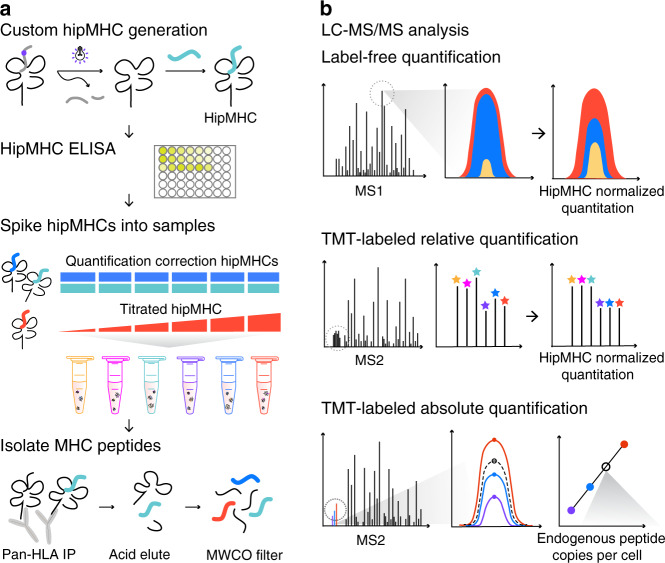
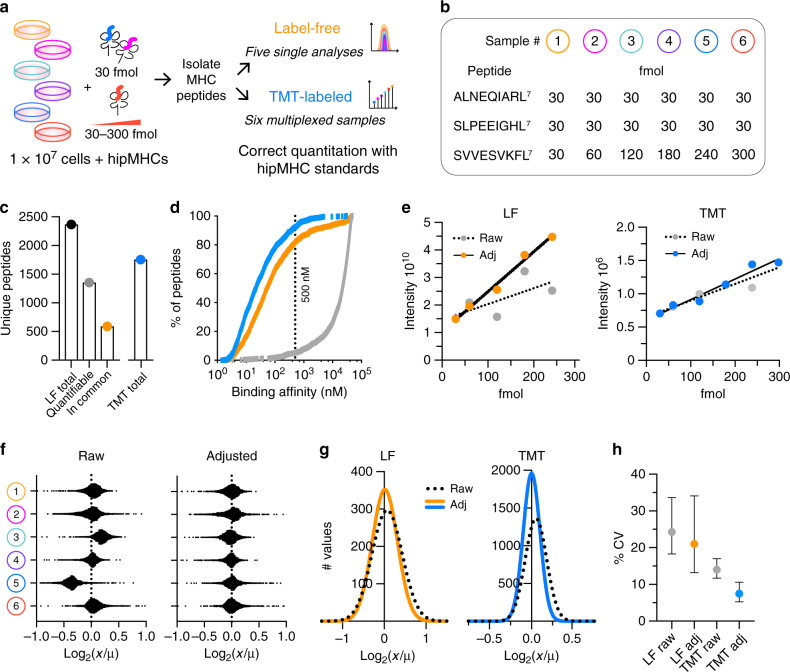
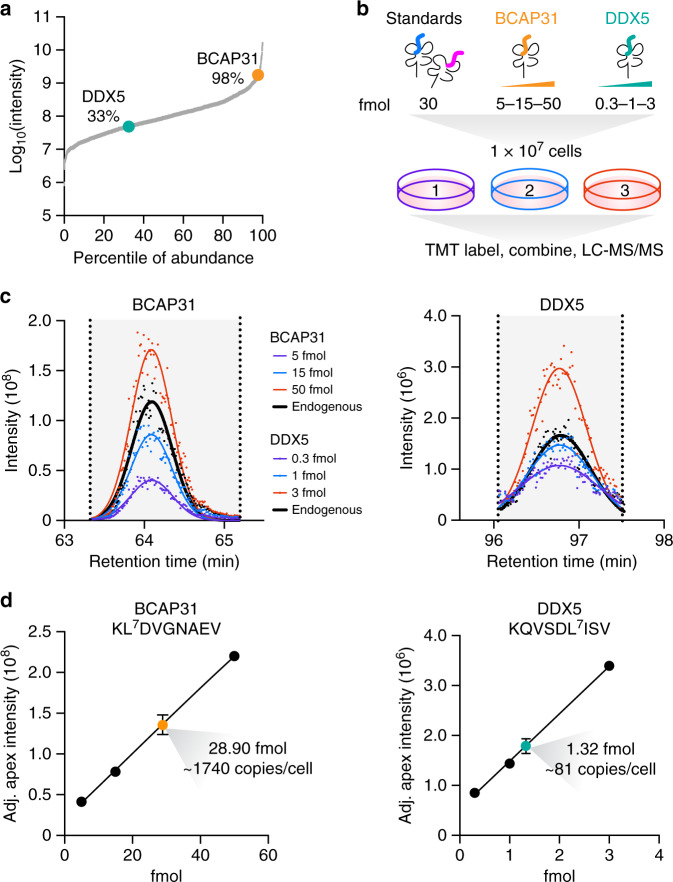
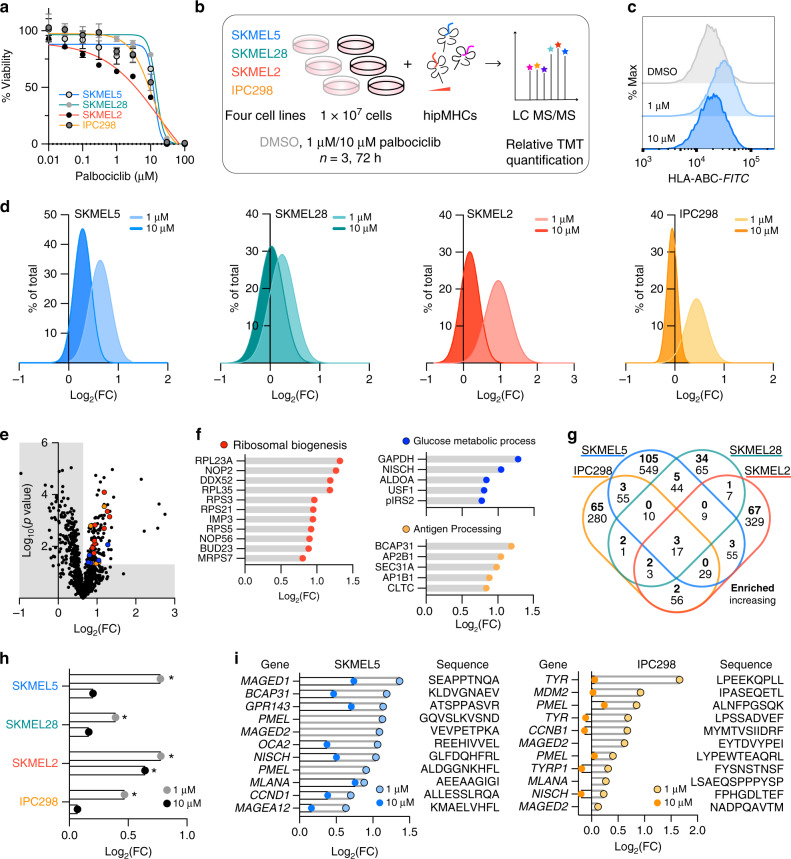
Peptides bound to class I major histocompatibility complexes (MHC) play a critical role in immune cell recognition and can trigger an antitumor immune response in cancer. Surface MHC levels can be modulated by anticancer agents, altering immunity. However, understanding the peptide repertoire's response to treatment remains challenging and is limited by quantitative mass spectrometry-based strategies lacking normalization controls. We describe an experimental platform that leverages recombinant heavy isotope-coded peptide MHCs (hipMHCs) and multiplex isotope tagging to quantify peptide repertoire alterations using low sample input. HipMHCs improve quantitative accuracy of peptide repertoire changes by normalizing for variation across analyses and enable absolute quantification using internal calibrants to determine copies per cell of MHC antigens, which can inform immunotherapy design. Applying this platform in melanoma cell lines to profile the immunopeptidome response to CDK4/6 inhibition and interferon-γ - known modulators of antigen presentation - uncovers treatment-specific alterations, connecting the intracellular response to extracellular immune presentation.
Overview
The claims and statistics of this paper haven’t been checked yet.
Run the check — free, no account needed. It reads the open-access text and checks the sources it cites.
Integrity signals
Registry
Cites
Statistics
Figures
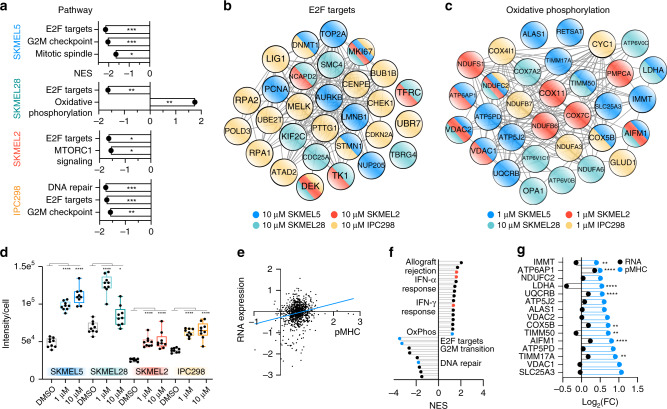
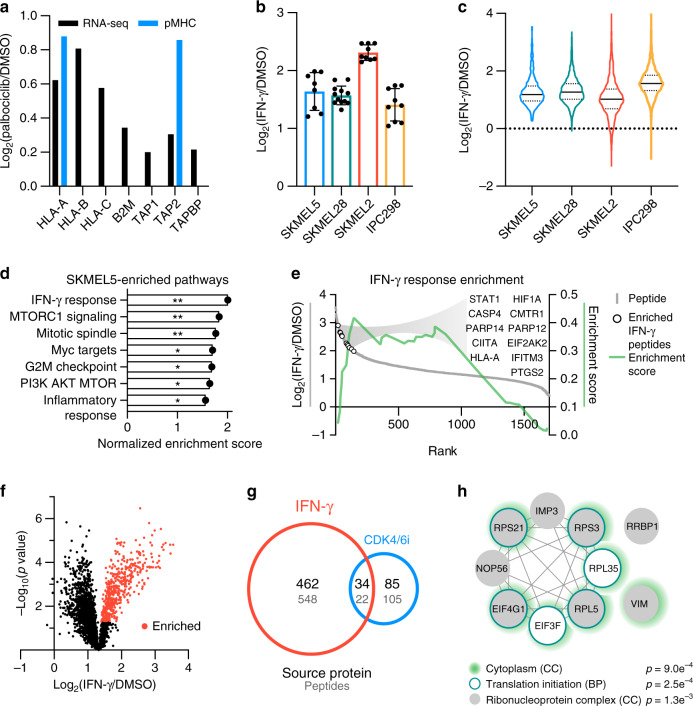
Verification
Claims the paper makes
The claims and statistics of this paper haven’t been checked yet.
Run the check — free, no account needed. It reads the open-access text and checks the sources it cites.
Claims other papers make about this one
Each is checked against this paper’s own text: does it say what the citing paper says it does?
In the citing paper
“the MHC class I peptidome of human melanoma cells exposed to the CDK4/CDK6 inhibitor palbociclib is enriched for tumor-associated antigens (TAAs) and peptides from E2F target proteins that are directly implicated in cell cycle blockage (Stopfer et al., 2020).”
From Immunomodulation by targeted anticancer agents (2021) · cites this paper as Stopfer et al., 2020
Self-check
Percentages, sums and reported differences re-computed from the paper’s own numbers.
The self-check needs the paper’s full text.
Citations
Cites
The Sequence Alignment/Map format and SAMtools
Li, H., Handsaker, B., Wysoker, A., Fennell, T., Ruan, J., Homer, N., Marth, G., Abecasis, G., Durbin, R., & 1000 Genome Project Data Processing Subgroup (2009) · Bioinformatics · doi:10.1093/bioinformatics/btp352 · Cited by 62,041
Subramanian, A., Tamayo, P., Mootha, V. K., Mukherjee, S., Ebert, B. L., Gillette, M. A., Paulovich, A., Pomeroy, S. L., Golub, T. R., Lander, E. S., et al. (2005) · Proceedings of the National Academy of Sciences · doi:10.1073/pnas.0506580102 · Cited by 53,625
STAR: ultrafast universal RNA-seq aligner
Dobin, A., Davis, C. A., Schlesinger, F., Drenkow, J., Zaleski, C., Jha, S., Batut, P., Chaisson, M., & Gingeras, T. R. (2013) · Bioinformatics · doi:10.1093/bioinformatics/bts635 · Cited by 51,709
Gene Ontology: tool for the unification of biology
Ashburner, M., Ball, C. A., Blake, J. A., Botstein, D., Butler, H., Cherry, J. M., Davis, A. P., Dolinski, K., Dwight, S. S., Eppig, J. T., et al. (2000) · Nature Genetics · doi:10.1038/75556 · Cited by 43,206
RSEM: accurate transcript quantification from RNA-Seq data with or without a reference genome
Li, B., & Dewey, C. N. (2011) · BMC Bioinformatics · doi:10.1186/1471-2105-12-323 · Cited by 22,179
Szklarczyk, D., Gable, A. L., Lyon, D., Junge, A., Wyder, S., Huerta-Cepas, J., Simonovic, M., Doncheva, N. T., Morris, J. H., Bork, P., et al. (2019) · Nucleic Acids Research · doi:10.1093/nar/gky1131 · Cited by 17,749
Differential expression analysis for sequence count data
Anders, S., & Huber, W. (2010) · Genome Biology · doi:10.1186/gb-2010-11-10-r106 · Cited by 15,581
The Molecular Signatures Database Hallmark Gene Set Collection
Liberzon, A., Birger, C., Thorvaldsdóttir, H., Ghandi, M., Mesirov, J. P., & Tamayo, P. (2015) · Cell Systems · doi:10.1016/j.cels.2015.12.004 · Cited by 13,807
WebLogo: A Sequence Logo Generator: Figure 1Preprint
Crooks, G. E., Hon, G. C., Chandonia, J., & Brenner, S. E. (2004) · Genome Research · doi:10.1101/gr.849004 · Cited by 12,480
Mootha, V. K., Lindgren, C. M., Eriksson, K.-F., Subramanian, A., Sihag, S., Lehar, J., Puigserver, P., Carlsson, E., Ridderstråle, M., Laurila, E., et al. (2003) · Nature Genetics · doi:10.1038/ng1180 · Cited by 10,197
Cited by
Sorted by citations
A guide to antigen processing and presentation
Pishesha, N., Harmand, T. J., & Ploegh, H. L. (2022) · Nature Reviews Immunology · doi:10.1038/s41577-022-00707-2 · Cited by 805
Cellular Senescence Is Immunogenic and Promotes Antitumor Immunity
Marín, I., Boix, O., García-Garijo, A., Sirois, I., Caballé, A., Zarzuela, E., Ruano, I., Attolini, C. S., Prats, N., Lopez-Dominguez, J. A., et al. (2022) · Cancer Discovery · doi:10.1158/2159-8290.cd-22-0523 · Cited by 365
Proteomics of Melanoma Response to Immunotherapy Reveals Mitochondrial Dependence
Harel, M., Ortenberg, R., Varanasi, S. K., Mangalhara, K. C., Mardamshina, M., Markovits, E., Baruch, E. N., Tripple, V., Arama-Chayoth, M., Greenberg, E., et al. (2019) · Cell · doi:10.1016/j.cell.2019.08.012 · Cited by 328
Towards targeting of shared mechanisms of cancer metastasis and therapy resistance
Weiß, F., Lauffenburger, D. A., & Friedl, P. (2022) · Nature reviews. Cancer · doi:10.1038/s41568-021-00427-0 · Cited by 295
Identification of tumor antigens with immunopeptidomics
Chong, C., Coukos, G., & Bassani-Sternberg, M. (2022) · Nature Biotechnology · doi:10.1038/s41587-021-01038-8 · Cited by 232
Metadata
- Authors
- Stopfer, L. E., Mesfin, J. M., Joughin, B. A., Lauffenburger, D. A., & White, F. M.
- Affiliations
- Koch Institute for Integrative Cancer Research At MIT (US)
- Massachusetts Institute of Technology (US)
- Corresponding author
- White, Forest M.
- Venue
- Nature Communications
- Published
- 2020-06-02
- Volume
- 11
- Issue
- 1
- Pages
- 2760-2760
- ISSN
- 2041-1723 (ISSN-L)
- PMC
- PMC7265461
- OpenAlex
- W3031716951
- Cited by
- 109
- References
- 79
- Citations by year
- 2026: 17 · 2025: 21 · 2024: 11 · 2023: 23 · 2022: 14 · 2021: 16 · 2020: 6
- FWCI
- 4.76
- Type
- journal article
- Language
- en
- Open access
- gold
- doi.org
- Locations
- Nature Communications (publishedVersion, cc-by)
- bioRxiv (Cold Spring Harbor Laboratory) (acceptedVersion)
- PubMed Central (publishedVersion, cc-by)
- PubMed (publishedVersion)
- RePEc: Research Papers in Economics (submittedVersion)
- DOAJ (DOAJ: Directory of Open Access Journals) (submittedVersion, cc-by-sa)
- DSpace@MIT (Massachusetts Institute of Technology) (submittedVersion, cc-by-nc)
- Funders
- Melanoma Research Alliance (565436)
- Array BioPharma
- Koch Institute for Integrative Cancer Research, Massachusetts Institute of Technology
- National Institutes of Health (CA210180)
- National Heart, Lung, and Blood Institute (T32HL105373)
- National Cancer Institute (U54CA210180, P30CA014051)
- National Institute of Environmental Health Sciences (T32ES007020)
- Topics
- Life Sciences › Biochemistry, Genetics and Molecular Biology › Molecular Biology › vaccines and immunoinformatics approaches
- Physical Sciences › Chemistry › Spectroscopy › Advanced Proteomics Techniques and Applications
- Health Sciences › Medicine › Oncology › Cancer Immunotherapy and Biomarkers
- Keywords
- immunopeptidomics, CDK4/6 inhibition, absolute quantification, melanoma, interferon-gamma, antigen presentation, cancer immunotherapy
- MeSH terms
- Antigens, Cell Line, Humans, Immunotherapy, Interferon-gamma, Peptides, Mass Spectrometry, Histocompatibility Antigens Class I, Antigen Presentation, Proteomics, Cyclin-Dependent Kinase 4, Cyclin-Dependent Kinase 6
About these checks
Registry, retraction, Cites and statistics results are computed, not judged, with one exception: a printed reference that no index lists is read once by a model before it counts as a citation error. Claims are extracted by a model and kept only when their quote appears verbatim in the text; each cited source is then checked, with a model’s help, for whether it says what the claim relies on. Those verdicts can be wrong — read the claim’s quote and the cited source before relying on one.
Statistics and arithmetic are recomputed, not judged.
Confidence bands are shown only for fields calibrated on our annotated test set. None is calibrated yet, so no band is shown.
What counts as a claim ›How we measure confidence ›How we check this ›
Are you an author, or do you see a problem with this page? Request a review
