

Associations of cardiovascular biomarkers and plasma albumin with exceptional survival to the highest ages
Open accessThe DOI matches its Crossref record; 72 of the 72 references it cites were found in a registry or an index.
Abstract
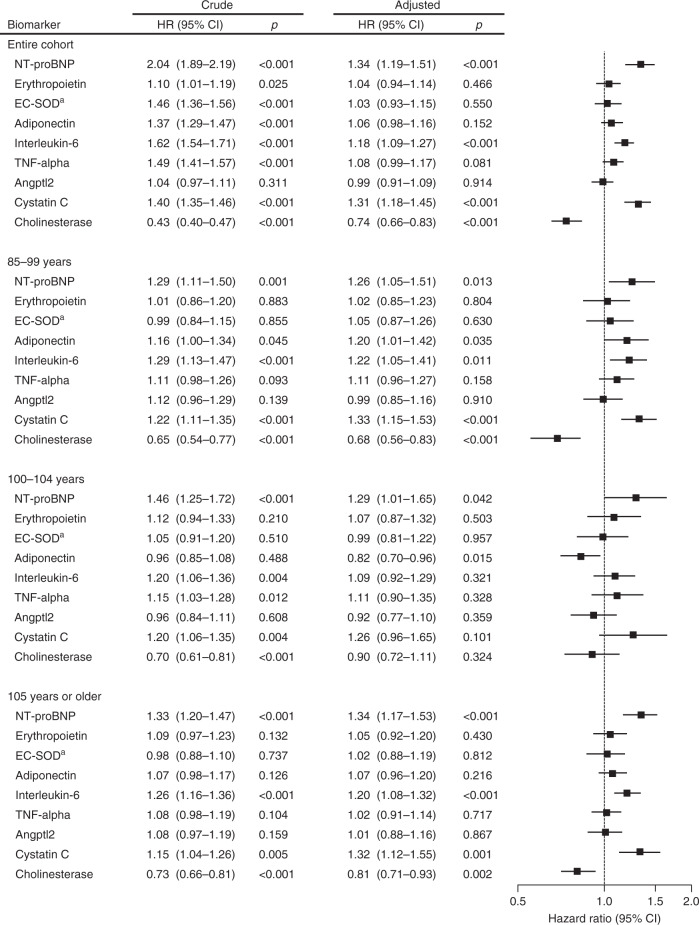
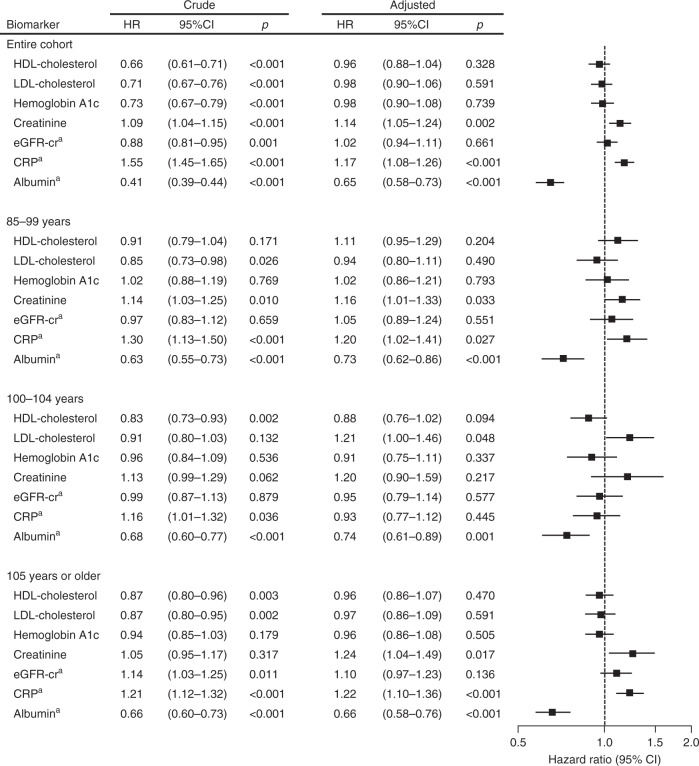
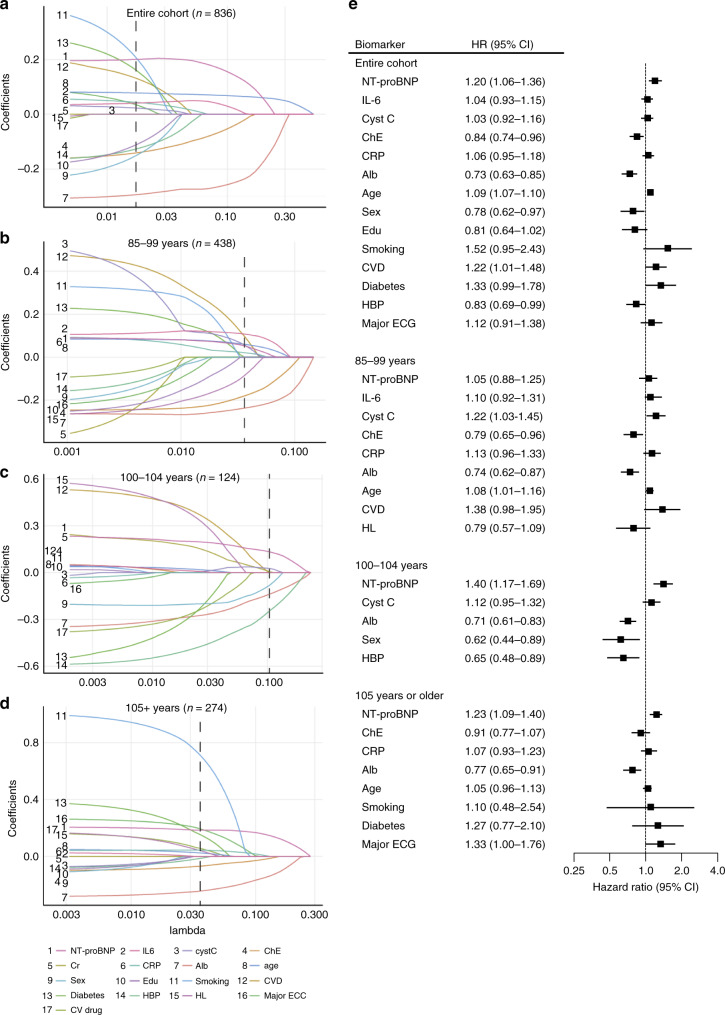
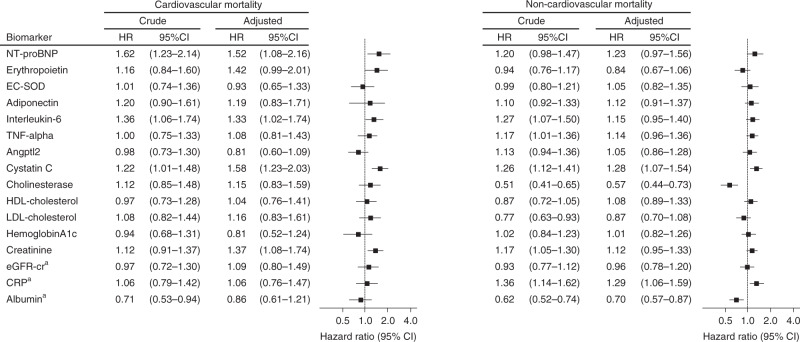
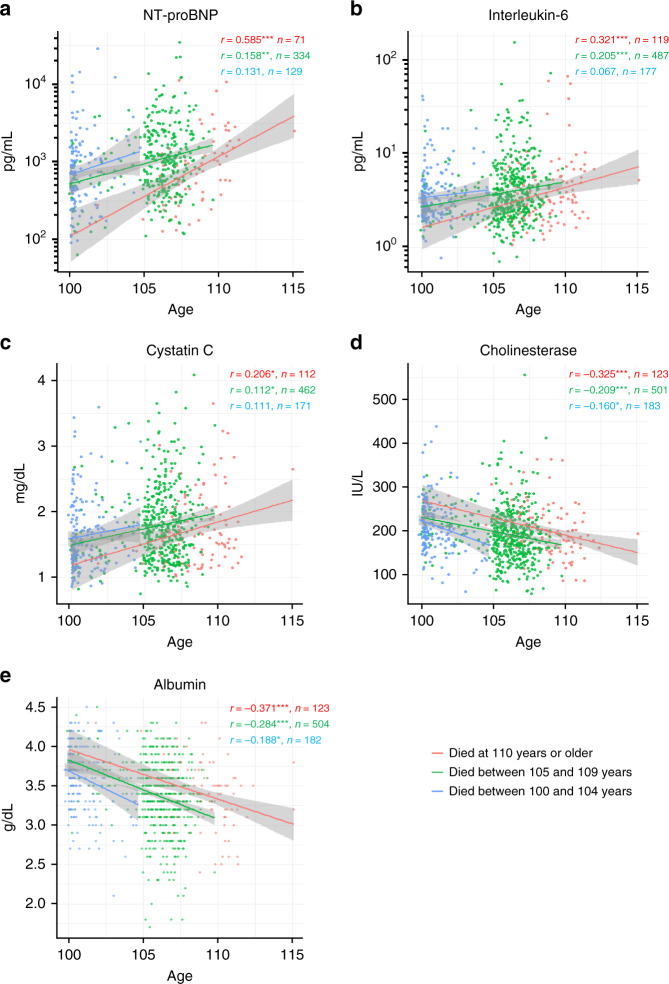
Supercentenarians (those aged ≥110 years) are approaching the current human longevity limit by preventing or surviving major illness. Identifying specific biomarkers conducive to exceptional survival might provide insights into counter-regulatory mechanisms against aging-related disease. Here, we report associations between cardiovascular disease-related biomarkers and survival to the highest ages using a unique dataset of 1,427 oldest individuals from three longitudinal cohort studies, including 36 supercentenarians, 572 semi-supercentenarians (105-109 years), 288 centenarians (100-104 years), and 531 very old people (85-99 years). During follow-up, 1,000 participants (70.1%) died. Overall, N-terminal pro-B-type natriuretic peptide (NT-proBNP), interleukin-6, cystatin C and cholinesterase are associated with all-cause mortality independent of traditional cardiovascular risk factors and plasma albumin. Of these, low NT-proBNP levels are statistically associated with a survival advantage to supercentenarian age. Only low albumin is associated with high mortality across age groups. These findings expand our knowledge on the biology of human longevity.
Overview
The claims and statistics of this paper haven’t been checked yet.
Free: it reads the open-access text and checks the first 5 claims that cite a source we can check. Create a free account to check every claim.
Integrity signals
Registry
Cites
Statistics
Figures
Verification
Claims the paper makes
The claims and statistics of this paper haven’t been checked yet.
Free: it reads the open-access text and checks the first 5 claims that cite a source we can check. Create a free account to check every claim.
Claims other papers make about this one
Each is checked against this paper’s own text: does it say what the citing paper says it does?
The source backs part of the claim, not all of it — or backs it for a different population, condition or comparison.
In the citing paper
“Moreover, chronic inflammation resulting from the accumulation of senescent cells worsens inflammaging through the overproduction of pro-inflammatory cytokines typical of the senescence-associated secretory phenotype (SASP).”
From Meta-hallmarks of aging and cancer (2023) · cites this paper as [65]
Experimental — accuracy not yet measuredThe cited source says what the claim attributes to it.
In the citing paper
“Elevated IL6 levels in plasma constitute a predictive biomarker of all-cause mortality in aging human populations 257 .”
From Hallmarks of aging: An expanding universe (2023) · cites this paper as [257]
Self-check
Percentages, sums and reported differences re-computed from the paper’s own numbers.
The self-check needs the paper’s full text.
Citations
Cites
López-Otín, C., Blasco, M. A., Partridge, L., Serrano, M., & Kroemer, G. (2013) · Cell · doi:10.1016/j.cell.2013.05.039 · Cited by 14,982
Lozano, R., Naghavi, M., Foreman, K., Lim, S., Shibuya, K., Aboyans, V., Abraham, J., Adair, T., Aggarwal, R., Ahn, S. Y., et al. (2012) · The Lancet · doi:10.1016/s0140-6736(12)61728-0 · Cited by 14,070
Revised Equations for Estimated GFR From Serum Creatinine in Japan
Matsuo, S., Imai, E., Horio, M., Yasuda, Y., Tomita, K., Nitta, K., Yamagata, K., Tomino, Y., Yokoyama, H., & Hishida, A. (2009) · American Journal of Kidney Diseases · doi:10.1053/j.ajkd.2008.12.034 · Cited by 6,422
Pearson, T. A., Mensah, G. A., Alexander, R. W., Anderson, J. L., Cannon, R. O., Criqui, M., Fadl, Y. Y., Fortmann, S. P., Hong, Y., Myers, G. L., et al. (2003) · Circulation · doi:10.1161/01.cir.0000052939.59093.45 · Cited by 6,401
Inflammageing: chronic inflammation in ageing, cardiovascular disease, and frailty
Ferrucci, L., & Fabbri, E. (2018) · Nature Reviews Cardiology · doi:10.1038/s41569-018-0064-2 · Cited by 3,690
Geroscience: Linking Aging to Chronic Disease
Kennedy, B. K., Berger, S. L., Brunet, A., Campisi, J., Cuervo, A. M., Epel, E. S., Franceschi, C., Lithgow, G. J., Morimoto, R. I., Pessin, J. E., et al. (2014) · Cell · doi:10.1016/j.cell.2014.10.039 · Cited by 2,764
Lakatta, E. G., & Levy, D. (2003) · Circulation · doi:10.1161/01.cir.0000048892.83521.58 · Cited by 2,244
Epstein, F. H., Levin, E. R., Gardner, D. G., & Samson, W. K. (1998) · New England Journal of Medicine · doi:10.1056/nejm199807303390507 · Cited by 1,927
Braunwald, E. (2008) · New England Journal of Medicine · doi:10.1056/nejmra0800239 · Cited by 1,257
Demographic and epidemiologic drivers of global cardiovascular mortality
Roth, G. A., Forouzanfar, M. H., Moran, A. E., Barber, R., Nguyen, G., Feigin, V. L., Naghavi, M., Mensah, G. A., & Murray, C. J. L. (2015) · New England Journal of Medicine · doi:10.1056/nejmoa1406656 · Cited by 1,188
Cited by
Items 101–148 of 148
Yan, D., Fan, Z., Li, Q., & Chen, Y. (2024) · International Journal of Molecular Sciences · doi:10.3390/ijms252312608 · Cited by 2
“They help to predict disease development and identify specific molecular targets related to the disease [1,2].”
Acute Cardiac Arrhythmias in Organophosphate Poisoning: From Bradycardia to Atrial Fibrillation
Bereda, G. (2025) · Indian Journal of Clinical Cardiology · doi:10.1177/26324636251355690 · Cited by 2
Arai, Y., Oguma, Y., Abe, Y., Takayama, M., Hara, A., Urushihara, H., & Takebayashi, T. (2021) · doi:10.21203/rs.3.rs-99870/v2 · Cited by 2
Self-citationCortez, B. N., Pan, H., & Aguayo‐Mazzucato, C. (2022) · bioRxiv (Cold Spring Harbor Laboratory) · doi:10.1101/2022.09.14.507908 · Cited by 3
Correlations between Aging, Telomeres, and Natural Compounds
Rakoczy, K., Wojdyło, L., Suwała, S., Klasen, K., Kuźnicki, J., Ziętek, M., & Kulbacka, J. (2025) · Aging and Disease · doi:10.14336/ad.2025.0853 · Cited by 2
The effect of chronic hyperglycemia on aging: implications in cognitive impairment
Sarkar, A., Saha, S., & Bhattacharya, D. (2025) · Elsevier eBooks · doi:10.1016/b978-0-443-33355-2.00027-x · Cited by 1
Lin, X., Jiang, Y., Wang, Y., Tan, S., Cui, X., Luo, Y., Lyu, H., Zhang, L., & Tang, P. (2026) · Orthopaedic Surgery · doi:10.1111/os.70243 · Cited by 1
“One plausible explanation for the upregulation of NT-proBNP in asymptomatic centenarians is that it reflects a compensatory homeostatic response to hemodynamic stress, which arises from prior cardiovascular or perioperative myocardial ischemia caused by hip fracture [33].”
Kurata, H., Meguro, S., Abe, Y., Sasaki, T., Arai, M., Hirose, N., & Hayashi, K. (2026) · GeroScience · doi:10.1007/s11357-026-02130-0 · Cited by 1
Self-citationWu, K., Peng, W. J., Li, J., Li, J. J., Qin, D., He, R., Xiong, K.-H., Ling, J.-W., Li, H., & Chen, G. (2026) · Molecular Medicine · doi:10.1186/s10020-026-01516-2 · Cited by 1
“…markedly, B-lymphocyte responses become sluggish, and natural killer cell activity decreases (Jasiulionis 2018; Kmiec et al. 2001), while at the same time, serum levels of pro-inflammatory cytokines (such as TNF-α, IL-6, and IL-8) remain persistently elevated (Gu et al. 2024; Hirata et al. 2020).”
Osawa, Y., Sasaki, T., Candia, J., Abe, Y., Wong, G., Bandinelli, S., Ferrucci, L., & Arai, Y. (2026) · GeroScience · doi:10.1007/s11357-026-02377-7 · Cited by 1
Self-citationHuang, N. X., Fang, F., Xu, Y., Huang, J., SANDERSON, J. E., & Yan, B. P. (2021) · Journal of Healthcare Engineering · doi:10.1155/2021/9543912 · Cited by 1
RetractedSyauki, A. Y., Ogawa, A., Simanjuntak, U. R. P., Mangiwa, I. G., Doi, M., Kageyama, S., Inoue, R., Taslim, N. A., & Irie, Y. (2022) · F1000Research · doi:10.12688/f1000research.76099.1 · Cited by 1
“Plasma albumin levels were correlated significantly with cholinesterase levels, inflammation, and NT-pro BNP levels (biomarkers of endogenous cardioprotective molecules).(36)”
BackgroundBiomarkers of Healthy Longevity: Lessons from Supercentenarians in Japan
Arai, Y., & Hirose, N. (2022) · Springer eBooks · doi:10.1007/978-981-16-7977-3_3 · Cited by 1
Self-citationCardiovascular Risk Factors in Centenarians
Lange, A., Silverman, M. A., & Golden, A. G. (2023) · International perspectives on aging · doi:10.1007/978-3-031-30915-1_4 · Cited by 1
Geraniol intake improves age‐related malnutrition in mice
Shibuya, S., Watanabe, K., Sakuraba, D., Nagata, T., Yamaguchi, Y., Suzuki, Y., & Shimizu, T. (2024) · Geriatrics and gerontology international/Geriatrics & gerontology international · doi:10.1111/ggi.14982 · Cited by 1
Park, D., Kim, S.-S., Sung, H. H., & Park, C.-E. (2020) · Korean Journal of Clinical Laboratory Science · doi:10.15324/kjcls.2020.52.3.172
“프로-뇌 나트륨 이뇨 펩타이드의 산물로 심실 벽 자극과 심근허 혈에 반응하여 좌심실 근세포에서 주로 합성되어 심장 혈관 항 상성을 유지하기 위해 심장에서 분비되므로 심부전의 병태 생리 학에 관여한다[21, 22].”
Li, Y., Shi, Y., You, J., Hu, W., Xu, Y., Wei, H., Abe, M., Cheng, J., Zong, L., & Dong, J. (2021) · Journal of Bio-X Research · doi:10.1097/jbr.0000000000000092
“Serum albumin is a useful marker of patients’ nutritional status.([19,20]) Siewert type II/III AEG patients are prone to hypoalbuminemia due to cancer-related dysphagia, increased metabolic rate, reduced nutritional intake, and cancer-related cachexia.”
BackgroundSasaki, T., Nishimoto, Y., Hirata, T., Abe, Y., Hirose, N., Takayama, M., Takebayashi, T., Okano, H., & Arai, Y. (2023) · eLife · doi:10.7554/elife.86309.sa2
Self-citationde Freitas, S. (2023) · Digital Library of Theses and Dissertations (Universidade de São Paulo) · doi:10.11606/d.9.2023.tde-10112023-175735
Wei, C., Fan, W., Zhang, Y., Sun, Q., Liu, Y., Wang, X., Liu, J., & Sun, L. (2024) · Coronary Artery Disease · doi:10.1097/mca.0000000000001333
“Several studies have shown that albumin can be an excellent predictor of risk in patients with coronary artery disease (CAD) [6 – 8].”
BackgroundSasaki, T., Tadaka, S., Hirata, T., Nishimoto, Y., Shikimoto, R., Abe, Y., Shiohama, A., Shirota, M., Motoike, I. N., Tamiya, G., et al. (2024) · Research Square · doi:10.21203/rs.3.rs-3916561/v1
Self-citationMODERN BIOMARKERS - PREDICTORS OF EARLYCARDIOVASCULAR AGEING (LITERATURE REVIEW)
Abdykassymova, M., Аbzaliyev, K., BUTROUS, G. S., Abzaliyeva, S., Kurmanova, А., Bitemirova, R., Sundetova, D., Sagalbayeva, U., Bugibayeva, A., Baizhigitova, N., et al. (2024) · BULLETIN OF SURGERY IN KAZAKHSTAN · doi:10.35805/bsk2024i001
“7,9,8,10 Furthermore, combined data from three prospective cohort studies: the Tokyo Centenarian Study (TCS), the Japanese Semi-supercentenarian Study (JSS), and the Tokyo Oldest Study of General Health (TOOTH).”
BackgroundProbiotics as Anti-aging Interventions
Singh, B., Mal, G., Kalra, R. S., & Marotta, F. (2024) · Springer eBooks · doi:10.1007/978-3-031-65459-6_12 · Cited by 1
Vitamin B12 and diabetic neuropathies
Serhiyenko, V. A., Markevych, M.-Y. Y., Sehin, V. B., & Serhiyenko, A. A. (2024) · INTERNATIONAL JOURNAL OF ENDOCRINOLOGY (Ukraine) · doi:10.22141/2224-0721.20.7.2024.1446 · Cited by 2
Clinical Antiaging Medicine: Antiaging Medicine from the Perspective of Centenarian Research
Arai, Y. (2024) · Springer eBooks · doi:10.1007/978-981-97-8514-8_67
Self-citationSasaki, T., Tadaka, S., Hirata, T., Nishimoto, Y., Shikimoto, R., Abe, Y., Shiohama, A., Shirota, M., Motoike, I. N., Tamiya, G., et al. (2025) · Research Square · doi:10.21203/rs.3.rs-6869504/v1
Self-citationShikimoto, R., Gondo, Y., Yasumoto, S., Abe, Y., Yagasaki, K., Yoshimura, K., Mimura, M., Hirose, N., & Arai, Y. (2025) · Journal of Geriatric Oncology · doi:10.1016/j.jgo.2025.102285
Self-citationOtaki, Y., Watanabe, T., Kato, S., Tamura, H., Nishiyama, S., Arimoto, T., Ichikawa, K., Konta, T., & Watanabe, M. (2025) · Internal Medicine · doi:10.2169/internalmedicine.5169-24
Anti-aging strategies for dogs
Lim, J. R., Yoon, J. H., & Han, H. J. (2025) · Journal of Veterinary Science · doi:10.4142/jvs.25202 · Cited by 1
“Furthermore, persistent chronic inflammation driven by cellular senescence results in tissue damage and reduced physiological resilience, significantly increasing the chronic disease risk and mortality in the elderly population [36,37].”
A shift in architecture of aging: Cellular pathways and molecular networks
Kozali, N., FassihRamandi, A., & Pahlavan, S. (2025) · Biomedicine Advances · doi:10.34172/bma.38
Microglia derived extracellular vesicles (EVs) in brain aging: a rejuvenation approach
RINALDI, A. (2025) · IRIS Research product catalog (Sapienza University of Rome) · Cited by 1
ヨシダ, ナ., Yoshida, N., & 吉田, 奈. (2022) · Institutional Repositories DataBase (IRDB)
Inflammation, aging and chronic diseases : implication of inflammasomes
Guerville, F. (2023) · theses.fr (ABES) · doi:10.70675/eac3286czda71z4606z9c90z3d3efeaf1afe
Bonnefous, H. (2025) · theses.fr (ABES) · doi:10.70675/67742b4az1242z4d30z964ezd8bf9300d4ac · Cited by 1
Liu, X., Li, H., Luo, Q., Wang, Q., Qu, Z., Zhang, Z., Zhang, J., Jin, X., Feng, Z., Zhang, W., et al. (2026) · Frontiers in Nutrition · doi:10.3389/fnut.2026.1790083
“Serum albumin levels decline with age, particularly among individuals aged ≥ 90 years (24), and higher levels have been positively associated with survival in centenarians (25).”
Hata, J., Sakata, S., Furuta, Y., Oishi, E., Shibata, M., Honda, T., Ago, T., Oike, Y., & Ninomiya, T. (2026) · Journal of Epidemiology · doi:10.2188/jea.je20250491
Self-citationNgoc, N. A. N., Thi, T. T. P., Huynh, B. C. N., Vũ, T. A., Thi, A. T. D., & Hong, H. H. L. (2026) · Journal of Biological Studies · doi:10.62400/jbs.v9i2.18135
Shiohama, A., Sasaki, T., Abe, Y., Shikimoto, R., & Arai, Y. (2026) · GeroScience · doi:10.1007/s11357-026-02355-z
Self-citationThe evolution of aging research: from theories to epigenetic reprogramming
Găitănaru, E.-C., Stroe, A.-A., Georgescu, S. E., Popescu, R. G., & Marinescu, G. C. (2026) · npj Aging · doi:10.1038/s41514-026-00437-y
Scoping review unravelling longevity secrets beyond the century mark
Ibrahim, S., Kheir‐Mataria, W. A. E., Abdelrahim, O., & Chun, S. (2026) · Discover Public Health · doi:10.1186/s12982-026-02363-6
“Despite their extreme age, supercentenarians had relatively low rates of overt cardiovascular disease, suggesting that delayed cardiac aging—reflected in lower NT-proBNP— may be a key biological mechanism enabling survival beyond 110 years [113].”
Understanding extracellular vesicles in antiaging
Ahmad, P., Estrin, N. E., Sculean, A., & Miron, R. J. (2026) · Periodontology 2000 · doi:10.1111/prd.70070
蔵田, 英. (2023) · Institutional Repositories DataBase (IRDB)
Chengula, B. (2026) · Lu Zone Ul (Laurentian University)
Metabolomic profiling identifies plasma protein biomarkers of biological agingPreprint
Luo, X., Liu, C., Xie, Y., Zhao, Y., Zhao, H., Huang, Y., Shuo, G., Wang, Y., Jian, X., Zhao, G., et al. (2026) · medRxiv · doi:10.64898/2026.09.27.26364110
Acute Kidney Injury in the Elderly
KIYKIM, A. A., Turgutalp, K., & Demir, S. (2026) · IntechOpen eBooks · doi:10.5772/intechopen.1017745
Cardiovascular resilience in centenarians
Carrera‐Bastos, P., Plaza‐Florido, A., Pérez‐Prieto, I., Radom-Aizik, S., Franceschi, C., Rodríguez-López, C., Rexach, J. A. S., Emanuele, E., & Lucía, A. (2026) · Nature Reviews Cardiology · doi:10.1038/s41569-026-01348-x
Mørk, N., Jensen, J. B., Bastard, P., Larsen, L. A., Bundgaard, B. B., Nygaard, M., Clemmensen, S. B., Tao, C., Catts, V. S., Puel, A., et al. (2026) · Journal of Human Immunity · doi:10.70962/jhi.20260143
“Clinical data from Japanese centenarians were collected through medical interviews and physical examinations performed by trained geriatricians according to previously described protocols (46).”
Self-citationOsawa, Y., Sasaki, T., Abe, Y., & Arai, Y. (2026) · The Journal of Frailty & Aging · doi:10.1016/j.tjfa.2026.100230
Self-citation
Metadata
- Authors
- Hirata, T., Arai, Y., Yuasa, S., Abe, Y., Takayama, M., Sasaki, T., Kunitomi, A., Inagaki, H., Endo, M., Morinaga, J., Yoshimura, K., Adachi, T., Oike, Y., Takebayashi, T., Okano, H., & Hirose, N.
- Affiliations
- Keio University (JP)
- Tokyo Metropolitan Institute of Gerontology (JP)
- University of Occupational and Environmental Health Japan (JP)
- Kumamoto University (JP)
- Gifu Pharmaceutical University (JP)
- Corresponding author
- Arai, Yasumichi
- ORCID
- Venue
- Nature Communications
- Published
- 2020-07-30
- Volume
- 11
- Issue
- 1
- Pages
- 3820-3820
- ISSN
- 2041-1723 (ISSN-L)
- PMC
- PMC7393489
- OpenAlex
- W3045818979
- Semantic Scholar
- 3fc1f17e71b2f520dfeab7958fb5d4a2d2bdfbd8
- Cited by
- 138
- References
- 72
- Citations by year
- 2026: 20 · 2025: 31 · 2024: 28 · 2023: 23 · 2022: 15 · 2021: 19 · 2020: 2
- FWCI
- 4.92
- Type
- journal article
- Language
- en
- Open access
- gold
- doi.org
- Licence
- cc-by
- creativecommons.org/licenses/by/4.0 (tdm)
- creativecommons.org/licenses/by/4.0 (vor)
- Locations
- Nature Communications (publishedVersion, cc-by)
- PubMed Central (publishedVersion, cc-by)
- PubMed (publishedVersion)
- RePEc: Research Papers in Economics (submittedVersion)
- DOAJ (DOAJ: Directory of Open Access Journals) (submittedVersion, cc-by-sa)
- Funders
- Keio University
- Japan Society for the Promotion of Science (15KT0009, 20H03678, 23617024, 21590775)
- Topics
- Life Sciences › Biochemistry, Genetics and Molecular Biology › Aging › Genetics, Aging, and Longevity in Model Organisms
- Health Sciences › Medicine › Geriatrics and Gerontology › Frailty in Older Adults
- Health Sciences › Medicine › Cardiology and Cardiovascular Medicine › Heart Failure Treatment and Management
- Keywords
- supercentenarians, centenarians, oldest old, human longevity, cardiovascular biomarkers, all-cause mortality, NT-proBNP, interleukin-6, cystatin C, cholinesterase, serum albumin, aging
- MeSH terms
- Aged, 80 and over, Aging, Cardiovascular Diseases, Female, Humans, Longevity, Longitudinal Studies, Male, Peptide Fragments, Predictive Value of Tests, Prospective Studies, Surveys and Questionnaires, Risk Factors, Serum Albumin, Biomarkers, Multivariate Analysis, Survival Analysis, Natriuretic Peptide, Brain
About these checks
Registry, retraction, Cites and statistics results are computed, not judged, with one exception: a printed reference that no index lists is read once by a model before it counts as a citation error. Claims are extracted by a model and kept only when their quote appears verbatim in the text; each cited source is then checked, with a model’s help, for whether it says what the claim relies on. Those verdicts can be wrong — read the claim’s quote and the cited source before relying on one.
Statistics and arithmetic are recomputed, not judged.
Confidence bands are shown only for fields calibrated on our annotated test set. None is calibrated yet, so no band is shown.
What counts as a claim ›How we measure confidence ›How we check this ›
Are you an author, or do you see a problem with this page? Request a review
Data sources
Bibliographic data: Semantic Scholar, OpenAlex, Crossref.
Contains information from the Semantic Scholar Academic Graph Datasets, made available under the ODC Attribution License (ODC-BY 1.0).
Semantic Scholar’s data is described in: Kinney, R., et al. (2023). The Semantic Scholar Open Data Platform. arXiv:2301.10140.
