

Converting microwave and telecom photons with a silicon photonic nanomechanical interface
Open accessThe DOI matches its Crossref record; 39 of the 39 references it cites were found in a registry or an index.
Abstract
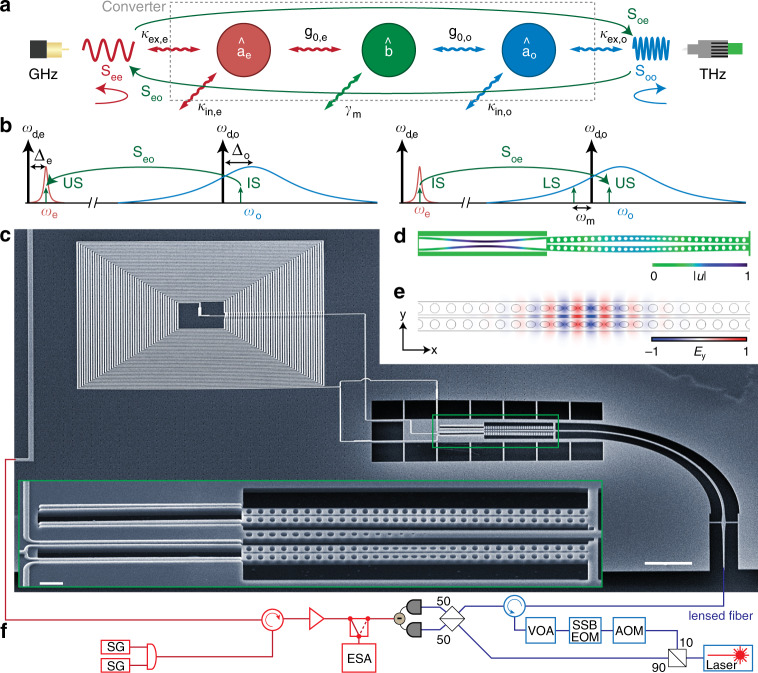
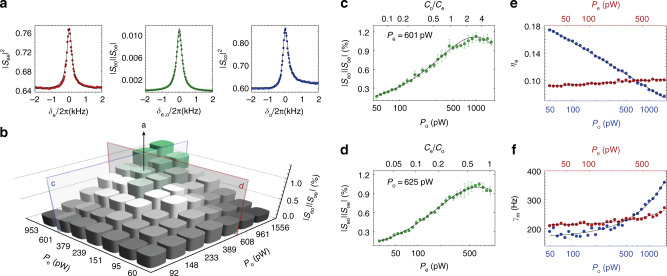
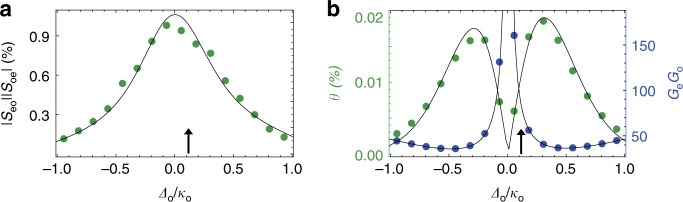
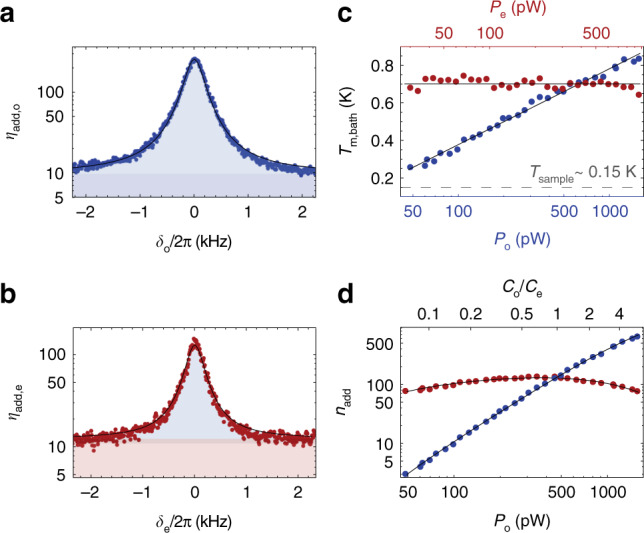
Practical quantum networks require low-loss and noise-resilient optical interconnects as well as non-Gaussian resources for entanglement distillation and distributed quantum computation. The latter could be provided by superconducting circuits but existing solutions to interface the microwave and optical domains lack either scalability or efficiency, and in most cases the conversion noise is not known. In this work we utilize the unique opportunities of silicon photonics, cavity optomechanics and superconducting circuits to demonstrate a fully integrated, coherent transducer interfacing the microwave X and the telecom S bands with a total (internal) bidirectional transduction efficiency of 1.2% (135%) at millikelvin temperatures. The coupling relies solely on the radiation pressure interaction mediated by the femtometer-scale motion of two silicon nanobeams reaching a V π as low as 16 μV for sub-nanowatt pump powers. Without the associated optomechanical gain, we achieve a total (internal) pure conversion efficiency of up to 0.019% (1.6%), relevant for future noise-free operation on this qubit-compatible platform.
Overview
The claims and statistics of this paper haven’t been checked yet.
Free: it reads the open-access text and checks the first 5 claims that cite a source we can check. Create a free account to check every claim.
Integrity signals
Registry
Cites
Statistics
Figures
Verification
Claims the paper makes
The claims and statistics of this paper haven’t been checked yet.
Free: it reads the open-access text and checks the first 5 claims that cite a source we can check. Create a free account to check every claim.
Claims other papers make about this one
Each is checked against this paper’s own text: does it say what the citing paper says it does?
The check wasn’t confident either way, so it gives no verdict — never disputed.
In the citing paper
“while high impedance resonators utilizing super-inductors have been able to achieve V zp on the order of a hundred millivolts [193]”
From 2022 Roadmap on integrated quantum photonics (2022) · cites this paper as [193]
Experimental — accuracy not yet measured
Self-check
Percentages, sums and reported differences re-computed from the paper’s own numbers.
The self-check needs the paper’s full text.
Citations
Cites
Kimble, H. J. (2008) · Nature · doi:10.1038/nature07127 · Cited by 6,023 · cited 3×
“[1] Kimble, H.”
BackgroundInfluentialAspelmeyer, M., Kippenberg, T. J., & Marquardt, F. (2014) · Reviews of Modern Physics · doi:10.1103/revmodphys.86.1391 · Cited by 5,501
Blais, A., Huang, R.-S., Wallraff, A., Girvin, S. M., & Schoelkopf, R. J. (2004) · Physical Review A · doi:10.1103/physreva.69.062320 · Cited by 2,989 · cited 3×
“Some of the most promising platforms to process quantum information locally, such as superconducting circuits [2], spins in solids [9], and quantum dots [10], operate naturally in the gigahertz frequency range, but the long-distance transmission of gigahertz radiation is relatively lossy and not resilient to ambient n…”
BackgroundQuantum technologies with optically interfaced solid-state spins
Awschalom, D. D., Hanson, R., Wrachtrup, J., & Zhou, B. B. (2018) · Nature Photonics · doi:10.1038/s41566-018-0232-2 · Cited by 1,059 · cited 2×
“Some of the most promising platforms to process quantum information locally, such as superconducting circuits [2], spins in solids [9], and quantum dots [10], operate naturally in the gigahertz frequency range, but the long-distance transmission of gigahertz radiation is relatively lossy and not resilient to ambient n…”
BackgroundBidirectional and efficient conversion between microwave and optical light
Andrews, R. W., Peterson, R. W., Purdy, T. P., Cicak, K., Simmonds, R. W., Regal, C. A., & Lehnert, K. W. (2014) · Nature Physics · doi:10.1038/nphys2911 · Cited by 826 · cited 3×
“[28] and we only take into account transduction between the upper two sidebands at ωd,j + ωm as shown in Fig.”
MethodSqueezed light from a silicon micromechanical resonator
Safavi-Naeini, A. H., Gröblacher, S., Hill, J. T., Chan, J., Aspelmeyer, M., & Painter, O. (2013) · Nature · doi:10.1038/nature12307 · Cited by 566 · cited 2×
“We realize conversion by connecting an optomechanical photonic crystal zipper cavity [25] with two aluminum coated and mechanically compliant silicon nanostrings [26] as shown in Fig.”
MethodOptical detection of radio waves through a nanomechanical transducer
Bagci, T., Simonsen, A., Schmid, S., Villanueva, L. G., Zeuthen, E., Appel, J., Taylor, J. M., Sørensen, A., Usami, K., Schliesser, A., et al. (2014) · Nature · doi:10.1038/nature13029 · Cited by 471 · cited 5×
“[7] Bagci, T.”
BackgroundMethodInfluentialCoherent optical wavelength conversion via cavity optomechanics
Hill, J. T., Safavi-Naeini, A. H., Chan, J., & Painter, O. (2012) · Nature Communications · doi:10.1038/ncomms2201 · Cited by 461 · cited 2×
“[22] Hill, J.”
BackgroundOptomechanical Transducers for Long-Distance Quantum Communication
Stannigel, K., Rabl, P., Sørensen, A. S., Zoller, P., & Lukin, M. D. (2010) · Physical Review Letters · doi:10.1103/physrevlett.105.220501 · Cited by 459
Balram, K. C., Davanço, M. I., Song, J. D., & Srinivasan, K. (2016) · Nature Photonics · doi:10.1038/nphoton.2016.46 · Cited by 360
Proposal for an optomechanical traveling wave phonon–photon translator
Safavi-Naeini, A. H., & Painter, O. (2011) · New Journal of Physics · doi:10.1088/1367-2630/13/1/013017 · Cited by 317 · cited 1×
“[20] Safavi-Naeini, A.”
Perspectives on quantum transduction
Lauk, N., Sinclair, N., Barzanjeh, S., Covey, J. P., Saffman, M., Spiropulu, M., & Simon, C. (2020) · Quantum Science and Technology · doi:10.1088/2058-9565/ab788a · Cited by 305 · cited 3×
“[12] Lauk, N.”
BackgroundMethodInfluentialSelf-citationEfficient bidirectional piezo-optomechanical transduction between microwave and optical frequency
Jiang, W., Sarabalis, C. J., Dahmani, Y. D., Patel, R. N., Mayor, F. M., McKenna, T. P., Van Laer, R., & Safavi-Naeini, A. H. (2020) · Nature Communications · doi:10.1038/s41467-020-14863-3 · Cited by 283
Microwave-to-optics conversion using a mechanical oscillator in its quantum ground state
Forsch, M., Stockill, R., Wallucks, A., Marinković, I., Gärtner, C., Norte, R. A., van Otten, F., Fiore, A., Srinivasan, K., & Gröblacher, S. (2020) · Nature Physics · doi:10.1038/s41567-019-0673-7 · Cited by 276 · cited 4×
“Using piezo-electricity coherent conversion between microwave and optical frequencies has been shown uni- and bidirectional [13, 14] at room temperature, and at low temperatures [15, 16] with integrated devices, so”
BackgroundInfluentialReversible Optical-to-Microwave Quantum Interface
Barzanjeh, S., Abdi, M., Milburn, G. J., Tombesi, P., & Vitali, D. (2012) · Physical Review Letters · doi:10.1103/physrevlett.109.130503 · Cited by 270 · cited 1×
“[21] Barzanjeh, S.”
Self-citationEfficient microwave to optical photon conversion: an electro-optical realization
Rueda, A., Sedlmeir, F., Collodo, M. C., Vogl, U., Stiller, B., Schunk, G., Strekalov, D. V., Marquardt, C., Fink, J. M., Painter, O., et al. (2016) · Optica · doi:10.1364/optica.3.000597 · Cited by 250 · cited 3×
“[17] Rueda, A.”
BackgroundMethodSelf-citationHarnessing electro-optic correlations in an efficient mechanical converter
Higginbotham, A. P., Burns, P. S., Urmey, M. D., Peterson, R. W., Kampel, N. S., Brubaker, B. M., Smith, G., Lehnert, K. W., & Regal, C. A. (2018) · Nature Physics · doi:10.1038/s41567-018-0210-0 · Cited by 243 · cited 6×
“However, it turns out that this noise limitation, which might in principle be overcome with active and efficient feedforward [3], accounts for only about 0.”
BackgroundMethodInfluentialFan, L., Zou, C.-L., Cheng, R., Guo, X., Han, X., Gong, Z., Wang, S., & Tang, H. X. (2018) · Science Advances · doi:10.1126/sciadv.aar4994 · Cited by 228 · cited 4×
“The latter could be provided by superconducting circuits [2] but - despite growing efforts and rapid progress [3, 4] - existing solutions to interface the microwave and optical domains lack either scalability or efficiency, and in most cases the conversion noise is not known.”
BackgroundMethodInfluentialSafavi-Naeini, A. H., Van Thourhout, D., Baets, R., & Van Laer, R. (2019) · Optica · doi:10.1364/optica.6.000213 · Cited by 213 · cited 2×
“[5] Safavi-Naeini, A.”
MethodPhotonic crystal nanocavity with a Q-factor of ~9 million
Sekoguchi, H., Takahashi, Y., Asano, T., & Noda, S. (2014) · Optics Express · doi:10.1364/oe.22.000916 · Cited by 204 · cited 2×
“[30] Sekoguchi, H.”
MethodSuperconductor–semiconductor hybrid-circuit quantum electrodynamics
Burkard, G., Gullans, M. J., Mi, X., & Petta, J. R. (2020) · Nature Reviews Physics · doi:10.1038/s42254-019-0135-2 · Cited by 196 · cited 2×
“Some of the most promising platforms to process quantum information locally, such as superconducting circuits [2], spins in solids [9], and quantum dots [10], operate naturally in the gigahertz frequency range, but the long-distance transmission of gigahertz radiation is relatively lossy and not resilient to ambient n…”
BackgroundTsang, M. (2010) · Physical Review A · doi:10.1103/physreva.81.063837 · Cited by 177 · cited 2×
“Starting point for the derivation of Vπ is the relation between the optomechanical coupling rate g0,o and the phase shift ∆φ experienced by an optical photon due to the number of phonons nph occupying the mechanical resonator [37]:”
BackgroundStationary entangled radiation from micromechanical motion
Barzanjeh, S., Redchenko, E. S., Peruzzo, M., Wulf, M., Lewis, D. P., Arnold, G., & Fink, J. M. (2019) · Nature · doi:10.1038/s41586-019-1320-2 · Cited by 160 · cited 3×
“[26] Barzanjeh, S.”
BackgroundMethodSelf-citationVainsencher, A., Satzinger, K. J., Peairs, G. A., & Cleland, A. N. (2016) · Applied Physics Letters · doi:10.1063/1.4955408 · Cited by 151 · cited 2×
“Using piezo-electricity coherent conversion between microwave and optical frequencies has been shown uni- and bidirectional [13, 14] at room temperature, and at low temperatures [15, 16] with integrated devices, so”
BackgroundCavity piezo-mechanics for superconducting-nanophotonic quantum interface
Han, X., Fu, W., Zhong, C., Zou, C.-L., Xu, Y., Sayem, A. A., Xu, M., Wang, S., Cheng, R., Jiang, L., et al. (2020) · Nature Communications · doi:10.1038/s41467-020-17053-3 · Cited by 123
Mechanically Mediated Microwave Frequency Conversion in the Quantum Regime
Lecocq, F., Clark, J. B., Simmonds, R. W., Aumentado, J., & Teufel, J. D. (2016) · Physical Review Letters · doi:10.1103/physrevlett.116.043601 · Cited by 99 · cited 2×
“Note that near-unity photon conversion ζRS = 4ηeηoCeCo/(1 + Ce + Co) can be achieved in the limit of Ce = Co 1 with Cj = 4Gj/(κjγm) being the electro- or optomechanical cooperativity, as demonstrated between two optical [22] and two microwave modes [23, 24].”
BackgroundProposal for Heralded Generation and Detection of Entangled Microwave–Optical-Photon Pairs
Zhong, C., Wang, Z., Zou, C., Zhang, M., Han, X., Fu, W., Xu, M., Shankar, S., Devoret, M. H., Tang, H. X., et al. (2020) · Physical Review Letters · doi:10.1103/physrevlett.124.010511 · Cited by 96
Lau, H.-K., & Clerk, A. A. (2020) · Physical Review Letters · doi:10.1103/physrevlett.124.103602 · Cited by 88
Figures of merit for quantum transducers
Zeuthen, E., Schließer, A., Sørensen, A. S., & Taylor, J. M. (2020) · Quantum Science and Technology · doi:10.1088/2058-9565/ab8962 · Cited by 76
Surpassing the Resistance Quantum with a Geometric Superinductor
Peruzzo, M., Trioni, A., Hassani, F., Žemlička, M., & Fink, J. M. (2020) · Physical Review Applied · doi:10.1103/physrevapplied.14.044055 · Cited by 73
Self-citationSuppression of Stokes scattering and improved optomechanical cooling with squeezed light
Asjad, M., Zippilli, S., & Vitali, D. (2016) · Physical Review A · doi:10.1103/physreva.94.051801 · Cited by 52
Kurpiers, P., Walter, T., Magnard, P., Salathe, Y., & Wallraff, A. (2017) · EPJ Quantum Technology · doi:10.1140/epjqt/s40507-017-0059-7 · Cited by 43
Quantum electromechanics of a hypersonic crystal
Kalaee, M., Mirhosseini, M., Dieterle, P. B., Peruzzo, M., Fink, J. M., & Painter, O. (2019) · Nature Nanotechnology · doi:10.1038/s41565-019-0377-2 · Cited by 41 · cited 2×
“Another possible improvement is to increase the mechanical frequency, which will reduce the number of added noise photons and help to approach the sideband-resolved regime [31].”
BackgroundSelf-citationAl transmon qubits on silicon-on-insulator for quantum device integration
Keller, A. J., Dieterle, P. B., Fang, M., Berger, B., Fink, J. M., & Painter, O. J. (2017) · Applied Physics Letters · doi:10.1063/1.4994661 · Cited by 34
Self-citationSuperconducting Cavity Electromechanics on a Silicon-on-Insulator Platform
Dieterle, P. B., Kalaee, M., Fink, J. M., & Painter, O. J. (2016) · Physical Review Applied · doi:10.1103/physrevapplied.6.014013 · Cited by 21
Self-citationMagnetic resonance imaging with optical preamplification and detection
Simonsen, A., Sánchez-Heredia, J. D., Saarinen, S. A., Ardenkjær-Larsen, J. H., Schliesser, A., & Polzik, E. S. (2019) · Scientific Reports · doi:10.1038/s41598-019-54200-3 · Cited by 17 · cited 2×
“[8] Simonsen, A.”
BackgroundFink, J. M., Kalaee, M., Norte, R. A., Pitanti, A., & Painter, O. J. (2020) · Quantum Science and Technology · doi:10.1088/2058-9565/ab8dce · Cited by 15
Self-citationLambert, N. J., Rueda, A., Sedlmeir, F., & Schwefel, H. G. L. (2020) · Advanced Quantum Technologies · doi:10.1002/qute.202070011 · Cited by 12
Self-citationCavity quantum electro-optics: Microwave-telecom conversion in the quantum ground statePreprint
Hease, W., Rueda, A., Sahu, R., et al. (2020) · Figshare · doi:10.48550/arxiv.2005.12763
Self-citation
Research works printed but not linked: 1
- 21. Regal, C. A. & Lehnert, K. W. From cavity electromechanics to cavity optomechanics. J. Phys.: Conf. Ser. 264, 012025 (2011).
Cited by
Optomechanics for quantum technologies
Barzanjeh, S., Xuereb, A., Gröblacher, S., Paternostro, M., Regal, C. A., & Weig, E. M. (2022) · Nature Physics · doi:10.1038/s41567-021-01402-0 · Cited by 348
Self-citationMicrowave-optical quantum frequency conversion
Han, X., Fu, W., Zou, C.-L., Jiang, L., & Tang, H. X. (2021) · Optica · doi:10.1364/optica.425414 · Cited by 227
A cryogenic electro-optic interconnect for superconducting devices
Youssefi, A., Shomroni, I., Joshi, Y. J., Bernier, N. R., Lukashchuk, A., Uhrich, P., Qiu, L., & Kippenberg, T. J. (2021) · Nature Electronics · doi:10.1038/s41928-021-00570-4 · Cited by 112
“388 [38] G Arnold, M Wulf, S Barzanjeh, ES Redchenko, A Rueda, et al.”
BackgroundSuperconducting-qubit readout via low-backaction electro-optic transduction
Delaney, R. D., Urmey, M. D., Mittal, S., Brubaker, B., Kindem, J. M., Burns, P. S., Regal, C. A., & Lehnert, K. W. (2022) · Nature · doi:10.1038/s41586-022-04720-2 · Cited by 159
Coherent Coupling between Phonons, Magnons, and Photons
Shen, Z., Xu, G.-T., Zhang, M., Zhang, Y., Wang, Y., Chai, C., Zou, C., Guo, G., & Dong, C. (2022) · Physical Review Letters · doi:10.1103/physrevlett.129.243601 · Cited by 156
“Particularly, magnetostrictive force [13,14], radiation force [15,16], electrostatic force [9,17,18], and piezo-electric force [8,19 – 21] have been used for coupling mechanical motion with magnons and optical or microwave photons.”
Method
Metadata
- Authors
- Arnold, G., Wulf, M., Barzanjeh, S., Redchenko, E. S., Rueda, A., Hease, W. J., Hassani, F., & Fink, J. M.
- Affiliations
- Institute of Science and Technology Austria (AT)
- Corresponding author
- Fink, J. M.
- Venue
- Nature Communications
- Published
- 2020-09-08
- Volume
- 11
- Issue
- 1
- Pages
- 4460-4460
- ISSN
- 2041-1723 (ISSN-L)
- PMC
- PMC7479601
- OpenAlex
- W3008542284
- Semantic Scholar
- e4187c916e096d11c74e4c75ae031f4b2a314b21
- Cited by
- 83
- References
- 36
- Citations by year
- 2026: 5 · 2025: 13 · 2024: 14 · 2023: 13 · 2022: 21 · 2021: 13 · 2020: 4
- FWCI
- 5.39
- Type
- journal article
- Language
- en
- Update notices
- correction (2020-10-01)
- Open access
- gold
- doi.org
- Licence
- cc-by
- creativecommons.org/licenses/by/4.0 (tdm)
- creativecommons.org/licenses/by/4.0 (vor)
- Locations
- Nature Communications (publishedVersion, cc-by)
- PubMed Central (publishedVersion, cc-by)
- PubMed (publishedVersion)
- arXiv (Cornell University) (submittedVersion)
- DOAJ (DOAJ: Directory of Open Access Journals) (submittedVersion, cc-by-sa)
- arXiv (Cornell University)
- Funders
- Institute of Science and Technology Austria (754411)
- European Commission (732894, HORIZON2020, 754411, 862644, 758053)
- Österreichischen Akademie der Wissenschaften (754411)
- Austrian Science Fund
- NOMIS Stiftung (758053)
- H2020 European Research Council (758053)
- Topics
- Physical Sciences › Physics and Astronomy › Atomic and Molecular Physics, and Optics › Mechanical and Optical Resonators
- Physical Sciences › Physics and Astronomy › Atomic and Molecular Physics, and Optics › Quantum Information and Cryptography
- Physical Sciences › Physics and Astronomy › Atomic and Molecular Physics, and Optics › Orbital Angular Momentum in Optics
- Keywords
- microwave-to-optical transduction, silicon photonics, cavity optomechanics, superconducting circuits, quantum networks, radiation pressure, nanobeams, transduction efficiency, quantum interface, millikelvin temperatures
About these checks
Registry, retraction, Cites and statistics results are computed, not judged, with one exception: a printed reference that no index lists is read once by a model before it counts as a citation error. Claims are extracted by a model and kept only when their quote appears verbatim in the text; each cited source is then checked, with a model’s help, for whether it says what the claim relies on. Those verdicts can be wrong — read the claim’s quote and the cited source before relying on one.
Statistics and arithmetic are recomputed, not judged.
Confidence bands are shown only for fields calibrated on our annotated test set. None is calibrated yet, so no band is shown.
What counts as a claim ›How we measure confidence ›How we check this ›
Are you an author, or do you see a problem with this page? Request a review
Data sources
Bibliographic data: Semantic Scholar, OpenAlex, Crossref.
Contains information from the Semantic Scholar Academic Graph Datasets, made available under the ODC Attribution License (ODC-BY 1.0).
Semantic Scholar’s data is described in: Kinney, R., et al. (2023). The Semantic Scholar Open Data Platform. arXiv:2301.10140.
