

Identification of a myotropic AAV by massively parallel in vivo evaluation of barcoded capsid variants
Open accessThe DOI matches its Crossref record; 44 of the 44 references it cites were found in a registry or an index.
Abstract
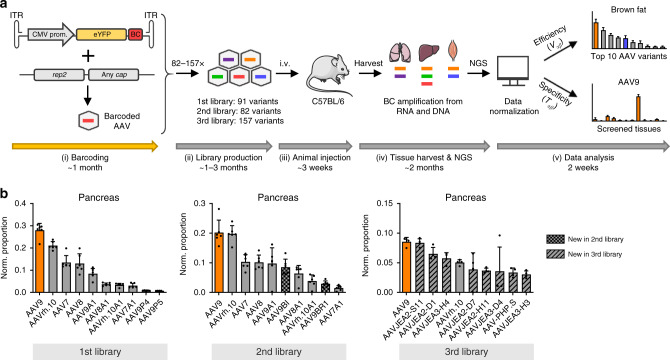
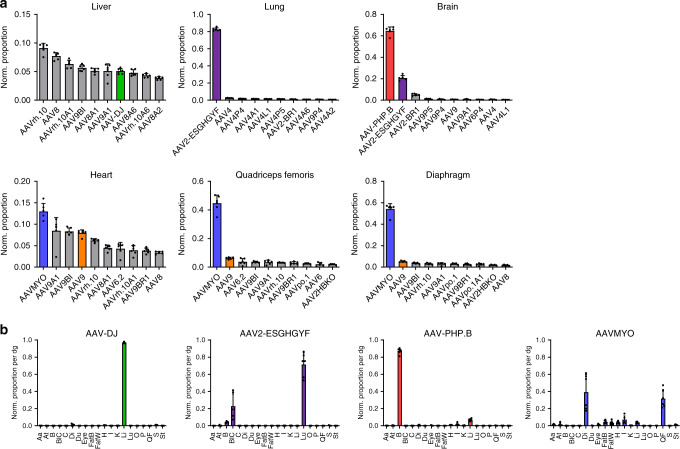
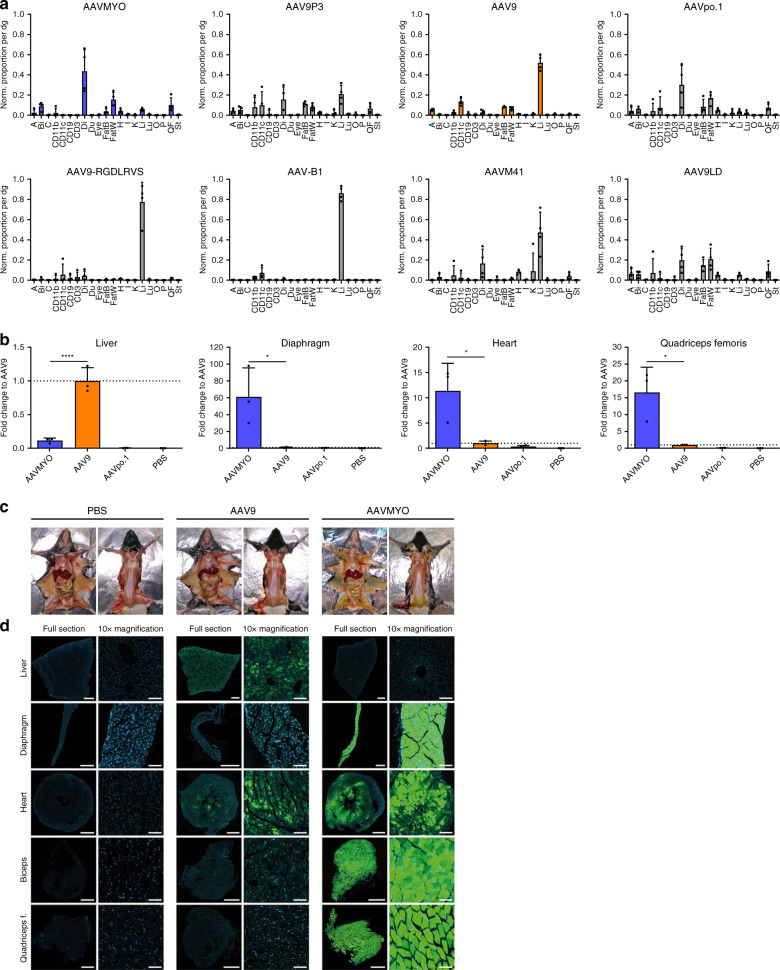
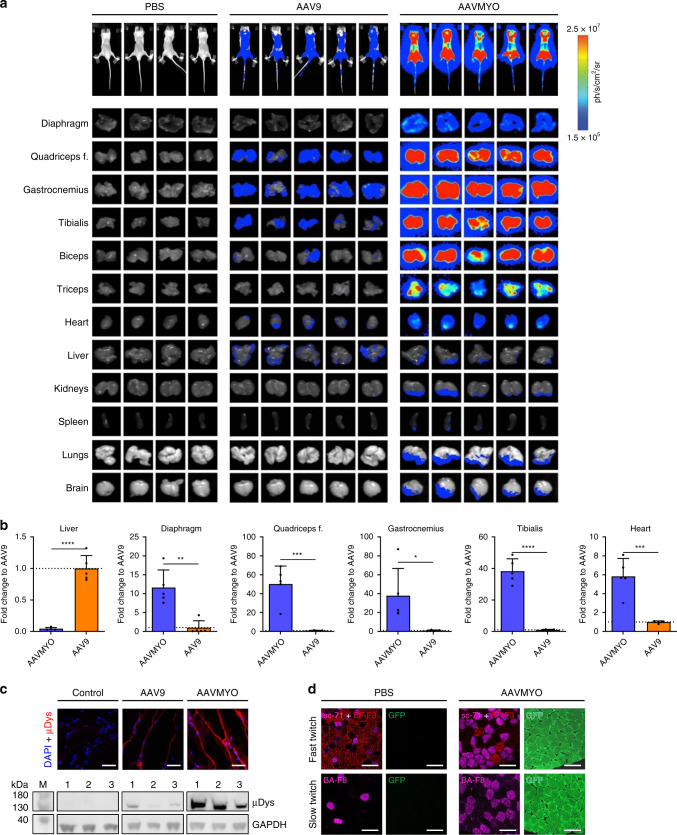
Adeno-associated virus (AAV) forms the basis for several commercial gene therapy products and for countless gene transfer vectors derived from natural or synthetic viral isolates that are under intense preclinical evaluation. Here, we report a versatile pipeline that enables the direct side-by-side comparison of pre-selected AAV capsids in high-throughput and in the same animal, by combining DNA/RNA barcoding with multiplexed next-generation sequencing. For validation, we create three independent libraries comprising 183 different AAV variants including widely used benchmarks and screened them in all major tissues in adult mice. Thereby, we discover a peptide-displaying AAV9 mutant called AAVMYO that exhibits superior efficiency and specificity in the musculature including skeletal muscle, heart and diaphragm following peripheral delivery, and that holds great potential for muscle gene therapy. Our comprehensive methodology is compatible with any capsids, targets and species, and will thus facilitate and accelerate the stratification of optimal AAV vectors for human gene therapy.
Overview
The claims and statistics of this paper haven’t been checked yet.
Free: it reads the open-access text and checks the first 5 claims that cite a source we can check. Create a free account to check every claim.
Integrity signals
Registry
Cites
Statistics
Figures
Verification
Claims the paper makes
The claims and statistics of this paper haven’t been checked yet.
Free: it reads the open-access text and checks the first 5 claims that cite a source we can check. Create a free account to check every claim.
Claims other papers make about this one
Each is checked against this paper’s own text: does it say what the citing paper says it does?
In the citing paper
“AAVMYO was also 9-fold detargeted from liver than AAV9 after intravenous administration in mice.”
From A versatile toolkit for overcoming AAV immunity (2022) · cites this paper as [115]
In the citing paper
“AAVMYO, a novel capsid with improved muscle tropism, was generated through random peptide display (115).”
From A versatile toolkit for overcoming AAV immunity (2022) · cites this paper as [115]
Self-check
Percentages, sums and reported differences re-computed from the paper’s own numbers.
The self-check needs the paper’s full text.
Citations
Cites
Error Detecting and Error Correcting Codes
Hamming, R. W. (1950) · Bell System Technical Journal · doi:10.1002/j.1538-7305.1950.tb00463.x · Cited by 5,377
ERROR DETECTING AND ERROR CORRECTING CODES
Chauhan, N., Yadav, P., & Kumari, P. (2014) · Cited by 3,270
RGD AND OTHER RECOGNITION SEQUENCES FOR INTEGRINS
Ruoslahti, E. (1996) · Annual Review of Cell and Developmental Biology · doi:10.1146/annurev.cellbio.12.1.697 · Cited by 3,191
Analysis of AAV Serotypes 1–9 Mediated Gene Expression and Tropism in Mice After Systemic Injection
Zincarelli, C., Soltys, S., Rengo, G., & Rabinowitz, J. E. (2008) · Molecular Therapy · doi:10.1038/mt.2008.76 · Cited by 1,490
Cre-dependent selection yields AAV variants for widespread gene transfer to the adult brain
Deverman, B. E., Pravdo, P. L., Simpson, B. P., Kumar, S. R., Chan, K. Y., Banerjee, A., Wu, W.-L., Yang, B., Huber, N., Pasca, S. P., et al. (2016) · Nature Biotechnology · doi:10.1038/nbt.3440 · Cited by 1,061
Dalkara, D., Byrne, L. C., Klimczak, R. R., Visel, M., Yin, L., Merigan, W. H., Flannery, J. G., & Schaffer, D. V. (2013) · Science Translational Medicine · doi:10.1126/scitranslmed.3005708 · Cited by 734
Grimm, D., Lee, J. S., Wang, L., Desai, T., Akache, B., Storm, T. A., & Kay, M. A. (2008) · Journal of Virology · doi:10.1128/jvi.00254-08 · Cited by 696
Self-citationSelection and evaluation of clinically relevant AAV variants in a xenograft liver model
Lisowski, L., Dane, A. P., Chu, K., Zhang, Y., Cunningham, S. C., Wilson, E. M., Nygaard, S., Grompe, M., Alexander, I. E., & Kay, M. A. (2014) · Nature · doi:10.1038/nature12875 · Cited by 450
Opie, S. R., Warrington, Agbandje-McKenna, M., Zolotukhin, S., & Muzyczka, N. (2003) · Journal of Virology · doi:10.1128/jvi.77.12.6995-7006.2003 · Cited by 364
Leborgne, C., Barbon, E., Alexander, J. M., Hanby, H., Delignat, S., Cohen, D. M., Collaud, F., Muraleetharan, S., Lupo, D., Silverberg, J., et al. (2020) · Nature Medicine · doi:10.1038/s41591-020-0911-7 · Cited by 336
Cited by
Items 201–265 of 265
Gene Therapy for Cardiomyopathy: Tools, Targets, and Trials
Agarwal, R. (2026) · Circulation Heart Failure · doi:10.1161/circheartfailure.125.013361 · Cited by 1
Deep-sequencing-guided library screening and profiling of AAV capsids in the primate retina
Fouani, Y., Blazevic, D., Oti, M., Becker, R., Strobel, B., Schönberger, T., Stephan, M., Wichert, S., Reichel, F. F., Seitz, I. P., et al. (2026) · Molecular Therapy Advances · doi:10.1016/j.omta.2026.201764 · Cited by 2
“37 Based on their abundance and progressive enrichment in the mouse retina, four AAV2 variants (AAV2-GDKTKYP, AAV2-PDATKHG, AAV2-DDATKQK, and AAV2-GAYPKSP) were nominated and vectorized, alongside four benchmark capsids (AAV2, AAV8, AAV9, and AAV2-7m8).”
InfluentialSelf-citationMundada, A. R., Badikol, A. R., & Mangu, K. (2026) · Neurogenetics · doi:10.1007/s10048-026-00921-3 · Cited by 1
“Current delivery systems provide only scant discrimination and risk of off-target editing in neuronal populations or glial cells that are not, strictly speaking, affected, with unpredictable conse - quences [114 ].”
O’Donohue, A. K., Chu, J., Norris, N., Kao, H.-Y., Yu, J., Lee, L. R., Grimm, D., Gunton, J. E., & Schindeler, A. (2026) · Gene Therapy · doi:10.1038/s41434-026-00636-y · Cited by 1
Self-citationAusiello, A., Lalaguna, L., López-Olañeta, M. M., Torroja, C., Palacios-Merino, J., Sánchez‐Cabezudo, C., Rivas, P., Villalba‐Orero, M., Fernandez-Cortes, E., García‐Pavía, P., et al. (2026) · Cardiovascular Research · doi:10.1093/cvr/cvag193 · Cited by 1
Updates on Cardiac Gene Therapy Research and Methods: Overview of Cardiac Gene Therapy
Romeo, F. J., Marvopoulos, S. A., & Ishikawa, K. (2022) · Methods in molecular biology · doi:10.1007/978-1-0716-2707-5_1 · Cited by 1
Dietz, J., Jacobsen, F., Zhuge, H., Daya, N., Bigot, A., Zhang, W., Ehrhardt, A., Vorgerd, M., & Ehrke‐Schulz, E. (2023) · Journal of Neuromuscular Diseases · doi:10.3233/jnd-221574 · Cited by 1
“In addition to the naturally occurring AAV serotypes, new capsids were developed to improve muscle transduction [56, 57].”
BackgroundOh, S. W., Han, J., & Park, S. (2024) · Rare Disease and Orphan Drugs Journal · doi:10.20517/rdodj.2024.16 · Cited by 2
Morales, L. (2020) · ScholarlyCommons (University of Pennsylvania)
“Directed Evolution” Improves Gene Therapy Vector for Muscle Disease
Robinson, R. (2021) · Neurology Today · doi:10.1097/01.nt.0000805784.12313.6a
Recombinant Adeno-Associated Virus for Cardiac Gene Therapy
Kok, C., Ravindran, D., & Kizana, E. (2022) · Springer eBooks · doi:10.1007/978-3-030-86140-7_9
WiTNNess : An international natural history study of infantile‐onset TNNT1 myopathy
Strauss, K. A., Carson, V. J., Bolettieri, E., Everett, M. E., Bollinger, A., Bowser, L. E., Beiler, K., Young, M., Edvardson, S., Fraenkel, N., et al. (2023) · Annals of Clinical and Translational Neurology · doi:10.1002/acn3.51884
“18,19 There are both murine and ovine models suitable for testing TNNT1 replacement and editing therapies, 20,21 but moving from preclinical studies to human trials requires deep understanding of the natu-ral disease course as it evolves over time.”
BackgroundSaad, N. Y. (2024) · Nucleic Acid Insights · doi:10.18609/nai.2024.011
Molecular and Digital Innovation in Pediatric Surgery
Sharrer, G. T. (2024) · Molecular Frontiers Journal · doi:10.1142/s2529732524500032 · Cited by 1
The Use of AAV Vector-based Gene Therapy in the Treatment of Ophthalmic Diseases. Literature Review
Batyrova, Z. A., Murtazalieva, A. S., Ramazanova, J. M., & Batchaev, A. S. ‐. (2025) · Ophthalmology in Russia · doi:10.18008/1816-5095-2025-2-244-250
Carlier, A., Barthélémy, I., Blanchard‐Gutton, N., Château‐Joubert, S., Aurade, F., Ozturk, T., Didier, N., Relaix, F., Tiret, L., Blot, S., et al. (2025) · bioRxiv (Cold Spring Harbor Laboratory) · doi:10.1101/2025.09.05.672814
“Myo-AAVs have shown greater efficacy in muscle transduction, which could be critical for durable and targeted therapies in the treatment of myopathies [59, 60].”
Horn, S., & Fehse, B. (2025) · Wiener klinisches Magazin · doi:10.1007/s00740-025-00564-4
EvoPRAISE: computationally guided directed evolution for rational AAV capsid engineeringPreprint
Ono, H., Fujino, S., & Sunagawa, G. A. (2025) · bioRxiv (Cold Spring Harbor Laboratory) · doi:10.1101/2025.11.02.686002
When pullulanase needs a little push: MyoAAV capsids enhance gene therapy for GSD IIIa
Venigalla, S., & Pacak, C. A. (2025) · Molecular Therapy — Methods & Clinical Development · doi:10.1016/j.omtm.2025.101648
“While both of the MyoAAV capsids achieved ∼ 95% glycogen clearance in skeletal and cardiac muscle tissues compared to untreated controls, AAV9 resulted in only ∼ 50% correction.”
InfluentialShimizu‐Motohashi, Y. (2025) · Brain and Development · doi:10.1016/j.braindev.2025.104489
Ji, J., Lefebvre, E., & Laporte, J. (2024) · Figshare · doi:10.6084/m9.figshare.26715793
Ji, J., Lefebvre, E., & Laporte, J. (2024) · Figshare · doi:10.6084/m9.figshare.26715790
Becker, J. (2023) · heiDOK (Heidelberg University) · doi:10.11588/heidok.00034091
Ji, J., Lefebvre, E., & Laporte, J. (2024) · Figshare · doi:10.6084/m9.figshare.26715781
Ji, J., Lefebvre, E., & Laporte, J. (2024) · Figshare · doi:10.6084/m9.figshare.26715787
Ji, J., Lefebvre, E., & Laporte, J. (2024) · Figshare · doi:10.6084/m9.figshare.26715784
Decoupling Efficacy from Toxicity: Engineering Spatial Control in AAV-Mediated Gene Therapy
Fan, Y., Tan, K., Chen, H., Chen, X., Pan, Y., Chen, Y., Ao, Y., Bu, Y., & Li, H. (2026) · Molecular Therapy Advances · doi:10.64898/2025.12.26.696588
“Similarly, AAVMYO, an RGD motif-containing AAV9 capsid variant, mediated robust transduction cross multiple muscle types following systemic delivery while maintaining muscle-specific tropism in various mouse strains 39 .”
Preclinical Safety and Tolerability of an AAV Vector Expressing TLR9 in Mice and HamstersPreprint
Wootton, S. K., Yang, C., Santos, I., & Thompson, B. (2026) · Research Square · doi:10.21203/rs.3.rs-8545024/v1
Winston, S. M., Brimble, M. A., Wiggins, K., Reeves, I. L., Spence, Y., Fan, B., Tan, S., Morton, C. L., Cheng, P.-H., Spence, M. Y., et al. (2026) · Molecular Therapy Advances · doi:10.1016/j.omta.2026.201680 · Cited by 1
Dual AAV amelioration of Lama2-null muscular dystrophy and neuropathyPreprint
McKee, K. K., & Yurchenco, P. D. (2026) · bioRxiv (Cold Spring Harbor Laboratory) · doi:10.64898/2026.02.09.704845 · Cited by 1
Spatial mapping of barcoded, brain-tropic AAVs using multiplexed RNA in situ hybridization
Fouani, Y., Oti, M., Jarosch, S., Blazevic, D., Duechs, M. J., Ketterer, S., Becker, R., Abele, S., Strobel, B., Schoenberger, T., et al. (2026) · Molecular Therapy Advances · doi:10.1016/j.omta.2026.201693 · Cited by 1
“28,29 Histological analytics, while offering spatial resolution, are inherently low-throughput and lack the multiplexing capacity to compare, at scale, the cellular and subcellular profiles of multiple AAV variants.”
A Comprehensive Study of AAV Tropism in the Marmoset Brain
Fang, K., Liu, H., Yao, Y., Xu, Z., Liu, X., Feng, C., Liu, Y., Li, T., Geng, G., Wu, R., et al. (2026) · Neuroscience Bulletin · doi:10.1007/s12264-026-01591-9 · Cited by 1
“To examine the tropism of 21 AAV capsid variants in the marmoset CNS, we employed a barcode-sequencing strategy previously validated in rodents and primates [15–18].”
Li, X., Li, J., Tan, Y., Samuelsson, A., Nguyen, V. B., Nair, R. V., Colombe, A., Grimm, D., Rosenfeld, M. G., & Kapiloff, M. S. (2026) · bioRxiv (Cold Spring Harbor Laboratory) · doi:10.64898/2026.02.16.706249
Self-citationThomsen, G. M., Kaspar, A. A., Ferraiuolo, L., Chu, B. T. T., Garcia, V. J., Weiss, R., Slaiwa, T. I., Casanova-Vallve, N., Cano, R., Hurley, E., et al. (2026) · Molecular Therapy Advances · doi:10.1016/j.omta.2026.201707
“66 Specifically, a peptide-displaying AAV9 mutant exhibited high efficiency and specificity in the musculature, which in combination with IT delivery may further decrease the required AAV dose for muscle targeting.”
Emerging Mechanisms and Therapeutic Strategies in Dilated Cardiomyopathy
Wang, L., Chen, C., & Wang, D. W. (2026) · Biomedicines · doi:10.3390/biomedicines14030523 · Cited by 2
Past, Present and Future of Regenerative Gene Therapy for Ischemic Heart Failure
González, L. F., Bouwman, M., & Bakkers, J. (2026) · Journal of Cardiovascular Translational Research · doi:10.1007/s12265-025-10731-x
McCoy, J. C., Wallace, L. M., Zhou, B., Price, B., Salzman, R., & Harper, S. Q. (2026) · Molecular Therapy Advances · doi:10.1016/j.omta.2026.201727
“Because we typically do not grow HEK293T cells past passage 30, we measured luciferase activity in C4 CMT1A cells at passages 20, 23, 28, and then in a newly thawed plug of cells at passage 2.”
Computationally guided discovery of Ly6e/LY6E-dependent AAV capsid variants
Ono, H., Fujino, S., & Sunagawa, G. A. (2026) · iScience · doi:10.1016/j.isci.2026.115554
Développement de thérapie génique par CRISPR/Cas9 appliquée aux myopathies liées à RYR1
Beaufils, M. (2023) · theses.fr (ABES) · doi:10.70675/1089ce60z1e74z4b3azaf28z6d014047da43
Gardin, A. (2023) · theses.fr (ABES) · doi:10.70675/ac839ccez52b2z45bez9294ze72731823d9b · Cited by 1
Lysosomal defects in Duchenne muscular dystrophy : advancing combined therapeutic approaches
Jaber, A. (2024) · theses.fr (ABES) · doi:10.70675/d5d1c272z2c2cz4571zb9ccz8134fc1276c2
Yin, L. (2026) · IntechOpen eBooks · doi:10.5772/intechopen.1016169
Polymerizing laminins: Assembly, functions and disorders
Yurchenco, P. D. (2026) · Matrix Biology · doi:10.1016/j.matbio.2026.102031
Luo, Y. E., & Barton, E. R. (2026) · Scientific Reports · doi:10.1038/s41598-026-59253-9
AAV Vector Toolkit for the Delivery and Expression of the Artificial microRNA in the Murine Heart
Galkin, I. I., Skopenkova, V. V., Shubina, M. Y., Polikarpova, A. V., Vassilieva, S. G., Savchenko, I. M., Лебедева, О. С., Goliusova, D. V., Sharikova, M. Y., Gureev, V. V., et al. (2026) · BioTech · doi:10.3390/biotech15030055
Duchenne muscular dystrophy: from gene to gene-ius therapies
Muchir, A., Musarò, A., & Chamberlain, J. S. (2026) · Skeletal Muscle · doi:10.1186/s13395-026-00439-0
Jereb, S., D’Alessandro, L. R., Morshed, N., Chen, M., Sartore, R., Han, Z., McKinney, J. E., Brauer, P. P., Harvey, J. W., Demers, M., et al. (2026) · bioRxiv (Cold Spring Harbor Laboratory) · doi:10.64898/2026.08.05.739854
“This motif was previously identified in AAV9 capsids with 7-mer insertions selected for muscle transduction (Tabebordbar et al., 2021; Weinmann et al., 2020).”
Lièvre, C., Robert, B., Mainieri, G., Jaulin, N., Cotinat, M., Carlet, N., Girard, T., Mandrycky, C., Mack, D. L., Adjali, O., et al. (2026) · Molecular Therapy Advances · doi:10.1016/j.omta.2026.201834
“The Spc5-12 mSEAP reporter cassette was packaged in five different myotropic capsids derived from the rAAV9 serotype and previously published by two different groups: the original AAVMYO capsid, 29 and four MyoAAV capsids (MyoAAV 1C, MyoAAV 1E, MyoAAV 2A, and MyoAAV 2E).”
GNE Myopathy: 25 Years After Gene Identification—Facts, Controversies, Enigmas, Prospects
Mitrani‐Rosenbaum, S., & Argov, Z. (2026) · Journal of Clinical Medicine · doi:10.3390/jcm15176566
“In all these approaches, the main problem remains the delivery efficiency, resulting in potentially toxic high viral doses: there are efforts to develop AAV envelope and promoter systems targeting muscle more specifically [92,93], thus potentially allowing a reduction in the viral vector dosages.”
X-linked myotubular myopathy, liver disease, and gene therapy
Pannia, E., Karolczak, S., Stine, R., & Dowling, J. J. (2026) · Journal of Neuromuscular Diseases · doi:10.1177/22143602261488126
“51 Next generation versions of this capsid have since been developed and are referred to as ‘AAVMYO2’ and ‘AAVMYO3’.”
Gil, J.-S., Lee, E., Na, H., Oh, G., Choi, E., Park, Y., Park, H., & Koo, T. (2026) · Molecular Therapy · doi:10.1016/j.ymthe.2026.09.006
Kornienko, J., Müller, L. H., Nickel, A. G., Kohlhaas, M., Börmel, M., Alfonso-Gonzalez, C., Oorschot, V. M. J., Fungate, M., Lewey, S., Kees, J., et al. (2026) · Circulation · doi:10.1161/circulationaha.125.077061
Jiang, T., Feng, Z., & Yuan, L. (2026) · The AAPS Journal · doi:10.1208/s12248-026-01313-z
“For tissue samples, because gDNA yield and DNA extraction recovery vary across tissue types, the alternative unit vg/ dg is often used instead of copies per µg gDNA to compare biodistribution levels across diverse tissues (17–19).”
Barresi, C., Maino, E., Chen, W., Prömer, J. J., Bock-Pereda, A., Hartl, M., Rüegg, M. A., & Herbst, R. (2026) · Cell chemical biology · doi:10.1016/j.chembiol.2026.08.014 · Cited by 1
Tate, G. R., McNulty, J., Widrick, J. J., & Gupta, V. (2026) · bioRxiv (Cold Spring Harbor Laboratory) · doi:10.64898/2026.09.23.753846
Darbey, A. L., Jin, W., Spicer, C., Greensmith, L., Sleigh, J. N., Counsell, J. R., & Fratta, P. (2026) · BMC Research Notes · doi:10.1186/s13104-026-07998-x
McCormack, N. M., Lee-Diaz, S., Reyes, T. R., Hogarth, M. W., Covington, J. L., Bragg, C. A., Harper, Z. O., Diehn, T., Novak, J. S., Halbert, C. L., et al. (2026) · Science Translational Medicine · doi:10.1126/scitranslmed.aei5938
Garza, I. T., Ramesh, V., Hu, Y., Rioux, M., Takar, M., Higgs, H., Lykken, E. A., Adams, R., Kunach, P., Kieffer, D., et al. (2026) · bioRxiv (Cold Spring Harbor Laboratory) · doi:10.64898/2026.10.07.756773
CNS targeted AAV gene therapies: Recent advances and clinical insights
Brown, B. P., Lewis, R. W., Jr., & Davidson, B. L. (2026) · Cell Reports Medicine · doi:10.1016/j.xcrm.2026.103118 · Cited by 1
Yun, P., Figueroa, L., Lee, C. S., Petegem, F. V., Voermans, N. C., Dirksen, R. T., Goldberg, M. F., Medne, L., Paul, J., Ryan, M., et al. (2026) · Journal of Neuromuscular Diseases · doi:10.1177/22143602261463646
Li, G., Han, F., Wang, C., Jin, M., Lin, J., Zhang, H., Yan, X., Wang, X., Sun, X., Yuan, Y., et al. (2026) · Cell · doi:10.1016/j.cell.2026.09.059 · Cited by 2
NUB1 Regulates Muscle Atrophy in Lung Cancer Cachexia via NF‐κB Signaling Pathway
Han, Y., Xia, Y., Li, W., Wu, J., Yu, T., Tan, D., Miao, D., Wen, L., Dong, X., Li, J., et al. (2026) · Advanced Science · doi:10.1002/advs.78492
Pien, Y.-C., Li, H. Z., Bulliard, G., Liu, H., Durbacz, M. Z., Xu, Z., Chai, A. C., Chemello, F., Sanchez‐Ortiz, E., Zabaleta, N., et al. (2026) · Journal of Clinical Investigation · doi:10.1172/jci202378
Metadata
- Authors
- Weinmann, J., Weis, S., Sippel, J., Tulalamba, W., Remes, A., El Andari, J., Herrmann, A.-K., Pham, Q. H., Borowski, C., Hille, S., Schönberger, T., Frey, N., Lenter, M., VandenDriessche, T., Müller, O. J., Chuah, M. K., Lamla, T., & Grimm, D.
- Affiliations
- Heidelberg University (DE)
- Vrije Universiteit Brussel (BE)
- University Hospital Schleswig-Holstein (DE)
- Boehringer Ingelheim (Germany) (DE)
- Corresponding author
- Grimm, Dirk
- ORCID
- Venue
- Nature Communications
- Published
- 2020-10-28
- Volume
- 11
- Issue
- 1
- Pages
- 5432-5432
- ISSN
- 2041-1723 (ISSN-L)
- PMC
- PMC7595228
- OpenAlex
- W3097033736
- Semantic Scholar
- 01280fa4b8e5a248d79c663eb0bc5477be5a0f75
- Cited by
- 259
- References
- 44
- Citations by year
- 2026: 44 · 2025: 65 · 2024: 54 · 2023: 50 · 2022: 34 · 2021: 12
- FWCI
- 14.07
- Type
- journal article
- Language
- en
- Open access
- gold
- doi.org
- Licence
- cc-by
- creativecommons.org/licenses/by/4.0 (tdm)
- creativecommons.org/licenses/by/4.0 (vor)
- Locations
- Nature Communications (publishedVersion, cc-by)
- PubMed Central (publishedVersion, cc-by)
- PubMed (publishedVersion)
- Lirias (KU Leuven) (submittedVersion, other-oa)
- RePEc: Research Papers in Economics (submittedVersion)
- DOAJ (DOAJ: Directory of Open Access Journals) (submittedVersion, cc-by-sa)
- VUBIR (Vrije Universiteit Brussel) (submittedVersion)
- Funders
- Association Belge contre les Maladies Neuro-Musculaires
- Deutsches Zentrum für Infektionsforschung (TRR179, 04.815, 272983813, TTU.HIV 04.815, TTU-HIV 04.803)
- European Commission (667751, HORIZON2020)
- Deutsche Forschungsgemeinschaft (EXC 81, 240245660, SFB1129, 272983813, TRR179)
- Bundesministerium für Bildung und Forschung (04.803, TTU-HIV 04.815, TTU HIV 04 803)
- Fonds Wetenschappelijk Onderzoek
- Universitätsklinikum Heidelberg
- Heidelberg Biosciences International Graduate School
- Topics
- Life Sciences › Biochemistry, Genetics and Molecular Biology › Genetics › Virus-based gene therapy research
- Life Sciences › Biochemistry, Genetics and Molecular Biology › Molecular Biology › RNA Interference and Gene Delivery
- Health Sciences › Medicine › Genetics (clinical) › Neurogenetic and Muscular Disorders Research
- Keywords
- adeno-associated virus, DNA barcoding, skeletal muscle, heart, diaphragm, gene therapy vectors
- MeSH terms
- Dependovirus, Animals, Capsid, Female, Genetic Vectors, Humans, Mice, Inbred C57BL, Muscles, Mutation, Organ Specificity, Genetic Variation, Genetic Therapy, Gene Library, Capsid Proteins, Mice, DNA Barcoding, Taxonomic, High-Throughput Nucleotide Sequencing
About these checks
Registry, retraction, Cites and statistics results are computed, not judged, with one exception: a printed reference that no index lists is read once by a model before it counts as a citation error. Claims are extracted by a model and kept only when their quote appears verbatim in the text; each cited source is then checked, with a model’s help, for whether it says what the claim relies on. Those verdicts can be wrong — read the claim’s quote and the cited source before relying on one.
Statistics and arithmetic are recomputed, not judged.
Confidence bands are shown only for fields calibrated on our annotated test set. None is calibrated yet, so no band is shown.
What counts as a claim ›How we measure confidence ›How we check this ›
Are you an author, or do you see a problem with this page? Request a review
Data sources
Bibliographic data: Semantic Scholar, OpenAlex, Crossref.
Contains information from the Semantic Scholar Academic Graph Datasets, made available under the ODC Attribution License (ODC-BY 1.0).
Semantic Scholar’s data is described in: Kinney, R., et al. (2023). The Semantic Scholar Open Data Platform. arXiv:2301.10140.
