

A computational method for detection of ligand-binding proteins from dose range thermal proteome profiles
Open accessPublished version of a preprint
The DOI matches its Crossref record; 32 of the 32 references it cites were found in a registry or an index.
Abstract
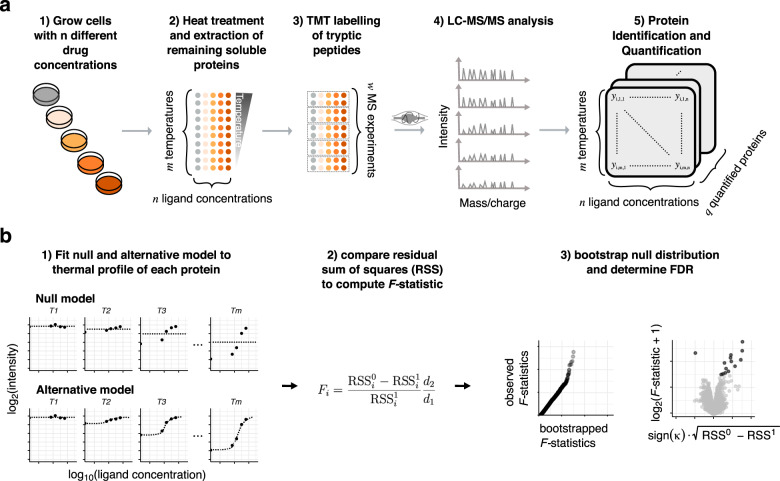
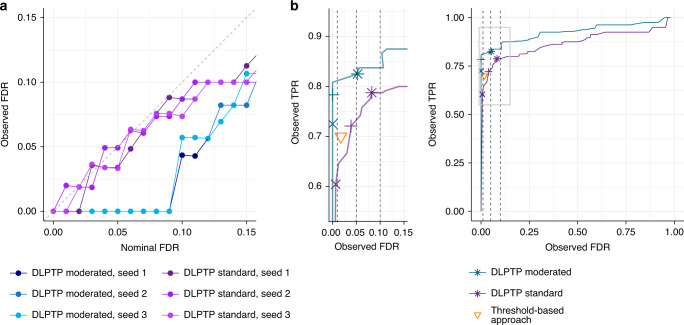
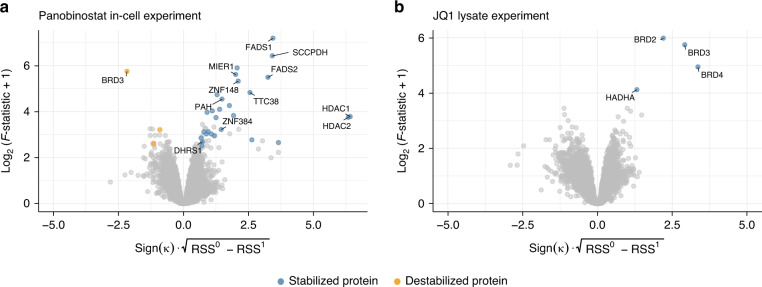
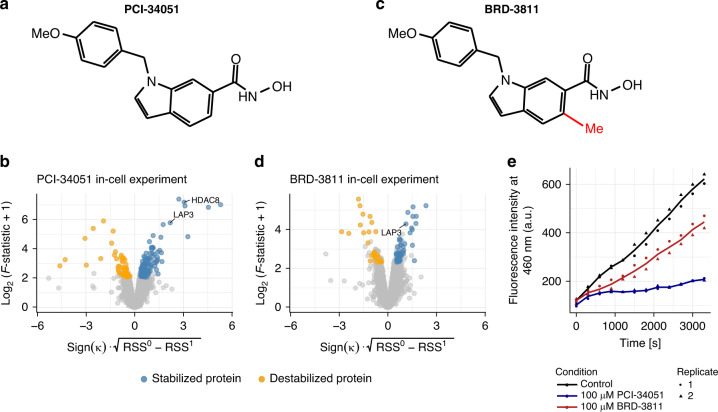
Detecting ligand-protein interactions in living cells is a fundamental challenge in molecular biology and drug research. Proteome-wide profiling of thermal stability as a function of ligand concentration promises to tackle this challenge. However, current data analysis strategies use preset thresholds that can lead to suboptimal sensitivity/specificity tradeoffs and limited comparability across datasets. Here, we present a method based on statistical hypothesis testing on curves, which provides control of the false discovery rate. We apply it to several datasets probing epigenetic drugs and a metabolite. This leads us to detect off-target drug engagement, including the finding that the HDAC8 inhibitor PCI-34051 and its analog BRD-3811 bind to and inhibit leucine aminopeptidase 3. An implementation is available as an R package from Bioconductor ( https://bioconductor.org/packages/TPP2D ). We hope that our method will facilitate prioritizing targets from thermal profiling experiments.
Overview
The claims and statistics of this paper haven’t been checked yet.
Free: it reads the open-access text and checks the first 5 claims that cite a source we can check. Create a free account to check every claim.
Integrity signals
Registry
Cites
Statistics
Figures
Verification
Claims the paper makes
The claims and statistics of this paper haven’t been checked yet.
Free: it reads the open-access text and checks the first 5 claims that cite a source we can check. Create a free account to check every claim.
Claims other papers make about this one
Each is checked against this paper’s own text: does it say what the citing paper says it does?
The source backs part of the claim, not all of it — or backs it for a different population, condition or comparison.
In the citing paper
“Thermal stabilization (i) is leveraged in thermal proteomics profiling (TPP), an approach that has been employed to, for instance, identify the ferrochelatase FECH as a frequent off-target of kinase inhibitors,224 or to uncover leucine aminopeptidase 3 as an off-target of several HDAC inhibitors.225”
From Advancing Targeted Protein Degradation via Multiomics Profiling and Artificial Intelligence (2023) · cites this paper as [225]
Experimental — accuracy not yet measured
Self-check
Percentages, sums and reported differences re-computed from the paper’s own numbers.
The self-check needs the paper’s full text.
Citations
Cites
limma powers differential expression analyses for RNA-sequencing and microarray studies
Ritchie, M. E., Phipson, B., Wu, D., Hu, Y., Law, C. W., Shi, W., & Smyth, G. K. (2015) · Nucleic Acids Research · doi:10.1093/nar/gkv007 · Cited by 40,458
Smyth, G. K. (2004) · Statistical Applications in Genetics and Molecular Biology · doi:10.2202/1544-6115.1027 · Cited by 11,829
A Limited Memory Algorithm for Bound Constrained Optimization
Byrd, R. H., Lu, P., Nocedal, J., & Zhu, C. (1995) · SIAM Journal on Scientific Computing · doi:10.1137/0916069 · Cited by 6,221
Selective inhibition of BET bromodomains
Filippakopoulos, P., Qi, J., Picaud, S., Shen, Y., Smith, W. B., Fedorov, O., Morse, E. M., Keates, T., Hickman, T. T., Felletar, I., et al. (2010) · Nature · doi:10.1038/nature09504 · Cited by 4,262 · cited 2×
“Next, we re-analyzed a dataset probing the BET bromodomain inhibitor JQ1 22 in THP1 cell lysate 23 .”
MethodMonitoring Drug Target Engagement in Cells and Tissues Using the Cellular Thermal Shift Assay
Molina, D. M., Jafari, R., Ignatushchenko, M., Seki, T., Larsson, E. A., Dan, C., Sreekumar, L., Cao, Y., & Nordlund, P. (2013) · Science · doi:10.1126/science.1233606 · Cited by 2,261
Tracking cancer drugs in living cells by thermal profiling of the proteome
Savitski, M. M., Reinhard, F. B. M., Franken, H., Werner, T., Savitski, M. F., Eberhard, D., Molina, D. M., Jafari, R., Dovega, R. B., Klaeger, S., et al. (2014) · Science · doi:10.1126/science.1255784 · Cited by 1,187
Self-citationQuantitative mass spectrometry in proteomics: critical review update from 2007 to the present
Bantscheff, M., Lemeer, S., Savitski, M. M., & Kuster, B. (2012) · Analytical and Bioanalytical Chemistry · doi:10.1007/s00216-012-6203-4 · Cited by 801
Self-citationFranken, H., Mathieson, T., Childs, D., Sweetman, G. M. A., Werner, T., Tögel, I., Doce, C., Gade, S., Bantscheff, M., Drewes, G., et al. (2015) · Nature Protocols · doi:10.1038/nprot.2015.101 · Cited by 659
Self-citationSignificance analysis of time course microarray experiments
Storey, J. D., Xiao, W., Leek, J. T., Tompkins, R. G., & Davis, R. W. (2005) · Proceedings of the National Academy of Sciences · doi:10.1073/pnas.0504609102 · Cited by 567
A Map of Protein-Metabolite Interactions Reveals Principles of Chemical Communication
Piazza, I., Kochanowski, K., Cappelletti, V., Fuhrer, T., Noor, E., Sauer, U., & Picotti, P. (2018) · Cell · doi:10.1016/j.cell.2017.12.006 · Cited by 556 · cited 8×
“The samples from each GTP concentration were split into 12 portions, which were then heated each at a temperature (42 – 63.9 °C) for 3min.”
ResultInfluential
Cited by
Tu, Y., Tan, L., Tao, H., Li, Y., & Liu, H. (2023) · Phytomedicine · doi:10.1016/j.phymed.2023.154862 · Cited by 190
In-Cell Structural Biology by NMR: The Benefits of the Atomic Scale
Theillet, F. (2022) · Chemical Reviews · doi:10.1021/acs.chemrev.1c00937 · Cited by 137
Small molecule photocatalysis enables drug target identification via energy transfer
Trowbridge, A., Seath, C. P., Rodriguez‐Rivera, F. P., Li, B. X., Dul, B. E., Schwaid, A. G., Buksh, B. F., Geri, J. B., Oakley, J. V., Fadeyi, O., et al. (2022) · Proceedings of the National Academy of Sciences · doi:10.1073/pnas.2208077119 · Cited by 127
“We also identi-fi ed two previously annotated ( + )-JQ1 off-targets, HADHA (33) and SRRM2 (34).”
Recent advances in isobaric labeling and applications in quantitative proteomics
Sivanich, M. K., Gu, T., Tabang, D. N., & Li, L. (2022) · PROTEOMICS · doi:10.1002/pmic.202100256 · Cited by 83
Systematic analysis of drug combinations against Gram-positive bacteria
Cacace, E., Kim, V., Varik, V., Knopp, M. R., Tietgen, M., Brauer-Nikonow, A., İnecik, K., Mateus, A., Milanese, A., Mårli, M. T., et al. (2023) · Nature Microbiology · doi:10.1038/s41564-023-01486-9 · Cited by 86
Self-citationDrug Target Identification in Tissues by Thermal Proteome Profiling
Mateus, A., Kurzawa, N., Perrin, J., Bergamini, G., & Savitski, M. M. (2021) · The Annual Review of Pharmacology and Toxicology · doi:10.1146/annurev-pharmtox-052120-013205 · Cited by 73
Self-citationHuman gut bacteria bioaccumulate per- and polyfluoroalkyl substances
Lindell, A. E., Grießhammer, A., Michaelis, L., Papagiannidis, D., Ochner, H., Kamrad, S., Guan, R., Blasche, S., Ventimiglia, L. N., Ramachandran, B., et al. (2025) · Nature Microbiology · doi:10.1038/s41564-025-02032-5 · Cited by 81
“For the hit calling, the data were preprocessed using the TPP package 49 and analysed using the TPP2D package 75 with an alpha of 0.1.”
InfluentialSelf-citationAdvancing Targeted Protein Degradation via Multiomics Profiling and Artificial Intelligence
Duran-Frigola, M., Cigler, M., & Winter, G. E. (2023) · Journal of the American Chemical Society · doi:10.1021/jacs.2c11098 · Cited by 50
Bayer, F. P., Gander, M., Küster, B., & The, M. (2023) · Nature Communications · doi:10.1038/s41467-023-43696-z · Cited by 45
Tampere, M., Pettke, A., Salata, C., Wallner, O. A., Koolmeister, T., Cázares‐Körner, A., Visnes, T., Hesselman, M. C., Kunold, E., Wiita, E., et al. (2020) · Viruses · doi:10.3390/v12121423 · Cited by 41
“2D-TPP: 2D-TPP results were analyzed as described previously [33,34].”
Methodd-amino acids signal a stress-dependent run-away response in Vibrio cholerae
Irazoki, O., ter Beek, J., Álvarez, L., Mateus, A., Colin, R., Typas, A., Savitski, M. M., Sourjik, V., Berntsson, R. P. ‐., & Cava, F. (2023) · Nature Microbiology · doi:10.1038/s41564-023-01419-6 · Cited by 32
Self-citationChemical proteomics accelerates the target discovery of natural products
He, S., Li, J., Zhou, J.-C., Yang, Z., Liu, X., & Ge, Y. (2024) · Biochemical Pharmacology · doi:10.1016/j.bcp.2024.116609 · Cited by 31
Stability-based approaches in chemoproteomics
George, A. L., Dueñas, M. E., Marín‐Rubio, J. L., & Trost, M. (2024) · Expert Reviews in Molecular Medicine · doi:10.1017/erm.2024.6 · Cited by 26
“43), although an isobaric trigger channel can be included to improve MS/MS analysis of peptides from these low-abundant proteins (Ref.”
BackgroundJi, H., Lu, X. M., Zhao, S., Wang, Q., Liao, B. Y., Bauer, L. G., Huber, K., Luo, R., Tian, R., & Tan, C. S. H. (2022) · Cell chemical biology · doi:10.1016/j.chembiol.2023.08.002 · Cited by 22
Shekhar, A., Lucrezia, R. D., Jerye, K., Korotkov, V. S., Harmrolfs, K., Rox, K., Weich, H. A., Ghai, I., Delhommel, F., Becher, I., et al. (2025) · Cell Host & Microbe · doi:10.1016/j.chom.2025.03.006 · Cited by 23
Self-citationCacace, E., Tietgen, M., Steinhauer, M., Mateus, A., Schultze, T. G., Eckermann, M., Galardini, M., Varik, V., Koumoutsi, A., Parzeller, J. J., et al. (2025) · Nature Communications · doi:10.1038/s41467-025-58730-5 · Cited by 26
Self-citationCellular thermal shift assay: an approach to identify and assess protein target engagement
Zhang, L., Wang, Y., Chang, Z., Zhou, Z., & Chen, Z. (2024) · Expert Review of Proteomics · doi:10.1080/14789450.2024.2406785 · Cited by 21
“By performing the w=m/2 multiplexed MS analysis, peptides are confirmed by database search and the quantified signals are aggregated at the protein level [41].”
ProSAP: a GUI software tool for statistical analysis and assessment of thermal stability data
Ji, H., Lu, X. M., Zheng, Z., Sun, S., & Tan, C. S. H. (2022) · Briefings in Bioinformatics · doi:10.1093/bib/bbac057 · Cited by 17
Hidden information on protein function in censuses of proteome foldedness
Cox, D., Ang, C.-S., Nillegoda, N. B., Reid, G. E., & Hatters, D. M. (2022) · Nature Communications · doi:10.1038/s41467-022-29661-2 · Cited by 16
Phaneuf, C. G., Aizikov, K., Grinfeld, D., Kreutzmann, A., Mourad, D., Lange, O., Dai, D., Zhang, B., Belenky, A., Makarov, A. A., et al. (2023) · Communications Chemistry · doi:10.1038/s42004-023-00861-1 · Cited by 15
Toward the analysis of functional proteoforms using mass spectrometry-based stability proteomics
Kang, J., Seshadri, M., Cupp‐Sutton, K. A., & Wu, S. (2023) · Frontiers in Analytical Science · doi:10.3389/frans.2023.1186623 · Cited by 15
“…and the melting curve for each protein is fit using diverse methods/software packages that can determine melting point shifts and melting behavior similarities (Savitski et al, 2014; Leuenberger et al, 2017; Childs et al, 2019; Mateus et al, 2020a; Kurzawa et al, 2020; Fang et al, 2021b).”
MethodExperimental and data analysis advances in thermal proteome profiling
Figueroa‐Navedo, A. M., & Ivanov, A. R. (2024) · Cell Reports Methods · doi:10.1016/j.crmeth.2024.100717 · Cited by 16
Local temporal Rac1-GTP nadirs and peaks restrict cell protrusions and retractions
Hu, J., Gong, X., & Strömblad, S. (2022) · Science Advances · doi:10.1126/sciadv.abl3667 · Cited by 15
Thermal Proteome Profiling for Drug Target Identification and Probing of Protein States
Sauer, P., & Bantscheff, M. (2023) · Methods in molecular biology · doi:10.1007/978-1-0716-3457-8_5 · Cited by 15
Self-citationThe rise of proteome‐wide biophysics
Mateus, A., Savitski, M. M., & Piazza, I. (2021) · Molecular Systems Biology · doi:10.15252/msb.202110442 · Cited by 13
Self-citationJandu, R. S., Bhattacharya, A., Antony, F., Al‐Seragi, M., Aoki, H., Babu, M., & Duong, F. (2025) · eLife · doi:10.7554/elife.104549.3 · Cited by 13
Network integration of thermal proteome profiling with multi-omics data decodes PARP inhibition
Burtscher, M. L., Gade, S., Garrido-Rodriguez, M., Rutkowska, A., Werner, T., Eberl, H. C., Petretich, M., Knopf, N., Zirngibl, K., Grandi, P., et al. (2024) · Molecular Systems Biology · doi:10.1038/s44320-024-00025-w · Cited by 7
“To identify signi fi cantly (de)stabilized proteins as hits in the 2D-TPP dataset, we used a recently introduced method (Kurzawa et al, 2020).”
MethodSelf-citationHerneisen, A. L., & Lourido, S. (2021) · BIO-PROTOCOL · doi:10.21769/bioprotoc.4207 · Cited by 10
Gerault, M.-A., Granjeaud, S., Camoin, L., Nordlund, P., & Dai, L. (2024) · Briefings in Bioinformatics · doi:10.1093/bib/bbae128 · Cited by 8
Cuevas-Cruz, M., Hernández-Guzmán, U., Álvarez-Rosales, P. C., Schnabel, M., Gómez‐Manzo, S., & Arreguín‐Espinosa, R. (2022) · Current Medicinal Chemistry · doi:10.2174/0929867329666220329090822 · Cited by 6
Proteomics contributions to epigenetic drug discovery
Noberini, R., & Bonaldi, T. (2023) · PROTEOMICS · doi:10.1002/pmic.202200435 · Cited by 5
Sueur, C. L., Rattray, M., & Savitski, M. M. (2024) · PLoS Computational Biology · doi:10.1371/journal.pcbi.1011632 · Cited by 9
Self-citationTP-MAP - an Integrated Software Package for the Analysis of 1D and 2D Thermal Profiling DataPreprint
Feyertag, F., & Huber, K. (2021) · bioRxiv (Cold Spring Harbor Laboratory) · doi:10.1101/2021.02.22.432361 · Cited by 5
Characterizing protein-protein interactions with thermal proteome profiling
Searle, B. C. (2024) · Current Opinion in Structural Biology · doi:10.1016/j.sbi.2024.102946 · Cited by 6
A multi-strategy antimicrobial discovery approach reveals new ways to treat Chlamydia
Ölander, M., Vázquez, D. R., Meier, K., Singh, A., de Sousa, A. S., Puértolas-Balint, F., Milivojevic, M., Mooij, L., Fredlund, J., Bosch, E. C., et al. (2025) · PLoS Biology · doi:10.1371/journal.pbio.3003123 · Cited by 4
“Data analysis was performed in R using the package TPP2D, as previously described [111].”
Self-citationSystematic screen uncovers regulator contributions to chemical cues in Escherichia coli
Binsfeld, C., Olayo-Alarcón, R., Jiménez, L. P., Wartel, M., Stadler, M., Mateus, A., Müller, C. L., & Brochado, A. R. (2025) · PLoS Biology · doi:10.1371/journal.pbio.3003260 · Cited by 5
“Next, we used in vivo thermal proteome profiling (TPP [54–57]), aiming to find caffeine-induced protein thermal stability changes that could explain the observed phenotype.”
Self-citationThermal proteome profiling unveils protein targets of deoxycholic acid in living neuronal cells
Luan, H., Li, X., Zhang, W., & Luan, T. (2023) · Advanced Biotechnology · doi:10.1007/s44307-023-00007-3 · Cited by 3
Deep thermal proteome profiling for detection of proteoforms and drug sensitivity biomarkersPreprint
Kurzawa, N., Stahl, M. M. S., Leo, I. R., Kunold, E., Becher, I., Audrey, A., Mermelekas, G., Huber, W. K., Mateus, A., Savitski, M. M., et al. (2022) · bioRxiv (Cold Spring Harbor Laboratory) · doi:10.1101/2022.06.10.495491 · Cited by 3
Self-citationSueur, C. L., Rattray, M., & Savitski, M. M. (2024) · bioRxiv · doi:10.1101/2023.10.26.564129 · Cited by 2
Self-citationCacace, E., Tietgen, M., Steinhauer, M., Mateus, A., Schultze, T. G., Eckermann, M., Galardini, M., Varik, V., Koumoutsi, A., Parzeller, J. J., et al. (2024) · bioRxiv (Cold Spring Harbor Laboratory) · doi:10.1101/2024.06.04.597298 · Cited by 3
Self-citationMSstatsTMT Improves Accuracy of Thermal Proteome Profiling
Figueroa‐Navedo, A. M., Kapre, R., Gupta, T., Xu, Y., Phaneuf, C. G., Beltran, P. M. J., Xue, L., Ivanov, A. R., & Vitek, O. (2025) · Molecular & Cellular Proteomics · doi:10.1016/j.mcpro.2025.100999 · Cited by 4
High-throughput profiling of drug interactions in Gram-positive bacteriaPreprint
Cacace, E., Kim, V., Knopp, M. R., Tietgen, M., Brauer-Nikonow, A., İnecik, K., Mateus, A., Milanese, A., Mårli, M. T., Mitosch, K., et al. (2022) · bioRxiv (Cold Spring Harbor Laboratory) · doi:10.1101/2022.12.23.521747 · Cited by 2
Self-citationYang, H., Chen, A., Ye, Y., Zhou, X., Li, Y., Wen, X., Du, Z., Lan, Z., & Yan, J. (2026) · Free Radical Biology and Medicine · doi:10.1016/j.freeradbiomed.2026.04.148 · Cited by 1
Identification of drug repurposing candidates for the treatment of polycystic kidney disease
Meyer, A., Sotiropoulou, P., Bouker, K., Svedberg, D., Hammar, R., Bange, H., Larsson, P., Mateus, A., Dietrich, D. R., & Artursson, P. (2026) · British Journal of Pharmacology · doi:10.1111/bph.70493 · Cited by 2
“In this study, we investigated the effects of the autosomal dominant GSTP1 ) and newly identified ( SLC25A4 , SLC25A5 , SLC25A6 , GANAB and PTK2 ) targets of salicylic acid as determined by thermal proteome profiling (TPP) using the 2D-TPP package in R (Kurzawa et al., 2020).”
Self-citationJandu, R. S., Bhattacharya, A., Antony, F., Al‐Seragi, M., Aoki, H., Babu, M., & Duong, F. (2025) · eLife · doi:10.7554/elife.104549.2 · Cited by 1
KOPI: Kinase inhibitOr Proteome Impact analysis
Li, G. X., Zhao, T., Wang, L. C., Choi, H., Lim, Y. T., & Sobota, R. M. (2022) · Scientific Reports · doi:10.1038/s41598-022-16557-w
Burtscher, M. L., Gade, S., Garrido‐Rodríguez, M., Rutkowska, A., Werner, T., Eberl, H. C., Petretich, M., Knopf, N., Zirngibl, K., Grandi, P., et al. (2023) · bioRxiv (Cold Spring Harbor Laboratory) · doi:10.1101/2023.08.15.553354
“To identify significantly (de)stabilized proteins as hits in the 2D-TPP dataset, we used a recently introduced method 40 .”
MethodSelf-citationFigueroa‐Navedo, A. M. (2023) · Digital Repository Service (Northeastern University) · doi:10.17760/d20621551 · Cited by 1
Phaneuf, C. G. (2023) · Digital Repository Service (Northeastern University) · doi:10.17760/d20621548
Lavallée‐Adam, M., Pelletier, A. R., Diedrich, J. K., Low, W., Pinto, A. F. M., Martínez‐Bartolomé, S., Petrascheck, M., Moresco, J. J., & Yates, J. R. (2025) · Journal of the American Society for Mass Spectrometry · doi:10.1021/jasms.4c00269 · Cited by 1
DT-TRAP enables accurate target recognition via simplified dosing and low-temperature incubation
Zhang, H., Yuan, W., Li, Y., Li, C., Xie, Y., Wan, N., Hao, H., & Ye, H. (2026) · Journal of Pharmaceutical Analysis · doi:10.1016/j.jpha.2026.101605
Temperature Range Thermal Proteome Profiling for Drug Target Identification: A Practical Guide
Xue, Y., Chen, P., Xing, M., Han, L., & Ying, W. (2026) · Journal of Proteome Research · doi:10.1021/acs.jproteome.5c01009 · Cited by 1
Liu, F., Zhang, H., Qu, Y., Zheng, H., Liu, S., & Zhang, X.-F. (2026) · Journal of Chromatography A · doi:10.1016/j.chroma.2026.467531
Metadata
- Authors
- Kurzawa, N., Becher, I., Sridharan, S., Franken, H., Mateus, A., Anders, S., Bantscheff, M., Huber, W., & Savitski, M. M.
- Affiliations
- Heidelberg University (DE)
- European Molecular Biology Laboratory (DE)
- GlaxoSmithKline (Germany) (DE)
- Corresponding author
- Bantscheff, Marcus
- Huber, Wolfgang
- Savitski, Mikhail M.
- ORCID
- Venue
- Nature Communications
- Published
- 2020-11-13
- Volume
- 11
- Issue
- 1
- Pages
- 5783-5783
- ISSN
- 2041-1723 (ISSN-L)
- PMC
- PMC7666118
- OpenAlex
- W3099234957
- Semantic Scholar
- 9db7eb07295e0ea94218a64dc0d01f77e30c74e7
- Cited by
- 53
- References
- 31
- Citations by year
- 2026: 5 · 2025: 9 · 2024: 9 · 2023: 15 · 2022: 10 · 2021: 4 · 2020: 1
- FWCI
- 2.86
- Type
- journal article
- Language
- en
- Update notices
- correction (2021-12-08)
- Open access
- gold
- doi.org
- Licence
- cc-by
- creativecommons.org/licenses/by/4.0 (tdm)
- creativecommons.org/licenses/by/4.0 (vor)
- Locations
- Nature Communications (publishedVersion, cc-by)
- bioRxiv (Cold Spring Harbor Laboratory) (acceptedVersion, cc-by-nc-nd)
- PubMed Central (publishedVersion, cc-by)
- PubMed (publishedVersion)
- RePEc: Research Papers in Economics (submittedVersion)
- DOAJ (DOAJ: Directory of Open Access Journals) (submittedVersion, cc-by-sa)
- Funders
- European Molecular Biology Laboratory
- European Commission (H2020, 633974)
- Deutsche Forschungsgemeinschaft (SFB 1036)
- Horizon 2020 Framework Programme (633974)
- Topics
- Physical Sciences › Chemistry › Spectroscopy › Advanced Proteomics Techniques and Applications
- Physical Sciences › Chemistry › Physical and Theoretical Chemistry › thermodynamics and calorimetric analyses
- Life Sciences › Biochemistry, Genetics and Molecular Biology › Molecular Biology › Protein Degradation and Inhibitors
- Keywords
- ligand-binding proteins, thermal proteome profiling, false discovery rate control, epigenetic drugs, HDAC8 inhibitors, target prioritization, R/Bioconductor package
- MeSH terms
- Adenosine Triphosphate, Pharmaceutical Preparations, Guanosine Triphosphate, Histone Deacetylases, Humans, Hydroxamic Acids, Indoles, Leucyl Aminopeptidase, Ligands, Protein Binding, Repressor Proteins, Temperature, Computational Biology, Proteome, Databases, Protein, Proteomics, Histone Deacetylase Inhibitors, Hep G2 Cells
About these checks
Registry, retraction, Cites and statistics results are computed, not judged, with one exception: a printed reference that no index lists is read once by a model before it counts as a citation error. Claims are extracted by a model and kept only when their quote appears verbatim in the text; each cited source is then checked, with a model’s help, for whether it says what the claim relies on. Those verdicts can be wrong — read the claim’s quote and the cited source before relying on one.
Statistics and arithmetic are recomputed, not judged.
Confidence bands are shown only for fields calibrated on our annotated test set. None is calibrated yet, so no band is shown.
What counts as a claim ›How we measure confidence ›How we check this ›
Are you an author, or do you see a problem with this page? Request a review
Data sources
Bibliographic data: Semantic Scholar, OpenAlex, Crossref.
Contains information from the Semantic Scholar Academic Graph Datasets, made available under the ODC Attribution License (ODC-BY 1.0).
Semantic Scholar’s data is described in: Kinney, R., et al. (2023). The Semantic Scholar Open Data Platform. arXiv:2301.10140.
