

The DOI matches its Crossref record; 60 of the 61 references it cites were found in a registry or an index.
A computational reward learning account of social media engagement
Open accessAbstract
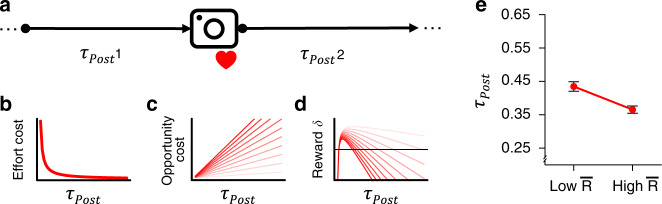
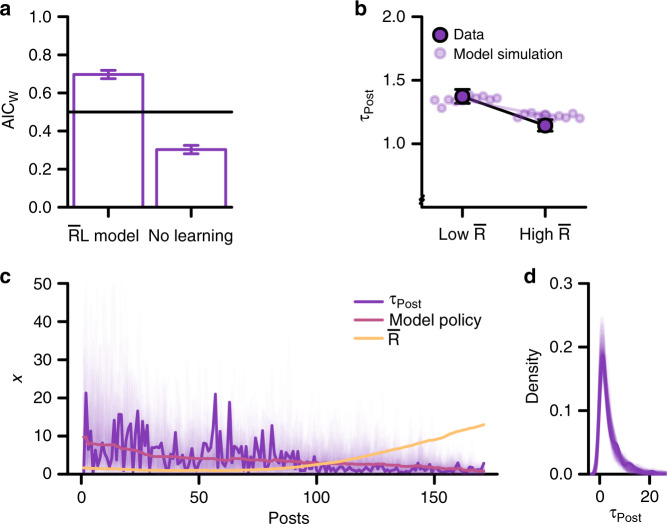
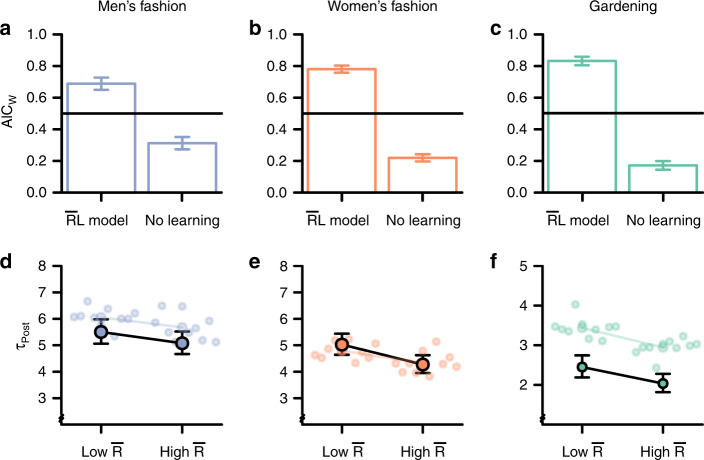
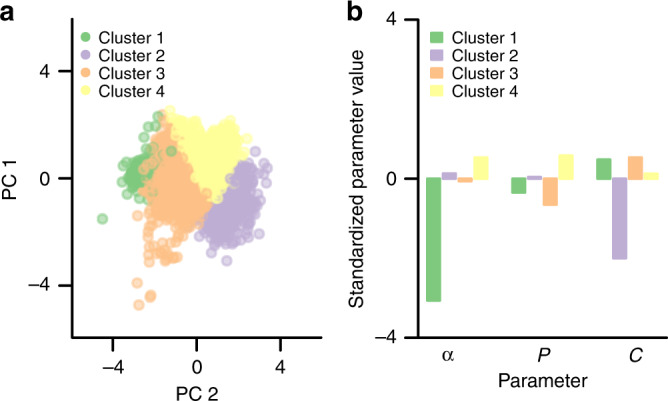
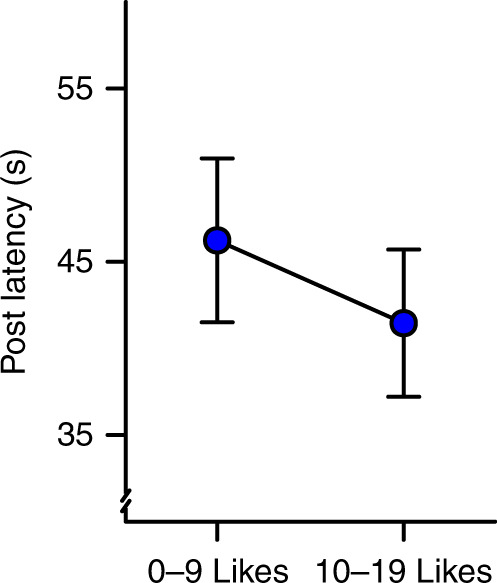
Social media has become a modern arena for human life, with billions of daily users worldwide. The intense popularity of social media is often attributed to a psychological need for social rewards (likes), portraying the online world as a Skinner Box for the modern human. Yet despite such portrayals, empirical evidence for social media engagement as reward-based behavior remains scant. Here, we apply a computational approach to directly test whether reward learning mechanisms contribute to social media behavior. We analyze over one million posts from over 4000 individuals on multiple social media platforms, using computational models based on reinforcement learning theory. Our results consistently show that human behavior on social media conforms qualitatively and quantitatively to the principles of reward learning. Specifically, social media users spaced their posts to maximize the average rate of accrued social rewards, in a manner subject to both the effort cost of posting and the opportunity cost of inaction. Results further reveal meaningful individual difference profiles in social reward learning on social media. Finally, an online experiment (n = 176), mimicking key aspects of social media, verifies that social rewards causally influence behavior as posited by our computational account. Together, these findings support a reward learning account of social media engagement and offer new insights into this emergent mode of modern human behavior.
Overview
The claims and statistics of this paper haven’t been checked yet.
Run the check — free, no account needed. It reads the open-access text and checks the sources it cites.
Integrity signals
Registry
Cites
Statistics
Figures
Verification
Claims the paper makes
The claims and statistics of this paper haven’t been checked yet.
Run the check — free, no account needed. It reads the open-access text and checks the sources it cites.
Claims other papers make about this one
Each is checked against this paper’s own text: does it say what the citing paper says it does?
The source backs part of the claim, not all of it — or backs it for a different population, condition or comparison.
In the citing paper
“Furthermore, the interval at which an algorithm rewards behavior influences how quickly it is repeated (Lindström et al., 2021).”
From Social Drivers and Algorithmic Mechanisms on Digital Media. (2024) · cites this paper as Lindström et al., 2021
Experimental — accuracy not yet measuredThe cited source says what the claim attributes to it.
In the citing paper
“Studies show that humans are susceptible to social feedback on digital media: Likes influence how quickly people post again (Lindström et al., 2021), whether or not they consider a post successful (Carr et al., 2018), and how happy, self-assured, and popular they feel after posting status updates (Rosenthal-von der Pütten et al., 2019; Zell & Moeller, 2018).”
From Social Drivers and Algorithmic Mechanisms on Digital Media. (2024) · cites this paper as Lindström et al., 2021
Self-check
Percentages, sums and reported differences re-computed from the paper’s own numbers.
The self-check needs the paper’s full text.
Citations
Cites
Reinforcement Learning: An Introduction
Sutton, R. S., & Barto, A. G. (1998) · IEEE Transactions on Neural Networks · doi:10.1109/tnn.1998.712192 · Cited by 27,225 · cited 3×
“As in Study 1, the estimated effect of R on posting latencies was stronger for individuals for whom the (cid:1) RL model provided a better fi t (see Supplementary Note 7).”
BackgroundMethodResultInfluentialReinforcement Learning: An Introduction
Sutton, R. S., & Barto, A. (2005) · IEEE Transactions on Neural Networks · doi:10.1109/tnn.2004.842673 · Cited by 25,268
lmerTest Package: Tests in Linear Mixed Effects Models
Kuznetsova, A., Brockhoff, P. B., & Christensen, R. H. B. (2017) · Journal of Statistical Software · doi:10.18637/jss.v082.i13 · Cited by 24,346
Advances in neural information processing systems 7
Cios, K. J., & Shields, M. E. (1997) · Neurocomputing · doi:10.1016/s0925-2312(97)90018-7 · Cited by 22,093
A theory of social comparison processes
Festinger, L. (1954) · Human Relations · doi:10.1177/001872675400700202 · Cited by 20,926
(1999) · Cited by 5,147
Centering predictor variables in cross-sectional multilevel models: A new look at an old issue.
Enders, C. K., & Tofighi, D. (2007) · Psychological Methods · doi:10.1037/1082-989x.12.2.121 · Cited by 4,462
NbClust : An R Package for Determining the Relevant Number of Clusters in a Data Set
Charrad, M., Ghazzali, N., Boiteau, V., & Niknafs, A. (2014) · Journal of Statistical Software · doi:10.18637/jss.v061.i06 · Cited by 3,396
AIC model selection using Akaike weights
Wagenmakers, E.-J., & Farrell, S. (2004) · Psychonomic Bulletin & Review · doi:10.3758/bf03206482 · Cited by 2,684
Herrnstein, R. J. (1970) · Journal of the Experimental Analysis of Behavior · doi:10.1901/jeab.1970.13-243 · Cited by 2,611
Cited by
Sorted by citations
Items 101–184 of 184
Acute isolation increases reward responsiveness in human adolescentsPreprint
Tomova, L., Towner, E., Thomas, K., & Blakemore, S. (2022) · Research Square · doi:10.21203/rs.3.rs-2312406/v1 · Cited by 2
Acute isolation is associated with increased reward responsiveness in human adolescentsPreprint
Tomova, L., Towner, E., Thomas, K., & Blakemore, S. (2023) · Research Square · doi:10.21203/rs.3.rs-2718114/v1 · Cited by 2
Hopkinson, N. S., Vrinten, C., Parnham, J. C., Radó, M. K., Filippidis, F. T., Vamos, E. P., & Laverty, A. A. (2023) · medRxiv · doi:10.1101/2023.06.03.23290924 · Cited by 2
“Second, social media use has been shown to have features in common with rewardseeking addictive behaviour (22).”
BackgroundDisinformation elicits learning biasesPreprint
Vidal-Perez, J., Dolan, R. J., & Moran, R. (2025) · eLife · doi:10.7554/elife.106073.1 · Cited by 2
A Study on Rewarding Mechanisms for Activating Silent Users in Social Media
Katikaridi, M. A., Tsalgatidou, A., & Koutrouli, E. (2023) · International Conference on Information, Intelligence, Systems & Applications (IISA) · doi:10.1109/iisa59645.2023.10345844 · Cited by 1
“The use of social media follows a reward-learning pattern, just as experiments with animals seeking for reward food [37].”
BackgroundIndividual curiosity modulates exploration in sequential book selection
Gong, X., Boorman, E. D., Shen, C., & Huskey, R. (2026) · PNAS Nexus · doi:10.1093/pnasnexus/pgag226 · Cited by 1
Case Study: LLM-Based Anxiety Climate Index
Marcondes, F. S., Gala, A. D. C. O. S., Magalhães, R., de Britto, F. P., Durães, D. A., & Nováis, P. (2025) · SpringerBriefs in computer science · doi:10.1007/978-3-031-76631-2_5 · Cited by 1
Grabner, C. Y. L., & Parra-Bolaños, N. (2025) · Revistalexenlace · doi:10.63644/qyrtez96 · Cited by 1
Celli, L., Villa, C. P., Ogata, M. Y., Filho, H. B. N., de Melo, C. M., de Freitas, M. C., & Haydu, V. B. (2025) · Behavior and Social Issues · doi:10.1007/s42822-025-00215-7 · Cited by 1
“Content created and distributed online is behavior, and controls other behaviors mediated by online platforms and their algorithms (Lindström et al., 2021).”
Kelly, M. M., Moore, P. S., Zai, A., & Allison, J. J. (2026) · JMIR AI · doi:10.2196/85419 · Cited by 3
“Both gaming and social media platforms operate through reinforcement mechanisms such as rewards, achievements, and personalized engagement, which encourage habitual usage [48].”
Digital echoes of cultural values: Cross-cultural differences in online norm-enforcement
Kenntemich, C., Brückner-Collet, D. O. I., & Rudert, S. C. (2025) · Computers in Human Behavior Reports · doi:10.1016/j.chbr.2025.100909 · Cited by 2
Social feedback mechanisms & misinformation: A neuroscience-based argument for algorithm regulation
Cohen, M. S., & Decety, J. (2026) · Behavioral Science & Policy · doi:10.1177/23794607251403323 · Cited by 1
“20 This relationship is consistent with reinforcement learning, where positive or negative feedback affects motivation for”
Fareri, D. S., & Dejoie, J. M. (2026) · Springer eBooks · doi:10.1007/978-3-032-02925-6_22 · Cited by 1
Zhang, C., Zhao, B., Yu, C., Wang, S., & Zhang, X. (2026) · Tourism Management Perspectives · doi:10.1016/j.tmp.2026.101458 · Cited by 1
One blind spot of the explainability debate: the specific needs and vulnerabilities of adolescents
Schweiger, G. (2026) · AI & Society · doi:10.1007/s00146-026-02962-6 · Cited by 1
“Empirical research documents compellingly that these algorithms are optimized to capture attention and maximize dwell time (Lindström et al. 2021).”
Animal models relevant to digital technology-based disorders
Tam, S. K. E., & Becker, B. (2026) · Journal of Behavioral Addictions · doi:10.1556/2006.2025.00307 · Cited by 1
Toward a psychology of real-life decision-making
Schakowski, A., Deffner, D., Kavelaars, M. M., Haux, L. M., Kuroda, K., Dhellemmes, F., & Kurvers, R. H. J. M. (2026) · Trends in Cognitive Sciences · doi:10.1016/j.tics.2026.07.003 · Cited by 3
Robotic Active Tactile Sensing Inspired by Serotonergic Modulation Using Active Inference
Novický, F., Offergeld, J., Janssen, S., & Lanillos, P. (2023) · Lecture notes in computer science · doi:10.1007/978-3-031-38857-6_3 · Cited by 2
A structural neural autopilot analysis of social media use around the pandemic lockdown
Xin, Y., Jin, L. J., Fong, J., & Camerer, C. F. (2026) · Journal of Economic Behavior & Organization · doi:10.1016/j.jebo.2026.107589 · Cited by 1
Innovative Lehr- und Lernformen (2): Digitale Lernformate
Agel, L., & Larsen, V. (2024) · Hebamme · doi:10.1055/a-2351-6937 · Cited by 1
Adolescent internet use and symptoms of depression: a rejoinder
Fitzpatrick, C. (2024) · Psychological Medicine · doi:10.1017/s0033291724000412 · Cited by 1
Association between the Taq1A polymorphism and problematic media use in preadolescent children
Emond, J. A., Renier, T. J., Yeum, D., Carlson, D. D., Ballarino, G. A., & Gilbert‐Diamond, D. (2025) · Frontiers in Psychology · doi:10.3389/fpsyg.2024.1395957 · Cited by 2
Szymkowiak, A., Madias, K., & Garczarek-Bąk, U. (2025) · Technology in Society · doi:10.1016/j.techsoc.2025.102860 · Cited by 3
Liu, W., Liu, J., & Niu, Z. (2025) · Complex & Intelligent Systems · doi:10.1007/s40747-025-02103-4 · Cited by 1
Gabay, A. S., Pisauro, M. A., O’Nell, K. C., Lynch, R., & Apps, M. A. J. (2021) · doi:10.31234/osf.io/cnqe4 · Cited by 1
Do ‘Likes’ in a Brand Community Make You Buy Less?Preprint
Liang, C., Wu, J., & Li, X. (2022) · SSRN Electronic Journal · doi:10.2139/ssrn.4002054 · Cited by 1
Characterizing human habits in the labPreprint
Nebe, S., Kretzschmar, A., & Tobler, P. N. (2022) · PsyArXiv (OSF Preprints) · doi:10.31234/osf.io/tgf27 · Cited by 1
Self-citationWeng, C. A., Bulgin, J., Diaz, S., Zhang, J., Tan, R., Li, L., & Armstrong-Hough, M. (2022) · medRxiv · doi:10.1101/2022.11.30.22282943 · Cited by 1
The Economics of AttentionPreprint
Loewenstein, G. F., & Wojtowicz, Z. (2023) · SSRN Electronic Journal · doi:10.2139/ssrn.4610993 · Cited by 4
Hidden reward: Affect and its prediction errors as windows into subjective valuePreprint
Vollberg, M. C., & Sander, D. (2023) · doi:10.31234/osf.io/cr2nd · Cited by 1
Disinformation elicits learning biasesPreprint
Vidal-Perez, J., Dolan, R. J., & Moran, R. (2024) · Research Square · doi:10.21203/rs.3.rs-4468218/v1 · Cited by 1
The Spread of (Mis)Information: A Social Media Experiment in PakistanPreprint
Hirshleifer, S., Naseem, M., Raza, A. A., & Razaee, A. (2025) · SSRN Electronic Journal · doi:10.2139/ssrn.5218495 · Cited by 1
What is the evidence for social media addiction?
Kalk, N. J., & Carter, B. (2026) · BMJ · doi:10.1136/bmj.s798 · Cited by 1
“13 14 Emerging evidence suggests that a particular pattern :impairedcontrol,increasing prioritisation,andpersistentusedespiteharm, accompaniedbymeasurablefunctionalimpairment.”
Digital culturePreprint
Acerbi, A. (2021) · doi:10.31219/osf.io/cjk4r
Synthesis of Human and Artificial IntelligencePreprint
Grüning, D. J. (2022) · doi:10.31234/osf.io/gf7k9
Dynamic Self-Similar kc-Center Network Based on Information Dissemination
Wang, L., Zhang, X., Yao, Y., & Yu, X. (2022) · Journal of Shanghai Jiaotong University (Science) · doi:10.1007/s12204-022-2559-6
Acerbi, A. (2023) · Oxford University Press eBooks · doi:10.1093/oxfordhb/9780198869252.013.41
Why People PostPreprint
Nitsch, F. J., Wertenbroch, K., & Plaßmann, H. (2024) · SSRN Electronic Journal · doi:10.2139/ssrn.4874305
Weng, C. A., Bulgin, J., Diaz, S., Zhang, J., Tan, R., Li, L., & Armstrong-Hough, M. (2024) · doi:10.2196/preprints.64850 · Cited by 1
Parvanta, C. F., & Vijay Prajapati (2024) · American Public Health Association eBooks · doi:10.2105/9780875533551ch03
Automated Influence and Value Collapse
White, D. J. (2024) · American Philosophical Quarterly · doi:10.5406/21521123.61.4.06
Success-Driven User Activity Contributes to Online PolarizationPreprint
Horn, S., Banisch, S., Batzdorfer, V., Reitenbach, A., Sartori, F., Schwabe, D., & Mäs, M. (2024) · SSRN Electronic Journal · doi:10.2139/ssrn.5031685
Social-Media-Lebenswelt und praktische Freiheit – Konzeption und Rekonstruktion eines Lernszenarios
Richter, P., & Matzke, P. (2025) · Springer eBooks · doi:10.1007/978-3-662-69672-9_1
Howard, A., Gmiro, Y., Gunnell, K. E., & Tamminen, K. A. (2025) · doi:10.71240/lcyc.168925
Disinformation elicits learning biasesPreprint
Vidal-Perez, J., Dolan, R. J., & Moran, R. (2025) · eLife · doi:10.7554/elife.106073.2
Armony, J. L., & Vuilleumier, P. O. (2025) · Cambridge University Press eBooks · doi:10.1017/9781009342919.020
Reward Learning in a Social World
Nicastri, C. M., Dejoie, J. M., Fareri, D. S., & Delgado, M. R. (2025) · Cambridge University Press eBooks · doi:10.1017/9781009342919.022
Using hidden Markov models to assess and correct for measurement error in digital trace data
Pankowska, P., Cernat, A., Keusch, F., & Bach, R. L. (2025) · Communication Methods and Measures · doi:10.1080/19312458.2025.2573265
“Unsurprisingly, these data are frequently used to study online behaviors, such as social media use, online news consumption, as well as online communities (Bach et al., 2022b; Howison et al., 2011; Lindström et al., 2021).”
Disinformation elicits learning biasesPreprint
Vidal-Perez, J., Dolan, R. J., & Moran, R. (2025) · eLife · doi:10.7554/elife.106073.3
Hu, C., & Sun, Y. (2025) · Advances in Applied Sociology · doi:10.4236/aasoci.2025.1512077
THE IMPACT OF THE TIKTOK APP ON THE MENTAL HEALTH OF YOUNG USERS
Ziemba, M., Ziemba, A., Giedzicz, K., Kulgawczuk, R., Zackiewicz, K., Wińska, A., Sędziak, O., Pietruszewska, H., Ogorek, A., & Czerepak, I. (2025) · International Journal of Innovative Technologies in Social Science · doi:10.31435/ijitss.4(48).2025.4318
Chinchella, N., Aldo Gangemi, A., Gazineo, A., & Lucifora, C. (2026) · Research Square · doi:10.21203/rs.3.rs-8328737/v1
Wang, E., & Huang, C.-Y. (2026) · International Journal of Strategic Communication · doi:10.1080/1553118x.2026.2626320
The spread of (mis)information: A social media experiment in Pakistan
Hirshleifer, S., Naseem, M., Raza, A. A., & Rezaee, A. (2026) · Journal of Development Economics · doi:10.1016/j.jdeveco.2026.103784
The social dilemma of online segregation: A dynamical model of platform choice
Banisch, S., Jacob, D., Willaert, T., & Olbrich, E. (2026) · Rationality and Society · doi:10.1177/10434631261428850 · Cited by 2
“…makes RL particularly relevant for modeling online interaction, where users repeatedly adapt their behavior to platform-speci fi c feedback signals (Lindstr¨om et al., 2021), and where bounded, backward-looking adaptation may be a more realistic account of behavior than forward-looking…”
Lange, M., Martinasek, M. P., & Heckert, N. (2026) · Frontiers in Public Health · doi:10.3389/fpubh.2026.1738207
“Peer normalization processes further contribute through social learning and descriptive norms, whereby observing peers’ behavior may reduce stigma and shift attention away from potential harms (72, 73).”
Schokkenbroek, J. M., Rebrean, M.-L., Roșca, C., Picout, M., Malgieri, G., Wagner, B., & Chamorro, L. S. (2026) · CHI Conference on Human Factors in Computing Systems · doi:10.1145/3772318.3791806
“These designs are known to exploit psychological mechanisms such as the aforementioned habit formation, reward-seeking, and reinforcement [64, 67, 91, 116].”
Dong, X., Wang, C., Tang, L., & Lian, Y. (2026) · BMC Public Health · doi:10.1186/s12889-026-27395-0
“Compared with structured attributes such as gender, age, or location, profile texts provide richer cues about users’ value orientations, life goals, and social positioning, and therefore offer a direct window into identity salience and self-categoriza-tion [30, 31].”
Tarifa‐Rodríguez, A., Ortega, J. V., & Elvira, A. C. (2026) · Journal of Behavioral Education · doi:10.1007/s10864-026-09629-8
Shock, Mystery, Meaning: Our Obsession with Crime Media and True Crime and Its Consequences
Ferguson, L. (2026) · Palgrave studies in victims and victimology · doi:10.1007/978-3-032-19456-5_4
Zhao, W., Han, D., Pang, Z., Wu, Z., & He, L. (2026) · Behaviour and Information Technology · doi:10.1080/0144929x.2026.2675639
Computational Modeling of Human Cognition and Behavior
Wang, X., & Wu, H. (2026) · Springer eBooks · doi:10.1007/978-981-95-5585-7_2
Religiosity and the use of generative AI chatbots: evidence from Türkiye
Dogan, S. (2026) · Journal of Psychology and AI · doi:10.1080/29974100.2026.2674672
Choi, E., Park, J., Eom, S., Park, J., & Kim, S. (2026) · Telecommunications Policy · doi:10.1016/j.telpol.2026.103252
Song, Y., & Kim, K. (2026) · Behavioral Sciences · doi:10.3390/bs16060972
“…share a package because it is emotionally engaging or socially valuable (Berger & Milkman, 2012; Berger, 2014), because it supports identity signaling (Chu & Kim, 2011; Buchanan, 2020), or because it provides conversational value in online interaction (Laato et al., 2020; Lindstrom et al., 2021).”
Everyday Auditing of TikTok's Generative AI Manga Filter
Encarnación, R., Morales-Navarro, L., Kambhamettu, H., & Metaxa, D. (2026) · Conference on Fairness, Accountability and Transparency · doi:10.1145/3805689.3812379
“Previous work on TikTok and Reddit has found that community engagement and social attention can be effective non-monetary incentives to producing content [29].”
Hematabadi, A., Rashidlamir, A., Motevalli, M. S., Schauer, M., & Arazi, H. (2026) · Health Education & Behavior · doi:10.1177/10901981261458638
An effort recalibration framework for digital media use and cognition
Wiradhany, W., Parry, D. A., & Aru, J. (2026) · Nature Human Behaviour · doi:10.1038/s41562-026-02500-w
“The shift from exploration to exploitation presents a dilemma, especially during learning 39,46 —that is, in line with reinforcement-learning principles 1,47 .”
The Reinforcement Effect of Social Media Likes in Depression
Mirea, D.-M., Chen, S., Ding, J., Palacio-Soto, K., Mildner, J. N., Kelley, S. W., Gillan, C. M., Nook, E. C., & Niv, Y. (2026) · JAMA Psychiatry · doi:10.1001/jamapsychiatry.2026.1430
Do Likes Reinforce Depression?
Huys, Q. J. M., & Orben, A. C. (2026) · JAMA Psychiatry · doi:10.1001/jamapsychiatry.2026.1373
Sarkar, R. (2026) · IGI Global eBooks · doi:10.4018/979-8-3373-8307-1.ch001
Rahayu, F. S., Wulandari, K., Christianto, S., Haryanto, I., & Marcelino, A. J. (2026) · Communications in computer and information science · doi:10.1007/978-3-032-33384-1_6
Aligning social media design with adolescent brain development: rationale and recommendations
Garg, Y., Siriudomsait, J., & Chidiac, B. (2026) · Frontiers in Digital Health · doi:10.3389/fdgth.2026.1880395
Tam, S. K. E., & Becker, B. (2026) · bioRxiv (Cold Spring Harbor Laboratory) · doi:10.64898/2026.07.31.742007
An Agent-Based Model Demonstrating Cap-and-Trade Regulation of Social Media to Reduce Consumer Harms
Eldridge, S. D. (2026) · Springer proceedings in complexity · doi:10.1007/978-3-032-21596-3_7
Problematic social media use is associated with altered directed exploration under uncertainty
Zhou, X., Liu, X., Dou, H., Zhao, H., Liu, Y., & Shen, X. (2026) · Addictive Behaviors Reports · doi:10.1016/j.abrep.2026.100737
“Variable social rewards, in which the timing and magnitude of social feedback (likes, comments, shares) are unpredictable, create a powerful uncertainty signal that may drive strategic exploration (Lindstrom et al., 2021).”
Risk of social networks addiction and emotional dependence in a sample of university students
Klimenko, O., Hernández-Flórez, N., & Vásquez-Tobón, D. (2026) · CES Psicología · doi:10.21615/cesp.7953
Shi, F., Jiang, M., Ding, J., & Ning, H. (2026) · Adolescents · doi:10.3390/adolescents6050084
Beyond Misinformation: Social Media and the Sculpting of Epistemic Agency
Flores, C. (2026) · Philosophy and Phenomenological Research · doi:10.1111/phpr.70166
Fang, B., Sun, Y., Bai, Y., Liu, W.-J., Lin, R., & Xia, W. (2026) · Journal of Affective Disorders · doi:10.1016/j.jad.2026.122605
Karimova, E., Potapov, V. V., Smolskaya, D. V., & Bobrov, N. V. (2026) · Neuroscience and Behavioral Physiology · doi:10.1007/s11055-026-02087-9
Zhang, X., Scholz, C., Schumacher, G., & Otten, M. (2026) · Media Psychology · doi:10.1080/15213269.2026.2746378
Metadata
- Authors
- Lindström, B., Bellander, M., Schultner, D. T., Chang, A., Tobler, P. N., & Amodio, D. M.
- Affiliations
- University of Amsterdam (NL)
- Karolinska Institutet (SE)
- Boston University (US)
- University of Zurich (CH)
- New York University (US)
- Corresponding author
- Lindström, Björn
- ORCID
- Venue
- Nature Communications
- Published
- 2021-02-26
- Volume
- 12
- Issue
- 1
- Pages
- 1311-1311
- ISSN
- 2041-1723 (ISSN-L)
- PMC
- PMC7910435
- OpenAlex
- W3130507978
- Cited by
- 185
- References
- 61
- Citations by year
- 2026: 49 · 2025: 43 · 2024: 33 · 2023: 33 · 2022: 18 · 2021: 8
- FWCI
- 31.88
- Type
- journal article
- Language
- en
- Update notices
- correction (2021-03-16)
- Open access
- gold
- doi.org
- Locations
- Nature Communications (publishedVersion, cc-by)
- PubMed Central (publishedVersion, cc-by)
- PubMed (publishedVersion)
- VU Research Portal (publishedVersion, other-oa)
- UvA-DARE (University of Amsterdam) (acceptedVersion, cc-by)
- DOAJ (DOAJ: Directory of Open Access Journals) (submittedVersion, cc-by-sa)
- Zurich Open Repository and Archive (University of Zurich) (submittedVersion, cc-by)
- Data Archiving and Networked Services (DANS) (submittedVersion, other-oa)
- Funders
- National Science Foundation
- Schweizerischer Nationalfonds zur Förderung der Wissenschaftlichen Forschung (100019, 176016)
- Nederlandse Organisatie voor Wetenschappelijk Onderzoek (016.Vici.185.058)
- Topics
- Social Sciences › Sociology and Political Science › Impact of Technology on Adolescents
- Social Sciences › Decision Sciences › General Decision Sciences › Decision-Making and Behavioral Economics
- Social Sciences › Communication › Digital Media and Philosophy
- Keywords
- social media engagement, reward learning, reinforcement learning, social reward, likes, posting behavior, effort cost, opportunity cost, individual differences, computational modeling, online experiments
- MeSH terms
- Female, Humans, Learning, Male, Reinforcement, Psychology, Reward, Social Behavior, Social Media
About these checks
Registry, retraction, Cites and statistics results are computed, not judged, with one exception: a printed reference that no index lists is read once by a model before it counts as a citation error. Claims are extracted by a model and kept only when their quote appears verbatim in the text; each cited source is then checked, with a model’s help, for whether it says what the claim relies on. Those verdicts can be wrong — read the claim’s quote and the cited source before relying on one.
Statistics and arithmetic are recomputed, not judged.
Confidence bands are shown only for fields calibrated on our annotated test set. None is calibrated yet, so no band is shown.
What counts as a claim ›How we measure confidence ›How we check this ›
Are you an author, or do you see a problem with this page? Request a review
