

The DOI matches its Crossref record; 60 of the 61 references it cites were found in a registry or an index.
A computational reward learning account of social media engagement
Open accessAbstract
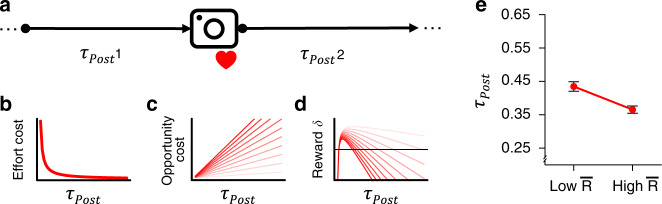
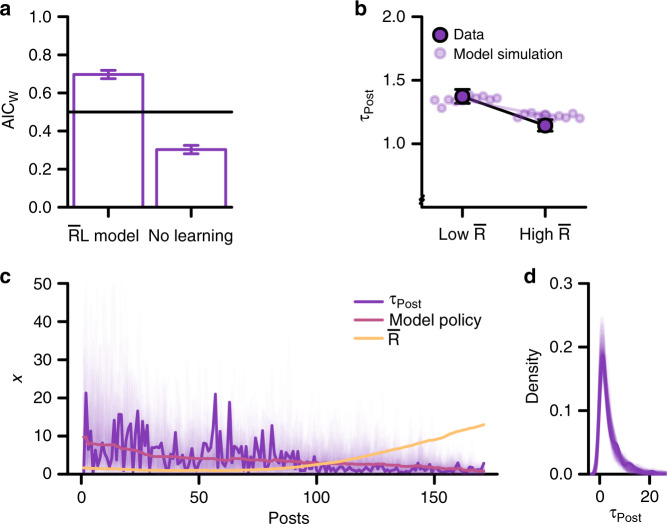
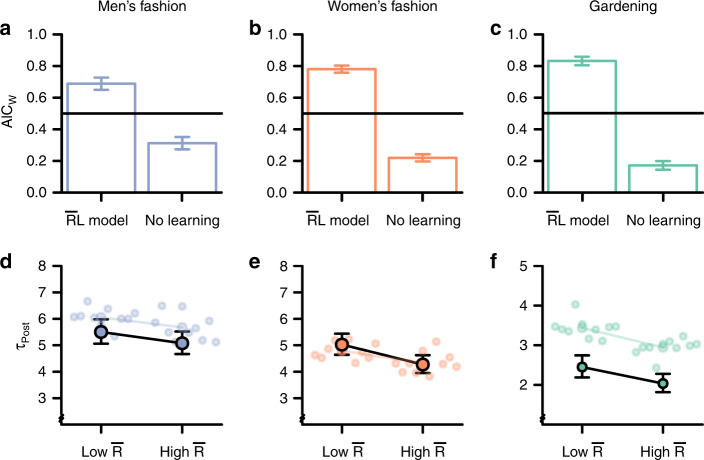
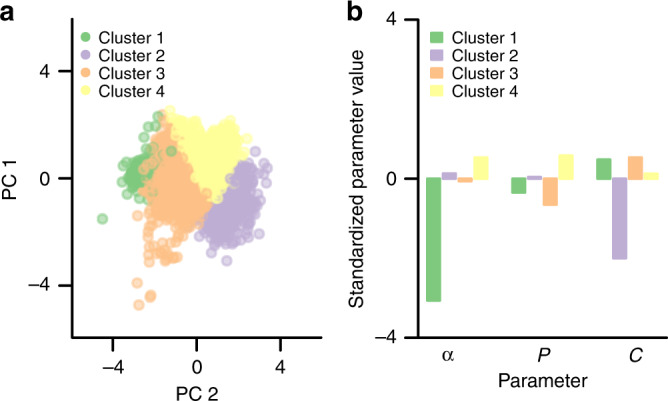
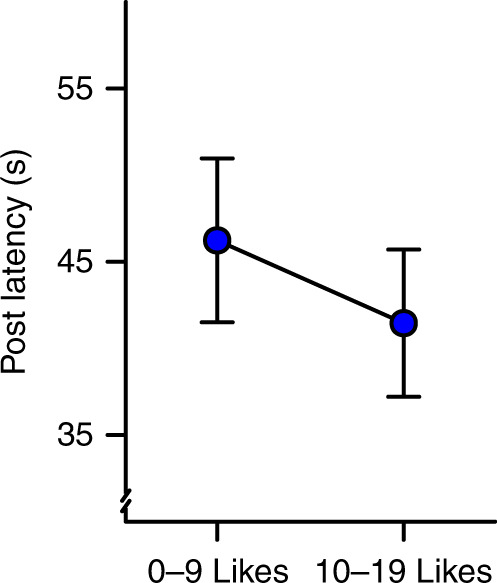
Social media has become a modern arena for human life, with billions of daily users worldwide. The intense popularity of social media is often attributed to a psychological need for social rewards (likes), portraying the online world as a Skinner Box for the modern human. Yet despite such portrayals, empirical evidence for social media engagement as reward-based behavior remains scant. Here, we apply a computational approach to directly test whether reward learning mechanisms contribute to social media behavior. We analyze over one million posts from over 4000 individuals on multiple social media platforms, using computational models based on reinforcement learning theory. Our results consistently show that human behavior on social media conforms qualitatively and quantitatively to the principles of reward learning. Specifically, social media users spaced their posts to maximize the average rate of accrued social rewards, in a manner subject to both the effort cost of posting and the opportunity cost of inaction. Results further reveal meaningful individual difference profiles in social reward learning on social media. Finally, an online experiment (n = 176), mimicking key aspects of social media, verifies that social rewards causally influence behavior as posited by our computational account. Together, these findings support a reward learning account of social media engagement and offer new insights into this emergent mode of modern human behavior.
Overview
The claims and statistics of this paper haven’t been checked yet.
Run the check — free, no account needed. It reads the open-access text and checks the sources it cites.
Integrity signals
Registry
Cites
Statistics
Figures
Verification
Claims the paper makes
The claims and statistics of this paper haven’t been checked yet.
Run the check — free, no account needed. It reads the open-access text and checks the sources it cites.
Claims other papers make about this one
Each is checked against this paper’s own text: does it say what the citing paper says it does?
The source backs part of the claim, not all of it — or backs it for a different population, condition or comparison.
In the citing paper
“Furthermore, the interval at which an algorithm rewards behavior influences how quickly it is repeated (Lindström et al., 2021).”
From Social Drivers and Algorithmic Mechanisms on Digital Media. (2024) · cites this paper as Lindström et al., 2021
Experimental — accuracy not yet measuredThe cited source says what the claim attributes to it.
In the citing paper
“Studies show that humans are susceptible to social feedback on digital media: Likes influence how quickly people post again (Lindström et al., 2021), whether or not they consider a post successful (Carr et al., 2018), and how happy, self-assured, and popular they feel after posting status updates (Rosenthal-von der Pütten et al., 2019; Zell & Moeller, 2018).”
From Social Drivers and Algorithmic Mechanisms on Digital Media. (2024) · cites this paper as Lindström et al., 2021
Self-check
Percentages, sums and reported differences re-computed from the paper’s own numbers.
The self-check needs the paper’s full text.
Citations
Cites
Reinforcement Learning: An Introduction
Sutton, R. S., & Barto, A. G. (1998) · IEEE Transactions on Neural Networks · doi:10.1109/tnn.1998.712192 · Cited by 27,225 · cited 3×
“As in Study 1, the estimated effect of R on posting latencies was stronger for individuals for whom the (cid:1) RL model provided a better fi t (see Supplementary Note 7).”
BackgroundMethodResultInfluentialReinforcement Learning: An Introduction
Sutton, R. S., & Barto, A. (2005) · IEEE Transactions on Neural Networks · doi:10.1109/tnn.2004.842673 · Cited by 25,268
lmerTest Package: Tests in Linear Mixed Effects Models
Kuznetsova, A., Brockhoff, P. B., & Christensen, R. H. B. (2017) · Journal of Statistical Software · doi:10.18637/jss.v082.i13 · Cited by 24,346
Advances in neural information processing systems 7
Cios, K. J., & Shields, M. E. (1997) · Neurocomputing · doi:10.1016/s0925-2312(97)90018-7 · Cited by 22,093
A theory of social comparison processes
Festinger, L. (1954) · Human Relations · doi:10.1177/001872675400700202 · Cited by 20,926
(1999) · Cited by 5,147
Centering predictor variables in cross-sectional multilevel models: A new look at an old issue.
Enders, C. K., & Tofighi, D. (2007) · Psychological Methods · doi:10.1037/1082-989x.12.2.121 · Cited by 4,462
NbClust : An R Package for Determining the Relevant Number of Clusters in a Data Set
Charrad, M., Ghazzali, N., Boiteau, V., & Niknafs, A. (2014) · Journal of Statistical Software · doi:10.18637/jss.v061.i06 · Cited by 3,396
AIC model selection using Akaike weights
Wagenmakers, E.-J., & Farrell, S. (2004) · Psychonomic Bulletin & Review · doi:10.3758/bf03206482 · Cited by 2,684
Herrnstein, R. J. (1970) · Journal of the Experimental Analysis of Behavior · doi:10.1901/jeab.1970.13-243 · Cited by 2,611
Lin, K.-Y., & Lu, H.-P. (2011) · Computers in Human Behavior · doi:10.1016/j.chb.2010.12.009 · Cited by 1,616
Social networking sites and addiction: Ten lessons learned
Kuss, D., & Griffiths, M. (2017) · International Journal of Environmental Research and Public Health · doi:10.3390/ijerph14030311 · Cited by 1,603
Emotion shapes the diffusion of moralized content in social networks
Brady, W. J., Wills, J. A., Jost, J. T., Tucker, J. A., & Van Bavel, J. J. (2017) · Proceedings of the National Academy of Sciences · doi:10.1073/pnas.1618923114 · Cited by 1,580
Bayesian model selection for group studies
Stephan, K. E., Penny, W. D., Daunizeau, J., Moran, R. J., & Friston, K. J. (2009) · NeuroImage · doi:10.1016/j.neuroimage.2009.03.025 · Cited by 1,423
Adaptive Coding of Reward Value by Dopamine Neurons
Tobler, P. N., Fiorillo, C. D., & Schultz, W. (2005) · Science · doi:10.1126/science.1105370 · Cited by 1,276
Self-citationPanel Data Econometrics in R : The plm Package
Croissant, Y., & Millo, G. (2008) · Journal of Statistical Software · doi:10.18637/jss.v027.i02 · Cited by 1,243
Online Social Network Site Addiction: A Comprehensive Review
Andreassen, C. S. (2015) · Current Addiction Reports · doi:10.1007/s40429-015-0056-9 · Cited by 1,212
Tonic dopamine: Opportunity costs and the control of response vigor
Niv, Y., Daw, N. D., Joel, D., & Dayan, P. (2007) · Psychopharmacology · doi:10.1007/s00213-006-0502-4 · Cited by 1,133
The like economy: Social buttons and the data-intensive web
Gerlitz, C., & Helmond, A. (2013) · New Media & Society · doi:10.1177/1461444812472322 · Cited by 871
The neurobiology of rewards and values in social decision making
Ruff, C. C., & Fehr, E. (2014) · Nature reviews. Neuroscience · doi:10.1038/nrn3776 · Cited by 716
Genetic triple dissociation reveals multiple roles for dopamine in reinforcement learning
Frank, M. J., Moustafa, A. A., Haughey, H. M., Curran, T., & Hutchison, K. E. (2007) · Proceedings of the National Academy of Sciences · doi:10.1073/pnas.0706111104 · Cited by 696
Social Comparison Affects Reward-Related Brain Activity in the Human Ventral Striatum
Fließbach, K., Weber, B., Trautner, P., Dohmen, T., Sunde, U., Elger, C. E., & Falk, A. (2007) · Science · doi:10.1126/science.1145876 · Cited by 646
Sherman, L. E., Payton, A. A., Hernandez, L. M., Greenfield, P. M., & Dapretto, M. (2016) · Psychological Science · doi:10.1177/0956797616645673 · Cited by 627
Moral outrage in the digital age
Crockett, M. J. (2017) · Nature Human Behaviour · doi:10.1038/s41562-017-0213-3 · Cited by 618
Media use and brain development during adolescence
Crone, E. A., & Konijn, E. A. (2018) · Nature Communications · doi:10.1038/s41467-018-03126-x · Cited by 464
The Importance of Falsification in Computational Cognitive Modeling
Palminteri, S., Wyart, V., & Koechlin, E. (2017) · Trends in Cognitive Sciences · doi:10.1016/j.tics.2017.03.011 · Cited by 448
One click, many meanings: interpreting paralinguistic digital affordances in social media
Hayes, R. A., Carr, C. T., & Wohn, D. Y. (2016) · Journal of Broadcasting & Electronic Media · doi:10.1080/08838151.2015.1127248 · Cited by 346
The Emerging Neuroscience of Social Media
Meshi, D., Tamir, D. I., & Heekeren, H. R. (2015) · Trends in Cognitive Sciences · doi:10.1016/j.tics.2015.09.004 · Cited by 322
The neural and computational systems of social learning
Olsson, A., Knapska, E., & Lindström, B. (2020) · Nature reviews. Neuroscience · doi:10.1038/s41583-020-0276-4 · Cited by 285
Self-citationvan den Bos, W., Cohen, M. X., Kahnt, T., & Crone, E. A. (2012) · Cerebral Cortex · doi:10.1093/cercor/bhr198 · Cited by 276
The social brain and reward: Social information processing in the human striatum
Bhanji, J. P., & Delgado, M. R. (2014) · WIREs Cognitive Science · doi:10.1002/wcs.1266 · Cited by 256
Learning the opportunity cost of time in a patch-foraging task
Constantino, S. M., & Daw, N. D. (2015) · Cognitive Affective & Behavioral Neuroscience · doi:10.3758/s13415-015-0350-y · Cited by 253
A normative perspective on motivation
NIV, Y., JOEL, D., & DAYAN, P. (2006) · Trends in Cognitive Sciences · doi:10.1016/j.tics.2006.06.010 · Cited by 251
What the brain ‘Likes’: neural correlates of providing feedback on social media
Sherman, L. E., Hernandez, L. M., Greenfield, P. M., & Dapretto, M. (2018) · Social Cognitive and Affective Neuroscience · doi:10.1093/scan/nsy051 · Cited by 240
Dopamine Modulates Reward-Related Vigor
Beierholm, U., Guitart‐Masip, M., Economides, M., Chowdhury, R., Düzel, E., Dolan, R. J., & Dayan, P. (2013) · Neuropsychopharmacology · doi:10.1038/npp.2013.48 · Cited by 227
Landers, R. N., Brusso, R. C., Cavanaugh, K. J., & Collmus, A. B. (2016) · Psychological Methods · doi:10.1037/met0000081 · Cited by 195
Persuasion, Influence, and Value: Perspectives from Communication and Social Neuroscience
Falk, E. B., & Scholz, C. (2017) · Annual Review of Psychology · doi:10.1146/annurev-psych-122216-011821 · Cited by 192
Niv, Y. (2007) · Annals of the New York Academy of Sciences · doi:10.1196/annals.1390.018 · Cited by 187
Online popularity and topical interests through the lens of instagram
Ferrara, E., Interdonato, R., & Tagarelli, A. (2014) · ACM Conference on Hypertext and Social Media (HT) · doi:10.1145/2631775.2631808 · Cited by 177 · cited 3×
“” In Study 1 ( N Users = 2,039), we tested our hypothesis in a large dataset of Instagram posts 30 (average number of posts per individual = 418, see Supplementary Table 1 for additional descriptive statistics).”
MethodInfluentialAre you happy for me … on Facebook? The potential importance of “likes” and comments
Zell, A. L., & Moeller, L. (2017) · Computers in Human Behavior · doi:10.1016/j.chb.2017.08.050 · Cited by 176
The costs and benefits of brain dopamine for cognitive control
Cools, R. (2016) · Wiley Interdisciplinary Reviews Cognitive Science · doi:10.1002/wcs.1401 · Cited by 164
How Community Feedback Shapes User Behavior
Cheng, J., Danescu-Niculescu-Mizil, C., & Leskovec, J. (2014) · Proceedings of the International AAAI Conference on Web and Social Media · doi:10.1609/icwsm.v8i1.14518 · Cited by 151
Social Cognition 2.0: An Interactive Memory Systems Account
Amodio, D. M. (2019) · Trends in Cognitive Sciences · doi:10.1016/j.tics.2018.10.002 · Cited by 145
Self-citationEstimating peer effects in networks with peer encouragement designs
Eckles, D., Kizilcec, R. F., & Bakshy, E. (2016) · Proceedings of the National Academy of Sciences · doi:10.1073/pnas.1511201113 · Cited by 127
Gu, R., Huang, W., Camilleri, J. A., Xu, P., Wei, P., Eickhoff, S. B., & Feng, C. (2019) · Neuroscience & Biobehavioral Reviews · doi:10.1016/j.neubiorev.2019.02.017 · Cited by 127
Rosenthal-von der Pütten, A. M., Hastall, M. R., Köcher, S., Meske, C., Heinrich, T., Labrenz, F., & Ocklenburg, S. (2019) · Computers in Human Behavior · doi:10.1016/j.chb.2018.10.017 · Cited by 126
Wohn, D. Y., Carr, C. T., & Hayes, R. A. (2016) · Cyberpsychology Behavior and Social Networking · doi:10.1089/cyber.2016.0162 · Cited by 123
Structured, uncertainty-driven exploration in real-world consumer choice
Schulz, E., Bhui, R., Love, B. C., Brier, B., Todd, M. T., & Gershman, S. J. (2019) · Proceedings of the National Academy of Sciences · doi:10.1073/pnas.1821028116 · Cited by 111 · cited 1×
“To allow for analyses of learning, we excluded all individuals with less than 10 posts 50 .”
Computational neuroscience approaches to social cognition
Hackel, L. M., & Amodio, D. M. (2018) · Current Opinion in Psychology · doi:10.1016/j.copsyc.2018.09.001 · Cited by 91
Self-citationAffect and Decision Making: Insights and Predictions from Computational Models
Roberts, I. D., & Hutcherson, C. A. C. (2019) · Trends in Cognitive Sciences · doi:10.1016/j.tics.2019.04.005 · Cited by 84
Patzelt, E. H., Hartley, C. A., & Gershman, S. J. (2018) · Personality Neuroscience · doi:10.1017/pen.2018.14 · Cited by 81
Personalized ad recommendation systems for life-time value optimization with guarantees
Theocharous, G., Thomas, P. S., & Ghavamzadeh, M. (2015) · International Conference on Artificial Intelligence · Cited by 74
Ad Recommendation Systems for Life-Time Value Optimization
Theocharous, G., Thomas, P. S., & Ghavamzadeh, M. (2015) · International World Wide Web Conference (WWW) · doi:10.1145/2740908.2741998 · Cited by 59
Worth its Weight in Likes: Towards Detecting Fake Likes on Instagram
Sen, I., Aggarwal, A., Mian, S., Singh, S., Kumaraguru, P., & Datta, A. (2018) · Proceedings of the 10th ACM Conference on Web Science · doi:10.1145/3201064.3201105 · Cited by 52 · cited 1×
“However, because there are signi fi cant economic motives on Instagram and similar platforms 31 , an assessment of reward learning on Instagram could be limited to some extent by the possibility of fraudulent accounts and “ fake likes, ” among other strategic uses 32 .”
BackgroundCarr, C. T., Hayes, R. A., & Sumner, E. M. (2018) · Communication Research Reports · doi:10.1080/08824096.2017.1409618 · Cited by 38
Changes in Engagement Before and After Posting to Facebook
Grinberg, N., Dow, P. A., Adamic, L. A., & Naaman, M. (2016) · CHI Conference on Human Factors in Computing Systems · doi:10.1145/2858036.2858501 · Cited by 36
Understanding Feedback Expectations on Facebook
Grinberg, N., Kalyanaraman, S., Adamic, L. A., & Naaman, M. (2017) · ACM Conference on Computer Supported Cooperative Work (CSCW) · doi:10.1145/2998181.2998320 · Cited by 32
The effects of feedback on human behavior in social media: an inverse reinforcement learning model
Das, S., & Lavoie, A. (2014) · doi:10.5555/2615731.2615837 · Cited by 30
Lindström, B., & Olsson, A. (2015) · Journal of Experimental Psychology General · doi:10.1037/xge0000071 · Cited by 27 · cited 1×
“…framework provides a plausible mechanistic basis for such processes, and thereby further expand the scope of simple reinforcement learning mechanisms for explaining see-mingly complex social behaviors, such as social exclusion 38 , behavioral traditions 46 , and socio-cultural learning 47 .”
BackgroundSelf-citationIncidental ostracism emerges from simple learning mechanisms
Lindström, B., & Tobler, P. N. (2018) · Nature Human Behaviour · doi:10.1038/s41562-018-0355-y · Cited by 27
Self-citation
Cited by
Sorted by citations
Citizens Versus the Internet: Confronting Digital Challenges With Cognitive Tools
Kozyreva, A., Lewandowsky, S., & Hertwig, R. (2020) · Psychological Science in the Public Interest · doi:10.1177/1529100620946707 · Cited by 479
Mechanisms linking social media use to adolescent mental health vulnerability
Orben, A., Meier, A., Dalgleish, T., & Blakemore, S.-J. (2024) · Nature Reviews Psychology · doi:10.1038/s44159-024-00307-y · Cited by 220
“This result aligns with a reinforcement learning modelling study of Instagram data, which found that the likes a user receives on their own posts become less valuable and less predictive of future posting behaviour if others in their network receive more likes on their posts 160 .”
Social Drivers and Algorithmic Mechanisms on Digital Media.
Metzler, H., & Garcia, D. (2024) · Perspectives on Psychological Science · doi:10.1177/17456916231185057 · Cited by 204
“Studies show that humans are susceptible to social feedback on digital media: Likes influence how quickly people post again (Lindström et al., 2021), whether or not they consider a post successful (Carr et al., 2018), and how happy, self-assured, and popular they feel after posting status updates…”
BackgroundAlgorithm-mediated social learning in online social networks
Brady, W. J., Jackson, J. C., Lindström, B., & Crockett, M. J. (2023) · Trends in Cognitive Sciences · doi:10.1016/j.tics.2023.06.008 · Cited by 132
Self-citationSocial media and well-being: A methodological perspective
Parry, D. A., Fisher, J. T., Mieczkowski, H., Sewall, C. J. R., & Davidson, B. I. (2021) · Current Opinion in Psychology · doi:10.1016/j.copsyc.2021.11.005 · Cited by 138
Metadata
- Authors
- Lindström, B., Bellander, M., Schultner, D. T., Chang, A., Tobler, P. N., & Amodio, D. M.
- Affiliations
- University of Amsterdam (NL)
- Karolinska Institutet (SE)
- Boston University (US)
- University of Zurich (CH)
- New York University (US)
- Corresponding author
- Lindström, Björn
- ORCID
- Venue
- Nature Communications
- Published
- 2021-02-26
- Volume
- 12
- Issue
- 1
- Pages
- 1311-1311
- ISSN
- 2041-1723 (ISSN-L)
- PMC
- PMC7910435
- OpenAlex
- W3130507978
- Cited by
- 185
- References
- 61
- Citations by year
- 2026: 49 · 2025: 43 · 2024: 33 · 2023: 33 · 2022: 18 · 2021: 8
- FWCI
- 31.88
- Type
- journal article
- Language
- en
- Update notices
- correction (2021-03-16)
- Open access
- gold
- doi.org
- Locations
- Nature Communications (publishedVersion, cc-by)
- PubMed Central (publishedVersion, cc-by)
- PubMed (publishedVersion)
- VU Research Portal (publishedVersion, other-oa)
- UvA-DARE (University of Amsterdam) (acceptedVersion, cc-by)
- DOAJ (DOAJ: Directory of Open Access Journals) (submittedVersion, cc-by-sa)
- Zurich Open Repository and Archive (University of Zurich) (submittedVersion, cc-by)
- Data Archiving and Networked Services (DANS) (submittedVersion, other-oa)
- Funders
- National Science Foundation
- Schweizerischer Nationalfonds zur Förderung der Wissenschaftlichen Forschung (100019, 176016)
- Nederlandse Organisatie voor Wetenschappelijk Onderzoek (016.Vici.185.058)
- Topics
- Social Sciences › Sociology and Political Science › Impact of Technology on Adolescents
- Social Sciences › Decision Sciences › General Decision Sciences › Decision-Making and Behavioral Economics
- Social Sciences › Communication › Digital Media and Philosophy
- Keywords
- social media engagement, reward learning, reinforcement learning, social reward, likes, posting behavior, effort cost, opportunity cost, individual differences, computational modeling, online experiments
- MeSH terms
- Female, Humans, Learning, Male, Reinforcement, Psychology, Reward, Social Behavior, Social Media
About these checks
Registry, retraction, Cites and statistics results are computed, not judged, with one exception: a printed reference that no index lists is read once by a model before it counts as a citation error. Claims are extracted by a model and kept only when their quote appears verbatim in the text; each cited source is then checked, with a model’s help, for whether it says what the claim relies on. Those verdicts can be wrong — read the claim’s quote and the cited source before relying on one.
Statistics and arithmetic are recomputed, not judged.
Confidence bands are shown only for fields calibrated on our annotated test set. None is calibrated yet, so no band is shown.
What counts as a claim ›How we measure confidence ›How we check this ›
Are you an author, or do you see a problem with this page? Request a review
