

Single-electron operations in a foundry-fabricated array of quantum dots
Open accessThe DOI matches its Crossref record; 44 of the 44 references it cites were found in a registry or an index.
Abstract
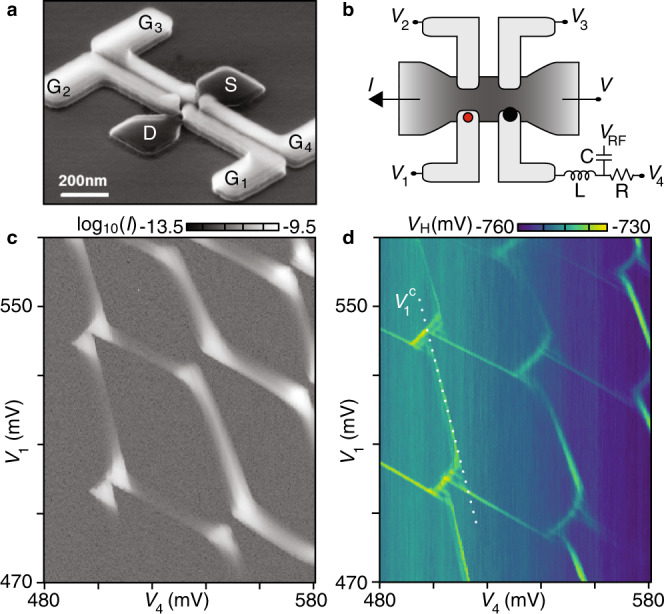
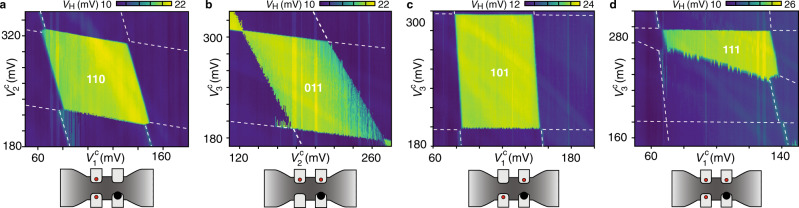
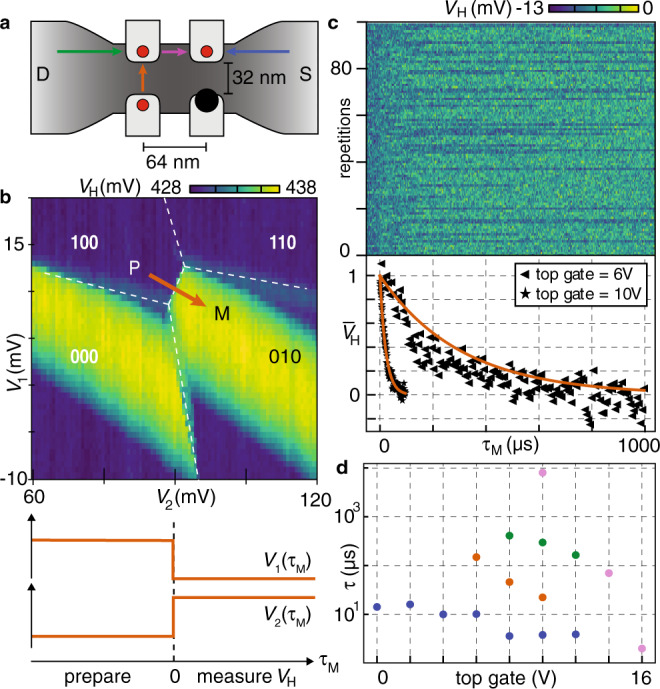
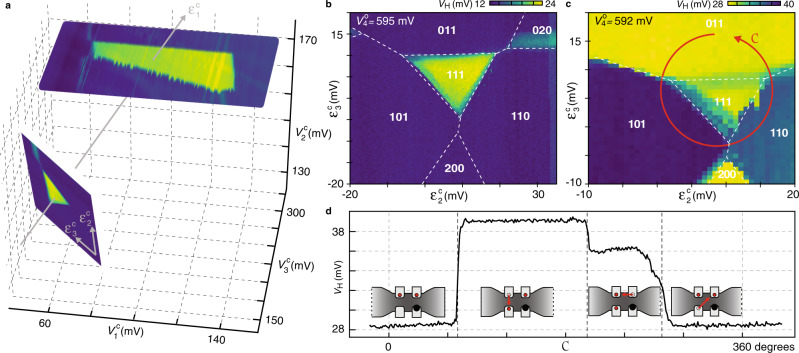
Silicon quantum dots are attractive for the implementation of large spin-based quantum processors in part due to prospects of industrial foundry fabrication. However, the large effective mass associated with electrons in silicon traditionally limits single-electron operations to devices fabricated in customized academic clean rooms. Here, we demonstrate single-electron occupations in all four quantum dots of a 2 x 2 split-gate silicon device fabricated entirely by 300-mm-wafer foundry processes. By applying gate-voltage pulses while performing high-frequency reflectometry off one gate electrode, we perform single-electron operations within the array that demonstrate single-shot detection of electron tunneling and an overall adjustability of tunneling times by a global top gate electrode. Lastly, we use the two-dimensional aspect of the quantum dot array to exchange two electrons by spatial permutation, which may find applications in permutation-based quantum algorithms.
Overview
The claims and statistics of this paper haven’t been checked yet.
Free: it reads the open-access text and checks the first 5 claims that cite a source we can check. Create a free account to check every claim.
Integrity signals
Registry
Cites
Statistics
Figures
Verification
Claims the paper makes
The claims and statistics of this paper haven’t been checked yet.
Free: it reads the open-access text and checks the first 5 claims that cite a source we can check. Create a free account to check every claim.
Claims other papers make about this one
Each is checked against this paper’s own text: does it say what the citing paper says it does?
The source backs part of the claim, not all of it — or backs it for a different population, condition or comparison.
In the citing paper
“More fully industry-compatible devices in Si-MOS have also been demonstrated25,26 but are at present limited by high levels of disorder owing to the qubits being formed directly at the Si/SiO2 interface.”
From Probing single electrons across 300-mm spin qubit wafers (2024) · cites this paper as [25]
Experimental — accuracy not yet measured
Self-check
Percentages, sums and reported differences re-computed from the paper’s own numbers.
The self-check needs the paper’s full text.
Citations
Cites
Single-shot read-out of an individual electron spin in a quantum dot
Elzerman, J. M., Hanson, R., Willems van Beveren, L. H., Witkamp, B., Vandersypen, L. M. K., & Kouwenhoven, L. P. (2004) · Nature · doi:10.1038/nature02693 · Cited by 1,679 · cited 1×
“In future experiments, a faster execution of C combined with spin-selective readout 28 may allow a more direct con fi rma-tion of the electrons ’ shuttling paths within the array.”
MethodA two-qubit logic gate in silicon
Veldhorst, M., Yang, C. H., Hwang, J. C. C., Huang, W., Dehollain, J. P., Muhonen, J. T., Simmons, S., Laucht, A., Hudson, F. E., Itoh, K. M., et al. (2015) · Nature · doi:10.1038/nature15263 · Cited by 919
A quantum-dot spin qubit with coherence limited by charge noise and fidelity higher than 99.9%
Yoneda, J., Takeda, K., Otsuka, T., Nakajima, T., Delbecq, M. R., Allison, G., Honda, T., Kodera, T., Oda, S., Hoshi, Y., et al. (2018) · Nature Nanotechnology · doi:10.1038/s41565-017-0014-x · Cited by 900
A programmable two-qubit quantum processor in silicon
Watson, T. F., Philips, S. G. J., Kawakami, E., Ward, D. R., Scarlino, P., Veldhorst, M., Savage, D. E., Lagally, M. G., Friesen, M., Coppersmith, S. N., et al. (2018) · Nature · doi:10.1038/nature25766 · Cited by 741
Storing quantum information for 30 seconds in a nanoelectronic device
Muhonen, J. T., Dehollain, J. P., Laucht, A., Hudson, F. E., Kalra, R., Sekiguchi, T., Itoh, K. M., Jamieson, D. N., McCallum, J. C., Dzurak, A. S., et al. (2014) · Nature Nanotechnology · doi:10.1038/nnano.2014.211 · Cited by 661
Interfacing spin qubits in quantum dots and donors—hot, dense, and coherent
Vandersypen, L. M. K., Bluhm, H., Clarke, J. S., Dzurak, A. S., Ishihara, R., Morello, A., Reilly, D. J., Schreiber, L. R., & Veldhorst, M. (2017) · npj Quantum Information · doi:10.1038/s41534-017-0038-y · Cited by 624
Maurand, R., Jehl, X., Kotekar-Patil, D., Corna, A., Bohuslavskyi, H., Laviéville, R., Hutin, L., Barraud, S., Vinet, M., Sanquer, M., et al. (2016) · Nature Communications · doi:10.1038/ncomms13575 · Cited by 604 · cited 4×
“The compact form factor of such arrays, whose foundry fabrication can be extended to larger 2 × N arrays, along with the recent demonstration of spin control 10 – 12 and spin readout 13,14 , paves the way for dense qubit arrays for quantum computation and simulation 15 .”
BackgroundMethodInfluentialSelf-citationResonantly driven CNOT gate for electron spins
Zajac, D. M., Sigillito, A. J., Russ, M., Borjans, F., Taylor, J. M., Burkard, G., & Petta, J. R. (2018) · Science · doi:10.1126/science.aao5965 · Cited by 552 · cited 1×
“ilicon spin qubits have achieved high-fi delity one-and two-qubit gates 1 – 5 , above error-correction thresholds 6 , promising an industrial route to fault-tolerant quantum computation.”
BackgroundCoherent singlet-triplet oscillations in a silicon-based double quantum dot
Maune, B. M., Borselli, M. G., Huang, B., Ladd, T. D., Deelman, P. W., Holabird, K. S., Kiselev, A. A., Alvarado-Rodriguez, I., Ross, R. S., Schmitz, A. E., et al. (2012) · Nature · doi:10.1038/nature10707 · Cited by 528 · cited 1×
“In fact, a two-dimensional triple dot, as in our device, is the smallest array that allows the exchange of two isolated electrons (Heisenberg spin exchange, as demonstrated in linear arrays 25 , requires precisely timed wavefunction overlap).”
BackgroundElectrical control of a long-lived spin qubit in a Si/SiGe quantum dot
Kawakami, E., Scarlino, P., Ward, D. R., Braakman, F. R., Savage, D. E., Lagally, M. G., Friesen, M., Coppersmith, S. N., Eriksson, M. A., & Vandersypen, L. M. K. (2014) · Nature Nanotechnology · doi:10.1038/nnano.2014.153 · Cited by 504 · cited 1×
“…of single-electron charge control is impressive for a recon fi gurable, silicon-based multi-dot circuit, it is not obvious how coherent single-spin control (e.g., via micromagnetic fi eld gradients 20 or spin – orbit coupling 12 ) can most easily be implemented in these foundry-fabricated structures.”
Background
Cited by
Burkard, G., Ladd, T. D., Pan, A., Nichol, J. M., & Petta, J. R. (2023) · Reviews of Modern Physics · doi:10.1103/revmodphys.95.025003 · Cited by 715
Materials challenges and opportunities for quantum computing hardware
de Leon, N. P., Itoh, K. M., Kim, D., Mehta, K. K., Northup, T. E., Paik, H., Palmer, B. S., Samarth, N., Sangtawesin, S., & Steuerman, D. W. (2021) · Science · doi:10.1126/science.abb2823 · Cited by 710
Semiconductor qubits in practice
Chatterjee, A., Stevenson, P., De Franceschi, S., Morello, A., de Leon, N. P., & Kuemmeth, F. (2021) · Nature Reviews Physics · doi:10.1038/s42254-021-00283-9 · Cited by 359
Self-citationQubits made by advanced semiconductor manufacturing
Zwerver, A. M. J., Krähenmann, T., Watson, T. F., Lampert, L., George, H. C., Pillarisetty, R., Bojarski, S. A., Amin, P., Amitonov, S. V., Boter, J. M., et al. (2022) · Nature Electronics · doi:10.1038/s41928-022-00727-9 · Cited by 364
Scaling silicon-based quantum computing using CMOS technology
Gonzalez-Zalba, M. F., de Franceschi, S., Charbon, E., Meunier, T., Vinet, M., & Dzurak, A. S. (2021) · Nature Electronics · doi:10.1038/s41928-021-00681-y · Cited by 272
Self-citationGenomic resources in plant breeding for sustainable agriculture
Thudi, M., Palakurthi, R., Schnable, J. C., Chitikineni, A., Dreisigacker, S., Mace, E., Srivastava, R. K., Satyavathi, C. T., Odeny, D., Tiwari, V. K., et al. (2021) · Journal of Plant Physiology · doi:10.1016/j.jplph.2020.153351 · Cited by 177
Review of performance metrics of spin qubits in gated semiconducting nanostructures
Stano, P., & Loss, D. (2022) · Nature Reviews Physics · doi:10.1038/s42254-022-00484-w · Cited by 165
Probing single electrons across 300-mm spin qubit wafers
Neyens, S., Zietz, O. K., Watson, T. F., Luthi, F., Nethwewala, A., George, H. C., Henry, E., Islam, M., Wagner, A. J., Borjans, F., et al. (2024) · Nature · doi:10.1038/s41586-024-07275-6 · Cited by 178
“More fully industry-compatible devices in Si-MOS have also been demonstrated 25,26 but are at present limited by high levels of disorder owing to the qubits being formed directly at the Si/SiO 2 interface.”
Noisy intermediate-scale quantum computers
Cheng, B., Deng, X., Gu, X. Q., He, Y., Hu, G., Huang, P., Li, J., Lin, B., Lu, D., Lu, Y., et al. (2023) · Frontiers of Physics · doi:10.1007/s11467-022-1249-z · Cited by 182
Universal logic with encoded spin qubits in silicon
Weinstein, A. J., Reed, M. D., Jones, A. M., Andrews, R. W., Barnes, D., Blumoff, J. Z., Euliss, L. E., Eng, K., Fong, B. H., Ha, S. D., et al. (2023) · Nature · doi:10.1038/s41586-023-05777-3 · Cited by 124
“Fabrication of larger arrays should also follow yield-enhancement trajectories established by the silicon-based classical microelectronics industry as designs are improved [6, 7].”
BackgroundCharge-noise spectroscopy of Si/SiGe quantum dots via dynamically-decoupled exchange oscillations
Connors, E. J., Nelson, J., Edge, L. F., & Nichol, J. M. (2022) · Nature Communications · doi:10.1038/s41467-022-28519-x · Cited by 122
“Because effective sampling rate is therefore not constant, we use the Lomb-Scargle method [8], which calculates spectra of unevenly-sampled discrete signals.”
MethodProbing quantum devices with radio-frequency reflectometry
Vigneau, F., Fedele, F., Chatterjee, A., Reilly, D. J., Kuemmeth, F., González-Zalba, M. F., Laird, E. A., & Ares, N. (2023) · Applied Physics Reviews · doi:10.1063/5.0088229 · Cited by 183
Self-citationA single hole spin with enhanced coherence in natural silicon
Piot, N., Brun, B., Schmitt, V., Zihlmann, S., Michal, V. P., Aprá, A., Abadillo-Uriel, J. C., Jehl, X., Bertrand, B., Niebojewski, H., et al. (2022) · Nature Nanotechnology · doi:10.1038/s41565-022-01196-z · Cited by 146
Self-citationA cryo-CMOS chip that integrates silicon quantum dots and multiplexed dispersive readout electronics
Ruffino, A., Yang, T.-Y., Michniewicz, J., Peng, Y., Charbon, E., & González-Zalba, M. F. (2021) · Nature Electronics · doi:10.1038/s41928-021-00687-6 · Cited by 139
Simultaneous single-qubit driving of semiconductor spin qubits at the fault-tolerant threshold
Lawrie, W. I. L., Rimbach-Russ, M., van Riggelen, F., Hendrickx, N. W., de Snoo, S. L., Sammak, A., Scappucci, G., Helsen, J., & Veldhorst, M. (2023) · Nature Communications · doi:10.1038/s41467-023-39334-3 · Cited by 138
“In both silicon and germanium [5, 6], two-dimensional approaches to scale-up quantum dots have been the focus of multiple recent efforts [7, 8].”
BackgroundColloquium : Advances in automation of quantum dot devices control
Zwolak, J. P., & Taylor, J. M. (2023) · Reviews of Modern Physics · doi:10.1103/revmodphys.95.011006 · Cited by 87
Fast and High-Fidelity State Preparation and Measurement in Triple-Quantum-Dot Spin Qubits
Blumoff, J., Pan, A., Keating, T., Andrews, R. W., Barnes, D. W., Brecht, T., Croke, E. T., Euliss, L. E., Fast, J., Jackson, C. A. C., et al. (2022) · PRX Quantum · doi:10.1103/prxquantum.3.010352 · Cited by 91
Fast High-Fidelity Single-Shot Readout of Spins in Silicon Using a Single-Electron Box
Oakes, G. A., Ciriano-Tejel, V. N., Wise, D. F., Fogarty, M. A., Lundberg, T., Lainé, C., Schaal, S., Martins, F., Ibberson, D. J., Hutin, L., et al. (2023) · Physical Review X · doi:10.1103/physrevx.13.011023 · Cited by 90
“In setup 1, the interdot and dot-to-reservoir tunneling rates can be modified by the dc voltage applied to a top metallic gate [20].”
BackgroundSelf-citationAlternatives to aluminum gates for silicon quantum devices: defects and strain.
Stein, R. M., Barcikowski, Z. S., Pookpanratana, S. J., Pomeroy, J. M., & Stewart, M. D. (2021) · PubMed · doi:10.1063/5.0036520 · Cited by 49
Silicon spin qubits from laboratory to industry
Michielis, M. D., Ferraro, E., Prati, E., Hutin, L., Bertrand, B., Charbon, E., Ibberson, D. J., & González-Zalba, M. F. (2023) · Journal of Physics D Applied Physics · doi:10.1088/1361-6463/acd8c7 · Cited by 64
Self-citationArtificial Intelligence in Medicine Using Quantum Computing in the Future of Healthcare
Davids, J., Lidströmer, N., & Ashrafian, H. (2022) · Springer eBooks · doi:10.1007/978-3-030-64573-1_338 · Cited by 47
Parity and Singlet-Triplet High-Fidelity Readout in a Silicon Double Quantum Dot at 0.5 K
Niegemann, D. J., El-Homsy, V., Jadot, B., Nurizzo, M., Paz, B. C., Chanrion, E., Dartiailh, M., Klemt, B., Thiney, V., Bäuerle, C., et al. (2022) · PRX Quantum · doi:10.1103/prxquantum.3.040335 · Cited by 41
Self-citationSpin Digitizer for High-Fidelity Readout of a Cavity-Coupled Silicon Triple Quantum Dot
Borjans, F., Mi, X., & Petta, J. R. (2021) · Physical Review Applied · doi:10.1103/physrevapplied.15.044052 · Cited by 39
Detection of breeding signatures in wheat using a linkage disequilibrium-corrected mapping approach
Dadshani, S., Mathew, B., Ballvora, A., Mason, A. S., & Léon, J. (2021) · Scientific Reports · doi:10.1038/s41598-021-85226-1 · Cited by 30
Electrical Control of Uniformity in Quantum Dot Devices
Meyer, M., Déprez, C., van Abswoude, T. R., Meijer, I. N., Liu, D., Wang, C.-A., Karwal, S., Oosterhout, S. D., Borsoi, F., Sammak, A., et al. (2023) · Nano Letters · doi:10.1021/acs.nanolett.2c04446 · Cited by 33
“Spin qubits can be operated at comparatively high temperatures [16–18] and their compatibility with semiconductor technologies spurred the realization of qubits made in industrial foundries [19, 20].”
Klemt, B., El-Homsy, V., Nurizzo, M., Hamonic, P., Martínez, B., Paz, B. C., Spence, C., Dartiailh, M., Jadot, B., Chanrion, E., et al. (2023) · npj Quantum Information · doi:10.1038/s41534-023-00776-8 · Cited by 37
Self-citationSingle-Electron Spin Qubits in Silicon for Quantum Computing
Hu, G., Huang, W., Cai, R., Wang, L., Yang, C. H., Cao, G., Xue, X., Huang, P., & He, Y. (2025) · Intelligent Computing · doi:10.34133/icomputing.0115 · Cited by 33
Crawford, O., Cruise, J. R., Mertig, N., & González-Zalba, M. F. (2023) · npj Quantum Information · doi:10.1038/s41534-023-00679-8 · Cited by 31
Tuning Arrays with Rays: Physics-Informed Tuning of Quantum Dot Charge States
Ziegler, J., Luthi, F., Ramsey, M., Borjans, F., Zheng, G., & Zwolak, J. P. (2023) · Physical Review Applied · doi:10.1103/physrevapplied.20.034067 · Cited by 42
“Advantages of this platform include a small device footprint [4–7], compatibility with industrial semiconductor fabrication techniques [4–6], and potential for operation with baseband pulses [7].”
BackgroundA Comparison of the Adoption of Genomic Selection Across Different Breeding Institutions
Gholami, M., Wimmer, V., Sansaloni, C., Petroli, C. D., Hearne, S., Covarrubias‐Pazaran, G., Rensing, S. A., Heise, J., Pérez‐Rodríguez, P., Dreisigacker, S., et al. (2021) · Frontiers in Plant Science · doi:10.3389/fpls.2021.728567 · Cited by 18
Single-Shot Readout of Multiple Donor Electron Spins with a Gate-Based Sensor
Hogg, M., Pakkiam, P., Gorman, S. K., Timofeev, A. V., Chung, Y., Gulati, G. K., House, M. G., & Simmons, M. Y. (2023) · PRX Quantum · doi:10.1103/prxquantum.4.010319 · Cited by 21
Recent advances in CRISPR technologies for genome editing
Song, M., & Koo, T. (2021) · Archives of Pharmacal Research · doi:10.1007/s12272-021-01336-4 · Cited by 18
Scalable on-chip multiplexing of silicon single and double quantum dots
Bohuslavskyi, H., Ronzani, A., Hätinen, J., Rantala, A., Shchepetov, A., Koppinen, P. J., Lehtinen, J. S., & Prunnila, M. (2024) · Communications Physics · doi:10.1038/s42005-024-01806-3 · Cited by 25
“…recent demonstration of SiMOS electron spin qubit quantum dot devices on 300 mm wafers with S e (1 Hz) as low as 3.6 (0.6) μeV/√Hz with lever arm 𝛼 = 0.3 (0.1) eV/V measured at mK temperatures that used Poly-Si/ SiO 2 /Si MOS stack strongly supports the “all-silicon” gate-stack approach [50,51] .”
InfluentialSelf-citationAutonomous Estimation of High-Dimensional Coulomb Diamonds from Sparse Measurements
Chatterjee, A., Ansaloni, F., Rasmussen, T., Brovang, B., Fedele, F., Bohuslavskyi, H., Krause, O., & Kuemmeth, F. (2022) · Physical Review Applied · doi:10.1103/physrevapplied.18.064040 · Cited by 18
“[10, 24] for details).”
InfluentialSelf-citationSingle-Electron Occupation in Quantum Dot Arrays at Selectable Plunger Gate Voltage
Meyer, M., Déprez, C., Meijer, I. N., Unseld, F. K., Karwal, S., Sammak, A., Scappucci, G., Vandersypen, L. M. K., & Veldhorst, M. (2023) · Nano Letters · doi:10.1021/acs.nanolett.3c03349 · Cited by 17
Meunier, T., Daval, N., Perruchot, F., & Vinet, M. (2025) · The European Physical Journal A · doi:10.1140/epja/s10050-025-01514-8 · Cited by 15
“For VLSI-compatible devices, linear and bilinear quantum dot arrays were demonstrated in FD-SOI [52,53].”
Self-citationSecchi, A., Bellentani, L., Bertoni, A., & Troiani, F. (2021) · Physical review. B./Physical review. B · doi:10.1103/physrevb.104.035302 · Cited by 12
Autonomous bootstrapping of quantum dot devices
Zubchenko, A., Middlebrooks, D., Rasmussen, T., Lausen, L., Kuemmeth, F., Chatterjee, A., & Zwolak, J. P. (2025) · Physical Review Applied · doi:10.1103/physrevapplied.23.014072 · Cited by 20
Self-citationContribution of Landraces in Wheat Breeding
Nadeem, M. A., Yeken, M. Z., Tekin, M., Mustafa, Z., Hatipoğlu, R., Aktaş, H., Alsaleh, A., Cabi, E., Habyarimana, E., Zencirci, N., et al. (2021) · Springer eBooks · doi:10.1007/978-3-030-77388-5_11 · Cited by 14
An Operation Guide of Si-MOS Quantum Dots for Spin Qubits
Hu, R.-Z., Ma, R.-L., Ni, M., Zhang, X., Zhou, Y. L., Wang, K., Luo, G., Cao, G., Kong, Z., Wang, G., et al. (2021) · Nanomaterials · doi:10.3390/nano11102486 · Cited by 11
“For future directions, researchers may be interested in hybrid qubits coupling [33], hot qubits [34,35], cryogenic control [69,70], foundry-fabrication [71,72], high fidelity readouts [73,74], and qubit number expansion [75].”
BackgroundExtended Hubbard model describing small multidot arrays in bilayer graphene
Knothe, A., & Burkard, G. (2024) · Physical review. B./Physical review. B · doi:10.1103/physrevb.109.245401 · Cited by 12
Control of dephasing in spin qubits during coherent transport in silicon
Feng, M., Yoneda, J., Huang, W., Su, Y., Tanttu, T., Yang, C. H., Cifuentes, J. D., Chan, K. W., Gilbert, W., Leon, R. C. C., et al. (2023) · Physical review. B./Physical review. B · doi:10.1103/physrevb.107.085427 · Cited by 13
Ungerer, J. H., Kwon, P. C., Patlatiuk, T., Ridderbos, J., Kononov, A., Sarmah, D., Bakkers, E. P. A. M., Zumbühl, D. M., & Schönenberger, C. (2023) · Materials for Quantum Technology · doi:10.1088/2633-4356/ace2a6 · Cited by 9
Valley-contrasting interband transitions and excitons in symmetrically biased dice model
Hao, L. (2021) · Physical review. B./Physical review. B · doi:10.1103/physrevb.104.195155 · Cited by 8
Alternatives to aluminum gates for silicon quantum devices: Defects and strain
Stein, R., Barcikowski, Z., Pookpanratana, S. J., Pomeroy, J. M., & Stewart, M. D. (2021) · Journal of Applied Physics · doi:10.1063/5.0061369 · Cited by 10
Khademhosseini, V., Dideban, D., Ahmadi, M. T., & Heidari, H. (2022) · Molecules · doi:10.3390/molecules27010301 · Cited by 7
“It is orth noting that the SET can utilize t o or ore quantu dots as islands [20,24,25].”
Gate reflectometry in dense quantum dot arrays
Ansaloni, F., Bohuslavskyi, H., Fedele, F., Rasmussen, T., Brovang, B., Berritta, F., Heskes, A., Li, J., Hutin, L., Venitucci, B., et al. (2023) · New Journal of Physics · doi:10.1088/1367-2630/acc126 · Cited by 18
“We also extend pulsed-gate experiments from [21] by designing symmetric gate-voltage pulses that allow the detection of forward and reverse interdot charge relaxation processes, as a function of dot detuning.”
InfluentialSelf-citationOne-dimensional flat bands and Dirac cones in narrow zigzag dice lattice ribbons
Hao, L. (2023) · Materials Science and Engineering B · doi:10.1016/j.mseb.2023.116486 · Cited by 9
“The first system we want to mention is the quantum dot array [103, 104].”
BackgroundIntegrated multiplexed microwave readout of silicon quantum dots in a cryogenic CMOS chipPreprint
Ruffino, A., Yang, T.-Y., Michniewicz, J., Peng, Y., Edoardo Charbon, A., & González-Zalba, M. F. (2021) · arXiv (Cornell University) · doi:10.48550/arxiv.2101.08295 · Cited by 7
Application of zero-noise-extrapolation-based quantum error mitigation to a silicon spin qubit
Sohn, H., Jung, J., Park, J., Jang, H., Stehouwer, L. E. A., Esposti, D. D., Scappucci, G., & Kim, D. (2025) · Physical Review A · doi:10.1103/925y-b4s1 · Cited by 7
Analysis and 3D TCAD simulations of single-qubit control in an industrially-compatible FD-SOI device
Philippopoulos, P., Beaudoin, F., & Galy, P. (2024) · Solid-State Electronics · doi:10.1016/j.sse.2024.108883 · Cited by 12
Towards scalable cryogenic quantum dot biasing using memristor-based DC sources
Mouny, P.-A., Dawant, R., Dufour, P., Valdenaire, M., Ecoffey, S., Pioro-Ladrière, M., Beilliard, Y., & Drouin, D. (2024) · Cryogenics · doi:10.1016/j.cryogenics.2024.103910 · Cited by 6
Multi-Gate FD-SOI Single Electron Transistor for hybrid SET-MOSFET quantum computing
Bersano, F., Palma, F. D., Oppliger, F., Braakman, F., Radu, I., Scarlino, P., Poggio, M., & Ionescu, A. M. (2022) · European Solid-State Circuits Conference (ESSCIRC) · doi:10.1109/esscirc55480.2022.9911479 · Cited by 6
“Materials and architecture have been optimized [5] to enable a fast integration of large quantum dots arrays with foundry manufacturing processes [6], [7].”
Prabowo, B., Dijkema, J., Xue, X., Sebastiano, F., Vandersypen, L. M. K., & Babaie, M. (2024) · IEEE Transactions on Quantum Engineering · doi:10.1109/tqe.2024.3385673 · Cited by 8
“The lever arm can be increased by designing the QD devices with quantum wells closer to the gate electrodes or by implementing the device in a silicon substrate, similar to a CMOS process [17], [18].”
MethodEsmaeilzadeh, B., Chamkouri, H., Usha, Z. R., Maqbool, S. A., & Touqeer, M. (2026) · Current Opinion in Solid State and Materials Science · doi:10.1016/j.cossms.2026.101263 · Cited by 5
Highly Tunable 2D Silicon Quantum Dot Array with Coupling beyond Nearest Neighbors
Wang, N., Kang, J., Lu, W.-L., Wang, S., Wang, Y.-J., Li, H.-O., Cao, G., Wang, B., & Guo, G. (2024) · Nano Letters · doi:10.1021/acs.nanolett.4c02345 · Cited by 10
“35–38 In the case of silicon quantum dots, challenges in device fabrication—particularly due to stronger electrostatic confinement—have led to few reports on 2D arrays, 5,39,40 which primarily focus on the tunability of tunnel coupling between nearest neighbors.”
BackgroundBlokhina, E., Sokolov, A., Giounanlis, P., Wu, X., Bashir, I., Leipold, D. R., Staszewski, R. B., Brambilla, A., & Bizzarri, F. (2021) · IEEE Open Journal of Circuits and Systems · doi:10.1109/ojcas.2021.3105005 · Cited by 6
Combining multiplexed gate-based readout and isolated CMOS quantum dot arrays
Hamonic, P., Nurizzo, M., Nath, J., Dartiailh, M., El-Homsy, V., Fragnol, M., Martínez, B., Julliard, P.-L., Paz, B. C., Ouvrier-Buffet, M., et al. (2025) · Nature Communications · doi:10.1038/s41467-025-61556-w · Cited by 8
Self-citationDesign and Modelling of Silicon Quantum Dot Based Single Qubit Spin Quantum Gates
Bhat, H. A., Malik, G. F. A., & Khanday, F. A. (2022) · International Journal of Theoretical Physics · doi:10.1007/s10773-022-05239-y · Cited by 4
“The lowest orbital energy in a quantum dot is well isolated from other higher excited electronic energy levels, this is due to strong electron confinement [21].”
BackgroundDispersive readout of a silicon quantum device using an atomic force microscope-based rf gate sensor
Denisov, A. O., Fuchs, G., Oh, S. W., & Petta, J. R. (2023) · Applied Physics Letters · doi:10.1063/5.0158196 · Cited by 7
Petkov, N., & Fagas, G. (2025) · Nanomaterials · doi:10.3390/nano15221737 · Cited by 4
“Similarly, the operation of a 2 × 2 QDs array (Figure 3C(e)) was studied by applying gate-voltage excitations on one of the gate electrodes coupled to a RF circuit, demonstrating exchange of electrons by spatial permutation [63].”
Artificial Intelligence in Medicine Using Quantum Computing in the Future of Healthcare
Davids, J., Lidströmer, N., & Ashrafian, H. (2021) · Springer eBooks · doi:10.1007/978-3-030-58080-3_338-1 · Cited by 5
Bohuslavskyi, H., Hashisaka, M., Shimizu, T., Akiho, T., Muraki, K., & Kumada, N. (2022) · Applied Physics Letters · doi:10.1063/5.0118391 · Cited by 3
“There is a growing demand for fast and precise readout electronics for cryogenic sensor devices over a broad range of scientific research and future quantum technologies [1-7].”
BackgroundSelf-citationSingle-electron routing in a silicon quantum-dot array
Utsugi, T., Kuno, T., Lee, N., Tsuchiya, R., Mine, T., Hisamoto, D., Saito, S., & Mizuno, H. (2023) · Physical review. B./Physical review. B · doi:10.1103/physrevb.108.235308 · Cited by 3
Fully-Tunable Tunnel-Coupled Quantum Dots and Charge Sensing in a Commercial 22 nm FD-SOI Process
Power, C., Moras, M., Sokolov, A., Rohrbacher, C., Wu, X., Amitonov, S. V., Kriekouki, I., Aprà, A., Giounanlis, P., Asker, M., et al. (2025) · IEEE Electron Device Letters · doi:10.1109/led.2025.3595384 · Cited by 3
Kachu, A., Angoth, T., Chebrolu, N. R., & Boda, A. (2025) · Scientific Reports · doi:10.1038/s41598-025-24038-z · Cited by 3
Individual Control of Characteristics of Vertically Stacked Silicon Quantum Dots
Kim, J., Mizutani, T., Sarava, T., Oka, H., Mori, T., Kobayashi, M., & Hiramoto, T. (2023) · Silicon Nanoelectronics Workshop (SNW) · doi:10.23919/snw57900.2023.10183968 · Cited by 2
Li, J., Yin, Z.-C., Li, Q., & Zhu, J.-J. (2025) · Chinese Physics B · doi:10.1088/1674-1056/ada551 · Cited by 2
High-Fidelity TiN Processing Modes for Multigate Ge-Based Quantum Devices
Bugu, S., Biradar, S., Blake, A., Liu, C. W., Myronov, M., Duffy, R., Fagas, G., & Petkov, N. (2025) · ACS Applied Electronic Materials · doi:10.1021/acsaelm.4c01499 · Cited by 2
MOS technology for quantum computing: recent progress and perspectives for scaling up
Hutin, L., Bertrand, B., Niebojewski, H., Mortemousque, P.-A., Cassé, M., Billiot, G., Jehl, X., Maurand, R., Urdampilleta, M., Niquet, Y., et al. (2021) · Conference digest · doi:10.1109/drc52342.2021.9467200 · Cited by 2
Self-citationNano-chevron quantum dot for spin-qubit applications
Tiessen, J. E., & Shi, J. L. (2021) · Nanoscale · doi:10.1039/d1nr02842a · Cited by 2
Bheemireddy, V. (2022) · Scientific Reports · doi:10.1038/s41598-022-13180-7 · Cited by 1
Simulating electron-vibron energy transfer with quantum dots and resonators
Hermansen, C., Caltapanides, M., Meden, V., & Paaske, J. (2024) · Physical review. B./Physical review. B · doi:10.1103/physrevb.110.205424 · Cited by 1
Demonstration of an always-on exchange-only spin qubit
Broz, J., Hoke, J. C., Acuna, E., & Petta, J. R. (2026) · Nature Communications · doi:10.1038/s41467-026-70943-w · Cited by 11
Klemt, B. (2023) · theses.fr (ABES) · Cited by 1
Inter- and intraband Coulomb interactions between holes in silicon nanostructures
Secchi, A., Bellentani, L., Bertoni, A., & Troiani, F. (2021) · Physical review. B./Physical review. B · doi:10.1103/physrevb.104.205409 · Cited by 9
Simple accurate model of silicon donor arrays
Lei, C., & MacDonald, A. H. (2022) · Physical review. B./Physical review. B · doi:10.1103/physrevb.106.045305
Towards Scalable Cryogenic Quantum Dot Biasing Using Memristor-Based Dc SourcesPreprint
Mouny, P.-A., Dawant, R., Dufour, P., Valdenaire, M., Ecoffey, S., Pioro-Ladrière, M., Beilliard, Y., & Drouin, D. (2024) · SSRN Electronic Journal · doi:10.2139/ssrn.4814534
Self-Heating Effects in RF Region of FDSOI MOSFETs at Cryogenic Temperatures
Han, H.-C., Edoardo Charbon, A., & Enz, C. (2025) · IEEE Journal of the Electron Devices Society · doi:10.1109/jeds.2025.3562752
“Among silicon technologies, the Fully-Depleted Silicon-On-Insulator (FDSOI) MOSFET is a promising candidate for quantum hardware technology due to its low power and adequate RF performance [7], [8], [9], as well as its compatibility with gate-defined quantum dot qubits [10], [11].”
Electron charge dynamics in metal-dot QCA cell using gate reflectometry
Orlov, A. O., Rahaman, M. I., Tóth, G., Szakmany, G. P., Jehl, X., Chisum, J. D., Lent, C. S., & Snider, G. L. (2025) · APL Electronic Devices · doi:10.1063/5.0271627
Effect of Edge-Shape in the Absorption Properties of Multi-Layered Graphene Quantum DotsPreprint
Aparicio, J. A. C., Molina, J. C., Deodanes, O. A. J., & Rudamas, C. (2025) · SSRN Electronic Journal · doi:10.2139/ssrn.5372933
Kim, J., Futagi, D., Mizutani, T., Saraya, T., Oka, H., Mori, T., Kobayashi, M., & Hiramoto, T. (2026) · Japanese Journal of Applied Physics · doi:10.35848/1347-4065/ae34bc
Single-Electron Transistors: Fundamental Concepts and Emerging Applications in Nanoelectronics
Wibowo, A. D., Uperianti, Hakimah, V. H., & Anshori, I. (2025) · International Symposium on Intelligent Signal Processing and Communication Systems (ISPACS) · doi:10.1109/ispacs68724.2025.11382949
“The integration of silicon-on-insulator (SOI) platforms represents a significant advancement that has further augmented the potential for enhanced integration [10], [25].”
Leakage-Protected Idle Operation of a Triangular Exchange-Only Spin Qubit
Broz, J., Hoke, J. C., Acuna, E., & Petta, J. R. (2026) · PRX Quantum · doi:10.1103/sljc-cmdw · Cited by 3
Kriekouki, I. (2022) · theses.fr (ABES) · doi:10.70675/9fed023fze214z429fzbf66z0d82f6e955c8 · Cited by 5
Klemt, B. (2023) · theses.fr (ABES) · doi:10.70675/c9289d27z7165z4474z83c2ze6a5cd30184e · Cited by 1
Metadata
- Authors
- Ansaloni, F., Chatterjee, A., Bohuslavskyi, H., Bertrand, B., Hutin, L., Vinet, M., & Kuemmeth, F.
- Affiliations
- University of Copenhagen (DK)
- Commissariat à l'Énergie Atomique et aux Énergies Alternatives (FR)
- Corresponding author
- Kuemmeth, Ferdinand
- ORCID
- Venue
- Nature Communications
- Published
- 2020-12-16
- Volume
- 11
- Issue
- 1
- Pages
- 6399-6399
- ISSN
- 2041-1723 (ISSN-L)
- PMC
- PMC7744547
- OpenAlex
- W3112135735
- Cited by
- 86
- References
- 43
- Citations by year
- 2026: 4 · 2025: 14 · 2024: 9 · 2023: 23 · 2022: 15 · 2021: 20 · 2020: 1
- FWCI
- 6.00
- Type
- journal article
- Language
- en
- Open access
- gold
- doi.org
- Licence
- cc-by
- creativecommons.org/licenses/by/4.0 (tdm)
- creativecommons.org/licenses/by/4.0 (vor)
- Locations
- Nature Communications (publishedVersion, cc-by)
- PubMed Central (publishedVersion, cc-by)
- PubMed (publishedVersion)
- Research at the University of Copenhagen (University of Copenhagen) (publishedVersion, cc-by)
- arXiv (Cornell University) (submittedVersion)
- University of Regensburg Publication Server (University of Regensburg) (submittedVersion, cc-by)
- HAL (submittedVersion, cc-by)
- RePEc: Research Papers in Economics (submittedVersion)
- DOAJ (DOAJ: Directory of Open Access Journals) (submittedVersion, cc-by-sa)
- University of Regensburg Publication Server (University of Regensburg)
- Funders
- Det Frie Forskningsråd (8073-00018B)
- Topics
- Physical Sciences › Physics and Astronomy › Condensed Matter Physics › Quantum and electron transport phenomena
- Physical Sciences › Physics and Astronomy › Atomic and Molecular Physics, and Optics › Semiconductor Quantum Structures and Devices
- Physical Sciences › Engineering › Electrical and Electronic Engineering › Advancements in Semiconductor Devices and Circuit Design
- Keywords
- silicon quantum dots, foundry fabrication, split-gate devices, electron tunneling, single-shot detection, electron exchange, spin qubits, 300 mm wafers
About these checks
Registry, retraction, Cites and statistics results are computed, not judged, with one exception: a printed reference that no index lists is read once by a model before it counts as a citation error. Claims are extracted by a model and kept only when their quote appears verbatim in the text; each cited source is then checked, with a model’s help, for whether it says what the claim relies on. Those verdicts can be wrong — read the claim’s quote and the cited source before relying on one.
Statistics and arithmetic are recomputed, not judged.
Confidence bands are shown only for fields calibrated on our annotated test set. None is calibrated yet, so no band is shown.
What counts as a claim ›How we measure confidence ›How we check this ›
Are you an author, or do you see a problem with this page? Request a review
Data sources
Bibliographic data: Semantic Scholar, OpenAlex, Crossref.
Contains information from the Semantic Scholar Academic Graph Datasets, made available under the ODC Attribution License (ODC-BY 1.0).
Semantic Scholar’s data is described in: Kinney, R., et al. (2023). The Semantic Scholar Open Data Platform. arXiv:2301.10140.
